I’ve been reading books by Erica James for nearly twenty years. Each time she publishes a new one, I add it to my wishlist as soon as it’s out in paperback. I did that with ‘Coming Home to Island House’ last year, and was delighted to be given it for Christmas. I have a lot of books on my to-read shelf, in addition to those I’m re-reading, but finally I started this novel a few days ago - and finished it this morning.
Erica James has a great gift of characterisation, and that’s immediately evident in ‘Coming Home to Island House’. Romily is the first person we meet, but we see her first from the perspective of three elderly gossips in the village. Romily is ‘fast’, and living a life of sin, according to these women. We also learn that she’s a novelist.
The year is 1939, and the whole book is set within the next couple of years, so the threat of war is already real. However, the village where Romily lives in a large house is still idyllic countryside, mostly peaceful, where everyone knows everyone else. Romily, we quickly discover, is secretly married to Jack Devereux; he’s considerably older than she is, and they were living together before that, despite the era. She’s on her way home after a European tour, and looking forward to seeing her husband again.
But a crisis happens, and Romily finds herself having to entertain Jack’s three adult children, and his niece Allegra. Arthur, the oldest, is not much younger than Romily. He is unimpressed to learn that he has a stepmother. He is a most unpleasant person who takes delight in tormenting his siblings, even as an adult. But we gradually learn why he’s so bitter and revengeful: it started when his mother died giving birth to her third child. Jack was not much of a father; he did what he could to support his children, but never showed any affection.
Hope, Jack’s middle child, has somewhat cut herself off from the family. She married Dieter, a German, and her father was very annoyed about it. Hope is now widowed, and caught up in grief. She’s been visiting her in-laws, and has been asked to do something which will change her life forever if she agrees. But she doesn’t see any way to refuse.
Then there’s Kit, a likeable young man who doesn’t have much ambition, and never felt good enough for his father. And Allegra, whose early childhood was miserable. She was then teased and tormented by her cousins, and treated rather badly by some of the household staff. She has not had a happy adult life recently, and has a secret which is beginning to scare her.
Within a few chapters I felt as if I knew all these very different folk, and was rooting for them to try to understand each other better. There are other people in the story: Florence, Romily’s maid, is important, as is Mrs Partridge, her housekeeper. Jack’s close friend and solicitor Roddy is significant, too. But perhaps my favourite character of all is Stanley, a young evacuee from London. He has had a neglectful and somewhat abusive past, but really doesn’t want to be in the countryside… his gentle blossoming under the caring treatment of the household is very moving.
I suppose there’s not a main plot as such, now I look back on the novel. It is composed of a series of subplots, nicely intertwining. There are some romantic threads, mostly quite low-key, as befits the era. The war becomes increasingly important as young men start to sign up or train for active service. But most significant is the way that Hope, Kit and Allegra start to understand each other a little better, and are able to become friends. None of them like Arthur, and he doesn’t seem able to be pleasant. He has some sordid secrets, and his marriage is not particularly happy. And yet I felt sorry for him, increasingly so as the story progressed.
There are some light-hearted moments, some shocking scenes (though none of them unexpected - there’s some good foreshadowing) and some moments of sheer pleasure. I found myself caught up in the family dramas, hoping for good outcomes, wanting to hug some of them, and tell others to stop being so dim. They all got under my skin one way or another, and while I could hardly put the book down by the time I was half-way through, I was sorry when it ended.
Definitely recommended to anyone who enjoys character-based women’s fiction which covers some quite serious issues.
Review copyright 2019 Sue's Book Reviews
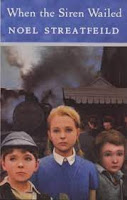
I have loved Noel Streatfeild’s books since childhood, particularly her classic ‘Ballet Shoes’, although my teenage favourites were the ‘Gemma’ series of four books. In recent years I discovered that she had written several other books which I had not previously come across, and have managed to acquire most of them.
I first read ‘When the Siren Wailed’ more than eleven years ago; all I remembered was that it was about a young family living in the World War II era. I wanted something fairly light to read; in retrospect this wasn’t a good choice from that point of view, as it’s much less light-hearted than most of Streatfeild’s fiction.
However, I was captivated almost from the start. Laura (nine), Andy (seven) and Tim (five) are the Clark children. They live in London in extreme poverty, often eating nothing but a single potato when payday approaches. But their home is filled with love, and they don’t know anything other than their tiny house with furniture in and out of the pawn shop, darned clothes passed down from family to family, and regular dirt and hunger.
Everything changes when they are evacuated into the countryside. They go to Dorset, and - after some confusion and an attempt to split the family - are billetted with a Colonel whom they call ‘Sir’, mostly looked after by his former batman, Elk, and his wife. They are not very impressed, at first, by an upper middle class home, with regular baths and early bedtimes. But they very much appreciate the variety and quantity of food available, the beautiful countryside, and the cleaner air. They miss their parents, but soon settle down.
Disaster strikes in several ways about half-way through the book. It would be a spoiler to say more; but the focus is on the ways that the children deal with disappointments and worries. There are some dramatic moments in their subsequent travels and adventures, and many insights into what life, and London in particular, would have been like during and after air raids.
There are no highly gifted children in this story (other than one with a cameo role later in the book); nor are there the cosy nannies or nurses of most of Streatfeild’s novels, though Mrs Elk somewhat fulfils that role. Laura is far more mature than most children her age, taking her responsibility as the oldest very seriously. I liked the differences between Andy, who has many ideas and likes to take action immediately, and his brother Tim, who is more sensitive.
While the gory side of war is kept to a minimum, the author doesn’t glorify it in any way. Tragedies and serious injuries are part of everyday life. As a piece of social history, I would recommend this very highly. It wasn’t published until 1974, but the author, born in 1895, lived through both World Wars and clearly wrote from personal experience.
Intended, I assume, for children of about eight or nine and upwards, this would probably appeal to anyone interested in the war years, and could make an excellent addition to a school or home educators’ study of World War II. The language is not juvenile or ‘easy read’, despite the characters’ young ages, so it could be of interest to teenagers keen on this topic who don’t mind a fictional storyline. I enjoyed reading it very much, and look forward already to reading it again in another ten years or so.
Review copyright 2017 Sue's Book Reviews
On my meandering way through re-reading the lengthy Chalet School series by Elinor M Brent-Dyer, once again, I've reached 'Lavender Laughs at the Chalet School' which I last read in 2003.
Published in Armada in abridged form as 'Lavender Leigh at the Chalet School', this book isn't really anything special. It takes place in the later war years, and features a motherless girl of about twelve called Lavender who has never been to school. Instead, she has travelled around the world with her aunt, the author of a large number of children's travel guides.
However, Lavender has not been well, and her aunt has been called up for military service so their doctor recommends that Lavender join the Chalet School. It has an emphasis on good health, and looks after its girls well - and while neither of them is at all keen, Lavender's aunt realises that it's probably the best thing for her niece.
It's a theme that's followed in several of the Chalet School series; Lavender has a hard time settling down at first, partly because she has an over-inflated ego, and partly because everything is so new to her. However she turns out to be a nice girl at her core, once she gets things into perspective.
There are various school incidents, chats in the staff room, tea parties, and the almost inevitable almost-tragic accident that turns people around. Formulaic, undoubtedly, but pleasant light reading nonetheless. Worth reading as part of the series, but not a book that stands out above the others.
While I'm fortunate enough to have one of the early hardback editions of this book, and it can sometimes be found in libraries, even the Armada paperbacks tend to be expensive second-hand as it's no longer in print.
Update: in 2012 this book was be re-published with the original full content by Girls Gone By, which has the advantage of making some of the old hardback editions less expensive too.
Review copyright Sue's Book Reviews, 23rd May 2011
It's years since I last read this book, one of my teenage favourites. It's long out of print now, but often available at charity shops or online places like Amazon UK which have a second-hand section.
Elizabeth Goudge's books are gentle, character-driven stories which I find I have to read deliberately slowly, or I miss a great deal of her observations. 'The Castle on the Hill' is about Miss Brown, who is forty-ish, and has lost her home and livelihood in World War II. She comes across Jo Isaacson, who is fifty-ish, a Jewish refugee, a brilliant violinist, and almost suicidal.
Then there are the delightful sisters with the unlikely names of Moppet and Poppet, aged six and four, who are Cockney children brought up very 'nicely', and who adore the story of Peter Rabbit.
These diverse characters and others are brought together by the historian Mr Birley, who lives in a small castle in Torhaven with two great-nephews. They all find peace and a haven from their fears and worries; yet there is still some violence in their lives: bereavement and tragedy, as was almost commonplace during the war.
The characterisation is very good, as always with this author's work. The story is long-winded in places, but the descriptions are good. I found it compulsive reading once I had got past the first couple of chapters: it was clear that horrors were going to occur, yet they were so sensitively handled that I found myself with a tear in my eye rather than feeling disgust of any sort.
Hope for the future is given despite present difficulties and tragedies; the ending was very encouraging on the whole. Recommended.
This is a circular style historical novel by Emma Dally. It begins in 1990 then back-tracks to 1920. That enables it to look at the grandparents and parents of Josie, the woman introduced at the start of the book.
I usually quite like this style of book. Sure enough, it was readable and reasonably interesting, at least to start with. There are a variety of characters, with the main ones being readily distinguishable. In addition, and it felt as if the settings were believable.
Unfortunately, there is far too much detail, much of it irrelevant (in my view). Rather than having intertwined sub-plots, it reads like a family history with isolated incidents. Even the significant ones are just recounted in a few pages without any build-up or emotion.
It's good for an author to know the entire history of her characters, of course. But somehow the book feels as if it was giving the author's outline. It tells us everything remotely related to the characters, but without any gathering together to turn it into a story.
More of a problem for me is that none of the characters are particularly sympathetic. I couldn't relate to them, and I didn't feel any emotion while reading this book. Still, the style is easy to read and I kept going to the end, albeit skimming a little in places.
At the end there is supposed to be a dramatic revelation. But even that was disappointing as there were no twists or turns at all. The secret, held for decades, had become obvious to me during the course of the book.
Not really recommended - it isn't a bad book, if you like this kind of thing, but I doubt if I'll read it again.
I love Noel Streatfeild's books. They're mostly about children, and intended for children - but are so well-written that I continue to enjoy them, and re-read periodically.
It's a long time since I had read 'When the Siren Wailed'. It's the story of a family of London children during World War II. As the story opens we learn that they're very poor, often hungry, but very much loved.
As rumours of war circulate, the children acquire gas masks, learn about blackouts, and are evacuated to a village in the east of the country. They are luckier than many; their hosts are strict, but caring, and there's plenty of food. But there are sufficient comments about unhappy evacuees to paint what is probably an accurate picture of what life was like for many.
There are scenes in London too, no doubt from the author's experience during these years. They clearly portray the mixture of fear and excitement that accompanied air raids. The horrors of war come through quite clearly, in unsentimental and non-gory language, and the characters are easy to empathise with.
I thought that the ending was a bit abrupt, although it tidied up a lot of loose ends at the same time. But that's not unusual with Noel Streatfeild. On the whole I thought it an excellent book. Suitable for children of about 7 or 8 upwards. There were one or two very moving moments and a vivid picture of life 60 years ago. Excellent.
I think this book should be recommended reading for anyone studying World War II (particularly at primary school).
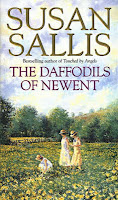
I tend to have mixed feelings about Susan Sallis' historical novels. They have interesting plots, and not too much of the horror of the past described. The people tend to be believable, too - but not, on the whole, sympathetic.
Still, having just finished reading 'A Scattering of Daisies', I decided to continue on to its sequel, second in the Rising family saga.
In 'The Daffodils of Newent', the Rising girls have grown up. April, the youngest, gets married in the first chapter. Her husband has a dark side, after suffering in World War I.
Nancy is already married to an actor; March, too, is married, but not very happily. Her husband is an old man; moreover there's a young and manipulative man who claims to love her.
Like the first book in the series, this is well-written, and I kept reading even though I still couldn't feel any sympathy for any of the characters. I'm not sure why this is, as they were all believable.
The ending was hopeful, I thought. But I didn't feel inspired to try any more in this series.
'Coming Home' is a saga novel by Rosamunde Pilcher, one of my all-time favourite writers.
It's the kind of book that doesn't fit easily into a genre. It's perhaps primarily a coming-of-age book. But at the same time it's a historical novel set initially in the prelude to World War II, and it's also something of a family saga. It's the third of Rosamunde Pilcher's long novels (over 1000 pages in paperback) and unique amongst them in that it focuses on a young girl rather than an elderly lady, and is based in the 1930s and 1940s.
The novel opens with Judith, an independent and sensible girl in her teens, preparing to go to boarding school as her mother and little sister Jess depart to live with her father in Singapore. We see the world through Judith's eyes, and I found her easy to relate to as she deals with the pain of saying goodbye, and the feeling of disorientation as she spends her term-time constantly with other people, and then her holidays at the rather bleak house owned by her Aunt Louise.
Teenage issues are lightly and sensitively touched upon, although they would probably seem unbelievably naive to a teenager today. For instance, Judith at 14 knows almost nothing about sex, so when she comes across a classic dirty old man she has no idea what he wants, but is terrified and feels violated, leading to nightmares that haunt her for years.
Judith settles fairly well into life at her new school, making friends with a 'landed gentry' family who invite her to spend a weekend with them, and who become the main focus of her life until she leaves school. She also decides to make the best of her time with her aunt, until tragedy strikes out of the blue, and she must uproot yet again. Throughout the book there's an underlying theme of Judith's need for a permanent home, although she's not the kind of person who's always longing for things to be different. Indeed, she's a matter-of-fact girl who takes life as it comes, and seems to exert a positive influence on most of the people she meets.
When she leaves school, just under half way through the book, World War II is just beginning. Judith has to make some difficult decisions - whether to go out to stay with her family, as planned, or to remain in the UK and take up war work. She gradually becomes more responsible and mature, learning about love and men in mostly gentle ways, with heartbreak along the way. But still there is a longing deep in her heart for somewhere she can call ‘home’. How her longing is resolved, and how the various sub-plots come to conclusion, is the topic of this thought-provoking book which delves into the heart of Britain in war-time. Perhaps a little slow-moving to start with, it soon becomes exciting and un-put-down-able.
The first time I read 'Coming Home' (probably about six years ago) I didn't like it as much as Rosamunde Pilcher's other novels. This is partly due to the war background, which is realistically described where appropriate, and partly because it took a while to get going. I found myself skimming descriptive sections, and then horrified at some of the things that happened to Judith. One of my personal nightmares is the thought of leaving a child not just at boarding school, but the other side of the world, without any contact other than letters for four years or more.
However I recently decided to read it again, and this time - knowing roughly what would happen - I took it more slowly. Even with several hours free at the weekend (and I read fairly fast!) it took me about six days to finish. While I still wouldn't rank it quite with the other saga novels by this author, I enjoyed it a great deal more than I did last time.
Reading more carefully than I did the first time, I could see how cleverly the author builds up to the various events, slotting Judith's (fictional) life in seamlessly with real events from history. A fair number of letters are included in the book, describing events from different perspectives, and one of them is credited as having been based on a real letter written at the time, describing an actual escape from a dangerous situation.
There are several other significant characters in the book, most of whom Judith meets while staying at her friends' house. Rosamunde Pilcher is a wonderful observer of human nature; she brings everyone to life without apparent effort. Each one felt realistic to me, despite being set in a period before I was born, and mostly moving in the kind of circles I've never met.
There's some inevitable class distinction between the wealthy upper-middle classes and the people who work for them, but it's gently done; the nanny is called by her first name and eats with the family. The nearby farmer's son goes riding casually with the daughter of the household, who rather despises her brother's dull boarding-school friends.
Also of course it provides sound historical background to World War II, a period which Rosamunde Pilcher lived through at similar age to Judith. Indeed her schooling, training and war experience were remarkably similar to Judith's. This is no doubt why the book feels authentic rather than heavily researched; just the right amount of naval or military detail is included where appropriate, rather than an overwhelming amount of information.
All in all, I'd recommend this to anyone with interest in the war years, or to anyone (adult or teenager) who enjoys character-based family novels with a fair amount of action. While there is some romance, it's fairly low-key and mostly secondary to Judith's need for security and a home. The ending is perhaps a little too tidy, but I don't find that a bad thing; I'm not keen on books that leave me wondering what on earth will happen.
Definitely recommended.
If you prefer a film to a DVD, then 'Film review: Coming home' is my review of the three-hour TV drama version of this book, produced in 1998.
I've enjoyed Elinor M Brent-Dyer's 'Chalet School' books for over thirty years, now. They're intended for teenage girls, of course, but are well enough written that they make a good crossover book, enjoyed just as much by many adults.
'The Highland Twins at the Chalet School' is one of my favourites in the entire series. I re-read it regularly, whenever I'm with someone who has one of the rare (and now valuable) hardback editions.
Flora and Fiona McDonald are sent to the Chalet School from their tiny highland island, when it is requisitioned by the admiralty during World War II. They come at first to stay with Jo Maynard and family. They have never been out of their safe environment, and have no concept of big cities or boarding schools.
They make friends and settle down, despite their sheltered upbringing and distrust of new things, and become very fond of Jo. Excitement happens when an important chart they're looking after is talked about, leading to some suspicious characters trying to get hold of it.
Just to add to the story, Fiona is gifted with second sight. She 'sees' the death of one of her family members, and is then able to bring comfort to Jo later on, when Jo is facing a potential tragedy in her life.
Very moving in places - fast-moving, with believable characters. Definitely recommended, if you like this series and can get hold of it. It's not often in print and tends to be very pricey second-hand.
You can also read my slightly longer review of 'Highland Twins at the Chalet School', written after re-reading in 2011.
I like reading Elinor M Brent-Dyer's 'Chalet School' series at odd moments, although they're really intended for teenage girls. Of them all, one of my absolute favourites is the moving and exciting story of when the school had to escape from Austria shortly before World War II.
I read 'The Chalet School in Exile' in its hardback edition; it was quite seriously abridged in the Armada paperback version.
As the story opens, Naziism threatens Austria, and the authorities decide that the school must leave, and start afresh somewhere in the UK.
The girls decide to make and sign a peace league; a few of them go on a picnic, so that they can hide it. Unfortunately they are followed by a small boy. Robin and Hilary are separated from the party, and Jo becomes frantic, collapsing in the arms of a young doctor, Jack Maynard.
An incident with an old and lovable Jewish watchmaker forces Jo, Jack, and a few others to become refugees, and a very exciting escape is described.
Meanwhile, the school closes, and girls are sent either to their home countries, or to other schools in Austria, or to the UK - where the Chalet School is eventually re-established in Guernsey.
Jo manages to star in this book in many ways, surprising everyone more than once.
Even re-reading for the fourth or fifth time, this book brings tears to my eyes in places. Very well written, and different from most of the other Chalet School books, since it doesn't actually feature much of the school at all.
Not always in print, unfortunately. Armada paperback versions can easily be found second-hand, but the newer full version published by Girls Gone By tends to be pricier, and the old original hardbacks are usually extremely expensive.
You can also read my more recent review of 'The Chalet School in Exile', written at the end of 2010
I've often seen books by RF Delderfield, mostly in second-hand and charity shops. I know there were some TV series made of some of his novels, but I'm not a television watcher, so I haven't seen any of them. Several people said they thought I would like his books, so I finally decided to buy a few from a charity shop.
I began with 'Late spring', which is the first part of the novel 'To serve them all my days'. In this book David Powlett-Jones, who was injured in World War 1, takes up a teaching post at a boys' boarding school.
David settles in gradually, bringing a bit of fresh life to the school, and falls in love. He also suffers tragedy while recovering from the trauma of the war.
There are some amusing incidents, and also some fascinating educational philosophy for its time. I thought the book was well-written and enjoyable, even if not terribly exciting, and there are some very moving moments.
Recommended - though not currently in print, it can often be found second-hand.
'Ultimate Prizes' is a novel by Susan Howatch, and is the third in the Starbridge series. Sequel to Glittering Images and Glamorous Powers.
This story is written from the perspective of Neville Aysgarth. He is a fictional Archdeacon in the Anglican Church during the 1940s.
It's very cleverly written. Neville isn't a particularly appealing character - yet the story is still gripping. Neville's habit of 'ringing down the curtain' on all unpleasantness has led to so much repression that he approaches a nervous breakdown in the midst of various crises.
The story unfolds as his life hits rock-bottom. He has to learn to face his pain before slowly re-forming his life, and finding a measure of healing.
I thought this book believable, if a tad dramatic in places. There are some interesting digressions into the theological debates of the time, as well as attitudes to World War II, Nazis and pacifism.
I didn't find this book quite as enjoyable as the first two. But I still thought it very readable and thought-provoking.
Highly recommended.
(I wrote a couple of longer reviews of this novel after I re-read it subsequently. I wrote this review of 'Ultimate Prizes' in 2007, and this review in 2017. )
As a teenager I read my way through all 50+ books of Elinor M Brent-Dyer's 'Chalet School' series, and thoroughly enjoyed them - even if they did become a bit 'samey' towards the end.
However one that stands out head and shoulders above the rest is 'The Chalet School in Exile', an exciting story about the school having to flee from Austria under threatened Nazi invasion. Most of the story is about the escape itself and its consequences.
There are some very dramatic and moving moments, a slightly unexpected romance, warm friendships, and a lovely ending.
Definitely recommended.
You can also read my more recent review of 'The Chalet School in Exile', written at the end of 2010