Showing posts with label Elizabeth Goudge. Show all posts

17 Mar 2019

The Castle on the Hill (by Elizabeth Goudge)

The Castle on the Hill by Elizabeth Goudge
(Amazon UK link)
I have slowly been re-reading my novels by Elizabeth Goudge, interspersed with other books. A week or so back I picked up ‘The Castle on the Hill’, which I last read in 2007 I did not remember much about it, other than three characters: a Jewish street musician, and two small sisters, one of whom loved the book ‘Peter Rabbit’.

I had entirely forgotten the main protagonist, Miss Brown. She is forty-two and never uses her first name. She is efficient, responsible and loyal, but when we meet her she has no idea what her future holds - if anything. The year is 1940 and the UK is at war. Miss Brown ran a guest house which was requisitioned by the army, and then blown up. So she has lost everything. And she is full of fear.

Miss Brown has been staying with a cousin, but at the start of the book she is going to spend the day with her cousin’s daughter. Her attention is caught by someone playing the violin; despite his disreputable appearance, she feels a sense of kinship with him. She does not suppose she will meet him again as she hurries to the train station, where she comes across the two small girls whom I also remembered, who are about to be evacuated.

Through various mishaps, Miss Brown misses her stop and is invited to become the housekeeper at a small castle, owned by the historian Mr Birley (whose books she has read and enjoyed) and his two great-nephews, Richard and Stephen. She manages to befriend the irritable butler Boulder, and quickly settles in, relieved and thankful to have found a place where she can be useful.

Elizabeth Goudge’s style is poetic, sometimes rather rambling and over-descriptive. But when I take the time to read slowly, I appreciate her use of language and metaphors. She takes an entire page to describe the elderly dog Argos at the castle; I could sense not just his appearance but his personality by the end. By word pictures and conversations, the story progresses slowly; sometimes gently, sometimes with violence, as the war takes its inevitable toll.

The two small girls, with the unlikely names of Moppet and Poppet are an important part of the story; one of them wise and responsible, the other artistic and emotional. But they don’t change much; they are really catalysts for Miss Brown to meet other people and eventually to find what her long-term future holds. Miss Brown herself discovers a depth of love she had not previously known, some of it requited, some of it not. But her loyalty, her common sense and her orderliness shine through all she does.

There is a strong Christian theme throughout, more overt than in some of the author’s other books. People pray in times of danger, and look to God to be their security; I didn’t have any problem with this, but some might find this content rather excessive.

I had expected to enjoy the book rather more than I did; instead I found it rather depressing in places. The ending is mostly positive, in a resigned acceptance kind of way. But although realistic for the era, I felt that too many people suffered or died. Perhaps I’ll reread it again in another ten years or so, but at present I’m not sure I will want to.


Review by Sue F copyright 2019 Sue's Book Reviews

30 Jan 2019

A City of Bells (by Elizabeth Goudge)

A City of Bells by Elizabeth Goudge
(Amazon UK link)
In re-reading the novels by Elizabeth Goudge, I reached ‘A City of Bells’, which I last read in 2003. Really I should have re-read this before I read ‘Sister of the Angels’ and ‘Henrietta’s House’ last year, as it’s the book which introduces the young and imaginative Henrietta. More significantly, because I had read the others recently, there’s an unexpected revelation in this book which I was expecting, so it was not as much of a surprise as it might have been.

Jocelyn is the main protagonist of the book, however. He is a young man, injured during the war (I assume the first World War) and very weary. We meet him as he is about to arrive in Torminster to stay with his grandparents. Grandfather is a clergyman, almost eighty years old but not yet retired, and Grandmother is a couple of years older, but still in good health, though growing frail.

Despite their years, they have their eight-year-old grandson Hugh Anthony living with them, and have adopted Henrietta, a young girl of similar age, whom Grandfather found in a children’s home. Her mother had died, and nobody knew who her father was. Henrietta is compassionate, imaginative and a deep thinker, with an unexpected element of wildness that appears from time to time. However she is continually grateful for her circumstances, and generally does what her grandparents expect of her.

Next door lives Mrs Jamieson, an elderly lady whose mind is wandering; we would probably say she has Alzheimer’s Disease nowadays. Her niece Felicity has come to stay, and Jocelyn is immediately attracted to her. Their worlds seem far apart, because Felicity is a successful actress, taking a break, and Jocelyn has no career or plans for the future. Until Torminster’s rumours start, and he ends up running a bookshop…

This is a character-based novel, one I had almost entirely forgotten, and which I have enjoyed re-reading very much. There’s a lot of description; I tend to skim descriptive passages in novels, but made myself slow down and read some of them deliberately, and found myself appreciating them. I was less willing to read the lines of poetry that were included despite their significance in Jocelyn’s life.

There’s some satirical, gentle humour here and there in the caricatures of some of the people, and Hugh Anthony’s down-to-earth and questioning nature, but there’s also a great deal that’s extremely moving. Henrietta is very affected by people who are lonely or impoverished, and when she loves somebody, it is whole-heartedly. She and Hugh Anthony provide an excellent contrast to each other.

Lovely writing, about delightful people in an old-fashioned (even for the era) country town. This wouldn’t appeal to everyone, but if you like slow-moving books with mostly believable characters and a fair amount of spiritual/Christian discussion (without any preaching) then I would recommend this novel.

I'm pleased to see that 'A City of Bells' was re-published since I last read it, and is also available in Kindle form. But it can often be found in second-hand or charity shops.


Review by Sue F copyright 2019 Sue's Book Reviews

29 Nov 2018

The Rosemary Tree (by Elizabeth Goudge)

The Rosemary Tree by Elizabeth Goudge
(Amazon UK link)
Re-reading books by some of my favourite authors is sometimes surprising, as I discover that I no longer like - or like better - a novel I have not read for nine or ten years or more. One author whom I find myself appreciating more and more as I get older is Elizabeth Goudge, who wrote character-based gentle fiction set, usually in the early or middle part of the 20th century.

I have just finished re-reading ‘The Rosemary Tree’. It’s a book which I found rather too long-winded and descriptive when I first read it. But in the past few days I have found myself absorbed, drawn into the family life and situations of the people concerned, slowing down to read and savour some of the descriptive passages.

The story is primarily about John, a somewhat absent-minded and somewhat clumsy (but very good-hearted) vicar in a small village in Devon. John is married to the hard-working Daphne, and they have three daughters: responsible Pat, who is about ten, sensitive Margary who is eight, and the delightful, dreamy Winkle (whose real name is Henrietta) who is five. The three girls are driven each day to a small private school which none of them like, and it’s clear early on that Margary is particularly unhappy there.

The book begins and ends with the viewpoint of Harriet, John’s old nanny, who lives in the vicarage but is mostly bedridden by serious rheumatism (which we now call arthritis). She observes the family from her window, and welcomes their visits. Sometimes she’s outspoken as she offers her opinion, but as she loves them all they rarely take offence.

Then there’s John’s Aunt Maria, who lives on her own in the big house not far away; she’s grown old and Daphne thinks she should sell her house, and move somewhere smaller. Into this family scenario a man in his late thirties called Michael arrives. It’s clear from his first appearance that he’s running away from something; he’s managed to leave even his wallet behind, so although he’s fairly well off (we learn quickly that he is a successful writer) he has no available funds, and thus is very hungry…

The story winds gently around these different people and their interactions. John is always nervous about initiating conversations, afraid he’ll get something wrong. Sometimes he can’t even pray; he regularly feels that he’s superfluous in his home, and forgets things Daphne asks him to do. Daphne is loyal and looks after the vicarage well, but she’s sometimes resentful that she has so much to do, and so little money.

Gradually each of the main characters, including two of the teachers at the girls’ school, discover new things about themselves, and are able to make changes. Some let go of past hurts and current troubles; others decide on new ways forward. Michael is the unwitting catalyst in some of this, but John, determined to follow his calling, makes far more positive differences than he realises.

There’s a lot of description, much of it beautifully written, and I took the time to read these passages slowly. I’m not a visual person, but even I managed to build up an idea of the places concerned. There’s quite a bit of poetry too; poetry really isn’t my thing and I sometimes skipped those, but I liked the literary references - in particularly to the story of Alice in Wonderland.

There’s a fair amount of talk about God; Elizabeth Goudge often included Christian themes and discussions, but she never preached. With John being a vicar, it’s hardly surprising that questions about life, death, heaven and prayer are covered, but they’re mostly either in conversation or personal reflection, and I doubt if anyone would find them offensive. Themes of redemption and forgiveness are strong, all surrounded with the need for self-giving love.

This is a gentle book from a different era, which cannot be appreciated fully if read quickly. I’m glad I decided to read it again, and look forward to enjoying it even more in another ten years or so.


Review copyright 2018 Sue's Book Reviews

13 Oct 2018

Gentian Hill (by Elizabeth Goudge)

Gentian Hill by Elizabeth Goudge
(Amazon UK link)
One of the authors I’m re-reading currently is Elizabeth Goudge, whose books were written in the middle part of the 20th century. I hadn’t read ‘Gentian Hill’ since 2005, and had entirely forgotten what it was about. So I started reading it about ten days ago, and have just finished it.

As with most of this author’s books, ‘Gentian Hill’ is full of descriptive passages, and is a thoughtful, often rambling story. When I took the time to read the descriptions, I appreciated that they were beautifully written; however I’m not a visually-oriented person, and they didn’t help me picture anything much; I simply liked the flow of words, sometimes using alliteration or assonance, though I don’t know if it was deliberate.

So although I took it slowly - Goudge’s books are not ones to read rapidly - I did skim some of the descriptions in order to get to the story. The plot, which is set around the year 1800, involves a young girl called Stella. She is ten at the start of the book, but old for her years. She has deep intuitions and insights, and a love of learning which rather concerns her adopted parents, hard-working farmers whom she adores.

But the book begins with the viewpoint of fifteen-year-old Anthony, a midshipman on a frigate with a cruel captain. He has been bullied and tormented, as well as living in some appalling circumstances, and has reached the end of his tether. So when his ship is anchored in a Devonshire bay, he decides to desert it and risk swimming to shore…

Inevitably the two meet and are drawn together, but along the way other important characters are introduced. There’s the strange-looking but wise and caring Dr Crane who looks after some of Stella’s education. There’s the AbbĂ©, a tall, rather terse man who, as we soon learn, has tragedies in his past. There’s the elderly and somewhat lonely Mrs Loraine, and the even more elderly shepherd Sol. Nor can I forget the faithful dog Hodge.

It’s a character-based novel, based on a legend which is gradually uncovered through the course of the book. It’s mystical, as with many of Elizabeth Goudge’s novels, with a strong Christian theme, yet without any preaching. Faith is taken for granted, not just in God but in dreams, and superstitions, and also the ability to recognise kindred spirits.

It took me a while to get into the book; the first chapter is somewhat sordid, though not gratuitously, and contrasts well with Stella’s happy home and childhood. Stella herself is independent, outwardly deferring to her parents, but following what she sees as a higher calling, often going out on her own without her parents knowing.

While the book is fiction, it’s set firmly in the historic context of the Napoleonic wars, and according to the author’s note at the start of the book, the legend on which she based the novel is also a real one, connected with a chapel in Torquay.

It was a good book to read at bedtime, just a chapter or two at a time. It was easy to put down, and also easy to pick up again; the characters are clearly drawn so it was easy to remember who was whom, despite quite a large cast of important people.

Recommended if you like thoughtful novels set in the early 19th century, and don’t mind quite a bit of descriptive prose with not a great deal of action.

Re-printed fairly often, and can often be found in second-hand or charity shops. Now available in Kindle form as well as print editions.

Review copyright 2018 Sue's Book Reviews

7 Jul 2018

Henrietta's house (by Elizabeth Goudge)

Henrietta's house by Elizabeth Goudge
(Amazon UK link)
Having recently read my newly-acquired ‘Sister of the Angels’ by Elizabeth Goudge, I wanted to re-read ‘Henrietta’s house’, which was written later and is related, though not a sequel. It's at least twenty years since I first came across it and read it, and I'd totally forgotten what it was about.

It doesn’t refer to any of the events in the earlier book, but has some of the same characters, though, strangely, they are slightly younger. The main one is ten-year-old Henrietta who lives with her grandparents. We meet her in this book as she is waiting eagerly for her adopted brother Hugh Anthony to return from his first term at boarding school.

Grandfather is a minister, a deeply religious and delightful elderly man, and the family live in the Cathedral Close of the fictional city of Torminster. Hugh Anthony is about to have his tenth birthday, and decides that he would like a picnic, some distance from home, where all his guests (other than Henrietta) are adults. He has had enough of boys at his school.

The main part of the book is about the different journeys that the various party guests take en route to the picnic; most of them don’t arrive at their destination, but have unexpected and varied adventures along the way. Elizabeth Goudge doesn’t exactly write fantasy; it’s more whimsical than that, set very much in the real world but with a decided element of a fairy-tale.

So there are adventures in an underground cave, a bower of leaves for a loving couple, and most of all, an unexpected treat for Henrietta. One could almost assume that the carriages were supposed to go astray; the horses, it seems know better than the people driving.

There’s not a great deal of plot, other than Henrietta making a delightful discovery, something that feels a tad unbalanced since it’s Hugh Anthony’s birthday rather than hers. However he doesn’t seem to mind, and is very pleased with all the food he gets to eat, as well as his exciting adventures.

The book is steeped in cathedral culture and history; this was written in 1945 but set early in the 20th century. There’s a gentle Christian theme throughout, as occurs in most of Goudge’s books, but she doesn’t preach or push her beliefs on her readers.

It’s perhaps too long winded, with extensive description and very little plot to be of much interest to today’s children, other than voracious and eclectic readers of perhaps nine to twelve or thirteen. But for adults hankering after a simpler era, and willing to suspend reality for a while, it’s a pleasant story.

Not currently in print, but sometimes available second-hand. 


Review copyright 2018 Sue's Book Reviews

9 Jun 2018

Sister of the Angels (by Elizabeth Goudge)

Sister of the Angels by Elizabeth Goudge
(Amazon UK link)
I’ve liked Elizabeth Goudge’s thoughtful novels since I was a teenager. A friend introduced me to her children’s classic, ‘The Little White Horse’ when I was about twelve or thirteen, and a few years later I fell in love with ‘The Herb of Grace’. I was delighted to discover that it was the middle novel of a trilogy, and even more pleased when I managed to acquire the other two books in the series at charity shops.

I’ve gradually bought other Goudge novels over the decades - they’re often found in second-hand shops, inexpensively. But I had drawn a blank with ‘Sister of the Angels’. I only learned of its existence within the last few years. It’s apparently related to ‘Henrietta’s House’, a children’s book which I liked very much but have not read in about twenty years.

Girls Gone By is a publisher who reprints a variety of hard-to-find children’s books from last century, using the original text as far as possible. A few years ago they published ‘Sister of the Angels’, but I was dubious about paying full price for it. I knew it was quite a slim volume, and felt that £13 was a bit of a high price. But eventually I found a better value edition in Amazon Marketplace, and bought it about eighteen months ago. It’s sat on my to-be-read shelf for all this time, and I finally read it over the past few days.

Henrietta is eleven in this book, and lives with her grandparents. Her grandfather is a minister, and mostly understands her well. Her grandmother is excellent at providing good meals and comfort, but expects punctuality and cleanliness. Henrietta is an artist - quite a talented one, already - and finds the spartan existence of the parsonage rather hard to take in the winter.

We meet her on the morning when her father - a very dreamy writer - is due to arrive in Torminister. It’s early December, and he’s coming back for Christmas. On her way to meet his train she takes a detour with Grandfather into the cathedral, and spends some time in her favourite chapel. It has some beautifully restored frescoes, and one wall that hasn’t yet been restored.

There’s some back story about the original artist who painted the frescoes, in the Middle Ages, and his namesake - a wandering artist - who was able to restore some of them, before running away and getting in trouble with the law. Henrietta knows exactly what pictures should appear on the last wall… she’s an intuitive, thoughtful child who sees visions and perhaps ghosts, but takes them as part of ordinary living.

The characters are classic Elizabeth Goudge style, rather caricatured as certain personality types, but no less lovable for all that. Henrietta is a caring, gentle person, old for her years, but made human by her frustrations, and her dislike of washing in cold weather.

It quickly became clear to me where the story was going; everyone has secrets, some of which are shared with the reader, others just hinted at. I don’t know if I was supposed to have guessed the biggest secret - but it didn’t spoil the story in any way. If anything, it added to the anticipation. It’s a short novel, even for a children’s book; it has 126 pages but the first thirty or so are various introductions. However the story is complete, moving in places despite its predictability, and I’m glad I’ve finally managed to read it.

The GGB publishers always give interesting introductions to their books and this is no exception. It begins with a detailed guide to the cathedral on which the Torminster one was based, and is followed by a brief biography of Elizabeth Goudge, and a few other notes.

Recommended if you like this style of novel, set I suppose in Victorian times. There’s quite a Christian emphasis, but that’s not really surprising when the entire story is based around a cathedral. The original readership would have been girls of around ten to twelve; today's children are less likely to enjoy this. But for those who enjoy historical fiction with plenty of description and complex language, it's definitely worth borrowing.

This seems to be the only edition of the book that seems to be available at all, and it's not currently in print. However it can sometimes be found in second-hand bookshops online. Due to its rarity, some of the prices asked seem extortionate to me, making the new price seem quite reasonable by comparison.

Review copyright 2018 Sue's Book Reviews

20 Mar 2017

Linnets and Valerians (by Elizabeth Goudge)

Linnets and Valerians by Elizabeth Goudge
(Amazon UK link)
I am very much enjoying re-reading the books by some of my favourite authors, and looked forward very much to re-reading this one by Elizabeth Goudge. Although she wrote several thoughtful novels for adults, she’s perhaps best known for her children’s book ‘The little white horse’. However I always preferred ‘Linnets and Valerians’ , which I came across in my teens, and last read eighteen years ago.

I remembered liking it so much that when I couldn’t find it on any of our shelves, I assumed someone must have borrowed it without returning it. So I promptly ordered a second-hand edition from the AwesomeBooks site. I started reading it a week ago. I was surprised to find that I had forgotten most of the plot, other than the main outline. Four children, in the early part of the 20th century, run away from their rather strict grandmother, and find themselves at their Uncle Ambrose’s house instead.

Uncle Ambrose, who was once a teacher (now a Vicar) decides to educate the children in a classical way. He insists that he doesn’t like children at all, but grows fond of them fairly quickly. He is looked after by Ezra, an intriguing and delightful character who functions as butler, cook, chauffeur and more. The children explore their neighbourhood, and as with many of Goudge’s books there’s an interesting mixture of Paganism and Christianity, of practical real-life adventures and mysticism.

Not that this is a fantasy story: it’s set very much in the real world, and the obvious theme is that of family relationships, of loss and reunion, of friendship and loyalty and hard work. But there’s also a strong good vs evil thread winding throughout, with gradual healing and forgiveness and restoration, in a way I enjoyed very much.

The four children are nicely drawn: Nan, the oldest at twelve, is responsible and kind, but also gifted with a special kind of insight. Robert, at ten, is an adventurer, forever imagining himself in heroic roles; he has a good imagination in a dramatic sense, yet is not very observant, nor does he have any real intuition. Timothy is eight, and the frailest of the children; he’s also extremely observant and highly intelligent, and his imagination is of a very different kind to his brother’s. The youngest, Betsy, is a delightful six-year-old who tags along with the family and has a great sense of her own importance.

Inevitably some of the storyline reflects upper-middle-class culture of a hundred years ago. Children are expected to obey their elders, particularly when given plenty of freedom to go out and about, and there are unpleasant threats made, some of which become realities, should they fail to meet their obligations.

In places the story is a little slow-moving, with a tad more description than I would have liked as a child, but I think it would appeal to avid readers from the age of about nine or ten, and of course adults who remember it fondly from their own childhoods.

Overall, I thoroughly enjoyed the book.

(Note that in the United States, it's published as 'The Runaways')


Review copyright 2017 Sue's Book Reviews

10 Nov 2016

The Herb of Grace (by Elizabeth Goudge)

The Herb of Grace by Elizabeth Goudge
(Amazon UK link)
After reading Elizabeth Goudge’s ‘The Bird in the Tree’ recently, it was time to enjoy its sequel again. This is a book I first read in my late teens, with no idea that there was a previous book, although I was aware of an untold backstory running through it. I loved the book then, and have enjoyed it more, probably, each time I have re-read it.

‘The Herb of Grace’ is the name of an inn not too far from Damerosehay, the old house belonging to the elderly Lucilla. Lucilla might be frail in body, but her will is as strong as ever, and her instinct tells her that her son George is not happy in London. George’s wife Nadine, whose thwarted love affair is sensitively covered in ‘A Bird in the Tree’, likes her smart and convenient London place, and has no thought of ever moving into the countryside. But the Herb of Grace is for sale, and Lucilla makes her plans.

Meanwhile George and Nadine’s five children - including the imaginative five-year-old twins Jerry and JosĂ© - have met and befriended a young woman called Sally Adair, who lives with her talented artist father John. Sally has also met David, George’s nephew, and her father happens to have met Nadine on a train. Their stories are told separately, gently introducing people and situations, until - by John Adair’s determination - they find themselves in in the same place.

There’s another story involving the mysterious barge-travelling odd-job people Malony and Annie-Laurie, whose story gradually unfolds in the warmth of the family home. There are a lot of people in the book, who are much easier to understand if read as sequel to ‘A Bird in the Tree’. This novel certainly stands alone, but minor characters - Lucilla’s daughter Margaret and son Hilary - could be seen as almost irrelevant without knowing the background.

I vaguely remembered the storylines, in particular something dramatic and of great historical interest that is discovered by accident by the twins, but I had forgotten about many of the interactions between people, and the way each character develops imperceptibly, finding healing and wholeness in the welcoming atmosphere of the inn.

Elizabeth Goudge’s writing is full of poetic description, something I have often skimmed or even skipped in the past, but I made sure to slow down and savour her words, as she tells us about the countryside, the views, and the immense charm of the Herb of Grace. I almost felt myself there, and delayed reading the last chapter so that I could be part of this engaging community of people for a little while longer.

Definitely recommended. Widely available second-hand.


Review copyright 2016 Sue's Book Reviews

14 Sept 2016

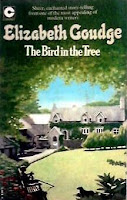
The Bird in the Tree (by Elizabeth Goudge)

The Bird in the Tree by Elizabeth Goudge
(Amazon UK link)
Although I read one or two books by Elizabeth Goudge as a child, it wasn’t until my teens that I discovered that she had also written novels for adults. Written in the 1930s and 1940s, they’re inevitably rather dated now, and her style tends towards the philosophical, even whimsical at times. She has a tremendous gift for characterisation, particularly of children, which makes them eminently re-readable. However, I have to be in the right mood; skimming simply doesn’t work with Goudge’s descriptive and thought-provoking books.

I first read ‘The Bird in the Tree’ in 1997, after finding it in a charity shop. I was delighted to do so, as I’d read its sequel, ‘The Herb of Grace’ many years earlier, and had been looking for this book for a long time. Each book stands alone, featuring different storylines; yet there’s a richness to the second which becomes deeper after reading and feeling part of the events of the first one. I re-read this in 2004 so I decided it was time to read it again.

The book starts with great excitement: David is coming to stay at Damerosehay! Its owner, Lucilla, is 78 and beginning to become frail, although she’s a determined lady who usually gets her own way. She’s created a haven for her family, and has the care of her three young grandchildren, Ben (who is 9) and his younger siblings Tommy and Caroline. Their parents are divorced; their father works in India, and their mother isn’t naturally maternal.

David is another of Lucilla’s grandsons, now grown-up and beloved by everyone. However it’s evident to all that he has a big problem, something he needs to talk about, but doesn’t know quite how to start. The book, at one level, is about his news, the reactions of those around him, and a difficult decision he has to make. But it’s also about the house itself: its history, the people who built it and lived there before Lucilla bought it. It’s about the children, too: one highly sensitive and intuitive; one impulsive, living for the moment; one insecure and worried.

At a deeper level the book is about the nature of truth: of the difference between factual accuracy and deeper insights or images that portray truths. It’s about being true to oneself and one’s family, of making difficult decisions, of faithfulness and tradition. It’s about generational differences in the way people see the world, and also about eternal truths which can transcend simple facts - of events that point to truth, and ways of behaving or acting that can bring about different truths.

This isn’t a book for those who want a quick read, nor for those who like fast plots and rapid action. It’s likely to appeal more to women than to men, despite David being one of the most important characters, but that’s perhaps because on the whole women are more likely to read thoughtful, philosophical books.

I think it could be of interest and perhaps benefit to anyone prepared to take the time to read it, however. Naturally the moral climate (and, indeed, the harsh ‘discipline’ used in some cases on the children) seem rather old-fashioned, but while some changes are undoubtedly for the better, there’s a lot to be said for Lucilla’s way of looking at the world.

Sometimes moving, often thought-provoking, and with an encouraging ending.

Review copyright 2016 Sue's Book Reviews

11 Jul 2016

The Dean's Watch (by Elizabeth Goudge)

The Dean's Watch by Elizabeth Goudge
(Amazon UK link)
I’ve read several of Elizabeth Goudge’s books over many decades now, after first coming across her children’s novel ‘The Little White Horse’ when I was a young teenager, and then one of her ‘Damerosehay’ series in my late teens. I’ve collected quite a few of her books now, mostly second-hand from charity shops or thrift stores where they can often be found inexpensively. Her writing is something of an acquired taste, and will not appeal to everyone as it can be slow-moving and highly descriptive.

It must be around eighteen years since I first acquired and read ‘The Dean’s Watch’. I had totally forgotten it when I picked it up to re-read a few days ago, and was at first a little daunted by the small print and lengthy paragraphs. I thought I would read a few pages… and found myself quite quickly caught up in the lives of the characters.

The story is set in the latter part of the 19th century. We first meet Isaac Peabody, a master craftsman who is the town watch and clock-maker. He puts immense effort and creativity into everything he makes, and also into the frequent repairs he must do. We learn a little about his past, and about the stress he experiences living with his spinster sister Emma. Isaac, unusually for his time, is a devout atheist.

The next chapter introduces us to the city, with a quick run through the centuries, eventually reaching 1865 when Adam Ayscough is installed as Dean. He’s described as ‘terrible’, yet he wants to see the city rejuvenated, the slums replaced by airy, pleasant dwellings for the poor, and the workhouse reformed. The city is most likely based on Ely, a town in Cambridgeshire where Goudge spent some of her childhood.

The other main characters in the novel are Polly, who works as a maid for Isaac and Emma, and Job, a teenage boy who currently works as apprentice for a violent and unpleasant fishmonger. Each of these people is lovingly introduced, and painted in such a way that there is never any danger of confusing them. There’s a lot of sensory description of both places and events, and I did, once or twice, skim a paragraph or two. But part of the enjoyment of Goudge’s writing is her evocative description, so I tried to make the effort to read more slowly, to savour the words and better imagine the surroundings in which these people live.

The plot, such as it is, revolves around the Dean gradually getting to know a few of the people in the city, and enabling their lives to become happier. He’s an old man and evidently in failing health. His wife rather despises him, but he has a great capacity for love, and only really discovers it during the course of the story. His watch, mended by Isaac, gives the title to the book, but I assume it has a double meaning, also describing the Dean’s watchfulness over his beloved city and its inhabitants.

As a piece of social history it gives excellent insights into ordinary people of all classes, and the customs and social niceties of the times. It’s undoubtedly a Christian book; the Cathedral and the Dean’s faith are highly significant, yet there’s no ‘preaching’ as such. There is, however, a mystical thread: people communicate with God, there are signs and omens, and intuitions so strong that they are as real as words spoken.

There isn’t much action, yet a great deal happens in the lives of several individuals. All in all, it’s a thoughtful and beautifully written book, reminiscent of calmer, slower times - yet bringing stark awareness of how very unpleasant life would have been for those born into the lower or otherwise impoverished classes.

I was surprised at how difficult it was to put down by the time I was around half-way through, and I finished it in just four days.  Definitely recommended to all who like slow-moving character-based and beautifully written stories.

It's the kind of book that is often found in charity shops, so I was a little surprised to see that it was re-printed a few years ago and is currently in print, albeit rather high priced for a paperback that is unlikely to appeal to many.

Review by copyright 2016 Sue's Book Reviews

14 Nov 2015

The Little White Horse (by Elizabeth Goudge)

The Little White Horse by Elizabeth Goudge
(Amazon UK link)
Over the years I’ve read many of Elizabeth Goudge’s books. While I wouldn’t class her as one of my favourite authors, I keep coming back to her books, and finding more in them. I’m currently - slowly - re-reading them, and my recent selection fell on the children’s book ‘The Little White Horse’, the one for which she is perhaps best-known.

I was given this book for a birthday present when I was about eleven or twelve, and remember finding it a bit dull at first; it took a while to get into it. However I eventually read and enjoyed it. It’s historical fiction, set in 1842, but is also of the genre known as ‘low fantasy’ - in other words, set in the real world, with real people (if caricatured at times) with some uncanny or unusual mystical features pervading reality.

The heroine of this story is thirteen-year-old Maria Merryweather. Recently orphaned, she and her beloved governess Miss Heliotrope are travelling to the West Country to live with Maria’s only living relative, Sir Benjamin, who lives in a manor house with some rather unusual and highly intelligent animals.

Maria soon learns that the countryside around her guardian’s manor house is under siege by some evil men who trap rabbits and steal food from the ordinary folk. Gradually she learns about her history, and something of Sir Benjamin’s past, and realises that she has an important and dangerous mission…

The story is a classic triumph of good over evil, but - unusually - set in the 19th century. Elizabeth Goudge has an excellent grasp of language; her descriptions are perhaps a tad long-winded in places, but quite evocative. The scene is nicely set, and Maria is a delightfully confident - and sometimes argumentative - protagonist, who quickly wins the hearts of Sir Benjamin, the local Parson, and the unusual people (perhaps gnomes) who work as servants in the manor house.

The nature of the intelligent animals - such Zachariah the cat, who draws pictures in the dust to communicate, and Wrolf the large ‘dog’ who knows exactly what to do - seems quite realistic in context, and contrasts nicely with Maria’s own dog, the beautiful but not very bright Wiggins. The mystical white horse of the title is seen only rarely, but has a part to play in Maria’s eventual resolution of the problem.

Modern readers might balk at the political incorrectness of the bad guys, who live in the forest and dress only in black, so are given the unfortunate appellation of ‘Black Men’. However it’s clear what’s meant; and even the wickedest of them turns out to have some good traits.

It’s a children’s book, intended for confident readers of about ten and upwards, so inevitably things are going to be resolved in the end; perhaps things are too tidily organised, including one remarkable coincidence that Maria discovers fairly early in the book. But it makes pleasant reading, and I’m glad I delved into it again.

Apparently this book was one of JK Rowling's childhood favourites. I'm not surprised; she was inspired by many great classics. While I read it, Maria's sightings of the 'Little White Horse' reminded me forcibly of the stag patronus of the Harry Potter books.

First printed in 1963, this is still in print, both in paperback and Kindle form as well as being widely available second-hand. Recommended for anyone over the age of about eight or nine who likes low fantasy or historical fiction.

Review copyright 2015 Sue's Book Reviews

31 Jul 2015

Green dolphin country (by Elizabeth Goudge)

Green Dolphin Country by Elizabeth Goudge
(Amazon UK link)
When I was a young teenager, my best friend introduced me to Elizabeth Goudge, and I read and liked a couple of her young adult fiction books. They were a little mystical, and a little more descriptive than I liked. But she told a good story. Some years later I was given the book ‘The Herb of Grace’, which I thoroughly enjoyed, and eventually I acquired the two other books in the same trilogy.

I then discovered more of her writing, mostly paperbacks in charity shops, and more recently put others of her books on my wishlist. ‘Green dolphin country’ (also known as 'Green Dolphin Street') is not currently in print, but a relative found it second-hand. So I finally had this book, considered a Goudge classic by many, in my collection.

It looked a bit daunting: nearly 600 pages of rather small print is not a quick read. But I began it about ten days ago, and have finally completed it.

The story begins in one of the Channel Islands in the middle of the 19th century. Marianne and Marguerite are sisters, but very different. Marianne, the elder of the two, is extremely bright in an era when girls were not supposed to think. She’s also very concerned with appearances, and wants, above all, to be successful. 

Her sister is a total contrast: loving, compliant, and contented. Into their lives come Dr Ozanne, who - they learn - was their mother’s first love, although he left the island many years previously. His wife has now died, and he’s returned with his son William, who’s a couple of years younger than Marianne, but a good-looking, strong boy.

The three young people take to each other quickly, and at first William is treated like a brother; however, Marianne falls in love with him and is determined to marry him. It takes Marguerite a lot longer to realise that her deep affection and friendship has also turned to love. William loves both girls, but wants to marry Marguerite; however for various reasons he’s stopped from speaking to her. He joins the Royal Navy, sponsored by the girls’ father, and then, due to being reckless and naive, he ends up in New Zealand…

The bulk of the book is then about his life in a new, newly colonised island, where the native people are  suspicious, sometimes hostile. William works as a lumberjack and gradually reaches the stage where he can consider supporting a wife. So he writes to his old friends, in the hope that Marguerite will come and join him. Unfortunately, he makes a mistake… one that seems highly unlikely, even given the elapsed time and William’s slight inebriation at the time. But apparently this part of the book is based on a real incident in the author’s ancestry.

Essentially, this is a story of redemption. What is a man to do, when he’s expecting a blissful reunion, only to find that someone else has travelled half-way across the world for his sake? What is a woman to do, believing herself rejected by the only man she ever loved? Can a woman change a rough, unmotivated - albeit gentle and kind - man to become more ambitious? Can a man learn to love a success-driven woman who shows little affection to anyone? The author moves between the different main characters of the book, unfolding their stories gradually, showing their thoughts as well as their actions, their connections as well as their separation.

Written in 1944, this has all the appearances of an epic saga, and on the whole I found it quite readable, albeit rather long-winded in places. I don’t find descriptions particularly interesting, and often skipped a page or two without missing any of the story. Elizabeth Goudge had a wonderful way with words, and sometimes I slowed down, and savoured some of her phrases and concepts. At others, I wanted to move faster to find out what was going to happen, how the story would end; and whether William would ever find his way back to the Channel Islands.

From a historical point of view, it was interesting to read about some of the uprisings and battles in New Zealand in the 19th century, something I knew almost nothing about. The author never visited that country, but she did her research well and it feels consistent to someone like me who has also never been there. It was a brave move, setting a story partly in the gentle, clean environment of a middle-class island in Europe and partly in a pioneering, often violent country thousands of miles away. But it works; I gather there was a film made of this story, which I hope to see some day.

I’m not sure that I’ll want to read this again, as it was quite draining at times; moreover, I never really liked Marianne. She becomes the most important character for much of the book, intent on improving and redeeming everyone else, yet most in need of redemption and healing herself. I suppose she got under my skin, which is the mark of an expert in characterisation, but it made the story less enjoyable.

Modern readers may be shocked at the casual use of a word which is now considered highly offensive, although I suspect that may have been changed in more recent editions. Mine is a 1975 impression.

Recommended if you’re interested in New Zealand in the 19th century, or if you like long, adventure-based sagas with plenty of description.


Review copyright 2015 Sue's Book Reviews

25 Sept 2007

The Castle on the Hill (by Elizabeth Goudge)

The Castle on the Hill by Elizabeth Goudge
(Amazon UK link)
It's years since I last read this book, one of my teenage favourites. It's long out of print now, but often available at charity shops or online places like Amazon UK which have a second-hand section.

Elizabeth Goudge's books are gentle, character-driven stories which I find I have to read deliberately slowly, or I miss a great deal of her observations. 'The Castle on the Hill' is about Miss Brown, who is forty-ish, and has lost her home and livelihood in World War II. She comes across Jo Isaacson, who is fifty-ish, a Jewish refugee, a brilliant violinist, and almost suicidal.

Then there are the delightful sisters with the unlikely names of Moppet and Poppet, aged six and four, who are Cockney children brought up very 'nicely', and who adore the story of Peter Rabbit.

These diverse characters and others are brought together by the historian Mr Birley, who lives in a small castle in Torhaven with two great-nephews. They all find peace and a haven from their fears and worries; yet there is still some violence in their lives: bereavement and tragedy, as was almost commonplace during the war.

The characterisation is very good, as always with this author's work. The story is long-winded in places, but the descriptions are good. I found it compulsive reading once I had got past the first couple of chapters: it was clear that horrors were going to occur, yet they were so sensitively handled that I found myself with a tear in my eye rather than feeling disgust of any sort.

Hope for the future is given despite present difficulties and tragedies; the ending was very encouraging on the whole. Recommended.

28 Oct 2004

Island Magic (by Elizabeth Goudge)

Island Magic by Elizabeth Goudge
(Amazon UK link)
The author Elizabeth Goudge's writing is always relaxed. It's perhaps a bit long-winded in places, but character-driven in a positive way, and sometimes, has a touch of magic. I don't expect to read her books in a hurry since there's usually a fair bit of description, which manages to add to the story rather than being boring.

'Island Magic' is a lovely book. Gentle and insightful writing takes us to the heart of a family living in the Channel Islands in the late 1880s. Rachelle, the mother, is the driving force behind the family. Her husband André struggles to keep going with a failing farm, trying hard to suppress his creative side.

They have five living children, each of whom has a distinct character so well developed that I found them quite recognisable. There's the intellectual bookworm Michelle, the caring motherly Peronelle, and the scared, anxious Jacqueline. These are the teenagers in the family who love each other dearly, and yet, at the same time, drive each other wild.

Then there's Colin, eight years old and yearning for independence. The book opens with Colin out at sea with three rather disreputable sailors. He knows that his parents would not allow him to be with them, yet he needs the escape from his mainly female household. Colin is his mother's favourite and knows how to manipulate her lovingly. He's an accomplished liar, having learned that life is most peaceful when he pretends that he has been following innocent pursuits. So he hides many of his activities from her.

The youngest in the family is Charlotte. At five years old she is perhaps the least believable of the children. She's contented and loving, even religiously pious. She is fond of everyone, even her bad-tempered and arrogant grandfather. When she isn't spending time with other children she imagines playmates of her own. As the baby she is somewhat spoiled by her sisters, yet her character seems to thrive on affection and attention. Charlotte causes no trouble to anybody.

The family is almost bankrupt and André is in despair. He thinks the only answer is to go and live with his father, but Rachelle cannot bear that idea. So they agree to six more months to see if they can survive. Rachelle is certain something will turn up - and indeed it does, in the form of a stranger rescued from a shipwreck. He comes to live in their stable to recuperate, and gradually becomes a vital part of the family.

There's obviously some secret about this man. We learn that he is no stranger to the Channel Islands, although he pretends to be. He has travelled widely and had many thrilling experiences, yet he suffers from a kind of depression. He does not want any relationship ties, yet he finds himself drawn to the whole family. He is determined to help each one in some way, seeing with an outsider's eye what the parents do not necessarily notice.

So it's a character-driven novel, descriptive, insightful and often moving. In about a year of the family's life there are inevitable problems, both major and minor, a serious illness, and changing perspectives for all.

Definitely recommended.

16 Apr 2004

The Heart of the Family (by Elizabeth Goudge)

The Heart of the Family by Elizabeth Goudge
(Amazon UK link)
'The Heart of the Family' is the last book in the Damerosehay trilogy by Elizabeth Goudge.

Sebastian Weber, who has suffered enormously during World War II and is in very poor health, comes to stay at Damerosehay. This is a large house in Hampshire which is owned by David and Sally Eliot. Sebastian has come to work as David's secretary although he has an irrational dislike of him. On arrival, in the rain, he meets David and Sally's daughter Meg, and is totally beguiled by her. She is only four years old but has an old-world charm that makes her wiser than her years.

Shortly after Sebastian's arrival, David - who is an actor - returns after a tour of America. He is exhausted, and also rather jaded by the continual mask he has to wear to meet his audiences. He carries within him deep scars from his time as a pilot in World War II, and some fresh shame at temptations from America to which he nearly succumbed. 

Sally is heavily pregnant and easily tired, and David is strongly aware of Sebastian's dislike. However his homecoming is not all painful. His daughter Meg is the light of his life, and he that finds his son Robin, now two years old, has matured considerably in his absence.

'The Heart of the Family' has, perhaps, the least plot of the three books in this series. Although it could be read as a standalone novel, it makes far more sense as the sequel to 'The Bird in the Tree' and 'The Herb of Grace'.

Nevertheless there are plenty of subplots and significant human interaction across the generations. Lucilla, beloved matriarch of the Eliot family now lives in a small cottage with her daughter Margaret. Lucilla is ninety-one, and sure that she does not have long to live. Nevertheless she usually knows what people are thinking, and still has a strong role in the organising of the family. She has a special bond with David, who was always her favourite grandson, and even more of an affinity with little Meg. Lucilla feels that those who are just beginning their life are closest to those who are nearing the end.

The book is also about Sebastian and his total acceptance into the Eliot family, filling a space which none previously knew existed. Despite his initial reluctance to be in the home of a man he hates, the peace of Damerosehay gets into his mind. He is perhaps most helped at first by the housekeeper Mrs Wilkes who ministers to him and mothers him in practical ways. Gradually more and more of his past is revealed, and the reasons for his bitterness and ill-health become clearer.

It's also about Sally coming to terms with her fears of childbirth, which she has previously been ashamed of, and it's about Lucilla's fears for every one of her descendants. It's about a young man falling in love with somebody his mother would not consider suitable, and it's about hope and integrity and faith. There's a mystical and religious underpinning of the conversations, as there is to some degree in all Elizabeth Goudge's books, with a sprinkling of poetry and classical allusions.

I have only read this book three times over several years. It never fails to move me as I empathise strongly with many of the characters. Elizabeth Goudge is brilliant at characterisation; all her people seem entirely believable, and she has a deep sensitivity which shines through all her writing. She understands both the elderly and the very young; she sympathises with the temptations that befall the middle-aged; she accepts as natural the fears that so many of us are hesitant to voice.

As with the others in the trilogy, this isn't a book to be read in a hurry, and I don't really recommend it to anyone who hasn't read at least 'The Herb of Grace' previously. It's long-winded, but not unpleasantly so; it's emotional and thought-provoking without leaving me drained. The ending is bittersweet, and provides good closure to the trilogy without leaving me longing for more. I am sad to say farewell to the characters each time I finish reading this book, and yet the ends are tied, the future is hopeful.

Recommended, preferably after reading the other two books in the series ('The Bird in the Tree' and 'The Herb of Grace').

12 Apr 2004

The Herb of Grace (by Elizabeth Goudge)

The Herb of Grace by Elizabeth Goudge
(Amazon UK link)
I first came across Elizabeth Goudge's writing when I was a child, and gradually discovered more and more of her books as I grew up. I found most of them second-hand at charity shops. 'The Herb of Grace' is the second in a trilogy of books about the Eliots of Damerosehay.

When I first read it in my teens I had no idea that it was part of a series. It stands alone without any difficulty, and is not plagued with a huge amount of flashback to the first book ('The Bird in the Tree'). Later on when I discovered the series, however, it added greatly to my understanding and enjoyment to read the three together.

The book is mostly about Sally Adair, who is in her early twenties. She is conscious both of a deep contentment about her life and a sense of shame that she has been so fortunate. She keeps house for her father, a well-known artist, and her only wish is - eventually - to have a husband and children. One of the delights of her daily life is to meet the five Eliot children and their dog in the grocery shop.

Nadine Eliot, in her late thirties, is not contented. She is a beautiful woman married to George, a rather older man who adores her, but she still clings deep in her heart to another love. While she has never met Sally, hers are the five children who run errands for her daily. She does her best for them and cares about them all, but has never been truly maternal.

George's mother Lucilla Eliot, who is eighty-five, is - despite her frail appearance - the centre and the driving force of her large family. She lives at Damerosehay, a beautiful old house near the Hampshire coast, with her spinster daughter Margaret. Lucilla is sensitive and deeply emotional, but also cannot help sometimes being rather manipulative when she believes she knows what is best for her loved ones.

Much of the book is about growth and healing, about wholeness and integrity. It's also about falling in love and self-sacrifice. It is almost entirely character-driven, with such delightful and distinct people that I think of them as close friends when I read this book even though it was written in the 1940s.

'The Herb of Grace' is not for readers who like fast action and complex plotting. Nor is it a book to read in a hurry. There's a wealth of description; I'm the kind of person who usually skips descriptive paragraphs, but in Elizabeth Goudge's writing they add a three-dimensional aspect to both the story and (more importantly) the people. As I slow down to savour the language and the images, I find myself in the minds of the different characters, experiencing their hopes and fears, seeing the inn come to life as once again it hosts residents and visitors.

It's a book to read and to re-read. I suppose I've read it five or six times in all, and it never fails to move me deeply. There are moments of gentle humour, moments of increased understanding about human nature, moments when my eyes are moist with tears. I don't know any other author who has such a great empathy with so many facets of personality, and such an awareness of what makes people the way they are, through both inborn nature and childhood experiences. It's a book that helps me find perspective in the minor irritations of life, where I can identify in turn with several of the characters and understand their viewpoints as they deal with different situations.

The only disadvantage is that it's rather long-winded at times, and some of the conversations are over-philosophical, exploring deep issues at a level not common in daily chit-chat. Elizabeth Goudge always has a little mysticism running through her books too: a sense of each human life being just one thread in the tapestry of eternity. As Lucilla grows older, so she becomes more able to read her family's faces, to know what they're thinking as well as what they're saying. She's also aware of the spirits of those who have died - not as ghosts, more as imprints on the places they loved.

I'd recommend this to anyone who enjoys a thoughtful character-driven novel. There's nothing unsuitable for children in it, but the concepts are probably beyond all but the most intuitive under the age of about eleven or twelve. It's a book to savour, to curl up with on a wet afternoon, or to escape for a while from the noise and overwhelm of everyday life.

'The Herb of Grace' has been reprinted many times in the past sixty years, in both hardback and paperback.

9 Apr 2004

The Bird in the Tree (by Elizabeth Goudge)

The Bird in the Tree by Elizabeth Goudge
(Amazon UK link)
'The Bird in the Tree' is the first novel in the Damerosehay series by Elizabeth Goudge.

The book opens with Ben (aged 9) and his younger siblings Tommy and Caroline rushing out to meet their adult cousin David, who is coming to stay at the family home, Damerosehay. In a few brief word pictures the children are described: Ben - delicate and sensitive; Tommy - loud and cheerful; Caroline - dreamy and mysterious.

Lucilla, David and the children's grandmother, is focal point of the family. She brought David up after his father died from war wounds; she is now looking after her three younger grandchildren, since their parents are divorced. Their father George works in India, and their mother Nadine runs an antique shop in London. Her home (Damerosehay) is a haven of peace to the entire family, and particularly for Ben, whose health suffered from the Indian climate, and also during his parents' many fights.

David's arrival is not as relaxed as usual, and Lucilla senses it. He has a secret which he knows is going to upset the stability of the family, and which will make Lucilla distressed and angry. He worries that he may have to forfeit future visits; indeed, his grandmother might reject him entirely. He doesn't tell her his news until he has spent a night in the house, and neither of them sleep very well. When he does tell Lucilla, her reaction is worse than he expected. However she comes up with a plan - indeed, a demand - which he agrees to fulfil before making a decision about his future.

That's a summary of the early part of the book, but this isn't a plot-driven novel. It's an early version of a family saga with strong characters who interact with each other deeply. Elizabeth Goudge was a very talented author, who managed to weave something magical into her stories, drawing personalities who are clear and distinct, making each conversation entirely believable in context. She must have been a superb study of human nature.

From the opening moment when the children go to meet David, to the time when Lucilla realises that there is something badly wrong, two fairly lengthy chapters have intervened. There is no further action during these chapters: the children meet David, and come back to Damerosehay in his car. But we learn about the marshes, and where the house is set; we learn about David's father - Lucilla's favourite son - and his tragic death; we learn about how Lucilla and David discovered Damerosehay twenty years previously, and how the rest of the family rallied round to pay for it. We also read about some of the legends of the area, which might seem irrelevant padding, but which reappear later in the book with significance to the story.

'The Bird in the Tree' was first published in 1940, and is the first of three novels about the Eliots of Damerosehay. With today's fast-paced writing style, they would probably have been condensed into one book if they had been written sixty years later, and what a loss that would have been! I'm not the kind of person who usually enjoys lengthy descriptions. I'm often tempted to skip over them and get to the conversations when I'm reading a slow-moving book. But I've learned not to do this with Elizabeth Goudge. Her descriptions are masterly paintings that bring the people and places alive. She doesn't just talk about what people see, she talks about their feelings, their longings, their imagination. There's something mystical about her writing, and yet the people are so real that when I finish her novels I feel as if I'm bidding farewell to dear friends.

It's not a book to rush through, or to read when there are demands of family and home. When I was distracted once or twice while reading this, I found I would read a page or two without taking in a word. It does need concentration, and peace - perhaps because Damerosehay itself is such a haven of peace. Life moves at a gentle pace, the young moving rapidly and the old taking their time as the pattern of the years unfolds, weaving past and present together.

It's a book about integrity, and faithfulness, and being true to oneself. It asks some poignant questions about truth, and whether it's better to give in to emotion to please oneself or to deny strong feelings for the sake of the wider community. There are faint Christian undertones, and a sense that moral order is God-ordained, but only in a low-key way. The book might seem quaint, even irrelevant to modern readers, yet it makes the point that human nature doesn't change; the struggles David is experiencing were mirrored to some extent in Lucilla's own youth, fifty years previously.

I like the way that all the generations are covered, from 78-year-old Lucilla down to five-year-old Caroline, each with their own part to play. The interactions between adults and children seem healthy and positive. Inevitably there are places that seem out-of-date, such as the whole issues of servants and the general class-consciousness of the 1940s leading to formal modes of address. But given that it's based in that period, I don't find it unpleasant.

All in all, I love this book. It's not for people who like action and adventure. But if you enjoy a cosy study of human nature, and have a few hours to spare with nothing demanding your attention, I can recommend it highly.

14 Jun 2003

City of Bells (by Elizabeth Goudge)

A City of Bells by Elizabeth Goudge
(Amazon UK link)
I do like Elizabeth Goudge's writing. It's gentle, reflective, and with some incredible insights into people's motivations. Her characters are always believable and well-drawn, too, although the plots tend to be a bit rambling and less important.

The novel 'City of Bells' is about Jocelyn, a young man who has a bad leg and is weary after the Boer War. He comes to Torminster to live with his grandparents.

Jocelyn is quickly caught up in the peaceful community of the town, and finds himself opening a bookshop. He mets his cousin Hugh Anthony and his grandfather's ward Henrietta - who later stars in the children's book 'Henrietta's House' - and the delightful actress Felicity.

Jocelyn also becomes intrigued by Ferranti, who previously lived in his house.

The people are all delightful and realistic, and while the book has no major plot, there are many gentle subplots which intertwine nicely, and a charming ending.

Recommended, if you like a slow-moving but enjoyable novel of this style. Out of print, but often available second-hand.

27 Oct 2001

The Rosemary Tree (by Elizabeth Goudge)

The Rosemary Tree by Elizabeth Goudge
(Amazon UK link)
I always like reading Elizabeth Goudge's novels. They're character-driven with intriguing people, and while there's more description than I would normally like, it's usually very well-written and integral to the book.

'The Rosemary Tree' is a gentle, relaxing book revolving around the delightful - if vague - vicar, John, and his attractive but irritable wife Daphne. Their three daughters attend a 'select' school where they are unhappy, and much of the book features the resolution of this problem.

Meanwhile Michael, a visitor to the village, has a 'past' he is ashamed of. He arrives in John and Daphne's lives, and his appearance threatens to turn their world upside-down.

As the various plots interweave, the author draws excellent word pictures of each individual, with a clear understanding of temperamental differences and high sensitivity. Perhaps over-descriptive in places, but on the whole a very enjoyable read.

Like so many of Elizabeth Goudge's books, this one is usually out of print. But it is widely available second-hand and in charity shops.

(You can also read my much longer review of 'The Rosemary Tree', with a link to a new edition, after I re-read it seventeen years later).

20 Sept 1999

Linnets and Valerians (by Elizabeth Goudge)

Linnets and Valerians by Elizabeth Goudge
(Amazon UK link)
'Linnets and Valerians' is a novel for children or younger teenagers by Elizabeth Goudge. This author is probably best known for her other children's book, 'The Little White Horse', but she also wrote novels for adults.

Note that 'Linnets and Valerians' is sometimes known by an alternative title of 'The Runaways'.

The story is about four children who run away from their strict grandmother, and find their uncle, who undertakes to teach them at home. He's rather strict too, but has a very human side to him as well.

The children become involved in superstitious practices and meet a sad old lady, eventually releasing her from her troubles and finding happiness themselves.

It's a slightly odd book, and distinctly old-fashioned, but enjoyable nonetheless. Not currently in print but fairly widely available second-hand.

Recommended to older children and teens, and of course their parents.


Review copyright 1999 Sue's Book Reviews.