Showing posts with label Madeleine L'Engle. Show all posts

18 Nov 2020

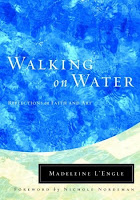
Walking on water (by Madeleine L'Engle)

Walking on Water by Madeleine L'Engle
(Amazon UK link)
It was rather by chance that I acquired the book ‘Walking on water’ by Madeleine L’Engle. She’s best known for her classic book ‘A Wrinkle in Time’ and its sequels, but she wrote some non-fiction as well. This one - about writing, art and Christianity - is probably my favourite of all her works. I last read it in 2008 so it was more than time to re-read.

The style of the book isn’t going to appeal to everyone, but I found it warm, inviting and inspiring. The author has written lots of snippets, loosely arranged in separate chapters, on topics related to art, and writing in particular. She looks at the question of what it means to be a ‘Christian writer’ - or a ‘Christian artist’ - and rejects many possible descriptions of these phrases.

Instead, she talks about her passion for writing, about losing herself in her work. She clearly had a very deep faith, and saw God in all she did, in particular the inspiration of her writing. But she also acknowledged the need for discipline, for putting pen to paper, for finding time and space to do what one feels called to do.

There are chapters about doing one’s work - whatever it is - to the glory of God, and about the way God, as creator, inspires all his creatures to create. She talks about the importance of getting on with one’s creation, whatever it might be, whether or not it’s ever going to be polished and presented to the public. A writer has to write, an artist has to paint, a singer has to sing… and in the doing of our calling, we find the work itself can take over.

The style is unusual, in that each chapter is divided into little snippets, each of them complete in itself. Some take up less than half a page, others continue over two or three pages. They all make points, some of them expressing, in different words, what the author has already said. But it doesn’t feel repetitive, Instead, it feels almost like sitting and having a chat.

There are anecdotes from the author’s own life, giving an impression of a focussed, caring mother and grandmother, who travels the world but loves nothing more than her own home and family. There are quotations from books, some of which she cites, others of which she acknowledges that she wrote down without any reference. She picks and chooses, and in places it all feels quite random - but there’s a thread running through that made me want to keep reading, although I had to stop every few pages, to think about what was written.

The subtitle of the book is ‘personal reflections on faith and art’, and that’s exactly what this book is. It was published in 1980, but other than references to typewriters it doesn’t feel at all dated. I loved it the first time I read it, and I enjoyed it just as much this time around. I should read it far more often than once every twelve years, and am already looking forward to reading it again.

Very highly recommended if you are interested in the connection between faith and art, or a writer's personal thoughts about her life and craft.

My other personal favourite books about writing (sadly not all in print) are:

- Writing on both sides of the brain by Henriette Anne Klauser
- Bird by bird by Anne Lamott
- One way to write your novel by Dick Perry
- The five-minute writer by Margret Geraghty
- Becoming a writer by Dorothea Brande
- Back to creative writing school by Bridget Whelan
- Writing great short stories by Margaret Lucke
- Guide to fiction writing by Phyllis Whitney


Review copyright 2020 Sue's Book Reviews

25 Feb 2019

Troubling a Star (by Madeleine L'Engle)

Troubling a Star by Madeleine L'Engle
(Amazon UK link)
In my quest to read through Madeleine L’Engle’s novels for teenagers, I finally reached the fifth in the Austin Family series, ‘Troubling a Star’. I had no idea what to expect: the first book in the series is introductory, the second mainly involves a camping trip around the United States. The third, ‘The Young Unicorns’, is set in New York and is a thriller, and the fourth, ‘A Ring of Endless Light’, is a poignant story of bereavement and growing love.

However, I was still a little surprised when the opening paragraph of the first (and several other) chapters sees Vicky Austen, who narrates the books, alone on an iceberg in the Antarctic. As gradually becomes apparent, this is no dream, or fantasy… she really is there, getting colder and colder, wondering how much longer she can survive.

The bulk of the book takes place some months earlier, however, and gradually leads up to the point at which Vicky is in this life-threatening situation. She isn’t quite sixteen at the chronological start of the novel. However she’s feeling somewhat out of place in the high school she has returned to, after a couple of years living elsewhere. She loves English literature, particularly Shakespeare and poetry, but has a hard time making friends, and doesn’t find much else to like in her school.

Her friend Adam Eddington, who appeared in an earlier book, comes to visit his great-aunt who lives quite near the Austins. He thinks Vicky would like her - and, indeed, the two become friends almost immediately despite the huge age gap. Vicky misses her grandfather, whom she lost in the summer, and finds Adam’s great aunt to be a fascinating, thinking person - perhaps the only person she can relax with.

Adam, meanwhile, is off on his research in marine biology, travelling to Antarctica. And since we know from the brief prologues to most of the chapters, Vicky gets the opportunity to go there too. But it’s not straightforward, and she receives some rather strange warnings.

A large part of the book covers Vicky’s travels to Antarctica, getting to know several of her fellow passengers on the ship which will take her there. There’s quite a political element to the book; Vicky herself is rather ignorant about world politics, but is aware that some world leaders can be corrupt, or at least power-hungry. And there’s a strong theme about ecology and the importance of preserving the Antarctic rather than trying to drill for oil or encourage too many tourists.

I was slightly confused that Madeleine L’Engle introduces two imaginary countries amongst the real ones. There’s a small European country with a prince who is on the trip. There’s also a small fictional South American country called Vespugia, in between Argentina and Chile, which is quite significant in the book. They’re done well - so much so that I even looked one of them up to see if it had ever existed, or if it was a region of one of the known countries. But the only references online were to these books.

I assumed, since Vicky narrates, that she is eventually rescued from the iceberg, but I was intrigued to discover how she arrived there - and as she becomes more desperate, the book becomes more tense. I found it quite hard to put down by the time I was half-way through. The pace is excellent, in my view.

As with most of L’Engle’s books there are a few low-key references to the Christian faith; in this one, angels are mentioned several times. ‘Angels watch over you’ is a farewell greeting used several times and Vicky writes some poems about angels. This makes a nice contrast to some of the more tense parts of the novel, and I don’t think it would be a problem for anyone who does not believe in angels.

While it’s probably best to read this after the earlier four books in the series, as some characters (particularly Vicky’s family, and also Adam) were introduced there, it’s not essential. This book stands alone, and I thought it worked very well.

Recommended to teenagers, and adults who like reading teen fiction.


Review by Sue F copyright 2019 Sue's Book Reviews

17 Jan 2019

A house like a lotus (by Madeleine L'Engle)

A house like a lotus by Madeleine L'Engle
(Amazon UK link)
I have been enjoying reading Madeleine L’Engle’s teenage fiction books, many of which I had not previously read. I’ve almost reached the end, The chronology is rather complicated as she wrote three separate series, but some of the characters overlap. ‘A House like a Lotus’ is third in the O’Keefe series. It features Polly, who is also a main character in ‘The Arm of the Starfish’ and ‘Dragons in the Water’.

Both the earlier O’Keefe novels are somewhat suspenseful adventure stories, but it becomes clear early in this book that it’s a more thoughtful character-based novel. Polly is nearly seventeen as we meet her in Greece, on her own and feeling somewhat forlorn. We quickly learn that she has just flown there from the United States. She should have been met by her uncle and aunt, but they have been unavoidably delayed.

It’s evident that Polly is a confident and fairly mature young woman, but that she has experienced some heartbreak over the past few months. She isn’t worried about spending a couple of days on her own, although she hopes her parents don’t know about it, as they would worry. A hotel is booked for her, and she decides to take an organised tour of Athens when a young man called Zachary Grey attracts her attention. He’s attractive, very friendly, and also wealthy. He offers to take her out for the day, and she agrees to take him up on the invitation.

Zachary is one of the characters who appears in L’Engle’s ‘Austen’ series about an entirely different family. So (as I have read them fairly recently) he was familiar to me as a somewhat pushy, arrogant young man. But I didn’t think he was going to be dangerous. Sure enough, they spend a few pleasant days together. Although Zachary is quite intrusive at times, he mostly respects Polly’s boundaries, and is the catalyst for her thinking more deeply about her recent past.

The narrative is interspersed cleverly with Polly’s memories. Some are in daydream format, as she re-lives or re-tells some of what has happened in the past couple of years. But the story mostly revolves around two women called Max and Ursula. Their relationship is fairly obvious from the start but comes as something of a shock to the somewhat naive Polly at first when gossip hits her. But her friendship with them - and Max in particular - is based on philosophy, literature and other shared interests. Overall I thought this was handled sensitively and well, given the 1980s setting.

There are more secrets in Max’s life, which gradually unfold. Evidently there is some crisis or betrayal which has caused Polly to want to cut her out of her life entirely. I was intrigued, and found it difficult to put the book down until I finally discovered what happened, towards the end of Part One.

Part Two sees Polly in Cyprus, where she is helping out at a conference in the (presumably fictional) village of Osia Theola. The descriptions feel realistic; apparently the author had spent some time in Cyprus shortly before writing this book. Polly makes some new friends from various nations, although I wasn’t entirely comfortable with some of the stereotypes. Again, though, the way she thinks of and observes people is probably appropriate for a well-travelled American teenager in the 1980s.

There’s a lot to think about in this book, with many important issues touched upon from Polly’s perspective. She grows up in several ways. While some of the book is shocking in content, the writing is consistently good. I thought the difficult scenes were covered with sensitivity, and minimal detail. As with all L’Engle’s books, there’s an underlying Christian theme. This one, as I gradually realised, involves forgiveness. But it’s not pushed or preachy in any way, and could be read by people of any faith or none.

The earlier books were, I thought, appropriate for younger teenagers. But this one has some more ‘adult’ content, and I wouldn’t really recommend it to anyone below the age of about fifteen or sixteen. It’s not necessary to have read the earlier books in the series, but doing so adds to the richness of the characters and gives a sense of catching up with old friends.


Review by Sue F copyright 2019 Sue's Book Reviews

22 Nov 2018

Dragons in the Waters (by Madeleine L'Engle)

Dragons in the Water by Madeleine L'Engle
(Amazon UK link)
I’m a little surprised to find how much I am enjoying reading Madeleine L’Engle’s books for teenagers. When we gradually acquired them for our sons, I had read the first two or three in the ‘Wrinkle’ series. But I had neither the time nor inclination to try the others. However in the past few years I have been reading through the various series, interspersed with other books, and so far have liked them all.

‘Dragons in the Waters’, first published in 1976, is the one I have just finished. This is is the second book to feature Poly (or Polly) O’Keefe, daughter of the former Meg Murry who was the main character in ‘A Wrinkle in Time’. In this book, Poly is fourteen, and is travelling on a ship with her brother Charles (12) and their father, on their way to Venezuela where he is to do some scientific investigations.

However the main protagonist is Simon, a thirteen-year-old boy travelling with his cousin Forsyth Phair. Simon is an orphan who has been living with his great aunt Leonis; they have been struggling financially and she finally decided to sell a family heirloom: a large portrait of a famous explorer, which belonged to one of her ancestors. Forsyth bought it and is taking it on the same ship as the O’Keefe family, with the expressed intention of donating it to a museum.

Also on the ship are two academic women, an elderly married couple, and a musician called Mr Theo who appeared in one of the earlier books. Much of the early part of the book focuses on the various interactions between these passengers and some of the ship crew, and in particular the friendship which develops quickly between Simon, Poly and Charles. There’s an element of suspense, too; Simon nearly suffers a fatal accident just before boarding, and overhears some worrying conversations…

Although the book is about teenagers, much of the story is quite complex. There is a primitive but loving tribe connected with Simon’s ancestors. There’s also a series of old letters which his aunt reads, written by his ancestor Quentin Phair, which rather debunk the theory that he was a great hero. There’s suggestions of smuggling, and moral questions about whether some forms of smuggling are less immoral than others. And there’s a shocking incident part-way through the book which raises the tension significantly.

I thought it a good story, which was quite hard to put down in the later chapters. As with most of Madeleine L’Engle’s books it involves low-key Christian themes, but without any preaching. Simon has some excellent questions about God, and is still angry at the loss of his parents. He has been rather put off any kind of faith by a singularly unhelpful minister.

All L’Engle’s books stand alone, but it’s probably best to read this after ‘The Arm of the Starfish’, where some of the characters were introduced. Note that, unlike some of L'Engle's other books, this is not fantasy but a thriller; there are no actual dragons in the story.

Recommended to teenagers who like an exciting read, and adults who enjoy this kind of teenage fiction.


Reviewcopyright 2018 Sue's Book Reviews

1 Oct 2018

A Ring of Endless Light (by Madeleine L'Engle)

A Ring of Endless Light by Madeleine L'Engle
(Amazon UK link)
I’m enjoying reading my way, gradually, through Madeleine L’Engle’s teenage fiction novels. Although I had previously read ‘A Wrinkle in Time’ and at least one of its sequels, most of L’Engle’s other books weren’t published until I was an adult so we didn’t acquire them until our sons were in their teens - and in those years I didn’t read many books myself. So it seemed like a good idea to start reading them now.

I found it a tad confusing at first to know what order to read them in, since some characters appear in different series. I was also mystified that my copy of the book ‘A Ring of Endless Light’ states that it’s the third in the Austin Family series, when it’s evidently the fourth…

I embarked on the Austin series a little over a year ago, not expecting too much. Rather than the mystical, time-travelling element in the ‘Wrinkle’ series, these books are about an ordinary family. They are narrated by Vicky, the second of four children, who is twelve in ‘Meet the Austins’.

In ‘A Ring of Endless Light’, the family are staying on ‘The Island’, in their grandfather’s home. It’s their favourite holiday destination, and is mentioned in the second in the series, ‘The Moon by Night’. Vicky’s father has finished his year in New York (covered in ‘The Young Unicorns’) and is trying to write a book. But the main reason they’ve come to stay for rather longer than usual is that grandfather is dying of leukemia. He is unlikely to live until the end of the summer, and the family want to be with him until the end.

It’s a sombre theme in a children’s book, one that permeates the whole story. Indeed, the book begins with the funeral of a family friend, and includes several other sad losses. Vicky, who is now almost sixteen, begins to think a lot about life and death. This is sometimes on her own, sometimes in discussion with grandfather or friends. As with most of L’Engle’s books there’s an underlying Christian theme, and this comes out in many of the questions, as Vicky ponders topics such as cryogenic freezing, standard burial or cremation, annihilation and heaven.

At the same time Vicky, who has often felt like the odd one out in her family, is beginning to blossom. No longer lanky and ‘all elbows’, she still isn’t a scientific genius like her older brother John, nor a beauty like her younger sister Suzy (who is also highly academic and scientifically minded). But she’s discovered a gift for writing, and for communicating in ways that others find harder. She feels closest to her seven-year-old brother Rob, who is wise beyond his years but still young in many ways.

There’s a romance element to the book too. Vicky is courted by three different young men, and goes on dates with them all. This isn’t cheating; she makes it clear to them all that she’s just a friend, and they all know about each other. The first is Leo, son of the man whose funeral is covered in the first chapter. Vicky has known him for years and never much liked him, but she discovers that he has some depth, and starts to like him as a friend. He’s a nice young man, but tries to push for more in ways that she doesn’t want.

Then there’s Zachary, who first appeared in ‘The Moon by Night’: he’s a wealthy, spoilt young man who drives too fast, and has a worrying heart condition. However Vicky considers him very good-looking, and attractive in a disturbing way. He insists he ‘needs’ her, and she feels a stir of excitement when she’s with him, though she doesn’t like his risk-taking nature, or his general cynicism.

The third young man is Adam, who is working in a marine biology centre with Vicky’s brother John. Adam is one of the cross-series characters, who first appeared in the book ‘The Arm of the Starfish’. Adam enlists Vicky’s help in a project he’s embarking on, relating to dolphin communication. She proves to be quite talented, and also realises that she would like him to be much more than a friend and colleague…

In wondering why three such different young men are given such important roles in this novel, it occurred to me that they represent three of CS Lewis’s classic ‘Four Loves’. Indeed, if we take into account the fourth young man in the book (Vicky’s brother John) all four are represented: John with family affection, Leo with friendship, Zachary as ‘Eros’, and Adam as self-sacrificing love.

As with the first two books in this series, there’s not a great deal of plot. The story is character-based, alternating poignant scenes with grandfather and Vicky’s growing relationships with her three admirers. I like the Austin family very much even they’re a tad idealised, with everyone helping each other, and pleasant evenings of singing and reading aloud. Yet there are tensions in the family; Vicky and Suzy don’t always get along, for instance. They’re all tense about the likelihood of losing grandfather, and show it in very different ways.

Vicky has a lot of freedom, and is a person of strong principles. It’s made clear that she feels liberated in being able to say ‘no’ to some of her young men’s advances, and to refuse to drink any alcohol. It’s a great example for teenage girls who might say ‘yes’ due to feelings of pressure and insecurity, and quite relevant in today’s culture when debates range over issues such as this.

I understand that the portrayal of dolphins in the book is somewhat incorrect; but it serves its purpose to contrast their generally playful and caring natures with some of the horrific examples of the cruelty of humankind. There is also a contrast between the family’s care of each other and those they love, and with grandfather’s gradual slipping away from the world.

There are many quotations from classics of all eras, including the Bible, and much that’s thought-provoking related to how we see life and end-of-life. The Christian themes, while inevitably prevalent (grandfather is a retired minister) are quite low-key, without any preaching.

After the first few chapters, I found this book engrossing. I thought it beautifully written, particularly the last chapter. By the time I reached the end, my emotions had been fully wrung out, and all I could think was, ‘Wow!’

Very highly recommended, to teenagers and adults.

This book could stand alone, but is best read after the earlier Austin books, and perhaps also ‘The Arm of the Starfish’ where Adam is introduced.

Review copyright 2018 Sue's Book Reviews

10 Jul 2018

The Moon by Night (by Madeleine L'Engle)

The Moon by Night by Madeleine L'Engle
(Amazon UK link)
A couple of years ago I decided to re-read through the works of several authors whose books I have enjoyed, in a somewhat structured way. I realised that although I had very much liked the few books I had previously read by Madeleine L’Engle, there were a surprising number which I had never read. 

Our collection was somewhat eclectic, and my adult son removed the ones that were his. But I’ve managed to acquire most of the ones we were missing, from charity and thrift shops.

‘The Moon by Night’ is the second book in the Austin family series intended for young teenagers. I read ‘Meet the Austins’ almost exactly a year ago, and then made the chronological mistake of reading ‘The Young Unicorns’ earlier this year, not realising that it was the third in the series. Not that it particularly matters. Even ardent fans of L’Engle’s writing do not always agree on the best order to read the books, and each one stands alone anyway.

‘The Moon by Night’, as with the first novel, is narrated by Vicky Austin. She’s almost fifteen when this book opens, and thinking about the future. We don’t know, at first, why she is so concerned and what is going to change. But we quickly learn that her uncle is getting married to her mother’s best friend. Vicky has been dreaming by the sea and is almost late for the wedding…

The bulk of the book, however, features the family travelling around the US and parts of Canada on a lengthy camping holiday. Vicky has an older brother, John, who is soon to go to university. Her younger sister Suzy is determined to be a doctor, and they also have a much younger brother, Rob. There’s a fair amount of family interaction, with minor squabbles here and there, and a lot of love from the parents who, on the whole, are quite relaxed.

Two young men are introduced in the book, both of them interested in Vicky, and very different in personalities. Vicky herself learns a lot about herself and what matters to her over the course of the book, and that’s really the main theme. There are many incidents at different campgrounds including interactions with pleasant (and unpleasant) people, as well as close encounters with a variety of wild-life.

Some parts of the book felt to me like a brief travel guide. Vicky describes the landscapes of the different states they pass through, in some detail. This was interesting at first, but by about half-way through I started skimming or even skipping the car journeys, unless there was some conversation. The author was clearly familiar with the identifying features of each state, some of which rang true (we lived in the US for a couple of years and did some travelling camping ourselves a couple of times) so I assume it was all accurate.

But although Vicky occasionally stops short and says that anyone wanting to know more can read a travel book, I still found a tad too much detail about the geography of the US, and rather a lot, here and there, about natural history too. The author also gently demonstrates her anti-war agenda and her horror at what white Europeans did to the original Americans; I don’t have any problem with that, in theory, as I agree with her. But it felt a bit odd to be mentioned so many times in a novel.

I didn’t dislike it; I think it could make a very good read-aloud for children interested in American geography and landscapes, perhaps tracing the journey on a map. But equally it felt as if the informative side of the book was there to fill out a somewhat limited storyline.

Certainly worth reading by fans of Madeleine L’Engle. It makes a good sequel to ‘Meet the Austins’, as well as introducing a significant and intriguing character who reappears in some subsequent books (not just Austin ones). It also, for those who like continuity, covers the gap between the Austin family living in a very small town in the first book, and a flat in New York in the third book.

As with all L'Engle's books there's an underlying Christian theme, but it's quite low-key and not at all preachy. Vicky herself is not entirely sure about her faith but is quick to defend those who are.

My edition is a British one, in which some American words have been changed ('petrol' for 'gas', for instance) but others, such as 'station wagon', have not. I'm not sure why publishers bother to make this kind of change, as most British children are familiar with American words - but it wasn't too intrusive and I didn't really notice until well over half-way through.


Review copyright 2018 Sue's Book Reviews

14 Jun 2018

The Young Unicorns (by Madeleine L'Engle)

The Young Unicorns by Madeleine L'Engle
(Amazon UK link)
In my mixture of reading and re-reading authors whose books I’ve enjoyed, I’m working my way through the young adult fiction by Madeleine L’Engle, most of which is new to me. We collected several of her books when my sons were teenagers, and I’ve bought others at charity shops. But until recently I had not read most of them. As far as I gather, there are three main series, with some overlapping characters. I’m not sure I’m reading in the best order, but since I intersperse with books by other authors, it’s not really a problem.

‘The Young Unicorns’ is third in the Austin series about a family with four children. John, the oldest, is away at university in this book so he doesn’t appear. Vicky is the oldest girl, in her teens, and her sister Suzy is about eleven. They have a younger brother, Rob. They live in a flat in New York, and have temporarily adopted Emily, who lives in the flat below, and whose father is travelling. Emily is a gifted pianist… to say more would be a spoiler.

The story is about gangs, and the potential problems that can accompany medical advances. It’s also about freedom, and asks some quite deep questions about what is meant by the word - whether anyone can truly be free. It also shows how apparent altruism can be a sign of a controlling personality… perhaps even mania. There’s a low-key religious element; much of the action takes place in or under a cathedral, and some of the clergy are important characters, as well as the visiting Canon Tallis. But there’s no preaching, or anything too overtly Christian.

It doesn’t have the fantasy/time travel elements that are present in ‘A Wrinkle in Time’ and its sequels. There are no unicorns at all, other than in a metaphorical/literary sense. But there’s a distinct element of medical science fiction. Having finished it, I’d class this book as a thriller, which isn’t my preferred genre. Yet, because it’s intended for older children/teens rather than adults, I found the tension gripping but not unpleasant. Nor is there any goriness, or serious violence.

Although, in retrospect, I realise that much of the book is a tad caricatured, I was so caught up in the story that it felt real. It did not make good bedtime reading, so I picked it up in the daytime instead, and could hardly put it down after the first few chapters.

L’Engle had quite a gift of characterisation, and I had no problem at all remembering who was whom despite a fairly large cast. The secretive Dave, who also spends a lot of time with the Austins and Emily, is a complex and fascinating character. Mr Theo, Emily’s music teacher, is elderly and insightful. Canon Tallis, who I met in one of the author’s books in a different series, is altogether delightful.

Some of the concepts are complicated, and some of the situations could be frightening to a younger child, so I wouldn’t recommend this to anyone under the age of about ten or eleven. Ideal for a fluent and keen reader who wants something with depth. I liked this book more than I expected to, once I had realised what genre it was in, and it’s left me with much to think about.

Recommended to anyone who wants a fairly quick read and doesn’t mind a bit of suspense.


Review copyright 2018 Sue's Book Reviews

26 Mar 2018

The Arm of the Starfish (by Madeleine L'Engle)

The Arm of the Starfish by Madeleine L'Engle
(Amazon UK link)
In amongst enjoying new books, and re-reading some of my favourite authors, I’m finding books that we’ve had on our shelves for years, but which I have never read. Several of them are by Madeleine L’Engle, best known for her ‘Wrinkle in Time’ trilogy (the first of which has recently been made into a film). I read one or two of them to my sons when they were teenagers, but the science fiction element didn’t really appeal to me at the time.

One of my sons loved the ‘Wrinkle’ books, however, so we gradually collected many more by L’Engle, most from charity shops or the Amazon marketplace. It’s only in the past couple of years that I’ve started reading them, and on the whole am liking them very much. Most are not science fiction at all.

A few days ago I picked up ‘The Arm of the Starfish’, which claims on the back to be a ‘mystery thriller’. It was written for older teenagers - the genre we would now call ‘young adult’ - so I vaguely expected something along the lines of Agatha Christie with teenage protagonists.

I was correct about the latter. Adam is the viewpoint character of the book. He’s sixteen, and very intelligent. He has been studying marine biology, working with an eminent scientists in the United States. We first meet him in the airport on his way to a small (fictitious) island off the coast of Portugal, to work for the summer with the celebrated Dr O’Keefe. His flight has been delayed several times due to fog. Out of the blue, he is approached by a very attractive girl around his age, who introduces herself as Kali Cutter. She says that she has important information about Dr O’Keefe, and that Adam needs to be warned…

Right from the first chapter, I could feel the tension. L’Engle had quite a gift of characterisation, and the confusion in Adam’s mind was easy to feel. I was pretty sure that Dr O’Keefe was Calvin from the ‘Wrinkle’ series, and that he was full of integrity… but so strong was the writing that I did wonder, for a while, whether Cali had a point. The action moves along solidly; not so rapidly that I lost track of what was going on, but with detours into sightseeing and conversation that kept the tension, and made it quite difficult to put the book down.

The biology project is perhaps unrealistic; Dr O’Keefe is studying the ways that starfish arms regenerate, wondering whether this can also apply to humans. I don’t know much about biology, or if starfish are indeed as closely related to humans as is stated. But that doesn’t matter. If it’s science fiction, it’s very well done, and the detail is minimal. The danger of such research getting into the wrong hands, however, feels all too real. The book was written over fifty years ago, yet the evils of ruthless greed are all too familiar.

Many of L’Engle’s books have a Christian theme, usually fairly low key. In this, there are two priests who have important roles; one sound and caring, the other not. The overall story has a clear good vs evil plot which could appeal to secular humanitarians or those of other religions.

There’s also an unexpected Christ figure, something I didn’t spot until it became clear in one of the last chapters. L’Engle doesn’t make the mistake of spelling out her beliefs, or writing forced conversations about Christianity. But the power of love is strong, and the importance of caring for everyone, no matter what their background or significance.

I wasn’t sure I liked this when I was about half-way through, and the climax to the book includes a shocking scene which I should perhaps have foreseen, but didn’t. But having finished it, I would rate it very highly. Not for young children, but teenagers who have read the later ‘Harry Potter’ books, or ‘Lord of the Rings’ might well enjoy this. And as an adult, I very much appreciated it too.

Definitely recommended.


Review copyright 2018 Sue's Book Reviews

22 Jan 2018

An acceptable time (by Madeleine L'Engle)

An acceptable time by Madeleine L'Engle
(Amazon UK link)
Interspersed with new books and those I am re-reading, I’m also picking up books which my sons read and liked in their teens, but which, for some reason, I have never previously read myself. Some of these are by Madeleine L’Engle, who is best known for her classic children’s novel ‘A Wrinkle in Time’. I have just finished reading the fifth book in her time quintet, ‘An Acceptable Time’.

The story is about Polly O’Keefe, the eldest child of Meg Murry and Calvin O’Keefe, who featured in the first book as teenagers themselves. They are now apparently married with a lengthy family of their own; Polly is in her late teens, probably sixteen or seventeen. She is spending some time staying with her grandparents, Meg’s parents, who are still working as scientists.

I realised when I reached the end, and found a family tree and list of books that I should perhaps have waited until I had read the other O’Keefe books, which might have introduced Polly at a younger age. However, it didn’t particularly matter; although some events from those books are referenced, this novel is complete in itself. As with some of the other books in the quintet, it features time travel, but not in a high-tech way.

Polly finds herself unexpectedly three thousand years in the past, after seeing two different young people whom she did not recognise, and who seemed to be dressed in skins rather than modern clothes. She is surprised that they speak a bit of English, but then learns that a friend of her grandparents (a bishop) has also been able to travel back in time, and has both learned some of their language, and taught them some English.

A young man called Zachary is quite keen on Polly - when she returns to the 20th century - and they go out a couple of times, but it’s clear that he’s quite ill. So when he, too, is able to travel back in time, they begin to wonder if it’s for his sake. The ancient peoples have druids and healers, and one of them thinks he might be able to help.

However, there are also fierce battles with another tribe who are suffering severe drought, and their ancient culture demands human sacrifice…

It’s quite a page-turning book, with a lot of action and some quite tense scenes. The science fiction aspects of time gates and tesseracts is not really explained, but that doesn’t matter too much. I’m not into science fiction, particularly, and the story is what mattered. There’s quite a bit of religious discussion, more so than in the author’s other books; however although the Christian message is explained fairly overtly, not pushed.

Moreover, it’s given in contrast to the ancient beliefs, or as something to remember when characters are afraid. The ancient beliefs in this book were mostly polytheistic and in some cases extremely unpleasant, contrasted with the modern people, and a handful of the ancient ones who believed in one ‘Presence’ rather than multiple gods and goddesses.

As with other books by Madeleine L’Engle, I found some of the conversations a bit stilted, and felt that there was a tad too much description in places. But overall it was a good read, one that I’d recommend to older children or teenagers who are interested in this kind of scenario, with modern characters interacting with ancient history.

Review copyright 2018 Sue's Book Reviews

6 Jul 2017

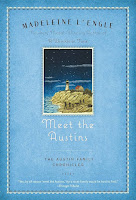
Meet the Austins (by Madeleine L'Engle)

Meet the Austins by Madeleine L'Engle
(Amazon UK link)
In my quest to re-read books by some of my favourite fiction writers, and discover some I’d missed, I decided to read another Madeleine L’Engle teenage book. It’s a busy period and I’m not reading much, so a shorter novel than usual was easy to finish in just a few evenings. I’ve been realising that although we’ve had several of this author’s books on our shelves since my sons discovered them close to twenty years ago, I had never (as far as I recall) read this one before.

‘Meet the Austins’ is a family story, introducing characters who, I assume, will feature in others in the series. Unlike the better known ‘Wrinkle in Time’ and its sequels, there’s nothing magical or mysterious in this book which features an ordinary American family. It was published in 1960, so I assume it was intended to be contemporary, and as such is an interesting snapshot into US life in that era.

Vicky is the narrator of this book. She’s twelve, and the second of four children. She and her older brother John have something of a love-hate relationship, although during the course of the book they realise that they are important to each other. Suzy is three years younger than Vicky, and Rob is about five. Their father is a doctor, their mother (as was typical of the era) stays at home and looks after the children and the household.

The story opens on a dramatic note as a phone call heralds a family bereavement. It shocks Vicky and makes her ask questions about life and God. Not long afterwards, a rather spoilt (and unhappy) girl called Maggy comes to join the family, temporarily at first, and the dynamics inevitably change.

There’s not much plot to this novel. Instead it’s a series of incidents showing family life, each chapter being complete in itself. The chapters are quite long; there are only five in around 150 pages. One of them is about a day that went wrong, with Vicky doing something she later regretted profoundly. One of the chapters is about a visit their uncle makes to their house, accompanied by a woman whom they all assume is a girlfriend. The final chapter describes a holiday to their grandfather’s home, by the sea, and a near tragedy.

There are some ongoing threads to the story, in particular that of Maggy’s gradual adaption to family life, and the decision as to what her future will hold. But since the book is an introduction to several people, it’s character-based. L’Engle had a gift for characterisation; perhaps some of her people are caricatured, but I very much liked the geeky John, the slightly rebellious Vicky, and the independent, determined Rob. Suzy was the least developed of the children; she’s rather over-shadowed by Maggy.

It’s not a great literary work but I’m glad I’ve read it at last. It would be suitable for any child from the age of about seven or eight who’s reading fluently, or as a read-aloud for the whole family. There’s a very low-key Christian theme - graces are said, Grandfather is a retired minister, and some theological questions are addressed without any preaching or even firm answers.


Review copyright 2017 Sue's Book Reviews

25 Feb 2017

Many Waters (by Madeleine L'Engle)

Many Waters by Madeleine L'Engle
(Amazon UK link)
In my gradual quest to read through Madeleine L’Engle’s fiction for teenagers, some of which I have never read before, I have just finished the fourth in the ‘Time Quintet’.

‘Many Waters’ is sometimes recommended to be read as the third rather the fourth book in the series which begins with the classic ‘Wrinkle in Time’, but I don’t see what difference it makes, as it stands alone. Whereas the first three mostly involve Meg Murry and her youngest brother Charles Wallace, this one is almost entirely about their twin brothers Sandy and Dennys, who play much smaller roles in the other books.

The twins are around sixteen in this book, and unlike their siblings are not science geeks. They’re still fairly academic, one planning to be a doctor and the other a lawyer. But in their brilliant and somewhat quirky family, they are considered the ordinary, practical ones who enjoy sports and gardening rather than obscure scientific theories.

The story starts when the twins, hunting in their parents’ lab for some cocoa powder, feeling fed up with the wintry weather outside, type a few things into their father’s computer which leads to their suddenly being transported to a different - and very hot - climate. They have no idea where (or when) they are, although it quickly becomes obvious to the reader as they meet people whose names are familiar from a Bible history context.

The novel is primarily historical fiction with some low-key fantasy which is almost indistinguishable from supernatural elements. Seraphim and nephilim mix with humans, and have the ability to change into different creatures at will (I wonder if JK Rowling’s animagi were inspired by them - indeed, it occurs to me as I write to wonder if her Weasley twins were in some measure inspired by Sandy and Dennys). Unicorns appear when summoned, by those who believe in them, and mammoths, smaller than their name might imply, function as family pets. El - the name for God in the book - speaks to some people directly, and there are also those who can hear messages from the stars.

There’s not a great deal known about this era of pre-history, but L’Engle has created a very believable world, based in an oasis, with people living in tents. Family feuds, jealousies, even a form of class consciousness are all common, but there are gentle, caring people too. Sandy and Dennys, at first considered alien giants, are gradually drawn into the community with growing awareness of what story they are unexpectedly part of, and what is to come.

Since this is the first (and, I believe, only) book to involve the twins as major characters, it could easily be read as a standalone novel rather than as part of the series. The science parts are minimal, and as a non-scientist myself, I felt that I could almost begin to comprehend the idea (if not the actuality) of quantum particle physics as demonstrated by the unicorns.

I thought the ending rather abrupt, and would have liked more about the twins’ family at the end, but it’s really my only minor complaint about what was otherwise an excellent book. I was surprised at how much I enjoyed it. The blend of history, fantasy and faith works extremely well, in my opinion, and could be read by anyone, whatever their belief (or lack thereof). In the introduction to my paperback edition Madeleine L’Engle says that she often wrote to help her explore difficult questions that occurred to her about time and space; she doesn’t make the mistake of trying to answer questions, instead she encourages readers to think outside the box.

It’s not a book for younger children, but could be read by anyone from the age of about ten and upwards who enjoys intelligent historical fiction and doesn’t mind a bit of fantasy.

Highly recommended.


Review copyright 2017 Sue's Book Reviews

18 Nov 2016

A Swiftly Tilting Planet (by Madeleine L'Engle)

A Swiftly Tilting Planet by Madeleine L'Engle
(Amazon UK link)
I’m enjoying re-reading favourite books by authors I’ve enjoyed, interspersed with some new ones. So I delved into my Madeleine L’Engle collection, and in the past year I have re-read both her best-known classic for older children, ‘A Wrinkle in Time’, and its sequel, ‘A Wind in the Door.’.

I’ve just finished the third in the author’s Time Quintet, ‘A Swiftly Tilting Planet’. I would like to say I have re-read it, but after the first few chapters I realised that I have absolutely no recollection of ever having read it before. This makes sense, when I think about it: the novel wasn’t published until 1978, by which time I was eighteen, and had little time for reading fiction. 

We acquired our paperback edition of this book in the late 1990s when my sons were young teenagers. Either they read this or my husband read it to them, but I never read it myself.

Until now. I emerged from the story feeling quite elated, although also a tad confused. Elated because it’s a powerful story, blending history, mythology and Christian faith, with an awareness of evil in the world that is very topical. Naturally there’s a positive ending - this series was written for older children and younger teens - but there’s an exciting path along the way.

At the same time I was somewhat confused because there are a lot of characters, many of them with similar names, in several different time periods. This is deliberate: Charles Wallace, the fifteen-year-old hero of this book, has to travel through time (on the back of a unicorn) in order to make minor adjustments to history in order to ensure that a crazy dictator doesn’t start World War III.

The way it’s written is very clever. Charles’ older sister Meg, now married and expecting her first baby, is able to ‘kythe’ with him to keep him on track, and to know where and when he is at every point. Charles is under attack; the ‘echthroi’ - the enemies of humanity - don’t want him to change anything, and he’s armed only with a poem - a ‘rune’, as they call it - calling heaven’s powers to himself, in a paraphrase of part of the famous St Patrick’s Breastplate prayer. Each chapter title then focuses on a separate part of the rune, as Charles learns more about his task.

Perhaps if I’d read more slowly, or kept notes of the time periods and specific names, it would all have been clearer. Perhaps, if I’d known a bit more about American history, it would have made more sense. As it was, I got the general idea, and enjoyed each brief scenario in itself, but entirely lost track of several threads and missed the eventual significance of how Charles actually succeeds in his mission.

It doesn’t matter; a deeper theme of the book, which struck me powerfully, was that of waiting for ‘the wind’ to guide, rather than trying to work out what to do based on reason and logic. I liked the way Charles Wallace - and the unicorn Gaudior, his angelic guide and transport - was given the freedom to follow his own reason, even against advice, and gradually had to learn to listen and trust that he would be led in the right path.

Some have complained that there’s too much of Christianity in these books; some complain the Christian parts are too pagan or ‘liberal’. I found the blend exactly right; this is science fiction at its best, in my opinion, with an underlying Christian worldview and a message of good triumphing over evil. It can be read at several different levels, by children, teens or adults, and provides a great deal to think about.

Highly recommended. It stands alone, but is probably best to read after the preceding two books in the series.

Review copyright 2016 Sue's Book Reviews

27 Jul 2016

A Live Coal in the Sea (by Madeleine L'Engle)

A live coal in the sea by Madeleine L'Engle
(Amazon UK link)
When I read Madeleine L’Engle’s teenage novel ‘Camilla’ about a month ago, I commented at the end of the review that I found the ending rather inconclusive. I cared enough about the main character that I wanted to know what would happen. I hadn’t expected to discover what the author intended, so was very pleased when a friend told me that there’s a sequel, and lent it to me.

‘A Live Coal in the Sea’ is decidedly an adult rather than teenage novel. Camilla, who was in her teens in the first book, is now a grandmother in her fifties. The first chapter shows her receiving a special award for her work in astronomy. It also introduces her adult son Taxi, who is an actor, and her daughter Frankie, who is an illustrator. Camilla has a student granddaughter too, Raffi, with whom she is very close; the daughter of Taxi and his wife.

However most of the story takes place in the past, in a series of flashbacks that move through Camilla’s life from the time when she was a student herself. The story is held together by conversations between Camilla and Raffi, who has been told something very disturbing by her father. There’s evidently some complex and rather murky secret in the family’s past, and Camilla decides that it’s time to speak out.

The book then gradually moves us forward through Camilla’s life, cleverly written so as to introduce a little of the story at the time. Every so often a little more time passes and we see her with Raffi again. It’s not entirely clear which sections are Camilla remembering, and which ones express what she actually talks about, but it doesn’t matter. The device works, even if the conversations between Camilla and Raffi are a bit stilted in places, and I found myself quickly drawn into the story, intrigued to find out how it would all fall into place.

While the blurb on the back calls this a ‘gripping and psychologically complex tale’, I didn’t find it tense or even particularly complicated, once I had become used to the switches in time. There are tangential comments about astronomy and simple number theory that I found interesting, but Camilla’s work mostly takes a back seat to her family life, and her relationship with her husband and extended family.

The characters are mostly three-dimensional and believable, and I found myself growing particularly fond of Camilla’s in-laws. It wasn’t a difficult read and I finished it in just a couple of days. Overall, I thought it a satisfying sequel which does, indeed, take the story forward and shows what happens in Camilla’s later life. Her close friend Luisa is also involved in the novel though the two are, inevitably, less close than they were as teenagers.

Older teens might enjoy this, but be warned that there there is some ‘adult’ content, including one particularly disturbing memory, and several rather frank discussions about sexuality. As with most of L’Engle’s books there’s a low-key Christian theme too, but it’s not pushy at all. The church is very much a part of Camilla’s life as she marries into a clerical family, so faith of some kind is taken for granted.

All in all, I liked this book very much.


Review copyright 2016 Sue's Book Reviews

26 Jun 2016

Camilla (by Madeleine L'Engle)

Camilla by Madeleine L'Engle
(Amazon UK link)
It’s many years since I first read Madeleine L’Engle’s best-known children’s classic, ‘A Wrinkle in Time’. It was only in the past twenty years or so, however, that I realised how many other books she wrote. Many of them go in and out of print, but I’ve managed to acquire quite a few, mostly second-hand, and have been reading them with interest.

I just finished her teenage novel ‘Camilla’, which I had not previously read. It’s told in the first person from the point of view of a fifteen-year-old teenage girl who lives in New York. Camilla has been quite sheltered from adult problems, but we meet her when she starts to realise that there’s something very suspicious about her mother’s close friendship with a man called Jacques, who she doesn’t particularly like.

Camilla’s best friend Luisa has parents who fight a lot, and she talks about it regularly; but Camilla doesn’t like to talk about her worries, and the way her parents seem to be growing apart. Nor does she like the thought of growing up herself. However, everything changes when Camilla gets to know Frank, Luisa’s older brother, who has returned from a boarding school. Luisa doesn’t want them to be friends, but they find a strong connection, and friendship blossoms.

So essentially it’s a coming-of-age story. It’s about teenage worries, and first love, and the blossoming of a girl into a young woman. It’s also about finding that one’s parents are human and fallible, and about seeing the reality of different kinds of marriage difficulties from a teenage perspective. It feels quite modern in that sense, so it was a surprise to learn that the novel was written as long ago as 1965.

A subplot of the book, which I found thought-provoking and moving, involves a man who had been seriously disabled in a war. We see him struggling to come to terms with it, alongside his dislike of being pitied or treated as too fragile. Some readers might dislike the regular references to God; yet they’re from the point of view of two teenagers trying to decide what they believe, and why, with some unusual theories thrown in. There isn’t any preaching.

The descriptive and narrative writing is good, as I would expect from this author, and the insights into Camilla’s mind felt realistic on the whole. However I found the dialogue a bit stilted, and the story sometimes a little too slow-moving. I found the ending rather inconclusive too, and a little depressing.

This would probably appeal to young teenage girls - perhaps older ones too - as well as adults who enjoy a bit of light reading from time to time.


Review copyright 2016 Sue's Book Reviews

12 May 2016

A Wind in the Door (by Madeleine L'Engle)

A Wind in the Door by Madeleine L'Engle
(Amazon UK link)
It’s a long time since I read Madeleine L’Engle’s ‘Time Quintet’ - indeed, I haven’t previously read all five. I certainly read ‘A Wrinkle in Time’ as a teenager, and I think I also read this one in my teens. But the others were published a little later and I seem to have missed them at the time.

We acquired four of the five 'Time' books when my sons were around nine and eleven. I read the first two aloud to them, but my husband was so intrigued by what he heard that he went on to read the later ones. So although I half listened, and read bits of one of them to myself, they mostly passed me by.

I was determined to rectify this situation, so I recently re-read ‘A Wrinkle in Time’, which I always liked very much. I have now just finished re-reading ‘A Wind in the Door’. Although some of the same characters are involved, in particular the teenage Meg Murry and her small brother Charles Wallace, this book stands alone and makes very little reference to the earlier one.

Charles, who is remarkably intuitive and bright, has been bullied at school. He’s also getting out of breath, and Meg knows that her mother is worried about him. The Murry parents are eminent - and at times absent-minded - scientists. However Mrs Murry seems to be spending all her time looking down her microscope, trying to find something related to mitochondria (which are real) and their farandolae (which are not)....

In the first half of the story, Meg tries to find out what is going on, both at Charles’ school and with his health. It’s character-based fantasy, mostly set in the real world, albeit populated with highly intelligent animals such as the dog Fortinbras and the snake Louise. The Murry family have everyday discussions and arguments, but clearly care for each other very much. The twins Sandy and Denys are down-to-earth and practical, and make a nice foil for the more mystically inclined Meg and Charles.

In the second part of the story, Meg has to solve some difficult problems, and venture into a very unlikely place, although by the time she gets there, along with her good friend Calvin and a disliked teacher, Mr Jenkins, it all feels quite believable. L’Engle neatly mixes science, fantasy and spirituality in a novel that’s sometimes confusing but which moves at quite a pace, despite a fair amount of conversation and introspection.

I have a few niggles: the way Charles is expected to adapt to school rather than being educated at home (or having the bullies dealt with); the way Mr Jenkins is portrayed so very negatively at first, and yet joins in the adventure with surprisingly little resistance. Still, I liked the way he gradually changes and is shown to have his own positive side.

Underneath the fantasy it’s a story about the battle of good and evil, about the power of love and friendship, and about doing what’s right, even if it seems pointless, never knowing when one small mistake might cause disasters on a cosmic scale. There are clear Christian values if one looks for them, including the importance of being known by name; but the book can be read from an entirely secular point of view too.

Ideal for any fluently reading child of about eight and upwards, or a good read-aloud for any age.

Review copyright 2016 Sue's Book Reviews

21 Oct 2015

A Wrinkle in Time (by Madeleine L'Engle)

A Wrinkle in Time by Madeleine L'Engle
(Amazon UK link)
I’m not sure when I first became aware of Madeleine L’Engle, and her classic children’s series about space and time. I think I probably read at least the first in the series as a teenager, but it didn’t leave much of an impression on me. It wasn’t until many years later that I read it - and some of the sequels - to my sons, who were about twelve and ten, and then came across some of her other works, in particular her non-fiction book about writing, ‘Walking on Water’, which I found extremely thought-provoking.

Since it’s probably seventeen years or more since I last read ‘A Wrinkle in Time’, first in the original ‘Time’ series, I decided it was time for a re-read. It’s not a long book, just over 200 pages and won a Newberry medal; it’s now considered a classic.

Thirteen-year-old Meg Murry is the main protagonist of this story. She’s the eldest of a family of four, but feels like a misfit in life. This isn’t just the hormones of a typical teenager; Meg is bright, but struggles with rote learning and schoolwork. Her mother is a very attractive physicist; Meg wears glasses and a brace, and considers herself ugly. Her father, also a brilliant physicist, has been away for some years, missing entirely for the past year. Meg idolises him, and hates the gossip that she can’t help hearing.

Meg has ten-year-old twin brothers, who are athletic and average, and she also has a five-year-old brother Charles Wallace, who didn’t speak until he was four, but is highly gifted as well as empathic. Meg and Charles have a strong bond, but Meg is often afraid. The first chapter introduces the family, their dog, the night sky, a terrible thunderstorm, some interesting sandwiches, and a strange old woman…

Events happen fairly rapidly, as is typical for a children’s novel. There’s not much introspection, although we learn quite a lot about what Meg is thinking, and regularly see her becoming angry and worried. Although the book begins in the real world, it’s a science fiction/fantasy novel, with a typical good vs evil battle, some unusual creatures, and the delightfully flawed Meg as heroine. The science of time travel is well thought out, even explained in a way that almost makes sense, and the plot works well with a mixture of light-hearted scenes and more tense, threatening ones.

I didn’t find the characterisation particularly strong; I never really understood the teenage Calvin’s part in the story. Moreover, Charles Wallace, while precociously intelligent, is gifted in ways that don’t seem quite believable even in the context of a fantasy world. Some of the dialogue is a bit stilted, too.

There are strong classical and Christian themes underlying the book, which reminded me in places of CS Lewis’s science fiction trilogy for adults. But they’re nicely done without being pushy or preachy. On the whole, the writing is good, the pace just right for this genre, and the resolution satisfying.

Ideal for fluently reading children from the age of about nine or ten. It works well to read aloud, too, but I found that some of the concepts needed me to pause and think, or even re-read an earlier page, and I think I understood the allusions and plot better on re-reading to myself.

It's not to everybody's taste, but it's a thought-provoking book in many ways, one which has been continually in print in various forms since its first publication in 1962.


Review copyright 2015 Sue's Book Reviews

30 Jan 2011

Two-part invention (by Madeleine L'Engle)

Two-part invention by Madeleine L'Engle
(Amazon UK link)
I find myself having a growing affection for Madeleine L'Engle's books. I only got around to reading her classic children's 'Wrinkle in time' series about fifteen years ago, and did not discover her non-fiction writing at all until relatively recently.

I was interested to find that she wrote a four-part autobiographical series, the 'Crosswicks Journal', based on her musings about life and faith while staying in her family home . I read the first in the series, 'A circle of quiet', last summer, and borrowed from a friend its sequel, 'The summer of the great-grandmother', which I read in the Autumn.

My son had the fourth book, 'Two-part invention' on his shelves, so I decided that as each book is complete in itself, I would read that next. Somehow, though, I kept picking up other books with the result that it took me two months to complete it. It didn't matter. Madeline L'Engle writes in a friendly, personal style that makes me feel almost as if I know her. Picking up one of her non-fiction books, even after a gap of a few weeks feels, almost like catching up with a friend who's been away for a while.

In this volume, she describes her first meeting with her beloved husband Hugh, when they were both working in the theatre. There are fascinating anecdotes about life as actors, and her general lack of boyfriends; the way she didn't quite 'belong' with the lifestyle of the famous and glitzy, and the gentle courtship that evolved when she and Hugh discovered that they had a great deal in common.

The book then tells of significant periods in their forty-year marriage, with high and low points as they raised children, moved to the country, and as her books started to sell. The book continues right up to the time when - as we know from the start is going to happen - Hugh loses his fight with cancer following some difficult and painful months.

I love the rather rambling style of these books: the regular digressions into other topics, and also the way that we're allowed so much insight into this very special relationship. In places it's quite moving, despite knowing all along what the ending would be.

Madeleine L'Engle talks frankly about her faith in places, without being the least bit pushy or preachy; she struggles with many questions, and rejects some of the traditional Christian viewpoints while seeking God and finding him her anchor in the most difficult patches.

She also talks about music; about how playing the piano helps her to relax, and re-focus, and begin to find healing and wholeness. The title of the book is from a piece by Bach.

Recommended to anyone who's read others in the Crosswicks series, or who likes fairly unstructured autobiographical writing. Still in print on both sides of the Atlantic.

Review copyright Sue's Book Reviews, 30th January 2011

1 Nov 2010

The summer of the great-grandmother (by Madeleine L'Engle)

The summer of the great-grandmother by Madeline L'Engle
(Amazon UK link)
I've slowly been reading an increasing number of non-fiction books by Madeleine L'Engle, even though she is probably best known for her fictional 'Wrinkle in Time' series for children.

After reading, and enjoying the first of the Crosswicks Journals, 'A Circle of Quiet' earlier in the year, I was delighted to be able to borrow the second of the series from a friend. I started reading it at the end of September, and have dipped into it at intervals for the past six or so weeks.

'The Summer of the Great-Grandmother' is the story of the summer season when Madeleine L'Engle's mother was in the last stages of Alzheimer's disease. She was frail and forgetful, yet still an important member of the family. The book describes the situation she is living in, the difficulties of communication and the pain of seeing a loved one suffering.

Interspersed with this there are many reflections about the past, written in journal style. There are anecdotes from the author's childhood, stories she had heard about (and from) her mother, and about her own grandparents and other relatives.

I found the number of different people mentioned to be a bit overwhelming and easily lost track of who was whom - but nonetheless, enjoyed the writing. It's thoughtful, sometimes moving, and gives an intriguing picture of the somewhat simpler life of the previous decades.

Definitely recommended. First published in 1974, but still in print on both sides of the Atlantic.


Review copyright Sue's Book Reviews, 1st November 2010

27 Aug 2010

The Small Rain (by Madeleine L'Engle)

Small Rain by Madeleine L'Engle
(Amazon UK link)
I first came across Madeleine L'Engle when my sons were younger, and I read them her best-known book for children, 'A Wrinkle in Time'. We collected more of her children's books, and in recent years I've started reading and enjoying some of her non-fiction.

However I had not previously read any of her novels for adults. I was pleased to find that we had 'The Small Rain', her first published novel, and have read it in the last few days.

It's about Katherine Forrester, a serious, deep-thinking child (at the beginning of the book) who is determined to be a great pianist like her mother. As the story opens, Katherine is ten years old, appearing in a play with her famous aunt, with whom she lives. She is frustrated that people never seem to tell her anything; in particular, the reason why she has not seen her mother for three years. However they are soon to be reunited.

The novel spans the next eight or nine years of Katherine's life, including bereavement, boarding school, and her first romantic affairs. Written in 1945, it was probably quite shocking in its way, since it does not try to gloss over human nature or fallibility. Katherine's parents are separated, and she begins both drinking and smoking in her early teens. She finds herself in some fairly unpleasant, seedy situations as she grows up, too.

Madeleine L'Engle states in the introduction that this novel is not autobiographical, but that some of Katherine's situations are her own; she sees her as a close sister. It was started when she was in college, and no doubt reflects realistic situations that she would have encountered. Despite having been written sixty-five years ago, the book feels quite up-to-date in its emotional impact, despite being obviously dated in some respects.

I felt that it was a bit long-winded in places, with conversation that didn't entirely flow. Some of the characters seemed a little flat, too. But overall I found it very readable, and finished it quickly. I look forward to reading the sequel, 'A Severed Wasp' at some point.

Review copyright Sue's Book Reviews, 27th August 2010

31 Jul 2010

A circle of quiet (by Madeleine L'Engle)

A circle of quiet by Madeleine L'Engle
(Amazon UK link)
I only discovered in the past few years that Madeleine L'Engle wrote several non-fiction books as well as her better known fiction ('A Wrinkle in Time' being probably her best-known book for children). At the end of 2008 I read her 'Reflections on Faith and Art' (Walking on Water), and thoroughly enjoyed it. So I was pleased to discover another of her books in a charity shop recently.

'A Circle of Quiet' is the first in a series of four journal-type books based around the authors memories and writing from her time at Crosswicks, the family home where she and her relatives tended to congregate in the summer months. There's no real structure to this book; those who like clear chapters and descriptions of what each is going to be about might be disappointed. But then those are not the kind of people who would enjoy the reminiscences and ideas of this amazing woman.

Madeline L'Engle writes about her children, about her gradual movement from agnosticism to faith, about what she means by 'truth'. She talks extensively about her writing, and the difficulties of juggling this necessary part of her life with her beloved husband Hugh and her children. She describes some of her neighbours, some of the people she loves and some whom she had difficulty with.

She is always honest, and writes with supreme clarity. Frequently as I was reading, I found myself nodding, with a sense of absolute rightness. She has the uncanny ability to put into words much that has been in my mind, thoughts that have sometimes bothered me - and yet L'Engle has no hesitation about sharing her innermost ideas.

Thought-provoking, sometimes moving, always eminently readable. I look forward to getting hold of many more books by this author in future. I am delighted to learn that many of them are now in print again.

This book remains in print on both sides of the Atlantic.


Review copyright Sue's Book Reviews, 31st July 2010