![]() |
| (Amazon UK link) |
16 Apr 2026
With love and kisses (by Patsy Collins)
28 Aug 2025
Snowdrift and other stories (by Georgette Heyer)
![]() |
| (Amazon UK link) |
27 Jul 2024
My Man Jeeves (by PG Wodehouse)
![]() |
| (Amazon UK link) |
30 Dec 2023
Victoria line, Central line (by Maeve Binchy)
![]() |
| (Amazon UK link) |
16 Jul 2023
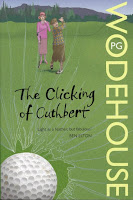
The clicking of Cuthbert (by PG Wodehouse)
![]() |
| (Amazon UK link) |
13 Aug 2022
The witch's vacuum cleaner (and other stories) (by Terry Pratchett)
![]() |
| (Amazon UK link) |
But it’s only recently that I realised that Terry Pratchett also wrote a lot of short stories for children, many of which have been collected in books. I understand that they represent some of his earliest writing and that many of them were published in magazines before he became well-known.
So when my eight-year-old grandson chose ‘The Witch’s Vacuum Cleaner (and other stories)’ from the library, I was quick to volunteer to read them aloud to him. And the first story, which involved a magician suddenly discovering that he could do magic rather than tricking his audience, was all we could have hoped for. My grandson was laughing and I was chuckling as the story progressed. The ending was perhaps a tad strange for a children’s book but it didn’t matter. We liked it very much.
However we weren’t quite so impressed by the next stories, which I read one at a time over the next few days. Several of them involve an imaginary town in the ‘Wild West’ of Wales, where sheepboys take part in rodeos, and there’s a spate of sheep rustling. While I liked some of the ironic references, some of the stories themselves lack any real plot or resolution. That doesn’t matter with just one or two, but we found they rather dragged in places.
That was true, too, of other stories: of a man who goes back in time due to a faulty television, and another who is taken up in a balloon and travels widely. The characters are likeable and some of the situations are mildly amusing. And, as with all Pratchett, they were quite satisfying to read aloud. His use of language is always excellent, and we could imagine some of the bizarre scenes quite well. But there isn’t much plot; instead they recount incidents, and then stop. Our least favourite involved an ant and a bee who decide to rebel and leave their colonies. Nice idea, but it didn’t really go anywhere.
However we did very much enjoy the final story, which involves some very small gnomes living, unseen, in a large store. In many respects this is clearly the precursor of the wonderful ‘Truckers’ trilogy. I’m glad Pratchett did start out with short stories, which are certainly different from most, and which gave him the opportunity to expand on some of his unusually creative ideas and imaginings without having to plan an entire novel.
Perhaps they shouldn’t have been collected and published; they really aren’t as good as the more polished, longer books, and I suspect he wouldn’t have wanted his early works read by the world. On the other hand, they do give a good introduction to the author for young children who aren’t yet ready for the Discworld books. And with the short story format they make good bedtime reading aloud, or could be read by children of around eight or nine and upwards who prefer reading to themselves.
Recommended in a low key way to children of about seven and up who appreciate bizarre short stories and don’t mind too much about plots - or for diehard fans of the late Sir Terry who will appreciate having more of his writing on their shelves.
Review copyright 2022 Sue's Book Reviews24 Jun 2022
A Place like Home (by Rosamunde Pilcher)
![]() |
| (Amazon UK link) |
So I was startled to see ‘A place like home’, a new collection of her short stories, available on Amazon towards the end of last year. I put it on my wishlist, having established that this was not simply a re-naming of one of her previously published collections, and was delighted to receive it for my birthday a couple of months ago.
I’ve just finished reading it - and appreciated the introduction explaining that these short stories were discovered in the British library, and have not previously been published in any kind of collection, though one or two were printed in magazines. There are fifteen short stories in this book, all of them typical Pilcher stories with three-dimensional characters, mostly positive family relationships, and satisfying conclusions - even if there are one or two somewhat unlikely coincidences here and there.
I have to admit that when I had read the first three or four, I began to see why these stories were not selected for the other collections. ‘The Blue Bedroom’ and ‘Flowers in the Rain’ are wonderful books, with short stories that are emotive, moving, beautifully written and full of the most delightful people. Not that these are disappointing; the characters are nicely drawn and likeable, and the stories pleasant to read. But they’re not as stunning or heart-wrenching as the ones in the earlier collections.
However, I still enjoyed these stories very much. The author had the most incredible gift of characterisation, which came to the fore in her novels, but which comes out too in short stories, even those of just a few pages. I felt empathy for all the viewpoint women in these stories, even though they’re quite different in their attitudes and lifestyles.
The first story, for instance, ‘Someone to Trust’, is about a young woman called Rachael. She has just broken up with a young man whom she’s been close to for a while, and needs the comfort and companionship of her cousin in the countryside. Rachael is able to give notice on her job and find someone to live in her flat without any difficulty and travels to stay with Sally. She meets a young man, and it’s fairly obvious that they’re going to become an item, but it’s not at all clear how it’s going to happen. It takes a huge coincidence - perhaps the most unlikely one in the book - before she is able to move on from her previous relationship.
But it’s so nicely done, with such likeable people, such ordinary - and yet beautifully written - descriptions that I just accepted the coincidence and enjoyed the story. The second story is less typical; there’s an anniversary dinner, a man who isn’t sure that he wants any commitment, an unexpected reunion… and then a slightly odd ending culminating in a lie; I wasn’t quite sure where it was leading, although I think the future was hopeful for all concerned.
Other stories are similar, with slightly different plots. Some were set in the United States with American vocabulary here and there, presumably written for - and perhaps published by - American magazines. The ones I liked best were towards the end; the final story is one of the shortest, but nicely rounded and entirely satisfactory. This is possibly because a small child is involved, and Rosamunde Pilcher was excellent at relationships with children; they don’t usually have huge parts to play, but they are warm, and some of the situations are extremely moving.
I only read one or two of the stories at a time, as it became hard to keep track of who was whom. I don’t often read short story collections for this reason; I prefer the depth and perspective of novels, on the whole. But I did enjoy these stories, and am very pleased to have this new collection. I would definitely recommend it to anyone who loves Pilcher’s writing, or fans of magazine-style short stories in general.
Review copyright 2022 Sue's Book Reviews27 Aug 2021
Not a drop to drink (by Patsy Collins)
![]() |
| (Amazon UK link) |
The first story is quite hard-hitting, featuring a young man called Mike. We see him trembling outside a pub, wondering if he will be able to go in. We don’t know why, but the story moves straight into a flashback of his former heavy drinking, moving on to the stresses it caused to his wife, as he remained firmly in denial. The writing is excellent, and this difficult issue is covered in a way that works well. The ending is entirely satisfactory too, as we learn, at last, why exactly he’s feeling so nervous.
The second story, ‘Don’t Touch the Water’ was much darker, in a slightly spooky way, and while, again, it was very well written, I found it disturbing rather than enjoyable. I liked the third story much better - it was a tad complicated, and as I was tired I had to go back and re-read some sections to make sense of it. But I thought it a very encouraging read.
Two further stories are about drinking, written in different ways; the author is clearly knowledgeable about the problems of alcohol out of control, and writes sensitively on this topic. The second of them is very short, but poignant. There’s another complex but gentle love story as well, which I also enjoyed. The first six stories are really character-based rather than having significant amounts of plot, but that’s what all the best short stories are, in my view, and this makes an interesting collection from that point of view.
However the last chapter, ‘Love Potion’, has a distinct plot rather than having any real character development, and I found it very dark. I had guessed some of the outcome, but not exactly how it was going to end… and was then most disappointed to find that it was in fact the last story in the book, as the Kindle read amount was only showing about 55%. The rest of the book is adverts for Patsy Collins’ other books - novels and short stories. Fair enough, as it’s a free ebook, but I’d have preferred this short collection to end on a more positive note.
Still, it filled the bill perfectly as an ebook I could finish in less than an hour. Certainly recommended as an introduction to Patsy Collins’ writing.
Review copyright 2021 Sue's Book Reviews17 Aug 2021
The Man With Two Left Feet (by PG Wodehouse)
![]() |
| (Amazon UK link) |
I started reading this on a late night flight when I was tired, but needed something to relax with. Wodehouse’s books are ideal for that, and having a series of short stories means there’s no continuity - so it’s easy to read just one or two at a time, and then put the Kindle down for hours, even days at a time. We had a busy schedule seeing relatives after a long gap, so it took me nearly a week to finish this book. I enjoyed it very much.
The feel of the book is that of classic Wodehouse; apparently this was quite an early collection, but the author’s skill at light humour and satire comes through clearly. Many of the stories include dancing as a significant theme, although it’s not until the final one that the story of the book’s title is told.
The first story in the book is about a young man who works as a detective, and has fallen in love with a dancer from a travelling troupe. She won’t marry someone who is not in the same profession; not because she is prejudiced, or because she doesn’t love him, but because she believes that the travelling life she leads is entirely unsuited to marriage with someone who has a different kind of job. The story outlines his attempts to be accepted on stage, despite a distinct lack of talent...
I was particularly pleased that the second short story in this book involved Bertie Wooster, best-known of Wodehouse’s hapless heroes. In this story, ‘Extricating Young Gussie’, Bertie is sent to America by his hatchet-faced and coercive Aunt Agatha to rescue his cousin Gussie from the clutches of a chorus girl. Naturally he doesn’t entirely succeed.
Another story, rather cleverly written, was narrated by a dog - it didn’t take long before that was obvious, and the author gets into the mind and behaviour of a dog in ingenious ways, with an unexpected and entirely satisfying conclusion.
The final story, ‘The Man with Two Left Feet’, is about a young man of sober and structured habits who takes secret dancing classes in the hope of surprising and pleasing his young wife, who used to work as a dancer. His ability is minimal, although he does eventually improve - and, once again, the conclusion is unexpected but works well.
All in all, I thought these stories very well-written. They were enjoyable to read, if you like Wodehouse’s unique style, and made an ideal book for dipping into on a flight or early mornings since each short story is entirely complete in itself.
Definitely recommended.
Review copyright 2021 Sue's Book Reviews20 Dec 2020
A Fresh Start (Short Stories)
![]() |
| (Amazon UK link) |
The stories are by different authors, half of whom I’d heard of. I particularly like the novels by Louise Candlish, JoJo Moyes and Sophie Kinsella, so was looking forward to reading their contributions. I don’t think I’d read anything by Ian Rankin or Adele Parks, but I knew the names. I didn’t recognise any of the others, although they are all listed as 'bestselling authors'.
They are quite a mixed bunch of stories, as would be expected of ten different writers, but the overall theme of each relates, as the book title suggests, to some kind of fresh start. One, for instance, involves a married couple making a new commitment to each other. One involves a father and daughter becoming closer, one involves an unexpected inheritance. Two of them involve women determined to get their lives back after a stressful marriage, or discovery of infidelity; the methods used, however, are entirely different.
There’s no particular genre in which these stories fall, so there’s something for everyone. One of them is about a new police officer, for instance, the ’fresh start’ relating to her new career. They are mostly somewhat light-hearted, but there’s poignancy too. And they’re all very well-written, with believable characters even if some of the situations or plots are a tad unlikely.
There isn’t much (if any) bad language in these short stories, nor anything explicit, although there are some implications and innuendoes in some of them. They would be appropriate for anyone of about fifteen and upwards to read, as well as for adults looking for a short book to pass an hour or so. There are only about 110 pages in all - so it really was extremely quick.
The book says on the back that it was sold for a pound and I see that Amazon is still selling it for that small amount, so it’s the kind of thing that could easily be added to a book order (perhaps to bring the total cost up to the level needed for free postage). Indeed, I’m delighted to find this series of ‘quick reads’ in case I need to do that at some point in the future. No doubt books like this can also be found at charity shops, too.
Ideal for holiday reading, or in a busy period to allow brief escapism. More likely to appeal to women than men, but could be read by anyone.
Review copyright 2020 Sue's Book Reviews30 Nov 2020
The Long, Tall Short Stories of Sue Jones
![]() |
| (Amazon UK link) |
Sue Jones is a talented writer whose skill and imagination takes her into many different genres. Her stories are of quite differing lengths, too. A few are under a thousand words but still manage to tell a good story. Others are two or three thousand words or more, with a bit more development and plot. Some feel well-rounded, others stop a tad more abruptly. One or two, she tells us, are based on real incidents (with all names and details changed, of course) but the majority are from her active imagination.
While I liked all her short stories - which include, as the blurb says, everything from vampires to vicars - a few stand out in my memory as extra special. The delightful ‘Megamoggy’, for instance, is an enormous cat, who manages to fall off a balcony onto a baker’s van. Or there's the memorable church mouse ‘Horace’, who gorges himself at Harvest Festival.
The stories are arranged alphabetically rather than by length or genre. The first short story, ‘A Change of Heart’ is a more typical magazine style short story, about someone who is soon to get married. Then an unexpected letter changes her mind, due to learning something shocking. But even with this fairly standard plot, there’s a somewhat unexpected (and entirely satisfactory) ending.
Some of the stories have a lot of humour in them - when Sue read ‘A Royal Presence’ at our writing group some months ago, for instance, we were all laughing in places. ‘The Last of the Communion Wine’, too, is very amusing - all the more so if read aloud.
But they’re not all light-hearted. Some stories are poignant, some are sad. Some touch on important contemporary issues. And some are just bizarre… it’s an ideal book to dip into, perhaps on holiday, or to read when you just have a few minutes available.
The final story, ‘When the Bough Broke’, is possibly the most poignant of all. It’s quite short, and I found it extremely moving.
All in all, I would recommend this collection highly to anyone, adult or older teenager, who likes quirky, mixed short stories.
Review copyright 2020 Sue's Book Reviews22 Sept 2020
Pistols for two (by Georgette Heyer)
![]() |
| (Amazon UK link) |
The opening story, which gives its title to the book, is about two frustrated and angry young men who are going to fight a duel. Although close friends for most of their lives, they have both fallen for the same young woman. Their jealousy and a misunderstanding causes events to escalate…
The second story is about a young couple who want to get married. They seem to be ideally suited, until the girl’s aunt discovers a connection that she really doesn’t like. So the story is actually about another romance, a long-standing one that - of course - is resolved.
Most of the stories are about romance, in a low-key Heyer kind of way, with entirely satisfactory resolutions. Having said that, they’re not all light-weight. One of them has an extremely bloodthirsty plot, which is quite disturbing in places, but, again, has a positive ending. One of them involves a young woman with an unkind, possibly abusive brother who gives her away after a gambling game. Two - including the first one - involve duels.
But they’re all written with Heyer’s masterly characterisation. Even in these stories, which are no more than 20 paperback pages each, she brings her people to life, making them believable and sympathetic, if not as memorable as some of the characters in her novels.
The conversations are believable, the details authentic, and there’s often some ironic or satirical humour in the interchanges between people. They’re historical fiction, of course, so there’s some archaic language, and anyone new to this style of writing might have to use a dictionary at first, although most words and phrases are fairly obvious when taken in context.
I always seem to forget just how much I like this short story collection, one I would recommend to anyone who likes Heyer’s style. It could also make a good introduction to her work, for someone not yet ready to read a full-length novel.
Definitely recommended.
(Note: these stories have recently been republished, along with three more recently-discovered short stories by Georgette Heyer, under the new title of 'Snowdrift'.)
Review copyright 2020 Sue's Book Reviews3 Jul 2020
Murder in the Mews (by Agatha Christie)
![]() |
| (Amazon UK link) |
The first one, with the same title as the collection, starts with Poirot walking home with his friend Chief Inspector Japp on bonfire night. They discuss how easy it would be for a shot to be made, unnoticed, amongst the bangs and cracks of fireworks.
Unsurprisingly, Poirot is summoned the following morning to help investigate a case in the Mews where they had been walking. A young woman is dead, and it looks at first glance as if she took her own life. But the evidence suggests that this might not be the case. So interviews are set up, and various possible perpetrators or witnesses are questioned.
As happens in so many of Agatha Christie’s stories, I swallowed the many red herrings in this cleverly-written story. Only as Poirot starts to reveal what really happened did things start to click, and I could see that it was an ingenious plot, and I should indeed have spotted the outcome.
The second story, ‘The Incredible Theft’ is more of a political story. Several people are having dinner together, and afterwards two men discuss some important documents. They take a brief walk in the evening air while the secretary finds all the paperwork, only to discover, on returning, that one vital document has vanished. Various theories are proposed, and Poirot is called in; nobody wants to make this loss public knowledge.
Again, it’s a cleverly-thought-out story, but I found it a tad too convoluted. I don’t think I would ever have guessed how the paper disappeared; when it was explained by Poirot, I could see that it made sense, but I didn’t feel there were sufficient clues - or maybe they were too bound up in politics and business discussions.
The third story, ‘Dead Man’s Mirror’, begins with a rather autocratic letter to Poirot, telling him to be ready to visit a somewhat eccentric peer, at a moment’s notice. Naturally Poirot doesn’t want to do this, but he does make some inquiries to find out more about the person concerned. And then when the summons comes, he decides to go anyway…
Poirot arrives to discover that the person who wrote to him is dead, apparently by his own hand. Once again there are many questions asked, and it’s a good story, although - yet again - I doubt if I could ever have guessed the outcome.
The final story, ‘Triangle at Rhodes’, is the shortest of the four - only twenty pages, whereas each of the others was around fifty - and it was my least favourite. Poirot is on holiday in Rhodes, staying at a hotel where there are just a handful of guests who get to know each other quite well. One of the wives is supposedly a siren, on her fourth husband; the other wife seems overlooked when her husband is attracted to the siren.
But, as I should have expected with an Agatha Christie story, nothing is as it seems. It was too short a story for much characterisation, and I found the outcome and explanation of what happened a bit dubious… it didn’t feel up to the author’s usual brilliance, although it’s rather a different scenario from her usual style.
Overall I liked this book, and would recommend it to anyone who likes light crime fiction from 1930s. Despite being around 90 years since this book was first published, it's still regularly re-printed as well as being widely available second-hand.
Review copyright 2020 Sue's Book Reviews
15 Apr 2020
The Mysterious Mr Quin (by Agatha Christie)
![]() |
| (Amazon UK link) |
I realised quickly that instead of being a full novel, this book is a collection of twelve short stories. The author mentions in the foreword that they were not written as a series; instead she wrote them as one-off stories, over quite a long period. What they have in common is that they all feature a comfortably well-off man in his sixties called Mr Satterthwaite, who sees himself as an observer of life, and a mysterious person known as Mr Quin.
The stories mostly feature either unsolved mysteries, or tragedies about to unfold, or people wrongly convicted of crime. In them all, Mr Satterthwaite is either staying with a connected family, or knows them - he’s quite well connected - or hears about them and becomes involved.
Mr Satterthwaite knows just about everyone in the upper classes - the book was first published in 1930, when the class system was still flourishing in the UK - but he also has a tremendous interest in the arts. He likes to support little-known painters, dancers and actors and help them out of obscurity. He has quite an eye for talent, and he is also very discerning. He believes he has a strong feminine side, which makes him far more observant and intuitive than he would naturally be. Decidedly sexist, but an unusual feature for a fictional hero nearly 100 years ago.
Whereas Mr Satterthwaite lives firmly in the real world, enjoying comfortable locations, and good quality food, Mr Quin is more mystical. He often appears, in a trick of the light, to have a chequerboard appearance, and his name first name is ‘Harley’ - many references associate him with the traditional Italian Harlequin, a kind of sprite-like servant who tended to thwart his master’s wishes, and follow his own. However Mr Quin, by contrast, has no master - as far as we know - and appears in order to help his friend to prevent tragedies and bring justice.
But who - or what - is Mr Quin, exactly? It’s not made clear. He appears and vanishes in strange ways, there when needed, gone when no longer necessary. I wondered at times if he was supposed to be an angel, although Christie was not known for overtly Christian belief. Perhaps it doesn’t matter. His role in most of the stories is to help Mr Satterthwaite to slow down and consider his impressions. He’s a catalyst for change. But then in the final story he appears a little differently, more a quirky, inexplicable being more like the sprite-like classic Harlequin.
I enjoyed the stories, which give insights into the world of the wealthy in the 1920s despite the paranormal aspect that is strongest in the final story. Of course there is plenty of off-stage violence, with killings and imprisonments, but as with most of the author’s books there’s nothing gory. And most of the stories end in positive, encouraging ways. I found the last one quite disconcerting, and liked it less than the others, but it was still very readable.
Agatha Christie always focussed on plots rather than characterisation, and that’s true for most of the people in these stories who are two-dimensional. However I did like Mr Satterthwaite, and found that by the end he had developed quite a distinct personality
Recommended if you like Agatha Christie or would like to try some slightly different short stories written nearly a century ago. While her books are widely available at charity shops and other second-hand booksellers, they are all also regularly in print.
Review copyright 2020 Sue's Book Reviews
23 Dec 2019
And Jesus Will be Born (by Adrian Plass)
![]() |
| (Amazon UK link) |
It turns out that it’s not a new book as such; most of the items in the collection have appeared in one of Adrian Plass’s other books or publications. But I’m convinced there are some I’ve never been before, even those which (according to the appendix) are in books I own and have read at least a couple of times.
Some of them probably are new to me, as it also states that unless otherwise stated, they were first published in the author’s advent calendar, in Germany. I wonder if they were translated from German for the sake of this book.
However, even with the handful which I recognised, it was a very pleasant selection of short pieces, mostly with the author’s standard slightly off-the-wall low-key humour. I particularly liked the piece about his family in Cornwall on holiday, which has an ending I didn’t see coming, and then stops. I read it aloud at a Christmas gathering a couple of weeks ago, and it was much appreciated. Apparently it’s from the author’s biographical book, but I had no memory of it at all. Evidently I should re-read ‘The Growing-Up Pains of Adrian Plass’ again as I haven’t read it for over ten years.
Poetry tends to wash over me. I did try to read the few poems in this book slowly and thoughtfully, and I could see that they were quite profound in places. But they didn’t move me as some of the prose pieces did. It’s a lovely mixture of light and a little deeper, and of course the theme of every piece of writing in this book is Christmas, or something to do with the Christmas story.
All in all, I liked it very much and would recommend it to anyone who would like a gentle collection of Christmas stories - true and fictional, poetry and prose - to read at a busy time of year. It’s not really a book to read it in one sitting. But it worked well reading about nine or ten pages a day. Sometimes I kept reading, or picked it up again later, but mostly I was content to read just two or three of the short pieces each morning.
It’s a book for Christians, or those on the fringe of Christianity, perhaps, or at least those who were brought up knowing the Biblical accounts of the Nativity. It takes for granted an understanding of God, and a general knowledge of the cast of characters involved in the birth of Jesus.
Review copyright 2019 Sue's Book Reviews
7 Aug 2019
With This Hand (by Sally Quilford)
![]() |
| (Amazon UK link) |
There are notes at the front of most of the stories. Some merely state which magazine originally published them, if relevant, possibly under a different name. Others were not published before this collection. A few have longer notes, explaining where the ideas came from, or who inspired them. There are some interesting personal insights amongst them.
The opening story is a classic romance, ‘The Hungry Years’. It’s about a middle-aged couple who are going through a lot of stress. He has lost his job, and she is always angry. There are some flashbacks to their early, hard up years, and an entirely satisfactory resolution. It’s not always easy for short stories to hold the attention; in just a few thousand words characters and situations have to be developed and something has to change. This first story fulfils all the requirements, and I found it quite moving.
The second story is about a couple who have just had their divorce finalised when something drastic happens. It’s kind of a ghost story, rather surreal, and also, ultimately, quite satisfying albeit a tad disturbing. The third story is about a young woman who has no sense of direction and regularly gets things wrong - but is very kind-hearted and courageous.
There’s a Christmas story next, one involving two children and a couple of single parents, and then a decidedly surreal story where the world pauses as a bride decides to speak honestly to several people she is frustrated with. That’s followed by another rather different story about a ceremony with a difference. There are quite a few stories about uncertain people, and more than one story with a hint - or more - of something surreal.
However nothing really prepared me for the final, much longer story, which - so the initial note explains - was based on a classic legend. It’s not one I knew about, and I found it all rather disturbing. There’s more violence than I’m comfortable with; it’s not the kind of story that would make it into mainstream women’s fiction. As with the others, the writing and characterisation is good, and I kept reading, out of curiosity as to where the story was going. But I didn’t like it as much as any of the others - and was glad I read it while travelling in the daytime rather than before going to sleep.
Other than the last story, I liked all the others very much. I didn’t pay anything for this collection which I downloaded on special offer seven years ago. I see it’s still available inexpensively for the Kindle. I would recommend it to anyone who likes mixed short stories including some with a supernatural element. It made ideal reading while travelling.
Review copyright 2019 Sue's Book Reviews
2 Jul 2019
The Orthodox Heretic (by Peter Rollins)
![]() |
| (Amazon UK link) |
I was given the book for my birthday a couple of months ago, and started reading it about a week ago. The introduction explains that these are stories - modern parables, to shake up people’s ideas and make them think. The author suggested reading them slowly, only one or two at a time. Since each is complete in itself, albeit with a brief commentary afterwards, it seemed like a good idea not to read the book in just a couple of sittings.
However, I read more than one story per day. The blurb on the back says that they are ‘provocative and often disturbing tales’, and I would agree. They’re quite a mixed bunch. Some appear to tell one of the Biblical parables, but with a different twist at the end. Some are entirely non-Biblical. Some pick up on phrases or beliefs that are popular in some Christian circles, and explore them in more depth. One or two verged on the outright heretical. I could see, in some, why more conservative readers might consider them wrong, even misleading.
But even as I found myself recoiling, a couple of times, I could see that this was due to some of my preconceived ideas. These stories don’t have the authority of Scripture, of course - but they are very thought-provoking. As, indeed, were the parables Jesus told, some of which would have made the religious leaders of his time very angry. But they’re stories - and stories reach into our emotions and make us ponder in ways entirely differently from direct teaching or exposition.
I can’t say that all the stories struck me equally. Sometimes I read one, and shrugged a little, and moved on. Different people will be affected in different ways, I’m sure, and not every story will strike a chord in every listener. The same was most likely true in Jesus’ time.
I don’t like dramas or stories being explained, in general. However, although I was a bit dubious about reading the commentaries after each story, the author manages to avoid insulting the reader’s intelligence. They are more along the lines of how the idea for the story came into being, and other meta-comments rather than hand-holding detailed explanations. And I found them interesting, on the whole.
The book is divided into three broad sections: Beyond Belief, God is Now Here (or Nowhere, depending on how one reads it) and Transformations. I couldn’t really tell the difference between those in the first and second sections, but the third one does indeed tell stories of different ways in which people’s hearts and minds were transformed in some way.
I know some folk will find it too disturbing, and some will write it off as completely off the wall. But I would recommend it to anyone wanting to be pushed a little out of their comfort zone. At least one or two of these stories will remain with me for some time, I’m sure.
Review copyright 2019 Sue's Book Reviews
23 Mar 2019
The Blue Bedroom and other stories (by Rosamunde Pilcher)
![]() |
| (Amazon UK link) |
Short stories are ideal to read at breakfast time, or before going to bed, as they are complete in themselves. However I’m not usually particularly keen on collections, preferring to read just one or two at a time in magazines. But Rosamunde Pilcher’s are the exception.
My all-time favourite short story, ‘Home for the Day’ is the second one in this book; it’s one I could relate to when I first read it, I loved it when I read it again, and I thoroughly enjoyed re-reading it a few days ago. It’s a simple story, really, about a businessman who spends an unexpected day at home, and discovers what his wife does during the daytime. But it’s beautifully written, with just the right amount of description for my tastes.
I also like the story which gives its title to the book. This one is about a young teenager who feels rather awkward and underdeveloped. She’s grieving her mother, and hasn’t yet developed a good relationship with her fairly new stepmother, who is expecting a baby. She grows up somewhat in this story, and the first tentative steps are taken in bonding.
Two other stories I particularly like are ‘The Tree’, and the final one, ‘An Evening to Remember’. I had not recalled that either of them are in this book, but as soon as I had started reading, I recalled them. The first is about a young couple who live in a somewhat unsatisfactory situation, but cannot afford to do anything about it. They give up a weekend in the country to entertain an elderly and somewhat cranky godfather.
The last story is one I could identify with almost more than anything, The viewpoint character, Alison, is not very organised, but has bought a special notebook because she is preparing to entertain her husband’s boss and his wife. He is hoping for promotion, and it’s important that everything goes well. What actually happens is the kind of disaster that I would not handle nearly as well as the protagonist does… and, as with all the stories in the book, it’s extremely well written.
I didn’t like all the stories as much as these four, and there were one or two which did not seem to me to have very much point. But they all paint pictures of interesting people, and while a few conversations are a tad stilted, I found myself caught up on the stories each time. Rosamunde Pilcher had a tremendous gift for characterisation, and even in these short stories, covering about twenty pages each, she created people who felt three-dimensional and sympathetic.
Inevitably they feel a bit old-fashioned; I’m surprised to find that the book was published as recently as 1985, although I suspect some of the stories were written earlier than that. The backgrounds are mostly quite upper class middle class, even if impoverished, and there’s a tendency to send children away to school, or have nannies to look after younger ones. The women are mostly housewives too, expecting to give up their jobs, or at least change them to suit their husbands, as soon as they’re married.
Feminists might object, as might those who see families as more integrated, not wanting the children to be separated from the adults. Yet a short story collection like this is a snapshot of a certain era, in a particular sector of society. And there’s a lot of emotion in this; relationships are what matter, not day to day lives or roles.
Definitely recommended if you like gentle (albeit sexist, at times) short stories of thirty or more years ago. Suitable for teenagers as well as adults.
Review by Sue F copyright 2019 Sue's Book Reviews
14 Feb 2019
A blink of the screen (by Terry Pratchett)
![]() |
| (Amazon UK link) |
The book is quite an eclectic mixture, with some even more random colour illustrations in a couple of places. It starts with a short story written when Terry Pratchett was only thirteen. His talent shines through even at that age. It’s a clever plot, very well written, with an excellent command of language. Other pieces progress through his young adult life, with brief explanations at the beginning about why they were written and where (if relevant) they were published. Some have links to his books.
Some of the stories are frankly bizarre, even by Pratchett standards. There’s a peculiar story about Christmas cards come to life, for instance, and a somewhat disturbing one about a writer who kills off his main character, only to find this character on his doorstep the following morning. There’s a lengthy science fiction one about multiple worlds, and one about virtual reality. There were one or two I read twice and still didn’t really understand.
In the last third of the book are some Discworld stories. Only in fact three real stories, one of which I had seen elsewhere. I particularly liked the one about Granny Weatherwax deciding to be ‘nice’.. It was amusing and thought-provoking at the same time. At the back of the book there is an appendix with a ‘deleted scene’ from that story; I could see why it was deleted as it didn’t really add to the main story, but it was well worth reading.
Other Discworld writings include medical terminology and conditions - I particularly liked the idea of Attention Surplus Syndrome - and the Ankh-Morpork national anthem, which contains parts where people aren’t even supposed to know the words. These were mildly amusing, but not what I would call stories. There’s a committee meeting of wizards giving a scene rather than a real story, and there’s a speech made by Lord Vetinari. I appreciated these because of my long-standing experience of the Discworld, but to anyone unfamiliar with the series, these short pieces would probably seem puzzling, or irrelevant.
On the whole, then, I very much liked this book and am glad I finally decided to read it. But I wouldn’t recommend it as an introduction to Pratchett; it’s more for fans who like his style and who know the Discworld and its inhabitants reasonably well.
Review by Sue F copyright 2019 Sue's Book Reviews
3 Dec 2018
Flowers in the Rain (and other stories) (by Rosamunde Pilcher
![]() |
| (Amazon UK link) |
I found that my memory was somewhat patchy concerning this book. The first story, ‘The Doll’s House’, is beautifully written. It’s about a young boy, who lost his father a year or two back, and is attempting to make a doll’s house for his sister from a kit. I had remembered how it ended, but still found it moving and encouraging.
However, I had entirely forgotten the second story, about a young man who travels to Scotland for his great-aunt’s 75th birthday party. The characters, as with all Pilcher’s people, are realistic and three-dimensional, and it’s a pleasant story but not particularly memorable.
I hadn’t remembered the story which gave the title to the book, either. And there were a few more which, though enjoyable to read, didn’t have all that much of a story. That’s not necessarily a problem - indeed it means I will most likely have forgotten them again by the next time I re-read this collection, probably in another eight or nine years.
Then I reached ‘The Watershed’. It’s about a woman in her fifties who lives with her husband in a large house seven miles from the nearest shop. She’s finding it a bit overwhelming, and is generally feeling low. So she wonders about buying a smaller house in the village where she shops. Her husband won’t be keen, though… I wasn’t at all sure where the story was going, and it wasn’t until the last pages when I remembered the ending vaguely; I had tears in my eyes three or four pages before the end, and had to get a couple of tissues when I had finished. It’s the most moving story I have read for a long time.
There are other good stories in this book, which made excellent bedtime reading as they’re all gentle, all uplifting in some sense, all positive and hopeful. And of course they are all complete in themselves, so there are no cliffhangers, although in some cases the ending was left somewhat open; perhaps that’s better than tying all the threads together, as it left me thinking about what might happen to the people concerned.
Rosamunde Pilcher’s greatest strength, in my view, was always her characterisation. In just a few sentences she created people I cared about, and in many cases could empathise with. If she had a fault, it was in her conversations which sometimes come across as a little stilted. But it’s a minor issue, one I can gloss over since the stories are so well-written.
Definitely recommended to anyone who enjoys gentle short stories of the kind found in some women’s magazines.
Review by Sue F copyright 2018 Sue's Book Reviews