Showing posts with label Rob Bell. Show all posts

10 May 2017

How to be Here (by Rob Bell)

How to be here by Rob Bell
(Amazon UK link)
The author Rob Bell is something of a controversial writer in the Christian world, particularly amongst US evangelical Christians. This is because he doesn’t always follow accepted doctrine, and he challenges the status quo. Since I find that appealing, not being much of a conformist myself, I have found his books interesting and, in some cases, motivating and encouraging.

‘How to be Here’ is his latest book, published last year. I put the paperback edition on my wishlist and was given it for a recent birthday. The subtitle is, ‘a guide to creating a life worth living’, a theme which seems to be following me around at present.

As with most of Bell’s books, the layout seems a bit strange at first. The paragraphs are short, some of them containing just a few words, and the writing is almost simplistic in style. That can hide some quite profound thoughts, expressed in a personal way; the concepts are much deeper than is immediately obvious.

While some of the author’s books are overtly Christian, this one is less so. He refers to Scriptural stories and theology in a low-key way, but without any expectation that the readers are believers. References and explanations are left to the notes at the back, which made interesting reading after I’d finished the main text.

The book starts with a word picture of a computer cursor, the ‘blinking line’, as he puts it, at the top of a new document, or placed at the end of text. Bell tells us about the first book he thought about writing, and how he tried at first to dictate it, but eventually realised he had to type it himself. And this takes us neatly on to the cursors that, metaphorically, sit waiting for all of us as we think about things we might do, or places we might go, or the people we might be.

The book looks at creativity in a wide sweep of activities, from bringing up children through to sweeping floors. It looks at our expectations, and our anxieties at producing something new for fear of what others might think. It talks of something to inspire us to get out of bed each morning. It makes the point that every one of us is a unique individual, with a life and series of circumstances that has never before been experienced.

The theme is similar to John Ortberg’s classic ‘If you want to walk on water you’ve got to get out of the boat’, but the text is much simpler, and accessible to anyone. It’s divided into seven chapters, and each of those has short sections, just two or three pages long, making one main point. There are plenty of anecdotes from Rob Bell’s own life, including times when he got things wrong, or tried something which didn’t work; but they were still valuable learning experiences. These make the point well: it’s better to do something and fail than do nothing for fear of failure.

As a writer myself, much of this book struck home with me, and gave me plenty to ponder. But it’s relevant to anyone who tends to avoid confrontations, or trying anything new, or getting on with something because of all the problems that might arise. One step at a time, Bell tells us. Take that step, get on with what we can do, and if others don’t like it, that’s not our problem.

Nothing actually new, nothing I hadn’t heard before; but clearly written and just what I needed to read right now.

Recommended to anyone. The worldview is Christian, as are many of the references (Bell is, after all, a pastor) but the principles could apply to people of any faith, or none.


Review by Sue F copyright 2017 Sue's Book Reviews

6 Aug 2015

What we talk about when we talk about God (by Rob Bell)

What we talk about when we talk about God by Rob Bell
(Amazon UK link)
The more books I’ve read by the American writer Rob Bell, the more impressed I have been. He’s a Christian minister who is firmly in the ‘progressive’ camp, dubbed ‘liberal’ by some, and undoubtedly controversial. His book ‘Love Wins’ caused a huge flurry of disagreement in the Christian world. But I thought it helpful and thought-provoking, and was very pleased to be given his most recent book a few months ago.

‘What we talk about when we talk about God’ is intended - so the back states - for those who are confused about God. But then, as God is infinite and cannot ever be fully understood, that applies to most of us. Rob Bell starts with explanations, apologies and anecdotes, and the book continues in the same kind of style.

His aim is to help people understand what he - and many others - mean when referring to God. As such, he first has to get rid of some misconceptions. God is not an old man in the sky. God is not a harsh judge, waiting for us to do wrong so we can be condemned. Nor is God a figment of our imagination, although how we perceive him is undoubtedly a reflection of our personalities, our upbringing, and our experience.

The author chooses just a few words - simple prepositions for the most part - to guide the reader through his ideas, to encourage people to ask questions, to think outside the box of their prejudices and what they’ve been taught (which may or may not be correct). As such, he gives an overview of what we mean by language; he gives word pictures of the universe and its magnitude; he explains how God takes us where we are, and moves us - and the whole of humanity - forward, a small step at a time.

Bell points out that nature - as the Bible says - declares the glory of God. He tells us why science doesn’t ‘disprove’ God, and why so many scientists are increasingly likely to turn to faith. He wins my admiration for being the first person ever to explain to me, in lay language, what the heart of quantum physics is, and how it’s yet more evidence of God’s existence.

All this and much more in an easily digestible book, written in the author’s typical style with short paragraphs interspersed with longer ones, lists of words spread out over the page, no justification for his right margins, and quite a bit of white space. I found it annoying in his earlier books, but he’s modified it so that now it has the feel of a friend discussing issues, explaining his viewpoint, encouraging his readers to think for themselves, and see God as over all and in all.

The book is about integration, and wholeness, and is refreshingly honest.

I recommend it highly.


Review copyright 2015 Sue's Book Reviews

21 Apr 2015

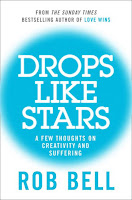
Drops like stars (by Rob Bell)

Drops like stars by Rob Bell
(Amazon UK link)
I’ve mostly enjoyed the books by Rob Bell; often controversial, he tends to paint the Christian life in different ways, and I find his writing often quite thought-provoking, masked in his unusual writing style with short sentences that seem almost too simple at first. So when I saw this book available inexpensively at the AwesomeBooks site, I hoped it would be worth reading.

In ‘Drops like stars’, the topic is how suffering can enhance creativity. Not that he puts it so directly. Instead he looks at scenarios of joy and grief, of life and death. He uses examples from the 20th century and examples from Scripture to demonstrate how God is with us in our suffering; not that he causes it, but that he cares, and loves us, and - if we allow him - can use our suffering to create something of beauty.

While this is true of our lives as a whole, Bell also talks about art in its many forms - music, sculpture, painting and so on - and shows how art is often refined, improved, able to speak more clearly to its audience when the composer has suffered and struggled, both in the production of the work concerned and perhaps in his or her personal life too.

It could be trite or formulaic, but somehow this book manages to be inspiring and encouraging. There are drawings and photos, including an amazing one of soap sculptures, and a lovely word picture at the end which explain where the title of the book originated.

It’s a very quick read; only about 130 pages, and with the author’s usual style of spaced out paragraphs and large margins, it could probably have been contained in half that number of pages. I might have been a bit peeved if I’d paid full price for it. 

Nonetheless, I liked it, and would recommend it if you can find it inexpensively. If you feel that you'd like it in new condition, it's available for the Kindle as well as in paperback.

Review copyright 2015 Sue's Book Reviews<

7 Apr 2014

Velvet Elvis (by Rob Bell)

Velvet Elvis by Rob Bell
(Amazon UK link)
The writer Rob Bell is quite a controversial writer in evangelical Christian circles, mainly due to his recent book 'Love Wins'. He used to be the pastor of an American mega-church (which he founded) and is also the narrator on a series of videos known as 'Nooma'. I'm naturally suspicious of mega-churches in general. I wasn't particularly impressed with Nooma episodes that we saw in a house group. Worst of all, I didn't much like the first book of Bell's that I read.

So I wasn't at all sure what to expect from 'Velvet Elvis', a book I had been thinking of buying for some time. I found it second-hand not long ago, and picked it up to read a couple of weeks ago. I'm glad I gave the author another chance: I found this book very appealing, right from the start.

The concept of God being concerned with all goodness and truth (not just that emanating from Christians) is one that I've been hearing and reading in many places recently. It's expanded upon in this book. I've always been keen on the idea of thinking about or 'testing' everything, going back to Scripture and (most importantly) to my relationship with God. I believe faith is a growing, moving concept that will inevitably embrace new ideas and - at times - throw away some outdated ones.

There's an excellent chapter in this book explaining some of the basics of Jewish thought. The author explains, for instance, the meaning of a 'yoke' - nothing to do with oxen. He outlines, too, the method whereby rabbis took disciples, and enlarges on what was meant by 'binding and loosing' in the first century. Jesus was, after all, thoroughly Jewish, as were his followers and biographers. Yet it's rare to hear a sermon letting us know that even the best-read Orthodox Jewish rabbis believed that the Scriptures needed constant re-evaluation and interpretation.

The rest of the book encourages us to look for God where we are, to understand that the church is a community intended to bless those outside it, not a holy huddle to meet on Sundays. It describes eternal life in terms of where we are now, as a continuum. It also reminds us that Jesus talked about a new earth rather than an abstract heaven.

I don't think I agreed with every word of the book, but that's not a problem. As the author said, we should test everything, including the words he writes. We're all on different paths, with our unique temperaments and gifts, and the Holy Spirit gives us different insights. If something does not apply to me, or if I think his interpretation is wrong, that's fine. There's room for variety. While love and harmony are important, there's nothing in the Bible to say that we should all agree on every fine point of doctrine or Scriptural interpretation.

Helpful, inspiring and thought-provoking. Definitely recommended.

Still in print on both sides of the Atlantic; available for the Kindle as well as in paperback.


Review copyright 2014 Sue's Book Reviews

5 Jan 2014

Love Wins (by Rob Bell)

Love Wins by Rob Bell
(Amazon UK link)
Although I heard of Rob Bell some years ago, as a somewhat unorthodox and thought-provoking American Christian writer and speaker, I had only previously read one of his books: Jesus wants to save Christians. I liked some of what he said, but felt that the style was too repetitive and rather annoying, and in the end found it a frustrating read.

So it's taken me three years to get around to reading anything else that he wrote. I eventually picked up 'Love Wins' because the rest of my family had read it and were talking about it - mostly in positive terms, but not entirely. I knew it had caused huge waves in Christian circles. Some people loved it, others denounced the author as a heretic. It seemed like a good idea to read what it actually says.

The style, once again, has some short sentences, but they're not as spread out as the first book I read, and I didn't find them annoying at all. There are proper paragraphs too, so they stand out more to make a point. Unquestionably informal, they feel almost as if someone is talking, pondering, asking the kind of questions I might ask myself.

For, essentially, this book asks a lot of questions. Some of them are quite awkward questions - ones which some Christians may see as over-challenging, the kind of thing that 'ought not' to be asked. But today's young people need to ask this kind of question and to be able to find responses themselves rather than being given pat answers.

So the reader - and this book is not necessarily intended just for those with Christian faith - is invited to start thinking about God, about the Bible, and about what they do and don't believe. We all have preconceived ideas - those we have been taught, those we have assumed or gathered from the way life has treated us.  Rob Bell does an excellent job of getting back to first principles, of asking who this God is whom Christians worship, and what the Bible means by love, by redemption, and by Heaven and Hell.

Critics have said that Bell picks and chooses what parts of the Bible to quote. Indeed he does - but so does any writer of Christians books. They could hardly quote the entire thing. The problem (for some) is that he chooses verses that - apparently - give credence to his viewpoints. But then, so do most Christians writers, and evangelists, and tracts. The references are mostly given in the book, and a good concordance (or online search) makes it simple enough to check the context, to look at different ways of translating the verses, and also to find those on the same topic which he does not quote.

Overall, I found 'Love Wins' to be very readable and quite thought-provoking. It doesn't give all the answers, and those it gives are left open to the reader to consider, and perhaps to respond to differently. The main focus, which I thought very positive, was of the importance of how we live, and how we grow in relationship with God and each other, and how we continually need to question our assumptions - the 'stories', as he puts it, which we tell ourselves, or perhaps which other people have told us.

While this book is undoubtedly controversial, and has many critics, I thought it a helpful overview of what many Christians believe, and would recommend it to anyone, particularly those who have been hurt or damaged by images of a slave-driving or vengeful God, or indeed by well-meaning Christians who don't really answer genuine questions.

Available in paperback form on both sides of the Atlantic, and also in e-book form for the Kindle.

Longer - but mostly fair - reviews of 'Love Wins' from a more theological stance can be found at Relevant Magazine and Christianity Today.


Review copyright 2014 Sue's Book Reviews

27 Dec 2010

Jesus wants to save Christians (by Rob Bell and Don Golden)

Jesus wants to save Christians by Rob Bell and Don Golden
(Amazon UK link)
I haven't read anything by Rob Bell, but have seen him on a few 'Nooma' DVDs - short anecdotes leading to discussion starters at a basic level for Christians and seekers. I've never before heard of Don Golden. I'd heard of this book but had not got around to looking for it, so was pleased when we were able to borrow it from a friend.

'Jesus wants to save Christians' has a sound starting point: the huge gap between the practices of most of the church in the 21st century and the principles Jesus espoused. Money is spent on building projects rather than feeding the poor, with hierarchies of organisation that make the business world look chaotic, at times.

The trouble is, the writing style just doesn't work. It's not the informality - I don't mind that at all. It's not even that it's written like somebody speaking rather than a book to read to oneself. But the layout (in my opinion) makes the book almost impossible to read. On nearly every page it suddenly breaks into single phrase paragraphs. Not just once or twice, but, often, ten or more one after the other. It's so very annoying that I couldn't manage to read more than two or three pages at a time, at first.

By the time I was about half way through I realised that these single-word or phrase paragraphs didn't actually add to what was said at all. They just repeated themselves, and I can only assume were there to fill up space which would have been better used by employing a somewhat larger, serifed font. So any time I came to a block of tiny paragraphs, I skimmed or missed it out entirely, and (as far as I know) didn't miss anything as a result.

The content is perhaps worth reading, although it doesn't say anything particularly radical to those of us who have never been involved in US mega-churches. There are some anecdotes here and there which are interesting, and some of the writing is thought-provoking. 

But I can't really recommend it because of all those infuriating tiny paragraphs.

Review copyright Sue's Book Reviews, 27th December 2010