Showing posts with label parenting. Show all posts

17 Nov 2024

How I met my son (by Rosalind Powell)

How I met my son (by Rosalind Powell)
(Amazon UK link)
Sometimes I visit a church book sale, and pick up a handful of books that look interesting. I don’t mind paying 50 cents for experiments; if I don’t like a book, I can always donate it back for someone else. One of the books I found, three years ago, was ‘How I met my son’ by Rosalind Powell.  The subtitle is ‘ A journey through adoption’, but I must have forgotten that when I pulled it off my shelf to read, as I had been expecting a novel.

It turns out that this book was written by the author, who is a journalist, wanting to chart her experiences with adoption. She says at the start that she had read glowing accounts, and some dire accounts, but not much that gave a balanced account, positive and negative. She also wanted something that would explain the entire process from start to finish, at least as she experienced it. 

So the book is part autobiographical, and part informational. It’s extremely well-written, so even though we had never really considered adoption ourselves, I found it very interesting. The early chapters chart her life as a young woman, enjoying partying and playing around, through her marriage and the frustration of being unable to conceive. She and her husband then spend a lot of money on IVF, again with disappointing results. 

It’s not a spoiler to say these things. It’s clear from the beginning that they will eventually adopt a boy, and the story explains what they went through to achieve their goal. I knew there were extensive checks made, of course; but I had not realised how very intrusive they can be. Rosalind Powell has a friendly social worker whom they like, but even so she finds it quite draining to have to give details about every aspect of their lives, over the course of many months. She is honest about the emotional highs and lows that she experienced, sometimes in despair, sometimes hopeful, often unsure as to whether they will be able to go through with it. 

In between the biographical account that slowly moves forward, there are chapters delving into aspects of adoption: the legal processes, the history of adoption, the way it works with non-traditional families, and more. I thought I might skim some of these sections but found them so interesting that I read everything, despite being eager to read on to find out more of the author’s story. The factual chapters are peppered with anecdotes, giving examples from other people’s experiences, and that’s what makes it so very readable.

Names, of course, have been changed. Some of the situations have, too. Even the author’s own adopted son’s name has been changed, and she deliberately stops the account when he reaches the age of ten. She recounts some of her conversations with him, as a young child, and also as he matures. She’s open about his background, and tries to answer his questions. Some of the conversations show her stress, as she says things that are not necessarily helpful - this would, I’m sure, be very encouraging for others who might wish they hadn’t responded to their children a certain way. 

Theirs is an adoption that evidently works well, on the whole - the issues that come up, in many cases, are typical for children of her son’s age, rather than being specifically related to his adoptive status. But there are extra problems that may arise, some of which I had never thought of. There’s a deep trauma, it’s thought, about any child, however young, abandoned by (or taken away from) their mother. There’s a sense of being passed around, if they go to several foster homes, or are fostered for a year or two before being adopted by someone else. There are questions about birth parents, and sometimes innocent questions from those around that can cause pain or turmoil.

The needs of the child are paramount nowadays, which is as it should be. Parents are challenged to be certain that they want to do this, and that they’re capable of dealing with children who might have been neglected or abused. Some adopted children have severe learning difficulties; some have physical disabilities; some are angry and can become violent. Some may be depressed, or over-compliant. All are likely to be challenging. 

I loved reading the story, and I’ve also learned quite a bit about the process of adoption - and what a long, stressful journey it is for all involved. Of course the laws are different in different countries, and even within the UK (where this book is based) rules and requirements can vary between different parts of the country, and may change as new situations come to light. But I would recommend this highly to anyone thinking about adopting, even if your situation is quite unlike those of this family. And if you’re not considering adoption, but  like well-written, interesting biographical books, this is, in my view, an excellent and unusual one to read.

Highly recommended. 

Review copyright 2024 Sue's Book Reviews

9 Oct 2017

Liberated Parents, Liberated Children (by Adele Faber and Elaine Mazlish)

Liberated Parents, Liberated Children (Faber and Mazlish)
(Amazon UK link)
I don’t remember when I first heard of the books by Elaine Mazlish and Adele Faber. Perhaps it was only fifteen or twenty years ago, but I feel as if their principles have always been tucked away in my consciousness. The best-known of their books is probably ‘How to talk so kids will listen, and listen so kids will talk’. They wrote some variations on that book, too: for instance, one related to teachers and school children, and one is specifically for dealing with teenagers. ‘Siblings without rivalry’ is also well-known and highly regarded in the circles I was part of as a parent.

So I’m not sure why I had never heard of ‘Liberated Parents, Liberated Children’. I came across the title while browsing the AwesomeBooks site recently. When I make an order, I like to find at least ten books, as the postage to Europe is a fixed charge. So when I saw this, in good condition, it was the work of a moment to add it to my shopping cart. My sons are adults now, and my grandchildren are currently the other side of the world. But I know from experience that these books are helpful in any kind of relationship, even if primarily intended for families with children and teenagers at home.

Unlike the other books I’ve read by these authors, this one is in semi-fictional form. That’s explained at the beginning: the authors wanted to described some of the growth they went through, while learning about principles of dealing constructively with children, and the new styles of speaking and relating that they had learned on a course. But they didn’t want to embarrass anyone, or reveal family secrets. So they invented a family, somewhat of a blend of their own families, and a circle of women who met regularly to learn and talk about progress dealing with communication and anger problems in the home. Each incident described was based on something in reality, but without any individual being identifiable.

Not everyone would like the format of ‘creative non-fiction’ (as it’s called elsewhere) but I found this book very readable. It didn’t exactly teach me anything new; the principles are those from the authors’ better-known books, but instead of being teaching guides with explanations, diagrams and lists, they are written in the form of discussions, experiences, and family struggles.

Jan is the name of the fictional narrator. She is married, and has three children: two boys and a girl. One of her problems is that her sons fight a lot, with the older one becoming very angry, sometimes bullying his brother. Jan tends to sympathise with her youngest, remembering her own life as a younger sibling. But she comes to realise, over the course of the book, that this helps nobody. Instead she learns new ways of talking to both sons, enabling them to come up with their own solutions to their differences.

Other situations covered, in other families, include children forgetting things for school regularly, making excessive demands on parents, yelling and making mess, and forgetting to feed a family pet. The motivator of the group the women attend is a calm, friendly presence offering suggestions and positive feedback, mirroring his philosophies in his responses to the women

What I particularly liked is that, rather than everyone trying the principles and living happily ever after, there are stories of setbacks and failures too. There are discussions about anger, about the dangers of making someone feel guilty, and about the importance of parents taking care of their own needs as well as those of their children.

Inevitably it’s somewhat idealised, and not every difficult situation can be improved in this way. It's also American; not every situation would necessarily apply elsewhere. But the principles still hold. It is not about permissive parenting, nor is it about parents being doormats, giving into their children’s every whim. 

For any parents - or grandparents, or anyone in authority, or indeed anyone struggling to communicate in any relationship - I would recommend this very highly, as a gentle guide to non-punitive non-coercive parenting. It’s well-balanced, well-presented, and, in my view, very well worth reading.

Review copyright 2017 Sue's Book Reviews

15 May 2017

Survival games personalities play (by Eve Delunas)

Survival games personalities play by Eve Delunas
(Amazon UK link)
I don’t remember where I first heard of Eve Delunas, or this book. Perhaps it was recommended in one of the many books I’ve read about temperament or personality type; perhaps it was on a forum I’m part of which discusses this issues. The book was quite expensive to buy new, so I kept it on my private wish-list for a while. When I spotted it inexpensively at the AwesomeBooks site, I ordered it.

I was at first a bit irritated when I started reading ‘Survival games personalities play’. This was not because of anything wrong with the writing or the book itself, but because a previous owner had used a highlighter and a permanent pen to underline or emphasise large amounts of text in the book. As I struggled through the first chapters, I wondered if I’d be able to understand anything at all.

It’s a testament to how very good the book is that by the time I was around two-thirds of the way through I no longer noticed the highlights or underlinings.

The book starts with an overview and history of temperament theory, most of which was familiar to me already, but which provides a useful introduction. It then launches into what it calls the ‘survival games’ each temperament tends to ‘play’ when under extreme stress. I found the concept of ‘playing games’ quite a confusing one; to me, games are enjoyable ways of socialising with friends, which we choose. The ‘survival games’ described by the author are completely different: they’re ways of dealing with stress, and are entirely subconscious.

However, that terminology is my only minor complaint about the book. As the author describes each of these ‘games’ in outline, I could see some of them immediately as they relate to various people I know. Others were harder to understand, but it made a useful reference chapter which I glanced at from time to time as I progressed through the book.

After the introductory chapters, there’s a section devoted to each of the four temperaments (Artisans, Guardians, Rationals and Idealists, as David Keirsey first termed them, and as I still think of them). While any of the ‘games’ can apply to anyone of any temperament, it made a lot of sense that certain ones appeal more to particular personality types, and also ties in with my own experience.

The author looks at ways to help people who are stuck in these games, and describes some of the strategies she has used when dealing with problems in marriages, parenting, businesses, and more. She’s a qualified psychotherapist and mentions several different kinds of therapy that helped different people. Some of them sounded rather strange to me, but the point is made that each individual and each case is different. What helps one person might make things worse for another. Hence, she explains, it’s important to see what - if any - ‘games’ are being played, and what temperament most likely fits the people concerned.

The final section gives some actual case studies with a challenge to the reader to figure out the most likely temperaments of the people concerned, and what might help them move forward. The author certainly doesn’t imply that all her methods are successful. In at least one case, the results were very disappointing. But that doesn’t mean it was wrong to try.

The writing is clear, easy to read and full of wisdom. There are some areas where an interested amateur couldn’t begin to go; the author has helped sufferers of serious abuse in childhood or later relationships, where unravelling the ‘survival game’ is only the beginning of helping the person concerned to find healing. But for milder cases, where communication has dried up, or parents are struggling with difficult teenagers, there’s a great deal that could potentially be helpful.

Overall I enjoyed this very much, and expect I’ll dip into the book regularly.

Review copyright 2017 Sue's Book Reviews

22 Dec 2016

Better than School (by Nancy Wallace)

Better than School by Nancy Wallace
(Amazon UK link)
Back in the early 1990s, when we lived for a couple of years in the United States, I borrowed a somewhat eclectic mixture of books from the local library. One of them had quite a profound influence on my understanding of education, and was my first real introduction to the idea of homeschooling. 

The author, Nancy Wallace, apparently died in 2008. But I have never forgotten her name, and was delighted when I found a copy of the book inexpensively in the Amazon Marketplace a few months ago.

‘Better than School’ was written in 1983 where, even in the United States, home education was still in its infancy. It wasn’t allowed in every State, and in some it was remarkably difficult to get permission. The Wallace family were living in an area where homeschooling was legal, but families had to get permission. The law in their State at the time only allowed it when children were suffering undue hardship by being in school. Testing took place every year. Very few people were aware that it was possible (and in some cases desirable) to educate one’s children at home.

Rather than being strictly chronological, the book opens with a ‘day in the life’, where we meet nine-year-old Ishmael and five-year-old Vita, having a leisurely breakfast before embarking on a busy day which includes reading, studying, music, preparing food together, and a great deal more. They’re an ordinary kind of family, where the siblings squabble at times, and the mother gets stressed when they are running late. Home education is clearly working for them, and from my perspective now it seems a normal, natural kind of day.

The book then returns to the time when Ishmael started school, a somewhat nervous, intelligent child who struggled with the rules and boundaries that are essential in classroom education. His natural curiosity was dulled, and he became depressed and anxious, prompting his parents to start looking into alternatives. There are sections about the legal battles they had to fight, interesting from the historical point of view, but not really relevant now, when home education is better understood in so many places.

Other chapters cover reading, maths, music, and more. Both the children showed early talent in music; both playing and composing, and part of the reason that Vita was home educated too was to allow enough time for the children to play their instruments, and spend time jamming and generally doing musical and dramatic things with friends and family. Vita learned violin by the Suzuki method, starting at six, and there are some very interesting observations about the pros and cons of this, alongside a detailed description of a week on a Suzuki residential course.

Reading it now, over twenty years after I first discovered it, I wasn’t as gripped or intrigued as I was the first time. My sons are adults; home education in their teenage years worked well, but our situation was very different from that of the Wallaces. Nonetheless I recognise many of the patterns of learning, in particular the tendencies of parents to become frustrated about some particular topic, while the child resists… and then, unexpectedly, is ready to learn and does so. Whether reading, or composing, or even understanding the way society works, children have their own schedule and, given the opportunities and encouragement, will do so when the time is right.

As an aside, Ishmael and Vita went on to be part of a singing duo, who have led workshops and performed internationally and have received several grants and awards.

Inevitably much of this book seems quite dated now; there were no home computers or tablets, and the Wallace family didn’t have a television. Still, as one of the earliest books by a home educating family, it’s an important milestone, and it’s written so well, with plenty of admissions of getting things wrong, that it could make interesting reading to anyone with an interest in learning or children’s education.

'Better than School' is not in print, and hasn't been for some time, but there are quite a number available second-hand, mostly in the United States.


Review copyright 2016 Sue's Book Reviews

23 Jul 2016

Natural Curiosity (by Lisa Carne)

Natural curiosity by Lisa Carne
(Amazon UK link)
I was delighted to be contacted by a publisher, a few weeks ago, and asked if I would like to read and review this book. I’m always eager to read new books by home educators, and although I had not previously heard of Lisa Carne, I liked the sound of this book. So I agreed, and the book arrived in my mailbox about ten days ago.

‘Natural Curiosity’ tells the story of a family’s adventures with learning primarily through the natural world. It begins by introducing the family’s philosophy of education, for which they use the acronym EPIC, standing for: explore, ponder, imagine, create. We learn a little about the author and her husband’s background, and the ways they ensured their children spent a lot of time outdoors and related well to nature in their earliest years.

It’s quite refreshing in that it’s not at all negative about schools. The author’s children (a boy and a girl) went to a local pre-school and, since they liked playing with their friends every day, decided that they would go to primary school. They knew that home education was an option, but it wasn’t until a few years later that, one at a time, they determined that they would prefer to continue their main education outside the school. The author stresses that there were none of the usual problems: simply a growing realisation that their needs were better met when they could learn in their own ways, at their own speeds, without the structure of a classroom.

They proceeded fairly naturally into a form of unschooling, based around the children’s interests in nature and the natural world. The son was particularly keen on dinosaurs and studying history through nature; the daughter was keener on birds and butterflies. By spending a lot of time outside, watching nature and asking questions, the author found that they were learning across the curriculum. They read books about natural history, both factual and fiction; they used technology to research questions about history and the animal world, they planned gardens and went for nature walks, and used their own natural curiosity.

The book is nicely structured, showing the children’s progress and looking at questions home educators are often asked. I like the way that school learning is seen as a positive thing for many, with benefits as well as disadvantages, and that the children retain friendships with school friends, nurtured both in playing together outside of school and in some online interactions with games such as Minecraft. I had no idea that this could be used to build historic structures or realistic areas, but these children, while not spending all their time shut up indoors, nonetheless use available technology in constructive ways as part of their education.

This style of learning would not work for everyone, of course. Not every child is interested in natural history or geology, and while there have to be benefits to all to work and explore outside, it’s important for any home educator, whether full-time or educating in addition to school, follow the children’s leads and interests rather than trying to impose their own. Nevertheless, this is a great picture of a family of motivated learners, aided and encouraged by parents who share similar interests.

My slight concern about the book is that the children have only been fully home educated for about a couple of years. While the author talks about their home education before ever going to school, and continuing at evenings, weekends and holiday times while they were registered at schools, they haven’t yet reached the teenage years, nor have they become in any way disillusioned by home education. Either that, or the author is very quiet about the bad days. For some, struggling with day-to-day home education, this could be quite discouraging as everything is presented so neatly, as an ideal solution for these children. I would love to know more about the times when things don't go so well.

The style of the book is a bit jumpy, too. There are random ‘notes’ and ‘interruptions’ throughout, presumably actual interruptions to the writing as a child points out something in nature or asks a question. But although interesting, I found it a bit distracting to have these interspersed in the text itself. I’d have preferred them at the end of chapters. However that’s a personal thing; for those dipping into the book rather than reading it straight through, they provide breaks in the text, and look quite appealing.

Towards the end the author writes about their general parenting style, which - like ours - tries to offer respect, good examples, low-key structure, and a listening ear at any point. Lots of good advice is offered, but it sounds as if these children are naturally motivated and inclined to want to please; not all children are as easy to unschool and parent, and, again, I’d have liked a bit more about times when things went wrong or were more stressful.

Still, these are minor gripes about what is, overall, an excellent introduction to the principles of unschooling, demonstrating how child-led learning can cover an entire curriculum - and more - and how children can flourish when encouraged to follow their passions and spend as much time as they wish on any project or interest.

Definitely recommended.


Review copyright 2016 Sue's Book Reviews

16 May 2016

Siblings Without Rivalry (by Adele Faber and Elaine Mazlish)

Siblings without Rivalry by Adele Faber and Elaine Mazlish
(Amazon UK link)
Looking in my bookshelves for something entirely different, I spotted this book. It’s one I read many years ago; I thought it very helpful, and used some of the methods described with my sons. In more recent years I read and thoroughly appreciated other books by Adele Faber and Elaine Mazlish, which are of more general use in communication with people, even though they are intended primarily for parents.

However, since I had a few hours to myself and wanted something a little different, I decided to start re-reading ‘Siblings without rivalry’, which is subtitled, ‘How to help your children live together so you can live too.’ I wondered if I would abandon it after a few chapters; my own sons are now in their late 20s so it’s no longer nearly as relevant as it was.

But I do spend time with other children and have sometimes been caught up in sibling arguments, usually when two children want the same thing at the same time. And this is a very readable book, with an approach I agree with philosophically: that of finding good solutions to problems and helping children learn to get along without parental interference, wherever possible.

The first chapter is introductory, giving examples of the kinds of problems many parents experience: children fighting, putting each other down, arguing over issues that seem petty to parents, and so on. Even though I’m long out of this phase of life, I found myself nodding and recalling incidents, either with my own children or those of friends. Children naturally squabble, and to some degree it’s useful in learning to get along with other people.

But there are boundaries that most parents feel the need to draw, and times when a child might be in danger, physically or emotionally. This book helps parents to see when it’s appropriate to get involved in sibling battles, and - most importantly, in my view - how to see them from the children’s point of view.

So there are chapters on the dangers of comparisons, on the need to express negative emotions before the child can move on, and on physical fighting. The authors recommend parents staying calm, listening to each child, and not taking sides. They don’t recommend ‘punishment’ of any kind, and only suggest a form of constructive time-out when children’s tempers are so high that they are unable to think straight, and potentially dangerous to each other.

While none of the material was new to me, it was a useful reminder about the parents’ roles in helping children learn to deal with problems that arise in the family. Even if they don’t get along with each other, the authors assert, children and teens can learn to cooperate and find compromises or solutions of some kind to most problems, so long as they’re given the right kind of listening, and so long as the parents have a great deal of patience!

The book is so readable, and so interesting that I read the whole thing, including the supplementary chapters to the 10th anniversary edition, in just a few hours. The style is deliberately relaxed, based on several workshops the authors ran, with anecdotes and individuals combined for simplicity, and some useful diagrams to make points quickly.

Of course parenting is never easy, and the tidy scenarios painted in the book are not always appropriate, nor will they always work - at least, not first time. But I’ve seen enough of them being effective that I believe strongly in the theory and would recommend this book highly to any parent - or relative or teacher - dealing with siblings who can’t get along at all, or who are worn down with children fighting.

Still in print on both sides of the Atlantic.


Review copyright 2016 Sue's Book Reviews

17 Oct 2015

That's my teenage son (by Rick Johnson)

That's my teenage son by Rick Johnson
(Amazon UK link)
From time to time I check for free Kindle books, and download anything that looks as if it might be interesting. I had never heard of Rick Johnson, and indeed no longer have any teenagers at home. But I still decided to acquire the ebook ‘That’s my teenage son!’ when it was offered free for a short time about eighteen months ago.

I got around to reading it a couple of months ago, and have finally reached the end, reading a few pages each morning. Not that it’s a difficult read, or dull; it’s well-written, and has some interesting anecdotes here and there alongside the recommendations and instructions. But I found it quite heavy going, and often gave up when I found the tone either condescending or annoying in other ways.

It starts well. I’d nearly forgotten that by the time I reached the end, but I was quite impressed with the first part of the book. It’s important to note that it’s written by an American evangelical Christian, probably of right-wing tendencies (although he keeps his politics out of the book, thankfully). He believes in American values such as efficiency, success, and a traditional (though sexist) view of masculinity. I realised this fairly quickly, but thought I would keep reading anyway.

And, indeed, the first part of the book makes some good points. Too many teenage boys go off the rails in our western society, turning to drugs, drink or promiscuity. Marriages fail, fathers abandon their children, and there are those without work ethic, or without wanting to take responsibility for their actions. There are also those who think nothing of cheating on their partners, who go into debt without caring… there’s a great deal that’s wrong. And while undoubtedly women have problems too, most young people in jail and convicted of violent crimes are male.

The author proposes that mothers can do something to help, even if they’re bringing up their sons alone. He stresses the importance of good male role models - grandparents, uncles, teachers, scout leaders - and describes a programme he runs for fatherless boys. This teaches them everyday skills that are traditionally passed on by fathers, giving them new challenges, and encouraging them to consider what it means to be masculine. So far so good, even if I took some of it with a little pinch of salt.

Another early section looks at some of the differences between men and women. I didn’t agree with everything, and believe there are always exceptions. But I was quite struck with the picture of women out-talking their teenage sons, overwhelming them with conversation, and giving reasons for doing (or not doing) things, hoping to solve everything with discussion. I've certainly seen that happen And it's all very well as far as it goes, but sometimes teenage boys aren’t good with language, and feel battered by words, unable to respond or even think straight. I asked one or two men if they felt this was fair, and the consensus was that it does indeed happen.

Had the book ended after the first few chapters, I would have recommended it highly. Unfortunately, it then started delving into what the author means by ‘manliness’, and the importance of male leadership in the home, and encouraging traits such as competitiveness, and even violence (in hunting) which, in my own background, are a bad idea.

Moreover, he talks about not just encouraging boys to find their potential, but about issuing difficult challenges, pushing them in a way that seems to me like bullying. Some would undoubtedly rise to the challenge, but he makes no mention of those who would be unable to fulfil them, and would feel like failures. And in the US, failing really isn’t considered acceptable.

Yes, the author talks about helping boys to learn through their mistakes and failures, which is a good principle. But he still assumes that ‘success’ is to be their aim, and that all boys should be encouraged to be great leaders, or the top of whatever their profession is. Which is a logical problem: as someone I know said, we actually need to be teaching young people to be ‘ordinary’, to live their lives in a positive way according to their abilities without always feeling themselves ‘special’ or that they’re a failure if they’re not at the top of their professions.

By the end of the book, when the author embarks on the qualities he wants to see in any young man interested in dating his daughter, the style had become so chauvinist I almost gave up. He said that his daughter won’t even open a car door as she expects a man to do it for her, no matter how much it might inconvenience him. I find this kind of thing unhelpful and condescending. Politeness is good, but this is going overboard, making girls and women out to be feeble and even manipulative.

If you can find it inexpensively, it’s perhaps worth perusing if you’d like a better understanding of how some boys and men function. But be prepared to pick and choose what applies, and to ignore the outright sexism that becomes more apparent in the latter part of the book.

The Amazon link is to the paperback edition of this book, since the Kindle edition is no longer free.


Review copyright 2015 Sue's Book Reviews

27 Jan 2014

Counselling and Helping (by Stephen Murgatroyd)

Counselling and Helping by Stephen Murgatroyd
(Amazon UK link)
I've had something of an interest in general helping and low-key advising for some years, albeit with little chance to do much of it in real life. I run sites intended to provide answers to some topics I know about, and answer questions on various forums online. But when family, friends or even acquaintances go through difficult times, I find it hard to know what to do. I can listen - and sometimes that's all that is needed - but started to feel that it would be helpful to read a book on the topic of counselling in general.

So I browsed a few online bookshops, reading blurbs and reviews, and discovered this particular one, very inexpensively, a few months ago. I had not heard of Stephen Murgatroyd, but apparently he's quite a significant person in the psychology, counselling and indeed writing world.

'Counselling and Helping' is quite a thin volume, only 160 pages in length. I found it a clear and readable introduction to general counselling, something the author equates with helping in almost any context. I very much liked the way that he brushed aside any mystique or suggestion that only a few special people could do this. Although the book is written primarily for those who undertake to counsel in a professional setting, it is also relevant for helping in any kind of relationship - friendship, parenting, even listening to acquaintances.

Anyone can go through stressful and traumatic periods of life, and it's clear different people are affected differently, due to their temperament, their upbringing, perhaps even their culture. The most important thing, when stressed, seems to be to have someone who can listen in a caring and non-judgemental way. This book advises how to go about this, either formally or informally.

There are some useful check-lists of ways to encourage others to open up and look at their problems from different viewpoints; of what to avoid saying or implying; even of how to avoid getting over-committed or burned out as a helper. There are exercises and role-playing ideas that are really only relevant in a professional situation, but a great deal that's of interest in greater understanding of others, and also of oneself.

Despite being accessible to the layperson, I found it a little heavy going at times. I deliberately only read a few pages each day, which gave me the chance to think over some of what was said. I'm not sure it's made any difference to me, but it's a book I can see myself going back to in the future.

I would recommend this for anyone who ever finds themselves listening to others going through difficulties, or indeed to anyone who is interested in learning more about counselling, or support groups of any kind.

Originally written in 1985, 'Counselling and helping' was most recently re-printed in 1996; it's long out of print, but can often be found second-hand.


Review copyright 2014 Sue's Book Reviews

22 Nov 2013

How to Talk so Kids can Learn (by Adele Faber and Elaine Mazlish)

How to talk so kids can learn (Adele Faber and Elaine Mazlish)
(Amazon UK link)
It’s probably twenty years since I first came across the writers Adele Faber and Elaine Mazlish. They are best known for their non-violent non-coercive parenting recommendations, as explained in the classic ‘How to Talk so Kids will Listen and Listen so Kids will Talk’, and ‘Siblings Without Rivalry’. Idealists, undoubtedly, but many of their ideas are very useful; on the whole I aimed to use them, or similar ways of raising my own children.

I was pleasantly surprised to learn that another book by these authors, ‘How to talk so kids can learn’ is on the recommended reading list for trainee teachers in the UK. I picked it up to browse a few months ago, and dipped into it from time to time before reading it cover to cover. The format is very similar to that of ‘How to Talk so Kids will Listen...’, with some anecdotes, clear explanations, cartoons depicting the most important points, and then some real-life discussion and further suggestions.

While the subtitle of this book is ‘At home and in school’, and it’s undoubtedly of value to those with large families, and those involved in home education, child-minding, or running any kind of children's group, it is intended primarily for teachers in schools - and as such I imagine it would be a very valuable resource. In today’s climate, where many children lack respect and motivation, it’s vital for a teacher to be able to inspire a child to think and participate, rather than (as happened too often in the past) by sarcasm, yelling, punishments or even excluding. The underlying thesis of this book is that most children do want to learn, if only they can be guided in the right direction, and treated with respect, as valuable individuals.

Topics are covered loosely in separate chapters which include ‘The Pitfalls of Punishment’, ‘Solving Problems Together’, and ‘How to Free a Child’. The subject matter is very similar to that of the original classic, but the difference is that other children are involved. A teacher cannot spend half an hour sitting with an individual child who is misbehaving or violent, because there is a whole class to deal with. Moreover the teacher is not in the same role as a parent: he does not need to teach the child morals or ethics, or even raise him. The teacher’s job is to impart information, skills and learning techniques.

I’m not a school teacher myself - thank goodness! Some of the scenarios in this book left me feeling exhausted at the thought of what would be involved. But I found it extremely interesting nonetheless. I like the style, the writing pace is just right, the cartoons break up the text a little and put the message over in a slightly different way, and the advice all makes excellent sense.

I know from experience that non-coercive respectful parenting is a great way to raise children - and am pleased to learn that this can be the case in the classroom, if teachers take the time to put these principles into practice -while acknowledging that no single book can provide all the answers.

Very highly recommended.

Review copyright Sue's Book Reviews

10 Feb 2013

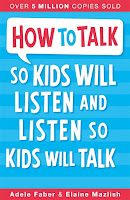
How to Talk so Kids will Listen and Listen so Kids will Talk (by Adele Faber and Elaine Mazlish)

How to talk so kids will listen and listen so kids will talk
(Amazon UK link)
It's many years, now, since I first heard of Adele Faber and Elaine Mazlish, an American writing duo who also run workshops on parenting. I expect someone recommended one of their books to me when we lived, briefly, in the US during the early 1990s when my sons were small. I know I very much enjoyed this one; the principles it put forward were some of those I believed in already, and which I had discussed with church friends at a short course we had done together. So while I liked the book, I didn't see the need to get a copy for myself...

However, when I saw 'How to talk so kids will listen and listen so kids will talk' on the Bookbag shelves, I leapt at the chance to re-read it. In doing so, I felt a touch of regret that I had not had a copy to refer to regularly when my sons were growing up.

This book aims to reverse the negative, punishment-based parenting that is so common these days. Children are seen not as problems, but as lovable small people needing a little guidance. The authors propose a new ‘language’ which begins with listening properly, helping children to deal with their feelings by encouraging them to name their fears - or anger - by observation, gentle discussion, and acceptance.

The next chapter is about encouraging co-operation. Parents are told not to demand, accuse, threaten or bribe their children, but to express a problem in neutral terms: ‘the milk is spilled; we need a cloth.’ Different techniques are advised, depending on circumstances. Far too many adults get caught up in trying to control rather than co-operate, and nagging rather than finding appropriate ways to communicate their wishes.

Further chapters include topics such as encouraging autonomy, finding alternatives to punishment, offering encouraging praise, and freeing children from roles: positive ones as well as negative name-calling.

Each chapter describes typical scenarios, then proposes alternative ways to deal with them. Towards the end of each chapter there’s a section with exercises for parents to try during the week, encouraging them to observe the ways they interact with their children. This is followed by examples from workshops which are easily recognisable, and mostly reassuring.

This 30th anniversary edition has been expanded, including a section written by the daughter of one of the authors, recounting some of the frustrations she had with her own children. The non-coercive, language of communicating came naturally to her, but it didn’t turn her children into angels, nor did it mean that she always made the right responses. Her account is amusing in places, and very encouraging.

My own experience in the past suggests that, while it’s not easy to adopt all the principles, they do work eventually. I made plenty of mistakes, but as the authors point out, there are always second chance with children.

Very highly recommended indeed.

You can also read my somewhat longer review of 'How to Talk so Kids will Listen and Listen so Kids will Talk' at The Bookbag.

27 Jul 2010

Learning without school (by Ross Mountney)

Learning Without School by Ross Mountney
(Amazon UK link)
Although I started home educating nearly thirteen years ago, I had not come across Ross Mountney or her 'Diary of a Home Educating Nobody', which apparently appeared in some newsletters by the Education Otherwise support group. But I was delighted when she emailed me, asking if I would be interested in linking to her site and reviewing her book for my home education website.

So for the past ten days or so, I've been browsing through 'Learning without school'. It's a clearly written book, forming a thorough guide to home education. Ross Mountney is a former teacher who has educated her children at home for some years, so she writes with the voice of experience. There's a good balance of theory and practice; with explanations about how to get started, why people choose to home educate, how children learn, and what to do about children with any kind of special need (including the academically gifted).

Pros and cons of different styles of home education are listed, and positive reasons for withdrawing children from school while acknowledging that school can be a great environment for some children. There's an encouraging chapter about social skills and friends, all of which I related to; it's a complete myth that home educated children are not able to socialise. Mixed in with the theory are plenty of personal anecdotes from the author, describing honestly some of the situations she encountered, and some of the changes she made as she learned alongside her children.

There are also several quotations from other home educating parents, giving different perspectives on their lives. They range from highly structured to fully autonomous educators, from those just starting with some trepidation through to experienced home educators with several years behind them. I was slightly disconcerted at the layout of these, some of which had black boxes that started on one page and then continued to another. I thought it a pity that the layout had not been planned slightly better by the editor or proof-readers. In a similar pernickety vein, I felt there were too many exclamation marks, and italicised words which, in print, don't really work.

However, those are very minor and don't in any way affect the content. My only real quibbles are that some of the legal details are incorrect (for instance the author claims that the LEA is responsible for all children's education; this is not in fact true. It is parents who are primarily responsible. The LEA only have a duty if they have evidence that education is not taking place) and that there's slightly too much emphasis on formal learning.

Despite a clear emphasis on flexibility, and adjusting to the needs of the child, there's still a lot of discussion about curriculum and school-type subjects, with the assumption that most parents will have particular expectations of their children rather than allowing them to lead the way.

Still, these are only small points. I think this book would be very useful for anyone wanting to know more about home education, particularly those in the UK, but much of the book would be relevant anywhere. It would also be of great benefit to parents worried about problems their children might be having in school. I only wish a book like this had been available when we were starting out on our home education journey nearly thirteen years ago.


Review copyright Sue's Book Reviews, 27th July 2010

8 Sept 2009

It's not fair! (by Gill Hines and Alison Baverstock)

It's not fair by Gill Hines and Alison Baverstock
(Amazon UK link)
I had never heard of either Gill Hines or Alison Baverstock. Nor is this a book I would have bought, since my two sons are now in their early 20s. But I've always liked parenting books, so when I saw it on the shelves for review of 'The Bookbag' site, I thought it would be interesting to read. I did wonder if it would be along similar lines to Mary Sheedy Kurcinka's 'Raising your Spirited Child', which I read about nine years ago, and thought excellent.

However, the 'bright and challenging' children described in this book are defined as being 'smart, sassy and sparky, with just a hint of precociousness.' This is rather different from the dreamy, perceptive and rather disorganised 'spirited' one.

A bright and challenging child tends to live in the moment, self-aware and verbal, able to argue well, frequently wearing his parents down. Modern recommended parenting methods are not necessarily helpful with this kind of child.

Problems arise since bright and challenging children are often unable to consider long-term consequences of their actions. As teenagers, they are more likely than most to experiment with dangerous or anti-social behaviours. They usually like being the centre of attention, and are more interested in present feelings and desires than any thought of the future.

The book is very well-written, full of anecdotes about bright and challenging children, with advice about what to do, and what not to do. There are questionnaires, places for parents to pause and think about certain aspects of parenting, and some excellent suggestions in the later chapters for preparing their children for the temptations of the teenage years.

It's intended for parent of children from eight to twelve, and most of the suggestions and recommendations are appropriate for this age-range. However, some children are clearly bright and challenging from a much younger age, and some teenagers are the despair of their parents due to consistently negative behaviour of the sort described in this book. So I feel it would be appropriate for parents of any age children who are finding it hard to deal with them.

Very highly recommended.

You can also read my slightly longer review of 'It's Not Fair' on the Bookbag site.

30 Jun 2009

Teach Yourself Home Education (by Deborah Durbin)

Teach yourself home education by Deborah Durbin
(Amazon UK link)
The writer Deborah Durbin is a journalist who has been home educating her daughters for the past five years. As a home educator myself (albeit 'retired' now), I was delighted when she asked me if I would review her book.

'Teach yourself home education' is published by Hodder, written for the long-standing and well-respected 'Teach yourself' series. The title is perhaps a slight anomaly: one can only really learn to home educate by launching into it, and seeing what happens. Every child is different, after all.

Still, this book undoubtedly covers just about every aspect of learning about home education from a theoretical point of view. It begins with an introduction, including a 'case study' of the author's own experience, and the reasons she started home educating, as well as one explaining a landmark court case in 1981 that fully established the right of British parents to educate their children at home.

The book then explains the legalities. It quotes from the Education Act, and looks briefly at employment law as it relates to children. It's interesting that this book has launched at a time when the British home education community is reeling from a negative report made at government level, suggesting that home educators be required to register with their authority, and undergo extensive monitoring. If this is passed - and it will be a seriously retrograde step if it is, leading, potentially, to all kinds of other government monitoring - then this chapter will have to be updated.

Subsequent chapters cover reasons for home education, evidence citing research for the positive benefits, and step-by-step guidance to getting started. There are sections explaining different styles of home education, how to gain qualifications (such as GCSEs) if desired, and also the surprisingly common question about 'socialisation'.

My only slight disagreement - and it's very minor - is that in writing about different styles of home education (and there are many) the author describes her own experience as 'autonomous'. Autonomous education is defined in the book 'Doing it their way' by Jan Fortune-Wood. It is basically a full-time child-led way of learning, with no required structure, no timetables (unless a child requests them), no differentiation between 'school' days and holidays.

My own style as a home educator was more like that described by Deborah Durbin - a lot of interest-led learning, but at least a small regular amount of maths and other overtly academic learning. It worked well for us - as I'm sure it does for her - but I think of it as eclectic, unstructured education rather than fully autonomous.

The book is mostly written in an objective style, explaining what is possible and how things work, with only a few glimpses into the author's own home education experience. Other home educators - adults and children - are quoted in places, usually in 'case study' type boxes. But the majority of the book is factual, as befits the 'Teach Yourself' style.

I have to admit, it's not a style that immediately appeals to me. The layout of the pages feel a bit fussy, at times, and I didn't think the 'key points' at the end of the chapters were particularly helpful. Still, that's due to the publishing style and doesn't affect the main content, which is very comprehensive. As I read, I don't think I learned anything new. But then I educated my sons at home for about nine years, and thus have read extensively on the topic.

I wish I'd come across a book like this when I was starting out, however. It's very reassuring on just about every aspect of home education, and would be excellent to hand to worried parents or friends. If you are considering home education, or wanting to know more about it, or if you know of people who do not send their children to school, I would highly recommend this useful book to you.

Other recommended books about home education: Free Range Education (edited by Terri Dowty); Homeschooling: a patchwork of days (by Nancy Lande); or for more extensive detail about research into home education, see Educating Children at Home (by Alan Thomas).


Review copyright Sue's Book Reviews, 30th June 2009

18 May 2009

Parenting your adult child (by Ross Campbell and Gary Chapman)

Parenting your adult child by Campbell and Chapman
(Amazon UK link)
The author Ross Campbell wrote my favourite books about parenting, including coining the idea of an 'emotional tank'; Gary Chapman wrote the books about love languages. They've teamed up for this one, about relating to adult children, so I was expecting a powerful book.

I bought 'Parenting your adult child' when I was about to become an 'empty-nester' last Summer. I wondered if it would help me come to terms with the new phase of life. Skimming it, I realised it wasn't like that at all. Instead it seemed, at first glance, to focus primarily on the problems that can arise when adult children don't leave the nest. So it sat on my shelves for a while

Recently I decided to read it anyway. And, indeed, it does cover many aspects of relating to adult children. It describes problems with children in their twenties who drift, never leaving home; or who don't want independence; or who treat their parents as doormats.

I don't have any of those problems, I'm thankful to say. But still I found it very interesting in understanding better how younger people think, and why the traditional model of the empty nest is no longer so appropriate. There is advice in dealing with behaviour problems, with boyfriends/girlfriends, with in-laws, with money... and one about what we leave our children as legacies, not just financial but moral and spiritual too.

The book is very well written, with anecdotes from the authors' experience (with names changed) and plenty of solid, clear advice. My only quibble was that on almost every page was a suggestion about going to counselling to resolve problems - but for some that may, of course, be appropriate.

I did also note that the book is ten years old, so their categories of 'baby-boomers' (as parents) and 'Generation X' (as the young adult children) is no longer so accurate. But much of what was said is still very relevant.

All in all, I'd highly recommend this book to anyone with adult (or nearly adult) children, particularly if you are having any problems with them. It's written from a clearly Judaeo-Christian perspective, but relevant to anyone.

Review copyright Sue's Book Reviews, 18th May 2009

12 Feb 2001

Without Boundaries (by Jan Fortune-Wood)

Without Boundaries by Jan Fortune-Wood
(Amazon UK link)
I had come across Jan Fortune-Wood on mailing lists about home education, and found some of her views intriguing. I'm fairly relaxed as a parent and educator, but not to the extent of believing totally in non-coercion and autonomy at every moment.

So I was interested to read the theory behind her beliefs, which is expressed in this book. The subtitle is: 'Non-coercive parenting and autonomous education'.

'Without Boundaries' is an excellent book, in my view. It outlines the 'Taking children seriously' philosophy from a common sense viewpoint, rather than the extremism with which it's sometimes associated.

Having said that, I found the first paragraph of each chapter unnecessary (it simply said in brief what she was going to say in the rest of the chapter!) and I didn't agree entirely with all the conclusions. Personally, I do think that some boundaries are, sometimes, a good idea.

Still, I thought this book well worth reading. It presents the best, most well-balanced presentation of the theory that I've come across.

Recommended.

6 Jul 2000

School's out: educating your child at home (by Jean Bendell)

School's out by Jean Bendell
(Amazon UK link)
I'd never heard of Jean Bendell before. I can't find anything about her online, but she was evidently a pioneer in her time. Her book 'School's Out' makes that clear.

This is a very well-written and interesting account of a home educating family in the UK. It was in the early days of what we now think of as home education. In other words, the era when parents started taking full responsibility for their children's education, rather than using either a school or a governess or tutor.

Some legal information is included, though it's not all current. There is also plenty of advice and suggestions. Inevitably some of the content is a bit out of date now, but I still thought it well worth reading.

Definitely recommended.

10 Jun 2000

Free Range Education (edited by Terri Dowty)

Free Range Education edited by Terry Dowty
(Amazon UK link)
I have only 'met' Terri Dowty online, on one of the bigger forums about home education in the UK. When I heard that she was proposing to put together a book about home education, written from the perspectives of several different parents, I was delighted to be asked to contribute.

I was thus involved with 'Free Range Education' (known affectionately as FRed) almost from the beginning. So it was a great thrill, at last, to see it in print. I can't, of course, judge my own contribution, so this review is about the rest of the book.

About twenty British families write about home education, in an unstructured and very enthusiastic way. The overwhelming impression given by the book is that children educated at home, free from the restraints and curriculum requirements of school, are mature, well-spoken, well-rounded individuals with a wide variety of gifts and abilities.

Each family in the book is different, having chosen to home educate for various reasons. Each adopts a different style, depending very much on the needs of the children. We read about day-to-day life in families from all walks of life, with some briefer comments from some of the children themselves.

There are brief sections outlining the legalities of home education in the UK, and answering some of the frequently asked questions. But the main focus is the personal experiences which make this a very enjoyable and inspiring book. I loved reading it, and feel honoured to have been a part of it.

Highly recommended.

26 Apr 2000

For the Children's Sake (by Susan Schaeffer Macaulay)

For the Children's Sake by Susan Schaeffer Macauley
(Amazon UK link)
The writer Susan Schaeffer Macauley is, I gather, related to the better-known Francis Schaeffer. However I have only heard of her in relation to home education, and particularly this book which has been recommended to me on some home educators' forums.

'For the Children's Sake' is based on the works of Charlotte Mason, a pioneer in early education at a time when children were expected to be seen and not heard, and to learn by rote vast quantities of boring information.

Charlotte Mason believed in learning for fun - in 'living' books, and nature walks, and discussions, and although her writing is rather lengthy and long-winded, Susan Schaeffer Macauley makes it available for the ordinary parent in this book.

There's plenty of common sense in the book, much of which seems obvious in these more enlightened days. Indeed, some of the ideas overlap surprisingly with the modern 'taking children seriously' non-coercive style of home education that's so popular in the UK.

However, as the book is written from a traditional Christian perspective, there's some emphasis on discipline (in the gentlest of senses) alongside questions about creativity and mutual respect.

I found it a bit heavy at times, but very interesting. Certainly I think it's well worth reading by any parents wanting to know more about the education process, and particularly anyone considering home education (known in the US as homeschooling).

It inevitably feels quite dated, but is still in print on both sides of the Atlantic.

23 Apr 2000

Doing it Their Way (by Jan Fortune-Wood)

Doing it their way by Jan Fortune Wood
(Amazon UK link)
I doubt if I would have come across this book in the ordinary way. But Jan Fortune-Wood was on one of the discussion groups I took part in, on the topic of home education in the UK. I was extremely interested in her theories of non-coercive parenting and autonomous education. So ordered a copy of this book.

The full title of this book is 'Doing it their way: home-based education and autonomous learning'. In essence, that's what it's about. There's a well-presented view of what autonomous eduction is, and also what it isn't. The author also explains, in a fairly comprehensive way, the non-coercive lifestyle that many home educating parents choose in the UK.

I found the book a bit heavy-going in places. And I didn't entirely agree with all the author's arguments. However, overall I thought it well worth reading, and very thought-provoking in places.

Recommended.

17 Feb 2000

How to Really Love your Teenager (by Ross Campbell)

How to Really Love your Teenager by Ross Campbell
(Amazon UK link)
'How to Really Love your Teenager' is one of the best parenting books I have ever read, written by the American Christian author Ross Campbell. It's one I dip into regularly, and which I've just finished reading in full, once again. It's friendly, encouraging and not at all pushy or condescending. 

There is plenty of good and reassuring advice about showing older children and teens that they are loved, no matter how they behave. There are guidelines for dealing with potential conflict, and creating a good environment for listening and sharing. There is also advice about helping teenagers to develop increased responsibility. 

As with his other books, Campbell proposes that children who behave badly or are depressed often have 'emotional tanks' running on empty. No matter how much their parents love them, they will not feel any better if they don't know it. But, he explains, for some reason, children and teenagers often miss clues and indications that they are.

So we're advised to spend time with our teens, offer them eye contact, take an interest in whatever interests them, and so on. It doesn't sound radical in today's climate where relaxed and non-coercive parenting is no longer unusual. But somehow the points the author makes, and the examples he gives hit home every time I read it.

The book is regularly updated, so it's worth searching for the most recent edition if you want to buy it. 

Highly recommended to all parents of children or teens.