Showing posts with label Susan Howatch. Show all posts

28 Sept 2017

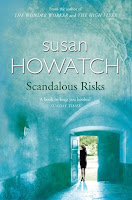
Scandalous Risks (by Susan Howatch)

Scandalous Risks by Susan Howatch
(Amazon UK link)
Re-reading books by favourite authors, I decided it was time for another Susan Howatch. Since I have re-read the first three in the Starbridge series in the past year, I picked up the fourth one, Scandalous Risks. I didn’t remember enjoying it, particularly; but then I didn’t remember how good the previous one, ‘Ultimate Prizes’ was, despite an entirely unappealing narrator and main protagonist.

This novel continues the story of Neville Aysgarth, now Dean of Starbridge Cathedral. However it’s told through the eyes of Venetia Flaxton, a girl whom, in the previous novel, very much admired Aysgarth when she was a child of nine. The novel opens in the 1980s, when Venetia takes a wrong turning and finds herself in Starbridge, somewhere she had determined never to see again. She meets her ‘talisman’... and then the majority of the book is a lengthy flashback to 1963, when Venetia was in her late twenties.

Venetia is an interesting person, youngest in a long family, not convinced that her father cares for her at all. She’s highly intelligent but fought against going to Oxford, and indeed almost anything her parents suggested. But, deciding she must leave their orbit for a while, she goes to stay with her friend Primrose Aysgarth (daughter of the Dean) for a few days in Starbridge. There she meets the upright and theologically conservative Bishop, Charles Ashworth (who was the main protagonist in the first Starbridge book, ‘Glittering Images’) and his wife Lyle. She also becomes re-acquainted with the Dean, and realises that even though he’s twenty-five or more years older than she is, her feelings for him are much stronger than that of admiration or friendship…

In theory the book stands alone, but with so many people from previous books, a great deal would be missed if this was read without the benefit of knowing Charles and Lyle’s story from the first book, as well as that of Neville and his unlikely wife Dido. The writing, as with all Howatch’s novels, is excellent. The style is terse, without irrelevant details, and the conversations feel realistic. The depth of character is superb; Venetia is naive and yet knowledgeable, insecure and, in other ways, confident. Neville is still, in my view, a rather disagreeable and manipulative person, and somehow this is conveyed through Venetia’s words, even though she herself adores him.

The storyline, however, becomes more and more unpleasant, raunchy in its implications, although the author wisely keeps the smutty scenes to a minimum, and undescribed other than in passing. The focus of the plot keeps returning to the book ‘Honest to God’ by John Robinson, which in theological circles in the 1960s was apparently quite controversial. It attacked traditional views of God, and proposed a very different kind of morality. Bishop Charles spends much of the book dictating his refutation of the book, while Neville tries to convince himself and Venetia that it portrays reality.

There are psychological twists and turns, as ever in this author’s books, and some fascinating - and, at times, very disturbing - insights into the hierarchy and practice of the Church of England in the 1960s. I think I’m glad I read it again, as I plan to keep going with the series. At times, particularly towards the end, it was almost impossible to put down. I’d remembered the main storyline, but forgotten most of the details and the outcome. Yet I didn’t really enjoy it, and was pleased to get to the end.

Worth reading if you're a fan of the author, and reading the Starbridge books in sequence.


Review copyright 2017 Sue's Book Reviews

13 Mar 2017

Ultimate Prizes (by Susan Howatch)

Ultimate Prizes by Susan Howatch
(Amazon UK link)
In my slow meanderings through books I have previously enjoyed by some of my favourite authors, I decided to re-read the third in Susan Howatch’s gripping Starbridge sequence. I re-read ‘Glittering Images’ for the fourth time in 2014, and ‘Glamorous Powers’ last year.

I hadn’t remembered ‘Ultimate Prizes’ with a great deal of fondness; I last read it in 2007. I knew it featured the Archdeacon of Starbridge, Neville Aysgarth, whom I never much liked in this or the later books that featured him. When a book is written in the first person by an unsympathetic narrator, it takes a very gifted writer to make the book enjoyable. Susan Howatch succeeds admirably, however.

The novel opens with an intriguing sentence about the morning after the Archdeacon ‘nearly’ committed adultery. The first time I read the book I was hooked. This time, recalling vaguely that plot point, I realised how clever an opening it is, and how the author gently misleads the readers all through the first sections of the book, so that when the act is ‘almost’ committed, it comes as something of a shock.

Immediately after the introductory section, explaining how clergymen in their forties don’t do such things, we are taken back three years to a dinner party where Neville meets a young and rather exciting society woman known as Dido. We learn at the same time as Dido does that he is married to a wonderful woman called Grace, and has five children, and also that the book is set in the early 1940s.

Howatch uses the technique known as ‘unreliable narrator’ to excellent effect. Neville is clearly deceived about many things in his life, and is holding together several stresses (and temptations) with a tight rein. His personality is such that he lives in the moment, regularly ‘bringing down the curtain’ on unpleasant situations or disagreements, so as to present a positive face to the public. He is dedicated to winning what he calls ‘prizes’ - achievements in life, the love of his family, and as much success as he can.

It’s not long before we begin to see cracks in his life - his wife is exhausted but determined to stay on the pedestal he has put her on; his children behave as well as they can, but wish he would be more ‘real’ with them. And he has a great antipathy to Jon Darrow, an older clergyman who is more Anglo-Catholic in his leanings, with a lot of intuitive insights and apparently mystical ability. So Neville is not happy when Jon sees him at his worst…

The storyline is complex, with many subplots, some of them relating to the previous books although it’s not necessary to have read them first. We see Neville with many different characters: as the administrator to his current bishop, as a close friend of a retired bishop, with his family, and with other acquaintances and friends. I found myself feeling quite sorry for him, and as the story progressed, surprised how much I liked him despite his brusque and pragmatic approach to life. The more his past is unpacked, the more three-dimensional and sympathetic he becomes.

I was intrigued, too, at the theological clashes that pepper several of the conversations: between the high Anglo-Catholics (like Jon), the lower evangelical modernists (like Neville) and the neo-orthodox, a new movement in the mid-twentieth century. I was surprised at how the terms were used then, rather differently from how they are now. Neville takes the Bible very seriously, but not literally, even discounting some of the miracles. However he stresses the immanence of Christ, and the importance of forgiveness and compassion, in a way that the neo-orthodox (in his perception) do not.

There are many issues raised but not solved: how to deal with war, whether pacifism is a valid response or not, and what to do with those on the ‘enemy’ side who do not believe in the principles of their leaders. These are less significant than the unravelling of Neville’s own past, and the discovery of what makes him the man he is, with his many hangups and failings, but the historical context and theological discussions help to flesh out the conversations.

That probably all sounds rather dull - yet it’s an excellent book, in my view, which I was almost unable to put down at times. Howatch’s style makes it thrilling, intriguing, and ultimately very satisfying. It’s over 400 pages of quite small type, but I finished it in under a week, often reading long past my preferred bedtime, and sometimes during the daytime too.

Highly recommended.


Review copyright 2017 Sue's Book Reviews

14 Aug 2016

Glamorous Powers (by Susan Howatch)

Glamorous Powers by Susan Howatch
(Amazon UK link)
It’s many years now since I first read Susan Howatch’s ‘Starbridge’ series, on the recommendation of a friend. I was hooked almost immediately and re-read them only a year or two later. A couple of years I decided it was time for a re-read, and did read and thoroughly enjoyed, again, the first, ‘Glittering Images’. But it’s only in the past few days that I decided to re-read the second in the series.

'Glamorous Powers' is told from the point of view of Jonathan Darrow, the middle-aged and brilliant Abbot who counsels (and sorts out) Charles in the first book. Susan Howatch is very gifted at showing different points of view, getting inside people’s heads and showing the contrast between their outward appearance and their inner thoughts and struggles. While Jon’s life is not as fragmented or deliberately ‘glittering’ as Charles’, he has a great deal in his past which is still unresolved…

We meet him as he’s experiencing a dramatic vision, one which he thinks is leading him to leave the monastery and resume some kind of life in ‘the world’. He has to discuss with with Francis Ingram, the chief Abbot in the order, and rather an old nemesis of Jon’s; the two have known each other since university days, when they had some quite serious clashes, and their paths haven’t crossed all that much as their churchmanship and theology are very different. Jon doesn’t in the least want to submit to Francis’ non-mystical style of leadership, but has no alternative.

So the first quarter of the book is taken up with discussions between the two, and a gradual unfolding of the past, with Jon gradually becoming less arrogant and more willing to listen. Part two sees him beginning on his new journey; part three sees his arrogance come to the fore, and some terrible things happening before things finally come together.

It’s hard to say much about the plot without giving things away; suffice it to say that the writing is excellent, the dialogue crisp, the psychology believable, at least to this layperson, and even knowing most of the plot in advance, the storyline still very gripping indeed. I had tears in my eyes at one particularly moving scene at the end of part three, and a thrill as I came to the final pages, remembering what was to come, yet wanting to read it slowly, to savour every word.

This style of writing is not for everyone; it’s steeped in mid-century churchmanship, with assumptions made that the reader understands ‘high church’ and ‘broad church’, liturgy, hierarchies and so on. It also assumes benignity towards Christianity, and an acceptance that God exists and is interested in individuals. Those without faith - or of other faiths - could certainly read this, but would have to put aside some of their preconceived ideas first.

Indeed, many who Christians may need to put aside some of their ideas about the church, or at least about those who run it. The priests and monks are quite frank about their failings and temptations, constantly fighting battles for self-control and discipline, while often giving in to their human nature.

There’s nothing particularly sordid about this; yet there is undoubtedly ‘adult’ content and ideas. Some might find the contents shocking; others may find it eye-opening; some may see it as exaggeration. For me, this book provides insights into humanity and frailty, and is, overall, full of hope.

Highly recommended to those who like a good story, who understand mysticism and temptation, or who are interested in good stories about churchmen, set in the middle of the 20th century.

Review copyright 2016 Sue's Book Reviews

27 Sept 2014

Glittering Images (by Susan Howatch)

Glittering Images by Susan Howatch
(Amazon UK link)
I love this book! It’s many years, now, since a friend recommended Susan Howatch’s work to me, commenting that her novels - and particularly the ‘Starbridge’ series - were essentially Christian psychological thrillers. That didn’t sound like a particularly appealing genre, but I trusted my friend’s judgement - and am so glad I did.

It took me a while to get into ‘Glittering Images’ the first time I read it. The second time, just a year later, I read a lot more quickly. I enjoyed it again in 2007, but that’s some time ago now. I picked it up again recently as I had come across a few quotations from it in a non-fiction book I was reading. I thought I might skim it - but was soon hooked again.

The story features 37-year old Charles Ashworth, an ordained minister who works in academic circles, and is a friend of the Archbishop. It’s set in the early part of the 20th century using some real people (or characters based on real individuals) but Charles is entirely fictional. He is given a mission by the Archbishop, to visit the Bishop of Starbridge and check whether he is or has done anything indiscreet, which might be pounced upon by the media.

Charles really doesn’t want to do this, but feels he can’t refuse this assignment. He is, in any case, quite interested to learn how the Bishop’s household functions: his wife Carrie is considered attractive but fluffy, while the Bishop is a strong-minded academic. Carrie has a companion, Lyle, who is known to be ultra-efficient.. and Charles is surprised at how attractive he finds her....

While the book is somewhat rambling in places, with a great deal of conversation, I found, once again, that it was remarkably difficult to put down. I could remember the broad outline of the plot, of course, and the eventual resolution - but much of the detail intrigued me all over again.

Perhaps Charles’ problems, which eventually surface in dramatic events, are caricatured and exaggerated. Perhaps the psychological investigation that follows - and helps him uncover them - is a bit too neat and tidy. But it makes very exciting reading, and Charles’ advisor - the mystical monk Jon Darrow - is a most intriguing character.

The writing is powerful, often quite terse (other than in the conversations) and dramatic, with very clever plotting as events and memories unfold. It didn’t grip me quite as much as it did that first time, and I didn’t feel as drawn to Charles as I did years ago - but still, it was a very enjoyable read, with some great insights into possible reasons for some behaviours.

The book has been criticised as suggesting that Anglican ministers are naturally as described in the book, but I don’t really think that’s fair: Charles and the Bishop of Starbridge are unusual, in contrast to the majority of other hard-working and ethical vicars around the country. My one reservation at recommending it widely is that there’s one somewhat explicit - and shocking - scene, and quite a lot of frank discussion about intimacies throughout the book. Perhaps it’s low-key compared to the majority of modern novels, but I would hesitate to recommend this to anyone under the age of about 16.

Still, it’s a book I will no doubt return to in future, yet again, and one that I recommend highly to friends.

Still in print, and now available inexpensively for the Kindle too.


Review copyright 2014 Sue's Book Reviews

22 Jan 2009

Sins of the Fathers (by Susan Howatch)

Sins of the Fathers by Susan Howatch
(Amazon UK link)
I so enjoy Susan Howatch's writing. she has an amazing gift of characterisation, which is cleverly used in her technique of using different voices to relate her novels.

I first read 'Sins of the Fathers' nearly nine years ago. While I found it gripping, I wasn't too impressed at the world of high finance, or the rather depressing ending. On re-reading recently, I was well aware of the setting but had entirely forgotten the plot, and indeed the climax.

It's the sequel to 'The Rich are Different', starting ten years later, in the mid part of the 20th century. The first person multiple viewpoint method of writing works extremely well to develop the various plots, and to let the reader see, gradually, how each character is motivated, and what has occurred in their past.

It mainly revolves around Cornelius van Zale, the amoral and slightly frighteningly vile head of a bank in the USA. All he really cares about is success and power in their various forms, although he is also devoted to his daughter Vicky and (in a different way) his wife Alicia. I had moments in the book when I felt a pang of sympathy for him, but these never lasted long.

The book is extremely well-written. I have little interest in high finance or the banking world, and usually get rather bored when reading novels on these topics. But somehow Susan Howatch's terse writing, combined with her incredible depth of characterisation, kept me reading almost every word.

Re-reading this book nearly nine years after I first read it, I found it gripping once again, although it took me nearly a fortnight to finish it. The end of the novel once again saddened me, but the conclusion was undoubtedly right.

Definitely best to read after 'The Rich are Different', although it could stand alone. Still in print in the UK, although not currently in the United States. Widely available second-hand.

Review copyright Sue's Book Reviews, 22nd January 2009

1 Oct 2008

The Rich are Different (by Susan Howatch)

The Rich are Different by Susan Howatch
(Amazon UK link)
It took me a while to become keen on Susan Howatch's writing. However, these days I count her as one of my favourite modern authors. She has a crisp, succinct style which introduces some remarkably well-rounded characters, each with his or her distinct personality. Her books often use multiple narrators, a technique which works brilliantly in unfolding different perspectives on the same situation.

I first read 'The Rich are Different' in 2000, and while I found it exciting and very well-written, I didn't consider it my kind of book. It's set in the early 20th century, in the world of high finance and business - and to be sure, that's not the kind of setting that usually appeals to me. So it's a tribute to the remarkable skills of this writer that I picked the book up to re-read a week ago, and despite its length (700 pages of small print) I have read at every available moment since, and finally finished it this evening.

Dinah, an ambitious but impoverished young woman, propositions Paul, a rich American banker, in the hope of saving her family property. We know they're going to get together - the opening sentence of the book tells us that she was looking for a millionaire and he was looking for a mistress. But that's just the start of this remarkably powerful novel which spans two continents and nearly twenty years.

The negative sides of ambition, lust and greed are themes throughout this novel, although there is no moralising as such. There are several very strong characters in addition to Dinah and Paul; in particular Paul's right-hand man Steve, and his great-nephew Cornelius. The first section of the book is told by Paul, the second by his wife Sylvia, and the third by Dinah. Steve, Cornelius and Dinah then narrate the final three sections of the book, drawing it to a surprising - yet somehow satisfying - conclusion.

Historically, the book begins in the years leading up to the Wall Street crash of 1929, in which most of the main characters are deeply involved. There are conspiracies and syndicates, there is fraud and theft as well as vast amounts of alcohol, and of course the inevitable and repeated adultery.

So it's really not my kind of book at all - and yet, re-reading it, I was just as gripped as I was the first time. I'd forgotten almost all the plot, and had also forgotten most of the characters. On the other hand, I did now appreciate the clever way the author has used the historical stories of Caesar and Mark Anthony as the basis of the relationship plotlines of this amazing novel.

Still in print in the UK, although rather highly priced at times; widely available second-hand.


Review copyright Sue's Book Reviews, 1st October 2008

17 May 2008

April's grave (by Susan Howatch)

April's grave by Susan Howatch
(Amazon UK link)
I have enjoyed Susan Howatch's writing for about eight or nine years now, particularly her 'Starbridge' series. I'm less keen on her historical sagas, and not at all sure what to make of her earliest work, the 'gothic' thrillers. Still, once I like a writer I tend to collect all her (or his) works, so I have them all on my shelves.

I don't remember if I've ever read 'April's Grave' before. Certainly not for a long time, and I didn't have any recollection of it - even slightly. As with all Susan Howatch's work, it's very well-written, fast-paced, and with believable characters who are clearly distinct, despite being pretty short: only 156 pages.

It's mainly told from the point of view of Karen, who is in America when the story opens. She goes out to dinner with Marnie - a man, who just happens to be in her town, and who was the best man at her wedding to Neville a few years back. She has not seen Neville for three years, since a major fight over his infidelity, but they are still legally married.

Karen makes a casual enquiry after her twin sister April, whom she has not heard from in three years. In discussion, they realise that April has apparently vanished from the face of the earth. Karen decides she will spend some time in the UK, seeing her stepson who has the unlikely nickname of Snuff, and possibly seeing Neville, whom she realises she still loves.

Suspicions rise that April must have been murdered. However, Karen and Nevile start on a tentative reunion, and travel to Scotland, to the place where they last saw April. Other people gather in the same place, for various reasons: Marnie, who works with Neville; Leonie, Neville's sister and housekeeper; Snuff, who plays an important part in the story, and Melissa, an old friend of Karen's who has also been Neville's lover during their separation.

I didn't find this nearly as frightening as some of Susan Howatch's other 'gothic' novels; although there's some tension as the story draws to a close, it's more like crime fiction - a 'whodunit'- than a real thriller. For me, that's a plus point as I don't like too much tension!

Other than Snuff, who was something of a shadowy figure, and Melissa, who rather a caricature, the people seemed real and the interactions believable - even if the end was rather melodramatic. But then that's what happens in gothic novels.

Recommended, on the whole. Not in print - and would probably be lost in antiquity if it weren't for Howatch's successes with her later novels - but frequently available second-hand.


Review copyright © Sue's book reviews, 17th May 2008. All rights reserved.

29 Aug 2007

Scandalous Risks (by Susan Howatch)

Scandalous Risks by Susan Howatch
(Amazon UK link)
Susan Howatch is such a good writer! She combines great characterisation with in-depth psychological understanding of people, and mixes them into gripping plot-lines, set in realistic situations. Her Starbridge series about the Church of England during the early to mid 20th century is - in my view - the peak of her work, although she doesn't seem able to write a bad book.

'Scandalous Risks' is the fourth of the Starbridge books, which - surpisingly - is currently out of print in the UK, although widely available second hand. It's narrated by Venetia, from the perspective of her late twenties when she was struggling with her identity in 1963.

Venetia is from an upper-class background, in the days when class was much more significant than it is now. She is very intelligent, but decided against going to university. She feels as if her parents can't really be bothered with her, but she has no idea what she does want out of life. She feels that she really ought to get married - or at least have fall in love.

She's very fond of the Dean of Starbridge, Neville Asygarth, known to his friends and family as Stephen. Aysgarth is in his sixties, and has a rather irritating society wife called Dido. His story is told in much more depth - from his perspective - in the third Starbridge book, 'Ultimate Prizes'; reading the books in order undoubtedly adds to their depth, but Susan Howatch is a skilled enough writer that it's entirely possible to read any of the books on their own. There are no annoying flashbacks, and each book is complete in itself.

Venetia has always known Aysgarth as a friend of her father's, from the time she first met him when she was nine. His daughter Primrose is about her age, and one of her closest friends. So when she decides to go and stay with Primrose for a while, she naturally sees a fair amount of the Dean. Suddenly things change, and she realises she is falling in love with him. Unfortunately, he finds this irresistable...

Alongside this main plot, which runs through the book, is considerable discussion of the book 'Honest to God' which had recently been published in 1963, and which I read recently out of interest. The book, despite having been written by an Anglican bishop, proposes a completely new idea of God, ignores the Incarnation, and - most significantly for this book - talks about a 'new morality' based entirely on love.

Aysgarth, a liberal who is a great fan of 'Honest to God', is quite sure that he and Venetia can have a loving, platonic relationship so long as nobody gets hurt, and so long as the relationship is not consummated. But naturally, it's not that simple in reality.. Susan Howatch very effectively shows the extreme dangers of such philosophies.

Meanwhile Aysgarth is also having trouble in his job as Dean, wanting to buy a rather controversial sculpture to display in the church-yard, amongst other issues. He comes up frequently against his Bishop, Charles Ashworth (whose story is told from his perspective in 'Glittering Images', the first book in the Starbridge series).

'Scandalous Risks' is slightly different from the other books in the series so far, in that it actually opens and closes in 1988, twenty-five years after the main events of the story, with Venetia taking a wrong turning from the motorway and finding herself back in Starbridge for the first time since 1963. This works very well, and leads to a very hopeful and positive ending despite everything.

t took me a little longer to get into this book than was the case with the earlier ones in the series, but - as so often happens - by the time I was half-way through it was almost impossible to put down, even though I had read it a couple of times before.

Definitely recommended, preferably after reading the first three Starbridge books in order.

20 Jun 2007

Ultimate Prizes (by Susan Howatch)

Ultimate Prizes by Susan Howatch
(Amazon UK link)
Susan Howatch is undoubtedly one of my top ten favourite modern writers, and it's her 'Starbridge' series of six novels about clergymen in the Church of England during the 20th century that I like best of all. I first read them seven years ago, then re-read only a year later. Now I'm reading them again, more slowly, and enjoying every moment.

Ultimate Prizes is the third in the series, following on from 'Glittering Images' and 'Glamorous Powers'. It's perhaps the most powerful of them all, featuring Neville Aysgarth, the Archdeacon. Despite narrating the book, so that we see everything through his eyes, he comes across as a rather manipulative and selfish man, rushing after 'prizes', ignoring anything remotely painful or embarrassing, and enjoying his success as a top administrator.

Indeed, the book opens with his admittance that he almost committed adultery - and then takes us to the time when he met a delightful young lady just about the time when his wife was feeling over-tired and unsocial. So immediately the scene is set for a man we probably can't trust.

Yet Neville, like all Howatch's characters, is immensely complicated. He wants to serve God - at least, he thinks so - and he is very fond of his wife and large family. His past has been rather painful - an idyllic childhood for seven years, followed by tragically altered circumstances and the rest of his youth being spent having to shape up to his rather harsh uncle's dictates, and push for success.

 Hints of this are given at the start of the novel. But it is only as life becomes unbearable for Neville after a series of very difficult circumstances that he finally admits to needing help and seeks counselling.

Jon Darrow, wise advisor in the first book and narrator of the second, returns in his wise counsellor role despite frequently clashing with Neville in the past. Sparks fly, but both men learn through the process of dealing with an emergency. The latter part of the book is gripping and fast-paced, and kept me reading for most of an afternoon until I could finish it, feeling surprisingly drained at the conclusion.

Highly recommended.

16 May 2007

Glamorous Powers (by Susan Howatch)

Glamorous Powers by Susan Howatch
(Amazon UK link)
'Glamorous Powers' is the second in Susan Howatch's superb 'Starbridge' series about clergymen in the Church of England, during the 20th century. It's complete in itself, but best read after 'Glittering Images'.

Jon Darrow is the hero of this book. No longer seen as the wise, mature counsellor through Charles Ashworth's eyes, Jon is the narrator of this book, and an entirely different side of his character emerges.

The story opens with Jon, an Anglican monk, having a vision of a chapel. He believes this is part of a call to leave the monastery and resume work in the world. In order for this to happen, he must persuade the Abbot-General. Unfortunately for Jon, Francis Ingram, the new Abbot-General, is an old rival of his, and they have never seen eye to eye.

At first it appears that this is because Francis is a rather dull, upper-class twit who has managed to manipulate his way into the affections of the previous Abbot-General, but as the book progresses it becomes clear that Francis does have a great deal of wisdom, and that he has Jon's (and God's) best interests at heart. The problem is Jon's own hang-ups, which are cleverly and gradually revealed as the book progresses.

The writing is excellent, mirroring Jon's own opinion that getting to the root of people's problems is like gradually taking more and more layers off an onion. Jon's pride and arrogance are clearly shown, in his lack of honesty with several people who he cares for, and in particular in the rather poor relationship he has with his adult children. Yet he doesn't think of himself as overly proud or arrogant, and frequently deceives himself as he plunges into one disaster after another.

It's an excellent book, one I could barely put down despite having read it in 2000, and again in 2001. I was no longer shocked or surprised by things that I didn't expect the first time I read it, but I was moved to tears afresh by one short passage, and utterly gripped by the time I neared the end.

Highly recommended.

22 Apr 2007

Glittering Images (by Susan Howatch)

Glittering Images by Susan Howatch
(Amazon UK link)
I was recommended 'Glittering Images' by a friend, some years ago. She told me it was a psychological thriller featuring Church of England clergymen in the early part of the 20th century. It was a long book - just over 500 pages - and the front cover, mostly in black [the one shown at the bottom of this review], didn't appeal to me at all.

The book sat on my shelves for awhile, until by chance I came across another novel by Susan Howatch, which I read - and loved. So one wet weekend, seven years ago, I picked up 'Glittering Images' for the first time.

The book is related by a thirty-seven-year-old widowed clergyman called Charles Ashworth. In chapter one he has tea with the Archbishop of Canterbury, and is asked to undertake an unusual commission. One of the bishops has apparently been creating a stir in church circles. The Archbishop is worried that this bishop, who is known for having a lot of female admirers, might have written indiscreet letters or journal entries, which could be jumped upon by the press. Charles is sent as an undercover spy to find out if this might be the case.

It doesn't sound terribly exciting, and it took me about four attempts to get into the book at first. Charles goes to stay with the bishop, supposedly to undertake some research for his next theological book, and gets chatting to several other guests. He is also strongly attracted to Lyle, the bishop's administrator, and companion to his wife.

But there's some kind of mystery surrounding Lyle, who seems to be much more involved with her employers than would be expected. Charles sets out to solve it, and in doing so unravels some of his own insecurities and childhood difficulties, helped - eventually - by an intelligent and forthright monk called Jon Darrow.

That probably still sounds rather dry... and in the hands of another writer, perhaps it would have been. But Susan Howatch has a wonderful style - fast-paced, terse, yet with incredible depth into the human psyche. Her characters are totally believable, even in the bizarre circumstances that gradually emerge for some of them.

As for the plotting, I think it is brilliant, with cliff-hangers at the end of chapters. There are some most unexpected events that kept me intrigued and interested at every moment. By the time I'd read the first hundred pages or so, I could hardly put the book down.

It's shocking in places, it's exciting, it's deep, it's thought-provoking. And while the chief characters are mostly Anglican clergymen, it's a book that seems to appeal to people of all faiths or none.

I first read the book in 2000, I re-read it in 2001, and I read it again recently... enjoying it all the more despite knowing what was coming.

It's the first of six novels in the 'Starbridge' series, and I recommend it highly! Unfortunately it's currently out of print, but is widely available second-hand.

11 Nov 2005

The Shrouded Walls (by Susan Howatch)

The Shrouded Walls by Susan Howatch
(Amazon UK link)
The writer Susan Howatch is one of my favourite modern novelists. She writes in quite a different vein from the family saga novels, which I also enjoy. She has a fairly terse style without too many adjectives, and yet builds up realistic and sympathetic characters.

In 'The Shrouded Walls', one of her early 'gothic' novels, she uses - as she often does - a first person narrative to get inside the mind of the main character. This is a 17-year-old girl, who has been orphaned at the start of the book. She has a twin (Alexander) but is clearly the stronger of the two.

The book is set in the 18th century, when an impoverished orphaned young lady would almost certainly have to be either a governess or possibly a housekeeper/companion. However fortune smiles on this young lady (her name, according to the blurb on the back, is Marianne - but it's barely mentioned in the book) when a gentleman she has never previously met proposes a marriage of convenience, for the benefit of them both.

She accepts this unusual offer, and is then drawn into mysterious surroundings and also a worrying puzzle. She learns that her new husband's father was murdered some years previously. It seems that any of the household, including her husband, could have been responsible.

So it's something of a thriller, almost in Mary Stewart's genre although without fast chases or exotic settings. It's also a kind of whodunnit, as Marianne gradually pieces together the clues. She talks to various people in the household and puts her thoughts and discoveries on paper as she writes to her brother. Naturally the puzzle is eventually solved, and everything tidied up, but not without a few shocks in the gothic style.

It's quite a good book, I thought. Towards the end it became gripping and I felt more and more drawn into the story. On the other hand, it doesn't feel authentically 18th century. The research is fine; I can't fault the daily routine or the way people dressed or travelled. On the other hand, the conversation and general descriptions sound like those of 20th century people. They don't have the older style inflexions or styles of speech that the better historical authors use so readily.

Nevertheless, I enjoyed reading it as a bit of escapism. It's not a long book (under 200 pages) and the gothic horror bits are not unpleasantly gory. If I weren't a huge fan of the author's Church of England series I doubt if I'd keep this for future reading, but since I have all her other work, it will stay as part of my collection.

17 Jul 2005

Call in the Night (by Susan Howatch)

Call in the Night by Susan Howatch
(Amazon UK link)
'Call in the Night' is one of Susan Howatch's early 'Gothic' novels. There are six of them in all. They're short, less than 200 pages each, and, in my opinion, nothing like as powerful as her later family sagas and the Starbridge series. Nevertheless, they're well-written and suspenseful without being gory or ghastly.

I read this book in about three hours this afternoon and didn't find it disturbing at all, despite not being much of a thriller reader. The genre is more like Mary Stewart's thrillers than a modern one. It's set in the pre-computer pre-mobile phone era, where long distance calls had to be done via an operator and were extremely expensive.

This story starts with Clare Sullivan (who narrates the book in the first person) receiving an anguished phone call in New York from her sister Gina, who is in London. The call is stopped abruptly, and Gina apparently vanishes. Clare's intuition tells her something is badly wrong, so she flies first to Paris, then on to London. She finds herself quickly embroiled in a dangerous and worrying set of circumstances.

Showing a distinct flair that comes out more strongly in the later novels, Susan Howatch manages to build up suspense by Clare's research. She meets people who know something about Gina, or what has happened to her, and they give their perspective. Each time we learn a little more although we're not entirely sure who can be trusted until the end.

The climax of the book is highly dramatic. Perhaps it's somewhat over melodramatic, but in context it appears entirely possible - another sign of a great writer. 

'Call in the Night' can often be found in an omnibus edition with some of Susan Howatch's other shorter gothic novels; this may be better value than buying the books individually. 

Recommended, if you like this genre of fiction. 

12 Jun 2005

The dark shore (by Susan Howatch)

The dark shore by Susan Howatch
(Amazon UK link)
I have slightly mixed feelings about Susan Howatch's books. Her 'Starbridge' series is, in my opinion, one of the most powerful, moving and brilliantly-written sets of novels I have ever read.. and re-read..... Her historical sagas, written rather earlier, are also very cleverly written and gripping. But I didn't enjoy them so much although I should perhaps re-read them one day.

However, her earliest work, six short 'gothic' novels, didn't really appeal to me at all when I first read them. I picked up a 'collection' of four of them from the thrift store, read them, and returned them. I thought them well-written, but much too dark for my tastes.

That was before I had read her other work and started to consider myself a Howatch fan. In subsequent years I've managed to acquire all six of these short books, but haven't got around to reading them again. Until yesterday, that is, when I picked up 'The dark shore'.

The story revolves around Jon, a rich businessman who works in Canada, who flies to London to marry Sarah. He has a grown-up son called Justin from his previous marriage, who has been brought up by Jon's mother. He also has some close friends in London, however it's immediately clear that there is a lot of mystery revolving around the death of Sophia, Jon's first wife.

Gradually the cast assemble at the lonely house where Sophia spent her last weekend, and both Sarah and Justin talk to various people to try and determine exactly what happened. Was Sophia's death an accident, as the coroner ruled, or murder? If the latter, who was the killer? And if the killer is now present, who might be in danger...?

The net slowly closes in, as we learn more about what happened from several different perspectives. I recognise this style now as one at which Susan Howatch excels: in the first of her Starbridge books, 'Glittering Images', she uses a similar technique.

I didn't find the book as dark as I remembered it, although I had forgotten almost everything that happened. I did find the characters reasonably sympathetic and their motivations understandable, and even in her early years Howatch's writing style stands out as concise, yet deep.

I probably wouldn't have enjoyed this so much if I hadn't read her later work. But 'The Dark Shore' was a good book - surprisingly so - and I would recommend it to anyone who likes a low-key thriller with some suspense but no gore.

2 Jul 2004

The Heartbreaker (by Susan Howatch)

The Heartbreaker by Susan Howatch
(Amazon UK link)
At last, the new novel by Susan Howatch, much awaited by her fans, was published in paperback! I re-read the entire series - Starbridge and St Benet's - in advance, to remind myself of the plots and people, before finally embarking on the new book.

'The Heartbreaker' is quite a shocking book. It's very different from the more staid Starbridge series about Church of England clergymen in the early and mid 20th centuries. There are some characters from earlier novels who appear in this, but the main protagonist is a newcomer: Gavin. Moreover, he's not a cook (like Alice from A Question of Integrity) or even a business expert (like Carter in The High Flyer). No, Gavin is - of all things - a male prostitute.

I didn't think I was going to like this book very much. I knew who Gavin was because I'm on a mailing list for people who enjoy Susan Howatch's books, and although I had avoided reading any spoiler discussions before I read 'The Heartbreaker', I couldn't help knowing the subject matter. I also knew that several people considered it a distinctly unpleasant story.

But I do like this author's writing, so I couldn't resist reading this, at least once.

The novel begins in the voice of Carta Graham, who was the main character in 'The High Flyer' (second book of the trilogy). She has suffered considerable trauma, and is currently taking a break from her career as a lawyer, working instead at the St Benet's healing centre as a fund-raiser. The book opens as she meets an old friend to discuss fund-raising strategy, and learns some unexpected secrets about his private life.

The next section is written from the perspective of Gavin, the 'heartbreaker' of the title. He seems a most unpleasant person to start with. He is convinced that everyone - male and female - will find him irresistibly attractive. He judges people almost entirely on their looks and sex appeal. It doesn't seem to occur to him that anyone could think beyond the bedroom, nor that anyone could find him unattractive in any way.

The book then continues, alternating these two first-person viewpoints. It's cleverly written with distinct styles for each (typical of Susan Howatch), showing the different viewpoints of events as the plot unfolds.

I have to say, though, I wasn't very impressed with the first part of the book. If it had been any other author, I would probably have given up about a third of the way through.

But as the plot develops, we slowly learn more about Gavin. He has terrible self-esteem, and a deep fear of his employer and her friends. It seems at first as if he could easily escape - and yet the ties that bind him to his job are far deeper than we first realise. One of this author's gifts is the ability to make the reader sympathetic to even the most unlikeable of people.

On the negative side, there's a lot of sleaze. Although the sex isn't explicit, it's referred to frequently with sufficient hints that my stomach turned a few times at some of the things he was expected to do. I wondered why it was necessary to show quite so many incidents; however, by the time I finished the book I thought it probably was the right amount. If anything, it was probably down-played on reality.

Inevitably Gavin eventually makes a bid for freedom under traumatic circumstances, making the book suspenseful and very exciting in places. I'm not one for thrillers in general - Agatha Christie is about my limit - but this managed to sustain my interest increasingly, without keeping me awake half the night with bad dreams. The suspense never lasted too long, and some real horrors that were uncovered were fairly lightly touched upon.

There's a good vs evil thread, and perhaps a more overt Christian message than is found in the other books in this trilogy. Not all the 'good' guys are Christians - or indeed heterosexuals - and there are some very shady characters with church backgrounds. The clergymen at St Benet's offer healing to everyone, freedom from whatever binds them, and a promise of help at whatever level is required. Integrity is one of the main values of the St Benet's centre: whatever one might think of prostitution, it's clear that Gavin's personality is so fragmented, and his lifestyle so distasteful to him, that he isn't free to be himself at any level.

It's a strong book with a lot to think about, and I'll probably read it again in a few years, but I wouldn't recommend it unreservedly. My stomach isn't particularly strong, and I coped with not just the sex references (mostly homosexual) but some clear hints of worse. All credit to Susan Howatch for keeping me reading!

If you enjoy thrillers, or are interested - for whatever reason - in either Christian healing or prostitution, then this book is well worth reading. It's extremely well-written. It can be read as a stand-alone novel, but in my view is best read as the third of the trilogy.

30 Jun 2004

The high flyer (by Susan Howatch)

The high flyer by Susan Howatch
(Amazon UK link)
'The High Flyer' is a novel by Susan Howatch, and is the second one in the 'St Benet's' series, which follows on from her Starbridge series.

This book mainly focuses on Carter Graham, a lawyer who works at a very high level in a top company in London. She's ambitious, intelligent and wealthy; she also appears to be highly organised and disciplined, and has spent the last few years following what she calls her 'life plan'. This, she thinks, will ensure that she succeeds in all possible fields - career, marriage and motherhood.

Carter is in her thirties, and recently married to Kim Betz - fitting in with her plan - who is another high flying lawyer. As the book opens, she has just discovered that her new temporary secretary is a man called Eric Tucker. Carter is annoyed at first, because she dislikes working closely with men; she worries that they might become flirtatious. However this young man behaves impeccably, so she agrees reluctantly to keep him for the two weeks while her regular secretary is away.

Unusually for Susan Howatch, this book is all written from Carter's perspective. It was clear to me from the start that while she is a supremely confident lady, there are bound to be flaws in her life-plan: life, after all, generally doesn't work out exactly as expected. And sure enough, that's what the book is about. Carter and Kim discover increasingly that they have significant differences in their expectations; worse than that, Carter starts to realise that Kim has hidden a lot of his past from her, and has even told her some lies.

There's a lot more suspense in this book than I normally like. The first time I read it, a couple of years ago, I found it almost impossible to put down. It was clear that either Kim or Carter had far more serious problems than were apparent to either of them, but for a while I wasn't sure which one was in danger. Gradually I could see the direction the book was going: one of them spends time with a rather seedy occult society, the other starts taking advice from some chance-met Christians connected with St Benet's healing centre.

Despite being part of a series, this book can be read as a stand-alone novel. As I had read the previous book 'A Question of Integrity', I knew that I could trust at least some of the St Benet's staff. I also liked seeing glimpses of people who had been major characters in that book. But still I wasn't sure what the outcome would be, and there are some shocking moments - no unnecessary gore, but events which I certainly wasn't expecting. When I read the book again recently, I did remember the main plots so there were no more shocks, but I still found it gripping.

The Christian side of the book is fairly low-key. The book talks about wholeness and integrated lifestyles rather than repentance or salvation. I found it an interesting insight into the dangers of ambition and high-flying business-people too; it was very thought-provoking towards the end.

Although I love Susan Howatch's writing, with a fast-paced style and people I can relate to strongly, I found it a bit over-suspenseful, and there was a little more bad language than I like. In discussing the book with other people, I learned that some readers object not so much to the conventional swearing, but to some unusual words coined by Carter: for instance she talks about 'nutterguff' (nonsense), or 'fluffettes' (roughly equivalent to 'dumb blondes'). I personally found this rather endearing, almost children's words used by this high flyer who was so totally in control of her work-life, but if that kind of thing annoys you, you may not want to read this.

With that one caveat, though, I would recommend this to anyone who likes suspenseful and well-written novels. There's no horror, no gore or detailed violence, but it's an exciting book with a great deal of tension. I'd also recommend it to anyone who likes books with good characters as well as plot.

25 Jun 2004

A Question of Integrity (by Susan Howatch)

A Question of Integrity by Susan Howatch
(Amazon UK link)
'A Question of Integrity' is a novel by Susan Howatch. In the United States, it is published as 'The Wonder Worker'. I've now read this book three times in five years. It's the first in a trilogy of books revolving around St Benet's Church, and the trilogy itself is a kind of sequel to six books forming the 'Starbridge' series that follows ministers in the Church of England from the early 20th century until the 1980s.

Alice, overweight, depressed, and very worried about her dying aunt, is caught in a rainstorm while out in London. Looking for shelter, she finds a church called St Benet's. To her surprise, it's not empty. Instead, some kind of service is taking place. Even more surprising, it's not a traditional church of England service but a 'healing' service, led by a tall clergyman called Nick Darrow. Alice finds him immediately attractive while feeling generally repulsed by the idea of people being emotional and asking God for healing.

On her way out - to her horror - Alice finds herself crying. The burden of caring for her aunt is too much. She is rescued by Nick, who offers to come and pray for her aunt. This starts a series of events which lead to Alice's life being increasingly bound up with the team at St Benet's. Inevitably she finds herself falling in love with Nick, but she is well aware that he has been married to a beautiful woman for twenty years and is a devout minister in the church. She is also convinced that she is so unattractive that no man would look twice at her anyway.

The first section of the book is told from Alice's perspective. Her name seems to have been deliberately chosen: there is more than one reference to Alice having fallen into 'wonderland' when she enters St Benet's and first meets Nick - who fights the temptation to be a 'wonder-worker'. The book as a whole is about Alice beginning to find peace with herself, a role in the world, and ways of expressing and finding love.

The second part of the book is told from the perspective of Lewis Hall, Nick's older colleague, who is a divorced priest with a penchant for smoking and drink. He's described as irascible, bear-like, grumpy, and yet oozing sex-appeal. The writing style changes when Lewis's section starts; it's written almost like a journal, detailing his innermost thoughts and worries, and admitting his temptations.

Lewis likes Alice very much in a fatherly sort of way, but is worried about her love for Nick. On the other hand he does not like Nick's wife Rosalind. She doesn't live at the communal Rectory in London, but in a beautiful home in Surrey where Nick commutes to at weekends. In Lewis's writing we get a hint that Nick's marriage may not be so perfect as it seems on the surface, but then again this could be Lewis's bias coming through.

The third section is told from Rosalind's perspective - again, a different style, and with new and somewhat shocking revelations as the story builds up to some dramatic events. Nick himself tells the fourth section of the book, and the final one returns to Alice's perspective after a series of climaxes and twists in the plot. One of Susan Howatch's gifts is that of telling a story from differing viewpoints, all in the first person, each one building on what went before and showing us the same events from different perspectives.

The theme of the book involves psychology, religion, failings and temptations, and also morality and integrity. Alice, who is not a Christian, has amazing integrity and serenity once she finds peace with herself. Nick, who appears on the surface to be full of integrity, has plenty of hang-ups from his youth. Amongst the lesser characters there are spiritual directors, gay activists, a hysterical woman... attempted murder, hypnosis, and a young man very confused about his sexuality.

I suppose the book would be classed as a psychological thriller. The first time I read it there were places where I felt very tense as well as places where I was shocked. But after the first few chapters it was almost impossible to put down. Reading it again recently - despite knowing what was coming - I still found it gripping. I find more in it each time I read it: the overlap between psychological, medical and spiritual language is fascinating. Wounds from the past in each character are revealing and thought-provoking, and the many subplots which weave an amazing pattern as they intertwine throughout the book.

There is of course a Christian worldview presented throughout the book, but there's nothing pushy about it. I've come across many atheists and agnostics who have enjoyed this book as much as I did - so don't be put off if the idea of a novel about a church healing centre sounds boring. The only slight disadvantage is that there's a melodramatic scene near the end of the book which seems rather unlikely. Although the first time I read it, I was so engrossed in the book that it didn't seem unbelievable at all.

All in all, highly recommended to anyone, so long as you have a day or two free to read it without interruption!

17 Jul 2001

The high flyer (by Susan Howatch)

The high flyer by Susan Howatch
(Amazon UK link)
Susan Howatch is one of my favourite modern writers. Her books are psychological masterpieces, plumbing the depths of human frailties and weaknesses. Yet at the same time they have an encouraging message of hope.

'The High Flyer', is a sort of sequel to 'A Question of Integrity'.  It's not necessary to have read it first; this one would stand alone without difficulty, as it focuses mainly on completely new characters. But it's classed as the second in the 'St Benet's' trilogy, and there's more depth of understanding from having read the first one beforehand.

Carter Graham is the main protagonist in this novel. She is an efficient business manager, married to someone similar. After introducing them, the book takes us back temporarily to their courtship, and the tensions they've had. These are exacerbated by an ex-wife who seems determined to cause trouble.

As Carter discovers more and more about her husband's past, she becomes increasingly worried. Occult links appear, and when she finally decides to talk to the ex-wife, she is prevented from doing so in a shocking way.

The plot moves rapidly towards an exciting climax, even if it does seem a little melodramatic in places. Nick, Lewis and Alice (characters from 'A Question of Integrity') appear, seen from Carter's viewpoint. But there's not much directly about them in this book.

'The High Flyer' is rather different from Howatch's other books. However I found it gripping and thought it well worth reading.

(You can also read my longer review of 'The High Flyer', which I wrote after re-reading just three years later)

9 Jun 2001

A Question of Integrity (by Susan Howatch)

A Question of Integrity by Susan Howatch
(Amazon UK link)
'A Question of Integrity' was, oddly enough, the first book I ever read by Susan Howatch. I say 'oddly enough' because it was one of her later books, and works best if read after her 'Starbridge' series of six. Or, at least, after 'Mystical Paths' which is the fifth in the Starbridge book.

So that's what I did this time. Although, having said that, it worked very well as a standalone novel the first time I read it.

'A Question of Integrity' (which was published under the title 'The Wonder Worker' in the United States) opens by introducing dumpy little Alice. She meets and falls in love with Nick Darrow, a charismatic (in the broadest sense of the word) clergyman who conducts healing meetings.

Nick helps Alice through a family bereavement, in an extremely moving passage of the book. He also helps her find both employment and some self-respect.

The book is told from four differing viewpoints. The plot builds skilfully as each character revels new facets about himself or herself, and also gives that person's perspective on events that have already been described by others. It's really a very clever device, and one that the author uses extremely well.

Towards the end of the book there are some dramatic crises, and my only (slight) disappointment was that the book ended rather suddenly, leaving me eager for more. What a relief it was, the first time, to realise that there were six books preceding this, and two more afterwards.

On the whole, though, it was excellent, and I thought it all the better for having re-read the Starbridge series first.

Highly recommended.

6 Jun 2001

Absolute Truths (by Susan Howatch)

Absolute Truths by Susan Howatch
(Amazon UK link)
The first time I read Susan Howatch's Starbridge series of six books about Church of England clergy in the 20th century, I found it thought-provoking, exciting, moving, and very cleverly written. I could hardly bear to read the final book in the series,  Absolute Truths, but when I did I thought it a perfect final book. It cleared up many threads, answered many questions, and gave a lot of hope for the future.

Re-reading the entire series recently, I wondered if I would like 'Absolute Truths' as much, since I knew what was coming.

I did.

It's a brilliant final novel in the Starbridge series.

It's told from the point of view of Charles Ashworth, who narrated the first book (Glittering Images) when he was a young man. In this story, however, he's much older, and is now an eminent Bishop in Starbridge.

Things start to go wrong for Charles, and events move rapidly towards a crisis point before he begins to find the way forward again.

I thought this novel was very cleverly plotted, drawing together threads from all the other books in the series, but still complete in itself. It feels like a real ending, too. Once again, I had no sense of anti-climax, or that the author had cheated. It was wonderful.

Highly recommended.