Showing posts with label Adrian Plass. Show all posts

31 Oct 2025

Cabbages for the King (by Adrian Plass)

Cabbages for the King (by Adrian Plass)
(Amazon UK link)
I have liked everything I’ve read by Adrian Plass, and reread his books regularly. I decided to delve into ‘Cabbages for the King’ in the past few days.  I last read it in 2015, so had forgotten most of the contents.

The overall theme of the book is that God uses inadequate people, and yet there are many wonderful things happening in Christian homes and gatherings. Unfortunately, most of us see what is wrong or boring rather than what is right and pointing people towards Jesus. 

Then follows a somewhat eclectic mixture of thoughts, skits, parables, poems and more. I’m not sure I followed the logic of the different sections - if there is any - but it really doesn’t matter. Plass likens his offerings to the cabbages at a greengrocer’s. He makes the important point that he is a Christian who writes, and that what he writes may be godly or not. A Christian greengrocer isn’t offering ‘Christian cabbages’, but does his work to the glory of God, in whatever ways are relevant: relating to his customers, for instance, or in declaring his profits and paying taxes.

At least, that’s my understanding of the purpose of this book. There’s an amusing skit near the start involving a greengrocer who prays over each sale, asking for specific guidance to match a cabbage with the customer. It’s exaggerated to make the point that we do our work in the way we’ve learned to do it; certainly we can and should pray for those we interact with, but we don’t have to submit every detail of every moment to divine scrutiny before we can take any action. 

I love the way that Adrian Plass admits to his failings and insecurities. Self-deprecating humour can sometimes be embarrassing or awkward, but he manages it expertly. He comes across as an extremely likeable person, albeit flawed. I find that very encouraging. 

He clearly adores his wife and four children, whom he mentions from time to time in this book, and yet never pretends to be an expert. When he’s asked to make a presentation to a conference on the topic of parenting, he manages to write something with a checklist of points to consider… only to have such a disastrous morning that he tears up his notes, and describes what has happened. And the audience respond very positively.

There are exaggerations and caricatures, of course; they’re sometimes a good way of making a point. So we see a couple discussing the perils of navigating in one sketch. Another involves a husband unable to get in more than a couple of words as his wife keeps expressing what she’s sure he must be thinking. I particularly enjoyed the skit about a couple involved in the important ministry of trapeze flying. 

Poems aren’t really my thing, and sometimes I skim or even skip poetry. I tried to make the effort, this time, of reading the poems in the book. They’re not long, but I had to slow down, to say the words in my mind, as poetry (at least for me) doesn’t read in the same way as other forms of writing. I don’t know that I understood what they all meant, but I thought they were well written and quite thought-provoking.

The parts I like best, however, are those when the author writes about himself, with his own anecdotes, questions and ideas. He manages to turn pat answers upside down, to challenge the silliness which some very devout Christians tend to spout. He delves below the surface, and exposes some of our hangups and worries, expressing all the time how essential it is to be real - to admit to our faults and failings, not to try to make ourselves look better than we are.

I don’t know that I’ll remember any of the details of this book for more than a few days, but each time I read books like this, I hope that some of the principles will have made their way into my subconscious mind. I shall probably read it again in another five or six years, and expect to enjoy it all over again.

It’s not my favourite of Plass’s books, but still well worth reading if you like his style. It would be good to dip into at odd moments, though I usually read it from cover to cover. 

Review copyright 2025 Sue's Book Reviews

24 Sept 2025

A smile on the face of God (by Adrian Plass)

A smile on the face of God by Adrian Plass
(Amazon UK link)
Every so often I like to read - or reread - a Christian biography. Some are much more interesting than others, and one that I recalled liking very much is the biography of Philip Ilott. Most people will never have heard of him; he was a hurting child, neglected and abused, who became a Christian, and, later, was ordained. Adrian Plass met him when they were both involved in a late-night TV production, and wrote his biography. I last read ‘A smile on the face of God’ in 2010 and had forgotten most of the details. 

Adrian Plass is an excellent writer, and he brings Philip Ilott to life extremely well in this book. We meet him first as a child of a very damaging - and damaged - mother. Some of the descriptions of what happened to him are traumatic, though, thankfully there is no gratuitous detail. There doesn’t need to be. Philip is a little boy starved of love who longs for approval and affection from his parents. His father, when he’s around, usually seems quite fond of him. But his mother either yells at him or does things to him which he knows are wrong. 

The one bright light in Philip’s childhood is his grandmother, who hugs him, and reads to him, and tells him Bible stories. She also tells him about St Alban, and Philip decides that this courageous saint will be his imaginary friend. The name of Alban has significance in several subsequent decisions. 

After he leaves school, he goes into the army, then becomes a Christian and goes into church army for a while. He falls in love with a girl called Margaret and puts a lot of effort into courting her. Eventually he decides to go into full-time ministry, so he trains to become an Anglican priest. I found myself liking Philip and Margaret very much. Margaret is a wonderful support to him, and helps him begin to discover that marriage can be good, and that not all young women are like his mother was.

The book covers Philip’s forays into different styles of churchmanship: he sang in a cathedral choir as a child, and loved the high church trappings. In the church army, he becomes much more low church, but never feels entirely comfortable. So, gradually, he returns to his high church roots, becoming Anglo-Catholic in his practices. 

He also comes across the charismatic movement, something he is deeply suspicious of at first. Philip has a lot of health issues, and feels very cynical about those who offer to pray for him, believing that he will be healed. Yet he senses the love of Jesus in the people who pray for him, and, unexpectedly, he does experience some dramatic healing. It takes a lot longer, with much counselling and prayer, before he begins to let go of some of his childhood traumas. And when he tries to blend Anglo-Catholic styles of church service with the offer of healing and charismatic prayer, he manages to alienate some of his congregation..

It’s not a fast-paced book, and there are no awards or national recognition of this man. But Philip Ilott is an inspiring example of how God can use even the most confused, damaged and hurting people, and that healing can happen. There’s no explanation about why, very often, healing doesn’t take place. Neither Adrian Plass nor Philip Ilott pretend to understand that. 

In a short review like this, I can’t express the warmth and commitment that shine through Philip’s story. It’s very sensitively told, yet without sentimentality. Philip is far from perfect; we see him clashing with his teenage daughter, and reacting negatively to any form of criticism. He doesn’t seem like a self-pitying type, but there are times when he falls into deep depression. And his health issues are severe at times. 

But all the time, supported and cheered on by Margaret, Philip listens to God, and follows what he believes to be the right path, making mistakes and learning from others. I would recommend this book highly to any believer who is interested to know how God works, sometimes, in ordinary people. 

Sadly, Philip Ilott died in 2010, about twenty years after this book was published. He would have been in his mid-seventies. 

Review copyright 2025 Sue's Book Reviews

30 Apr 2025

Still crazy (by Adrian Plass)

Still crazy by Adrian Plass
(Amazon UK link)
I have loved almost everything Adrian Plass has written since I first discovered his first wonderful ‘Sacred diary’ book back in the late 1980s. He is a very versatile writer, with novels, poetry and non fiction in a variety of genres. Underlying them all is his Christian faith, often with profound questions being asked. Yet he is never preachy or pushy.

I was delighted when I read that he had published another book, ‘Still crazy’, a few years ago. I waited until it was out in paperback before adding it to my wishlist, and was given it for my birthday a year ago. I was going to read it almost immediately, but the blurb on the back mentions that this collection includes ‘fresh entries from the Sacred Diary and new insights into the world of the Shadow Doctor.’ So I decided to re-read Adrian Plass’s full-length fiction books over the course of the past year, in preparation.

And finally I picked this book up to read a couple of weeks ago. I quickly realised that it’s mostly non-fiction, and quite a random collection. The introduction describes the author’s own ‘craziness’, as he puts it, including a bizarre incident when he found himself balancing a bottle of wine on his head, waiting for his wife to arrive… 

Plass also claims that God works in an ‘off balance’ kind of way, particularly through Jesus. And, over the course of this book, he challenges a lot of traditional Christian thinking and rigid evangelicalism. Some might find what he says disturbing, but to me it’s refreshingly honest. He doesn’t try to give answers, and doesn’t criticise those who stand by their long-held beliefs. But he - hopefully - opens a few minds, and encourages his readers to think outside the box.

There are nine main chapters to the book. I had forgotten that the blurb only mentions two updates from the author’s fictional books. For some reason I had thought there might be an update on the Robinson family, but there isn’t. Even more disappointingly, there is no update on the people in the book ‘Ghosts’. I don’t know why I had thought there might be; the ending is tantalisingly open. And the characters in these books all managed to get under my skin. 

However, the chapter ‘Adrian Plass and the summer festival’ is a welcome addition to the ‘Sacred diary’ books, and does update a very stressful situation that arose, relating to his fictional daughter-in-law Josie, at the end of ‘Adrian Plass and the church weekend’. I liked that chapter very much.  I also appreciated the eighth chapter, ‘Shadow of shadows’, which gives some insight into the past, with some anecdotes involving Doc’s late wife Miriam, who was only briefly mentioned in 'The past awaits'

Other chapters are a mixture of anecdotes, explanations, brief conversations and poems. Adrian Plass writes well, as ever, and I found myself quite caught up in each chapter; I mostly read one per day, sometimes just half a chapter if it was particularly long. But looking back, I’m not sure I remember anything in particular. There’s a chapter entitled ‘All people great and small’ which describes some apparently ordinary people who had a significant effect on the author’s life, albeit in apparently tiny ways. 

There’s a chapter about surviving during the pandemic, which I could certainly relate to. There’s an interesting chapter about Scargill House, a retreat centre where Adrian and his wife Bridget worked for some time (and where they still sometimes run workshops). And the final chapter is about love. Once again it’s full of different anecdotes and ideas, apparently unconnected, as well as some poems.

I’m not a fan of poetry in general, and though I did try to read through the poems in the book, they didn’t really do anything for me. But I enjoyed the rest of the book - once I’d accepted the lack of updates on ‘Ghosts’ or the Robinson family - and am sure I will read it again in a few years’ time. It didn't make me laugh aloud like some of the author's other books, and it didn't move me to tears. But I smiled a few times, and there was much to ponder.

Recommended if you like Adrian Plass’s work; but not so much as an introduction to his writing. ‘Still crazy’ gives the impression of being an eclectic gathering of his thoughts, almost as if he wanted to capture several bits and pieces, rather than writing a more coherent book. The book cover rather reflects this.Still, some of his other books are similarly random in structure and style. And hopefully there will be more in future.

Review copyright 2025 Sue's Book Reviews

26 Apr 2025

Shadow Doctor 2: the past awaits (by Adrian Plass)

Shadow doctor 2: the past awaits by Adrian Plass
(Amazon UK link)
I so enjoyed rereading Adrian Plass’s unusual novel ‘The Shadow Doctor’ earlier in the week that I went straight onto its sequel, ‘Shadow Doctor 2: the past awaits’. I hadn’t remembered anything from it - I’ve only read it once before - but hoped it would answer some of the questions that were left open at the end of the first book.

It opens with Doc telling Jack that he’s going to be ‘stalking a lion’ later that day. Jack is still getting used to being Doc’s assistant, or colleague, and he tends to take things literally. He does realise that it must be a metaphor of some kind, but he still isn’t very good at seeing how Doc’s mind works.

Then there’s a fair amount of flashback, sensitively done without being tedious. But I’m not sure how useful it is, as I doubt if anyone would pick up this book without having read the first one. I certainly wouldn’t recommend doing so, as the brief explanations involved don’t begin to cover the situation. 

Eventually, after some discussion, Jack realises exactly what is meant, and he’s almost more shocked than if it had been a real lion. Doc is planning to confront a well-known Christian speaker, someone whom Jack rather idolised in the past. Jack isn’t sure he wants to be involved, but then decides that he will, partly in his role as driver, and partly out of curiosity. 

It’s rather an unpleasant encounter, as Doc brings to life something very wrong in the speaker’s life. But not before the speaker has mentioned several very unpleasant parts of Doc’s life, particularly when he was angry and depressed after the death of his wife. Jack is a bit embarrassed to hear these things, but both he and Doc are slowly learning to be more vulnerable with each other.

On the way back, Doc decides to call in and visit an elderly, sick retired minister who has been writing to him. Jack doesn’t think this is a good idea, but it turns out to be a surprisingly refreshing visit. The minister had been feeling that his life was a waste of time, and that he was clinging onto his faith by a thread. And he shares some terrible things that happened to him in the past, leading him to lose trust in God.

The writing is good, as I expect with Adrian Plass. But both these characters - the famous speaker and the retired minister - seem a tad stereotyped. The famous person is bombastic and arrogant, the minister humble and depressed. And I find myself a little cynical that meetings such as those described would actually make as much difference as they do in the book. Not that I thought it at the time; I was quite caught up in the stories, and moved by the second one. 

There’s a lot of conversation in this book, as Jack explores his new role. He has a whole list of questions he wants answered, though he’s getting better at choosing his moments. The shadow doctor doesn’t like lists, and really doesn’t like answering in a straightforward way. The two men are about as different as possible, personality-wise. But they both like helping people, albeit in very different ways. And they both want to follow Jesus, but recognise that they make a lot of mistakes. 

Jack gets to meet Martha, the lady who takes the initial query, calls for the shadow doctor, and learns about how their ministry started and how it’s funded. He also gets to meet an elderly lady with dementia, Martha’s grandmother, and senses that he should ask what seems like a very bizarre question. It turns out to be exactly the right question, and Jack and Doc talk more about being in ‘the flow’ - which, in Christian jargon apparently means something like following the leading and prompting of the Holy Spirit.

There’s a lot more… although really no plot as such, other than Jack meeting a young woman and starting to fall in love. Certainly the open questions at the end of the first book get answers, but I didn’t find this book as inspiring or thought-provoking as the first one. I suppose it's more what Brian McLaren calls 'creative non-fiction' than a novel as such, since so much of it is taken up with exploring Adrian Plass's own ideas and beliefs about the church, and about how to be a follower of Jesus.

I would recommend this to anyone who liked 'The Shadow Doctor' as the sequel, as it does bring a lot of closure. It's also an interesting read, with some digressions into humour and even a couple of puzzles. But I don’t think it would work as a stand-alone, as there’s too much background necessary from the first book.

Review copyright 2025 Sue's Book Reviews

24 Apr 2025

The Shadow Doctor (by Adrian Plass)

The Shadow Doctor by Adrian Plass
(Amazon UK link)
The writer Adrian Plass is, in my opinion, extremely versatile. He’s best known, probably, for his satirical ‘Sacred diaries’ books which were very popular in the 1990s. I have read them several times, and still find myself laughing aloud at his self-deprecating and sometimes unexpected humour. 

But he’s also written thought-provoking short stories, some novels about church life, or family relationships. He’s also written articles, shared anecdotes, and explained parts of the Bible in ways that resonate strongly. He avoids cliches, except when poking fun at them. He writes based on his experience, and his imagination, and, I’m increasingly sure, based on promptings from the Holy Spirit. 

And he wrote ‘The Shadow Doctor’ and its sequel, books which are mostly written from the point of view of a young man called Jack who has recently lost his beloved grandmother. He is given a letter which she wrote shortly before she died, and in it she tells him about a man she met whom she just knows as ‘Doc’. Doc met her when she was very depressed, and rescued her in an unexpected way. 

Jack goes to meet Doc, and gets drawn into his apparently random, unstructured and often confusing lifestyle. There’s plenty of good coffee, and Jack finds things to do, but he isn’t really sure why he’s there. 

The first time I read ‘The Shadow Doctor’, I found myself a bit puzzled as to what it was ‘really’ about. Was the Shadow Doctor, like Nunc in ‘An Alien at St Wilfred’s’, an angel in disguise? Or was he, perhaps, going to turn out to be someone malignant - would it be a thriller? The cover of the book looks a little spooky. There’s a byline on the front: ‘He shines new light into darkness and despair - but can he escape his own shadows?’ What, I wondered, did that mean?

The second time I read it, a few years later, before reading the newly published sequel, I had more of an idea where it was going. And re-reading it again just now, I found it all the more thought-provoking, and very moving. Doc avoids all jargon - particularly Christian jargon - and generally avoids answering questions directly. He uses metaphors and hyperbole, and sometimes deliberately misleading statements. 

Doc and Jack are very different in personality. Jack is quite straightforward and literal, and wants clear explanations. He has a history of helping people, although he acknowledges that often he used phrases or concepts that he had been taught, but had never fully taken on board. He likes the way that Doc relates to and helps people, but finds it very hard to see how it happens. Doc talks about listening rather than talking, and going with what he calls ‘the flow’. 

There are some delightful stories about Doc and Jack meeting different people. Some are planned meetings after someone asks for help, and some are apparently chance meetings. Doc treats everybody as if they were the most important person in the world, and tries to hear or observe what they are saying or thinking underneath the words they say. 

In the stories given, it’s evident that he’s listening to the prompting of the Holy Spirit, though he never says it (and Jack doesn’t seem to be aware). But there are no stories about things going wrong, or Doc making major mistakes using this awareness of ‘flow’, so it’s perhaps a little unbalanced. And some of Doc’s pronouncements which make Jack uncomfortable could have traditional Christians up in arms, objecting to what they might see as heresy.

But I loved it. I was caught up in the story, and the interactions, and longing to be able to respond and understand in the ways that Doc does. I imagined him, in appearance, facial expression and voice (though not accent) rather like Peter Capaldi in his role as the 12th Doctor Who. I was a bit surprised, when checking my last review, to discover that I felt the same way back in 2021. 

There are rather a lot of unanswered questions in this book: What exactly is a ‘shadow doctor’? How is he funded? What exactly will Jack’s role be if he decides to join him permanently? Who is George? And how does the phone receptionist Martha fit in? Some of these are covered in the sequel, but the first time I read this first book, I was a tad frustrated at so many open threads. 

Of course this is fiction, and all the situations invented. But the more I read it, the more I take on board some of the principles. I know that Adrian Plass and his wife Bridget still travel a fair amount, and speak at conferences, and retreat centres and so on. It occurred to me as I finished this book that perhaps Adrian himself works with something like Doc’s ‘flow’, when he talks to individuals. That he explains it - albeit in a convoluted manner - suggests that there’s a lot of him in Doc, and that the theories and concepts, in being shown and taught to Jack, are equally being shared with a lot of Christians who are equally stuck in Christianese lists and regulations, rather than stepping out and following Jesus. 

It’s not to everyone’s taste. There's not a lot of plot, and some of the situations and people are a bit stereotyped. Maybe the 'solutions' are too pat.  But if you like Plass's writing, and want something a bit different, I would highly recommend this book. I liked it so much that, while I usually spread out my rereading of each author, I’m going to reread the sequel to ‘The Shadow Doctor’ immediately. 

Review copyright 2025 Sue's Book Reviews

8 Mar 2025

Ghosts (by Adrian Plass)

Ghosts (aka Silver Birches) by Adrian Plass
(Amazon UK link)
I have been re-reading some of my collection of Adrian Plass’s fiction books over the past year or so, around one per month. I have just finished ‘Ghosts’, which I last read in 2015. I had remembered the broad idea of the book, and the main character, but had forgotten all the other people and what transpires.

There’s not a whole lot of plot in this book. David Herrick, who narrates, is a Christian speaker whose wife Jessica died after a short illness about six months before the story opens. He is still devastated, still longs to see and hear her, and is reluctant to talk to her. He describes walking around a lake, praying, and having an encounter with someone else; but all he wants is his wife. 

Out of the blue he receives a letter from an old friend called Angela. She was Jessica’s best friend many years earlier, although they hadn’t been in touch in recent years. Angela discloses that Jessica contacted her shortly before she died, and that she gave Angela something to be passed on to David at an appropriate time. Angela says she’s thinking of getting together a few of their old friends in a kind of reunion in the mansion where she lives, and which she is trying to renovate. 

Angela also explains that her husband ran off with someone else and that she’s struggling with anger and frustration as well as practical difficulties related to the maintenance and renovation of a huge building. 

David decides - after much internal debate - that he will go to the reunion, and learns that five other old friends have also agreed to go. Angela was always a good organiser, and she has a loose structure for the weekend in mind. The other five people are: Peter, Mike, Andrew, Graham and Jenny. 

David vaguely remembers them all.  Peter was one of the most ‘religious’ of their youth group, always ready with Bible verses or somewhat pat answers to problems. Mike was a bit of a buffoon who liked being the centre of attention. Graham was a bit nervous, Andrew rather serious, and Jenny a hard-working person who always seemed to volunteer for putting out chairs or serving coffee. 

It’s about twenty years since they have been together as a group, although some of them have seen each other in the meantime. And they’re all a bit nervous at first, unsure what to expect. Angela has some ice-breaker questions, including asking each of them what they fear the most. 

And then most of the weekend involves gradual opening up as each person gradually becomes more vulnerable. One of them leaves early after an angry attack, but the rest start to relax in each other’s company. They enjoy meals together, and David has some private conversations with two of the group where quite a bit is revealed. 

It’s not a book for everyone. It’s intended for people who know and love God, primarily, and who don’t mind novels where hearts open and guts are metaphorically spilled. Several of the group talk about loneliness and decisions that they have made; one is sure he’s a failure in family life; one is uncertain whether God even exists. And much more. 

There’s a very moving incident on Saturday afternoon when David finds one of the group reading poetry, and agrees to go outside with him to climb birch trees. This scene is so significant that the book was retitled ‘Silver Birches’ at some point. It’s referred to almost in passing later on in such a way that I had to pause, and read it again, as I realised what was being said.

There are places so touching that I found tears threatening, particularly towards the end. I wish there had been a bit more to the story, but perhaps it’s right that so many threads are left open. David has developed emotionally in opening up to the group, and finds hope for the future, while still grieving for Jessica.

It’s perhaps all rather sanitised; I doubt if people in this situation would open up as much as they do, or be so honest. Perhaps one or two of the group are a bit two-dimensional. But as a thought-provoking character-based novel, I thought it worked extremely well. The writing is beautiful, and I loved re-reading this book. 

Definitely recommended, if you like this kind of thing. 

Review copyright 2025 Sue's Book Reviews

14 Feb 2025

Stress Family Robinson 2 (by Adrian Plass)

Stress family Robinson 2: the birthday party by Adrian Plass
(Amazon UK link)
Since I re-read ‘Stress family Robinson’ by Adrian Plass just over a month ago, I decided it was time to read its sequel. I last read ‘Stress family Robinson 2’ in 2010, and had mostly forgotten the story. The subtitle is ‘The birthday party’, and I had not even remembered whose birthday was being celebrated.

The first ‘...Robinson’ book is narrated by the family’s close friend known as Dip. The second book is narrated by Kathy Robinson, who is fast approaching fifty. I had just reached that milestone myself when I last read it, so could appreciate some of Kathy’s worries as she felt that life was racing by too rapidly. 

However by that stage of my life, both my sons had grown up and left home, whereas Kathy and her husband Mike still have all three of their offspring living with them. Jack is twenty-three, and a likeable young man who gets on with everyone. Mark has just turned 18 and is still regularly clashing with his mother. Felicity is ten, and as delightful as ever. 

Dip - whom I related to quite strongly in the first book - is still Kathy’s closest friend. She is treated by all the Robinsons as one of the family, although she’s still living on her own rather than accepting their long standing invitation to live with them. She pops in and out regularly, and sometimes expresses her frustration or irritation with Kathy. Kathy tends to react spontaneously, and is sometimes oblivious to other people’s feelings. She doesn’t want to hurt anyone, but is not gifted with tact or diplomacy. 

Dip has something preying on her mind, a forty-year-old secret that she hasn’t told anyone. She wants to share it with Kathy, but Kathy, instead, complains about her family, particularly Mark. When we learn Dip’s secret it’s poignant and moving, and Kathy begins, slowly, to pause and listen to God rather than expressing the first thing that comes into her mind.

As with so many of Adrian Plass’s books, this is a mixture of light-hearted and more serious. There were a couple of places where I laughed out loud, and others where I felt quite emotional. There’s a strong underlying Christian theme, of course; but none of the main characters is super-religious or pious. They are portrayed as ordinary, fallible people who really want to follow Jesus but often get it wrong. 

The story is told over the course of just one week, which is quite a momentous one since so much happens. We see the relationship between Mike and Kathy demonstrated beautifully in their actions, including their bickering and misunderstandings. The two are very different: Mike is a junior school headmaster, and likes structure to his days. He likes to plan things, and make lists. 

So it’s slightly surprising that Mike suggests a party for Kathy, with less than a week’s notice. Even more surprising is that dozens of people accept the invitation to a ‘sixties style’ party, and that they manage to get the house tidy, clean and organised in just one day. And at the end is one of those very poignant scenes which brought a tear to my eye, even though I had - a page or two earlier - remembered what was coming. 

Essentially it’s a story about a somewhat ordinary family with its mixture of love and annoyance, caring and apparent apathy. Kathy makes so many mistakes in her parenting, but her children do know that she would lay down her life for them if it became necessary to do so. And Mike, for all his apparent lack of emotion, has a deep love for his wife and children, and is willing to take almost any steps to show this, so long as they let him know what they want.

Overall, I thought this a wonderful book and hope I won’t leave it fifteen years before I read it again.

Definitely recommended; but best read after the first ‘Stress family Robinson’ book. They are out of print but can fairly easily be bought second-hand. They can also sometimes be found as a two-in-one edition called 'Keeping up with the Robinsons'. 

Review copyright 2025 Sue's Book Reviews

3 Jan 2025

Stress family Robinson (by Adrian Plass)

Stress family Robinson by Adrian Plass
(Amazon UK link)
Since I had decided to re-read Adrian Plass’s fictional books, I turned to the ones I hadn’t read for the longest time. I had remembered the first ‘Stress Family Robinson’ book as quite light-weight, not one of my favourites but still a good read. I was a little shocked to discover that I last read it in 2010. I had not realised it was such a long time ago; more than time to re-read. 

I knew that the story revolved around the Robinson family, although I had forgotten their names. Mike is the father. He’s kind, and works as an excellent headmaster. He also likes a lot of structure and organisation, although he’s better at coming up with plans than keeping to them. Mike’s wife Kathy is much more emotional, and usually reacts before thinking about the consequences of her words spoken in anger. 

They have three children. Jack is nineteen, a likeable young man who is trying to discover who he really is, though he still lives at home. Mark is fourteen, and a typical grumpy, rude teenager who often causes Kathy to feel distraught. Then there’s six-year-old Felicity, who is a delight, beloved by them all. 

The story is narrated by their friend who is known to all as Dip. This nickname is explained in the book. She is very close to all the Robinsons, who fulfil some of the deep yearnings she mostly keeps inside. She has never married, and at fifty has realised that she won’t ever be a mother. But she wishes that she could. Dip, as she tells us at the beginning, is fifty - but not inside. And Mike is in his mid-forties, so not much younger, although the first time I read this book, I thought of Mike and Kathy as youngish, and Dip as elderly.

The last time I read this, I was the same age as Dip, and found I could relate to her quite well. This time I’m fourteen years older than she is, which is rather a shock to realise, although - like Dip - I don’t feel it. Unlike her I have a husband, two sons and, since I last read this, two grandchildren. But I still like and empathise with Dip in her need for privacy, her unwillingness to reveal too much about herself, and her wish to help with calming down arguments. She’s diplomatic and very kind.

We first meet the family in the chaos of trying to get ready to travel to the airport for a holiday in the United States. Dip is going to look after their house and some stick insects, and offers to do some tidying and cleaning after they have left. So we see the ‘packing arguments’ that happen every time the family goes away, and also learn how the stick insects were acquired. Dip tells the story while digressing regularly into the past, explaining situations or telling anecdotes. And it works very well.

Shortly after the family leaves - at last! - Dip answers the phone and finds herself in a remarkably difficult situation. She doesn’t immediately respond honestly, and is terrified of causing offence to someone in her church who is very touchy, and thinks nobody likes him. She tries to figure out what she can say that will minimise the hurt, then a neighbour points out that she would be lying…

I found myself quickly involved in the story, much of which I had forgotten. When I read the chapter about Felicity’s sports day, I did recall the ending but it still brought a tear to my eyes. And I found a lot of it very moving. I don’t know if this is because, the older I get, the more I appreciate family life and also realise just how pointless many arguments are. 

There’s a Christian thread to the book, of course, but as ever Adrian Plass keeps it quite low key, and certainly doesn’t try to imply that the church or Christians in general are wonderful. Kathy and Mike are followers of Jesus who make a lot of mistakes. One of their sons has not been to church for some time although they don’t really know where he stands, faith-wise. Their younger son is still expected to attend, but is becoming more and more resentful. 

I don’t think there’s anything particularly deep in the book; there’s some gentle humour, though nothing that made me chuckle. Some of the characters are perhaps a tad caricatured, and yet the things they say and their feelings seem all too real. I thoroughly enjoyed re-reading ‘Stress family Robinson’, and am looking forward already to re-reading the sequel in a few weeks’ time.

Review copyright 2025 Sue's Book Reviews

25 Nov 2024

An alien at St Wilfred's (by Adrian Plass)

An alien at St Wilfred's by Adrian Plass
(Amazon UK link)
I love re-reading the books by Adrian Plass. He’s one of my favourite modern Christian writers, and his books cover quite a variety of topics and styles. He’s best known for his fictional diaries that combine humour with insight. He has also written some more poignant stories that are thought-provoking in different ways. 

One of these is ‘An alien at St Wilfred’s’, a book which I had not read since 2007. I recalled the basic outline - that a small white being calling himself Nunc appears in a church and helps a few people. But I hadn’t remembered the characters concerned, or anything much of the storyline (other than the final sentence). 

The main character, the one who narrates most of the book, is a somewhat disillusioned Anglican clergyman called David Persimmon. He’s quite tall and somewhat overweight. He does care about people but is inclined to speak without thinking of the consequences, sometimes appearing quite insensitive. He’s also rather clumsy, often tripping over or knocking things down. And he’s having a crisis of faith. He lives alone, and is mostly quite unhappy - partly due to conflict with some of his parishioners.

Then one Thursday evening he sees Nunc, sitting peacefully on the church steps, emanating a kind of glow. Nunc agrees that he’s a kind of alien but won’t say anything about where he has come from, or why he’s there. He says that most people won’t be able to see him - just four or five in all. And he asks David to gather together a few people to ‘wait’ with. Nunc has learned most of his English out of the books he’s found in the church library, and some ancient editions of the prayer book. So his language is sometimes somewhat stilted.

Despite David’s extreme conflict (in particular with his organist) there are three very different people whom he likes and respects. So it’s not difficult for him to choose his small group. Hartley is the first one. Hartley cleans the church, and loves to do any little job he’s asked to do. It’s clear that Hartley has some learning difficulties, and has lived his life in institutions. He’s in a very good house at present, with an excellent carer who understands him. Hartley is very good-hearted and kind, speaking his mind, and letting people know when he doesn’t understand. He also has an excellent memory. 

The second person David chooses is Dot, an eighty-year-old woman of strong faith, who was recently widowed. She has evidently mothered him somewhat, and is outspoken when she has to be, but always in a positive way. She has been a believer for fifty years, and deeply misses her husband.  

The third person is Richard Craven, someone who shares David’s cynical outlook on life, and also his sense of humour. They constantly tease and criticise each other, but their friendship is deep - each feels that the other is the one person they can be truly open with. 

So they come with their very different personalities, backgrounds and problems and meet the little alien. There are four main chapters describing the four Thursday evenings they spend together. Each one is supposedly written by one of the four human participants, and I thought their different voices were handled very well. Hartley gives a detailed account of who said what, and also gives very poignant hints about some of the people who hurt him in the past. 

Dot then recounts the next meeting, not mincing words as she becomes exasperated with David and Richard’s flippancy. She also writes about a moving experience she has when she’s alone with Nunc, who has a gift for asking the right questions.  The other two meetings are described by Richard and then the last one by David.

There’s a lot that’s covered in each one. Issues are uncovered sensitively; there’s some entrail-sharing, as they say, and none of them is entirely comfortable with this. But Nunc, through it all, remains calm, and loving. And, as David says, they all quickly learn to love him, and to respect what he says. There’s some humour in the book: David and Richard have an ongoing joke with each other where they start out pretending to be very serious, only to end with a bad pun or other witticism. This is in part to hide their hurts, but it’s also quite amusing. 

Once I had started reading I found it difficult to stop. It’s not a long book, and perhaps it’s not all that deep - but the writing drew me in, the characters felt real (even if the minor ones are a tad caricatured). Overall, I thought it a very moving and encouraging book.

Definitely recommended. Sadly this book is not currently in print, but it can often be found inexpensively second-hand. 

Review copyright 2024 Sue's Book Reviews

19 Oct 2024

Adrian Plass and the Church weekend (by Adrian Plass)

Adrian Plass and the church weekend by Adrian Plass
(Amazon UK link)
The book ‘Adrian Plass and the Church weekend’ is the sixth and final volume in the ‘Sacred Diary’ series by the real Adrian Plass. I last read this a little over ten years ago and had entirely forgotten what happened. So, as I have recently re-read the rest of the series, finishing ‘The sacred diary of Adrian Plass on tour’ in September, I was looking forward to reading this one again.

The events in this book take place at least seventeen years after the last one. In ‘..on tour’ Adrian and Anne’s son Gerald, newly ordained as an Anglican minister, was apparently dating someone unspecified. In this book, where Adrian’s age is given as 62 ¾ , Gerald is not just married to the delightful Josey, but they have a sixteen-year-old son Cameron. Cameron is remarkably similar to Gerald as a teenager in the first book (when Adrian was a mere 37 ¾). 

The story involves Adrian re-starting his journal after he is asked if he will help to organise a church weekend. Their former elder Edwin is no longer with them. Instead, his church has a leader called Dennis who appears to be vague and very laid-back. So much so that there are frequent references to him apparently lying on a beach on a Caribbean island. However Dennis clearly takes in all that is said, and joins in or comments when necessary. Adrian mentions that he’s a good speaker and a pleasant man. 

Adrian not only agrees to take on the organising, but says that Anne will also do her part. And as Anne is the efficient person in their marriage, the bulk of it falls on her. It turns out that she’s very pleased, because this weekend is a joint one with Gerald’s church, so they will get to see their son, daughter-in-law and grandson.

Entries follow as Adrian tries to field both sensible and bizarre questions, but eventually he and Anne set out for the house where the weekend is to be held. It’s run by a Christian organisation with a lot of volunteers headed by a dour and rather cynical man. And it seems that something has become muddled, since the admin team are expecting an entirely different group of people…

As with the previous ‘Sacred Diary’ books, there are some serious issues covered, and also some humour. It’s not laugh-aloud funny as the first book was, but I did enjoy the various phone calls from Leonard Thynn and his wife Angels. They try to follow their SatNav around the country, only making it briefly to the houseparty on the last day.

Underlying the whole weekend is a secret that Josey has shared with Adrian which she hasn’t even told Gerald just yet. It’s evidently some illness, but no details are given. Adrian is honoured that he is chosen as the first recipient of her news; but he finds it very difficult to behave normally, unable to talk even to Anne about it. There’s a resolution of sorts at the end. I loved Adrian’s relationship with his daughter-in-law. 

There are a lot of new characters mentioned, some of them more than others. I lost track of who was part of Adrian’s church and who was from Gerald’s congregation, and it didn’t much matter. There’s a bit of delving into the past for some, and there’s a couple who are on the verge of splitting up - again - before another passionate reunion. 

There are some features of the weekend that might trigger memories for anyone who has ever been on a church weekend (or indeed any other kind of residential social gathering). It all felt quite familiar to me, including the evening ‘talent show’ which Adrian has asked someone else to organise…

I’m very glad I re-read this, and I liked it very much while I was reading. I would recommend it to anyone who has read the earlier books in the series, but it would probably be confusing to anyone who hadn’t. It would also help if a reader has at least some personal knowledge of church life, and can smile with the characters. 

I wish it had been slightly more conclusive, but other than that I liked it very much.

Review copyright 2024 Sue's Book Reviews

13 Jun 2024

The Sacred Diary of Adrian Plass, Christian Speaker, aged 45 3/4 (by Adrian Plass)

The Sacred Diary of Adrian Plass, Christian Speaker, aged 45 3/4
(Amazon UK link)
I recently re-read Adrian Plass’s original ‘Sacred Diary’ trilogy. I have loved them since I first read them in the early 1990s, and dip into them regularly. I find them funny, poignant and thought-provoking every time. So it was evidently time to re-read the first sequel, ‘The Sacred Diary of Adrian Plass, Christian Speaker, aged 45 ¾’.  I last read this in 2014.

The idea of the book is that the fictional Adrian Plass has decided to resume his diary, charting a few months in the course of his life as a Christian speaker. His first entry is during a sermon at his church, when his mind is wandering. He mentions that he has been invited to several events over the course of the next few months. He’s still working in an office, but many of the events are at weekends, and he has plenty of annual leave to use up. So he hopes to be able to agree to most of them.

Inevitably many of the diary entries focus on Adrian’s family: the fictional Adrian is married to Anne, and they have just one son, Gerald. This book is set eight years after the original ‘Sacred Diary’, so Gerald is now in his mid-twenties. Although we learn that he had moved out, he’s now back in the family home for a few months. Gerald still makes puns and satirical jokes, and he’s started re-writing bits of Scripture for modern audiences, taking more than a little artistic licence to make a point. He’s writing a lot and going for walks on his own, and Adrian is getting a bit concerned about him.

Adrian’s church features too. The pastor, Edwin, is still there, and he’s a wonderful creation. Edwin is full of wisdom and intuition. He loves all his congregation, and knows how to deal with each one, without causing anger or offence. He has a sense of humour too, and a strong sense of his own fallibility. I liked Edwin very much. 

Edwin organises a support group to pray for Adrian as he does his many talks. It’s a bit of a mixed bunch, mostly Adrian’s friends. Leonard Thynn, a strange person who often misunderstands what’s going on, is nonetheless devoted to the Plass family. Richard and Doreen Cook are overly ‘religious’ and appear to be lacking a sense of humour. And there’s a new, rather fluffy lady who keeps offering the same piece of ‘wisdom’, over and over…

I love these books so much. I find them inspiring, encouraging and thought-provoking. They’re also very funny. I laughed aloud more than once, even at events or discussions that I recalled as they came up. Adrian Plass (the real one, who wrote the books about the fictional Adrian keeping a diary) is a very talented writer. He puts his faults and quirks on display in his other books, and, albeit in caricatured form, in the fictional Adrian’s personality in these books. 

I suspect that this book was intended to be a kind of finale to the earlier three books. It has that kind of feeling about it. Several threads are nicely tied up; we learn what Gerald’s future is to hold, and what he has been pondering about so long. We discover, too, what happens to Adrian’s bête noire in his office, Everett Glander. 

As well as that, we get insights into the world of a Christian speaker, both positive and negative - and, I suspect, mostly realistic. We even learn why Leonard Thynn kept borrowing the Plass family cat in the first book...

I’m happy that the author didn’t stop at this, after all. There are two more ‘Sacred Diary’ books written some years later, which I will be rereading over the next few months. But my recollection is that, good though they were, they didn’t live up, quite, to either this one or the original ‘Sacred diary’ trilogy. 

I would definitely recommend this book if you have read the earlier ones. Having said that, if you’re not a Christian and have no experience with the church or Christian meetings, you might find them rather bewildering. If you’re a strict fundamentalist, at the other extreme, you might find them shocking, and think they’re heretical. 

But for the ordinary believer-in-the-pew, who loves God and would like to love other people even if they’re rather annoying, I would recommend this very highly. It stands alone but is definitely best read after the first ‘Sacred Diary’ book, and preferably the other two as well. 

Review copyright 2024 Sue's Book Reviews

13 May 2024

The Theatrical Tapes of Leonard Thynn (by Adrian Plass)

The Theatrical Tapes of Leonard Thynn by Adrian Plass
(Amazon UK link)
Having decided to re-read Adrian Plass’s fictional books, I reached ‘The Theatrical Tapes of Leonard Thynn’, third in the original ‘Sacred Diaries’ trilogy. I last read this in 2017, and recalled finding it amusing. The first time I read it, which was probably in the early 1990s shortly after it was published, I had to put the book down during one scene, as I was laughing so much.

On subsequent reads I knew what was coming, but still appreciated the book. And this time, once again, I found myself chuckling aloud several times. While I knew the main story and the brilliant ‘twist’, I had entirely forgotten the lead-up to the main event.

The story is about a ten-minute production which Adrian’s fictional church were planning to put on, for a local church competition. I’m not sure why they were only supposed to have a couple of weeks to put it together, but inevitably it starts with a lot of discussion and some misunderstandings. Several people have ideas of short plays or readings, most of which are unsuitable (albeit amusingly bad) but eventually a play, written by Adrian’s neighbour, is chosen. It’s written in verse, and tells the well-known Biblical story of Daniel in the Lions’ Den. 

It’s not a long book, less than 140 pages and only nine chapters. And the premise is that Leonard Thynn, Adrian’s somewhat strange friend, has a tape recorder and is recording all the rehearsals and the eventual play itself. It’s not clear why he does that, nor why he apparently allows Adrian to transcribe everything. But it works extremely well. 

Leonard Thynn’s mother, whose first name we never learn, is rather deaf so she makes several amusing errors; but she takes her task as wardrobe mistress seriously. Leonard himself is asked to be the prompter, and that leads to quite a poignant scene as he discovers what a prompter is… although he never entirely gets it. And then there’s a young man who wants a smoke machine, with smoke in every scene. 

Edwin, the elder of the church, exerts a calming and diplomatic influence over everyone, while Adrian’s son Gerald provides a lot of humour, as well as some unexpectedly deep comments. The most interesting subplot is perhaps the one involving the Flushpools, the henpecked Stenneth and his strict, overbearing (and often rude) wife Victoria. Assigned a part in the play that’s entirely inappropriate for her character, she slowly realises how harsh she has been, as she thinks about the role she needs to take on. 

There’s a whole lot more to this very cleverly crafted book. I would have thought it would be quite difficult to read an apparent transcript but it’s so well done that I barely thought about the potential awkwardness. As for the play itself - well, it would be a spoiler to say anything about it, other than that I love reading that section every time. I do feel a touch incredulous about the way in which several of the actors manage to re-write their lines (rhyming) in an impromptu way, but it’s a minor issue. 

There's a Christian thread running through this book, of course: this is, after all, a church production. Some excellent points are subtly made, such as the importance of this kind of group, working on a project rather than putting on happy masks on a Sunday morning. And there are some prayers, but they're honest and real. This contrasts to some extreme Christian jargon - exaggerated, I hope - which may go over the heads of people who have not been part of church circles.

It’s best to read this after ‘The Sacred Diary of Adrian Plass aged 37 ¾’, which introduces most of these characters, otherwise it would be quite confusing. The second book, ‘The Horizontal Epistles of Andromeda Veal’ isn’t so important as background, although I always like reading all three in order.  Definitely recommended. 
 
  Review copyright 2024 Sue's Book Reviews

22 Mar 2024

The Horizontal Epistles of Andromeda Veal (by Adrian Plass)

The Horizontal Epistles of Andromeda Veal by Adrian Plass
(Amazon UK link)
I’m glad I decided to re-read my fictional books by Adrian Plass; I finished the wonderful ‘Sacred Diary of Adrian Plass aged 37 ¾’  about six weeks ago, and thoroughly enjoyed it all over again. In the last couple of days I’ve re-read the sequel, ‘The Horizontal Epistles of Andromeda Veal’, which I last read in 2017.

I knew the story, such as it is, of course. Andromeda, a small and determined girl is in hospital with her leg in traction, after breaking her femur. She writes a letter to the fictional Adrian’s wife Anne, asking if she can write to her. Andromeda’s father left them after some arguments, and her mother has gone with a friend to Greenham Common, to protest against cruise missiles. This was a significant issue in the 1980s when this book was published, but I think even those who don’t recall the crisis would get the point. Andromeda’s mother is so caught up in political fighting and trying to save the world that she doesn’t have time for her lonely daughter.

Anne is very touched, and sends Andromeda several addresses, as well as some envelopes and stamps. Despite being flat on her back Andromeda manages to write a lot of letters to different people in the church, and some famous people too. In the introduction, Adrian says he gathered together all the letters which Andromeda had kept, and also as many of her originals as he could find from amongst the recipients. 

I wasn’t all that keen on this book when I first read it, feeling that it didn’t begin to compare with the first ‘Sacred Diary’ book. And certainly it isn’t as funny; there’s a deeply poignant thread in Andromeda’s loneliness, despite the attempts by her mother’s friend Glenda to indoctrinate her into militant feminism. Andromeda longs for affection, and would really like a doll… 

However there are some very amusing sections, partly in Andromeda’s frequent misuse of words and phrases, and partly in snippets of Adrian’s ‘diary’ which are sent to her.  I think her spelling is exaggeratedly bad for a child of eight, and some of her malapropisms unlikely for an intelligent girl (would she really think a celibate monk was a ‘halibut nunk’?  Would she continue to misspell people’s names even when they write to her…?  It’s done for the sake of humour, but although the vocabulary is good, the spelling reminded me of that of a five-year-old.  

It’s a minor niggle; I had to slow down to read Andromeda’s letters, and that was not a bad thing. Some of her misunderstandings or mistakes made me smile. And on the whole I liked reading this - it’s not a long book, less than 200 pages, with some of it in quite large print. 

There are low-key Christian points made about God’s love and forgiveness; Andromeda herself, in her innocence, points a finger at some of the reasons that churches split or don’t recognise each other. The writers of the letters are friends of Adrian’s and Anne’s in their church so it’s hardly surprising. There are also some slightly risque references here and there which Andromeda is clearly entirely unaware of. 

I didn’t have a problem with understanding who the famous people were - politicians or church leaders, mainly - but those who weren’t adults in the UK in the 1980s might struggle to understand some of the references. With that proviso, I would recommend this highly - but do read the first ‘Sacred Diary’ book first, to understand who the characters are.

Review copyright 2024 Sue's Book Reviews

7 Feb 2024

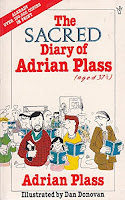
The Sacred Diary of Adrian Plass (aged 37 3/4) by Adrian Plass

The Sacred Diary of Adrian Plass
(Amazon UK link)
I love re-reading my collection of books by Adrian Plass. I don’t really do ‘favourites’, but he’s certainly in my top five living Christian writers. I first came across ‘The Sacred Diary of Adrian Plass (aged 37 ¾)' in the late 1980s when it was published, after starting life (I understand) as a magazine column. I loved it then, and I still love it now when I read it, as I aim to do at least once per decade. 

The last time I read this book was in 2016, which doesn’t feel all that long ago… but it’s nearly eight years, so it was definitely time for a re-read. I remembered a lot of the content, but not all. Once again I found myself laughing out loud every few pages.

The book is written in diary format, written by someone who, a tad confusingly, has the same name as the author although his family is different. The real Adrian Plass - author of the book - is married to Bridget and they have three sons and a daughter. The fictional Adrian Plass, supposed writer of the diary, is married to Anne and they have just one son, the teenage Gerald. Apparently this has led to many misunderstandings over the years.

The Adrian in the book (the one I will refer to for the rest of the review) comes across as likeable and intelligent, but somewhat caught up in his own estimation; and frequently making blunders. Right from the start it’s clear that he’s writing about his life, his family, his church and his faith. The book is written satirically, with a lot of self-deprecating humour.To give one example, he makes the claim that Christmas is getting too commercial and that he’s only going to send 10 cards, then a few pages later finds himself absentmindedly buying large numbers of multi-packs.

Adrian is by turns a buffoon, somewhat pompous and entirely naive. He misses what’s going on with his son and a girl who Adrian thinks is going out with someone else. He ignores his family’s demands while spending a lot of time giving practical help to members of his house group. He is asked to take on a position of responsibility and takes it far too seriously… 

That might not sound remotely amusing out of context, and the humour won’t appeal to everyone. But if you are - or ever have been - part of a church, or indeed any other religious group, and if you’re willing to have your ideals and principles turned inside out at times, this is a light-hearted book which manages to make some excellent, thought-provoking points about the nature of the real Christian life. 

And there are some serious entries in the diary. Unexpected people decide they are interested in following Jesus, partly due to Adrian even if things didn’t work out quite as he planned. And there’s a lovely, elderly couple whose story makes a very poignant background to some of the more light-hearted anecdotes.

There are many ‘in’ jokes which might not mean much to today’s younger folk, or indeed to those who have never been in a church or Christian group. But I think there’s enough in this that this could still appeal to a modern generation, if only to show the value of not taking oneself too seriously. 

It’s a wonderful book which I’m sure I will continue to read regularly. 

Note that there are several sequels to this book, some with similar titles. But this one, where the fictional Adrian is aged 37 (and three-quarters) is the first and, in my view, the best. 

Review copyright 2024 Sue's Book Reviews

13 Apr 2023

Seriously Funny 2 (by Adrian Plass and Jeff Lucas)

Seriously Funny 2 by Plass and Lucas
(Amazon UK link)
I have thoroughly enjoyed almost everything I have read by both Adrian Plass and Jeff Lucas, two of the best modern Christian writers, in my opinion.  So it was a no-brainer to acquire the books they wrote as a collaborative project, in particular the two entitled ‘Seriously Funny’. I re-read the first book in May last year, but hadn’t read ‘Seriously Funny 2’ since 2013. 


I’ve had a busy few weeks with visiting family, so I’ve just read a few pages of this each morning, when I could grab a few minutes to myself. It’s not a typical devotional book, but still gave me things to think about. More importantly, it gave me reassurance about life as an ordinary, everyday believer who struggles, at times, to think beyond the immediate chores and demands of those around me. 


It’s written in letter format; I wondered, when I first read this, if Jeff and Adrian wrote the letters knowing they were going to be published, and thus adjusted the way they wrote to take account of this. They come across as authentic, sometimes vulnerable; yet also with quirks that suggest they’re thinking as much about their future readers rather than each other. 


I found it a little jarring, for instance, when the letters mention the other person’s name every few paragraphs, rather than just in the simple greeting at the beginning. I don’t use people’s names when I’m talking to them, unless I need to get their attention for some reason - and I certainly don’t when I write the bulk of a letter or email to them. People can read letters at their leisure; no need to keep using their names. 


But it’s a minor gripe, and perhaps unfair to harp on about it. The bulk of the book is wonderful, discussing everything that comes to their minds. They talk about faith and Christian practice in a very relaxed, informal style. They express their frustration with jargon, and clichés, and pat answers, which are far too often given to people asking genuine questions. 


The integrity of the two comes through strongly, along with their humanity. I chuckled inwardly at the ongoing discussions of Jeff’s secret obsession with table tennis when he was a student; I smiled as they shared their ignorance (in the past) about what a concordance is. I loved the phrasing, the self-deprecating humour, and the evident camaraderie that exists between the two.


The titles of these books sum up exactly what’s inside them: amusing comments and asides which gently cushion the far more serious issues that the two authors discuss in their ongoing letters. They don’t claim to know all the answers, but they share experiences, acknowledging all the time that they could have been mistaken, and that anything positive is due to the indwelling Holy Spirit.  


Not everyone would like this style, which could be considered irreverent or even unsound by some. But if you’ve found that any of the books by either Adrian Plass or Jeff Lucas resonate with you, I would recommend this as well as the first in the series.


Review copyright 2023 Sue's Book Reviews