![]() |
| (Amazon UK link) |
29 Mar 2025
Apple Bough (by Noel Streatfeild)
22 Feb 2025
The painted garden (by Noel Streatfeild)
![]() |
| (Amazon UK link) |
30 Jan 2025
A vicarage family (by Noel Streatfeild)
![]() |
| (Amazon UK link) |
15 Dec 2024
Far to go (by Noel Streatfeild)
![]() |
| (Amazon UK link) |
12 Nov 2024
Thursday's child (by Noel Streatfeild)
![]() |
| (Amazon UK link) |
25 Sept 2024
The Bell Family (by Noel Streatfeild)
![]() |
| (Amazon UK link) |
17 Aug 2024
The Growing Summer (by Noel Streatfeild)
![]() |
| (Amazon UK link) |
9 Jun 2024
Gemma in Love [Goodbye, Gemma] (by Noel Streatfeild)
![]() |
| (Amazon UK link) |
2 May 2024
Gemma Alone/Gemma the Star (by Noel Streatfeild)
![]() |
| (Amazon UK link) |
15 Mar 2024
Gemma and Sisters (by Noel Streatfeild)
![]() |
| (Amazon UK link) |
31 Jan 2024
Gemma (by Noel Streatfeild)
![]() |
| (Amazon UK link) |
21 Nov 2023
Party Shoes (by Noel Streatfeild)
![]() |
| (Amazon UK link) |
12 Aug 2022
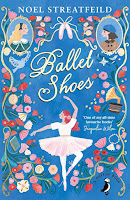
Ballet Shoes (by Noel Streatfeild)
![]() |
| (Amazon UK link) |
The main story, of course, is well-known. Great-Uncle Matthew, affectionately known as GUM, is a somewhat absent-minded collector of fossils. His orphaned niece Sylvia looks after him, with her former nurse known as Nana and a cook and housemaid - rather an extensive household, it seems to me from this 21st perspective, but quite a small staff for the era (1930s) in which it was written.
Gum finds three babies in rather different circumstances over about five years, and brings them to Sylvia, convinced she will be thrilled. Adoption was evidently a simpler process then than it is today, and the three girls, Pauline, Petrova and Posy, are brought up by the loving but old-fashioned Nana, and for the first ten years or so of their lives, they are comfortably off. Gum has gone on a long voyage of exploration, but put plenty of money in the bank. Sylvia is a bit dubious about when he might return so she puts some of the money aside… but eventually it runs out.
The two older girls have been going to a private school, but Sylvia can no longer afford to send them there, and decides to take in some paying guests. This works out well, and at the suggestion of one of the boarders, they are offered free places at a Stage and Dancing Academy. Pauline discovers a talent for acting, and Posy is an exceptionally good dancer, as well as a clever mimic. But Petrova wants to be some kind of engineer, and likes cars and aeroplanes much better than she likes dancing or acting.
The story is about their day-to-day lives, painting a wonderful picture of a loving - if unusual - family in the era. While the circumstances and finances mentioned are clearly well out-of-date, the personalities and conversations seem entirely relevant to today, albeit tinged with an innocence that seems to be gone from modern life. The children’s squabbles are minimal, but realistic, and Sylvia’s concerns about money all too relevant to families today.
I’d entirely forgotten some of the scenes, and many of the details, but loved re-visiting some of my favourite fictional characters, entering their world again for a few hours. I loved the book just as much as I did when I first read it over fifty years ago, and would recommend it highly to children - particularly girls - over the age of about eight or nine, and to adults who read these books in their own childhood.
Review copyright 2022 Sue's Book Reviews
23 Jan 2022
I ordered a table for six (by Noel Streatfeild)
![]() |
| (Amazon UK link) |
But I hadn’t realised until relatively recently that she also wrote some books for adults, which were out of print until Bello - an imprint of Pan Macmillan - republished them. I read a few reviews and decided that some of them were probably not to my taste, but a couple of others intrigued me. So I put ‘I ordered a table for six’ on my wishlist, and was given it a little over a year ago. It’s taken me this long to read it…
I have to say, it doesn’t encourage me to buy any more of Streatfeild’s grown-up books. It’s a character-based novel, which is fine, and one or two of the people are quite likeable. There’s Letty, an excellent secretary/PA, who works hard and is quite observant. There’s Meggie, too, whom we don’t meet until later in the book. She’s nearly 17; she’s unspoilt, honest and finds it hard to behave like an adult. She’s the daughter of Adela - who’s a very strange, insecure person.
This book is set in the war years, and Adela has turned her London house over to a charity, making clothes for people who have been bombed. This sounds positive, but she’s a remarkably self-centred character who likes the esteem and admiration she gets from running this company - although many of the garments produced are uncomfortable and ugly. She’s funded by an American man who’s married to an old school friend of hers, and shortly after the book opens, we learn that he is coming on a visit.
So Adela decides to have a little dinner party at a local restaurant. Just six people: in addition to herself and her patron, she’s inviting her daughter (who normally lives in the country with her aunt and uncle), a young man who’s visiting the patron, Adela’s niece - who works all hours at canteens for air raid shelters - and a young man who one of her son Paul’s friends. Paul, we learn, was Adela’s pride and joy but did something so dreadful that she never wants to see him again. She was a terrible mother, who gave her son everything he could possibly demand, and yet neglected her daughter whom she didn’t much want.
Just typing all this makes me realise that the characters are well-drawn, even if mostly not very likeable, as I recall not just their names, but quite a bit about them. That’s partly because the viewpoint switches regularly, so that we see not just the actions but the thoughts of many of the different people, and gradually the past unfolds. It’s quite a readable book, and at times I found it difficult to put down, although there’s really not a whole lot of story.
However, unlike with the author’s books for children, I didn’t feel much empathy for anyone, and kept wondering when the story was going to start. It takes awhile to organise the dinner party - mostly done by Letty - and it’s only the last few chapters that feature it. There are some thought-provoking ideas gently raised, and there are also hints through the book that something terrible is going to happen. Letty’s young man is very against the idea that she might have to go to the party. Meggie keeps wishing she could be in an air raid, and the young man at the dinner party is looking forward to being a fighter pilot, hoping he might eventually make his parents proud.
The climax comes shortly before the end of the book, clearly meant to be shocking, and yet with so much foreshadowing, I was expecting it earlier. What did shock me was the result - and the way the book then ended, with nothing encouraging for the future, other than one person beginning to wonder if there might be a God. We don’t know what happens to any of the characters, or how their particular problems were resolved (or not). I know Streatfeild did tend to end her novels abruptly but there is usually at least some hint of resolution, and a way forward.
All in all, although I’m glad I’ve read this, I found it somewhat disappointing. Maybe I was expecting something lighter; I couldn’t help contrasting it negatively with the innocence and good relationships that tend to run through the author’s children’s books.
Review copyright 2022 Sue's Book Reviews24 Mar 2019
Dancing Shoes (by Noel Streatfeild)
![]() |
| (Amazon UK link) |
‘Dancing Shoes’ was originally entitled ‘Wintle’s Wonders’. I managed to get hold of a second-hand edition about ten years ago, and when I read it then I had no memory of having read it previously. Re-reading it in the past couple of days, I recalled only the vaguest idea of the plot, but I liked it very much.
Rachel and Hilary are the main protagonists of this novel. Hilary is Rachel’s adopted sister, and they are both ten years old when the story opens. It starts with a tragedy in their lives, as happens quite often in the Streatfeild world. Rachel’s father had died some years earlier, and now her mother also dies after a nasty accident.
Rachel and Hilary are very different. Hilary is quite an extravert, a talented dancer, and somewhat allergic to hard work. Rachel is serious, loyal, and quiet, mostly keeping her feelings to herself. Rachel’s aunt Cora runs a dancing school and offers the girls a home, but they have to attend her school and be trained as dancers. Which Hilary is happy to do - she wants to be in a showy dance troupe, doing handstands and tap dancing as well as ballet. But Rachel has no talent for dancing and hates being on stage.
Rachel is also worried about Hilary getting into bad habits. She was about to audition for the Royal Ballet School when their mother died, and supposedly had a glittering future ahead as a ballet dancer. A lot of the story is about Hilary’s determination to be a ‘Wintle’s Wonder’ dancer, while Rachel tries to coerce her into taking ballet more seriously.
While there are some caricatures amongst the minor characters, I thought both Rachel and Hilary were very well created and quite three-dimensional. They are both likeable girls with very different personalities. They are in stark contrast to Aunt Cora’s daughter Dulcie, who is a couple of months older than Rachel. Dulcie is a talented dancer but is very arrogant about it, not helped by her mother’s over-praise and adulation.
Most of Noel Streatfeild’s books have talented children in them, usually dancers. So it’s unusual to find that the ‘promising’ ballet dancer, Hilary, has very little interest in taking her talent seriously. Will she be wasting her life if she abandons ballet for other kinds of dance…? The question is considered from various perspectives. I felt a bit sorry for Rachel at first, but she becomes almost compulsive in her determination to make Hilary do something she really doesn’t want to do.
In a way, it’s Rachel’s story as she is the one who gradually matures, listens to other people’s opinions, and starts her own career path in the final chapter. Although I had forgotten the story as such, it was fairly easy to see where the plot was going in the last couple of chapters. And, as with most of Streatfeild’s novels, once everything is settled, the book ends very quickly.
‘Dancing Shoes’ was written for girls of around eight to twelve, as were most of this author’s books. But I think I like them even more now than I did when I was that age, seeing the children’s development from the perspective of several decades on. They make excellent read-alouds, and while they’re inevitably dated (as is obvious from some of the comments related to money) the personalities and issues covered are always topical.
Highly recommended if you like children’s fiction of this kind, or if you know of children who like stories about dancers and stage schools.
Review by Sue F copyright 2019 Sue's Book Reviews
3 Feb 2019
Caldicott Place (by Noel Streatfeild)
![]() |
| (Amazon UK link) |
I read it almost in one sitting. Streatfeild’s books were intended for older children or young teens, and it only has about 160 pages. But I was caught up in the characters immediately.
The Johnstone family were comfortably off and happy, we learn, until their father has a nasty car accident. Bill, the eldest boy, is almost thirteen when this tragedy happens. Carol is eleven-and-a-half, and Tim is nearly eight. They have a dog called Jelly whom they all love, but he is primarily Tim’s dog. Bill is something of a science nerd, and Carol is a ballet dancer; not one of Streatfeild’s utterly focussed and brilliant potential ballerinas, but quite talented. She hopes to do some kind of dancing professionally when she’s an adult.
The car accident was not their father’s fault, but he is unconscious for a while, and when he starts to recover from his physical injuries, he seems to have changed personality. No longer loving and enthusiastic, he seems to see everyone through a fog of apathy. Carol and Tim aren’t even allowed to see him in hospital; Bill and his mother are very worried. Finances prove a problem too, so they have to move somewhere small and poky so that their mother can go out to work rather than looking after their large house. That means different schools, different dancing classes, and - worst of all - Jelly has to be left with the people who rent their house.
Then something astonishing happens - something so unexpected that the family doesn’t know quite what to make of it, and I hadn’t remembered it coming. There’s the chance of moving out into the countryside, so long as they are willing to take on the added responsibility of three paying guests, children of around the same ages as the three Johnstones, who for various reasons have no real home.
It’s a character-based story, with the underlying theme of their father’s slow, often tentative moves in positive directions. There are some caricatures, of course, and while the children are fairly three-dimensional, they have similarities to children in Streatfeild’s other books. Sophie, the youngest of the paying guests, for instance, reminded me a lot of Lydia in the ‘Gemma’ series.
There’s gentle humour in some of the interactions, and one or two parts that are unexpectedly moving. It’s dated, of course; published in the 1960s there are overtones of sexism and racism and a definite class-consciousness. But Streatfeild’s stories aren’t concerned with these; they are a (probably realistic and most likely unconscious) background to some of the scenes rather than anything deliberate.
Recommended to anyone from the age of about eleven and upwards who enjoys a good, character-driven story about changing circumstances. Or to adults like me who loved these books as children.
'Caldicott Place' is often found in charity shops, but also reprinted from time to time.
Review by Sue F copyright 2019 Sue's Book Reviews