Showing posts with label Rachel Hore. Show all posts

22 Sept 2019

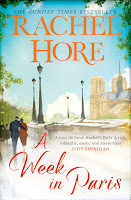
A Week in Paris (by Rachel Hore)

A week in Paris by Rachel Hore
(Amazon UK link)
I have read about half a dozen novels by Rachel Hore over the past ten years or so. I have liked them all, although not so much that I immediately put all her other books on my wishlist. However, when I spotted ‘A Week in Paris’ at a church book sale a few months ago, it was an easy decision to buy it. It sat on my to-be-read shelf since then, and I picked it up to read a few days ago.

As with many recent books, this story takes place in two separate time periods, and the plot involves the gradual uncovering of some secrets in the past. But this is a little different from many in that the ‘past’ section of the book takes place in France before and during its occupation by Nazi forces in the 1940s.

Fay is the main viewpoint character. We meet her first when she is sixteen, in 1956, on a school trip to Paris. She is pretty sure she has never been there before, but various places seem to trigger a sense of deja vu. When she gets home she asks her mother, Kitty, if she has ever been to Paris, but Kitty is very reticent about the past. Fay’s father Gene died during the war and her mother still grieves for him; Fay doesn’t like to push her to talk about her early childhood, or the events surrounding her father’s death.

Then the book moves forward a few years, to 1961. Fay, in her early twenties, is now a talented violinist, about to go on a concert tour to Paris. Her mother is convalescing in hospital, after a psychiatric incident, and Fay is very concerned about her. There are clearly events in the past which Kitty has been keeping to herself, which are disturbing her seriously.

The bulk of the book takes place during Fay’s week in Paris. She plays in concerts, and also follows up a clue which her mother gave her when she last saw her. This takes her, eventually, to a woman called Nathalie who knew Kitty in the 1940s, and who also knew Fay as a child. And over the course of three afternoons, Nathalie gradually tells Fay about her early childhood. Nathalie apparently knew Kitty - or knew all about her - when she first went to study the piano in Paris, and tells the story of her meeting and falling in love with Gene.

The way the book is written is clever, slowly building up a picture of Kitty’s life as a young adult, and the birth of Fay, alongside the growing concerns about war. I’m not usually very keen on war-related books, but this one stays character-based, not skating around some of the terrible issues of war, but seeing events from a civilian point of view. I could feel Kitty’s fears, her worries for her daughter, and her terror of losing her husband. He is a doctor, but it becomes clear that he’s also involved in some underground activities.

I’m not sure I had ever before understood even a little of what it must have been like for people living in France while it was occupied; the daily terror of interrogation, the gradual disappearance of Jews, the suspicion of neighbours. I had not appreciated, either, that the rationing and availability of food in Paris was even worse than it was in the UK during this period. Rachel Hore, who is apparently a historian anyway, has done her research extremely well. She sets the scenes in a way that seem authentic to me, without being overtly educational. It's the small, sensory details that keep it realistic.

Fay as a young adult is a likeable person, although I didn’t find her entirely three dimensional - and while I could relate a bit better to Kitty, I never did understand why she told Fay nothing at all about her early childhood. There’s a low-key romantic thread too; Fay bumps into Adam, a young man she met when she was sixteen, in what is perhaps too much of a coincidence for reality. But it’s not impossible, and it happens early enough in the book that it didn’t matter.

I worked out who Nathalie was, in the narration, long before Fay did. And I had also guessed the incident that both Nathalie and Kitty are unwilling to tell her, so when it is revealed there is no sense of surprise. I had guessed early on what the initial, nameless prologue referred to, too; it’s neatly finished in an epilogue, but, again, there is nothing unexpected. If I have a slight gripe with the book it's that there are too many hints and too much introspection which then stop any element of surprise when the answers appear.

But overall I thought it a powerful, moving book. It’s very well-written, and the ending, albeit predictable, is entirely satisfactory.

Definitely recommended.


Review copyright 2019 Sue's Book Reviews

7 Mar 2016

The House on Bellevue Gardens (by Rachel Hore)

The House on Bellevue Gardens by Rachel Hore
(Amazon UK link)
I’ve liked all the books I’ve read by Rachel Hore, over quite a few years now, so I was delighted when I saw her latest novel available for review at the Bookbag site. Each of this author’s books is somewhat different; when I saw the image on the front cover, I thought immediately of a somewhat old-fashioned house in a London square.

That’s pretty much what ‘The House in Bellevue Gardens’ is about. Leonie is an artist, who lets out rooms to people in need. There’s Peter, who occupies the basement and lives in squalor; an elderly Indian couple, Hari and Bela, and a rather shy young man called Rick who is writing a graphic novel.

Then there are two young women whom we meet at the start of the book: Rosa is from Poland; she’s come to London look for her brother. Stef has run away from a controlling relationship and has nowhere else to go.

The format of the book seems a little confusing at first, with short sections from different viewpoints. Despite their different backgrounds, I found it a bit difficult to distinguish Stef and Rosa sometimes, but Leonie is a delightful person, and her unfolding story kept me reading, sometimes for an hour or more at a time. There are some caricatures in the minor characters, but that’s not necessarily a bad thing.

It’s not a fast action story, nor is there any clear plot. The recurring theme is that of freedom, and the many ways in which people can be trapped. There’s a bird stuck in a chimney whose struggles and eventual fate mirror those of some of the people. The writing flows almost poetically at times; the author’s use of description and setting are excellent, full of sensory detail.

The last few chapters felt a bit hurried, with one or two surprises and much that was predictable. But it’s a thought-provoking book, and I enjoyed it.

You can also read my slightly longer review of 'The House on Bellevue Gardens' at the Bookbag site.

Review copyright 2016 Sue's Book Reviews

8 Aug 2013

A Gathering Storm (by Rachel Hore)

A Gathering Storm by Rachel Hore
(Amazon UK link)
I first read one of Rachel Hore’s books about five years ago, and liked it very much. So much so that I have gradually collected more of her books over the years. She writes thoughtful women’s fiction, saga style, usually blending present-day and past stories within family settings. It works well, and turns out to be similar to the theme in ‘A Gathering Storm’, her fifth novel, which I have just finished reading.

The prologue, set in the year 2000, features an elderly woman called Beatrice slipping into a chapel for a memorial service. We quickly learn that it’s for her friend Angie, yet she had not been in touch with her for many years. She is particularly interested in Angie’s son Tom and his teenage daughter Lucy; when the service finishes, she almost goes to speak to them but is prevented from doing so by another elderly woman whom she addresses as Hetty. And the prologue ends with Beatrice agonising over a lie... one that gradually unfolds in the rest of the book.

The years fast forward to 2011. Lucy, now in her twenties, is in a car with her boyfriend, clearly not on the best of terms. She want to explore an old family house; he does not want to. He is persuaded eventually, but then she decides to stay in the neighbourhood for a few days. And through various circumstances she finds herself chatting to Beatrice, now an old lady, who feels that it’s important to talk about the past, and why Lucy’s father - who has also died - was searching for some unknown uncle by the name of Rafe.

We then leap back to 1935. Young Beatrice, an only child, becomes friendly with the four Wincanton children who live nearby. Angie is the oldest and rather a selfish, spoilt teenager, although she can be very friendly and kind when she feels like it. They spend the summer together, and their lives are, thereafter, entwined irrevocably. Beatrice and Angie fall for the same young man, but their lives drift apart when Beatrice starts war work.

The pace of the novel was exactly right for me to read it over several evenings. The different time frames could have been confusing; every so often we return to 2011 as Beatrice becomes tired, and Lucy leaves for a while. The story is supposedly told over several days, but it’s not in the first person; instead it works well as lengthy flashbacks, looking into the past, helping Lucy to understand what life was like, and - gradually - what comprises Beatrice’s enormous long-held secret.

Long before the secret was revealed, I had guessed what it would be, but that didn’t matter at all. The story moved forward apace, and there were some quite exciting scenes as Beatrice becomes involved in secret work during the war, putting her life into grave danger. I have to say, I couldn’t quite reconcile her actually choosing to do this, given her circumstances - and although some of it was horrific, I knew that she was going to come through alive, since she was still around in 2011 to tell her story to Lucy.

I liked Lucy very much, and was pleased at the resolution of the book, although sad that Lucy’s father was not around to find out what had happened. I was slightly mystified, too, why Beatrice had not simply got in touch with Tom after Angie’s funeral, despite what Hetty said. But this kind of mild frustration with characters is indicative of excellent writing, making them feel very real to me.

All in all, I thought this a very readable and thought-provoking book.

Recommended.


Copyright Sue's Book Reviews, August 8th 2013

28 Sept 2012

The glass painter's daughter (by Rachel Hore)

The Glass Painter's Daughter by Rachel Hore
(Amazon UK link)
I first came across Rachel Hore about four years ago, when Amazon started recommending her books to me, based on what I already liked. I put one of them - 'The dream house' - tentatively on my wishlist, and liked it very much when I read it. Since then I read a couple more, and enjoyed them too. They're character-based books, often involving a dual time-frame.

I was given 'The glass painter's daughter' for Christmas last year, but my shelf of unread books is so full that it's taken me nine months to get around to reading it - and it hasn't been a quick read.

The story is told from the point of view of Fran, a young woman who is a tuba-player, travelling around the world. She gets an SOS call from Zac who works for her father in his glass restoration business, letting her know that her father has had a stroke. Fran rushes home, concerned that she had not been getting along with her father for some time, and still upset that there is secrecy - or at least silence - surrounding the circumstances of her mother's death when she was a small child.

Fran and Zac get involved in a difficult project, trying to restore a window from a church that was bombed. In hoping to find out what it originally looked like, Fran comes across a diary written over 100 years previously, by a girl called Laura. The narrative then alternates between the present and the past, as Fran not only learns about Laura and the stained glass window, but starts to discover more about her own background - and also attempts to communicate with her father.

Among other things Fran spends time with an old friend called Jo who seems oddly unpredictable, and joins a choral society which is conducted by the rather gorgeous Ben. Fran just got over a difficult relationship but finds herself more and more attracted to Ben, and it seems to be mutual...

Then there's Amber, a young and nervous girl who lives in a hostel. She is fascinated by art, and glass-painting in particular. She's also fascinated by by angels. And there are a lot of angels in the shop, including one hanging in the window.

It's quite a long book - over 400 pages - and it took me over a week, reading a chapter each evening, to get into it properly. It's rather slow-moving at first, and there's a lot of detail about the way stained glass windows are made. The author has evidently done her research well; it doesn't come across as patronising or educational, and yet I don't really read fiction to learn about a new craft. I could have done with rather less information, albeit well-presented.

However, by the time I was half-way through the book I began to find the storyline much more interesting. I did sometimes forget the various names - there's quite a cast, and with two different storylines it was sometimes difficult to remember where I was. I read the second half of the book in about three days, and found some of it quite moving. By contrast to the beginning of the book, the last chapters seemed to race by; I found myself wanting to slow down a bit and find out rather more of what was happening. By this stage I felt I knew the characters a bit better and didn't want to gloss over their doings.

The ending worked well, if predictably so and it's the kind of book that I'm sure I'll be lending to friends. It's refreshing in that it has no bad language at all, and not even a mention of any intimate scenes - just the vaguest of hints.

There's a surprising amount of Christian content for a modern secular book; not that there's any preaching, even subtly, but there's a delightful Vicar called Jeremy who was friends with Fran's father, and who somewhat takes her under his wing. So as well as the fairly extensive angelic theme to the book, there are talks about forgiveness, and reaching out to the poor, and more. It felt quite low-key to me, and worked well, but might perhaps be disturbing to anyone who is an atheist and unwilling to suspend their disbelief.

I'm glad I read it, and would definitely recommend 'A Glass Painter's Daughter'. Available in Kindle form as well as paperback.

Review copyright Sue's Book Reviews, 28th September 2012

16 Apr 2011

A place of secrets (by Rachel Hore)

A place of secrets by Rachel Hore
(Amazon UK link)
I've read a couple of other books by Rachel Hore, and enjoyed them. So I was very pleased when I saw this for a euro at a church bookstall - particularly since it was only published about six months ago.

'A place of secrets' is the story of Jude, a young woman who has suffered some tragedy in her life. She has often been plagued with a strange dream, oddly realistic, where she is running through the woods searching for her mother. Even odder, her young niece Summer seems to be having the same dream...

Jude is a valuer of antiquities, and takes on a job at a stately home near where her sister and Summer live. She goes to examine and value a collection of journals and books about astronomy, and finds herself becoming friendly with the family. She finds herself particularly in rapport with the grandmother, who is devastated that this collection will have to be sold in order for the roof to be mended.

Jude is also interested in a cottage where her grandmother - who has plenty of secrets - used to live, and in a folly that looks as if it might be dangerous, and has something of an atmosphere. And she's very drawn to a young man who lives in the cottage, and sometimes works in the folly.

The relationships are complex, but I felt that the people were mostly believable, and didn't have much problem distinguishing them. Jude was a sympathetic person whom I warmed to, which meant that I felt some of her suspense; it was not really a good book to be reading before going to sleep.

The biggest problem with this book is that there are an incredible number of coincidences... both in what Jude discovers and in the way people turn up out of the blue, and are found to have an important part to play in the story. I had to suspend belief several times; I don't mind doing so in a fantasy novel, but it seems odd to have to do so in something set in 21st century England.

I could accept the slightly surreal generational dreams and their eventual explanation, which was nicely done; but the appearance of a jewel, a young man, and a torn journal (amongst others) added up to way too many coincidences.

Still, it was written in a very readable style, and on the whole I enjoyed it very much. Recommended, so long as you don't object to the coincidences and an ultra-tidy ending.


Review copyright Sue's Book Reviews, 12th April 2011

1 Sept 2009

The memory garden (by Rachel Hore)

The memory garden by Rachel Hore
(Amazon UK link)
I first came across Rachel Hore when I was recommended some of her books by Amazon. I liked what I read about them in the reviews, and put a couple on my wishlist. I very much enjoyed the first one I read - 'The dream house' - and looked forward to getting into another.

'The memory garden' is well-written, relaxing and enjoyable, although it took me well over a week to get through it. The main story features a young and rather stressed woman called Mel. She goes to Cornwall, in the hope of a retreat from the current overwhelming nature of her life, taking a sabbatical from work to write a book about local artists. She finds herself intrigued by some pictures she finds there. She is also very interested in Patrick, the owner of the place she is temporarily renting.

Past and present intertwine, as we learn about the young woman who did the paintings, and gradually Mel puts the story together. There's also, naturally, a low-key romance which takes many twists and turns.

I didn't find the book particularly memorable; nor did I find it totally irresistible, and sometimes found I had to back-track to see what I'd read the previous evening. Still, overall I found it gentle and heartwarming, with a satisfying conclusion. Recommended.


Review copyright Sue's Book Reviews, 1st September 2009

5 Jul 2009

The dream house (by Rachel Hore)

The dream house by Rachel Hore
(Amazon UK link)
I'd never heard of Rachel Hore. But her novels were recommended to me on Amazon, based on books I had already read and rated. I read some of the reviews, and thought they sounded just my kind of book. So I put her novels on my wishlist, and was delighted to receive one for Christmas last year.

'The dream house' is unquestionably women's fiction, almost a saga novel. It's mainly in the present, but involves some diaries that take us into flashbacks of the early part of the 20th century.

The main character is Kate. She is finding her London job tiring, at the start of the book, and is worried that she spends too little time with her children. So when her husband Simon suggests that they should sell their house, and buy somewhere bigger in the country, she is happy to do so.

They stay at first with Simon's mother Joyce, and things seem to be going well... until Simon starts behaving strangely, and it's clear that there are problems afoot.

Meanwhile Kate has a strange dream after buying a locket in a second-hand shop. Then she meets Agnes, a delightful old lady, and begins to explore the past through her eyes. A family tree at the start of the book means that some of the unexpected revelations in the book were not in fact surprises; others, later on, were fairly predictable.

It took me a few days to get into the book, but I found the characters - particularly Kate - very believable. While I could see what was coming most of the time, I enjoyed the way it was written, and the process by which circumstances happened. By the end I found it hard to put down. There was a little too much use of coincidence for realism, but somehow it didn't matter.

Overall, I found this novel very enjoyable. I look forward to reading more by Rachel Hore. I'd highly recommend this to anyone who enjoys women's fiction that's more than a couple of hundred pages.


Review copyright Sue's Book Reviews, 5th July 2009