![]() |
| (Amazon UK link) |
26 Mar 2026
Standing on my knees (by Jeff Lucas)
27 Jul 2025
The cactus stabbers (by Jeff Lucas)
![]() |
| (Amazon UK link) |
31 Mar 2025
Faith in the fog (by Jeff Lucas)
![]() |
| (Amazon UK link) |
30 Dec 2024
I was just wandering (by Jeff Lucas)
![]() |
| (Amazon UK link) |
31 Oct 2024
How not to pray (by Jeff Lucas)
![]() |
| (Amazon UK link) |
29 Dec 2023
Rediscovering the Father Heart of God (by Jeff Lucas)
![]() |
| (Amazon UK link) |
30 Sept 2023
Lucas on Life (by Jeff Lucas)
![]() |
| (Amazon UK link) |
13 Jun 2023
Staying in the Boat (by Jeff Lucas)
![]() |
| (Amazon UK link) |
13 Apr 2023
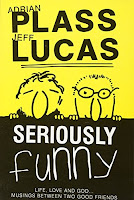
Seriously Funny 2 (by Adrian Plass and Jeff Lucas)
I have thoroughly enjoyed almost everything I have read by both Adrian Plass and Jeff Lucas, two of the best modern Christian writers, in my opinion. So it was a no-brainer to acquire the books they wrote as a collaborative project, in particular the two entitled ‘Seriously Funny’. I re-read the first book in May last year, but hadn’t read ‘Seriously Funny 2’ since 2013. 
(Amazon UK link)
I’ve had a busy few weeks with visiting family, so I’ve just read a few pages of this each morning, when I could grab a few minutes to myself. It’s not a typical devotional book, but still gave me things to think about. More importantly, it gave me reassurance about life as an ordinary, everyday believer who struggles, at times, to think beyond the immediate chores and demands of those around me.
It’s written in letter format; I wondered, when I first read this, if Jeff and Adrian wrote the letters knowing they were going to be published, and thus adjusted the way they wrote to take account of this. They come across as authentic, sometimes vulnerable; yet also with quirks that suggest they’re thinking as much about their future readers rather than each other.
I found it a little jarring, for instance, when the letters mention the other person’s name every few paragraphs, rather than just in the simple greeting at the beginning. I don’t use people’s names when I’m talking to them, unless I need to get their attention for some reason - and I certainly don’t when I write the bulk of a letter or email to them. People can read letters at their leisure; no need to keep using their names.
But it’s a minor gripe, and perhaps unfair to harp on about it. The bulk of the book is wonderful, discussing everything that comes to their minds. They talk about faith and Christian practice in a very relaxed, informal style. They express their frustration with jargon, and clichés, and pat answers, which are far too often given to people asking genuine questions.
The integrity of the two comes through strongly, along with their humanity. I chuckled inwardly at the ongoing discussions of Jeff’s secret obsession with table tennis when he was a student; I smiled as they shared their ignorance (in the past) about what a concordance is. I loved the phrasing, the self-deprecating humour, and the evident camaraderie that exists between the two.
The titles of these books sum up exactly what’s inside them: amusing comments and asides which gently cushion the far more serious issues that the two authors discuss in their ongoing letters. They don’t claim to know all the answers, but they share experiences, acknowledging all the time that they could have been mistaken, and that anything positive is due to the indwelling Holy Spirit.
Not everyone would like this style, which could be considered irreverent or even unsound by some. But if you’ve found that any of the books by either Adrian Plass or Jeff Lucas resonate with you, I would recommend this as well as the first in the series.
27 Feb 2023
Grace Choices (by Jeff Lucas)
![]() |
| (Amazon UK link) |
‘Grace Choices’ is subtitled, ‘Walking in step with the God of grace’, which is quite a claim to make. But the writing is quite pragmatic and honest about the fact that most of us get it wrong at least some of the time. There are nine chapters, after an introductory session explaining why Jeff Lucas decided to write the book. He explained that he saw a lot of people in different circumstances, and that many of them, including some devout believers, felt imprisoned in a wall without a hint of grace.
So the book takes us through different aspects of grace. There’s a good balance of Scripture, personal anecdotes and commentary. The first chapter tries to persuade us to believe the truth that God really does love - and like - each of us, that it’s not just an abstract theological idea. He acknowledges that many people have been badly damaged in their childhoods, through no fault of their own, and that it can be very difficult, sometimes, to believe that the God of the universe really does care about us.
The book goes on to look at possibilities of changing and maturing. It emphasises more than once the need of forgiveness, not to ignore bad things, or even to stop consequences to the perpetrator; but because forgiveness opens up our hearts and minds, and stops us dwelling on hurt, or potential revenge.
I was particularly taken with a chapter about seeing God’s grace in day-to-day events, pointing out that we can’t relive the past or see into the future. But we can appreciate what we have, and acknowledge God’s hand in a beautiful sunset, or a flower in bloom, or a hug from a loved one. We can also try to ensure that we become a means of grace to other people - showing God in us, rather than (as can be all too easy) criticising and complaining.
It’s quite basic: there wasn’t anything new in this book, or anything I had to research further. There wasn’t anything I disagreed with, either; I appreciated the author’s anecdotes and insights, and also found some of the comments to be a useful reminder of grace all around us, and of ourselves showing grace, if possible, to those around us.
I read about ten pages each morning, which gave me a good chunk of the book to ponder on - and hopefully to recall in the future, even after the book is back on its shelf. Jeff Lucas writes well, without being pushy or authoritarian, and all in all I thought this a good book.
Intended for believers - some familiarity with the Bible is taken for granted. The book is particularly for those who feel insignificant or who find it difficult to relax or laugh, but could be picked up by anyone who would like to know more about God’s grace in practice.
Recommended.
31 May 2022
Seriously Funny (by Adrian Plass and Jeff Lucas)
![]() |
| (Amazon UK link) |
I had remembered that the format was that of letters - the two writers take it in turns to write to each other. I don’t know whether this was real correspondence, later turned into book format (after, I assume, some editing) or whether the letters were written specifically for the book. It doesn’t much matter; the topics discussed are wide-ranging and interesting, including plenty of the somewhat self-deprecating anecdotes that both Plass and Lucas are known for.
While these two writers are from somewhat different Christian traditions, Jeff Lucas being primarily a speaker/preacher living in the US, and Adrian Plass primarily a writer in the UK, they also have a great deal in common including a quirky, sometimes cynical way of looking at the world and the church. They admit to boredom in church services and meetings, and to thinking thoughts they really shouldn’t about ways of getting rid of particularly dull or annoying speakers.
But they also agree on much more important matters - that of caring for everybody, no matter how unimportant they might feel, of finding Jesus in everyone, and of trying to be a follower of Jesus, expressing his love for those around them. So, as the title of the book suggests, the book is both serious and amusing; humour is used by both writers to good effect to introduce significant issues and to explore questions of theology, morality and ethics.
Each letter is just a few pages long and I read two or three each day, finding much to ponder. Having said that, when I started writing this I couldn’t really recall anything said other than a few of the anecdotes. But as with most books like this, the content eases its way into my subconscious, and I will recall what is needed at appropriate moments.
There are no great theological discoveries or solutions, and even when I read this for the first time, I don’t think there was anything new or dramatically different. But I love the way both these writers look at the world, accepting people for who they are, with no need to wear metaphorical masks, no need to be competitive or to make up personalities for the world. Both these men have had troubled pasts in different ways, both have worked through extremely difficult periods, and both are honest - sometimes embarrassingly so - about their mistakes.
Probably not of great interest to anyone outside the church, but a refreshing and fairly quick read for anyone who might have found church meetings boring, or who gets irritated when people imply that everything is wonderful all the time. it's not hilariously funny, but amusing at times, poignant in places, and quite thought-provoking.
Definitely recommended.
Review copyright 2022 Sue's Book Reviews26 Feb 2021
Specks and Planks (by Jeff Lucas)
![]() |
| (Amazon UK link) |
I was given ‘Specks and Planks’ for Christmas, having learned that this was Jeff Lucas’s newest book. I was slightly surprised to realise how very recently it had been written, as the prologue and introduction reference the Coronavirus pandemic. Not that the book touches on it too much, but it’s taken as a background to much of the writing. Some of the anecdotes mention Covid patients, some refer to how life in lockdown or isolation is rather different from what we’re used to.
The book is a collection of 34 short chapters, each one containing an anecdote and relevant thoughts. None of them is more than three or four pages long, so I decided to read two or three of them each day over the past couple of weeks.
The title is based on Jesus’ command to his disciples to avoid taking specks out of their neighbours’ eyes while ignoring the planks in their own. This unusual metaphor has been discussed and unpacked by many theologians over the millennia; perhaps the planks refer to judgmentalism, not just the way we tend to point the finger at (or become irritated by) negative traits in others which are our own faults.
However Jeff Lucas doesn’t try to explain what this might mean in any detail. He just takes it as the broad theme to the book - that of learning more about himself through his actions, foibles and mistakes. He paints himself as a somewhat bumbling, often confused chap, delving into his strongly enthusiastic and evangelistic past for some of the stories.
In the pages of this book we meet a dedicated nurse, a legalistic church member who later lost his faith, a friend and his mother who welcomed the young Jeff Lucas on holidays… and many more individuals. They’re highlighted briefly, coming to life in my mind, and each story is followed by a gentle lesson, or thought, or prod to the conscience.
As with most books of this kind, it’s hard to remember many details after I’ve put it down for the day, but I hope that the stories and their following thoughts have made their way into my subconscious. And it’s certainly a book I hope to read again, in a few years’ time.
Excellent writing, with an honesty that might shock some believers (or non-believers, for that matter) who think that everything should be perfect, or at least that people should not admit to their faults. But the focus is on being kind, on assuming the best, and on seeing Jesus in even the most unlovable of people.
Very highly recommended.
Review copyright 2021 Sue's Book Reviews30 Sept 2020
Lucas Out Loud (by Jeff Lucas)
![]() |
| (Amazon UK link) |
It’s quite a short book, only 100 pages in all, but full of thought-provoking anecdotes and commentary. Each section is just three or four pages, and I read around three of them each day for a little over a week. Lucas starts by recounting stories or slightly surreal scenarios with wry humour, often casting himself as a likeable buffoon, or a victim of circumstances. These accounts are interesting, and they’re then followed by brief comments on church life or Scriptural passages.
The anecdotes or introductions aren’t just light humour to catch the attention; they’re relevant, in different ways, to the ideas and insights that follow. For example, there’s a chapter about hugging, with some suggestions for ensuring that hugs are innocent, and a warning about dangers of over-enthusiastic hugging… with just a couple of paragraphs at the end, pointing out gently how important the weekly contact is to some folk who live alone. Reading this in the pandemic year when ‘social isolation’ and ‘physical distancing’ have become commonly used phrases, it was all the more poignant.
Another section recounts the author’s attempts to lose some weight - whether true or fictional, I have no idea. But he makes the point that the starting point is in the mind: in order to exercise early, or go to the gym, or give up unhealthy foods, the first battles are in our minds. We make excuses, procrastinate, persuade ourselves that we really need more sleep, or a sugar fix. Likewise, as he gently points out, any kind of spiritual discipline starts in the mind.
My summaries don’t begin to touch on the thoughtful, insightful way in which Jeff Lucas writes these short sections. In just a few paragraphs he tells stories, or presents ideas, and I found them all fascinating, in different ways. It was then very easy to segue into the more serious epilogue - often just a paragraph or two - which is the point of each section.
Lucas is no fundamentalist; he calls himself a charismatic evangelical, but is well aware of the failings of every label, and every variation within church culture and practice. He is honest about his thoughts and feelings, and very sympathetic towards those who struggle to fit in with church life, and the hypocrisy that can sometimes be found there.
Intended for people who follow Jesus, this book could be read by anyone interested in the church, or who struggles to maintain any kind of spiritual life. But there’s also a great deal for any believer, whatever stage they are in. I don’t think I learned anything new, exactly, but I was certainly reminded of some important truths, and saw some issues in new lights.
Review copyright 2020 Sue's Book Reviews
25 Mar 2018
Lucas Unleashed (by Jeff Lucas)
![]() |
| (Amazon UK link) |
I’m currently re-reading books by several of my favourite authors, so picked up ‘Lucas Unleashed’ about a week ago, as I had not read it since 2011. I couldn’t remember what was in it; I quickly realised that this is a book of short chapters, each one no more than three or four pages long. Each one focuses on some aspect of life, with relevance to the Christian faith.
My first reading was long enough ago that I didn’t recall any of the anecdotes in the book, so it felt as if I were reading it for the first time. In the introduction, Jeff Lucas explains that the word ‘unleashed’ in the title doesn’t mean that he’s about to unleash a torrent of insults, nor that he’s unhinged. It means that he writes without worrying about conventions, protocols or blandness.
The book is written for people who love God but often struggle with what goes on in the church, or in the name of Christianity. By looking at incidents in his own life, or those of other people, Lucas gently draws out parallels with his faith. He doesn’t push his points; indeed, sometimes he leaves chapters a bit open, so much so that I would have liked another paragraph or two to round them off. I’m sure it’s deliberate, as he intends to provoke people to think outside the box, to ask questions, and to draw their own conclusions.
Each chapter introduces a different person or situation. We meet, for instance, an elderly person in the sunset of his life, and a minister serenaded by three friendly drunks. There are poignant accounts of children who are sick, or living in extreme poverty, and there are pictures of Jeff Lucas himself in potentially embarrassing situations.
One comment I have kept thinking about, from early in the book, is that Christians are told to be salt in the world, not sugar. Had he spent a couple of paragraphs expounding on this, I would have skimmed and rolled my eyes. As a passing thought in the middle of an anecdote, the word picture was powerful and memorable.
I read a few chapters each day, and while I don’t recall the details of most of them, I hope some of the principles and ideas will have sunk into my subconscious and helped me in my sporadic and often confused journey as a follower of Jesus.
Review copyright 2018 Sue's Book Reviews
22 Oct 2017
Grace Choices (by Jeff Lucas)
![]() |
| (Amazon UK link) |
‘Grace choices’, subtitled ‘Walking in step with the God of grace’ is rather different from other books I’ve read by this author. It feels a little heavier, for one thing. Not that it’s a particularly long book - under 200 pages in paperback - but it took me a while to get into it. The introductory chapter takes us to a book signing, demonstrating the startling contrast between two women in the queue. One was knowledgeable - even passionate - about Christianity, but scared: afraid to laugh, worried that God was going to strike her at any moment. She believed in the doctrine of grace, but seemed not to experience it in her life. The other, wheelchair-bound and with a long history of abuse, was full of laughter and life.
So, the author proposes, we make our choices - not to suffer or not, but in how we respond to them. It’s not always easy to respond gracefully, or even to notice God’s grace. Believing in grace poses more questions than it answers. But still, he believes that we can find and experience grace in everyday life, sometimes in the midst of horrendous suffering, if we are willing to watch and listen.
It took a while to get going. In the first couple of chapters it felt as if the author was rather labouring the point. It wasn’t turgid, exactly, although that word occurred to me. But rather slow and wordy. Perhaps, though, it’s impossible to introduce the topic in a way that even begins to express the amazing, outrageous nature of what God’s grace really means.
Subsequent chapters introduce different ways to look for grace: in beauty, in other people, in the church, in the world. I don’t think I read anything that was new to me, but there were some useful reminders. Lucas writes about accepting and giving forgiveness, being open to touches of unexpected grace, about being the means of grace to those around us. He shares personal anecdotes, and by the time I was about halfway through I was finding it interesting, and - in places - thought-provoking.
It’s well-written, and there’s plenty to think about. But I didn’t find it as moving or indeed as relevant as Philip Yancey’s classic ‘What’s so Amazing about Grace?’ which covers similar ground. Still, well worth reading for anyone who struggles with the concept of grace, or (perhaps more importantly) who finds it difficult to experience grace in day-to-day living.
Review copyright 2017 Sue's Book Reviews
6 Aug 2016
There are no strong people (by Jeff Lucas)
![]() |
| (Amazon UK link) |
I acquired ‘There are no strong people’ about six months ago, and have spent the past couple of weeks reading it, a chapter or two at a time. As is immediately clear, this is a book about the biblical judge Samson. Each section looks at part of his life and the author makes observations about what went wrong. The theme is that even someone as strong and anointed as Samson, best known for his super-human strength, can make serious mistakes and end up destroying their lives.
The typical Sunday School anecdotes of Samson are totally sanitised; most of his life story is 15-rated at least, perhaps 18. From the Scriptural account it’s clear that he found some women irresistible, had a violent temper, and liked to take revenge on perceived hurts. He’s not the kind of leader anyone would naturally follow or like.
However the book starts at the beginning, when Samson’s mother was visited by an angel and told that her son was to be a Nazarite: someone who did not shave his head, took a vow of abstinence from alcohol, and avoided various other things that would make him ‘unclean’. What I had not previously realised was that a Nazarite vow was usually a temporary thing; more significantly, it was his mother who was told about it: not his father, and not Samson himself.
Jeff Lucas writes a great deal about what are essentially quite short passages, suggesting for instance that Samson was quite spoiled as a child, and that he had his parents entirely under his thumb. This could be taken from the Scripture passages, although it’s not stated overtly; he certainly paints a possible picture of this strange man who evidently had a calling of some kind, yet made so many mistakes.
Once I had realised that this was not a devotional book or even a study as such, I was able to build up a picture of Samson in my mind that was clearer than I had previously. It’s not a particularly pleasant image; he comes across as boorish, greedy, immoral and violent. It doesn’t even seem as if he were particularly intelligent, as he was taken in so easily by women.
There are ‘lessons’ throughout the text, outlined in some of the chapter headings: secrets can make us sick; dissatisfaction is likely to lead us into temptation; anger can be inflammable; even the strongest can fail. They make good points although my personality is so far from Samson’s that few of them were relevant to my own situation.
While it’s not a bad book, I found the style a bit annoying; the sentences are quite short, and the layout is strange with some enormous text that looked as if it should be section headings, but was so big that it was disturbing. Moreover, the book lacked Lucas’s usual dry humour and is almost devoid of personal anecdotes. Yet it wasn't a Bible study as such, as much of the commentary was speculation on behalf of the author.
Overall, while it could be useful for some, I thought this was not up to Jeff Lucas's usual standard.
Review copyright 2016 Sue's Book Reviews
29 Apr 2016
All Questions Great and Small (by Adrian Plass and Jeff Lucas)
![]() |
| (Amazon UK link) |
‘All Questions Great and Small’ is a series of questions and answers that were given on the authors’ ‘Seriously Funny’ tour; they felt that this particular selection deserved a wider audience, and I’m very glad that they and their publishers put this book together.
It’s divided into eight sections - after the introduction - which loosely group the questions together by theme. The first one, for instance, is entitled, ‘Now that reminds me of a time when…’. It includes questions about funny stories, embarrassing anecdotes and so on, encouraging Plass and Lucas to reminisce about events in their lives.
The second section is headed, ‘Where’s my soapbox?’ and includes questions where the two might be expected to have strong opinions - on American evangelists, for instance, or some irritating Christian jargon phases. I didn’t really distinguish this from the third section, ‘Telling it like it is’, and by this stage I wasn’t really noticing these loose chapter headings, but reading each question and answer for its own merit.
As ever, there’s self-deprecating humour in many of the responses, some of which made me smile or nod appreciatively. But this isn’t just light-hearted quips; the book contains much that’s profound, and thought-provoking, and some questions where I heaved a wonderful sigh of relief to know that even such well-known speakers feel the same as I do, despite evidence that many in the church would disagree.
I was going to read just a few pages each morning, but found it so enjoyable that I finished it in a couple of weeks. I feel reassured, enlightened, and encouraged and would recommend it to anyone with any interest in the Christian life, or church in general, whether or not you’re feeling positive about them.
Available for the Kindle as well as in paperback form.
Review copyright 2016 Sue's Book Reviews
9 Mar 2016
Standing on my Knees (by Jeff Lucas)
![]() |
| (Amazon UK link) |
I bought ‘Standing on my Knees’ from the Awesome Books site a few weeks ago. The subtitle is, ‘Establishing a lifeline of prayer’*, which sounded a bit heavy-going. I wasn’t entirely sure what to expect. So it was a great relief to read, in the first chapter, that the author tends to turn tail and run when presented with a book that has ‘prayer’ in the title, put off by the ‘heady mixture of inspiration and intimidation…’.
With such encouragement, I was pretty sure I’d find the book refreshing and helpful. Each chapter takes part of the so-called Lord’s Prayer that people my age (at least in the UK) learned as children, to be said in school Assemblies and church services. It’s not a new idea to focus on a sentence at a time of this classic prayer outline that Jesus taught his disciples, but then again, there’s no better prayer structure in existence.
As one who feels daunted by hearing long and passionate prayers in church meetings, and who keeps quiet when others talk casually about their two-hour quiet times, I was relieved to find that Jeff Lucas takes a much more pragmatic approach. God is our father; he’s with us all the time, and a few minutes’ chat through the day, as we go about our lives, is likely to be a great deal more constructive than focussed hours. That’s not to decry those who are gifted in intercession or called to pray for lengthy periods; but it’s not required, and certainly not a mark of being a ‘good’ Christian.
We are encouraged in this book to pray in whatever ways we can, assured that anyone can come to God at any point. Prayer does not have to be long, it shouldn’t be a monologue (even though it often feels that way) and it’s fine to pray about anything and everything. Forgiveness of ourselves as well as of others is vital, and we need God’s strength to get through the day.
None of this is new to me, but in the context of the author’s reflections, peppered with anecdotes and his gentle, self-deprecating humour, it makes an excellent, thought-provoking read. Sometimes I only managed a few pages at a time, as I wanted to reflect on what was said.
Definitely one to re-read, and I would recommend it highly.
*Unfortunately the combination of the title and sub-title have given me a slightly annoying earworm, featuring the misquoted words of a spiritual song, 'It's me, it's me, it's me, O Lord, standing on my knees in prayer..."
Review copyright 2016 Sue's Book Reviews
20 Jan 2016
The Cactus Stabbers (by Jeff Lucas)
![]() |
| (Amazon UK link) |
I was given ‘The Cactus Stabbers’ for Christmas, and picked it up to read, intrigued as much as anything by the title. This fairly slim volume (a little over 130 pages in all) contains around twenty short chapters, most of them describing an encounter that the author had with a variety of different people around the world. In a few he recounts anecdotes that have taught him useful lessons, such as the time he went camping, or the build-up to the Christmas season.
I could relate to a lot of the book, realising that some of the people included were caricatured, and yet realistic. The ‘cactus stabbers’ turn out to be people utterly dedicated to a cause in a way that caused Lucas to consider how passionate he is about his own faith.
He writes, too, of an elderly lady who taught him about confidence in the future, of a control freak he came across, of someone who has decided to smile… and a host of other fascinating people and situations.
I read two or three chapters each day for about a week, first thing in the morning, and found much to think about. I don’t remember everything I read, but it was refreshing and thought-provoking and I look forward to reading it again in a few years.
Not everyone would appreciate the informality of the writing, or indeed the clear Christian focus - in all Jeff Lucas’s writing, he gently points us to Jesus - but I enjoyed it very much. Recommended.
Review copyright 2016 Sue's Book Reviews
22 May 2015
Faith in the Fog (by Jeff Lucas)
![]() |
| (Amazon UK link) |
I put ‘Faith in the Fog’ on my wishlist last year, and was very pleased to receive it for Christmas last year. It’s partly anecdotal, charting the author’s journey to Christian faith, which was often punctuated by difficult questions and serious doubts. It also encourages people to keep hold of what faith we have, to look to Jesus, and to remember that God is with us, no matter what.
The book is - in essence - a study on the passage of the Bible where the resurrected Jesus sees some of the disciples after a fruitless night of fishing. He suggests they throw their nets one more time, which results in a good catch, and that prompts them to recognise him. He cooks breakfast for them, and then has an important chat with Peter. (John chapter 21).
Jeff Lucas says that this is his favourite passage of Scripture, one he ponders often. He starts with an anecdote, the time he wanted to visit the Sea of Galilee with great anticipation, only to be stopped by the guard: a priest, who would not allow him to go any further, because he was wearing shorts. The story takes a chapter to tell, charting Lucas’s disillusionment with other Biblical places he had visited, and the image that the priest was giving to tourists: that God was angry with people who wear shorts.
It’s a great introductory chapter, told in the author’s highly readable style, with detours and asides, weaving a story and making his points with gentle thoroughness. In further chapters, he goes on to think about the disciples themselves: what made them go out fishing? Was it wrong of them to do so? Why didn’t they recognise Jesus? Why was this episode so significant for Peter?
There are no definitive answers given - as Lucas says, at the end of his foreward, he’s neither analysing the Biblical text nor is he trying to push any agenda by looking at them. Instead, he invites the reader to think through these and many other questions. He gives some of the historical and cultural contexts, to aid in the discussion, but manages to do so in a friendly way, neither condescending nor directly educational.
I’ve been reading it in the past couple of weeks, around a chapter per day. It’s not the kind of book to read straight through, as there’s a great deal to think about; I could only process so much at a time. The Bible passage on which the book is based is one I’ve read many times; I’ve heard sermons about it too, although I don’t remember the content of them. But never have I thought so deeply about it, or gained so much insight into what might have been going on in the minds of these weary disciples whose worlds had been turned upside down by recent events.
At the same time, Jeff Lucas talks about some of his own insecurities and worries, many of which resonated strongly. He describes the times when he wondered what he was missing, when everyone else in a church service was apparently lost in worship, and he felt nothing. He talks, too, about his frustration with some sermons - including his own - and the encouragement he’s received, sometimes at unexpected moments.
I thought it an excellent book, and was sorry to reach the end. I would recommend it highly to anyone, particularly those who might feel as if they’re ploughing through the Christian life rather than coasting; where God is sometimes hard to find amidst the fog of confusion and the mire of everyday life.
Highly recommended.
Review copyright 2015 Sue's Book Reviews