Showing posts with label Wayne Jacobsen. Show all posts

13 Jun 2025

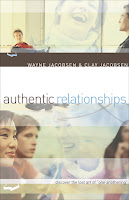
Authentic relationships (by Wayne and Clay Jacobsen)

Authentic relationships by Wayne and Clay Jacobson
(Amazon UK link)
It’s a long time since I read most of the books by the Christian writer Wayne Jacobsen, all of which I found thought-provoking and inspiring. I last read ‘Authentic relationships’ in 2009, so it was more than time for a reread.

This book actually has two authors; Clay Jacobsen is Wayne Jacobsen’s brother, and the introduction explains that they wrote the book together. But instead of alternating chapters or anecdotes, they write as if one person, combining their expertise and experience. And it works extremely well.

The subtitle of this book is: ‘discover the lost art of “one anothering”’. And that’s exactly what it sets out to do. The authors have take a selection of phrases from the New Testament which include the phrase ‘one another’. They suggest that a large percentage of the church has become so caught up in rituals and private devotions that we have missed Jesus’ mission to reach out to each other, and those around us, in love.

There are anecdotes throughout to illustrate their points. They begin with an introduction, demonstrating how lonely people can be, and how we tend to see each other as being self-sufficient. Too many of us try to portray that we are comfortable, in charge of our lives, and that we don’t need any help. Perhaps our Christian brothers and sisters rally round when there’s a sudden crisis. But there are ongoing needs: unemployment, caring for elderly relatives, single parenthood, and so much more. 

The first chapter looks at the summary verse, ‘love one another’, which is supposed to be the primary mark of Christians, and a way that others will know who we are. The authors make the point that we love because God loved us, so we need to know his presence and grace before we can demonstrate it to others. But they also remind us that we should offer practical care, listening to the prompting of the Holy Spirit as we meet and interact with those around us. 

The book is in four main sections. The first is the most basic, outlining what it means to love, to accept and forgive, and to honour each other. The suggestions are straightforward, perhaps obvious; there’s nothing I haven’t come across elsewhere. But it’s always good to be reminded of these things, and I found a lot of the stories and suggestions both encouraging and motivating. 

The second section is more about reaching out into the community. There are chapters on being hospitable, sharing with each other, serving and building each other up. Again, the anecdotes and examples are quite inspiring. The writing is good, and feels seamless too - there’s no way of knowing where one Jacobsen brother stops and another starts. I’m not good at initiating new friendships, and some of these chapters were quite challenging.

The third section, then, is about sharing the journey with others, and the fourth, shortest section is about deeper relationships. This includes the importance of confessing to each other (when appropriate and helpful), acknowledging our failings and faults rather than trying to look better than we are. It also includes a useful section about submitting to each other. This is not in the sense of doing whatever someone else wants, but more along the lines of submitting a paper to an editor, or proof-reader. 

The authors give examples of people who submit their ideas and visions to a group of church leaders, or to their fellowship group, for discussion and comment. But in the end, as the authors remind us, we must listen to God ourselves and follow his leading, even if it goes against the advice of those around us. Submitting involves listening, and perhaps being prepared to debate a point, or make some changes. But it doesn’t mean giving someone else the authority to tell us what to do.

The authors recommend using this book in a study group, and as such have discussion questions at the end of each chapter. I can see that it might be useful, either as part of a regular fellowship group, or for a few people to meet specifically to cover the topics in the book. However I mostly ignored the questions as I was doing this on my own. I read one chapter a day over a couple of weeks, and would recommend it highly to anyone interested in the concept of Christian community, in the broadest sense. 

Review copyright 2025 Sue's Book Reviews

16 Jan 2025

Beyond Sundays (by Wayne Jacobsen)

Beyond Sundays by Wayne Jacobsen
(Amazon UK link)
It’s hard to believe that it’s almost two decades since I first came across a book by Wayne Jacobsen. It was under the semi-pseudonym of Jake Colsen, in a book he co-wrote with Dave Coleman. I haven’t been able to find other books by Dave Coleman, but managed to acquire several by Wayne Jacobson. I found them all well-written, sometimes moving, and very readable. 

So I was very pleased to be given one that I didn’t have, ‘Beyond Sundays’, for Christmas. I started reading it at the beginning of the new year, and have just finished, reading a chapter or two each day. 

As with Jacobsen’s other books, the focus is very much on our relationship with God, and how that’s what matters to us most, however we pursue it. But the main theme of this one is encapsulated in the subtitle: ‘why those who are done with the religious institutions can be a blessing for the Church.’ By ‘the Church’, he refers to the body of all believers worldwide, whether or not they are connected with a local church congregation. 

The book begins with some statistics. It was written in 2018, and at the time the author claimed that in the previous few decades, sixty-five million Americans had stopped attending a local church congregation. Just over half of them no longer identified as Christian, but thirty-one million still called themselves believers. He says that this latter group have become known as the ‘Dones’ - not a word I had previously heard in this context. He also claims that this number is nearly as many as those who still regularly attend local churches in the United States. 

I don’t know if the figures are accurate, and suspect they changed significantly in the aftermath of the Covid pandemic. But the point remains: large numbers of American Christians (and Europeans, too, in my experience) who are serious about following Jesus do not belong to a local church congregation, for a variety of reasons. This book doesn’t really cover reasons why - other books by this author look into that. Instead it looks at ‘What next?’ 

Wayne Jacobsen was himself a pastor for many years. He acknowledges that many pastors find it difficult when people leave their churches. He assigns primarily financial motives to this, and this is where I somewhat depart from his experience. The church pastors and ministers I have known seem to me to have cared about their congregations as people, on the whole. The focus on funding tended to be minimal unless there was some specific fund-raising project, or a serious lack in church finances. 

I have also never experienced the kind of coercion or control that he describes. It’s true that in some churches the pastor can imply that attending Sunday services regularly is a vital part of being a believer. But others welcome anyone, whether a regular attender or not, and don’t try to ‘guilt’ anyone into being part of their congregation. That means it’s easier for me to be loosely affiliated to a local church, taking part in some of their connected activities, and attending services around once a month. I quite like the social aspect of a church service, and the songs and liturgy; I appreciate them all the more for not going every week.

Jacobsen is mainly writing for those who feel torn apart by guilt, or who are being criticised by those who are still part of a local congregation. He makes it clear that we all have to follow our own path, and be aware of how God leads us. Some people benefit from the structure and regularity of a church service; others do not. There’s no right or wrong, as there’s no right or wrong in denominational churches. None of us is perfect, and we should accept and care for one another, regardless of what label someone chooses to use. 

I don’t know that I learned anything new from this book, although it made interesting reading. Nor did I find it as inspiring as some of the author’s previous books. But perhaps that’s because I’m more confident and comfortable in the role as a ‘mostly done’. And it’s a useful summary of the author’s feelings and beliefs, with plenty of reference to Scripture as he charts some of his journey and experiences.

Recommended if you’re interested in this subject, or generally feeling as if you don’t like being part of a church congregation but still want to follow Jesus.

Review copyright 2025 Sue's Book Reviews

11 Jul 2018

Finding Church (by Wayne Jacobsen)

Finding Church by Wayne Jacobsen
(Amazon UK link)
I have kept an eye out for books by Wayne Jacobsen since reading, many years ago, the book ‘So you don’t want to go to church anymore?’. That book, a fictionalised account of people becoming unhappy with their structured mega-church and discovering a more relational way of following Jesus, was quite a landmark in the lives of many.

I have appreciated a couple of other books by this author, and have just finished reading ‘Finding Church’, which has the subtitle ‘What if there really is something more?’ I haven’t been following Wayne Jacobens’s blog or Facebook page and wondered if it was going to be a book encouraging people to re-join established congregations. There are many books which do that, agreeing that the institutional church is far from perfect, but citing many advantages or benefits to belonging to a local congregation.

However, this book does not do that. Not that the author is anti-church in any way, and he acknowledges that in many cases a church congregation can provide a good environment for many people, either for short periods or long-term. New believers can be taught basics, and make some useful friendships through a local congregation. People can explore and use their gifts, and many Christians enjoy singing as a way of worshipping God, something which is easier to do in a group than on one’s own.

Nevertheless, there are thousands of people who have become dissatisfied with local congregations for a wide variety of reasons. Sometimes these reasons may be critical or negative, with or without validity. Many local church groups become rule-bound, requiring Sunday morning attendance in order to be ‘part’ of the local expression of the body. They usually follow a set format, whether formal liturgy or a ‘worship time’ and ‘teaching time’, with little room for individuality. This suits some people, but we are all different - and when a congregation is made up of all ages, many nationalities, and many educational and cultural levels, it’s impossible for any talk or style of music to be relevant to everyone.

In many cases, people leave their local church congregations because they feel that there should be something different. They long for ways of connecting with others that don’t rely on sitting in rows on a Sunday morning. This book is, in a nutshell, about finding the Church - by which the author means the Body of Christ worldwide - by following Jesus directly, being open to the leading of the Spirit, and forming friendships with those around us.

The author mentions that the house church movement, and home groups within larger congregations, can be useful ways of connecting and forming stronger relationships than is possible in a once-a-week congregational setting. But he notes with sadness that they, too, often become rule-bound and institutionalised, perhaps expecting too high a degree of accountability, or extensive funding, or formulating rules which are seen as more important than loving God and our neighbours.

The writing is well-organised, carefully structured, and refers regularly to Scripture in context. The author shares some of his own experiences, both positive and negative, and his gradual acceptance of the idea that it’s fine not to belong to any local congregation. He examines many objections, including a chapter with specific questions and some answers, and he also sets out what he proposes - and is beginning to find in his own life and ministry.

Jacobsen is very keen not to be prescriptive. To produce a set of strict guidelines or objectives would create yet another rule-bound movement that would miss the point entirely. So he lays out his arguments, in the early part of the book, focussing on what he calls the ‘new creation’, where we are not bound by the laws or structures which were in place before Jesus.

He also suggests some principles, or values, to encourage people to move forward. So, for instance, there is a chapter called ‘Order without Control’, and another on ‘Authority without Hierarchy’. They form very general guidelines explaining how these Biblical precepts can be kept, without deteriorating into man-made requirements.

Personally, I found this book extremely encouraging. Much of what the author said resonated strongly with me - perhaps because I’ve been asking questions of this nature for some years. I have to admit I found some sections of the book a tad dry, perhaps too obvious; yet he had to write in a lot of detail to cover as many possible objections as he could. Others might disagree strongly with the principles in the book, and that’s okay; we’re all at different stages.

I hope it will, at least, help others to understand how it’s possible to be a follower of Jesus without belonging to any specific congregation. I hope it might also help those within traditional or modern church settings, who want something more, to see ways of reaching out into the community, and of building loving relationships with other believers during the week.

I recommend this very highly to anyone interested in these issues. Available fairly inexpensively for the Kindle as well as in paperback form.

Review copyright 2018 Sue's Book Reviews

21 Jan 2018

The Naked Church (by Wayne Jacobsen)

The Naked Church by Wayne Jacobsen
(Amazon UK link)
I’ve only read a handful of books by Wayne Jacobsen, but have liked them all in different ways. So when I discovered a couple more, inexpensively, on the Amazon Marketplace (though no longer in print) I ordered them and have just finished reading ‘The Naked Church’.

The book is intended for people who are feeling somewhat dissatisfied or burned out by church experiences, or who feel that Christians are no different from anyone else. It doesn’t point fingers or criticise; the author acknowledges that the established church comes in many shapes and sizes, and in many cases is an excellent way of helping people becoming closer to God.

However, the theme of his book is that there’s a great deal wrong with the way that the church worldwide functions today. Christians are not generally known by their love for each other. Evangelistic crusades may result in hundreds of people making ‘decisions’ for God, but rarely have much long-term effect. In the west, we are caught up in materialism, in maintaining expensive buildings and following routines and structures which, in many cases, move people further away from God rather than helping them to develop intimacy with him.

The introduction mentions the classic fable of the Emperor’s New Clothes. The author suggests that it is all too easy for modern Christians to follow false teaching, or turn up week by week for church services because that’s what everyone else is doing. Yet, he believes, a large part of the church - at least in the United States, where he lives and works - is ‘poor, blind and naked’, like the church in Laodicea to whom one of the messages in the book of Revelation was addressed.

Most of the book is written in paired chapters. The first of each looks at ways in which 20th century Christians are (the author believes) deceived, and the second looks at what might change. For instance, he compares modern structured church programmes with the communities that developed in the early church. He is careful to acknowledge that much of what we do nowadays can be useful, and that lives can be changed. Yet we are not radiating the love, passion and authority that was so evident in the first century Christians.

I found some of the book a little heavy-going, and rarely read more than one chapter at a time. This was first published in 1987 and would have been extremely thought-provoking then, although so many other writers have written on a similar topic that I didn’t find anything new. Still, reminders are good, and there was much to think about. The presentation was nicely done, and the contrasting chapter style worked well.

It’s not particularly easy to get hold of this book, although if you see it at a reasonable price it’s worth reading, in my view. Most likely to be read by those who are already struggling somewhat with Christian traditions or styles, but I think it could be of value to those in leadership who would like to see positive suggestions for change, described in an organised way.

Recommended.


Review copyright 2018 Sue's Book Reviews

10 Oct 2016

In my Father's Vineyard (by Wayne Jacobsen)

In my Father's Vineyard by Wayne Jacobsen
(Amazon UK link)
I very much enjoyed the couple of books I read by Wayne Jacobsen, and - as I tend to do in such circumstances - searched Amazon for anything else he had written. There weren’t very many books, but I noticed one, now out of print, which had an attractive looking cover and some positive reviews. 

I decided, rather than putting it on my wishlist, I would buy a very inexpensive version advertised in the ‘Marketplace’, and have it delivered to relatives on a recent UK trip.

I knew that ‘In my Father’s Vineyard’ would be hardback, but had not taken note of the number of pages (just over 100). In addition, I had not realised that it was a larger size book than normal: the design made it feel like a gift book. My second-hand copy was in pristine condition, and I quickly realised that it’s written in the style of a devotional: short chapters, each one looking at a brief passage of Scripture, with some relevant thoughts.

While it wasn’t what I was expecting (I suppose I should have read the reviews more carefully!) I quickly found myself liking it very much. The main focus is John chapter 15, which starts, ‘I am the vine…’, using the analogy of a vineyard and vine-grower as one for Christian growth and increasing maturity. The author recounts his own childhood, where his earthly father was indeed a vineyard owner, so he writes from extensive experience about vines and vine-growing, something which would have been familiar to Jesus’ listeners in the 1st century, but about which most of us in the western world know very little.

Each chapter is two or three pages long, with a brief passage of Scripture (not all from John 15) at the side, and some thoughts about both vine-growing and the Christian life. The commentary is often thought-provoking, and the insights into the life of a vineyard owner very interesting too.

The book is divided into broad sections reflecting the four seasons, explaining how each period of the year has a specific purpose in the life of the vine, including the ‘rest’ period over the winter when there is no obvious growth, and where the vines have to be protected from winter storms.

I learned about pruning: why it must be done, and when it has to be done if it’s not to destroy the entire vine. I learned about the importance of waiting for the right time to harvest the fruit, too. And I was reminded that the ‘fruit’ we grow in our own lives is not so much our work, but those of love, joy, peace and so on, as outlined in Galatians 5.

I read a chapter - or sometimes two - over the course of a few weeks, and liked it very much. There are 29 chapters in all, so it’s ideal as a month’s devotional reading. I’m sure I’ll pick it up again some time, and in the meantime would recommend it to anyone who would like to know more about vine-growing, and also about how the analogy can be used in relation to the Christian life.

Recommended to any believers who would like to dig a bit further into this well-known passage, and perhaps gain a different perspective.


Review copyright 2016 Sue's Book Reviews

29 Sept 2011

So you don't want to go to Church anymore? (by Jake Colsen)

so you don't want to go to church anymore by Jake Colsen
(Amazon UK link)
It was about five and a half years ago that I first heard of Jake Colsen (pseudonym for two writers: Dave Coleman and Wayne Jacobsen) and this amazing book.

I first read 'So you don't want to go to church anymore?' in April 2006; it was available to read online, or to print; some friends had downloaded, printed and laminated a version, which we were able to borrow. I was not sure what to expect, but found it profoundly moving and thought-provoking in the extreme.

While I had been happy enough with the church congregations we attended both in the UK and, later, in Cyprus, I was well aware of growing discontent with 'organised religion' and the dangers of institutions and structures swamping the spiritual life of many. We were beginning to see stresses locally, and this book was exactly what I needed to read at the time.

I even wrote some further thoughts about the book - called 'What is Church anyway?' - on another blog, and over the intervening years have thought, off and on, about the contents. I've read several other books on similar topic, but never quite managed to let go of the idea of attending a church service on Sunday mornings, even though it had become rather sporadic in the past couple of years.

Events transpired to make me want to read this again. I have it in printed book form now, bought from Amazon and have lent it to several people, all of whom have found it interesting and thought-provoking. After a frustrating morning last Sunday, I decided re-read the book for the theology rather than the story; I have to admit that, as a novel, it lacks much substance. The main plot is Jake's growing awareness of what it means to follow Jesus, alongside his increasing disillusionment with organised Christianity.

The story begins when Jake hears a slightly strange character called John talking about Jesus to a group of angry people. He is intrigued, and they chat awhile. Jake is an assistant pastor at a large and outwardly successful church, although he is not entirely comfortable with some of the things that are going on. And when John appears one Sunday morning and asks for a tour of the premises, Jake begins to see things through different eyes, realising the futility of much of what they do. He also becomes aware of how it can be all too easy to try and shame people into church attendance, rather than encouraging them to follow Jesus and care for each other.

The book does stress - through questioning and conversation, again - that there is nothing wrong with believers meeting together on Sunday mornings to sing, or pray, or even listen to talks, if it is what they feel to be right, if they find it helpful, and if it encourages them to walk with Jesus through the week. The book does not push different kinds of informal church services, or even house churches... it proposes a completely different model, more in line with that of the early New Testament, where the Church - as the Body of Christ - consisted of individual people caring for and walking alongside each other.

Jake goes through several difficult stages during the course of the book, and for a while blames John's radical outlook. But gradually he grows in trust and contentment, as he meets others on a similar journey. He begins to reach out in similar ways to others, and finds whole new meanings to words like 'fellowship' and 'gathering'.

I remembered most of the plot from before, so I read it this time for the theology and encouragement rather than for the story itself. And, once again, found the book extremely helpful and inspiring - so much so that I even jotted down a few sentences in a notebook for easy reference.

I would recommend it to anyone, with the caveat that we are all at different stages, walking slightly different paths, so it undoubtedly will not appeal to everyone in every situation.

Review copyright Sue's Book Reviews, 29th September 2011

12 Nov 2009

He Loves Me! (by Wayne Jacobsen)

He Loves Me by Wayne Jacobsen
(Amazon UK link)
I first came across Wayne Jacobsen as one half of the pseudoym 'Jake Colsen' in the excellent book 'So you don't want to go to church anymore'. It was a while later when I bought his book 'Authentic Relationships', which I enjoyed. So I went ahead and bought this one too, and have been reading it for the past couple of weeks.

'He loves me!' is subtitled 'Learning to live in the Father's affection'. That's exactly what the book is about. It discusses what is meant by God's love, and how we can be absolutely certain that it will never fail. That means, of course, that we don't have to do anything to earn it. Obvious? Certainly. It's the theme of Philip Yancey's excellent and inspiring book 'What's so Amazing about Grace?' and indeed the parable of the Prodigal Son.

But how many Christian believers feel the need to jump through hoops, even though they declare - with their minds - that they are saved by grace alone? How absolutely certain are we of our Father's love?

I don't think I've ever doubted that God loves me; I don't, as Jacobsen suggests, imagine that he loves me any less when life happens to be fraught or upsetting in some way. But it's not easy to throw off the structure-orientation of my evangelical teenage years, and truly believe wholeheartedly that God truly, absolutely and unconditionally loves me even more than I love my own sons. That he doesn't make life more difficult if I'm not reading the Bible much, or if I forget to pray in the mornings.

It's a very reassuring, inspiring and thought-provoking book. Each chapter has questions at the end, intended for small group discussions or further personal ponderings; but I found the chapters themselves very full, and read just one each day. It's one of the best books I have ever read.

I have one single complaint. The foreword to the book is terrible. It's condescending, full of assurances about how the book will change my life, and how confident the foreword-writer is about what I will think or do having read the book. It was so bad that it nearly put me off reading altogether. The last time I read such dreadful blurb was on the book 'Purpose driven life', which I don't recommend at all.

Thankfully I was able to overcome my principles and read the book anyway, despite the foreword. I'm glad I did. But if you do happen to pick it up, or borrow or buy it, I suggest that you go straight to the author's introduction. Or, better still, right into chapter one.

Highly recommended.


Review copyright Sue's Book Reviews, 12th November 2009

6 Jun 2009

Authentic relationships (by Wayne Jacobsen and Clay Jacobsen)

Authentic Relationships by Wayne and Clay Jacobsen
(Amazon UK link)
I'd come across Wayne Jacobsen's writing before: he's one of the authors who combine in the pseudonym of Jake Colsen, in the excellent fictional 'So you don't want to go to church anymore?'. His brother, Clay Jacobsen, works in broadcasting.

The two Jacobsen brothers wrote 'Authentic relationships: discover the lost art of one anothering' together. It's a very thought-provoking book about Christian community, in the best sense of the word. Starting with Jesus' command to love one another, the authors look at several of the 'one another' verses that are in the New Testament. They suggest what they might have meant at the time, and - most importantly - how they can be applied today.

The first part of the book looks at how we can best demonstrate God's love by reaching out to other people around us. They describe the vital importance of fully accepting others, with all their faults and hangups, making us safe people to talk to. They point out, too, the dangers of gossip.

There are then some chapters suggesting how to begin to reach out, some about developing relationships with our acquaintances, and finally some suggestions about mature, committed relationships and what it means to have such close fellowship. It's rarely found these days, but the authors suggest that if we start by following some of their suggestions, we may - on rare occasions - come across other believers who will behave the same way, thus opening the door for truly authentic friendships.

I was particularly taken with the interpretation of the idea of submitting to one another. It was rather different from standard evangelical teaching, focusing not on authoritarianism obedience, but on mutual submission and letting go of our own expectations or need to be right. I found the chapter quite challenging; what they suggest seems much more akin to what would have been meant at the time than what is often taught today.

Each chapter ended with a few discussion questions, for anyone wanting to use the book with a few friends or in a small group. I'm not sure how appropriate they would be - I didn't find the questions particularly helpful. But for someone wanting to explore these ideas, they could make a good starting-point.

I'm not sure how far I will be able put the authors' ideas into practice, being a fairly private person by nature. However, it would be very encouraging to see more real community within the Christian church.

I found the book interesting and often thought-provoking, and certainly expect to be reading this again in future. Highly recommended.


Review copyright Sue's Book Reviews, 6th June 2009