Showing posts with label Agatha Christie. Show all posts

21 Dec 2020

Peril at End House (by Agatha Christie)

Peril at End House by Agatha Christie
(Amazon UK link)
We have a large number of Agatha Christie books, but when I see another one at a church book sale or charity shop, I tend to buy them. That was the case with ‘Peril at End House’, which I acquired at the end of October. I have just finished reading it.

This is a novel featuring Hercule Poirot, after his theoretical retirement. But rather than being called in to a tricky case, he’s there at the beginning. He and his friend Hastings, who is the first person narrator of the book, are on holiday at a place called St Loo. Apparently it was based on Torquay, but as I’ve never been there I don’t know how realistic it might have been.

They get chatting to a young girl called Nick, who comments that she’s plagued by wasps. Poirot becomes concerned when he realises that her hat has a hole in it, and that there’s a bullet on the ground. It would appear that someone shot at her. With the noise of boats nearby, it could well have gone undetected.

Nick is having lunch with some friends, but Poirot manages to speak to her alone. He learns that she’s had three rather worrying incidents in the past week or so. A heavy picture fell onto her bed, a boulder nearly hit her when it was dislodged, and there was a problem with her car, which could have been fatal. She doesn’t seem too worried, putting everything down to coincidence. She insists that she has no enemies, but Poirot tries to persuade her that her life may be in danger.

The book is more character-based than some of Christie’s crime novels. It seems clear that whoever has been attempting to kill Nick must be someone close to her, and Poirot eventually makes a list. Her housekeeper and gardener are there, as well as an Australian couple who are renting part of Nick’s property. There’s her rather flaky friend Frederica, who seems vague and temperamental, an art dealer who is in love with Frederica, and a jaunty sailor who’s rather keen on Nick.

Then there’s Nick’s cousin Charles, who is her next of kin and also her lawyer. He’s a bit formal and uninteresting, and is well aware that her house, though large, is in need of substantial repairs. So there’s very little to inherit. But he seems to have the most motivation, and also the opportunity…

As with most of Agatha Christie’s novels, the plot is very clever. She leaves a gentle trail of clues, some of them red herrings, throughout the book. I had managed to work out one or two of the details that are eventually revealed. . But I had not begun to realise the actual - and very ingenious - way everything happened, although once Poirot had explained, it was quite believable.

Set in the 1930s, it’s inevitably dated and some of the content (particularly related to drug usage) is somewhat shocking. The people are perhaps a little caricatured, but that doesn’t matter too much; it makes them easier to distinguish. And I have always liked Hercule Poirot. He’s arrogant, and extremely stereotyped, but quite amusing at times. His dialogue with Hastings provides some light relief in what would otherwise be quite a tense novel.

All in all, I thought this was a good example of a light crime fiction book, and would recommend it to anyone who likes the genre.

Review copyright 2020 Sue's Book Reviews

13 Aug 2020

The Moving Finger (by Agatha Christie)

The Moving Finger by Agatha Christie
(Amazon UK link)
We have a large collection of Agatha Christie novels, many of them bought second-hand when my sons were still living here. I still haven’t read them all, and am currently working my way through some of the unread selection. I have found some of them a bit tedious to read, but others are gripping. I’ve just finished ‘The Moving Finger’, and it’s definitely in the latter category!

The story is told in the first person by a young man called Jerry Burton. He is a pilot who was badly injured in an air crash. He’s recovering, and is doing well; but his doctor tells him to have a long convalescence in a peaceful village, away from the stress of city life, and away from well-meaning but intrusive friends.

So Jerry, who appears to be independently wealthy, rents a house in the village of Lymstock with his sister Joanna. He finds the village community to be quite friendly, if nosy; everyone knows what everyone else is doing. And before long he receives a nasty anonymous letter full of false insinuations.

He assumes it’s someone objecting to newcomers, and throws it away. But then he learns that other people in the village have also been sent these nasty letters. There’s no truth in any of them, but people still feel upset, even violated. The language is crude, and the nastiness of the style leaves them hurt, angry or - in some cases - afraid.

And then something else happens, which turns it into a much more unpleasant scenario. This is followed, a week later, by a horrible crime. Experts are called in, and Jerry does a bit of amateur detecting alongside the local and other police. He also becomes increasingly attracted to a young woman in the village…

Agatha Christie’s skill was always in her plotting rather than her characterisation, but the first person narrative works well in this story. Jerry is a likeable person, as is his sister. We know he can’t be involved in the letter-writing as it started before they ever appeared on the scene, and the letters often refer to people they don’t know, or situations they are unaware of.

But pretty much everyone else in the village is under suspicion. As ever, clues and red herrings are dropped neatly, leading the police - and the reader - along trails that lead to dead ends. I really thought I had guessed the perpetrator about half-way through; it was only in the last few pages that I realised, somewhat to my relief, that I was wrong.

The writing is crisp, the people different enough that I had little difficulty remembering them all, the conversations realistic, if a tad stilted in places. And the plotting is, of course, impeccable. When the villain is finally unmasked, and explanations made, everything makes sense. Could I have guessed…? It’s implied that Jerry should have been able to work it out, and we see everything through his eyes, so perhaps I could. But I think the red herrings were too well planted. I was so certain I was right that I could hardly bear to put the book down, and read it in just two or three sittings.

The book cover says that this is a ‘Miss Marple Mystery’, so I was quite looking forward to investigations and discussions with Christie’s famous elderly lady. As it was, Miss Marple only appears in the last two chapters, and while she (inevitably) works out who did it, she doesn’t appear at all in the main part of the story. It’s my only gripe; if the book had not mentioned her, I would have been pleasantly surprised at her appearance rather than disappointed that she was not brought in earlier.

First published in 1943, 'The Moving Finger', along with most of Agatha Christie's other novels, is regularly re-printed in new editions.

Definitely recommended if you like this kind of mid-20th century light crime fiction.

Review copyright 2020 Sue's Book Reviews

3 Jul 2020

Murder in the Mews (by Agatha Christie)

Murder in the Mews by Agatha Christie
(Amazon UK link)
I am still discovering, on our shelves, books by Agatha Christie which I had never previously read. Possibly they were acquired by - or for - one of our sons when he was a teenager. Our copy of ‘Murder in the Mews’ evidently came from a second-hand shop or church bookstall. I had not realised until I started reading it that it’s not a novel, but four short stories involving Hercule Poirot.

The first one, with the same title as the collection, starts with Poirot walking home with his friend Chief Inspector Japp on bonfire night. They discuss how easy it would be for a shot to be made, unnoticed, amongst the bangs and cracks of fireworks.

Unsurprisingly, Poirot is summoned the following morning to help investigate a case in the Mews where they had been walking. A young woman is dead, and it looks at first glance as if she took her own life. But the evidence suggests that this might not be the case. So interviews are set up, and various possible perpetrators or witnesses are questioned.

As happens in so many of Agatha Christie’s stories, I swallowed the many red herrings in this cleverly-written story. Only as Poirot starts to reveal what really happened did things start to click, and I could see that it was an ingenious plot, and I should indeed have spotted the outcome.

The second story, ‘The Incredible Theft’ is more of a political story. Several people are having dinner together, and afterwards two men discuss some important documents. They take a brief walk in the evening air while the secretary finds all the paperwork, only to discover, on returning, that one vital document has vanished. Various theories are proposed, and Poirot is called in; nobody wants to make this loss public knowledge.

Again, it’s a cleverly-thought-out story, but I found it a tad too convoluted. I don’t think I would ever have guessed how the paper disappeared; when it was explained by Poirot, I could see that it made sense, but I didn’t feel there were sufficient clues - or maybe they were too bound up in politics and business discussions.

The third story, ‘Dead Man’s Mirror’, begins with a rather autocratic letter to Poirot, telling him to be ready to visit a somewhat eccentric peer, at a moment’s notice. Naturally Poirot doesn’t want to do this, but he does make some inquiries to find out more about the person concerned. And then when the summons comes, he decides to go anyway…

Poirot arrives to discover that the person who wrote to him is dead, apparently by his own hand. Once again there are many questions asked, and it’s a good story, although - yet again - I doubt if I could ever have guessed the outcome.

The final story, ‘Triangle at Rhodes’, is the shortest of the four - only twenty pages, whereas each of the others was around fifty - and it was my least favourite. Poirot is on holiday in Rhodes, staying at a hotel where there are just a handful of guests who get to know each other quite well. One of the wives is supposedly a siren, on her fourth husband; the other wife seems overlooked when her husband is attracted to the siren.

But, as I should have expected with an Agatha Christie story, nothing is as it seems. It was too short a story for much characterisation, and I found the outcome and explanation of what happened a bit dubious… it didn’t feel up to the author’s usual brilliance, although it’s rather a different scenario from her usual style.

Overall I liked this book, and would recommend it to anyone who likes light crime fiction from 1930s.  Despite being around 90 years since this book was first published, it's still regularly re-printed as well as being widely available second-hand.

Review copyright 2020 Sue's Book Reviews

20 May 2020

Sad Cypress (by Agatha Christie)

Sad Cypress by Agatha Christie
(Amazon UK link)
I felt like reading one of our large collection of Agatha Christie books, and found a few that I had not previously read. I have no idea how we acquired ‘Sad Cypress’ but as far as I know I had never read it. I picked it up last night, and found it so engrossing that I finished it this afternoon.

This book has an interesting construction, one which I don’t recall from previous novels by this author. It opens with a scene in a courtroom. Elinor, a young woman, is accused of murdering another woman called Mary. She pleads ‘not guilty’...

The story then moves back a month or two, and we meet Elinor chatting to her cousin-by-marriage and fiance Roderick. She loves him deeply but he’s a reserved kind of person so she tries to mask her emotions. Elinor has just received an anonymous hand-written note telling her that she needs to check up on her aunt, as someone else is trying to worm her way into her affections.

Elinor’s aunt has been ill for a while, so she and Roddy go to see her, and tell her of their engagement. It’s something she has always wanted - Roderick is her late husband’s nephew - so she’s very pleased. She is attended by two nurses and a cheerful doctor pops in and out - and he’s rather taken with Elinor.

Mary is someone Elinor and Roddy remember from their childhood, who lived in the lodge of Elinor’s aunt’s house. The aunt always took an interest in her, and paid for her education - which has left Mary in a bit of an awkward situation, back in the era when ‘class’ was determined by birth, and someone from the working classes was not supposed to be well-educated and charming. Mary has rejected a local young man who likes her, but when Roderick is captivated by her, she refuses to have anything to do with him while he’s engaged to Elinor. She wants, in any case, to train as a nurse or masseuse.

Although Agatha Christie was not great at characterisation, she could tell an excellent story, and this one is very well-written. The prologue had told me that Mary was going to be murdered, and that Elinor was going to be accused - and the story moves forward cleverly indicting Elinor at each point. I was fairly sure that there were a lot of red herrings, and that she would not in fact be guilty. But then I started to wonder; this author is good at double-bluffing; perhaps, I thought, Elinor really IS guilty.

Hercule Poirot gets involved, at the request of the doctor who suspects that Elinor might be guilty but wants anything that might demonstrate her innocence. And even if she is guilty, he wants Poirot to find out if any reasonable doubt can be cast over the case. It seems like an impossible situation: everything points to her being the only person who could possibly have done the deed. But is the evidence just too strong? Has someone ‘planted’ the clues…? And if she didn’t do it - and another crime, that becomes apparent part-way through the investigations - then who did?

Sometimes I get an inkling of ‘whodunit’ when I read Agatha Christie’s books. In this, I had no idea at all. When Poirot announces that all the people he had spoken to had lied to him, I guessed one or two of the incidents, but not all of them, and not those essential to the plot. And I still didn’t know whether or not Elinor was guilty…

As ever with this writer, the plot is clever, the clues and red herrings neatly in place, and an excellent story is told. I had no idea why the book is called ‘Sad Cypress’; apparently it’s a quotation from ‘Twelfth Night’.

Definitely recommended if you like light mid-century crime fiction with no gore, and don’t mind a fair amount of both legal and medical jargon.  As with most of Agatha Christie's novels, this one remains almost constantly in print and can also fairly easily be found second-hand.

Review copyright 2020 Sue's Book Reviews

15 Apr 2020

The Mysterious Mr Quin (by Agatha Christie)

The Mysterious Mr Quin by Agatha Christie
(Amazon UK link)
We have quite a collection of Agatha Christie books, most of them picked up inexpensively from second-hand shops. I’ve read the majority, but not all of them. One of the ones I had not previously read is ‘The Mysterious Mr Quin’.

I realised quickly that instead of being a full novel, this book is a collection of twelve short stories. The author mentions in the foreword that they were not written as a series; instead she wrote them as one-off stories, over quite a long period. What they have in common is that they all feature a comfortably well-off man in his sixties called Mr Satterthwaite, who sees himself as an observer of life, and a mysterious person known as Mr Quin.

The stories mostly feature either unsolved mysteries, or tragedies about to unfold, or people wrongly convicted of crime. In them all, Mr Satterthwaite is either staying with a connected family, or knows them - he’s quite well connected - or hears about them and becomes involved.

Mr Satterthwaite knows just about everyone in the upper classes - the book was first published in 1930, when the class system was still flourishing in the UK - but he also has a tremendous interest in the arts. He likes to support little-known painters, dancers and actors and help them out of obscurity. He has quite an eye for talent, and he is also very discerning. He believes he has a strong feminine side, which makes him far more observant and intuitive than he would naturally be. Decidedly sexist, but an unusual feature for a fictional hero nearly 100 years ago.

Whereas Mr Satterthwaite lives firmly in the real world, enjoying comfortable locations, and good quality food, Mr Quin is more mystical. He often appears, in a trick of the light, to have a chequerboard appearance, and his name first name is ‘Harley’ - many references associate him with the traditional Italian Harlequin, a kind of sprite-like servant who tended to thwart his master’s wishes, and follow his own. However Mr Quin, by contrast, has no master - as far as we know - and appears in order to help his friend to prevent tragedies and bring justice.

But who - or what - is Mr Quin, exactly? It’s not made clear. He appears and vanishes in strange ways, there when needed, gone when no longer necessary. I wondered at times if he was supposed to be an angel, although Christie was not known for overtly Christian belief. Perhaps it doesn’t matter. His role in most of the stories is to help Mr Satterthwaite to slow down and consider his impressions. He’s a catalyst for change. But then in the final story he appears a little differently, more a quirky, inexplicable being more like the sprite-like classic Harlequin.

I enjoyed the stories, which give insights into the world of the wealthy in the 1920s despite the paranormal aspect that is strongest in the final story. Of course there is plenty of off-stage violence, with killings and imprisonments, but as with most of the author’s books there’s nothing gory. And most of the stories end in positive, encouraging ways. I found the last one quite disconcerting, and liked it less than the others, but it was still very readable.

Agatha Christie always focussed on plots rather than characterisation, and that’s true for most of the people in these stories who are two-dimensional. However I did like Mr Satterthwaite, and found that by the end he had developed quite a distinct personality

Recommended if you like Agatha Christie or would like to try some slightly different short stories written nearly a century ago.  While her books are widely available at charity shops and other second-hand booksellers, they are all also regularly in print.

Review copyright 2020 Sue's Book Reviews

21 Feb 2019

One, two, buckle my shoe (by Agatha Christie)

One, two, buckle my shoe by Agatha Christie
(Amazon UK link)
We have a large collection of Agatha Christie's novels, mostly acquired when my sons were teenagers. I have read most of them, but there are some I have never read, or which I read so long ago that I have entirely forgotten them. Last year I decided I would read some of them, interspersed with other books, and I have finished about seven or eight. On the whole I liked them, but I can’t say I looked forward to reading another.

This time I tried ‘One, two, buckle my shoe’, which sounded interesting. Each chapter is headed by a line from the nursery rhyme, and Hercule Poirot, who is involved right from the start, think about the different lines and particularly a shoe buckle…

We first meet Poirot feeling nervous as he goes for a dental appointment. He sees various other patients, and has his treatment, and spots a lady wearing a buckled shoe getting out of a taxi. He chats to the boy who opens the door (a fan of crime fiction), and to some of the other people in the waiting room. And then he leaves, feeling relieved… only to learn, later in the day, that someone has died. The police think it was probably by the person’s own hand, but Poirot’s instincts are against this. He is convinced that a crime has been committed…

The book follows the usual course of Christie’s crime fiction. Possible suspects are interviewed, various red herrings are followed, and more than one other person dies later in the book. I find this style works well in the author’s country home stories, where there are only half a dozen or so very different people, any of whom could have done the deed; usually the prime suspect then loses their life, and is thus ruled out. The boundaries are clear in most of those books, and I can often work out what happened, and who was the perpetrator.

However this book involved (in my view) rather too many people. Agatha Christie wrote excellent plots, but her characterisation was not particularly good. Poirot certainly has plenty of character, but I found the various suspects rather two-dimensional and difficult to distinguish. Amongst the patients there’s a wealthy (but unassuming) businessman, a lady who used to be a missionary, someone from the Home Office, and a dubious Greek man.

Then there are household staff, there’s a second dentist, and two young men who are interested in girls, rather to the dismay of the girls’ families or friends. I found that if I put the book down for a few hours I had forgotten who was whom… and I didn’t much care.

There’s a lot of politics involved too, and mention of people meeting abroad, or on ships. Poirot’s memory is excellent and he never forgot anything, but I found myself skimming too often, and probably missing significant parts.

On the whole, I found myself less than enthusiastic about this book, and also feeling that I need to take a break from crime fiction. It’s not a genre I particularly like anyway. Having said that, I found it difficult to put down in the last few chapters, as I was interested to find out what had happened. When Poirot - as is inevitable - explains what happened, and who did the deed, and for what reason, I could see that it was very cleverly planned. But there weren’t really sufficient clues for me to have worked it out, and the motivation was only there if a very minor incident had been seen as significant.

It’s not a bad read, but I wouldn’t recommend it as an introduction to Agatha Christie’s books.

Review by Sue F copyright 2019 Sue's Book Reviews

14 Jan 2019

The murder on the links (by Agatha Christie)

Murder on the links by Agatha Christie
(Amazon UK link)
We have a large collection of Agatha Christie novels, and there are still some which I have not previously read. Gradually I’m working my way through them, and have just finished ‘The murder on the links’. This is one of the earlier novels involving not just the famous Belgian detective Hercule Poirot, but his friend (and scribe) Arthur Hastings. This book is written from the point of view of the latter.

There is a prologue involving Hastings on the train, meeting a rather attractive girl who is worried about her sister. This short chapter is somewhat cryptic, and its significance is not clear until much later in the book.

The real story starts when Poirot, recently retired from the police force and hoping for some interesting private work, receives a letter from a French millionaire. The letter states that M Renauld is worried about some unknown threat, and has a secret which cannot be revealed in writing. So he asks that Poirot join him as soon as possible…

So Poirot and Hastings make their way to France, and quickly become embroiled in a complicated murder case which seems, at first, to baffle even the brilliant detective. They are slightly hampered by the French police force, and by various involved people who are clearly not telling the entire truth…

The front cover (and, indeed, the book title) are slightly misleading; the cover depicts legs in golfing socks with a golf club and ball lying at the side of what is evidently a body. While there is indeed mention of a golf course, it is not yet complete, and the person concerned has not been playing golf, nor is he dressed in clothes of this kind. Perhaps the illustrator did not read the book.

As with most of Christie’s books, the plot is cleverly developed, with clues and red herrings nicely scattered around to confuse both the local police and the reader of the book. I did in fact grasp the importance of some of the things that were evident to Poirot (though not to the sometimes clueless Hastings). I didn’t guess the outcome - and it came in several parts - and am not sure I could have done.

There’s an underlying low-key romance, too, which I was not expecting - it makes a pleasant extra thread to the story. The characterisation, as with most of this author’s books, are not all that great; she tended to work in caricatures or exaggeration rather than creating truly sympathetic people. It doesn’t particularly matter, as it’s the plot and investigation which are most important, but even a day after finishing it I find that I have forgotten almost all the names already.

Pleasant enough light crime fiction, with nothing gory - or even disturbing, if one accepts that there will be dead bodies at some point in a story of this nature. On the whole I thought it an enjoyable diversion.

Available in Kindle form as well as a variety of print editions, and regularly found second-hand.


Review by Sue F copyright 2019 Sue's Book Reviews

17 Nov 2018

The Secret Adversary (by Agatha Christie)

The Secret Adversary by Agatha Christie
(Amazon UK link)
While most of my favourite novels are character-based family sagas, I like reading light crime fiction from time to time. Agatha Christie was one of the originators of this genre, and wrote an astonishing number of clever books. We have a large collection but I still haven’t read them all. A week ago I embarked on ‘The Secret Adversary’, which, I later learned, was Christie’s second published book.

Rather than being a standard crime story, this one is more of a thriller, although there is still something of a mystery to solve. But we first meet two young people: Tommy, who was a soldier in the first world war, and his old friend Prudence, usually called Tuppence. Both are struggling to make ends meet in post-war London, and decide to embark on a business together, solving problems or going on adventures.

Tuppence is approached on her way home by someone who wants to employ her, but when she meets him, she mentions a name which she has heard, almost at random, and clearly startles him. She is given some money and told to come back the following day…

This starts a train of events which leads both Tommy and Tuppence into very serious danger. They become entangled with a gang, mostly political, who want to undermine the country. Their leader, known as ‘Mr Brown’, is apparently ruthless. A young American woman called Jane Finn is known to have had some important documents prior to the loss of a big passenger ship; these documents, if found, would cause immense problems for the current government.

Much of the political intrigue went over my head; almost 100 years ago political leanings weren’t quite the same as they are now anyway. But the search for Jane, and the documents, and the mystery of Mr Brown’s identity made for a very exciting storyline. Various other characters are introduced gradually, some obviously unpleasant, others presumed to be on Tommy and Tuppence’s side.

I had guessed who Mr Brown was by the time I was about half-way through the book, although for a while I assumed I was probably wrong; Agatha Christie was, after all, brilliant at laying false trails. But my hunch didn’t spoil the story at all - indeed, it made it all the more tense.

Having finished, I have to acknowledge that the story is somewhat unrealistic; the young pair and their friends are remarkably lucky. Both are able to talk or bluff their way out of what would have been quite terrifying situations. The gang members and their leader show no mercy; yet at times they are easily fooled.

Unusually for Agatha Christie, there’s a low-key romance running through the book (indeed, there are two of them by the end). I’m not sure that all the relevant conversations are entirely believable, but perhaps the upper middle class people of a hundred or so years ago did speak like that. There’s some light repartee which is quite amusing, and some ironic asides here and there, which were welcome light touches in an otherwise quite heavy storyline.

A book like this doesn’t make the best bedtime reading, and by the time I was half way through, I could barely put it down.

Definitely recommended if you enjoy this genre of gore-free early 20th century crime fiction.

This book is still in print in the UK, widely available at second-hand or charity shops, and also free to download in various formats from Project Gutenberg.


Review copyright 2018 Sue's Book Reviews

24 Sept 2018

Destination unknown (by Agatha Christie)

Destination unknown by Agatha Christie
(Amazon UK link)
Interspersed with reading new books and re-reading some of my favourites, I’m trying to read my way through the large number of Agatha Christie novels we have on our shelves. One of my sons was quite keen on her crime fiction in his teens, and I picked up quite a few at charity shops. One of the books I had never previously read is ‘Destination unknown’, which I finished yesterday.

Unlike the majority of this author’s books, this is more a thriller than a mystery to be solved. There’s no Poirot or Miss Marple; no false clues or unexpected perpetrator. Indeed, there’s no real way for the reader to work out what’s going on; I had an inkling about one of the people who was revealed later in the story, but little idea of where the plot was going.

Set in the 1950s, which was when the book was written, the story begins with a missing scientist. Tom Betterton has been involved in splitting atoms - the author is unsurprisingly rather vague about the details. Two UK officials have been trying to trace him, concerned about his ‘left wing’ beliefs and the possibility of Tom’s having given or sold secrets to Communists.

They interview, among other people, Tom’s wife Olive. They’ve only been married for six months, and she seems tearful and very worried, but the two officials believe that she knows more than she is saying. And when she announces that her doctor has recommended she take a holiday abroad, they think this probably means that she’s going somewhere to find him. So they arrange to have her followed…

It’s hard to say more without giving spoilers. But as the blurb on the back states, Helen, a different woman entirely, someone bereaved and depressed, agrees to impersonate Olive. It’s thought that she must have received some kind of information about where to go to find Tom. Most of the story then follows Helen as she learns to play her role faultlessly, meets and talks to various people, receives signs and indications of where she should go… and worries about what will happen when she finally reaches her supposed husband at the 'unknown destination'.

There’s a fair amount of politics in the story, although all rather confusing; people seemed to see communism and fascism in far more stereotyped viewpoints, without understanding either, than we tend to today. The ‘Iron Curtain’ was firmly in place, and there was some deep-set racism apparent in some of the words used in the book (‘natives’, for instance) although Agatha Christie was a product of her era; I doubt if she actively believed that Europeans were inherently superior to other cultures.

But overall, the writing is very good, paced exactly right for my tastes, and with just enough tension to keep me turning the pages. Thrillers aren’t my preferred genre, and I wondered if I would like it, once I realised that it wasn’t a standard crime mystery. But I found myself more involved in the characters than I usually do with Agatha Christie’s books.

Although I had the right idea about who might be responsible, overall, for what turned out to be an elaborate and complex project, I had not guessed many of the other twists and turns that were revealed in the last chapters. All in all, I enjoyed it a lot more than I expected to, and would recommend it to anyone who likes mid-20th century mild thrillers.

Regularly re-printed despite the age of this book.

Review copyright 2018 Sue's Book Reviews

5 Jul 2018

Appointment with death (by Agatha Christie)

Appointment with death by Agatha Christie
(Amazon UK link)
I try to vary the genres of books when I’m reading, and currently am cycling through around ten fiction authors, one of whom is Agatha Christie. We have an extensive collection of her books - over forty of them - some of which belong to one of my sons. I am trying to work my way through the ones I haven’t yet read, and yesterday picked up ‘Appointment with death’.

The novel is set entirely in the Middle East, featuring a group of holiday-makers. The main character is Sarah King, who has recently qualified as a doctor. However the most significant - and interesting - people are a family of adults, the Boyntons. Mrs Boynton is overweight, clearly not in the best of health, and extremely controlling. It’s never made quite clear what she does to ensure compliance from her daughter and step-family, but they all seem to live entirely under her thumb.

Lennox Boynton, who must be around thirty, is married to Nadine but seems to have lost the will to live - certainly he has no energy to defy his mother, or to move out of the family home. Raymond is next; in his mid-twenties, he makes an unfortunate remark at the start of the book, which comes back to haunt him. He’s quite close to his sister Carol, who is also extremely stressed. Essentially they are captives to their mother’s every whim; she has an almost hypnotic control over them.

Then there’s Ginevra - Jinny - who is in her late teens, and seems to be quite unstable, continually wringing her hands or tearing things to pieces. She is Mrs Boynton’s daughter, but is treated just as badly as her step-siblings.

Agatha Christie was better at plotting than characterisation, but in this, which is a psychological thriller as much as a mystery, she has created some intriguing personalities. There are others involved - a doctor, a society lady, a friend of the Boynton family, and a few more, none of whom stand out particularly. But in the really horrible character of Mrs Boynton, she created someone unpleasantly memorable. It was inevitable, of course, that this vile person would meet her end - it’s even mentioned on the back of the book.

So the first part of the book is a build-up to Mrs Boynton’s demise, where the author cleverly lays a whole host of clues, making it entirely possible that any - or all - of the characters could have committed the deed. The famous detective Hercule Poirot just happens to be nearby and is called in to advise; he interviews each of the important members of the group, and draws up notes. He even produces a list of significant points that might otherwise be overlooked.

Naturally, Poirot solves the crime, with a complex explanation that begins by eliminating everyone else. In most of Agatha Christie’s books, I feel like kicking myself if I haven’t worked out ‘whodunit’ by the last chapter or two. But in this one, I’m not sure I could have worked it out, although I can see that there are hints along the way. I had already worked out some of the solution - which parts of the stories told in the interviews were lies, for instance - but not the perpetrator.

The story is easy enough to read, and there’s no gore or overt violence; Christie was good at having her bodies off-stage, and in this book the method is not one to cause stomachs to churn anyway. But it’s quite a tense story; the control exercised by Mrs Boynton, and the psychological explanations (by an expert) quite chilling at times.

Inevitably there are descriptions or comments that could be constituted racist by today’s understanding, but that kind of thing has to be accepted when reading this era of fiction. I don’t know how accurate the descriptions of places are, but they felt realistic enough to me. Overall I liked the book, and it could make a good starting point for anyone who isn’t familiar with Agatha Christie, or the mid-20th century light crime genre which she popularised.

'Appointment with death', as with others by this author, is regularly re-printed, and can also be found fairly easily second-hand.

Review copyright 2018 Sue's Book Reviews

29 Apr 2018

After the Funeral (by Agatha Christie)

After the Funeral by Agatha Christie
(Amazon UK link)
We have quite a large collection of crime fiction novels by Agatha Christie. Some belonged to my older son when he lived at home, but he left them here, as he could easily find replacements inexpensively in UK charity shops. Crime fiction isn’t my favourite genre, but I quite like the occasional foray into Christie’s works - they’re usually non-gory, with crimes committed off-page, and the focus on the solution of some complex puzzles.

‘After the Funeral’ is a book I hadn’t previously read, so I picked it up a week or so back, feeling like a change from modern women’s fiction. As with all this author’s books, it’s set in the middle of the 20th century. As with many, it features an upper middle class family whom we meet as they gather after the funeral of the family head, Richard Abernethie.

Richard’s younger sister Cora is known to be outspoken, and not considered particularly intelligent. Yet she has a certain astuteness that her contemporaries take seriously, although the younger generation write her off as weird. So when Cora makes a passing comment about her brother having been murdered, nobody believes her… and yet a seed is planted in their minds.

Everyone goes home, after the reading of a not particularly inspiring will, and the book follows several of them as they return to their daily lives. The younger generation include a lawyer, an actor and his wife, and a potential businesswoman who is married to rather a weird young man.

Then another dramatic and unexpected event happens, which brings to mind Cora’s comments, and is the catalyst for an ongoing investigation. The family lawyer - who was an old friend of Richard Abernethie - eventually calls in Hercule Poirot…

Agatha Christie isn’t known for her characterisation, but she creates a believable selection of people in this novel, any of whom could potentially have committed either or both of the crimes. Her skill was always in the gentle trail of red herrings and clues, leading the reader to being quite certain that the wrong person was the perpetrator. She does that brilliantly in this book. At some point in the story, I was almost certain that each of the main characters must be guilty… all except for the one who is eventually revealed.

There’s no cheating in Christie’s books. All the evidence is there to see, if only I had added everything up correctly. When Poirot makes his denouement in the final chapters, I was nodding and agreeing that this is, in fact, the only satisfactory solution.

The book is quite long, with a tad too much detail and rambling conversation for my tastes. Yet it’s in the details that the clues are planted, and the crime, eventually, solved. This one was particularly well plotted, in my opinion, and I’d recommend it to anyone who likes this kind of mid-century light crime novel,

First published in 1953, 'After the Funeral' has been almost continually in print in many versions. It can also be found fairly easily in second-hand and charity shops.

Review copyright 2018 Sue's Book Reviews

11 Jan 2018

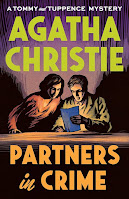
Partners in crime (by Agatha Christie)

Partners in crime by Agatha Christie
(Amazon UK link)
I wanted something reasonably light, but different from the contemporary women’s fiction novel I had just completed. An Agatha Christie seemed ideal. I have a large collection, some of which I have never previously read, and ‘Partners in crime’ was the one sitting on my to-be-read shelf.

This turns out to be a series of short stories linked by what we would now call a ‘story arc’. In the first chapter we meet a young, fairly well-off couple called Tommy and Tuppence. Agatha Christie doesn’t usually go in for characterisation, focussing more on clever plotting. But in Tuppence she created a likeable, outgoing young woman with a great deal of both courage and ambition. In the first chapter we meet her expressing how much she enjoys her comfortable life; yet she finds herself bored.

A visitor from Scotland Yard soon changes that. He tells them about a detective agency which was an undercover rendez-vous for a nefarious gang; we don’t learn a great deal about what the gang did, but it doesn’t much matter. The person running the agency, we learn, has been arrested but the police would like to round up some of the other members of the gang. So they propose that Tommy and Tuppence take over, and give them some code words and phrases to look out for.

There are then a series of incidents, each one taking just one or two chapters. Various clients arrive at the offices with mysterious events or problems to solve. And, despite no experience in this field at all, Tommy and Tuppence manage to sort everything out. They read crime fiction avidly, and put themselves into the roles of famous detectives, from Sherlock Holmes through to Agatha Christie’s own most famous detective Hercule Poirot.

I very much enjoyed this book. Some of the crimes are quite light-weight, and there’s plenty of light-hearted badinage between Tommy and Tuppence, who are clearly devoted to each other. It’s easy to forget the reason they’re manning the agency; however in the last chapters, things become more serious and there’s quite an exciting finale to the book.

While Agatha Christie crime fiction doesn’t always make good bedtime reading, this one was ideal. Recommended to anyone who enjoys this genre. Some of the detective references went over my head - I was not familiar with them all - but it didn’t matter at all.


Review by copyright 2017 Sue's Book Reviews

14 Jul 2017

The mirror crack'd from side to side (by Agatha Christie)

The mirror crack'd from side to side by Agatha Christie
(Amazon UK link)
We have quite a large collection of books by Agatha Christie, probably the best-known writer of light crime fiction in the middle of the twentieth century. We picked up most of them second-hand, initially for my sons who liked reading them in their teens. Now I’m slowly working through them myself.

‘The mirror crack’d from side to side’ is set in the fictional small village of St Mary Mead, home of Miss Marple. She is becoming quite elderly; Miss Marple now has a live-in helper who drives her wild, and finds it difficult to get about. But she and her friends take a lively interest in everything that goes on around them, and like to gossip about the modern housing estate, complete with supermarkets, which has grown up around the village.

Most of the story, however, is related to Gossington Hall, a large stately home in St Mary Mead. I particularly loved the description of the East Lodge, ‘a charming porticoed little building replete with inconvenience…’. The Hall has been bought by a film star and her fifth husband, and within a few chapters of the book most of the cast gather at a large garden fete given at the Hall, which attracts most of the locals.

The initial chapters introduce us to several of the important characters of the book, seen in context. Agatha Christie was very skilled in her plotting of books, and this is no exception. I’ve always felt that her characterisation, by contrast, was less well developed. Some of her people seem very two-dimensional. However, in this book I was quite drawn to Miss Marple, and a few other characters too.

Unsurprisingly there’s a murder that takes place at the fete, one that apparently happens in full view of several people. As ever, red herrings abound. I thought I was doing quite well with spotting things before the police did, or before they were spelled out, only to learn, as I continued to read, that I had fallen nicely into the intended misdirection. I hadn’t guessed the actual perpetrator or the motive until about a paragraph before all was revealed, and felt quite tense when reading the last fifty pages or so, as Miss Marple works out what has happened.

My one gripe about this book is the rather unpleasant language used to describe a child who was born with a serious mental handicap. We don’t know much about the child, but the attitudes of the times are rather shocking. The very non-PC words used could be considered seriously disturbing.

The attitude towards prescribed drugs also seems rather bizarre over fifty years later; but could be considered part of the social history of the era.

All in all, I thought it a very good example of Agatha Christie’s work. As with all this author's novels, it remains almost continually in print, but is also widely available second-hand.


Review copyright 2017 Sue's Book Reviews

15 Dec 2016

Crooked House (by Agatha Christie)

Crooked House by Agatha Christie
(Amazon UK link)
We have quite a collection of Agatha Christie novels. Some of them belonged to one of my sons, but were left here to add to my own; I only started reading her classic crime fiction about fifteen years ago, and find they make good light reading, rather different from the family sagas, contemporary fiction or historical novels which I most often read.

‘Crooked House’ is one that I had not previously read. It’s narrated by a young man called Charles who wants to marry a girl called Sophia. They met abroad, and she hasn’t spoken much about her family; but on arriving back in the UK, after an assignment elsewhere, he discovers her caught up in a murder enquiry.

I found the family involved to be rather interesting, as they’re supposed to be a typical Greek origin family. The patriarch is Aristide Leonides, who had lost several children but keeps his two living ones in his rather oddly designed spacious manor house. Sophie is the oldest of his grandchildren; she has a younger brother and sister who are both also living at home, educated by a live-in tutor for various reasons.

Charles’ father is a police officer, so he finds himself interested in the case from both perspectives: as an outsider, and also as someone wanting to become part of the family, yet unable to do so until the crime is solved. He’s a friendly person and soon gets to know the different family members.

Inevitably there are caricatures: Sophia’s mother Magda is an actress who spends most of her life imagining herself in some dramatic role. Sophia’s uncle Roger is a likeable, but rather clueless person who tries hard to please everyone, and ends up annoying them all. There’s a maiden aunt who mostly raised the grandchildren, a large and benevolent ‘nannie’, a morose teenage boy, and a talkative girl who wants to be a detective…

As with most of Christie’s novels, there are many people who could have committed the crime, yet at first none of them appear to have any motive. Red herrings are gently strewn around, putting suspicion first on one person and then on another. I had my own suspicions from fairly early in the book, and although I started to wonder, part way through, if I could possibly be right, I was pleased to discover that I was.

It’s not usual for me to spot ‘whodunit’ in Agatha Christie’s books; she usually focuses more on plot than character, and I get lost with the twists and turns. However in this book character turns out to be very important, and from that point of view it wasn’t at all difficult.

I thought the ending rather morbid, albeit mostly off-stage (as are the crimes themselves, most of the time) but this was first published in 1949 when the UK still had the death penalty, so perhaps it wasn’t unreasonable.

Inevitably this is very dated, but conversation and story move at a reasonable pace, and it’s a well-told tale.

Review copyright 2016 Sue's Book Reviews

10 Aug 2016

The Boomerang Clue or Why Didn't They Ask Evans? (by Agatha Christie)

Why didn't they ask Evans by Agatha Christie
(Amazon UK link)
We seem to have acquired rather a large collection of Agatha Christie books. I didn’t start reading them until about ten years ago, but they’re widely available second hand and various members of the family have picked them up for us. I haven’t read all of them, however. I have to be in the right mood for a bit of crime fiction.

I decided to read ‘The Boomerang Clue’ a few days ago. This is an alternative title for the novel also known as, ‘Why didn’t they ask Evans?’ This phrase is uttered by a dying man, and triggers a long and convoluted investigation by two young people: Bobby, the Vicar’s son, and Frankie, a close friend of his otherwise known as Lady Frances.

Both are convinced that there’s something suspicious about an apparent accident when someone falls over a cliff, and soon realise that things are not what they seem. They evolve a complex scenario where Frankie pretends to crash her car - an old one, bought from Bobby and his hapless friend Badger, who are trying to run a second-hand car dealership. This throws them into the heart of a somewhat troubled household; an unpredictable man, a worried wife, an accident-prone small son, and the charmingly friendly brother of the household head.

As with most of Christie’s novels there are false clues everywhere, although rather than leaving it to the reader to figure out, Bobby and Frankie themselves set out on many trails, some of them more useful than others. They ask questions, leap to conclusions, aren’t entirely sure who to trust or who to suspect… and only after an exciting finale do they gradually figure out the truth.

I’m not sure I could have guessed exactly what happened, as the plot is complex, involving wills, forgery, impersonation, drugs and more… but I liked the friendship between Bobby and Frankie and was content to go along with their reasoning, albeit with one or two of my own suspicions. Christie isn’t known for making the greatest characters, but I thought the two main protagonists were better drawn than typical for her books, and I got quite a feel for some of the others in the cast too.

The dialogue is perhaps stilted, but not untypical of the mid-20th century upper class scenario, and I found myself quite caught up in the storyline. By the time I was half-way through I wasn’t too keen on reading it at bedtime; by the last third, I could barely put it down.

Definitely recommended to anyone who likes crime fiction.

Review copyright 2016 Sue's Book Reviews

4 Feb 2016

Murder is easy (by Agatha Christie)

Murder is easy by Agatha Christie
(Amazon UK link)
It’s been a while since I read an Agatha Christie book. I have quite a big collection of her novels, but rarely think of picking them up. However, in the mood for something a bit different, I decided to pick one I hadn’t previously read.

‘Murder is easy’ stars a young man called Luke Fitzwilliam, a policeman who has returned to the UK after a spell abroad. He meets an elderly lady on the train, who spins what appears to be a bizarre story of crimes committed in her village, which she plans to report to Scotland Yard.

The next day, Luke learns something which makes him realise that perhaps there was something in her story… and goes, himself, to stay in the village. He passes himself off as a writer, and starts to make investigations…

While Luke isn’t a particularly strong character, nor subtle about his questioning, he’s quite likeable and good-hearted. That was just as well, because this was rather a dark story which didn’t turn out to be good bedtime reading at all. The village has an atmosphere, and some of the characters are decidedly creepy. I found myself concerned about Luke and one or two others, quite apart from wanting to know ‘whodunit’.

Purists might wish that Miss Marple had been involved; it was the kind of village she would have liked, but it worked well, I thought, to have a young and enthusiastic (if not always very intuitive) detective. I was a little surprised that there was quite a significant romantic thread, unusual in Christie’s novels; some of the relevant conversation was perhaps a bit cringeworthy, but then dialogue wasn’t one of the author’s strong points.

What Agatha Christie lacked in characterisation she more than made up for in her plotting. While this story does depend very much on a small number of people, most of whom are somewhat caricatured, she neatly lays her clues and red herrings, leading me exactly where, I assume, she intended her readers to go. I was pretty sure from early in the book that I had guessed the criminal; my hunch became more and more certain as the book progressed, and I was surprised that Luke had not come to the same conclusion.

And then it turned out that I was wrong. What should have been clear - and the clues were there - was obfuscated by the clever direction in which the story went. The last few chapters are even creepier than the rest, so I was glad that I had decided to finish the book in the daytime.

Recommended if you like this style of mid-20th century light crime fiction. Still in print on both sides of the Atlantic, and also widely available second-hand in many different editions.

Review copyright 2016 Sue's Book Reviews

28 Jul 2014

The Mysterious Affair at Styles (by Agatha Christie)

The Mysterious Affair at Styles by Agatha Christie
(Amazon UK link)
I was able to find a couple of Agatha Christie books, free for my Kindle, some time ago from Project Gutenberg. Wanting something different from the light romance I’d been reading lately, I decided to read this one. I had no memory of ever having read it before, although to my surprise I discovered later that I did first read 'The Mysterious Affair at Styles' back in 2001.

This is the first of Christie’s books with the well-known Hercule Poirot. The plot features - as so many of the author’s books do - a fairly well-to-do family living in a country home, with guests invited - including the narrator, Hastings, who is friendly with one of the inhabitants. The family is a little complicated - there’s an elderly woman who brought up two stepsons; however she recently re-married someone considerably younger than she is, who nobody really likes. There are various other people in the household - a companion, the wife of one of the sons, and various servants.

A murder happens, and nearly all the household come under suspicion for various good reasons. It’s really a very clever plot; even as the clues gradually unravelled I could not recall who the murderer was, and I was taken in by several red herrings, even while realising that the narrator must inevitably be on the wrong track, one way or another.

When the perpetrator was finally revealed, it all made sense, and the clues fell into place perfectly; Agatha Christie was brilliant at plotting, filling in all the details and leading her readers astray without ever making them feel cheated.

While the characterisation isn’t great - it’s my one slight problem this author - I did appreciate good writing and tight plotting after so many more modern chick-lit books that seem to suffer from lack of editing.

I should also add that my Gutenberg edition of this book was lacking the images included in the book form. While this would not matter for illustrations, these were supposedly snippets of paper with significant text, which were necessary to read to understand the plot fully. Happily I was able to find a paperback version of this book and read from that instead of on my Kindle; I hope that the official Kindle editions have the images included.

The link above is to a paperback edition; there are several available, and this can often be found second-hand. Some of the Kindle editions are inexpensive too.

Review copyright 2014 Sue's Book Reviews

19 Jun 2013

Taken at the flood (by Agatha Christie)

Taken at the flood by Agatha Christie
(Amazon UK link)
While I’m not a fan of thrillers and crime fiction in general, I do like reading the occasional Agatha Christie. Written in the early and middle of the 20th century, her stories reflect a calmer, politer way of life than we are used to, where violent crime stands out as a mystery to be solved. Christie’s people are not the most well developed, but then these are not primarily character-based novels; instead, they are puzzles for which she cleverly lays both clues and red herrings.

It was only when I had finished reading ‘Taken at the Flood’, and was entering the information into one of the online book sites that I realised that I had previously read it, in an edition confusingly titled ‘There is a tide’. It was only seven years ago, so I am astounded and a little shocked, since I had no memory at all of having read it before... (see note below)

In this story, the first victim is Gordon Cloade, a wealthy man who is tragically killed in a bomb attack in London. Gordon had been in the habit of funding his various impecunious relatives, and had half promised that they would share his fortune after he had passed away. However, shortly before his demise, he had married Rosaleen, a young widow. As the story starts, Rosaleen is understood to be living in Gordon’s family home with her somewhat overbearing brother.

We get a good picture of Gordon’s family members, although I found myself sometimes forgetting who was whom as there were so many of them. Some are quite sympathetic towards the young Rosaleen, when they finally meet her; others are more hostile. Some of them are keen to ask her for money, and she comes across as quite kind-hearted if a bit weak-willed; her brother evidently rules the roost.

A stranger arrives in the village, asking questions about Rosaleen’s first husband, who supposedly died in South Africa.. or did he?

Naturally Gordon is not the only victim in this story; there is no mystery surrounding his death, just a great deal of tension and argument amongst his loved ones. But someone else dies, and clues seem to point in one direction... except that they are perhaps a bit too obvious. The police are uncertain, and Hercule Poirot, who is called in to investigate, feels that the whole ‘shape’ of the apparent crime is wrong.

As always with Agatha Christie’s novels, there’s a great deal of talking. This is really where her books fall down, as she didn’t write the most believable conversations. Nor does she really distinguish between Gordon’s various surviving relatives; other than some of their interests, I found them all somewhat bland. I had my suspicions about who might have ‘dunnit’, but was - as so often - quite wrong. Poirot solves everything in the end, unsurprisingly, and it all makes sense.

I didn’t feel that the plot was as clear-cut or well-planned as some of the author’s other books, and found the final few pages particularly unsatisfying. Not a bad story, but not one of my favourites, nor one I would particularly recommend to anyone new to Agatha Christie or light crime fiction.

Note: according to Wikipedia's page on this book, 'Taken at the flood' was the author's title for this book, but the US publishers chose 'There is a tide' for their first edition in 1948. Both phrases are taken from a speech in Shakespeare's 'Julius Caesar'.


Review copyright Sue's Book Reviews, 19th June 2013

10 Feb 2009

Mrs McGinty's dead (by Agatha Christie)

Mrs McGinty's dead by Agatha Christie
(Amazon UK link)
I only started reading Agatha Christie books a few years ago. I was pleasantly surprised - they're light, they're mostly very cleverly written, and they're not as gory as I had expected. I don't enjoy them sufficiently to buy them new, but when I see one in a charity shop which we don't already have, I usually buy it.

Hence the arrival of 'Mrs McGinty's dead' on my to-be-read bookshelf a week or so back. I wanted a short, light read a couple of days ago, so picked it up.

It's a standard mystery novel. Hercule Poirot is asked to investigate the death of a charwoman some months previously. Someone has been tried and convicted, but the police officer involved in the case is convinced that the wrong person is in prison. So Poirot gets to know the residents of the village, and - of course - eventually figures out 'whodunit'.

Agatha Christie's primary skill is in her plotting, along with the laying of false clues to lull the reader into a false sense of confidence about the perpetrator of her crimes. However, I'm always less impressed with her characters, who tend to be two-dimensional and sometimes hard to distinguish from each other.

Lack of characterisation doesn't matter in a plot-based book where there are only a few people. But in this one, there are more individuals than I could remember, and I frequently lost the train or logic when Poirot was having discussions or making deductions.

Moreover, I worked out who was the guilty party about half-way through the book. I thought I had probably followed a neatly laid false clue, only to find that I had in fact spotted a real one. I haven't read a Christie for quite some time, so was surprised to get it right.

It was all right for a light read for anyone who is a fan of this genre or author, but I wouldn't particularly recommend it. Agatha Christie has written much better books. Still, it's evidently popular with many since it's still in print, over 50 years after it was written, in several versions in both the UK and USA. There's even a new edition that's a facsimile of the original.

Review copyright Sue's Book Reviews, 9th February 2009

7 Dec 2007

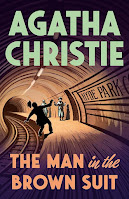
The Man in the Brown Suit (by Agatha Christie)

The Man in the Brown Suit by Agatha Christie
(Amazon UK link)
Every so often I like a change from my steady diet of character-driven sagas or romantic novels. So when I saw several paperbacks by Agatha Christie in a charity shop, recently, I couldn't resist.

'The Man in the Brown Suit' isn't in her normal style of murder mystery, or whodunit. It's really a thriller. I didn't realise that at first, though, because the novel does start with two murders - or, at least, two deaths.

It's narrated by Anne Bedderfield, a young woman who's alone in the world after the death of her highly academic father. She first sees a man on a railway station who is frightened by something, and falls onto the line. He appears to have died instantly, but the doctor who comes forward to examine him may not in fact have been a doctor...

Next, in an apparently unrelated incident, a woman is found dead in a house that's available for rent. A man in a brown suit is the clear suspect.

Yet there does seem to be a connection between the two deaths, as far as Anne is concerned. In desperate need of some excitement, she spends the last of her money on a ticket on a ship to South Africa, following some clues she has discovered. There she meets several other people - the genial Sir Eustace, his dour secretary Paggett, and his dashing but abrupt second secretary Harry Rayburn. Anne gets all the excitement she could wish for, with a wounded man bursting into her cabin, and another trying to push her overboard.

Oh, it's all a bit unlikely, or perhaps it's just that the book is now over eighty years old, and we live in a different, faster-paced electronic world. Not that 'The Man in the Brown Suit' seems particularly dated, other than the lack of modern amenities, and a bit of inherent colonial-style racism (the black South Africans are referred to as 'natives', for instance).

But it's all a bit unbelievable. Naturally the good guys survive - well, Anne has to, as she's narrating - and the conclusion is neat and tidy. I had even guessed most of the revelations that occurred towards the end, about who were the good guys and who were the not-so-good.

Still, an enjoyable and exciting light novel, well-written and very cleverly plotted. So much so that it's been almost constantly in print in both the USA and UK. There were so many characters that I didn't always keep track of who was who, or even where the plot was going, but it didn't seem to matter.

Recommended.