Showing posts with label Veronica Henry. Show all posts

20 Jun 2026

The secret beach (by Veronica Henry)

The secret beach by Veronica Henry
(Amazon UK link)
I’ve liked all the books I’ve read by Veronica Henry. So when I saw her novel ‘The secret beach’ at a church bookstall a few months ago, it was an easy decision to buy it. I’ve just spent the last few days reading it. 

The main protagonist is a woman called Nikki, who is in her early forties. We first meet her in a prologue set twenty years before the main story, where she’s about to meet someone on a secret beach. She is going to say something which they will both find difficult, but we don’t learn what this is until much later in the book.

The main story opens as Nikki finds a house that she loves, not far from where she grew up. It’s near a special beach, and she falls for it as soon as she sees it. It needs a lot of work done, but she’s still surprised to learn that she’s able to buy it without any competition. A lot of the book then follows the gradual transformation of her new home, culminating in a housewarming party.

25 Feb 2023

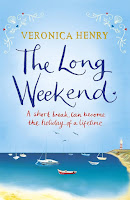
The Long Weekend (by Veronica Henry)

The Long Weekend by Veronica Henry
(Amazon UK link)
I read a few books by Veronica Henry a few years ago, and liked them very much. So I added a few more to my wishlist. One of them, which I was given for Christmas 2020, is ‘The Long Weekend’. It sat on my to-be-read shelf for over two years - I’m not entirely sure why - but I finally picked it up to read a few days ago.  


It’s a novel set over the course of a long bank holiday weekend - with a few flashbacks into the past - but it involves rather a large cast of characters. What links them is a luxury and somewhat quirky hotel in Cornwall, called ‘The TownHouse’.  It’s run by a couple called Claire and Luca; he is a superb and creative chef, she is an excellent administrator. 


They only have eight rooms, of varying sizes, but they’re almost all going to be occupied over the weekend. They also expect lunch visitors, and quite a crowd at the bar, so Luca, Claire, and their receptionist Angelica are going to be busy. 


Early in the book there’s a paragraph explaining who the visitors will be, as Claire consults her list and reminds herself; this was useful to me, since each section involves a different person or group, and it was quite hard, at first, to remember who was who. 


There’s a wealthy couple who visit regularly, and who have a proposal to make to Luca and Claire. I’ve already forgotten their names. There’s a man called Colin, coming with a ‘friend’ and her daughter, taking up two rooms. There’s a young couple, Laura and Dan, who have booked the very smallest room, one that’s only really suitable for a single person, and there are three rooms booked by six men coming on a stag weekend. They have promised not to be rowdy or to do anything embarrassing. 


Naturally, since the novel revolves around these people, there are secrets from the past, some of which unfold during the course of the story. Claire has a shock when she sees the groom from the stag night; she knew him many years earlier. Colin has managed to keep a significant part of his life a secret from his wife and family, and Laura is searching for her father, whom she has never met.


I found the stories interesting, although as the different groups of characters don’t interact with each other, the book feels more like several short stories spread out, switching from one to another to draw them out and to give a bit of tension. I thought Claire’s flashback story was probably the most interesting and developed part of the novel, but the people I liked best were Laura and Dan. 


The stories are quite engaging, and I found myself turning the pages wondering what would happen. The writing has a nice pace, and the conversations mostly feel believable. There’s nothing particularly deep, but as a light holiday read, it’s a good book, albeit fairly typical chick-lit. 


However. I didn’t find any of the characters fully three-dimensional. This may be because there are so many, and we only get their stories in short chapters spread through the book - so there’s nobody I could relate to.  I also thought there was rather too much emphasis on physical passion; two of the stories involve times of infidelity in the past, supposedly indulged in due to the heat of the moment, impossible to resist - which doesn’t feel realistic, and made me less interested in the characters concerned. 


Even less believable are two instances in the book of sudden, unplanned bedroom scenes, and one, not unplanned, but rather sordid. Thankfully there’s not too much detail in most of the encounters mentioned, and the two unplanned ones are instrumental in moving the plot along. 


They’re minor gripes, but the latter one means I wouldn’t recommend this to teenage friends, or, indeed, anyone who doesn’t like reading about this kind of thing.  


But if you’re looking for some light reading, and don’t mind the many people with different stories, and an ending that leaves some of the threads still rather open, it’s worth trying. Despite all the above comments, I did enjoy reading it, and often read fifty or more pages at a time, wanting to know what would happen in each of the different stories.


Review copyright 2023 Sue's Book Reviews

6 Apr 2022

How to find love in a bookshop (by Veronica Henry)

How to find love in a bookshop by Veronica Henry
(Amazon UK link)
I’ve mostly enjoyed the books I’ve read by Veronica Henry, an author I discovered about three years ago. So I added a few interesting-sounding titles of hers to my wishlist. One particularly intriguing title is ‘How to find love in a book shop’ which I was given for Christmas… in 2020! I have so many books on my to-read shelf that I have only just read it.

It’s a pleasant story that takes place in a village where most people know each other. The main character is Emilia, whom we meet in chapter one waiting for her father to die. It’s not the most attractive start to a book, but it follows on from a prologue, set thirty years earlier, when Emilia was a baby and her father Julius a single father deciding to put in an offer on a very run-down bookshop, realising he has to find somewhere to settle with his small daughter.

There are a couple of other flashbacks early in the book, so we learn about Julius before he got married, and the reason why he is on his own. It’s all rather poignant, but doesn’t actually have much bearing on the main part of the story which features Emilia’s attempts to revive and run her father’s book shop after he dies.

I found the cast of characters quite confusing - for the first half of the book each chapter seems to introduce someone different, and while their names and professions are quite distinct, none of them was really three-dimensional enough for me to feel as if I knew them. They mostly have some kind of connection with the shop, and with Julius himself; he was evidently a very caring person who spent a lot of time with people, helping them to find suitable books. However he wasn’t a good businessman, and as Emilia discovers, the book has not been making a profit for some time. Indeed, quite the reverse.

We meet , for instance, a young woman who is a teacher but loves to cook and runs a little ‘a deux’ restaurant; then there's Sarah, the ‘lady of the manor’ whose daughter Alice is due to get married. Therre's a musician with a snooty girlfriend, and a rough kind of guy, estranged from his wife and worried that his son doesn’t really know him… and many more. I’ve already forgotten most of their names. Inevitably some romances happen - the title of the book makes that rather clear - but I’m not sure I cared sufficiently about any of them to mind much what happened.

Not that it’s a bad book - I did find some of the storylines intriguing, although the switching between different characters means that subplots are left hanging while someone else’s life is described. It’s a bit of a soap opera style, I suppose, although the writing is good, and I did appreciate the many low-key literary references. But the people are a tad too caricatured, and Alice too sweet and naive to be realistic. I did rather like Dillon, the gardener at the large manor house, and I quite liked June, a motherly kind of woman who loves to read and regularly helps at the shop, although her story, which isn’t really revealed until towards the end of the book, also feels a bit unrealistic.

Still, it made an enjoyable few days’ light reading - and if the endings are a little predictable, they are entirely satisfactory.

This book would make good holiday reading if you like light women’s fiction; there’s nothing steamy, only minimal bad language, and the characters are mostly likeable, even if not entirely three dimensional.

Review copyright 2022 Sue's Book Reviews

11 Dec 2020

A family recipe (by Veronica Henry)

A family recipe by Veronica Henry
(Amazon UK link)
I’ve liked the novels I’ve read so far by Veronica Henry, so I added a few to my wishlist, and was given ‘A Family Recipe’ for my birthday earlier in the year. I picked it up to read a couple of days ago, wanting something reasonably light, and found it quite difficult to put down by the time I was half-way through.

The story is set in two different periods, as is not uncommon in modern novels. It opens in April 1942, introducing 18-year-old Jilly Wilson. She’s the only daughter of a doctor and a teacher, and they seem to have been quite liberal parents for the era. We meet Jilly as she is quietly sneaking out of the house after dark, to meet a young man who is about to go off to train as a fighter pilot. They met at a dance, the night before, and had an instant spark of kinship… and this is their last chance to see each other before he leaves.

The inevitable happens in the park, and then the bombing starts. We already know that Jilly lives in Bath, a fairly small town in those days, one which wasn’t really prepared for an air raid. Devastation happens all around her, and she races back home… only to discover that disaster has happened.

The story then moves forward seventy-five years to 2017. This time, Laura is the main character. She’s a mother in her early forties, who is dreading saying goodbye to her younger daughter Willow. Willow is about to start a course at York University, and they’re having a kind of farewell party the night before. Laura loves to cook and bake, and is a natural hostess, even though she’s full of dread at the thought of her nest emptying.

Her dread is is tinged with concern too, because Willow has suffered asthma most of her life, with some very serious attacks that sent her to hospital. She’s been clear for the past eighteen months, with better medication, but Laura worries that she will be careless.

Willow has an older sister, Jasmine, who is responsible, practical and organised. We don’t see much of Jasmine, who must have had a bit of a difficult life with her sister in and out of hospital. But she’s a likeable and thoughtful person - and is also off to university, for the third year of her course.

Laura’s husband Dom has been an excellent father, although recently he has been extremely stressed about a huge building project which is going rather too slowly for his tastes. He has invested a huge amount of money and time, and has taken out a potentially crippling bank loan. He tells Laura everything, but she has taken almost no interest in his work, partly because she has been so caught up with Willow.

So Dom and Laura take their daughter to York, and do what they can to settle her in. But she doesn’t want them to stick around, so they set off for home. They stop for coffee at a service station, and there Laura learns something that shocks her, and turns her entire world upside down…

The writing is good, the pace excellent, and the switch between 1942 and 2017 works well. I had guessed the connecting character before it was revealed; it’s not really a secret, and was clear fairly early in the book. We then see that character and her closest friend in both scenarios - as very young adults, in a terrifying war-torn world, and as 93-year-old women.

I found Laura a bit difficult to relate to - I could entirely understand her worries as a mother, and her dread of the empty nest. But she’s also very driven, and surprisingly astute, which didn’t quite gel with her lack of interest in what her husband was doing. When she receives her terrible shock, she seems to recover much more quickly than I would expect, harbouring a great deal of anger yet somehow channelling it into constructive occupations. And she’s totally unwilling to discuss it.

On the other hand, I very much liked her grandmother, known as Kanga. She brought Laura up when her mother was killed, and is strong and empathic, despite being elderly. She’s extremely generous, too, and supportive without (on the whole) being judgemental. I would like to be like Kanga at that age!

It’s essentially a character-based story, with an emphasis on cooking - several characters are skilled at preserving and baking, and there are a few recipes at the end of the book as well as one in the course of the story. It made an excellent light read, and I’d recommend it to anyone who likes this kind of women’s fiction with a dual timeline.

Review copyright 2020 Sue's Book Reviews

17 Oct 2020

A home from home (by Veronica Henry)

A home from home by Veronica Henry
(Amazon UK link)
I’m always pleased when I discover a new (to me) author whose books I like. One writer I discovered just a year ago was Veronica Henry. I very much enjoyed the first book I read by her, so I started adding more to my wishlist. I’ve just finished reading ‘A home from home’, which I was given last Christmas.

It’s a heart-warming character-based story, set mainly in Somerset. There are two families who have been divided by a long-standing feud. This started when an entire plot of land and house was gambled away by the owner, over a century before the story began. But bad feeling has continued…

Tabitha is an outspoken and impetuous young woman who has been living with her elderly great-uncle for some years. Her parents are divorced, and she has found affection and motivation in life from her great-uncle Matthew and his wife Joy. Joy died a couple of years before the story starts, and Matthew has been grieving. But we don’t actually meet him because there’s a terrible accident in the first chapter.

A young man with the unlikely name of Dash is on the scene. It turns out that he’s from the ‘other’ family, although he knows very little about the long-standing feud. He’s just arrived in the area, determined to renovate the tumbledown mansion he is living in. He also has plans for developing some of the land. He would like to be friendly with all his neighbours, and he’s rather taken with Tabitha. But she is prickly, suspicious, and also, of course, very upset.

Tabitha’s gentle cousin Georgia comes to the rescue. Georgia’s story is something of a sideline, but we see her working as an editor, longing to be recognised as a writer. She’s recently broken up with someone and is still stressed about that. She and Tabitha haven’t spoken for months, but they are very close, almost like sisters.

Then they learn that Great Uncle Matthew has left his house to three people: Tabitha, Georgia, and a young man called Gabriel. Gabriel had never previously heard of Uncle Matthew, and although his surname is the same as Dash’s, he knows nothing about his heritage, or the family home, or the feud. Gabriel is a skilled knife-maker, concerned about how his business will continue as the landlord is putting up the rent. He has a partner, Lola, and a delightful small daughter called Plum.

I found the various family relationships a bit complex to follow; it wasn’t until I finished the book that I noticed a family tree (or, rather, two family trees) at the beginning of the book. I’m not sure it would have helped much, since it turns out that there are some family secrets making things even more complicated. The unexpected division of Matthew’s property is the catalyst for uncovering several surprising relationships.

As with the author’s other books, the writing is good, the pace excellent, and the characterisation nicely developed. I found Tabitha a bit difficult to relate to - she’s quite insecure, but also very easily angered, and not at all tactful. I liked Georgia very much, however, and I also grew fond of Georgia’s parents, although their role is relatively small. Once I was about half way through the book it was difficult to put down - not that there's any fast action, but several of the people were getting under my skin. Reading it in just a few sittings made it easier to keep track of who was whom.

The ending is entirely satisfactory, if perhaps inevitable - I had seen the various 'surprises' coming, but that didn't matter at all. I like a book where most of the loose ends are tied up, and where the future looks hopeful for everyone. So all in all, I liked this book very much and would recommend it to anyone who likes thoughtful women’s fiction.

Review copyright 2020 Sue's Book Reviews
1 Sept 2020

High Tide (by Veronica Henry)

High Tide by Veronica Henry
(Amazon UK link)
I so enjoyed the first book I read by Veronica Henry last year that I put a few more of her novels on my wishlist, and was delighted to receive ‘High Tide’ for Christmas last year. Once again, a book by this author sat on my to-be-read shelf for quite a long time, but I finally started reading it a couple of days ago.

I finished this morning, and am already looking forward to reading a couple more books by this author which are still waiting on my shelf. It’s a lovely read, a character-based story revolving around four main likeable people who are all connected to a small town on the Cornish coast called Pennfleet. The town is fictional, but apparently loosely based on another real town in the area.

I did find it a tad confusing at first trying to remember who was whom. Kate is the person we meet first, a high-powered and very talented event organiser who lives in New York. She has flown to the UK for her mother’s funeral; Joy wasn’t particularly old, or ill, but had a nasty fall which was fatal. Joy and Kate were close emotionally, and Joy - whom we gradually get to know through other people’s comments and memories - was a lovely, selfless and hard-working woman who is missed by everyone she knew.

Sam is the next person we meet; he’s a widowed father of two teenagers, who gave up a career in medicine to bring his grieving children to a small town where they could make a new start. He loves to cook and runs a thriving shop that sells quite exotic food. Kate goes there to eat, and we learn a bit about them both as they introduce themselves. I liked Sam very much.

Then there’s Vanessa, whose husband Spencer has just died; his funeral is on the same day as Joy’s. Spencer was very wealthy, rather older than his wife, and although they liked each other well enough they had mostly drifted apart. Spencer’s ex-wife and friends have never really taken to Vanessa, so instead of going to the house to socialise with these people, she persuades one of the funeral drivers, Nathan, to take her to a bar and have a drink with her…

I never really came to terms with Vanessa, nor with Nathan who is hard-working and honest but didn’t seem entirely real. However I did very much like Mary, who has worked as housekeeper and general factotum for Spencer, and has become good friends with Vanessa. We learn a lot about Mary’s story too, struggling to keep her family after her husband lost his job.

That’s more about different people than a review would usually warrant, but I’ve mentioned so many because they got under my skin in different ways. There are other characters too, but I didn’t have much trouble distinguishing them; some are a tad caricatured, but that doesn’t matter in this kind of book.

The writing is good, the conversations believable, and the pace exactly right for reading either at odd moments or in longer periods. Kate has to come to terms with her past, as she starts to pack up her mother’s house and sort through her possessions; Vanessa and Nathan have to decide what to do in the present, and Sam is looking more towards the future, as he sees his teenagers growing up all too fast, and wonders what will happen when his nest empties.

My only slight gripe is that there's a little more bad language than I'm comfortable with, and one brief but shocking scene that Kate recalls from her past, with a very unpleasant usage of a 'strong' word.

Perhaps the ending is a tad too tidy, many things falling neatly into place for most of the people in the story, but I don't mind that at all. And in some respects the future is still somewhat open - I'd love to know what Kate is going to do, for instance. I gather the author has written other novels based in the same town, so maybe they will give a glimpse of what has become of these different people and their relationships.

Overall, I very much enjoyed reading 'High Tide', and have already put some more of this author’s books on my wishlist.

Review copyright 2020 Sue's Book Reviews

13 Sept 2019

The Forever House (by Veronica Henry)

The Forever House by Veronica Henry
(Amazon UK link)
I had not heard of Veronica Henry when Amazon started recommending one of her books to me, a couple of years ago, based on what I had previously liked. I like to try new authors, and the reviews of her books seemed mostly positive, so I added ‘The Forever House’ to my wishlist. I was given it for my birthday nearly eighteen months ago, and it sat on my to-be-read shelf for all that time.

I finally started it on Sunday, and finished it this morning. What a wonderful book! It’s well-written, with some three-dimensional characters, a very low-key romance, and an entirely satisfying conclusion.

Brenda is the first person we meet; she’s a young estate agent who runs her own business, and is clearly very successful in what she does. She’s saving up for the deposit on a house of her own - a ‘forever house’ - but in the meantime lives in a flat above her office.

We meet her as she’s about to do a valuation on a large, well-maintained house called Hunter’s Moon. Sally and Alex are the owners, but Brenda just meets Sally to start with. This is appropriate, as these two women are the main protagonists of the novel. Sally is in her late sixties now, and it quickly becomes apparent that she and her husband really don’t want to sell their family home. But Alex has recently been diagnosed with a life-threatening illness, and they want to move somewhere cheaper and easier to maintain.

Brenda and Sally like each other immediately; and although they play very different roles, and have different skills, I found their personalities a bit too similar to distinguish them easily. They are both good organisers, both have an eye for design, both are extremely kind and intuitively empathic. That doesn’t matter when we’re involved in the contemporary part of the book, as Brenda organises an open day and attempts to sell the house.

But a significant part of the book takes place in 1967 when Sally had just left home, and when she first meets Alex and his family. It’s nicely done; the forays into the past work almost seamlessly, as Sally remembers events from her youth. Sally came from a working-class family who didn’t travel much, and who were quite close. Brenda came from a military family who moved constantly; hence her deep desire for a home of her own. However, both have traumas from their past, which are hinted at and eventually revealed; and despite the very difficult circumstances and names, I more than once forgot which one I was reading about.

It was my only slight problem with the book; one which probably wouldn’t have arisen if I had not kept reading when I needed to sleep. There’s a wide cast of minor characters, some of them a tad stereotyped, but I didn’t have any problem distinguishing those. A lot of the story involves Alex’s family, when he is a young man and his younger sister Annie is about sixteen. Their mother Margot was a well-known novelist at the time. She was bohemian in the extreme, and suffered mood-swings as well as some writers’ block.

I didn’t much like Margot; I felt quite sorry for her husband at times. And I never entirely believed in their oldest daughter Phoebe, who is a clothes designer - but that didn’t matter. Alex and Annie felt well-rounded and believable, and Sally - who works for them - likeable, well-organised, and good humoured.

There’s not a whole lot of plot. The storyline switches between the present and the past, gradually building up a picture of how Sally and Alex met and fell in love, and also gradually revealing more about Brenda’s past, including her former connection with someone who betrayed her. Perhaps more could have been made of her rivalry with another estate agent company, whom she used to work for; but I was glad there wasn’t any direct conflict or tension.

By the time I was just a few chapters in I could hardly put this book down. I found the last couple of chapters extremely moving, and when I had finished, I immediately put a few more Veronica Henry novels on my wishlist.

Definitely recommended to anyone who likes gentle character-based women’s fiction.


Review copyright 2019 Sue's Book Reviews