I have enjoyed many of the thoughtful books by Catholic writer Henri Nouwen, and tend to pick them up second-hand any time I have the chance. When I saw this one, I didn't realise at first that I had previously read it five years ago, in a special combined edition.
'Life of the Beloved' was originally written by Nouwen for a secular Jewish friend of his. He wanted not to 'convert' him, or to explain in detail what the Bible says (his friend, after all, was well steeped in Jewish history and culture) but to help him understand how much God loved him, to begin to sense that he was a beloved child in a broken world.
I found the writing to be powerful and moving. It wasn't that it said anything new, but the way it was said was very thought-provoking and often moving. The author uses as themes for individual chapters the four words: Taken, Blessed, Broken and Given. He examines what these concepts meant to him over the years, and how he had - very slowly - come to accept the love of God no matter what his circumstances.
It's honest and often moving, and in places reads very much like a letter to a friend, although at times I forgot that there was a specific audience. There's a prologue and epilogue which talk more about it, but the bulk of the book - barring a few specific comments about the friendship - are relevant to anyone.
It's quite a short book, only around 120 pages, but there's a lot to digest if taken slowly. I read just a chapter (or less) per day for nearly two weeks and enjoyed it very much.
Highly recommended. Written in 1992 it's still in print on both sides of the Atlantic.
Review copyright 2014 Sue's Book Reviews
It's some years since I first came across the writing of Henri Nouwen, a Dutch Catholic priest who, in the latter part of his life, worked in a community for disabled people. I haven't read any of his books for a while, so it seemed like a good idea to re-read 'Reaching Out' which I first read in 2006.
There are in fact two books in my edition of this volume, with the cover as shown on the left. The main part, 'Reaching Out', explores three themes of Christian growth. Nouwen writes, often movingly, about his journey through life, growing in three ways related to himself, those around him, and God.
Re-reading six years after I first read it, I didn't find it quite as moving or inspirational as I did the first time; nonetheless, there's a lot to ponder. Nouwen writes well, in a thoughtful way. His first theme is that we need to move from inner, sometimes selfish loneliness into a what he calls solitude, a place where we can be comfortable on our own. I found this section interesting, but as one who has always liked - even needed - time to myself, and who relishes entire days alone, I didn't find all that much to inspire me.
The second part of the book talks about the move from what Nouwen calls hostility towards true hospitality in every sense of the word. He suggests that it's too easy to see people - our families, our work colleagues, our Christian brothers and sisters - as nuisances, impinging on our time. Perhaps hostility is too strong a word; and yet it's far too easy to see our own concerned as more important, to want to change people, to have them fit in with us.
Hospitality, we're told, isn't just inviting people for meals but giving them a safe place to open up, to be themselves, to know that they are loved. Nouwen writes about the importance of treating our children, our students, our apprentices with the same courteous hospitality as we would treat important visitors, giving them the freedom to relax and grow in the way God has made them.
The final part of the book focuses on moving from our illusions to a deep form of prayer that is beyond simple petitions. While I'm not sure I fully grasped the kind of illusions that were mentioned, I found the section about prayer very encouraging. Nouwen writes about an ongoing, heartfelt communication that enters into the fibre of our being as we are filled with God's Spirit, and involve Him in every part of our lives.
It's not a book I could read quickly. I intended to read perhaps half a chapter every morning for a couple of weeks, but found very often that just two or three pages gave me sufficient food for thought. So I read it over several weeks, and thought about it a great deal. I hope that the ideas and suggestions within the book will remain with me for some time to come.
At the end of my edition of 'Reaching Out', there's also a much briefer book, 'Beyond the Mirror' that looks at how Henri Nouwen's life focus and attitudes changes as he faced the possibility of dying after a road accident. Also extremely thought-provoking, but I don't know if it's included in other editions of this book.
Recommended.
Review copyright Sue's Book Reviews, 26th September 2012
I've been reading - and collecting - books by the late Henri Nouwen for a while, now. He was a Catholic priest who spent his later life working in a community in Canada for the mentally disabled. His writing is full of wisdom and gentleness, focusing strongly on the love of God. Nouwen suffered from depression for much of his life, and evidently found some release through his writing.
This volume, which I have just finished after reading a chapter or two per day for about a fortnight, contains two of his works: 'Life of the Beloved', and 'Our Greatest Gift'. In the first of these, Nouwen attempts to explain his amazing knowledge of being God's beloved child. He gives an introduction, describing a close friendship with a young Jewish writer, and addresses the bulk of the book to him.
There wasn't anything really new to me, but I like Nouwen's writing style, and his way of looking at aspects of belief and God's love. Writing to a young man of different faith, yet similar background (in some ways) gave an interesting slant, too.
The second book in this little volume is about caring for the dying, and also about preparing to die. I found it quite thought-provoking, if a little strange in places. The author manages to avoid being morbid, yet I couldn't quite come to terms with his suggestions that in our release from this world we effectively give the greatest gift we can to those who come after us. Nor was I entirely comfortable with his emphasis on the spirits of those we love remaining in or with us after they have passed on.
Still, I'm glad to have read it, and will no doubt continue reading more works by this fairly prolific writer.
Review copyright Sue's Book Reviews, July 2009
I've read quite a few books by Henri Nouwen, in the past three years. He was a Catholic priest who spent the last years of his life working in a community for the disabled. During his life he struggled, sometimes, with depression; he writes honestly about this, and other problems he experienced, and his writing is usually quite thought-provoking.
'Can you drink the cup?' is a short book, just over 120 pages in a small format. It basically examines the question in the title: the one which Jesus asked some of his disciples, near the end of his life. He looks at questions such as: What does it mean to 'drink the cup'? How does the imagery of drinking work as a metaphor for the Christian life?
There are three main sections to this book, which focus on three different aspects of (literally) drinking a cup, ie holding the cup, lifting it, and then finally taking a sip. With anecdotes and personal experience, and the authors own thoughts, he writes with his usual clear style and brings to life some of Jesus' teaching.
I have to admit I found it a little slow-moving, and not as obviously inspiring as some of Nouwen's other books. Perhaps I just wasn't in the right frame of mind to read it, although I did so over several days. I re-read some sections a day later, wondering if I had missed something, but I don't think I did.
Still, it felt like a book to return to in a few years, and will probably find something completely different in it when I do.
Recommended on the whole, but the new prices seem very high for such a short book; look out for it second-hand, or as part of a bigger volume that holds several of Henri Nouwen's books.
Review copyright Sue's Book Reviews, 26th May 2009
I do like Henri Nouwen's writing. He was a Catholic priest who thought deeply about his faith, and who wrote in a simple yet thought-provoking way. I borrowed one of his books nearly three years ago, and since then have slowly been collecting a few myself.
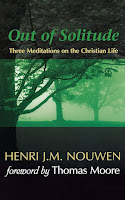
'Out of Solitude' is subtitled 'Three meditations on the Christian Life'. It's a small book, only 63 pages, divided into three sections. Each one was originally given as a sermon, and they transfer well to the printed page. I read them over three days, one meditation per day, and found myself re-reading the first two almost immediately, so as to better understand and take in all that Nouwen was saying.
The first meditation is on the theme of solitude, looking at the time when Jesus withdraw from his disciples to pray in the midst of a great deal of activity. The second is about the importance of caring in a society so keen on curing.
I had not really considered this distinction before, but Nouwen explains how caring, in the way that Jesus cared, involves reaching out to people at their own level, to suffering alongside them and empathising, rather than merely seeking to solve their problems.
The final meditation is on the topic of expectation - of looking forward to better things in life, as well as in the expectation of eternal life. I didn't find this one so helpful or thought-provoking as the first two, but it was still well worth reading.
I shall no doubt come back to this little book again in the future, and have already ordered a couple more books by Henri Nouwen. Definitely recommended to anyone seeking to follow Jesus.
Review copyright Sue's Book Reviews, 4th April 2009
'Reaching Out' is an excellent and thought-provoking Christian book by the late Henri Nouwen, a Dutch Roman Catholic priest. He explores three movements in spiritual growth: from loneliness to solitude, from hostility to hospitality, and from illusion to prayer. He looks at three ways in which people are often hurting - by being lonely, hostile or filled with illusions - and devotes a section of the book to each.
Nouwen looks at reasons why we tend to look inward and suffer, although his writing is gentle and there's no tone of condemnation. He then discusses ways of reaching beyond our pain to find contentment in being alone, and what it means by being truly hospitable and able to pray.
I was particularly struck by his descriptions of hospitality, focusing as they did on welcoming both strangers and friends, particularly family, yet giving them the complete freedom to be themselves, not trying to manipulate or change them.
It wasn't a book to read at one sitting; although the concepts were not hard, and the language flowed well, there were a lot of thought-processes involved and I found a chapter at a time to be plenty. It's a book I shall return to frequently, I expect.
At the end of this edition of the book is a short piece, 'Beyond the Mirror', which describes in detail what happened when the author had an unexpected accident that almost killed him. Very moving and encouraging.
Highly recommended.
'The Inner Voice of Love' is a book of reflections by Henri Nouwen, a Roman Catholic priest who died just over 10 years ago. It was originally written as a private journal when he was going through a difficult period, struggling with loneliness and depression. Some time later, friends persuaded him to have them published to help others who might be going through similar problems.
It's an honest account, painfully so in places. The author considers his needs and values, and the way he sought to meet them without necessarily considering God.
The introduction warns that it's not a book to read straight through, and that not everything will apply to all readers. Instead, it recommends looking at the titles of each reflection and choosing those which seem appropriate. However I decided to read a few a day for a week or two. It's not a long book (just under 100 pages) and I thought the progression might tell something of a story, as the author comes to grips with what's haunting him and moves forward.
I found it quite readable, but nothing special. Maybe if I were going through depression myself it might have been more meaningful, but much of what he says seems quite basic. It was a pleasant enough book, with some good insights, but I'm not sure I'll read it again.
This is a fairly short book by the late Henri Nouwen, a Roman Catholic priest who spent some years pastoring a community for disabled people in Canada. He was inspired to write this book after many years studying and pondering on a painting by Rembrandt, depicting the return of the Prodigal Son.
The book is broadly divided into three sections, mirroring the author's spiritual journey. He thinks of himself first as the younger son, wanting to do his own thing, giving in to temptation, and finally returning.
Then a friend points out that he's really more like the older son - not seriously rebelling, but being resentful that he does not receive enough recognition. So this becomes the second stage of his journey.
Finally someone says that he is like the father, working as a priest and pastor, so the last section explores what it means to become more like Christ.
Quite thought-provoking, although I personally thought the author probably took more out of the painting that was meant to be there, and certainly more from what is basically a fairly simple paragraph. I was a little uncomfortable at times, too, when he talked about becoming God - although in context he seemed to mean becoming LIKE God, which I don't have a problem with.
Still, I thought it an interesting book and well worth reading.