Showing posts with label Cecelia Ahern. Show all posts

26 Apr 2021

The Marble Collector (by Cecelia Ahern)

The Marble Collector by Cecelia Ahern
(Amazon UK link)
On the whole I have liked the books I’ve read by Cecelia Ahern. They often have unusual themes, some of them quite quirky, bordering on fantasy. I had not come across her novel ‘The Marble Collector’, so when I spotted it at a church book sale, it wasn’t a difficult decision to spend fifty cents to acquire it.

It’s a tad complicated in structure, with two different first person narrators. It took me a few chapters to realise that those narrated by the elderly Fergus Boggs are all headed ‘Playing with Marbles’, while those by his daughter Sabrina are headed ‘Pool Rules’. Indeed it’s not immediately obvious what their relationship is, but it is quickly made clear.

Sabrina works at a swimming pool for the elderly as a lifeguard, although she rarely has to do anything much. She’s married to Aidan and they have three sons; they have evidently been having some marriage problems, but she isn’t entirely sure why he keeps hassling her, asking what’s wrong, or if she’s happy, when she really doesn’t know herself. Aidan has taken their sons away on a camping trip, including some time to observe a solar eclipse.

An incident at the pool causes Sabrina to lose her temper for a moment, although she quickly regrets it. And it’s agreed that she should take the rest of the day off. She isn’t entirely sure what to do, when she gets a phone call from Lea, a nurse at the rehabilitation centre where her father is staying after a debilitating stroke. Lea has just taken delivery of some boxes of his stuff, sent by his ex-wife, and she wants Sabrina to check them first rather than potentially upsetting her father with things he can’t remember.

Three of the boxes contain a staggering number of marbles, carefully catalogued, although a few seem to be missing. Sabrina’s mother knows nothing about them. So she decides to try and figure out why on earth her father has these marbles, and what has happened to the missing ones.

Meanwhile, her father’s story is told non-chronologically, starting from when he was a small child in a strict school where the priest beats him and shuts him in a cupboard. Over the course of the book we learn a lot about his childhood and his relationship to his five brothers. We also discover that he played and collected marbles from quite a young age - and, eventually, why neither his wife nor his daughter knew anything about them.

The writing is clever, gradually revealing more about Fergus’s life, so in my mind I was piecing it together as Sabrina sets out to visit a lot of different people. Gradually the story unfolds in her mind, as she meets more and more people. I found the timeline a tad unrealistic - she fits a huge amount of driving and talking in the course of just one day. And there’s a bizarre anachronism (if that’s the correct word) in that there’s a full moon on the evening of a solar eclipse, which should be impossible.

However, I can accept both these as part of the often unusual worlds that the author creates. I had more problem with the amount of detail that went into describing the various marbles and related games - a topic that didn’t interest me in the slightest - and I was also quite disturbed by the amount of ‘strong’ language, much of which I thought gratuitous.

And while I kept reading, and it did become more interesting towards the end, I found the story dragged somewhat in the middle. It could have been rather shorter - or, better still, more condensed in the middle with rather more at the end. We see a bit of hope for the future in the final pages, as Sabrina has learned all about her father’s obsession, and he has started remembering some of the things he had forgotten. But it’s not really conclusive, and I’d have liked to see them meeting again, and to know whether or not Sabrina’s marriage was going to survive.

So I guess the people got under my skin towards the end, which is a sign of good characterisation. But I didn't find it 'beautiful' as the front suggests, nor emotional or touching, as the blurb on the back implies. I doubt if I’ll read 'The Marble Collector' again. Others of this author’s books are more interesting, and the amount of bad language in this one means I probably won’t be lending it out much.

But don't necessarily take my word for it. Many readers absolutely love this book. 

Review copyright 2021 Sue's Book Reviews

28 Feb 2021

The Time of my Life (by Cecelia Ahern)

The Time of my Life by Cecelia Ahern
(Amazon UK link)
I’ve read several books by Cecelia Ahern over the years. I’ve liked some of them very much, others I found well-written and interesting, but not so appealing. Each one has been quite different, and some of them include slightly surreal elements as part of an otherwise ordinary setting - so when I see her books inexpensively at a church bookstall, I usually buy them.  ‘The Time of my Life’ is one I picked up a few months ago, and I’ve just finished reading it.

Lucy is the narrator of this book. She’s approaching thirty, and insists she’s content, living in a tiny flat and working as a translator for manuals. She has plenty of friends, and she gets along with her brothers and mother although she finds her father very difficult. She keeps hoping for a connection with him, but he’s quite a cold, unpleasant person who has little interest in his adult offspring.

The story opens when Lucy finds a letter waiting for her. She’s received several such letters recently, and has ignored most of them. But she realises she’ll have to do something… so, rather reluctantly, she phones to make an appointment. With her life.

Yes, this is the bizarrely quirky element to this novel. Lucy’s life is a real person whose entire job consists of documenting and researching what she has done. It’s somewhat surreal, but seen as quite acceptable, if a tad unusual, to all the characters in the book. The logistics don’t add up - if I tried to over-think Lucy’s discussions with her life, or Life’s discussions with other people, I quickly became confused. It was better simply to accept this oddity as an everyday part of the story, as everyone else around her seems to do.

We quickly learn that Lucy is still in love with her former boyfriend Blake. He is a TV presenter and explorer who left her nearly three years earlier. However, nobody knows that he left her. She didn’t want to have friends feeling sorry for her, so they agreed to spread the story that she left him. Unfortunately this led to their mutual friends feeling sorry for Blake, and castigating Lucy as hard-hearted, insisting she had ruined his life.

That’s far from the case, as Blake has had many successes, whereas Lucy lost the job she liked the day after he broke up with her. She then moved from their shared and quite luxurious apartment into the cubbyhole she now occupies, and has felt as if her parents disapprove strongly, as they were quite keen on Blake. And she’s let a lot of things slide. She used to like cooking; now she microwaves ready-meals. Her flat is a mess, with stains on the carpet, and there isn’t really room for her furniture. The only thing she likes is her cat - and she’s not allowed to have a cat in the building.

I liked Lucy very much, and could mostly empathise strongly with her. She’s lost her motivation, and she cares more about other people than about her own circumstances. She’s also got into the habit of telling lies, some of them more serious than others; many of them resulted from the initial lie about her breakup with Blake. But she’s also in her job under false pretences, though nobody has yet found out…

It’s a character-based story, and I thought it done very cleverly. Lucy takes some positive steps, although she’s prone to getting things wrong, and life - or Life - gets in the way several times. Naturally enough there’s a love interest, and some family dynamics, and stresses at work. It’s believable (in a surreal kind of way, at times) and quite thought-provoking. It got me thinking about how lies - or simply unsaid truths - can spiral out of control, maybe over years or even decades.

And yet.. it didn’t grab me as some books do. I didn’t long to find out what was happening next, so I didn’t pick it up at every possible moment. That means it’s taken me several days to finish even though it’s quite light-weight in style. It would make a great holiday read in my view; it doesn’t require great mental effort (in fact, I don’t recommend using any, as the premise of Life as a person is too weird to be analysed) and it’s easy to put down.

Recommended if you like this author, or are interested in trying women’s fiction with an unusual twist.

Review copyright 2021 Sue's Book Reviews

20 Jan 2021

How to Fall in Love (by Cecelia Ahern)

How to fall in love by Cecelia Ahern
(Amazon UK link)
I’ve liked the other books I’ve read by Cecelia Ahern, so when I saw her novel ‘How to Fall in Love’ at a church book sale, it was an easy decision to fork out fifty cents to buy a second-hand copy.  It sat on my to-read shelf for a few months, and I finally picked it up a few days ago.

The story is told from the point of view of a woman called Christine, who is in her early thirties. She runs a recruitment agency, where it’s clear that she goes well beyond the call of duty in her care and compassion for her clients. We see her interacting with a nervous young man who is full of fears, so she works with him in a sensitive way, to help him prepare for the possibility of a job interview.

But the story involves a fortnight when she takes time away from her job to be with a seriously depressed man called Adam. It took me a little while to realise this as the first chapter is a bit disjointed, dealing with cliches about lightning not striking twice, and the way this isn’t true. It all feels a bit philosophical and I couldn’t quite see the point of this. It relates to the start of the story, but doesn’t really add anything.

We quickly learn, however, that Christine has twice been with someone who was about to take their life. She is sure she said something unhelpful with the first person - even though she was only with him by chance - so she’s determined not to make any mistakes in dealing with Adam. She’s not a therapist, but he refuses to see a professional…and they have an agreement that she will try to make his life worth living before his next birthday, which is just a couple of weeks away.

Christine is a huge fan of self-help books, and each chapter of this book is head with a different (imaginary) book title of this nature. It’s quite a clever device, and it make her feel very believable. Caricatured, to be sure - but I could entirely relate to the need to buy books on any topic I want to know more about, even if the stereotypical ‘five ways to…’ is not quite my taste.

So, armed with some of these books, Christine first attempts to help Adam enjoy life more - but ends up almost as miserable as he is. It doesn’t help that she has just left her husband, and he’s started leaving very nasty messages for her, and for several of their friends and relatives. There’s some light relief in a few scenes with Christine’s family - her rather camp father and two somewhat bossy sisters - but it’s not until near the end of the book that we learn why Christine grew up without a mother.

There’s a side story involving her closest friend - and the owner of her favourite book shop - who discovers something shocking and wants to follow it up… but it rather peters away and is never resolved. I’m not at all sure why that storyline was in the book, as it doesn’t really relate to the rest. However it doesn’t much matter; perhaps it was just another indication of Christine being determined to help as many people as possible, and gradually realising that sometimes the best thing is just to listen rather than to advise.

It took until I was about half-way through before I started to find the people engaging, but I did grow to like both Adam and Christine very much. I didn’t know where the story was going: one of the things Christine helps Adam to do is to try to woo his ex-girlfriend Maria, whom he had hoped to marry. But she’s clearly starting to fall for him herself.

Despite the very serious issue that is the theme of the book, it’s a fairly easy read, with plenty of light-hearted moments. So I wasn’t quite expecting a very poignant and moving scene involving a new character towards the end of the book. It highlights why some teenagers feel like taking their lives (and in some cases succeed). It’s an important sideline, and very well written, but it’s another part of the book that feels almost added on rather than being part of the main storyline.

Overall, though, I liked the book and would recommend it to anyone who likes women’s fiction that includes some contemporary issues.

Review copyright 2021 Sue's Book Reviews

9 Nov 2014

The Year I Met You (by Cecelia Ahern)

The Year I Met You by Cecelia Ahern
(Amazon UK link)
The books by Cecelia Ahern are all different. Some are quirky, some emotional, and some are decidedly strange. I've read several and like the style of writing, so I was pleased when I saw this one available for review at the Bookbag site.

Jasmine is the main protagonist of 'The year I met you', and also the narrator. She has just lost her job, an is on a year’s ‘gardening leave’: she is still salaried and not allowed to start another job.

The only quirk to this book is that it's written in the second person. Jasmine addresses the book to her neighbour Matt - the ‘you’ of the title - and works, on the whole, although it seems a bit odd at first. However, that's about all that marks it out. There isn’t much emotion, the characters are rather flat, and it’s almost entirely predictable throughout. There’s minor conflict but it’s all happily resolved; even a couple of mildly creepy people turn out to be reasonable enough underneath.

I’m making it sound dreary, but somehow it isn’t. The author has a good writing style, with realistic dialogue; there are, despite the lack of plot, some interesting scenes. I particularly liked the ones involving her sister Heather, who has Down Syndrome. I suppose it made a pleasant way of seeing into the lives of some everyday people who were learning about themselves - and there's an inevitable romance (though not with Matt).

The novel made ideal bedtime reading, one or two chapters at a time. There were no cliffhangers, no real tensions, so it was easy to put down, and pleasant to pick up again the following evening. There's some bad language (though not unreasonable in context) but the intimate scenes take place off stage.

Read it by all means if you like this author, or if you want something easy to read to take on holiday. But don’t expect too much. Then again, the blurb on the back calls this a ‘dazzling gem’, ‘heartbreaking and uplifting’ - so perhaps I’m missing the point.

Available in hardback both sides of the Atlantic, and also in Kindle form.

You can also read my longer review of 'The Year I Met You' on the Bookbag site.

Review copyright 2014 Sue's Book Reviews

27 Aug 2014

One Hundred Names (by Cecelia Ahern)

One Hundred Names by Cecelia Ahern
(Amazon UK link)
I’ve enjoyed some of the books by Cecelia Ahern, though not all of them. Nonetheless, I like her writing style, and the fact that her novels are never run-of-the-mill or predictable. I was intrigued enough by the blurb for this one that I put it on my wishlist, and was given it for a recent birthday.

‘One hundred names’ is about Kitty, a journalist who has been fired from her TV job after an investigation and report that went badly wrong. She’s consumed with guilt, and worried about her other job as a reporter for a magazine. She is close friends with the owner, Constance, who is very sick; the opening scene shows Kitty reluctantly visiting her friend in hospital.

Kitty is given one last chance to write a great story - and it’s a mysterious one. A hundred names are listed, with - she assumes - a link of some kind. But she is given no clue what the link might be, and has around two weeks to come up with 5,000 words. She starts working through the list but is met with rejections and disappointments - several nbpeople have moved, or are not interested in speaking to her.

Gradually she finds a few people who are willing to meet her, but as she gets to know them, she becomes more and more puzzled about the assignment. There are some diverse stories, and she’s able to dig beneath the surface to some degree - but can’t figure out what they all have in common.

It’s a character-based story. In getting to know a few people from the list, Kitty overcomes some of her fears and inhibitions, and starts to think more about other people. She realises that she had lost her love of stories, and begins to regain it. She eventually figures out what her article is about - I suddenly realised it myself, a few pages before it’s revealed - and also discovers who her real friends are.

In a sense there’s not much plot; it’s a light read which I finished in just a few days despite being quite a long book. I did sometimes lose track, briefly, of who was whom; the characters aren’t particularly well-developed, other than Kitty, and some of the stories were a bit far-fetched. Still, it’s quite thought-provoking.

I'd recommend this for holiday reading if you enjoy lightweight women's fiction. It's available in Kindle form as well as paperback, but is almost as expensive electronically.


Review copyright 2014 Sue's Book Reviews

3 Jan 2013

The Gift (by Cecelia Ahern)

The gift by Cecelia Ahern
(Amazon UK link)
On the whole, I like Cecelia Ahern's novels. Having said that, I was not all that impressed with her first and best-known book (PS I love you); however, I've picked up subsequent novels she has written, usually in charity shops, and mostly I've liked them. They sometimes have a hint of the supernatural - or surreal - and are light, but well-written.

So when I saw 'The gift' for a little over a pound in a British charity shop last summer, I had little hesitation in buying it. And while it sat on my to-be-read shelf for some months, I picked it up mid-December, thinking it would be a pleasant light read for the Christmas season. I didn't have much time for reading, but expected to finish it fairly quickly, reading a few chapters each evening.

In the event, it took me over two weeks to get through this book. It's not that it was a difficult read. But it was very strange and not at all uplifting. It wasn't as quirky as some of the author's other books, but decidedly bizarre.

The entire style is rather strange, too. For this is a tale within a tale. It opens on Christmas morning when a teenage boy, angry at his parents, throws a frozen turkey through a window. He is taken to a police station and then - to while away the time, or perhaps to distract him - is told a long story about a guy called Lou whom the police dealt with that morning.

The majority of the book is about Lou, a workaholic who neglects his family. He makes promises that he can't keep, and frequently wishes he could be in two places at one time.  His life changes one morning when he meets a homeless man called Gabe. It's never spelled out in the book who Gabe really is, but my suspicions were raised almost immediately. With the Christmas theme and the events that gradually unfold, it becomes fairly obvious.

Lou buys Gabe a coffee, although he's not quite sure why he does, and then - out of character again - offers him a job in his mailroom.  From there on, the story gets odder and odder. We see a few glimpses of Lou's long-suffering family, but most of the action takes place in the office. It's not at all clear why Lou is such a workaholic, or even what he gains from the long hours he works. Gabe eventually gives Lou some tablets which have a very peculiar effect which temporarily seems to make his busy life rather easier. Only it's not that simple...

As I read, I kept finding myself forgetting who was whom (other than Lou and Gabe) and was slightly startled when there was a temporary return to the teenage boy at the police station - a part of the story which seemed almost irrelevant, and made the narrative jar. Moreover, I really struggled to like Lou. It's not much fun reading a book where the main character is tedious, so that didn't really encourage me to keep going.

Lou does start to feel more human towards the end of the book, and I began to feel that perhaps there was some hope for him... and then there's an extremely depressing conclusion.

The moral of the story is clear - don't neglect family for work - but this is not at all a light and frivolous Christmas story. I kept reading, wondering what would happen, but some nights it was tempting not to bother. Having said that, the writing is good and the main part of the story mostly flows well... but when I'd finished, I rather wished I hadn't bothered.

Really not recommended. If you like this author's writing and don't mind a heavier, somewhat depressing read, then I would suggest looking out for it second-hand rather than paying the new price.


Review copyright Sue's Book Reviews, 3rd January 2013

17 Feb 2011

Where Rainbows End (by Cecelia Ahern)

Where Rainbows End by Cecelia Ahern
(Amazon UK link)
I've read - and own - a few books by Cecelia Ahern now. Mostly, I've enjoyed them as gentle light fiction, many of them with a slightly surreal tinge. I don't buy them new, but am always eager to find them in second-hand and charity shops.

So I was pleased when I found 'Where Rainbows End', inexpensively, a few months ago. It's the story of Rosie and Alex, best friends at their primary school. The story opens when Rosie is about to turn seven, featuring an invitation to her party, and a mildly amusing exchange about whether or not Alex's dog will be welcome.

The book then continues in epistolary format, with notes, emails, letters, and even transcripts of instant chat sessions. It's cleverly done, covering Rosie and Alex's lives over the next four decades without any narrative, other than a brief epilogue.

The friendship, naturally, has its ups and downs but there's a sense of being kindred spirits, sharing all their hopes and dreams with each other, despite each of them finding other friends and - as they get older - lovers. When Alex and his family move to the USA, Rosie is devastated, but their friendship continues through email and chat; she plans to move nearby, after being accepted for a college course... then circumstances change, and her life is never the same again.

It's a light-hearted book, which is perhaps a bit long-winded in places. In what is, I assume, an attempt to make the correspondence seem realistic, there's a fair amount of rambling, some of which I skimmed if it wasn't adding to the story. It wasn't a book I had to keep picking up through the day, but I enjoyed reading a chapter or two at night, over a couple of weeks.

The ending was somewhat inevitable after much heartbreak and many misunderstandings, but overall I thought it an enjoyable read, if not as good as some of the author's other books.

'Where Rainbows End' has been published many times in paperback, and has recently been released as a film called 'Love, Rosie'; newer editions of the book may have this title as an alternative.

Review copyright Sue's Book Reviews, 17th February 2011

15 Oct 2009

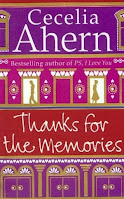
Thanks for the Memories (by Cecelia Ahern)

Thanks for the Memories by Cecelia Ahern
(Amazon UK link)
Although I wasn't very keen on Cecelia Ahern's first novel, I'm glad that I didn't judge her based on that; I've very much enjoyed her more recent works. They're slightly surreal, but the people are believable and the stories well written.

'Thank you for the memories' is a somewhat quirky novel about two people who, at the beginning of the book, have nothing in common at all. Justin is an art history expert who lives in London. He's recently divorced, and has been invited to give guest lectures at a university in Dublin. While he's there, he is persuaded to donate some blood, rather against his wishes.

We meet Joyce as she's getting over the loss of her unborn baby, after a nasty accident. She is naturally grieving, and is not helped by the break-up of her marriage. And she's very confused to find that she suddenly has some memories, some of which appear as dreams, which don't seem to belong to her at all.

The novel follows Justin and Joyce in turn, as they happen to meet or come in contact; I found it very odd at first but it unfolds nicely and realisation came to me before it did to Joyce.

There are some very amusing moments, and some which are poignant; the ending is inevitable (and rather a relief - I did worry that it might be left open, or with Justin none the wiser) but many of the events during the main part of the book are far from predictable.

Cecelia Ahern has a remarkable gift for creating unusual scenarios and making them seem believable, at least while reading the book. Recommended, if you don't mind suspending reality for a while.


Review copyright Sue's Book Reviews, 15th October 2009

24 Sept 2007

A Place Called Here (by Cecelia Ahern)

A Place Called Here by Cecelia Ahern
(Amazon UK link)
I wasn't totally impressed with the first - and best-known - novel by Cecelia Ahern (PS I love you). But I thought it well-enough written that when I saw other books she had written in second-hand or charity shops, I was happy to buy them.

I read 'A Place Called Here' on a couple of flights, and overnight in an airport. It was the ideal kind of book for that situation. It's light enough that it didn't require deep thought. It's interesting enough that it kept me turning pages. And yet it is not so gripping that I couldn't put it down when I needed to sleep.

The story is about Sandy Shortt, who is something of a misfit. She is extremely tall, for one thing, in sharp contrast to her surname. She is also very logical and organised, and has a compulsion to search for missing things - and people. It all started when her neighbour Jenny-May vanishes when they are both ten years old.

By the time the story starts, Sandy runs a missing persons agency. She has reunited various lost family members, but there are still several unsolved cases which she has studied extensively.

Then Sandy herself disappears, and finds herself in a different world: one filled with people and objects that have mysteriously gone missing from the real world.

It's bizarre and surreal... and yet somehow the story works. In this strange other world there are socks, phones, wallets, even sofas... all of which have vanished without trace. There are also some of the people whose cases Sandy was working on. They have settled down, sometimes even married and had children, accepting their new lives after they've been there for a while.

The writing is very good; the story delightful, and unexpectedly moving in places. It's also strangely believable - it doesn't feel like fantasy at all. In some ways it's a bit like another of Ahern's novels, 'If you could see me now'.

 Recommended.

4 Jun 2007

If you could see me now (by Cecelia Ahern)

If you could see me now by Cecelia Ahern
(Amazon UK link)
The writer Cecelia Ahern's first book, 'PS I love you', was a best-seller that I didn't particularly like. It has a great concept, and an excellent start... but it became progressively more unrealistic (in my view, anyway) and I found the narrative rather confusing.

But when I saw 'If you could see me now' second-hand, I thought it worth trying. I haven't heard much about this, and had little idea what to expect. I was captivated!

It's about imaginary friends. Yes, those imaginary friends that so many small children acquire for a few months. But the imaginary friends in this book are real. Part of the story is related by one called Ivan. It's not an easy job being an imaginary friend. Most people can't see them, and even those that do stop needing them after a while. And then they stop seeing them too.

Ivan is just moving on to a new 'best friend' when the book opens. He is seen by Luke, a likeable six-year-old boy who's surprisingly well-balanced despite a very unusual background. He has no father, and his mother is an alcoholic ' free spirit'. He lives with his aunt Elizabeth, who appears to be an uptight obsessive-compulsive who only gave a home to Luke because she felt it her moral duty.

But Elizabeth sees Ivan too. This is almost unheard of. Ivan appears to be about her age, and there's a mutual attraction. Elizabeth doesn't - or won't - understand that he is imaginary, although Luke seems to understand quite easily.

It's partly a book about love, although not a romance in any traditional sense. It's also about coming to terms with the past, and unlocking creative freedom - yet it's not at all heavy. I didn't quite believe in any of the people - except perhaps Ivan, ironically! - but they weren't unpleasant caricatures. The writing was very fluid and the story flowed well.

Recommended.

13 Jun 2005

PS I Love You (by Cecelia Ahern)

PS I Love You by Cecelia Ahern
(Amazon UK link)
The book 'PS I love you' has been remarkably successful. Cecelia Ahern is a new author, yet her debut novel has hit international bestselling lists, and is apparently going to be made into a film. Having said that, I don't generally opt to read bestsellers, particularly when they're not in the so-called 'chick-list' genre. However I came across this book second-hand, and decided I would try it. Reviews elsewhere are mostly pretty impressive, and I don't like to be too narrow-minded about my reading tastes.

I thought it started well, and the concept was excellent. The story opens with Holly grieving for her recently dead husband Gerry, who died from a brain tumour aged 30. She isn't looking after herself or getting out at all, and her family and friends are worried about her. Then she discovers a package Gerry left behind, with a letter to her and ten envelopes, one for each remaining month of the year, in which he has left some kind of instruction or advice.

So the book covers the next ten months while Holly starts to see her friends again, finds a job, goes out partying and even begins to laugh once more. Gerry is like a constant presence telling her what to do, and she slowly learns to live again and make decisions for herself.

It could have been brilliant and moving. Many readers seem to consider that it is, but somehow I can't see it. I didn't find it very well-written: the dialogue isn't very realistic, and informal language seems to creep into the narrative rather often, but not frequently enough that it works as a style.

I also found it annoying that viewpoints seemed to chop and change rapidly even within one scene. Holly is the main viewpoint character, so the majority of the events are seen from her perspective, but every so often we're given a glimpse into someone else's mind - sometimes even quite minor characters - in a way that disrupts the flow.

I also felt there was far too much emphasis on going out to pubs and clubs, drunkenness and partying. Do people of thirty really do that kind of thing? I probably sound a bit like Holly's straight-laced oldest brother Richard when I say that, and yet I don't mean it that way. I just don't personally know of anyone who lives such a wild life, and haven't even heard of people past student age doing this kind of thing.

Overall, I felt there were too many characters with not enough depth, too much sordid detail about trivialities, rather a lot of introspection from Holly which would have been better shown in action, and too little about the main plot. I didn't find any of the book amusing (although many reviews claim it's witty) nor emotionally moving (despite being told on the back that it would guarantee to tug on my heartstrings).

Having said that, it was fairly compulsive reading - over 500 pages in paperback, but I read it in less than a day. There were some nice touches, too.  Holly's family reminded me a little of some of Maeve Binchy's Irish families. Although her siblings are rather caricatured, with two of them being very flat, I felt there was a lot of potential both in the rigid Richard - who nevertheless cares for his family deeply - and in the wild Ciara who returns from Australia.

Not really recommended, although for anyone who enjoys light-weight chick-lit, this is certainly above average. And it's extremely popular, so evidently most people like it rather more than I did.