Showing posts with label American. Show all posts

14 Jul 2015

Fried Green Tomatoes at the Whistle Stop Café (by Fannie Flagg)

Fried Green Tomatoes at the Whistle Stop Cafe by Fannie Flagg
(Amazon UK link)
This isn’t a book I would ever have chosen despite the intriguing title. I know nothing about Fannie Flagg, and I tend not to choose American books in general. It was given to me by a friend about five years ago, but it sat on our shelves unopened, almost forgotten, until one evening we watched - and very much enjoyed - the related film ‘Fried Green Tomatoes at the Whistle Stop Café’.
 
So I moved the book to my ‘to be read’ shelves, and finally picked it up about ten days ago. I’d almost entirely forgotten the plot of the film, although, once I got started, I did recall the middle-aged Evelyn Couch becoming friendly with the elderly Ninny Threadgoode when her husband was visiting his mother at a nursing home. Ninny starts talking about the past - the family she learned to love, the café run by one of her sisters in law, and some of the strange people who passed through their lives.

It took a few days to get into the book; it flits between the 1930s and the 1980s and I had a hard time keeping track of all the people in the 1930s. But that didn’t matter too much; gradually the main characters emerged and I found myself, like Evelyn, eager to hear more, while also interested in her personal struggles with negative self-esteem and compulsive eating.

The story in the 1930s is shocking in places, dealing as it does with rampant racism (there are many instances of a word that is considered totally taboo these days), violence, infidelity, and at the same time the total acceptance of a lesbian couple. There’s a macabre mystery which is ongoing, too, in a low-key kind of way; Evelyn and Ninny never do discover ‘whodunit’, but it’s revealed in another flashback towards the end of the book; something I’d quite forgotten from the film, but recalled as I read it.

And yet, despite the alien culture of drop-outs, legal apartheid and paternalism, there’s a warmth that seeps into the pages and conversations from the past. There’s a sense of extended family, and of caring for strangers; this is long gone in the 1980s section, where Ninny is alone in the sterile nursing home, and Evelyn struggles in her marriage.

It’s cleverly written, intertwining past and present as it does, gradually building up the storylines, and closing them up towards the end. There’s a poignancy in the last pages which is perhaps inevitable, and a sense of hope for the future, too.

I won’t be rushing to re-read this, but I’m glad I made the effort. Recommended if you’re interested in American social history of the 1930s, or just want a good read that’s very different from most novels.

There are some traditional 'Southern' recipes in the back, but they sound decidedly unappealing to this Brit!

Review copyright 2015 Sue's Book Reviews

6 Jun 2015

Texas Whirlwind (by Bonnie Blythe)

Texas Whirlwind by Bonnie Blythe
(Amazon UK link)
I hadn’t heard of Bonnie Blythe before, but I had been searching for light Christian fiction, and found one of her books available free to download for my Kindle nearly three years ago. It took me this long to get around to reading it, however.

‘Texas Whirlwind’ is the story of Emma, a young single woman who has adopted some toddler twins from Haiti. She is a caring, if slightly scatty person, and we meet her as she moves back to a town where she lived for a while as a teenager.

Emma takes the twins to a local doctor for a checkup, only to discover that this doctor is a former boyfriend, Travis, whom she considers that she treated rather badly. However there’s clearly still a spark between the two of them. We soon learn that Emma has recently broken up with an arrogant guy who didn’t want her to go through with the adoption. While she adjusts to life with the twins, she really doesn’t want to start a new relationship.

Travis is very good with the twins, and it was clear almost from the beginning that he and Emma would get together eventually. Unfortunately instead of any conflict or genuine misunderstandings drawing them apart for a while, much of the book is taken up with their introspective wonderings. The story alternates their viewpoints, as well as that of one or two other characters, and I started skimming after a while; the navel-gazing becomes rather tiresome, each of them convinced (despite evidence to the contrary) that the other isn’t seriously interested.

There’s a dramatic incident around the middle of the book, leading to a great deal of tension in the latter half, and it was well-paced and emotional; I found it quite difficult to put down at this point. I couldn’t quite believe in the villains of the piece, and I’m not entirely sure the author did either, as they’re one-dimensional and there doesn’t seem to be any real motivation for what they do. But even the drama towards the end is diluted with Emma and Travis wondering what the other is thinking, and feeling they’re not good enough, so that I almost wanted to lock them in a cupboard to sort it all out.

The Christian side of the book is almost incidental; not that it’s a problem to have a novel that’s about Christians rather than being pushy. The two main characters belong to a church, and prayer is seen as essential; there’s no preaching, but in a few cases the actual words said in a prayer are recorded, which seemed a bit intrusive.

My biggest problem with the book is that it ends very abruptly; several people have a sudden change of heart, but there’s no real explanation of why, nor any real motivation for these changes.

Overall I thought it a pleasant enough read; the theme of adopting from Haiti is quite unusual, and the two main characters, introspection apart, are likeable and believable.

I don't know that the title of the book is particularly appropriate, since Emma is far from a whirlwind character, but perhaps it referred to Travis's emotions on meeting her again.

No longer free for the Kindle, but inexpensive in this form. Not currently available in print.


Review copyright 2015 Sue's Book Reviews

17 Jan 2014

The Return of Hyman Kaplan (by Leo Rosten)

The Return of Hyman Kaplan by Leo Rosten
(Amazon UK link)
I remember reading and very much liking the books by Leo Rosten about Hyman Kaplan when I was a teenager, enjoying the linguistic intricacies of students attempting to learn the English language in America. I was thrilled to find the first one - 'The Education of H*Y*M*A*N K*A*P*L*A*N', a couple of years ago. I looked for some time for its sequel, discovering it inexpensively on the AwesomeBooks site at the end of last year.

'The Return of H*Y*M*A*N K*A*P*L*A*N' charts another year in the beginners' grade of the American Night Preparatory School for Adults  - what, I suppose, we would call TEFL today. The wonderfully patient and inspiring Mr Parkhill continues to plan interesting lessons for his multi-national group of students, regularly interrupted by the larger-than-life Mr Kaplan.

Stereotypes abound; the humour is at the expense of those for whom English is difficult, although sometimes it turns out that the joke is in fact on the absurdities of the language, while the students' logic is impeccable. Mr Kaplan stars in every chapter, full of his own importance, and yet generous, open-minded, and determined to learn, one way or another.

It's years since I read this book, so I was delighted to find it. Although I remembered a lot of the stories, they were still amusing and prompted a few chuckles. I wouldn't rate it as 'hilarious' as its contemporary reviewers did - this was first published in 1960 - but I enjoyed reading this very much, along with the introduction of my 2000 re-print, which places it in context for 21st century readers.

Recommended, if you don't mind this kind of stereotyped humour.

Not currently in print, although second-hand versions are more common than they used to be; however, I'm pleased to see that the Hyman Kaplan books have now been issued in Kindle form, both sides of the Atlantic.


Review copyright 2014 Sue's Book Reviews

26 Jul 2011

It Happens Every Spring (by Catherine Palmer and Gary Chapman)

It Happens Every Spring by Catherine Palmer and Gary Chapman
(Amazon UK link)
Browsing free books for the Kindle, as I do fairly regularly, I was interested to see a novel by Catherine Palmer, an American Christian author whom I've come across before. I found her books quite light, a bit low on characterisation, and sometimes a little over-preachy, but mostly well-written with good stories.

It wasn't until I started reading it a couple of days ago that I realised that it was written in conjunction with Dr Gary Chapman. He is the author of the books about love languages, and (more recently) a book about recurring 'seasons' in marriage, which sounds very interesting.

'It Happens Every Spring" is the story of four different marriages set in small-town America, in a place called Tranquillity. There's a newly-married couple, an older, retired couple, a blended family with twins, and the main couple of the story, Brenda and Steve who are recent empty-nesters. I gather that this is the first book in a series of four, and that each of the others focuses specifically on one couple.

There's a very interesting character called Cody who appears fairly early in the book, and demonstrates how prejudice is still rife; Cody is a homeless young man who behaves in a childlike way, and seeing how Brenda related to him positively was a good way of seeing her more as a whole person.

Then there's Patsy who owns a beauty salon, and where much of the conversation happens. I found this aspect of the book rather bizarre, reminding me of one or two ultra-light American films I have seen where something similar happened. It felt like a device for getting women together, but I could not believe the number of times the characters seemed to call by for yet another change to their hairstyles (including colours) or having their nails 'done'.

 I found it a bit shocking that everyone had sufficient disposable income to indulge in this kind of thing regularly, but perhaps it does happen in the USA. What I found particularly bizarre was that the beauty salon was called 'Just as I am', a quote from an old hymn, which seemed like the ultimate irony since Patsy encouraged people NOT to like themselves just as they were but to keep experimenting with new looks.

However, as a device for women getting together to chat it worked well, aided by an attached café where Patsy's clients were encouraged to hang out and drink tea. The book is light, after all, and the characters not particularly well developed, so the various conversations were useful in helping to build up some idea of the different women. The writing is good and I found the story interesting, reading in just two or three sittings as I wondered how Brenda and Steve's problems would be resolved.

I found some of their argument scenes almost painful in their realism, although the points about different love languages and lack of communication were made rather too obviously at times. Brenda evidently needed quality time whereas Steve needed physical touch, but nobody had ever explained this to them - even though they were both involved in acts of service to each other, which neither appeared to recognise.

There is perhaps a bit too much overt Christian input - it works just fine from Cody (who believes that only Christians will give him chocolate cake) but there are rather a lot of quoted Scripture verses which would probably put off people who are not believers, and yet seem irrelevant to those of us who are. The resolution seemed a little too simplistic, as well.

But overall I did enjoy the book, and since it was free I am glad I downloaded it. I'm interested to know how the situations develop, but can't quite decide whether to buy the other books in the series or not.

No longer available free, but recommended anyway in a low-key kind of way. The link to the paperback book version, which has second-hand editions available although they are sometimes very highly priced. 


Review copyright Sue's Book Reviews, 26th July 2011

7 Apr 2011

Elsie Dinsmore (by Martha Finley)

Elsie Dinsmore by Martha Finley
(Amazon UK link)
I don't suppose I would ever have read anything by Martha Finley, who died about 100 years ago, but for two things. Firstly it appeared in Amazon's recommendations to me for the Kindle, and it was free. More significantly, her 'Elsie' books are referenced - albeit in rather condescending terms - in the book 'Jo of the Chalet School'.

So I downloaded 'Elsie Dinsmore', first in the series, and read it over the past week. It features the rather too-good-to-be-true Elsie, who is brought up with her aunts and uncles of similar age. She is eight when the story begins, subject to regular bullying by her youngest aunt and uncle, and treated with disfavour by their governess.

She is looked after materially by her grandfather and his second wife, but longs more than anything to be loved. She finds plenty of affection in her maid 'Mammy', who has brought her up as a devout Christian. But there's a lot of the inherent racism of the era in the USA; the black servants, while much loved by Elsie, are clearly considered somehow inferior to the rest of the family.

Shortly after the book opens, Elsie's father Horace returns to the family home and meets his daughter for the first time. Unfortunately he has somehow been biased against her, and treats her coldly and harshly at first. He issues orders that he expects to be obeyed without question. This eventually leads her to a battle of conscience when he asks her to do things she believes to be wrong.

There is rather too much preaching for my tastes. I can't imagine how this book would appeal to today's children, and can understand why the books have been parodied. Nobody could be quite so humble and pious at the age of eight. Elsie's worst fault appears to be her tendency to dissolve into tears at little provocation. Some of her moral scruples seem very dated, too, although her refusal to be a tattletale is admirable.

Somehow, though, it made compulsive reading. There are a lot of characters, who I suppose are developed further in other books in the lengthy series. While Elsie is too much of a paragon to be believable, she did rather grow on me as the book progressed. So after finishing, I downloaded some of the sequels which are also available free for the Kindle.

I wouldn't really recommended this, unless you're curious about these much maligned classics and are able to skim or put up with the lengthy Bible expositions and Elsie's attacks of conscience.

The links given above is to a paperback edition of this book, which has evidently been re-published now it's out of copyright. But I would suggest for free e-book editions, if you want to read it (or are curious at least to see it) either on Amazon or Project Gutenberg.


review copyright Sue's Book Reviews, 7th April 2011

19 Jan 2011

In the Company of Others (by Jan Karon)

In the Company of Others by Jan Karon
(Amazon UK link)
Jan Karon is the US author of the gentle 'Mitford' series, featuring the elderly Anglican minister known as Father Tim, and his writer/illustrator wife Cynthia. She is now writing books that focus on Father Tim elsewhere in the world; the first in this new trilogy was 'Home to Holly Springs', where Tim returned for the first time in many years to his childhood town, and unearthed some family secrets.

The second in the series, 'In the Company of Others' was released in hardback in Autumn 2010. I don't usually get hardback editions of books, but I had a voucher for Amazon.com, and friends travelling to the USA... so as I didn't want to spend half the voucher on postage, and couldn't find much else that I wanted, I thought I might as well treat myself to this new book.

In this book, Tim and Cynthia travel to Ireland for a long-awaited holiday. They stay in a guest lodge and get to know the owners, and something about their family tensions. They also discover a journal, about 150 years old, which is interspersed in some of the narrative. The holiday is unexpectedly extended, and they get involved not just in the lives and stresses of their new friends, but help to solve a crime mystery.

I have slightly mixed feelings about this book. I liked the pace, and the characterisation as ever is good. Tim and Cynthia have a delightful, believable relationship... and the dialogue, some of it in Irish brogue, was a great deal easier for me to read than that of the US South in 'Home to Holly Springs'. It was a gentle story, which I read in twenty-minute bursts at bedtime for almost four weeks, but I didn't have any inclination to read it at other times of the day.

However, taking so long over it meant that I found myself regularly confused about the other characters, of whom there were many - those in the journal as well as in the main story, and eventually I gave up trying to remember, which meant that the later part of the story had less impact than perhaps it should have done.

Fans of the Mitford series will probably enjoy it, so long as they don't mind the action having moved right out of Mitford, and since it stands alone, with mainly new characters, it would probably work as an introduction to Karon's novels too, for anyone who likes a gentle paced character-driven story. There is, as with all her books, a low-key Christian aspect to it, but it's nicely done without being preachy or pushy.

Overall I did like it, and am glad I read it, though I shall think twice before ordering another Jan Karon in hardback... even if I have an Amazon voucher to spend. The links at the top is to the current edition at the UK Amazon site, but it's often available online second-hand at much better prices.

Review copyright Sue's Book Reviews, 19th January 2011

10 May 2009

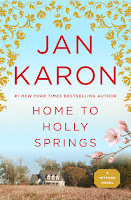
Home to Holly Springs (by Jan Karon)

Home to Holly Springs by Jan Karon
(Amazon UK link)
Jan Karon is a popular American Christian author. She is best known for her nine-volume 'Mitford' series about Father Tim, an Episcopalian priest in a small town. The series begins with 'At Home in Mitford', where Tim is a sixty-year-old bachelor and ends with 'Light from Heaven', where Tim - now married - has retired.

So I was delighted to learn that Jan Karon has begun a new series, probably three books, about Father Tim's childhood and background. The first of these is 'Return to Holly Springs', where he takes a trip to the place where he grew up. Reviews on Amazon were very mixed, but eventually, when it was out in paperback, I put it on my wishlist and was delighted to receive it for my birthday.

In this book, Father Tim is seventy but still young at heart. He has been sent a cryptic note from Holly Springs, simply asking him to come home. His wife is unable to accompany him, so he takes Barnabas, his elderly dog, and sets off for the town where he has not returned in forty years. He hopes that he might manage to get in contact with some old friends - if they are still alive - and perhaps come to terms with a few of the demons of his past.

I did find the book rather slow moving, in the early chapters. Tim meets a lot of people, most of whom speak in a dialogue that's not familiar to me. It was used by a few people in the Mitford books, but there's a lot more of it in this one, and it rather slowed down my reading. The story changes frequently from past to present, as Tim manages to get in touch with various people, and there's then a flashback where we learn about them in his childhood. There are also ongoing memories of his beloved mother, and his father whom he remembers with some anger and bitterness. I enjoyed the back stories although the sheer volume of characters was a bit confusing at first.

Still, the pace did pick up a bit and by the time I was half way through the book, I found that I was more and more interested in the plot. I suppose if I'm honest there were too many coincidences. It's a small town, admittedly, and most people know each other. But several of the meetings with old friends and acquaintances did seem rather contrived. They were written from the perspective of God co-ordinating them, which made them seem more believable, but I couldn't help feeling that everything fit together slightly too neatly at times.

But it's only a minor criticism. Some people have criticised the book more severely for becoming too psychological, or for involving Tim in a rather murkier past than would have been guessed. There is also criticism about the very minor swear words that were used, although in the UK these words are hardly significant. More disturbing for me was the continual use of 'ma'am' and 'sir' by Tim and others... words which seem sarcastic, almost rude from my perspective, but are of course intended as forms of respect in the Southern states of the USA.

The dramatic discoveries nearer the end of the book included one that I had been expecting for a few chapters; clues were certainly there, so that although there were one or two surprises, the main one was not unexpected - and thus not unrealistic. Everything was nicely wrapped up, with even a very short epilogue/afterword to tie up one last thread. I like to see books end tidily, so I didn't mind at all that there was something of a 'happy ever after' feel.

If you haven't read the Mitford series, you probably wouldn't find this book at all interesting. If you like Mitford only for the small-town niceness, I suppose you might find this one a bit psychologically complex and murky. But for anyone who has enjoyed the series, doesn't mind a rather deeper book, and would like to know more about Father Tim and his background, I'd definitely recommend it.


Review copyright Sue's Book Reviews, 10th May 2009

1 Nov 2008

Amusing Ourselves to Death (by Neil Postman)

Amusing ourselves to death by Neil Postman
(Amazon UK link)
I'd never heard of Neil Postman, until one of my sons was given this book. Then the other son had to read it as part of a theology course. Neil Postman was apparently a humanist rather than a Christian, however.

'Amusing ourselves to death' is rather dated now. It was written in 1985 when television was immensely popular, particularly in the USA, but computer technology was still in its infancy. It's a thought-provoking book, and while I didn't agree with all that the author wrote, I thought it well worth reading and pondering.

Postman's premise is that George Orwell's vision of the future matched fairly well with Communist countries - restricted information, altered history, 'big brother' watching every move and censoring speech, etc. But he claimed that it is Aldous Huxley's vision which matches far more closely with the reality of the west, and particularly the USA. Huxley saw a world in which nothing was restricted. Instead, people had so much leisure and so much entertainment that they ceased questioning or thinking.

Postman does not actually criticise the entertainment on television, believing that it is - or was - mostly done very well. The problem, he claims, is that far more serious issues have become reduced to show business by being shown on TV. News, religion, politics - he takes a chapter on each, demonstrating how each has had to adapt to fit in with the mass media culture.

News comes in short sound-bites from all over the world, delivered by smiling, smart-looking presenters who expect us to have forgotten it all by the time the show has ended.

Religious television has glamorised, well-dressed men and women spouting prosperity. Even the better of the TV evangelists, he claims, has completely lost any sense of mystery or community that we would find in churches.

As for politics - as I read this book, the run-up to the 2008 American presidential elections were in their final week. He is absolutely right in that balding, frowning, obese men would have no chance at all of being elected in a TV age. Instead recent US presidents have been fast-talking, smiling, smooth operators who respond instantly in a crisis. To the voting public, their lives and personal beliefs seem to matter far more than the policies of the parties they stand for. And even then, we don't see the real people, just the distortions displayed for our viewing pleasure on TV.

Capitalism, Postman claims, is attacked daily by television adverts. No longer can consumers choose carefully between several good products, selecting the best quality that will most meet their needs. Instead they are bombarded with dubious claims about the products in question, and emotional appeals to get in touch with long-lost relatives (using a particular phone line, or email provider) or treat the love of their lives to the best coffee, or chocolate, or perfume.

There's a lot in this book, and while it's a little heavy-going in places, I found it very readable. I didn't agree with all he wrote, however. He seemed to think that the age of lengthy talks and debates was somehow 'better' than the age of technology and fast-moving pictures. I agree that it's different, and that perhaps we have lost something, but we seem to have gained something too. Yes, much of the information we are fed is trivial, and school curricula tend to be disjointed, sometimes (as in one example he quotes) even based around a televised series where the subject is actually chosen not because it's of use to students, but because it makes good television.

Where does it leave us? Postman is sensible enough to realise that nobody is going to switch off their TVs just because of his book. Those that are addicted will probably remain so, and we're not going to lose the multi-media aspects of life that we now take for granted.

I personally think that with the introduction of home computers, now probably as widespread in the west as television was in the 1980s, we have actually moved on. Computers are interactive; we choose which sites to visit rather than being bombarded with a set TV schedule.

Indeed, with satellite TV there is a great deal more choice over viewing, but television is still essentially a top-down medium, whereas computers allow us to reply, to debate, and to research at a much greater level.

A lot to think about. Certainly worth reading, in my opinion.


Review copyright Sue's Book Reviews, 1st November 2008