Showing posts with label Adele Faber. Show all posts

9 Oct 2017

Liberated Parents, Liberated Children (by Adele Faber and Elaine Mazlish)

Liberated Parents, Liberated Children (Faber and Mazlish)
(Amazon UK link)
I don’t remember when I first heard of the books by Elaine Mazlish and Adele Faber. Perhaps it was only fifteen or twenty years ago, but I feel as if their principles have always been tucked away in my consciousness. The best-known of their books is probably ‘How to talk so kids will listen, and listen so kids will talk’. They wrote some variations on that book, too: for instance, one related to teachers and school children, and one is specifically for dealing with teenagers. ‘Siblings without rivalry’ is also well-known and highly regarded in the circles I was part of as a parent.

So I’m not sure why I had never heard of ‘Liberated Parents, Liberated Children’. I came across the title while browsing the AwesomeBooks site recently. When I make an order, I like to find at least ten books, as the postage to Europe is a fixed charge. So when I saw this, in good condition, it was the work of a moment to add it to my shopping cart. My sons are adults now, and my grandchildren are currently the other side of the world. But I know from experience that these books are helpful in any kind of relationship, even if primarily intended for families with children and teenagers at home.

Unlike the other books I’ve read by these authors, this one is in semi-fictional form. That’s explained at the beginning: the authors wanted to described some of the growth they went through, while learning about principles of dealing constructively with children, and the new styles of speaking and relating that they had learned on a course. But they didn’t want to embarrass anyone, or reveal family secrets. So they invented a family, somewhat of a blend of their own families, and a circle of women who met regularly to learn and talk about progress dealing with communication and anger problems in the home. Each incident described was based on something in reality, but without any individual being identifiable.

Not everyone would like the format of ‘creative non-fiction’ (as it’s called elsewhere) but I found this book very readable. It didn’t exactly teach me anything new; the principles are those from the authors’ better-known books, but instead of being teaching guides with explanations, diagrams and lists, they are written in the form of discussions, experiences, and family struggles.

Jan is the name of the fictional narrator. She is married, and has three children: two boys and a girl. One of her problems is that her sons fight a lot, with the older one becoming very angry, sometimes bullying his brother. Jan tends to sympathise with her youngest, remembering her own life as a younger sibling. But she comes to realise, over the course of the book, that this helps nobody. Instead she learns new ways of talking to both sons, enabling them to come up with their own solutions to their differences.

Other situations covered, in other families, include children forgetting things for school regularly, making excessive demands on parents, yelling and making mess, and forgetting to feed a family pet. The motivator of the group the women attend is a calm, friendly presence offering suggestions and positive feedback, mirroring his philosophies in his responses to the women

What I particularly liked is that, rather than everyone trying the principles and living happily ever after, there are stories of setbacks and failures too. There are discussions about anger, about the dangers of making someone feel guilty, and about the importance of parents taking care of their own needs as well as those of their children.

Inevitably it’s somewhat idealised, and not every difficult situation can be improved in this way. It's also American; not every situation would necessarily apply elsewhere. But the principles still hold. It is not about permissive parenting, nor is it about parents being doormats, giving into their children’s every whim. 

For any parents - or grandparents, or anyone in authority, or indeed anyone struggling to communicate in any relationship - I would recommend this very highly, as a gentle guide to non-punitive non-coercive parenting. It’s well-balanced, well-presented, and, in my view, very well worth reading.

Review copyright 2017 Sue's Book Reviews

16 May 2016

Siblings Without Rivalry (by Adele Faber and Elaine Mazlish)

Siblings without Rivalry by Adele Faber and Elaine Mazlish
(Amazon UK link)
Looking in my bookshelves for something entirely different, I spotted this book. It’s one I read many years ago; I thought it very helpful, and used some of the methods described with my sons. In more recent years I read and thoroughly appreciated other books by Adele Faber and Elaine Mazlish, which are of more general use in communication with people, even though they are intended primarily for parents.

However, since I had a few hours to myself and wanted something a little different, I decided to start re-reading ‘Siblings without rivalry’, which is subtitled, ‘How to help your children live together so you can live too.’ I wondered if I would abandon it after a few chapters; my own sons are now in their late 20s so it’s no longer nearly as relevant as it was.

But I do spend time with other children and have sometimes been caught up in sibling arguments, usually when two children want the same thing at the same time. And this is a very readable book, with an approach I agree with philosophically: that of finding good solutions to problems and helping children learn to get along without parental interference, wherever possible.

The first chapter is introductory, giving examples of the kinds of problems many parents experience: children fighting, putting each other down, arguing over issues that seem petty to parents, and so on. Even though I’m long out of this phase of life, I found myself nodding and recalling incidents, either with my own children or those of friends. Children naturally squabble, and to some degree it’s useful in learning to get along with other people.

But there are boundaries that most parents feel the need to draw, and times when a child might be in danger, physically or emotionally. This book helps parents to see when it’s appropriate to get involved in sibling battles, and - most importantly, in my view - how to see them from the children’s point of view.

So there are chapters on the dangers of comparisons, on the need to express negative emotions before the child can move on, and on physical fighting. The authors recommend parents staying calm, listening to each child, and not taking sides. They don’t recommend ‘punishment’ of any kind, and only suggest a form of constructive time-out when children’s tempers are so high that they are unable to think straight, and potentially dangerous to each other.

While none of the material was new to me, it was a useful reminder about the parents’ roles in helping children learn to deal with problems that arise in the family. Even if they don’t get along with each other, the authors assert, children and teens can learn to cooperate and find compromises or solutions of some kind to most problems, so long as they’re given the right kind of listening, and so long as the parents have a great deal of patience!

The book is so readable, and so interesting that I read the whole thing, including the supplementary chapters to the 10th anniversary edition, in just a few hours. The style is deliberately relaxed, based on several workshops the authors ran, with anecdotes and individuals combined for simplicity, and some useful diagrams to make points quickly.

Of course parenting is never easy, and the tidy scenarios painted in the book are not always appropriate, nor will they always work - at least, not first time. But I’ve seen enough of them being effective that I believe strongly in the theory and would recommend this book highly to any parent - or relative or teacher - dealing with siblings who can’t get along at all, or who are worn down with children fighting.

Still in print on both sides of the Atlantic.


Review copyright 2016 Sue's Book Reviews

22 Nov 2013

How to Talk so Kids can Learn (by Adele Faber and Elaine Mazlish)

How to talk so kids can learn (Adele Faber and Elaine Mazlish)
(Amazon UK link)
It’s probably twenty years since I first came across the writers Adele Faber and Elaine Mazlish. They are best known for their non-violent non-coercive parenting recommendations, as explained in the classic ‘How to Talk so Kids will Listen and Listen so Kids will Talk’, and ‘Siblings Without Rivalry’. Idealists, undoubtedly, but many of their ideas are very useful; on the whole I aimed to use them, or similar ways of raising my own children.

I was pleasantly surprised to learn that another book by these authors, ‘How to talk so kids can learn’ is on the recommended reading list for trainee teachers in the UK. I picked it up to browse a few months ago, and dipped into it from time to time before reading it cover to cover. The format is very similar to that of ‘How to Talk so Kids will Listen...’, with some anecdotes, clear explanations, cartoons depicting the most important points, and then some real-life discussion and further suggestions.

While the subtitle of this book is ‘At home and in school’, and it’s undoubtedly of value to those with large families, and those involved in home education, child-minding, or running any kind of children's group, it is intended primarily for teachers in schools - and as such I imagine it would be a very valuable resource. In today’s climate, where many children lack respect and motivation, it’s vital for a teacher to be able to inspire a child to think and participate, rather than (as happened too often in the past) by sarcasm, yelling, punishments or even excluding. The underlying thesis of this book is that most children do want to learn, if only they can be guided in the right direction, and treated with respect, as valuable individuals.

Topics are covered loosely in separate chapters which include ‘The Pitfalls of Punishment’, ‘Solving Problems Together’, and ‘How to Free a Child’. The subject matter is very similar to that of the original classic, but the difference is that other children are involved. A teacher cannot spend half an hour sitting with an individual child who is misbehaving or violent, because there is a whole class to deal with. Moreover the teacher is not in the same role as a parent: he does not need to teach the child morals or ethics, or even raise him. The teacher’s job is to impart information, skills and learning techniques.

I’m not a school teacher myself - thank goodness! Some of the scenarios in this book left me feeling exhausted at the thought of what would be involved. But I found it extremely interesting nonetheless. I like the style, the writing pace is just right, the cartoons break up the text a little and put the message over in a slightly different way, and the advice all makes excellent sense.

I know from experience that non-coercive respectful parenting is a great way to raise children - and am pleased to learn that this can be the case in the classroom, if teachers take the time to put these principles into practice -while acknowledging that no single book can provide all the answers.

Very highly recommended.

Review copyright Sue's Book Reviews

10 Feb 2013

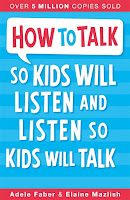
How to Talk so Kids will Listen and Listen so Kids will Talk (by Adele Faber and Elaine Mazlish)

How to talk so kids will listen and listen so kids will talk
(Amazon UK link)
It's many years, now, since I first heard of Adele Faber and Elaine Mazlish, an American writing duo who also run workshops on parenting. I expect someone recommended one of their books to me when we lived, briefly, in the US during the early 1990s when my sons were small. I know I very much enjoyed this one; the principles it put forward were some of those I believed in already, and which I had discussed with church friends at a short course we had done together. So while I liked the book, I didn't see the need to get a copy for myself...

However, when I saw 'How to talk so kids will listen and listen so kids will talk' on the Bookbag shelves, I leapt at the chance to re-read it. In doing so, I felt a touch of regret that I had not had a copy to refer to regularly when my sons were growing up.

This book aims to reverse the negative, punishment-based parenting that is so common these days. Children are seen not as problems, but as lovable small people needing a little guidance. The authors propose a new ‘language’ which begins with listening properly, helping children to deal with their feelings by encouraging them to name their fears - or anger - by observation, gentle discussion, and acceptance.

The next chapter is about encouraging co-operation. Parents are told not to demand, accuse, threaten or bribe their children, but to express a problem in neutral terms: ‘the milk is spilled; we need a cloth.’ Different techniques are advised, depending on circumstances. Far too many adults get caught up in trying to control rather than co-operate, and nagging rather than finding appropriate ways to communicate their wishes.

Further chapters include topics such as encouraging autonomy, finding alternatives to punishment, offering encouraging praise, and freeing children from roles: positive ones as well as negative name-calling.

Each chapter describes typical scenarios, then proposes alternative ways to deal with them. Towards the end of each chapter there’s a section with exercises for parents to try during the week, encouraging them to observe the ways they interact with their children. This is followed by examples from workshops which are easily recognisable, and mostly reassuring.

This 30th anniversary edition has been expanded, including a section written by the daughter of one of the authors, recounting some of the frustrations she had with her own children. The non-coercive, language of communicating came naturally to her, but it didn’t turn her children into angels, nor did it mean that she always made the right responses. Her account is amusing in places, and very encouraging.

My own experience in the past suggests that, while it’s not easy to adopt all the principles, they do work eventually. I made plenty of mistakes, but as the authors point out, there are always second chance with children.

Very highly recommended indeed.

You can also read my somewhat longer review of 'How to Talk so Kids will Listen and Listen so Kids will Talk' at The Bookbag.