30 Jun 2009

Teach Yourself Home Education (by Deborah Durbin)

Teach yourself home education by Deborah Durbin
(Amazon UK link)
The writer Deborah Durbin is a journalist who has been home educating her daughters for the past five years. As a home educator myself (albeit 'retired' now), I was delighted when she asked me if I would review her book.

'Teach yourself home education' is published by Hodder, written for the long-standing and well-respected 'Teach yourself' series. The title is perhaps a slight anomaly: one can only really learn to home educate by launching into it, and seeing what happens. Every child is different, after all.

Still, this book undoubtedly covers just about every aspect of learning about home education from a theoretical point of view. It begins with an introduction, including a 'case study' of the author's own experience, and the reasons she started home educating, as well as one explaining a landmark court case in 1981 that fully established the right of British parents to educate their children at home.

The book then explains the legalities. It quotes from the Education Act, and looks briefly at employment law as it relates to children. It's interesting that this book has launched at a time when the British home education community is reeling from a negative report made at government level, suggesting that home educators be required to register with their authority, and undergo extensive monitoring. If this is passed - and it will be a seriously retrograde step if it is, leading, potentially, to all kinds of other government monitoring - then this chapter will have to be updated.

Subsequent chapters cover reasons for home education, evidence citing research for the positive benefits, and step-by-step guidance to getting started. There are sections explaining different styles of home education, how to gain qualifications (such as GCSEs) if desired, and also the surprisingly common question about 'socialisation'.

My only slight disagreement - and it's very minor - is that in writing about different styles of home education (and there are many) the author describes her own experience as 'autonomous'. Autonomous education is defined in the book 'Doing it their way' by Jan Fortune-Wood. It is basically a full-time child-led way of learning, with no required structure, no timetables (unless a child requests them), no differentiation between 'school' days and holidays.

My own style as a home educator was more like that described by Deborah Durbin - a lot of interest-led learning, but at least a small regular amount of maths and other overtly academic learning. It worked well for us - as I'm sure it does for her - but I think of it as eclectic, unstructured education rather than fully autonomous.

The book is mostly written in an objective style, explaining what is possible and how things work, with only a few glimpses into the author's own home education experience. Other home educators - adults and children - are quoted in places, usually in 'case study' type boxes. But the majority of the book is factual, as befits the 'Teach Yourself' style.

I have to admit, it's not a style that immediately appeals to me. The layout of the pages feel a bit fussy, at times, and I didn't think the 'key points' at the end of the chapters were particularly helpful. Still, that's due to the publishing style and doesn't affect the main content, which is very comprehensive. As I read, I don't think I learned anything new. But then I educated my sons at home for about nine years, and thus have read extensively on the topic.

I wish I'd come across a book like this when I was starting out, however. It's very reassuring on just about every aspect of home education, and would be excellent to hand to worried parents or friends. If you are considering home education, or wanting to know more about it, or if you know of people who do not send their children to school, I would highly recommend this useful book to you.

Other recommended books about home education: Free Range Education (edited by Terri Dowty); Homeschooling: a patchwork of days (by Nancy Lande); or for more extensive detail about research into home education, see Educating Children at Home (by Alan Thomas).


Review copyright Sue's Book Reviews, 30th June 2009

27 Jun 2009

The Secret Dreamworld of a Shopaholic (by Sophie Kinsella)

The Secret Dreamworld of a Shopaholic by Sophie Kinsella
(Amazon UK link)
My negative preconceptions about so-called 'chick-lit' like this began to be turned upside down about three years ago. But I still couldn't bring myself to read one of those bright pastel covers, until I just happened to come across a book by Sophie Kinsella ('Shopaholic and Sister') in a charity shop. Yes, it was undoubtedly chick-lit. It was also intelligent fiction, well-written, with a good dose of humour and some great characterisation.

Soon afterwards, I came across another unrelated book by the same author ('The Undomestic Goddess'), also in charity shop. I very much enjoyed that, too.

So I was very pleased when I came across 'The Secret Dreamworld of a Shopaholic', first in the series, in yet another charity shop. It's taken me just a day and a half to finish it. That's not, I hasten to add, because it's so light that it takes no effort at all. Nor is it that I've skimmed - far from it. Instead, I found it so enjoyable that I carried it around the house with me, dipping into it at every available moment.

Rebecca Bloomwood is a financial journalist. Somehow, she managed to bluff her way into a high-powered job, without actually knowing anything much about finance. And what nobody realises is that she has a serious addiction to shopping, and no idea at all about budgeting. She's somewhat scatterbrained, highly impulsive, very judgemental about appearances, and thinks nothing of embroidering the truth... or even telling outright lies if they will serve her purpose or (more likely) hide her addiction and shameful debt from those around her.

Rebecca is also surprisingly likeable. She's actually quite humble. She has a bizarre sense of humour. More importantly, she genuinely cares about her family and friends, meaning that the lies she tells them are - in part - to protect them from the truth about who she is, and what she does with her money. Moreover, she has a deep sense of integrity; a moral code that runs deeper than her frivolous nature, and which comes up at surprising - and sometimes moving - moments in the book.

The story basically charts Rebecca's rapid descent into ever-increasing debt, peppered with letters form her bank manager and others. She narrates the story with frequent irony as she attempts to save money by 'investing' and cutting back, and also some clever self-revelation which is quite amusing in places, albeit flavoured at times with irritation at her total unawareness of what she is doing. Or perhaps, like so many addicts, she is simply in denial.

The eventual solution to her problems (because, of course, something has to happen to begin to free her from the nightmare) arises mainly from her own abilities. The ending worked well - it felt right, it tidied up a few ends, but it wasn't too rapid or too neat and perfect. It also left the story a little open for the sequels.

There's a love interest in the story, which is only really resolved towards the end, but it's not fraught with too much tension. I'm glad to say that there aren't any detailed love-scenes, and in the entire book there are only a few expletives.

It's exaggerated, of course. At least, I hope nobody is QUITE as extreme as Rebecca. Yes, you have to suspend reality and yes, Becky can be quite annoying... But it's good fun, well-written, and - in my view - very enjoyable.

All in all, I'd highly recommended this book to adults or teens - probably women, on the whole, though I should think some men might enjoy it too. Particularly recommended if you think this kind of book is going to be nothing but fluff.

Note that for some reason the title was changed the rather less inspiring 'Confessions of a Shopaholic' in the United States edition.


Review copyright Sue's Book Reviews, 27th June 2009

26 Jun 2009

The Neglected Mountain (by Malcolm Saville)

The Neglected Mountain by Malcolm Saville
(Amazon UK link)
I do like Malcolm Saville's books for teenagers. I discovered and fell in love with the 'Lone Pine' series in my teens, and gradually collected them all. Most of the earlier ones were only in print in slightly abridged Armada paperbacks at the time, so those are the editions I have. I'm delighted to see that many of them were republished in facsimile form by the Girls Gone By publishers, although I would have thought they would appeal to boys as much as girls.

'The Neglected Mountain' is seventh in this series of adventure stories for teenagers. The series started with 'Mystery in Witchend', when a group of young teenagers, and some nine-year-old twins started a secret club for tracking strangers, being kind to animals, and being loyal to each other.

Although the author originally planned to keep all the club members at the same age, the characters evidently developed beyond his original ideas, as all the best characters do. And so, in this book, the older Lone Piners are sixteen, and beginning to realise how much they mean to each other, with just a hint of mild romance to come in later books.

The adventure in this story centres around dogs being stolen. It's set in the Shropshire hills, as with many of the other books in the series, and involves the ten-year-old twins' Scottie, whose name is Macbeth (Mackie).

There's humour in some of the twins' conversation and antics, and also a surprising amount of moving passages that made my eyes mist over, related to the Lone Piners' loyalty and affection for each other, and their love for Mackie. Although I like all the books in the series, some of the earlier ones seem a little artificial in places, and difficult to get into. In a way, it feels as if the Lone Pine series really gets going in this book, with some excellent characterisation.

There's nothing too deep, despite some thrills and excitements, and narrow escapes. I suppose a book like this is too innocent for most of today's teens. It also reflects a bygone age, when teenagers of sixteen were still considered children, albeit older ones, and ten-year-olds were quite safe to be out on their own in the mountains.

I always enjoyed these books, and am pleased to find that I like them just as much now as I did over thirty years ago. This is one of my favourites. Definitely recommended if you can find this book inexpensively; unfortunately the hardback or more recent editions tend to be very highly priced, but the paperbacks can sometimes be found in second-hand or charity shops.


Review copyright Sue's Book Reviews, 26th June 2009

24 Jun 2009

Turning Point (by Bowering Sivers)

Turning Point by Bowering Sivers
(Amazon UK link)
I'd never heard of Bowering Sivers. I wasn't sure I even believed her name was real when Amazon recommended this book highly to me. And, as it turns out, her real name is the much more likely-sounding Brenda Bowering. She's apparently well-known as a children's writer, which perhaps accounts for the modern and slightly bizarre-sounding pseudonym.

I was looking forward to a light, humorous novel when I started 'Turning Point', based on the reviews on the front cover, one line of which states: 'It bubbles with humour on every page.' The blurb on the back sounded good too: Ruth re-thinks her life, and has to decide what to do about two young men who come into her life....

Ruth is 44. As the novel opens, she is recovering from an unexpected heart attack. She is single, although she nearly got married over twenty years previously. But now she lives with her widowed mother, with whom she has a strange and somewhat co-dependent relationship. The heart attack is the catalyst for some re-thinking of her future, and an attempt to get out of the rut in which she finds herself... although she's reluctant to do so.

She's aided in this by a rather charming theatre director called Ian, one of the young men mentioned on the back. But she is equally hampered by her spoilt brother Matthew, who is a struggling and very selfish actor. While their mother seems to rely on Ruth and manipulates her into staying with her, it's Matthew who is given financial hand-outs and allowed to behave as badly as he wishes. I really didn't like Matthew at all.

I did like Ruth, however. Just as well, since it's her story. Unfortunately I found most of the other characters to be rather typecast and flat. The story flowed fairly well - I kept reading to find out what happened, although it wasn't the most inspiring writing - but I could see the climax of the book coming some time before it did. And I didn't find much to laugh about. Yes, Ruth's occasional acerbic wit and terrible self-esteem sometimes made me smile, but I certainly didn't find any bubbly humour. Rather the reverse, I felt. Ruth's situation was quite depressing.

The ending then happened rather quickly, and much too neatly. I like threads being tidied up at the end of novels, but they didn't hang together in this book. Both Matthew and Ruth appeared to change character in the final pages, leaving me a little bewildered.

Still, it's not bad for light, easy reading, for anyone who enjoys women's fiction, particularly if you have any interest in the theatre. I was pleased that, compared to many modern novels there is very little bad language, and only a couple of fairly mild bedroom scenes.

I may well read it again in five or six years, and perhaps will like it better second time around. Most reviews I've seen of this book were overwhelmingly positive, so it's entirely possible I've missed something.

Review copyright Sue's Book Reviews, 24th June 2009

22 Jun 2009

When the Church Leaves the Building (by David Fredrickson)

When the Church leaves the building by David Fredrickson
(Amazon UK link)
I had not heard of David Fredrickson. He is an American, who was the pastor of a church congregation for about thirty years. I came across this book because it was 'recommended' to me by Amazon. This is probably because of the other books I had read and enjoyed on similar theme.

'When the Church Leaves the Building' is, unsurprisingly, another book focusing on 'church' as the Body of Christ, rather than a building or specific congregation. The theme is for Christian believers to be relationship-based rather than institutional.

The author relates how he and his congregation felt the need first to throw off their structure and programs. He quotes an amusing 'typical' church structure, which I certainly recognised as familiar from most non-liturgical services I have attended over the years - not intending to decry those who choose to meet together on a Sunday morning, but showing how the focus can all too easily be on the services rather than the other people. And while undoubtedly some people can find and worship God in a typical congregational service, all too many are counting the tiles on the ceiling and thinking about lunch.

Even after developing a much freer, non-hierarchical structure to their Sunday mornings, based more on the New Testament model of everyone bringing a song, or something to say (rather than an organised performance by the 'worship team'), Fredrickson found that his congregation still relied too heavily on the Sunday services. So they made the even more radical decision to stop meeting as a group on Sundays altogether for a couple of months.

The main narrative, describes the steps taken, the difficulties encountered, and what happened locally. Alongside this is described a related, metaphorical incident when the author tried climbing a dangerous cliff, and had a hard time getting back to the starting point.

Scripture related to the word 'church' is explored, too; the whole book is set in the context of wanting to grow in Christ, and in love for others. The author explains how any gathering of believers is 'the church' - even just two or three, getting together over coffee. He stresses how important it is to continue to meet, to talk about life and doctrinal issues, to encourage and support each other, to use our gifts to build each other up. But he doesn't believe that most large Sunday morning gatherings are actually helpful to many people.

It's not the greatest literature. I found it easy to read; I was interested in the process, and how people related to what happened. But I didn't find the writing as such particularly inspiring. However, I thought the content well worth reading.

It's also very encouraging to those of us who are increasingly disillusioned with Sunday morning 'church' services, and should be interesting to those who disagree, too.

Similar themed books I've read in the past couple of years, some of which are quoted in this book, are 'Divine Nobodies',So you don't want to go to Church any more?', 'Liquid Church', 'Blue like jazz', 'They like Jesus but not the Church', 'Church that works' and (with some reservations) 'Pagan Christianity'

Review copyright Sue's Book Reviews, 22nd June 2009

21 Jun 2009

Rose in Bloom (by Louisa M Alcott)

Rose in Bloom by Louisa May Alcott
(Amazon UK link)
I've always enjoyed novels by the American writer Louisa M Alcott. She's best known for her classic teenage story 'Little Women' and its three sequels, but she also wrote a few other books, which have mostly remained in print for over 100 years. I borrowed some from the library in my teens, and was then unable to find them until they were re-printed again recently.

'Rose in Bloom' is the sequel to 'Eight Cousins', which I re-read last week.

In this story, Rose returns from travelling abroad and finds that four of her cousins are adults. The aunts would like her to marry one of them, but Archie falls in love with Phebe, and Steve with Kitty. That leaves the dashing "Prince' Charlie, and the intellectual bookworm Mac.

Archie's love does not progress smoothly, because some of his relatives cannot forget Phebe's humble origins. So she decides to go away for a while and seek her fortune, singing professionally in choirs and teaching music. Steve has no problems with his romance, and Rose finds herself starting to fall for the attractive Charlie, despite his many weaknesses.

Uncle Alec, as always, is Rose's chief confidante and advisor, and Rose finds herself torn, when she sees Charlie continuing in his destructive lifestyle. Meanwhile, she determines to immerse herself in philanthropy, funding houses for homeless teenagers and orphans.

Although it must be well over twenty years since I last read these books, I found that I did remember the most shocking even that happens, although I had quite forgotten how it took place. I'd also forgotten most of the subplots, and also the slightly annoying moralistic tone that pervades the book. I suppose it was typical for the era - this was first published in 1975 - but despite Louisa M Alcott's feminism (for the time) and belief in healthy lifestyles, it seems extremely old-fashioned, rather prudish, and decidedly sexist.

As such, I very much doubt if it would appeal to the majority of today's teenagers, other than those who enjoy similar books, preferring old-fashioned romances to gritty modern novels. I enjoyed it - despite skimming in a few places - and am glad I was able to find it to add to my book collection, but would only really recommend it to people who enjoy other books by this author, and similar ones of the era.

Available in Kindle form as well as various print editions, and free as an ebook from Project Gutenberg.

Review copyright Sue's Book Reviews, 21st June 2009

19 Jun 2009

In God's underground (by Richard Wurmbrand)

In God's underground by Richard Wurmbrand
(Amazon UK link)
The writer Richard Wurmbrand was a pastor in Rumania, and later on in the West. We have three of his books on our shelves, and I have to admit to being unimpressed with the first one I read (a few years ago) - The Church in Chains.

Still, I was intrigued by the author, who I knew spent some years of his life in prison during the Communist regime in Rumania, so a couple of weeks ago I embarked on his autobiographical account of that period, 'In God's underground'.

I found it gripping reading. He describes the events leading up to his first arrest in 1948, and the dreadful conditions of the prison to which he was taken. The book basically follows him through various jails, sometimes in appalling circumstances. He was constantly hungry, frequently beaten or tortured, and towards the end there was an attempt to brainwash him. Through it all he stayed constant in his Christian faith, and refused to renounce it, or to embrace Communism.

I don't like graphic descriptions of violence; this book could have resorted to that very easily. But somehow Wurmbrand manages to describe some of the things that were done to him and those around him, without being over-gory or provoking nightmares. He is also as fair as he can be to the Communist leaders, and the guards who treated him so badly.

He quotes Marx sometimes, trying to point out the fallacies in many of the arguments which were prevented. Moreover, it's clear that he always strove to love his enemies and find some source of joy in Christ, even when he was suffering deeply in his physical body. That could have come across as super-holy or unrealistic, but he's very honest in his own failings and temptations, and I didn't find it cringeworthy or annoying at all.

A lot of people play small roles in this incredible story. I did find myself forgetting them when they re-appeared in later jails or other situations, and quite lost track of who was in power, who was out of favour, which Christians had renounced their faith, and which stood firm. 

However, I soon found that it didn't matter too much if I forgot names and circumstances. The main plotline is so strong that I kept reading. Clearly Pastor Wurmbrand was going to survive his experience, since he wrote the book years later, but I didn't know how he would do so, particularly when he was suffering severely with tuberculosis.

It's a bit old-fashioned and long-winded in places, and there's a fair bit of 'preaching' when he remembers what he said to some of the prisoners and guards. It's all relevant though, and fits well with the subject matter of the book.

Recommended to anyone who would like to know what happened in the Rumanian prisons during the Communist era. Long out of print, but can fairly easily be found second-hand. It's also now available fairly inexpensively in Kindle form.


Review copyright Sue's Book Reviews, 19th June 2009

18 Jun 2009

Who is it that can tell me who I am? (by Jane Haynes)

Who is that that can tell me who I am by Jane Haynes
(Amazon UK link)
I had never heard of Jane Haynes. This is hardly surprising, since she has only written one book. She's a psychotherapist who lives in London, and I only came across her book when it was available for review at The Bookbag, and sounded interesting.

'Who is it that can tell me who I am? is a fascinating book. It contains true accounts of psychotherapy sessions, from the author's perspective. The first section is about her own therapy, as she comes to terms with a very painful childhood; it's also about her relationship with her therapist, written - unusually - in the second person, addressed to him.

The second half of the book describes some of her own clients, with their permission (and with names withheld in most cases) who she saw after she herself had become a qualified psychotherapist.

I thought it gave a good insight into how the therapeutic process can work over many sessions. It also questions some of the traditional principles and taboos - such as the idea that a therapist should never touch the client, in any way, even if they obviously need a hug, or that the therapist should be a 'blank slate' rather than a person with plenty of problems of their own.

I found the book fairly complex in places. I couldn't read more than about twenty pages at one sitting, so it's taken several weeks to finish. I'm glad I knew at least a little bit about psychological terminology and Jungian archetypes, too, or it would have been quite confusing at times. The language is abstract and sometimes long-winded, and I sometimes had to re-read paragraphs to take them in.

It's a very honest and thought-provoking book, as well as being interesting, and I expect to re-read it in a few years. I'd recommend it to anyone who wants to know more about therapy, from the perspective of both the client and the therapist. But don't expect to read it in one sitting!

(You can read my longer review of 'Who is it that can tell me who I am?' at The Bookbag site)

17 Jun 2009

Eight Cousins (by Louisa M Alcott)

Eight Cousins by LM Alcott
(Amazon UK link)
Louisa May Alcott is best known for her classic American teenage novel, 'Little Women' and its sequels.I have read and re-read those many times during my teens and adulthood, and was pleased when I discovered, many years ago, that she had also written some lesser-known novels.

'Eight Cousins' is one of these, which I read many years ago - probably thirty or more! - but was unable to find again until recently. I now have the unabridged paperback version published by Dover Evergreen Classics, and have re-read the book over the past few days.

It's about Rose, a young orphaned teenager, who lives with two great-aunts. They love her, but have little idea how to help her stay healthy and to mature. Her Uncle Alec is her legal guardian, but has been away at sea. He returns and is horrified by her shy, pale, weak behaviour, and decides to give her plenty of fresh air and good food. He also tries to encourage her to spend time with her seven cousins - all boys, of varying ages.

I'd pretty much forgotten what it this book was about, and enjoyed it on the whole. Each chapter is an incident in Rose's first year of learning to care for her cousins, and take care of her health. There are some amusing incidents, and one or two sections that are quite moving, too.

It's obviously dated, with authorial asides typical of the era (it was first published in 1875), and some parts that seem extremely sexist. It's also evidently intended to publicise Louisa M Alcott's pet theories about the need for teenage girls to get exercise, wholesome food, good surroundings, and lessons in housework and cooking. At the time, these were probably very radical ideas. She also manages to throw in 'lessons' to the reader about boys behaving in gentlemanly ways, avoiding eye-strain, and the dangers of smoking.

I doubt if it would appeal to many teenagers today, but for those - adults or teens - who enjoy old-fashioned novels, I think it's worth reading. It could probably be enjoyed by younger children too - probably from the age of about eight or nine - if they read well and don't mind the dated style and language.

Overall I thought it a good light read. Particularly recommended for anyone who enjoyed Louisa M Alcott's other books such as 'Little Women', 'Good Wives', etc.

Note: There is a sequel to 'Eight Cousins', entitled 'Rose in Bloom'.

Review copyright Sue's Book Reviews, 17th June 2009

14 Jun 2009

The Dipper (by Marcia Willett)

The Dipper by Marcia Willett
(Amazon UK link)
I started reading Marcia Willett's novels about ten years ago, I suppose, and have gradually collected them all. In the last couple of years I've been re-reading some of the ones I read first, and enjoying them all over again.

Last week I re-read 'The Dipper', which I first read in 2001. I'd pretty much forgotten what it was about, although I did find that, as I read, one or two plot threads came back to me.

It's basically about three very different neighbouring couples. There's the elderly Quentin and Clemmie, who have a good marriage and contented life, other than some dark shadow from their past, hinted at in early chapters, and explored more thoroughly later on.

Then there are Claudia and Jeff who have what appears, on the surface, to be a perfect marriage. However Claudia never lets anyone know that Jeff, while polite and attentive, never seems to find her physically attractive. Her frustration grows and her self-esteem is eroded. To make things worse, she really wants to be accepted by local high society, and finds herself gently snubbed.

Finally, there are Alistair and Phyllida, a likeable couple with a delightful small daughter called Lucy. Alistair is in the navy and travels a great deal, but life is pretty good to them, and Phyllida is happy to know that she's pregnant again. Then a serious problem arises, which has ever-widening repercussions in their relationship.

These people interact with each other, and their friends and neighbours, some of whom have appeared in other novels by Marcia Willett. For someone who had never read anything by her, there might seem to be a rather overwhelming number of minor characters, with past histories hinted at, yet not having much place in this novel. I do personally quite like meeting 'old friends' in this way, but it could be confusing to someone reading this on its own, although it is of course a standalone novel.

Nothing too thought-provoking or deep, and I had no problem reading a few chapters per evening for about a week - it wasn't exactly gripping stuff. But I enjoyed it, and found a tear or two in my eyes more than once in the course of the book. I expect to re-read it again in another seven or eight years! Recommended to anyone who likes light women's fiction without any violence or bad language. But it might be worth reading one or two of the author's earlier books first.

Available in Kindle form, though not currently in print otherwise. Fairly widely available second-hand.


Review copyright Sue's Book Reviews 14th June 2009

8 Jun 2009

Love's Unending Legacy (by Janette Oke)

Love's Unending Legacy by Janette Oke
(Amazon UK link)
I first started reading Janette Oke's light Christian novels in the early 1990s when we lived in the USA for a couple of years, and where they were widely and easily available from libraries. Then, in the last ten years or so, I've started acquiring a few of my own. I was particularly pleased when a friend, leaving Cyprus, passed on to me a few I didn't have in a series I could remember having enjoyed.

'Love's Unending Legacy' is the fifth book in the 'Love Comes Softly' series, which is about a Christian family in the pioneer days in the USA. In this book, Marty and Clark return from their long visit out to the west west to see Missie and family, which was the subject of the fourth book in the series, 'Love's Abiding Joy'. They are getting over a terrible accident that left Clark with only one leg. Marty takes a long time to recover from the journey, prompting her family to worry about her...

Meanwhile, their son Clare and his wife Kate anticipate the birth of their first baby, and their youngest son Luke prepares to leave for medical college. Marty can't imagine how she will survive as her nest gradually empties: a sentiment I could certainly appreciate. Only her daughter Ellie is left at home, and when Ellie falls in love she can't imagine how she could ever break her mother's heart by leaving too.

It's very light Christian fiction. There's a bit too much 'preaching' for my tastes; I don't know if the lengthy graces and deep conversations that - by the by - explain the gospel message would have been realistic for the time. I find that kind of episode in a novel makes me cringe somewhat, and I'm someone who believes in it. I hope it doesn't affect unbelievers too negatively - my tendency is to skim such passages. Nevertheless, the characters somehow get under my skin.

Janette Oke has a gift for bringing people alive, and even though there are also rather too many descriptive passages for my liking, and mentions of people from other books who are not relevant to this one, I could relate to Marty and her family easily. I even found myself with tears in my eyes at least two or three times as I read this book.

Easy reading that's somehow difficult to put down. Recommended to anyone who enjoys this kind of book, whether a teenager or a nostalgic adult. It's not great literature, but it's clean and makes pleasant light reading.


Review copyright Sue's Book Reviews, 8th June 2009

7 Jun 2009

A Patchwork Planet (by Anne Tyler)

A Patchwork Planet by Anne Tyler
(Amazon UK link)
I first started reading Anne Tyler's novels, recommended by a friend in the USA, about 15 years ago. I had mixed reactions to start with, but over the years they have definitely grown on me.

So I was delighted to be given 'A Patchwork Planet' for my recent birthday. I finally picked it up to read a few days ago, and found it very readable. It's full of beautiful observations, gentle, wry humour, and some pathos too. Typical for this author, and very enjoyable.

It's told from the first person perspective of Barnaby Gaitlin. He's a young man who has grown out of his wild teenage years, helped by the trust of his grandfather. He now works for a company that does odd jobs for the elderly. His wife has left him, and he finds his family rather stressful. But he's reasonably contented with his small apartment, his monthly visits to his daughter, and the occasional family get-together.

Then he meets the organised, trustworthy and attractive Sophia. He feels drawn to her, feeling at first as if she is some kind of angel (his family specialise in angelic visits). He wonders if she has been sent to turn him into a worthy human being who will fit in better with other people. So he's slightly surprised when he realises that Sophia is actually rather keen on him. And naturally, he is flattered...

There's not much more plot than that to 'A Patchwork Planet'. The enjoyment of the book is in Barnaby's observations and musings, not just about his family and friends, but about the various people he works for, and the jobs they ask him to do.

I did find the ending slightly inconclusive, as I often do with Anne Tyler's novel. I also found some of the reflections on the inevitability of old age to be rather depressing.

But overall, I thought it a very good book. Recommended.


Review copyright Sue's Book Reviews, 7th June 2009

6 Jun 2009

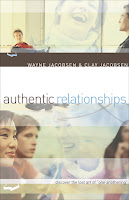
Authentic relationships (by Wayne Jacobsen and Clay Jacobsen)

Authentic Relationships by Wayne and Clay Jacobsen
(Amazon UK link)
I'd come across Wayne Jacobsen's writing before: he's one of the authors who combine in the pseudonym of Jake Colsen, in the excellent fictional 'So you don't want to go to church anymore?'. His brother, Clay Jacobsen, works in broadcasting.

The two Jacobsen brothers wrote 'Authentic relationships: discover the lost art of one anothering' together. It's a very thought-provoking book about Christian community, in the best sense of the word. Starting with Jesus' command to love one another, the authors look at several of the 'one another' verses that are in the New Testament. They suggest what they might have meant at the time, and - most importantly - how they can be applied today.

The first part of the book looks at how we can best demonstrate God's love by reaching out to other people around us. They describe the vital importance of fully accepting others, with all their faults and hangups, making us safe people to talk to. They point out, too, the dangers of gossip.

There are then some chapters suggesting how to begin to reach out, some about developing relationships with our acquaintances, and finally some suggestions about mature, committed relationships and what it means to have such close fellowship. It's rarely found these days, but the authors suggest that if we start by following some of their suggestions, we may - on rare occasions - come across other believers who will behave the same way, thus opening the door for truly authentic friendships.

I was particularly taken with the interpretation of the idea of submitting to one another. It was rather different from standard evangelical teaching, focusing not on authoritarianism obedience, but on mutual submission and letting go of our own expectations or need to be right. I found the chapter quite challenging; what they suggest seems much more akin to what would have been meant at the time than what is often taught today.

Each chapter ended with a few discussion questions, for anyone wanting to use the book with a few friends or in a small group. I'm not sure how appropriate they would be - I didn't find the questions particularly helpful. But for someone wanting to explore these ideas, they could make a good starting-point.

I'm not sure how far I will be able put the authors' ideas into practice, being a fairly private person by nature. However, it would be very encouraging to see more real community within the Christian church.

I found the book interesting and often thought-provoking, and certainly expect to be reading this again in future. Highly recommended.


Review copyright Sue's Book Reviews, 6th June 2009

2 Jun 2009

Magic flutes (by Eva Ibbotsen)

Magic flutes by Eva Ibbotsen
(Amazon UK link)
I really didn't know what to expect from this book, sent to me by The Bookbag for review. I'd never heard of Eva Ibbotson, although it turns out that she writes two basic genres: ghost stories for children, and light romantic novels set in the early 20th century.

'Magic flutes' is in the latter category. It's published as a Young Picador, which suggests that it's intended for the teenage market. However I doubt if it would be of much interest to younger teens, and almost certainly not to most boys. It's not exactly chick-lit either. But writing, as a not-so-young fan of light romantic fiction, I thoroughly enjoyed it.

The two main characters, Guy and Tessa, could hardly be more different. Guy was a foundling, abandoned as a newborn baby in Newcastle in the early part of the 20th century. Tessa is an Austrian princess, born around the same time.

By the time the story opens, in the 1920s, Guy is a millionaire, in love with the beautiful, widowed Nerine. He is determined to woo her afresh, and is quite certain that the perfect setting for his bride is a huge Austrian castle.

Tessa, meanwhile, owns such a castle. However, Tessa is now an orphan, and no longer wealthy. She has left home and works, incognito, in a struggling theatre company as the under wardrobe mistress.

These worlds collide when Guy decides to buy Tessa's castle, and to employ the theatre company in a production of 'The Magic Flute' as the perfect setting to propose to his intended bride ...

My only complaint about this novel is that it was rather slow to get started. I felt that there was too much detail and background in the early chapters. But by the time I was about a third of the way into the book, I was hooked. The writing is good, the characters well-drawn, the conversation realistic.

All in all, I thought it an excellent book. It reminded me slightly of Georgette Heyer's novels - and that's a great compliment - despite being set much later in history. There was almost a hint of 'The Sound of Music' too. But really it's in a genre of its own, which I hesitate to target since almost anyone could enjoy it if they happen to like light romantic fiction.

(My longer review of 'The Magic Flute'  can also be found on the Bookbag site)