Showing posts with label writing. Show all posts

6 May 2026

The writing life (by Annie Dillard)

The writing life by Annie Dillard
(Amazon UK link)
I’ve seen books by Annie Dillard recommended by more than one other writer whom I trust, so I put a few of her books on my wishlist, and was given a couple of them for my recent birthday. One of them was ‘The writing life’, a short book which sounded interesting. So I picked that one up to read about ten days ago.

I had thought it would have some Christian content; the author calls herself a Christian, and her books were recommended in Christian books. If not overtly so, I thought it might be a helpful, if quirky guide to writing. The blurb on the back, for instance, asks the question: ‘How do you prepare yourself, all alone, to enter an extraordinary state on an ordinary morning?’

Possibly I should have read some of Annie Dillard’s other books first. This isn’t really a guide to writing, and it doesn’t answer the question on the back. Instead, it’s somewhat random jottings about the creative process, and the struggles she has gone through. She writes, for instance, about different sheds or other private locations where she has written books. 

30 May 2025

Bestseller (by Celia Brayfield)

Bestseller: secrets of successful writing by Celia Brayfield
(Amazon UK link)
I have a lot of books on my shelves about writing. This is no surprise; I tend to collect a large number of books on any topic in which I’m interested, many of them bought second-hand. What does surprise me is that there are at least half a dozen which I have never read. I’ve decided to try and read one per month, and started with ‘Bestseller’ by Celia Brayfield.

I have no idea where I acquired this book. It’s marked ‘1.99’ in pencil on the inside cover, but it’s not clear whether the currency is pounds or euros. I probably picked it up in a charity or thrift store; the subtitle, ‘secrets of successful writing’ would have appealed. But not enough for me to read it, apparently.  According to GoodReads, I shelved it in 2017 so I’ve evidently had it for at least eight years.

Most books about writing cover similar ground, but with a slightly different focus. The theme of this one is that of writing not just a book, but a bestseller. Even in 1996 when this was first published, that wasn’t an easy thing to do. And while the author had written four novels before writing this book, and I assume they sold well, I had not heard of any of them. 

Still, it’s a well-written and well-constructed book. The author makes it clear that it’s about story-telling, of unlocking our subconscious and crafting the books we have inside us. And she explains her points giving examples from books which, presumably were selling well at the time she wrote the book. I was not familiar with any of them, but they still mostly made the points effectively. 

There are chapters claiming to offer ‘secrets’, but this isn’t done in an over-dramatic way. Instead it asks us to think about stories, about what makes a good opening scene, and so on. And just about every aspect of writing a novel is covered. We’re invited to think about location, and how much description is appropriate. We look at characters: at the importance of introducing the main one within the first few pages. I hadn’t quite realised how vital it is that this viewpoint character should have clear flaws as well as virtues. But, thinking about books I have loved, that is undoubtedly the case.

The author also looks at plots, at the importance of a strong beginning, and what to do when stuck in the middle. She suggests various possible methods of structuring a book, whether writing out detailed chapter summaries or letting the book tell itself.  She looks at editing, too, though not in a great deal of detail, and about finding a publisher, via an agent, and marketing. She makes some good points about most writers, by nature, not being suited to lots of networking and promoting. 

I had quite high hopes for the section about getting going, but really the author just talks about willpower, and about making a time and place for writing. She insists that it should be our second or third priority - that we should forget about housework and even cooking while in the throes of a novel. I can’t bring myself to do that, which is probably why I’ve never managed to finish a novel, despite starting several. 

I thought there were some useful reminders in this book, though most of it was familiar to me. It’s good that most published authors agree on most parts of how to write; but it means that books about writing are, mostly, quite similar. Perhaps that’s why I never manage to read more than two or three in a row. 

Inevitably, too, the book is somewhat dated. There’s almost no mention of computers, and self-publishing was really in its infancy when this book was written. There’s a lot of discussion about writing by hand, and the distractions of the phone. There is no mention, of course, of modern distractions such as social media or computer games.

Overall, I’m glad I read it. If you haven’t read a lot of books about writing, and if you can find this one inexpensively, it’s thorough and interesting to read. And possibly worth reading even if, like me, you have read rather a lot of books on writing. This is no longer in print, though it's available in ebook form; however paperbacks can fairly often be found second-hand. 

Review copyright 2025 Sue's Book Reviews

31 Dec 2024

The artist's way for retirement (by Julia Cameron)

The artist's way for retirement by Julia Cameron
(Amazon UK link)
Back in 2017, I acquired (second-hand) a couple of books by the American author Julia Cameron that came highly recommended. They were supposed to encourage creativity and provide inspiration for anyone feeling a bit blocked or uncertain where their lives were heading. I spent a few months attempting to get into one of them, and failed. In the end, I gave up. 

Four years later, in the summer of 2021 we were able to travel after eighteen months of restrictions due to the pandemic. We stayed at a family-run AirBnB, and I saw a book by Julia Cameron on the shelves. I dipped into it a couple of times, and thought it looked interesting, although mostly intended for younger people. When I returned to Cyprus, I discovered that she had written ‘The Artist’s way for retirement’, and decided to download it for my Kindle. 

I was already a bit dubious about the power of ‘morning pages’ (three sides long hand recommended), daily solo walks and weekly ‘artist dates’. These three requirements felt too rigid to me when I tried to read one of the author’s books four years earlier. But I decided to give it a try, and also to write answers to all her questions - memories of childhood, teenage years and so on, and quick answers to questions about what we enjoy, what risks we might take, what makes us feel happy and much more.

I never did manage three pages of longhand, but for a couple of months I did write at least one page in a notebook, and made other notes and responses. I ensured I went out for daily walks, even though many of them were with a close friend. Artist dates are trickier; the name is a bit confusing as I think of a ‘date’ as going out with someone else, and she insists that these must be alone. 

But she gives quite a broad definition. While some people might enjoy visiting art galleries or exhibitions, an ‘artist date’ might just mean browsing a good bookshop, or a craft store; it might mean watching a movie; it might even mean spending a couple of hours reading a childhood favourite book. The point is to do something special, that doesn’t fit into the usual routine, and try to do so every week.

Then after a few month, my interest petered out. 

In the summer of 2022 I spent a week staying in a flat that had no wi-fi, so I decided to start again, this time using my laptop which is so much easier to write on.  I managed every day that week, but then went to stay with relatives. Early morning writing was no longer possible, so once again I put the book aside.

A few weeks ago, I wondered if I should start yet again, but that seemed pointless. I hadn’t gained much from the first couple of times, so instead I started where I had left off in 2021. But I didn’t answer the questions, other than in my head. I just read the final few chapters, skimming in places where it became repetitive.

And that’s really my issue with this book. It doesn’t actually have a whole lot of substance. The principles, I think, are good: write daily if possible, get some exercise, do something different once a week. Think back to childhood and figure out if there’s anything that appealed then, which could be taken up again in retirement. Many examples are given of people who, in their sixties or seventies, began painting, or writing, or baking, or many other possible activities. Some of these are quite inspiring, but they’re also very similar. ‘I was stuck, then remembered I always wanted to (whatever) …. so I took the plunge, and now I’m happily creative’. 

As I was skimming through the last chapters, I noted that I do still try to write something most days (this is recommended by many different authors and books). I aim to do something a bit different once a week. But although it’s all too easy to get caught up in trivia, I write blogs, and run a couple of websites; I knit hats for babies, and I belong to a writing group. As an Introvert I don’t want too much social activity. And I’ve already done some of the things suggested in the book, such as keeping careful track of all spending. 

I was also a bit disturbed by the author’s suggestions of trying to hear from people who had died. Indeed, much of the 'spiritual' side of the book is what we used to call 'new age'. Also, I rolled my eyes at her insistence that we should visualise places or people. I’m one of many people who doesn’t see anything when I close my eyes, so this kind of suggestion is not helpful, and can be irritating.

As far as I can tell, there’s not much in this book that’s different from the one I dipped into back in 2021, except that the focus is on retired people rather than those going out to work or dealing with young families. And I’m not sure it’s all that helpful anyway to those of us who prefer general principles to detailed expectations. I could have read the prologue or a summary of the book and that would have given me as much as reading the book in its entirety. I'm glad I finally read to the end (albeit rapidly) as I like closure, and it's not a terrible book. But it shouldn't have taken three and a half years. 

Still, for anyone feeling stuck in a rut, or as if something is missing in their lives, this might be a useful book to start working through. And if you want to take it seriously, then answer the questions and exercises, and try to follow the suggestions. But when you get bored, or feel as if it’s not going anywhere, it's probably time to stop. 

My personal favourite books about writing (sadly not all in print) are:
 
- Writing on both sides of the brain by Henriette Anne Klauser
- Bird by bird by Anne Lamott
- Walking on water by Madeleine l'Engle
- The five-minute writer by Margret Geraghty
- Becoming a writer by Dorothea Brande
- Writing great short stories by Margaret Lucke
- Guide to fiction writing by Phyllis Whitney


Review copyright 2024 Sue's Book Reviews

29 Dec 2024

Writing on both sides of the brain (by Henriette Anne Klauser)

Writing on both sides of the brain by Henriette Anne Klauser
(Amazon UK link)
I read the book ‘Writing on both sides of the brain’ by Henriette Anne Klauser in 2010, and remembered that I found it extremely useful. So I thought it would be a good idea to re-read it. I have quite a collection of writing books but this one stood out in my mind as something a bit different.

The style of the book is somewhat informal, but also clear and informative. It feels almost as if the author is chatting, or explaining something via email rather than trying to be instructive. And it spends a lot of time focussing on the two parts of the brain - theoretically left and right, although I never can remember which is which. 

The author also uses the terms ‘Caliban’ and ‘Ariel’ but that’s not particularly helpful to people (like me) who have not seen or read Shakespeare’s ‘The Tempest’. Nor (in my view) is it encouraging to think of one side of our brain as a monster, since both sides are needed. 

So I prefer to think of them in more general terms, as the creative, spontaneous, flexible part, and the more structured, organised and logical part. Whenever I’ve filled in a questionnaire to determine which side of my brain is dominant, it comes out very even, so perhaps this is why I find it hard to remember which side is which. But it also means that it’s often very difficult for me to get started on anything, as I have both sides pulling equally…

The first chapter of the book explains, in a chatty way, how anxieties and stresses about writing go back centuries; yet, in the scheme of human development over the millennia, writing is a very new skill. It points out how for some adults, writing was taught in quite a negative way, full of corrections. This is in stark contrast to the way that children learn to speak, where parents and carers encourage all attempts at language, no matter how flawed. 

Chapter two takes us into what I think of as the heart of the book: what the author calls ‘Rapidwriting’. The idea is to allocate ten minutes (with a timer, if necessary) then sit and write (or type) without correcting anything. The idea is to stimulate the creative side of our minds, while letting the more structured, critical editor take a rest. I’ve done this before, and I did it for several days while reading this book. It’s fine to produce rubbish, the author assures us. Most artists, composers or other creators have far more that is thrown away than ever reaches the public.

And she’s right: after three or four days writing things that went nowhere (based on some writing prompts I had), I started writing something that I knew, instinctively, would be a reasonable short story. Of course one then needs to find other time to expand, and then edit anything that’s going somewhere, and this is where the other, editorial side of the brain comes in. We’re told that all too often this editor is critical and can stop creativity before it ever gets going. But if we invite it to look at our work, it is helpful (essential, in fact) to turn the ideas into high quality writing.

The author mentions a ‘wall’ that we’re likely to reach during rapidwriting, but at other times too. Hitting the wall is something more often experienced by runners or climbers, who must push through to finish. And it involves total exhaustion. With writing it’s obviously more psychological than physical. But there seems to be truth in the concept, even so. I would also endorse the suggestion that pushing through and continuing is likely to lead to something even better than what has gone before.

There’s a lot more in the book too, some of it quite prescriptive. The author recommends a ‘progress log’ where we chart everything we do, whether or not we think a piece of writing has a future. I did start this, but it soon felt like a chore and I couldn’t see that it was particularly constructive.

Not everything was relevant to me, and perhaps ironically I hit something of a wall about two-thirds of the way through the book. I put it aside for a couple of weeks before deciding to finish it; at that point I didn’t do any more exercises or even rapidwriting (though I hope to get back to that in the new year). But I did take in some useful pointers that I hadn’t remembered, such as the need for a piece of writing to end well, with some explanations about what that means in practice.

There’s perhaps too much about visualisation in the book, something which simply isn’t possible for those of us who don’t ‘see’ images in our minds. I didn’t like the suggestion of a ‘spirit guide’ at the end, either. But overall, I thought this an excellent book and, in places, quite inspiring. Not everything will apply to everyone, but if you’re feeling stuck or stressed about writing (fiction or non-fiction, for leisure or for work) then this book can provide some excellent insights and positive ways to move forward.

As a slight aside, I do find myself slightly puzzled by the use of the preposition 'in' in the book's title.  I would have used 'with', since a literal interpretation of the title is rather disturbing. But that only occurred to me recently, so perhaps it doesn't matter. 

Highly recommended. 

My other personal favourite books about writing (sadly not all in print) are:
 
- Bird by bird by Anne Lamott
One way to write your novel by Dick Perry
Walking on water by Madeleine l'Engle
The five-minute writer by Margret Geraghty
Becoming a writer by Dorothea Brande
Back to creative writing school by Bridget Whelan
Writing great short stories by Margaret Lucke
Guide to fiction writing by Phyllis Whitney

Review copyright 2024 Sue's Book Reviews

6 May 2024

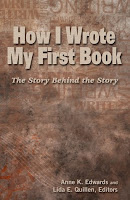
How I wrote my first book (by Lida E Quillen and Anne K Edwards)

How I wrote my first book
(Amazon UK link)
I was on a flight, and had finished a book on my Kindle. I didn’t want to start another novel, so browsed through my unread non-fiction folder. When I spotted ‘How I wrote my first book’, edited by Lida E Quillen and Anne K Edwards, I decided to try that. I had apparently downloaded it at no cost as long ago as 2011, shortly after it was published when it must have been on a special, promotional offer. I see from Amazon that it’s no longer available for the Kindle at all, so the link at the side is to the paperback edition. 

I had little idea what to expect from this book, which is subtitled, 'The story behind the story', but hoped it might give some inspiration related to writing. I had assumed it would be a longish story explaining how one person came to write a book. It turns out to contain shortish descriptions by 20 different writers about the process they went through before their first books were published. These writers are quite diverse: old and young, male and female; some who loved writing since childhood, some who had never thought of writing a novel. 

I had never heard of any of the authors included in this collection. But the stories are mostly quite interesting, albeit some more so than others. Some are full of ironical humour, others more stilted. I found a few of them rather tedious, and completely skipped one of them; but thoroughly enjoyed others. I read perhaps three of them on my flight, and since, returning, have dipped into the Kindle book, reading one or two chapters at a time. I finally finished the last one this morning.

It was fascinating reading about these different people and their approaches to writing, and as a purely biographical/anecdotal book, I would rate it reasonably well. However as a guide to writing, it was less useful. There was no consistent pattern that emerged. Indeed, the styles are as diverse as the people concerned. 

Some of the writers wrote a book in under six months, some took over twenty years. Some planned everything, some did no planning at all. Some struggled to find the time, some wrote to fill in unexpected free time. One wrote on a boat, after being persuaded to write by others. Some were close to despair, some were confident in what they had written. 

The first chapter was possibly the most useful. The author explained that there probably needs to be about a million words that are discarded by a writer before anything useful emerges. This is a bit depressing, but probably true. Later chapters were more individual; what applies to one writer may not apply at all to another. The final one had a clever analogy with crystal-growing - possibly taken to extremes but quite thought-provoking. 

However the only thing that emerged overall is something I knew already (albeit not very often putting it into practice) - to be a writer, one must write. Regularly. Not necessarily at a set time or place, not necessarily every day. But still… without putting words on a page, either handwritten or typed, a book will not get written. 

As a free Kindle book, I thought this was worth reading once. I didn’t actually learn anything new, but it was interesting reading such a variety of experiences of writing. I don’t think I’d pay the paperback price; there are so many books about writing that if I had to buy one, I’d choose one with direct instruction and exercises rather than this anecdotal one.

My personal favourite books about writing (sadly not all in print) are:
 
Writing on both sides of the brain by Henriette Anne Klauser
Bird by bird by Anne Lamott
One way to write your novel by Dick Perry
Walking on water by Madeleine l'Engle
The five-minute writer by Margret Geraghty
Becoming a writer by Dorothea Brande
Back to creative writing school by Bridget Whelan
Writing great short stories by Margaret Lucke
Guide to fiction writing by Phyllis Whitney

Review copyright 2024 Sue's Book Reviews

28 Dec 2023

One way to write your novel (by Dick Perry)

One Way to Write your Novel by Dick Perry
Over two decades ago, I came across the book ‘One way to write your novel’ by Dick Perry, while browsing my father’s bookshelves. I started reading, and found it quirky, interesting, and instructive. I had no real plans to write a novel at the time, but could see that the author’s structured method could be quite helpful, if one’s mind worked that way. A decade or so later, browsing a second-hand store, I came across this book and decided I would like my own copy. 

However, it’s taken me until a few months ago to pick it up to re-read. All I remembered was that it was a way of organising one’s thoughts, and planning the outline of a novel before embarking on the actual writing. Writers are loosely categorised as ‘planners’ or ‘pantsers’ (ie those who plan in advance, or who write by the ‘seat of the pants’ (in American phraseology). I quite like unplanned writing, and thought of myself as a pantser for many years. But a few months ago I had a huge ‘aha!’ moment when I realised that in general I do a lot of planning, and that this might suit my writing style better. 

‘One way to write your novel’ was first published in 1969. It was revised in 1972, apparently, and I have a sixth edition paperback, published in 1984. So inevitably there’s a lot that’s very dated and not relevant to today’s writers. But that mostly relates to technology, and to the tedium of having to retype one’s novel at least twice after the first draft. The final chapters, too, explaining about sending boxes of printouts to publishers is no longer relevant in today’s electronic era. 

However, the bulk of the book is full of sound, inspiring advice to those who like to plan. The first chapter covers topics like finding time, being efficient in one’s use of time, and encouraging the reader to get going if they have ever considered writing a novel. Just thinking about it, Dick Perry assures us in his chatty style, is not going to get us anywhere. 

The second chapter suggests that the first draft of a novel can be written in 100 days - not such an unlikely prospect, given that many people (including me) have attempted first drafts of novels in just 30 days with the annual NaNoWriMo project. What Dick Perry insists is that the planning must be done in advance, and the next few chapters look at what’s necessary.  He begins with characters, with checklists and other suggestions about how to create interesting and believable people. 

The book moves on to covering what’s involved in a novel: dialogue, setting and locations, and how to make a novel sparkle so that it stands out. None of this was new to me (even though I had entirely forgotten the specifics of this book) but I liked the way the author wrote, as if to friends, with personal commentary and plenty of humour. Finally he reaches the part which I think of as the most difficult: actually plotting the novel. He uses card indexes, another reminder that this book is over fifty years old, although of course people who prefer to draft writing by hand could follow his advice exactly. I prefer to use an application like Scrivener which has its own ‘card index’ system built in. But the principles work extremely well. 

I never asked whether my late father’s one published novel was planned using this method. I don’t know if any of my previous attempts will make it to publication, or whether I might start a new one with plenty of planning in advance. I tried to use the author’s method to put some structure into one of my ‘NaNoWriMo’ draft novels written without any planning, and realised just what a good idea it might have been to plan in advance. Planning doesn’t mean there are no surprises, or that everything is known in advance. But it does help the main plot to advance, ensures that necessary subplots are mentioned in suitable places, and brings the overall story to a conclusion. 

The final chapters of Dick Perry’s book cover the editing process, and again I thought there was a lot of value, even if the methods he uses (literally cutting - with scissors - and then stapling papers together) are no longer necessary. The author died in 2002, apparently, so I hope he had a chance to use computer software for some of his novels. But the content of his chapter about editing is very useful, in particular the things he mentions that budding writers should look out for.  

There are parts of this book that wouldn’t be considered politically correct in today’s society, and places where he’s quite rigid in his recommendations. His example ‘story’, used throughout to illustrate the principles he writes about, is hackneyed and (at times) decidedly weird. But it makes the points well, and I’m sure I’ll dip into this book in future, maybe even reading from cover to cover again if I feel inspired to begin a new novel.

Very highly recommended, if you want a method of planning a novel, don’t mind an informal style of writing and are happy to skip or skim parts that are not relevant. It's long out of print, but is the kind of book that turns up from time to time in second-hand stores, both physical ones and online. 

My other personal favourite books about writing (sadly not all in print) are:
 
Writing on both sides of the brain by Henriette Anne Klauser
Bird by bird by Anne Lamott
Walking on water by Madeleine l'Engle
The five-minute writer by Margret Geraghty
Becoming a writer by Dorothea Brande
Back to creative writing school by Bridget Whelan
Writing great short stories by Margaret Lucke
Guide to fiction writing by Phyllis Whitney

Review copyright 2023 Sue's Book Reviews

22 May 2022

Bird by Bird (by Anne Lamott)

Bird by Bird by Anne Lamott
(Amazon UK link)
I’m not sure where I first heard of Anne Lamott; possibly recommended in some other book I read. I discovered that she’s written both novels and non-fiction including some on the topic of faith, and one, which is highly rated on the topic of writing. I put this (and a couple of others) on my wishlist and was given them for my birthday earlier in the year. I’ve just finished reading ‘Bird by Bird’ which is the book about writing.

I should make it clear from the outside that although the author is a person of faith, and mentions God a few times, it’s not at all a religious book, or a typical one written by a Christian writer. There is some quite strong language used in places, and the ‘instructions’ of the sub-title are very general, relaxed and full of personal reflections, mostly from what might be called a ‘secular’ viewpoint.

It’s nonetheless a very engaging book, full of honesty, as the author recounts - for instance - the horrors of sitting in front of a blank screen when all ideas have vanished, or the way she describes her loathing in exaggerated terms of authors who are ‘successful’. She uses hyperbole several times to make good points, and while I think I might find her a tad overwhelming if I attended one of her classes, I thought what she said in the book was excellent, encouraging, and extremely reassuring.

Some of the advice, of course, is the same as any writer would say. In order to finish anything, one has to start. To have a final copy, one needs a first draft. It doesn’t matter if that first draft is rubbish (Anne Lamott uses a much stronger word which is perhaps more memorable) and it doesn’t matter if some of the writing is pointless, or goes nowhere. She recommends a minimum of 300 words per day, less than is commonly advised, but then it’s much easier to write 300 than 1000.

She explains, too, how to get to know our characters, letting them wander into our minds, asking them questions, letting them lead the way in short stories or novels. It’s not new advice, but the way it’s expressed is helpful. Indeed, it’s the way the book is written that makes it so engaging; it’s not laugh-aloud funny but there are definitely some amusingly written sections of writing, not just the hyperbole.

Publication, the author insists, is not the supreme goal of writing, although it is, of course, very nice to be published. But it’s not straightforward, it takes a huge amount of effort and stress - and the satisfaction of writing is in the writing itself. This book was written before the popularity of self-publication via print-on-demand services, but the points made should hold: a book needs months, maybe years of writing, re-writing, asking for advice from one or two trusted people, editing and proof-reading. But at some point one needs to let go; to allow one’s work to be finished, even if only printed out and read to one or two people, or it’s possible to keep going forever, without progressing.

I have a full shelf of writing advice books already, some of them more helpful than others; most of them are inspiring to some extent and each time I read one I determine to write more, to set targets, to follow all the suggestions given. It never lasts more than a few weeks. But maybe, just maybe I might manage 300 words per day, and finish some of my many started projects even if nobody else ever gets to read them.

Having said that, there are some sections that went right over my head; it’s an American book, and references to American sports or other activities meant very little to me.

Definitely recommended if you are interested in writing, and want an honest - sometimes almost brutally honest - viewpoint of life as a writer, with plenty of suggestions and ideas rather than a structured plan or instructions.

My other personal favourite books about writing (sadly not all in print) are:
  
- Writing on both sides of the brain by Henriette Anne Klauser
- One way to write your novel by Dick Perry
- Walking on water by Madeleine l'Engle
- The five-minute writer by Margret Geraghty
- Becoming a writer by Dorothea Brande
- Back to creative writing school by Bridget Whelan
- Writing great short stories by Margaret Lucke
- Guide to fiction writing by Phyllis Whitney


Review copyright 2022 Sue's Book Reviews

18 Nov 2020

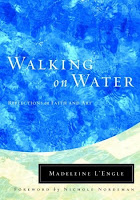
Walking on water (by Madeleine L'Engle)

Walking on Water by Madeleine L'Engle
(Amazon UK link)
It was rather by chance that I acquired the book ‘Walking on water’ by Madeleine L’Engle. She’s best known for her classic book ‘A Wrinkle in Time’ and its sequels, but she wrote some non-fiction as well. This one - about writing, art and Christianity - is probably my favourite of all her works. I last read it in 2008 so it was more than time to re-read.

The style of the book isn’t going to appeal to everyone, but I found it warm, inviting and inspiring. The author has written lots of snippets, loosely arranged in separate chapters, on topics related to art, and writing in particular. She looks at the question of what it means to be a ‘Christian writer’ - or a ‘Christian artist’ - and rejects many possible descriptions of these phrases.

Instead, she talks about her passion for writing, about losing herself in her work. She clearly had a very deep faith, and saw God in all she did, in particular the inspiration of her writing. But she also acknowledged the need for discipline, for putting pen to paper, for finding time and space to do what one feels called to do.

There are chapters about doing one’s work - whatever it is - to the glory of God, and about the way God, as creator, inspires all his creatures to create. She talks about the importance of getting on with one’s creation, whatever it might be, whether or not it’s ever going to be polished and presented to the public. A writer has to write, an artist has to paint, a singer has to sing… and in the doing of our calling, we find the work itself can take over.

The style is unusual, in that each chapter is divided into little snippets, each of them complete in itself. Some take up less than half a page, others continue over two or three pages. They all make points, some of them expressing, in different words, what the author has already said. But it doesn’t feel repetitive, Instead, it feels almost like sitting and having a chat.

There are anecdotes from the author’s own life, giving an impression of a focussed, caring mother and grandmother, who travels the world but loves nothing more than her own home and family. There are quotations from books, some of which she cites, others of which she acknowledges that she wrote down without any reference. She picks and chooses, and in places it all feels quite random - but there’s a thread running through that made me want to keep reading, although I had to stop every few pages, to think about what was written.

The subtitle of the book is ‘personal reflections on faith and art’, and that’s exactly what this book is. It was published in 1980, but other than references to typewriters it doesn’t feel at all dated. I loved it the first time I read it, and I enjoyed it just as much this time around. I should read it far more often than once every twelve years, and am already looking forward to reading it again.

Very highly recommended if you are interested in the connection between faith and art, or a writer's personal thoughts about her life and craft.

My other personal favourite books about writing (sadly not all in print) are:

- Writing on both sides of the brain by Henriette Anne Klauser
- Bird by bird by Anne Lamott
- One way to write your novel by Dick Perry
- The five-minute writer by Margret Geraghty
- Becoming a writer by Dorothea Brande
- Back to creative writing school by Bridget Whelan
- Writing great short stories by Margaret Lucke
- Guide to fiction writing by Phyllis Whitney


Review copyright 2020 Sue's Book Reviews

16 Jan 2020

Writing from life (by Lynne Hackles)

Writing from life by Lynne Hackles
(Amazon UK link)
When I’m interested in a topic, I tend to collect rather a lot of books on the topic; as soon as I’ve bought or acquired a couple, I get recommendations for others, and they all seem interesting in different ways. One of those topics is writing - I have an entire bookshelf devoted to this topic, and am trying hard not to want any more. Instead, I determined to re-read some of them this year, and work my way through the advice or exercises.

I don’t know how I came across ‘Writing from life’ by Lynne Hackles. A note at the front says that I have had it since 2011, but not whether I bought it or was given it, nor how I came across it. Perhaps I read a recommendation in a writing magazine, or perhaps Amazon suggested it. I can recall having dipped into it a couple of times, and found some interesting insights. But I had never read it from cover to cover, so I started doing so at the beginning of the year and have just finished.

The subtitle of the book is ‘How to turn your personal experience into profitable prose’. The author succeeds in explaining how to do this in a variety of ways. The first chapter is called ‘Writing and your life’, and contains exercises which seem quite simple: jotting down earliest memories, making lists of happy or sad occasions, looking through photo albums to trigger emotions and to bring to the surface some events we might have forgotten.

I did several of the exercises, hoping they would inspire me to do some writing, but that didn’t work too well. However these exercises, as I gradually realised, were meant more as a storehouse to pick from rather than triggers in themselves. At one point the book asks for a list of ten interesting people we know. Later in the book, the author explains how to take one of them, to change the name and other obvious characteristics, and to mix and match with other people - using incidents from our own past, perhaps - to begin a piece of fiction.

We’re encouraged to make notes of conversations we hear, odd incidents in the news, things we observe that others might not notice. The author tells us to ask, ‘What if?’ about events, even if they don’t seem all that interesting in themselves. For instance, the postman delivers a letter and it’s a note from a friend. But what if it was something else…? What if it was a blackmail letter, unearthing a deep secret? Or what if it was actually intended for a neighbour, and we opened it by mistake, and saw something private…? We can invent far-fetched ideas and choose one of them to move our story forwards.

I’m most interested in fiction, but the chapters about short stories and novels come towards the end of the book. Before that are ideas for letters and articles - advice I’ve seen before, and have taken up several times. So there wasn’t really anything that was new to me, and in places I had already written some of the things the author suggests. But I found the writing style encouraging - it’s nicely paced and lively, with a mixture of advice and anecdotes about the author or other folk who followed her advice.

I didn’t do all the exercises; I got the general idea, however, and think it could be very useful for someone who doesn’t really know where to start with writing. It’s probably more useful for non-fiction than fiction, but that’s a good place to start. I very much liked the idea that we all have stories that are of interest to others, even if they don’t seem all that exciting ourselves. And, indeed, my first ever published article (a very long time ago!) was about an experiment we tried, when my sons were young, of renting an allotment for a couple of years.

Despite not finding anything actively new, I enjoyed reading ‘Writing from Life’, and would recommend it to anyone starting out on writing. We often read advice to ‘write what we know’ - Lynne Hackles explains how we can do exactly that.

My personal favourite books about writing (sadly not all in print) are:
 
Writing on both sides of the brain by Henriette Anne Klauser
Bird by bird by Anne Lamott
One way to write your novel by Dick Perry
Walking on water by Madeleine l'Engle
The five-minute writer by Margret Geraghty
Becoming a writer by Dorothea Brande
Back to creative writing school by Bridget Whelan
Writing great short stories by Margaret Lucke
Guide to fiction writing by Phyllis Whitney

Review copyright 2020 Sue's Book Reviews

17 Mar 2019

The ultimate guide to writing and marketing a bestselling book

The ultimate guide to writing and marketing a bestselling book by Dee Blick
(Amazon UK link)
I don’t know where I first saw this book - I had never heard of Dee Blick, and the title isn’t one that would naturally appeal to me. But perhaps Amazon recommended it to me, because I have bought (or added to my wishlist) so many other books about writing. The reviews were uniformly good, and although the front cover did not appeal to me at all, I found a Marketplace edition for just a pound or two, so when I was in the UK about eighteen months ago, I ordered it.

‘The ultimate guide to writing and marketing a bestselling book on a shoestring budget’ is not exactly a catchy title, but sounded like the kind of thing that could be useful. I had been in the process of writing a non-fiction book for some years; we planned to self-publish, but I had almost no idea about marketing. I planned to advertise it on my (related) website, and write a blog post, and hoped - rather naively - that people would like it, and recommend it. I had no expectations of a ‘bestseller’, but thought it could be useful to read about possible marketing strategies.

I published my book six weeks ago, and started reading this book shortly afterwards. I found the first few chapters interesting; the author describes some of her own journey as she started to write books, mostly related to business. She ignored expert advice at first, but gradually learned techniques and platforms to market her books. They reached Amazon bestselling levels - although she goes on to say that if a book reaches the top hundred of any category it can be called ‘bestselling’ - and that can happen, at least temporarily, after just one or two sales.

The first part of the book is about the planning and writing process, so not particularly relevant to me any more (at least until I get going on something else) but I found it interesting, although by the time I had read three or four chapters I was getting a bit tired of the continual promotion of the author’s books. Yes, I wanted to read some of her experience, but it began to feel a bit pushy as she kept quoting titles, and using examples that weren’t relevant to me at all.

Still, there is helpful advice about writing style, beating procrastination and other suggestions. The first section is only supposed to be for non-fiction writers, but a lot of what the author suggests could be relevant to anyone. I particularly liked the check-list style summaries which are placed at the end of each chapter.

Section Two of the book begins with useful information about the ‘additional’ pages - again, nothing new to me, but a good outline of what is expected, and what can be added in addition to the main content. Chapters about editing, selecting a title and creating a good cover and layout could also be helpful to writers who are floundering, or who have not thought about these things. There’s advice, too, about pricing and the various forms of self-publishing; I didn’t read every word, as I had already got past that stage, but it seemed to offer good advice, albeit continually peppered with not entirely relevant information about the author’s career and her other books.

The marketing section - which starts in chapter 14 - was what interested me the most, but unfortunately I did not find it particularly helpful at all. This is mainly because I am not a pushy person. As a strong introvert I am not going to give talks, or radio interviews, nor am I going to contact people out of the blue to ask them to review or promote my book. I was particularly uncomfortable about the suggestion to manipulate the Amazon search engines by daily searching for and then clicking on one’s own book.

Still, the encouragement to use social media was interesting. I do use social media in a low-key way - and the chapter about Twitter made me re-look at this platform, although I have never entirely seen its use. But the more I read, the more I realised I’m not cut out to be a marketer. I am very reluctant to try to push anyone to spend money on something I have written unless they are genuinely interested!

I skimmed several chapters, missing out entirely the sections promoting the author’s books. However some chapters are written by other people. I particularly liked the one about reviewing, by Sue Magee of TheBookbag, a site I used to review books for (and may do again one day… if time allows). The chapter about blogging was a timely reminder to me to write more on my main blog, something I regularly neglect.

On the whole, I thought this book well-written and potentially useful. But I did not like the way that the book itself had a promotional style, nor the assumption that a writer will be outgoing and pushy. I would rather resign myself to occasional sales by genuinely interested people than go to the trouble of manipulating figures and wearing down people’s tolerance by reminding them continually what I am doing.

Recommended in a low-key way if you are writing (or have written) a book and have the right kind of personality to do some marketing. It could also be very useful if you would like to write a book but know little or nothing about how to go about it, and what is involved in self-publication.

My personal favourite books about writing (sadly not all in print) are:
 
Writing on both sides of the brain by Henriette Anne Klauser
Bird by bird by Anne Lamott
One way to write your novel by Dick Perry
Walking on water by Madeleine l'Engle
The five-minute writer by Margret Geraghty
Becoming a writer by Dorothea Brande
Back to creative writing school by Bridget Whelan
Writing great short stories by Margaret Lucke
Guide to fiction writing by Phyllis Whitney

Review by Sue F copyright 2019 Sue's Book Reviews

10 Jan 2018

Wake up and live! (by Dorothea Brande)

Wake up and live! by Dorothea Brande
(Amazon UK link)
Last year I read an excellent book about writing by Dorothea Brande. I had not previously heard of her, although I saw her work recommended in several places. I was surprised to find that she wrote early in the 20th century; while a tad old-fashioned in places, and inevitably outdated as far as technology is concerned, much of her advice was excellent, as suited to contemporary writers as to those of the past.

So when I realised that she had written another book, I put it on my wishlist. ‘Wake up and live!’ has been re-published recently, and I was delighted to receive it for Christmas. I started to read it soon afterwards, and found that one chapter at a time was plenty.

As with the author’s other book, it’s a little formal by today’s standards. It’s also a little irritating at the beginning, in that she writes about having discovered a ‘formula for success’, but doesn’t give details until much later in the book. However by the time I reached the place where the ‘formula’ is revealed, it was no surprise, as the book had worked up to that point. ‘Act as if you cannot fail’, is the ‘secret’ - one which, had I not read the earlier part of the book, would have seemed trite.

The earlier chapters of the book, however, look at the way that most of us subconsciously look for failure. Procrastination is a way of putting off what we don’t want to do; much of the time, the author tells us, this is because we think our task is either going to be painful in some way, or because we expect to fail. I wasn’t sure about this when I read it, and still think it’s a bit simplistic; but it’s certainly true sometimes.

Case studies are given including someone who had the ‘will to fail’ and changed, and someone who was convinced that the only times he could succeed in anything was if it was a last resort: if he was down to his last pennies, with no way of making money, only then would he set to work to write material that was accepted for publication. The importance of self-discipline is stressed, along with a realistic attitude of success.

‘Failure’ does not just include writing rejections; it can include failing relationships, or the inability to finish (or even get started on) a piece of work. I don’t suppose everyone would find the recommendations or suggestions helpful, as we’re all different. The author rather assumes that all procrastinators are alike, and of course there was no Internet when she was writing, so one modern source of endless distraction and procrastination was not considered. Nor did she take into account the problem of chronic illness, either physical or mental, which dogs so many people and makes them unable to be productive in the sense she encourages.

The final chapter has a selection of widely varying ‘exercises’ designed to help readers develop more self-discipline in certain areas, or to overcome faults. I’m not planning to do as she suggests (to write them down and pull one randomly out of a drawer once a month), but the principle seems sound. To conquer an ongoing bad habit or distraction, one either has to find a way to avoid it completely, or to go overboard in indulging it so that it becomes a chore rather than a desirable pastime.

Overall, I thought this an excellent little book, one I’d recommend to anyone feeling ‘stuck’. It’s intended primarily for writers, but could be of interest to anyone feeling bogged down in procrastination, if there is no physical or other cause for it.

My personal favourite books about writing (sadly not all in print) are:
 
Writing on both sides of the brain by Henriette Anne Klauser
Bird by bird by Anne Lamott
One way to write your novel by Dick Perry
Walking on water by Madeleine l'Engle
The five-minute writer by Margret Geraghty
Becoming a writer by Dorothea Brande
Back to creative writing school by Bridget Whelan
Writing great short stories by Margaret Lucke
Guide to fiction writing by Phyllis Whitney
  

Review copyright 2018 Sue's Book Reviews

31 Dec 2017

The five-minute writer (by Margret Geraghty)

The five-minute writer by Margret Geraghty
(Amazon UK link)
The author Margret Geraghty has written more than one book about writing as well as a number of other publications. I have two of her books, and have dipped into them both fairly often. But this year I was determined to read some of my writing books in full, so I embarked on ‘The five-minute writer’ at the end of April…

It’s a series of fifty-eight writing exercises, each one designed to take about five minutes. I thought, when I started reading it, that I would manage a couple of the exercises every day (I even assigned a notebook specifically for it) and finish within a month. I finally finished it today after skimming the last few sections. It’s not that it’s uninteresting - far from it. But it’s really not the kind of book to read from cover to cover, and I found that I quickly became bogged down in the exercises, and the need to write something at times when I wanted to relax and read.

Each exercise is preceded by a page or two of explanation and examples, and I found many of these helpful reminders about writing styles, or triggers for short stories. The author covers such diverse topics as ‘turning points’ (looking at times when we changed direction in some way), using colours to help demonstrate emotional states, different ways of looking at characters, brainstorming names… something to suit almost anyone. I even picked a couple of the exercises that piqued my interest particularly, and adapted them to use in the local writing group that I belong to.

I thought the book was very well-written, and liked the informal but instructive style. Most of the exercises were thought-provoking and achievable, if not always in as little as five minutes. I expect I’ll dip into the book again when I need inspiration, or something to prompt me to write. But I’m not in that place right now.

Recommended to anyone wanting some ideas to get started with writing, and prompts to spend at least five minutes each day on something creative and, at times, unexpected.

My other personal favourite books about writing (sadly not all in print) are:
 
Writing on both sides of the brain by Henriette Anne Klauser
Bird by bird by Anne Lamott
One way to write your novel by Dick Perry
Walking on water by Madeleine l'Engle
Becoming a writer by Dorothea Brande
Back to creative writing school by Bridget Whelan
Writing great short stories by Margaret Lucke
Guide to fiction writing by Phyllis Whitney

Review copyright 2017 Sue's Book Reviews

30 Apr 2017

Non-fiction books: A writers' guide (by Michael Legat)

Non-fiction books: a writers' guide by Michael Legat
(Amazon UK link)
I’ve been collecting books about writing for a long time now. Some of the earliest ones I acquired were by the late Michael Legat. I’ve had this one over twenty years, and have dipped into it several times. I’ve lent it to friends, too. Finally, a few weeks ago, I decided I would read it in its entirety.

‘Non-fiction books: a writers’ guide’ has a self-explanatory title. The book is divided into three main sections: What to write about, how to write a book, and how to sell a book. The focus is exclusively on non-fiction, but covers a wide variety of topics.

The first section has a good basic introduction about writing non-fiction in general, followed by a lengthy and exhaustive list of possible genres. The author is frank in his appraisal of each, and suggests which ones are more appropriate for beginners. Some subjects - such as health, or law - are only suited to professionals in the field. Autobiographies are only likely to sell if the author is well-known, but he adds that writing one’s own autobiographical accounts can be a good exercise to start non-fiction writing, even if the final product is just stapled together for the grandchildren.

I admit I skimmed over some of the entries. I’m never going to write on legal issues, or sports, or war. However there was plenty to interest me in other genres. As much as anything, this is a useful reference for anyone wanting to write in almost any topic.

The middle chapter begins with a useful guide to planning, something the author recommends for non-fiction. He explains both linear and what he calls the ‘sunburst’ method for coming up with a structure to a book, and gives advice on dividing it into chapters and sections. He explains about considering one’s audience - whether to write for beginners or experts in a given field - and about developing one’s style. None of this was new to me, but it was interesting nonetheless.

This section became less helpful when the actual writing process was discussed. The book is nearly twenty-five years old, so was written before most people had computers in the home. He mentions word processors, but assumes that most of his readers will be writing on a typewriter. Even when considering electronic equipment, there is no mention of email, and the only way to store documents was on floppy disks.

The final section is about approaching publishers and/or agents. Again, there is a mixture of useful advice and information that’s now out of date. Still, Michael Legat had a very readable style. He uses some low-key humour here and there, so I kept reading to the end.

Recommended in a low-key way to anyone thinking of writing a non-fiction book. Ignore the parts that are no longer relevant, and don’t expect anything that can’t be found elsewhere online, or in writing magazines. But as a general reference, with everything in one place, it could make a good addition to any writing bookshelf.

My personal favourite books about writing (sadly not all in print) are:
 
Writing on both sides of the brain by Henriette Anne Klauser
Bird by bird by Anne Lamott
One way to write your novel by Dick Perry
Walking on water by Madeleine l'Engle
The five-minute writer by Margret Geraghty
Becoming a writer by Dorothea Brande
Back to creative writing school by Bridget Whelan
Writing great short stories by Margaret Lucke
Guide to fiction writing by Phyllis Whitney
  

Review copyright 2017 Sue's Book Reviews