Showing posts with label Erica James. Show all posts

20 Mar 2026

The ideal husband (by Erica James)

An ideal husband by Erica James
(Amazon UK link)
I have liked Erica James’ books since I first started reading them over 25 years ago. As she publishes each new one - and it’s around one per year - I put it on my wishlist as soon as it’s out in paperback. I was very pleased to be given ‘An ideal husband’ for my birthday, nearly a year ago. As I was re-reading my Erica James novels at the time, I put this one on my to-read shelf, and have only just read it this week. 

The main character is a very likeable women in her early sixties called Louisae. She’s driving home on a beautiful spring day, feeling as if, perhaps, there might be something to look forward to. She’s been struggling for a couple of months, trying to stay strong. Her husband of nearly forty years announced just after Christmas that he was leaving her for a much younger woman. 

Up to that point she had thought Kip was the perfect husband. He was kind, responsible, good with the children - and their two small granddaughters - and she loved him. She was looking forward to spending more time with him as their retirement years approached. Now the future seems bleak. But nothing prepares her for the shock of seeing a ‘for sale’ board in front of their home. 

12 Feb 2026

A secret garden affair (by Erica James)

A secret garden affair by Erica James
(Amazon UK link)
I have liked all the books I’ve read by Erica James, since my husband first gave me some of her books over twenty-six years ago. She’s quite a prolific writer of character-based novels, and I usually acquire each one after it is published as a paperback. I was given ‘A secret garden affair’ for Christmas 2023 but had not read it until the past few days, as I was slowly re-reading my collection of Erica James’ books at a rate of about one per month.

The main character in this book is a likeable young women called Libby. She’s in her late twenties, and we meet her on her way to stay at Larkspur House. The novel is set in 1981, so the whole country is obsessed with the upcoming wedding between Prince Charles and Lady Diana.  Libby is taking refuge after she caught her fiancĂ© in bed with her best friend, three weeks before her wedding. She feels betrayed and deeply hurt, and knows she will be welcomed, loved and not judged by Elfrida and Bess, two women in their late seventies. 

13 Dec 2025

Swallowtail Summer (by Erica James)

Swallowtail summer by Erica James
(Amazon UK link)
I’ve been rereading my books by Erica James, and thoroughly enjoying them - most of them, anyway - over again. I wasn’t sure whether I wanted to reread ‘Swallowtail summer’, since I first read it only five years ago. But I’d given it five stars on GoodReads and LibraryThing, and I had entirely forgotten what it was about. So I decided I would reread it after all.

The main focus is a spacious, comfortable holiday home called Linston End, on the Norfolk Broads. It’s owned by Alastair, who must be in his fifties. We quickly learn that his wife Olga died about six months earlier, and that he’s been travelling. He’s now made a decision about his future, and has returned, concerned only about the effect that his news will have on his closest friends.

The second chapter introduces Simon and Sorrel. Simon has been Alastair’s close friend for many years, but Sorrel resents their friendship, although she knows it’s important to her husband. Sorrel appears to have obsessive tendencies; she likes her kitchen to be spotless, and insists that her cutlery is all arranged perfectly. They have a daughter called Rachel and a son called Callum, both in their early twenties. 

10 Nov 2025

Letters from the past (by Erica James)

Letters from the past (by Erica James)
(Amazon UK link)
I have been rereading my collection of novels by Erica James over the past two-and-a-half years, and mostly liking them very much. I wasn’t going to reread the ones I had read in the years since about 2020. Instead, I was looking forward to reading two new ones that I have recently been given. 

But then I noticed that ‘Letters from the past’, which I read in June 2021, is a sequel to ‘Coming home to Island House’, which I reread last month. The characters in this family saga, set in the early years of World War II, had got under my skin. Erica James has a talent for characterisation which means I often feel a little sad when I’ve finished one of her books. It’s like saying goodbye to people I have started to care about.

So I’ve just reread ‘Letters from the past’, and found that I hadn’t remembered the story at all. It was quite confusing in the early part, the first time I read it, as there’s such a big cast, and I hadn’t recently read the first book. This time, they were all still fairly fresh in my memory, in particular Romily, who isn’t in fact related to anyone else directly, but who cares deeply for her large step-family. In a sense this is her story; but there are many other important characters and several excellent subplots.

This book is mainly set twenty years after the first one. Kit and Evelyn are married with nineteen-year-old twins. Hope and Edmund are also married, and she has become a best-selling children’s writer. He works as GP in their village. They weren’t able to have children of their own, but brought up their German foster-child Annelise, eventually adopting her. She now works at Oxford University. 

The obnoxious and sadistic Arthur is as bad as ever, married to his third wife Julia, who is a damaged, subservient woman who puts up with whatever he doles out. His adult son Ralph appears to be almost as bad as his father, and his young son Charlie (whose mother is Julia) is away at boarding school, though he’s only seven.  

There are other characters too, familiar from the first book, and some new ones introduced in this story. The most significant is Red St Clair, an American who meets Romily and annoys her intensely. Her publishers would like them to work together on a script, but it’s clearly not going to work. It’s also clear that they are likely to get together at some point, though it’s hard to see how this might happen with so much animosity…

However, the story starts in a very unpleasant way with some anonymous letters. They’re composed of words and letters cut out of newspapers, and sent to various women in the village. Hope gets one telling her that Edmund is unfaithful. She can’t believe it… but doubts are sown. Evelyn gets one telling her that Kit isn’t the father of her twins… and she knows that there is a faint possibility that someone else was responsible, although she has never told Kit. Florence, who works for them, has a letter too, as does the unfortunate Julia. 

There are several theories about who sent the letters, but I hadn’t guessed (or remembered) who the perpetrator was until right before it was revealed. And in the meantime, the poison pen writer has spread doubt and worries, and started to cause stress between husbands and wives. But nobody is willing to tell their spouses about them…

Romily has secrets about her past, as does Red, and they gradually emerge. Annelise finds out something that worries her - and she also learns that Stanley, whom she thinks of as a brother, is in love with her. Hope and Edmund have an argument and she goes out for a walk which nearly ends in tragedy… and all this takes place towards the end of 1962, where smog still existed in London, and where there was a terrible winter, with vast amounts of snow and extreme cold. 

I love the way that the people are so three-dimensional, each with their flaws, and things they don’t necessarily want to talk about. Evelyn is a bit shadowy, and her twins feel like names only. But in Kit and Hope and Romily I really felt as if I were meeting old friends again. It was nice to get to know Annalise and Stanley, and also (somewhat) Annalise’s cousin Isabella, who is now an actress. I also liked the introduction of Charlie, although for most of the book he’s away at school. And I appreciated the way that some characters decide, deliberately, to become kinder, nicer people. One in particular has something of an epiphany.  

I think it’s harder to create believable villains, but Erica James has managed it well in this book. Florence’s mother-in-law is a complainer; Florence can’t do anything right, in her eyes. Arthur’s housekeeper/PA is snooty and unpleasant, too, and Arthur himself is frankly evil - he takes pleasure in hurting other people. I’m glad we don’t learn exactly what he does to Julia, nor too much detail about how he used to beat Ralph; the hints, and what we see in the book, are more than enough to make him quite a frightening person. He doesn’t seem to have any redeeming features, other than a superficial charm when he first meets people. 

The book is written in short chapters, each one focussing on a different member of the family. A few are told in the first person when someone is talking about what happened in the 1940s, as if talking to someone else. It could have been confusing, but each chapter is headed with the name of the person concerned, the location and the date. And once I’d got back into feeling as if I were part of the family, I had no trouble with the regular switching of viewpoint. All their stories overlap anyway, and are all the better for having so recently reread the first book. 

It’s quite a long book - over 500 pages in paperback - but I read it in just a few days. It was too easy to pick it up to read ‘just another chapter’, and then, as they’re so short, another… and I felt totally absorbed.  I loved rereading this, and am already looking forward to doing so again, in another decade or so.

Highly recommended if you like women’s fiction with some depth. But I would definitely recommend reading ‘Coming home to Island House’ first. The first time I read this, I liked it but didn't love it. This time I thoroughly enjoyed it, in part because of its being a sequel. 

Review copyright 2025 Sue's Book Reviews

17 Oct 2025

Coming home to Island House (by Erica James)

Coming home to Island House by Erica James
(Amazon UK link)
It’s only about six and a half years since I read Erica James’ novel ‘Coming home to Island House’. But I’ve been re-reading her novels over the past couple of years and decided I would continue even with the ones I acquired more recently. I had entirely forgotten the details of the story, though I had a vague memory of the overall plot.

Romily is the main character; she’s a vivacious, intelligent crime writer who fell in love with the much older Jack. They lived together for a while, which, in a contemporary novel would hardly raise an eyebrow. But this was in the late 1930s, and some of the residents of their village were shocked. Jack had been widowed many years earlier, and since then had a steady stream of women. Romily is the first one he truly loved, and they were recently married, in a small civil ceremony which very few people know about. 

We never learn how old Jack is; just that he’s twenty-seven years older than Romily. I assume she’s in her mid-thirties, or thereabouts, which makes him in his mid-to-late sixties. As the story starts, she’s coming back to their home, Island House, after a European tour promoting her latest book. There are rumours of war, and she’s looking forward to being home again. But then she discovers that he’s very ill… 

The bulk of the story involves a requirement by Jack that his three adult children (Arthur, Hope and Kit) and niece Allegra must live together in Island House for a full week. It’s evidently a large place since there’s room for them all. There’s a cook/housekeeper, Mrs Partridge, and a kitchenmaid called Florence whom Romily rescued from an abusive household. 

It’s primarily a character-based book, with quite a variety of different personalities. Arthur, the oldest, is not just pompous and bossy, he has a sadistically cruel streak which leads him to make some very bad decisions. Nobody seems to like him much. He’s married to Irene, who seems to keep spending his money.  Irene was originally Kit’s girlfriend, and he’s still angry that Arthur poached her, although it seems to me that he had a lucky escape. 

Kit is a very likeable man, although he has little idea what he wants to do with his life. He works in London, but is rather bored. He and his sister Hope used to be close, but they’ve grown apart. The reason for this is that Hope married a German, much to her father’s disgust. He threw her out, and she then refused to invite any of her family to her wedding. And now she’s a widow. She learns that her father is very ill, and when she decides to return to the UK she is asked an unexpected huge favour by her sister-in-law, who is married to a Jew. 

Allegra, meanwhile, has been singing in Venice, with a manager who seduced her, promoted her, and then ran off with all her earnings. She’s penniless, so when she hears that her uncle is ill, she decides to go back, at least for a while.

It’s not a fast-paced book, but once I was a few chapters into it, I could barely put it down. Erica James has a gift of creating believable people, with all too human flaws. They make mistakes, but are mostly nice underneath. The book includes a lot of explanations of past misunderstandings, and regret for previous mistakes. Allegra had left behind her best friend Elijah who was in love with her. Kit and Hope felt that their father was often angry and didn’t love them, but gradually they realise that he was grieving for their mother, and desperate to keep them all safe. 

Arthur is perhaps the least believable of the main characters. He seems to have no redeeming features at all, yet I found him rather dull rather than creepy. I do think that creating believable villains is a lot harder than creating likeable ordinary people. As a bullying older brother I could accept him; he lost his mother when he was quite young, he was sent to boarding school long before he was ready, and he was bullied there. But when his actions show him cruel and heartless he veers over into being not quite believable.

However, that’s really my only minor gripe with the book - and Arthur isn’t meant to be likeable or sympathetic. I thought everyone else was very realistic, and their interactions and conversations entirely believable. There are some children in the mix, too: the author seems to me particularly good at inventing delightful three-dimensional children. Stanley is the eleven-year-old evacuee who wins everyone’s hearts and Annaliese is a delightful toddler who plays quite a part, too.

I’m not usually a fan of books set in the war years, but perhaps that’s because they’re often grittily unpleasant with gratuitous violence. This novel doesn’t gloss over what’s going on in Europe; several of the young men in the village enlist when war is declared, and they don’t all return home. Some return with terrible injuries, and many with what would now call post-traumatic stress syndrome. 

It also explores - in a very low-key way - the changes society was experiencing in this era. Romily is an egalitarian, despite having married a wealthy landowner, and tries not to stand on ceremony with the people she employs. She’s quite unafraid of what people think of her, too, and very good at understanding what goes on inside people. The arguments and misunderstandings between family members possibly also reflect some of the conflicts on a global scale, although this is not referred to.

There are twists and turns in the book, some of them shocking - but nicely foreshadowed - and a mostly hopeful ending, although I thought I would like to have known more about what was going to happen to the characters. Then I remembered that there’s a sequel - ‘Letters from the past’, set over twenty years later but including some of the same people. So I’ll be rereading that in another month or so.

If you like character-based women’s fiction set during World War II, but set in a village that’s mostly idyllic, then this is an ideal book to read. It’s not a short novel: nearly 500 pages in my paperback edition. But I finished it in just three days. 

Review copyright 2025 Sue's Book Reviews

6 Sept 2025

Song of the skylark (by Erica James)

Song of the skylark by Erica James
(Amazon UK link)
With a few exceptions, I like Erica James’ novels very much. I’m glad I decided to reread them over the past couple of years. The two I liked least first time around proved to be rather more interesting than I had thought. And those I enjoyed the first time have been every bit as readable and moving as they were the first time.

I first read ‘Song of the skylark’ in 2016, and had entirely forgotten both the characters and the storyline. But I did recall having liked the book. This time, it was compulsive reading; it’s not a short book, but I finished it in just three days. 

Lizzie is the main character, and she’s a very well-drawn one with plenty of faults. We first meet her when she’s feeling sorry for herself after losing her job. She’s aware that she hasn’t behaved well - an affair with one’s married boss is not generally recommended - but she still feels that she was treated badly. Her former boss, Curt, hasn’t lost his job and he’s said he’ll stay in touch. He has said he will leave his wife, and Lizzie trusts him implicitly. 

Meanwhile she’s gone to live with her parents temporarily, since she can no longer afford any rent. She’s applied for lots of other jobs in London, but with no luck. So her mother suggests she volunteer at a local care home, where they encourage visitors to chat to residents, and generally help out. Lizzie isn’t keen on this idea, but decides, with bad grace, to try it out. On the first day she meets Mrs Dalloway, who’s in her late 90s. Lizzie nearly tips Mrs Dalloway out of her wheelchair, but not quite. And they get talking. 

Lizzie’s former job was as a researcher, and she’s very good at asking basic leading questions. She’s also very good at listening. And Mrs Dalloway tells a good story. Her name is Clarissa, and she was born in the United States, although her mother was English. At 19, having lost both her parents, she decides to visit England and see if she can meet her estranged British grandparents. Her only relative in the US is her wealthy American grandmother. 

From this point, Lizzie’s story is interspersed with Clarissa’s, which is in stark contrast. She crosses the Atlantic in a luxury liner in the spring of 1939. There are rumours of war in Europe, but she doesn’t really believe it. She meets the film star Effie Chase and her two good friends, Ellis and Artie. For the first time in her life, she feels free, and is determined to be more confident and outgoing. 

Her visit to her English grandparents starts with a disaster, but gradually they become close… and she can no longer easily return to the US once war is declared. But she’s full of courage and determination. She persuades her grandparents to take in two German Jewish refugee boys, and she meets and falls in love with an airman… 

The story takes place over several visits, and in between we see Lizzie as she starts thinking about her life and what she might do long-term. She’s made a lot of mistakes and hurt a lot of people. But Mrs Dalloway’s story makes her feel rather humbled. 

There are other characters in the book: I liked Lizzie’s parents very much, and her young nephew Freddie, too. Lizzie has a twin brother Luke, who is far more laid-back and peaceloving than she is. Luke is married to the rather uptight Ingrid who likes her life to be organised and efficient, and who disapproves of Lizzie’s lifestyle. So there are family dynamics and stresses going on, covered in a realistic and mostly encouraging way.

When I read a dual-timeframe story, I sometimes skim the ‘past’ sections a bit, as I find the ‘now’ chapters more interesting. But in this book I was gripped by Clarissa’s story, which is full of war-related tragedy; nothing gratuitous but a lot that’s very moving. It makes Lizzie realise how her own problems are quite minor by comparison, and gives her the impetus to start being more positive about herself and her relationships.

There’s a bittersweet - but entirely expected - ending, and much that’s left open as far as Lizzie is concerned. But I didn’t mind that. She’s grown and changed in the course of just a few weeks, and the outcome for her is positive, whatever happens.

Definitely recommended if you like character-based women's fiction.

Review copyright 2025 Sue's Book Reviews

12 Jul 2025

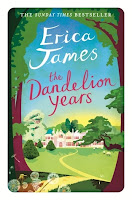
The dandelion years (by Erica James)

The dandelion years (by Erica James)
(Amazon UK link)
It’s over nine years since I acquired and read ‘The dandelion years’ by Erica James. I had no memory of the story at all, or any of the people, so it was definitely time for a re-read. 

The main character is a young woman called Saskia, who is celebrating her 32nd birthday as the book opens. Not that she’s out partying or drinking. She lives at home with her father and two grandfathers, and has done so since her mother and two grandmothers died in a car crash, when she was ten. 

The grief never left her, and for a while she became somewhat reclusive. But her grandfathers educated her at home when she started to hate her school, and she has turned into an intelligent, free-thinking and confident woman. She recently ended a relationship that her grandfathers weren’t too happy about. Not that they are over-protective: they would love her to find someone to love. But he didn’t seem like the right person.

Saskia’s father Ralph owns an antiquarian book shop, and Saskia works in a specially-built studio at home, restoring old books to something like their original splendour. She’s clearly very talented at this, and quite a perfectionist. She sometimes helps in her father’s shop, but her passion is book restoration. And she’s very happy with the status quo. 

Inevitably things change. Ralph is contacted by a woman he used to be in love with, and they agree to resume a friendship… and possibly something more. And Saskia meets a man called Matthew, who has recently lost a dear and elderly friend called Jacob. He has inherited the house, and an extensive - and valuable - book collection. Saskia goes with Ralph to start valuing the books.

Around the same time, Saskia discovers an old hand-written diary tucked inside a large family Bible, amongst some books that have been delivered. She starts reading, and is hooked…

Much of the novel then works in a dual-timeline way, as Saskia struggles through trying to decipher writing that’s hard to read. But the story is so interesting, that she keeps going. It’s written by a shy young man who is chosen to work at Bletchley Park, during World War II, attempting to decipher messages from the German government. It was very secretive work there and nobody was supposed to talk about it or what they did, even amongst themselves. And this shy young man falls in love.

It’s a beautifully written story, clearly well-researched and demonstrating some of the privations of war. The author of the old diary is billetted with a most unpleasant woman who is a terrible cook, and who doesn’t allow her lodgers to heat their rooms or have hot baths. And it’s a gentle love story at the same time, told from the perspective of someone who cannot believe that a beautiful, outgoing girl could ever be interested in him. And unfortunately, her snooty family agree. 

But we only learn what happens to these young people a chapter at a time, as the main story continues. It’s primarily character-based, which is what I like about Erica James’ novels. She brings people to life, and I find I care about them. When tragedies happen - and there are two in the course of the novel, in addition to the ones that took place a couple of decades earlier - I could begin to feel for them, and thought the descriptions of their emotions were sensitively and helpfully written.

Definitely recommended if you like character-based women’s fiction that’s not too predictable, and which has something a bit deeper than some. By the time I was half-way through, I didn’t want to put this down. 

Review copyright 2025 Sue's Book Reviews

8 Jun 2025

Summer at the lake (by Erica James)

Summer at the lake by Erica James
(Amazon UK link)
On the whole, I very much like Erica James’ novels, and am glad I decided to reread them. I last read ‘Summer at the lake’ in 2015, and had entirely forgotten it. But I knew that I liked it. I always like rereading a book which I know I’m going to enjoy - assuming my tastes have not changed too much. 

The first person we meet is a young woman called Floriana. She is feeling quite agitated over an unexpected invitation to ‘save the date’ for a wedding. We don’t learn who Seb, the groom, is, exactly, until rather later in the book. But it’s clear that he and Floriana had a strong connection in the past. They haven’t spoken in a couple of years, and she really doesn’t know how to respond. 

And as she walks home from her tour guide job in Oxford, pondering about her family and about this unexpected invitation, she walks blindly into the road… and the next thing she knows, an ambulance is approaching.

Two of the people who come to Floriana’s aid when she has her accident are a young man called Adam, and an elderly woman called Esme. Adam, who is a property developer, is just going through a possible breakup with his long-term girlfriend. So he’s feeling quite stressed. Esme is a bit of a hermit; she lives alone with her cat, and rarely goes anywhere other than to the local shop. But Esme feels quite drawn to Floriana, and Adam is a thoroughly likeable person who usually wants to do the right thing. 

Adam and Esme exchange phone numbers, and even manage to visit Floriana in hospital, pretending to be relatives. And so an unlikely three-way friendship begins. The two younger characters bring some life to Esme’s rather predictable, safe existence. And she starts to tell some of the story of her past…

The second part of the story happens when all three make a trip to Lake Como in Italy. Floriana is there to attend Seb’s wedding. Esme is there because she wants to find out what happened to some people she knew when she travelled there with her artist father as a young woman. And Adam is there because they need a driver, and because Esme wants to do a bit of matchmaking. 

They’re all distinct, three-dimensional characters, nicely drawn and realistic. Then there’s some well-written and believable conversation as they get to know each other. Seb is an important person in Floriana’s life - or was, until he cut her off. But when they meet in Oxford, she isn’t entirely sure what to expect. So there are several subplots running alongside each other: does Floriana love Seb, or is she ready to move on? Will Esme learn anything about the people she is looking for? Will the three of them manage to get along well, staying in lodgings together? Will Seb be happy married to the rather self-centred Imogen?

It’s quite a long book, nearly 400 pages in my hardback edition, and it was a busy week so it took me several days to finish it. But when I had the chance to sit down to read, I found the story engrossing. The three main characters started to get under my skin; since I had entirely forgotten the story I had no idea whether Adam and Floriana would get together eventually, nor whether Esme would find anything or anyone from her past. 

The scenes set in both Oxford and in Italy feel entirely authentic, without being overtly educational. The author makes it clear in a brief introduction the beginning that she is familiar with both places, and did quite a bit of research too. 

There are some surprises in the novel, including two quite dramatic scenes that I was not expecting, as well as some more relaxing, somewhat predictable parts of this book. The balance works well, and as someone who appreciates character-driven novels, I liked it very much.

As a bonus, I don’t think there was any bad language at all, and there are no explicit scenes. Overall I thought this a lovely book, one which would make a good introduction to Erica James’ writing, even though it isn’t quite as enjoyable as my favourite of her novels (‘Precious time’). 

Review copyright 2025 Sue's Book Reviews

29 Apr 2025

The hidden cottage (by Erica James)

The hidden cottage by Erica James
(Amazon UK link)
I’m slowly reading my way through my extensive collection of Erica James novels, which I’ve acquired over the past twenty-five year. I’m reading them roughly in the order in which they were written, and just finished re-reading ‘The hidden cottage’, which I read in 2014. Unsurprisingly, I had entirely forgotten the story and all the characters.

Mia is the main protagonist of this book. She’s in her fifties, and works creating and selling designer hats. She is married to Jeff, who’s a bit grumpy and rather a male chauvinist, but mostly they seem to get along reasonably well. They have three adult children: Jensen, Eliza and Daisy. 

Mia is very close to Jensen, possibly because in his first few years Jeff wasn’t involved in his life. And unfortunately Jeff and Jensen seem to bring out the worst in each other. But as the story begins, they are all gathering to celebrate Jensen’s thirtieth birthday, and to meet his American girlfriend Tattie. 

Not that this is the start of the book. The first person we meet is Owen, a newcomer to the village. He is quite surprised at something he sees, and it’s an excellent start to the novel. He then moves into a quiet cottage, and gradually we learn why he’s so attached to it. Owen is quite wealthy, and able to live on his savings. And he’s a talented piano player. 

There are plenty of back stories that gradually come to light in a story that I thought was very well-told. The first time I read this book I thought that the first half was too slow-moving. But this time, I liked it very much. I thought the pace was excellent, introducing believable people and I didn’t have any trouble remembering who was who. 

One of the best-drawn characters, I thought, was Mia’s older daughter Eliza. She’s quite a rigid perfectionist who works extremely hard and rarely takes any time off. Eliza has recently fallen in love, however, and is beginning to explore her emotional side. She is very disappointed that Greg is unable to get to Jensen’s birthday party, as she would like him to meet her family. 

And then there’s Daisy, who is unquestionably her father’s favourite child. She was somewhat spoiled as a youngster, and hated to disappoint him in any way. She’s working in a job he arranged for her, but really dislikes it, and is planning a major change in her life. She doesn’t know quite how to tell him, though.  

Several things come to light during Jensen’s birthday gathering, including the fact that Tattie has a nine-year-old daughter. Madison is a delightful child, and we see some scenes from her perspective. Erica James has a particular talent for creating well-rounded, believable children and Madison, in my view, adds a great deal to this book. 

What the author doesn’t do so well, however, is creating realistic villains. I realise that nobody is all bad, and some balance is good. But I never quite believed in Jeff; he’s not exactly a villain anyway, though he displays some very negative characteristics. But I also felt quite sorry for him at times. He’s not inherently bad. 

There is another character who behaves in an appalling way that causes major unhappiness to someone else, but we don’t get to know him at all. And there’s a back story that involves some horrible abuse, but, again, we never actually meet the perpetrators. 

In the second half of the book there’s a dramatic and shocking incident which I think I was half expecting; perhaps it had remained in my subconscious from the first time I read it. I’m not sure why it was necessary to the story; a slightly less terrible outcome could have worked, too, in my view. 

But overall, I thought ‘The hidden cottage’ was a well-written, thought-provoking book about family relationships. It’s set in a village where everyone knows everyone else, and one or two people are prone to gossip. A lot of Erica James’ novels are set in small communities like this, and feel authentic; perhaps she herself grew up in a small village. 

If you like women’s fiction that’s primarily character-based, with a few shocks along the way, then I would recommend this book. I’m very glad I re-read it. 

Review copyright 2025 Sue's Book Reviews

20 Mar 2025

The real Katie Lavender (by Erica James)

The real Katie Lavender by Erica James
(Amazon UK link)
It’s twelve years since I read Erica James’ novel ‘The real Katie Lavender’. So, unsurprisingly, I had forgotten both the plot and the characters. On the whole I like this author’s novels - I keep collecting them - but some, in my view, are much better than others. I hadn’t remembered this as one of my favourites, but started it, a few days ago, with an open mind.

It’s quite a dramatic opening. Katie, who is thirty, thinks she’s immune from shocks. Her beloved father died a few years earlier, and then her mother died unexpectedly a year before the story begins. She is still grieving, and misses them both; but she’s living in her mother’s home, where she loves gardening. And she has a job that she likes. 

Except that, on the first page, we learn that she has just been made redundant. She doesn’t react badly, and as she returns to her desk she notices her phone ringing. It’s a solicitor whom she has never heard of, asking her to a meeting. She had received a letter from the company the previous day, and was puzzled as they were not a firm she had heard of before.

But she decides she might as well take an extended lunch-break. She calls her best friend Tess to tell her that she’s lost her job, and that she’s on her way to a mysterious meeting. Then she gets to the lawyer’s office, and is handed a letter, written by her mother, giving her some shocking information…

The rest of the book is about Katie making some difficult decisions as she goes to check out some people she had never previously heard of. She meets not just the person she was looking for, but his extended family. She happens to arrive during a 90th birthday party for a delightful lady called Cecily, and is taken for a waitress. Then there’s a terrible tragedy that’s hits the family, along with some potential scandal… and she is slowly drawn into their lives. 

It’s a character-based book with some people whom I liked very much. Cecily is astute, intelligent and kind. Her daughter-in-law Pen is passionate about gardening, and somewhat absent-minded, but she’s also very intuitive and generous. And Pen’s son Lloyd is a free spirit who works making furniture, and loves to travel. He has no interest in making a lot of money. He’s rather good looking, too…

On the other hand, Lloyd’s cousins Rosco and Scarlet are snooty hard-hearted and driven. Scarlet, married to Charlie, is also pregnant and wants to talk endlessly about her hopes and fears for her baby. And their mother is elegant, refined, and extremely brittle.

Tess is a good friend to Katie - almost like the sister she never had - and is happily married to Ben. Tess’s brother Zac is also a good friend; he’s an excellent hairdresser, and is gay. Perhaps somewhat stereotyped, but still a likeable person who cares a lot about his friends. Tess and Zac don’t agree with some difficult decisions Katie makes, but they are still fully and unconditionally supportive. 

The book encompasses business problems, although never in so much detail as to be boring. It covers adultery, too, and the different reactions to it that the betrayed spouses might feel. There’s a lot of conversation and some introspection. But although apparently I found it too long-winded the first time I read the book, I didn’t feel that way at all this time. Indeed, at times I could hardly put it down. 

The writing is good, and the nicest characters feel entirely three-dimensional. Perhaps the gradual softening of the more unpleasant people is a tad unlikely, but they never become fully friendly. And I thought it was an encouraging ending.  Recommended if you like fairly light-weight women’s fiction.

Review copyright 2025 Sue's Book Reviews

19 Feb 2025

Promises, promises (by Erica James)

Promises, promises by Erica James
(Amazon UK link)
I’m glad I decided to re-read my collection of Erica James novels. She has quite a gift of characterisation, and a good pace to her writing. She usually avoids ‘strong’ language, and scenes of intimacy and some of her books are quite moving.

It’s nearly thirteen years since I read ‘Promises, promises’, and I had entirely forgotten both the people and the storyline. I found it quite readable, despite being a bit over-informal in places, and finished it in just a couple of days. Yet I didn’t particularly enjoy it. 

Ella is one of the main characters in this book, and one of the most likeable, too. She’s in her early thirties, and works as an interior designer and decorator. It’s clear that she’s very talented, and has built up quite a good clientele. She lives on her own after having broken up from a seven-year relationship with a man called Lawrence. She is still in touch with his 19-year-old son Toby, but still angry with Toby’s younger sister Alexis who made her life a misery, and never accepted her.

Ella has been commissioned for a Disney-style mural for the Edwards family. Ethan, the father, is courteous and friendly, but - as Ella quickly learns - is also quite arrogant, and something of a womaniser. Ethan’s wife Francine is snooty, rude and extravagant. Ella becomes friendly with Maggie, who cleans for them. Maggie is another likeable character who loves romantic novels and travel magazines. Unfortunately she’s married to the dreadful Dave, who expects her to do everything in the house, and puts her down continually.

I don’t mind a few caricatured minor characters in a novel - sometimes they’re a good balance to well-rounded, believable main characters. But in this book, other than Ella and Maggie, pretty much everyone falls into a stereotypical role. Well, other than Mrs Oates, Maggie’s neighbour, and Hal, a youngish man who has made a fortune with video games. But we don’t really get to know either of them. And the caricatures are all negative.

Francine and her neighbours (and her parents) are the worst caricature of ‘nouveau riche’ types who think themselves better than anyone else. Dave and his dreadful mother (and Dave and Maggie’s son) are selfish slobs. And the three teenage girls who feature are all caricatures of the worst kind of stereotyped rude teenager who think the world revolves around them, and ignore their parents except when they want something from them. Maggie’s mother and her cronies are frankly bizarre… 

The novel is told from different perspectives, changing with each new chapter, and that mostly works well. Ella, Maggie and Ethan are the viewpoint characters although everything is told in the third person, so there are no distinctive voices. They have all made promises to themselves. Maggie wants to lose some weight, and learn to stand up for herself. Ella wants to move on from her broken relationship, and let her head rule her heart. 

As for Ethan, he has decided to keep away from one-night stands and remain faithful to his wife. Although he’s apparently already broken that resolution just a few days into the new year. I found Ethan one of the most dislikable characters, possibly because he isn’t as caricatured as some of those who were deliberately intended to be unpleasant. 

Ella first meets Ethan in a multi-storey car park one evening, when he’s about to be mugged. It’s a dramatic and unusual start to a friendship - of sorts - and, given the genre, means it's somewhat inevitable that they are going to end up together. I was pleased when I thought I was wrong about that.  Ella decides to try again with Lawrence when his daughter has a change of heart - but then Lawrence turns out to be rather pushy and insecure. 

The most disturbing thing I felt about all these people is that they seem to spend most of their time thinking about going to bed with each other. It’s not just Ethan; his neighbour Christine has been lusting after Ethan, though he has no interest in her. Maggie meets a young man at her neighbour’s house and instantly starts fantasising. And Maggie’s mother and her friends seem to spend their time wanting to find men, although at the same time they want Maggie to be faithful to Dave. The only one who seems to care about commitment and wedding vows is Ella. 

A lot of the book feels rather poor taste, though I liked it more the first time I read it, and it has plenty of fans. While I did keep reading - almost compulsively at times - I’m not sure I'll want to read this again. It’s supposedly light-hearted, perhaps intended to be humorous. But I thought it quite unpleasant in places, and so it's not a book I would recommend. Erica James has written far better novels than this one. 

Review copyright 2025 Sue's Book Reviews

17 Jan 2025

The queen of new beginnings (by Erica James)

The queen of new beginnings by Erica James
(Amazon UK link)
I’m slowly re-reading the many novels I have on my shelves by Erica James. I’ve read some of them more than once, and they feel nicely familiar when I re-read. But there are others which I have read only once, when I first acquired them, and for which I have no memory whatsoever. One of the latter group is ‘The queen of new beginnings’, which I read back in 2011. I’ve just reread it, and, on the whole, liked it very much. 

The first character we meet is the rather grumpy Clayton, who is trying to write his obituary. Not that he’s old or ill; but it’s a clever device that lets us see some of what’s gone on in his life without undue explanations. We quickly learn that he is a writer who’s had success in the TV world in the past. But his writing partner went off with his girlfriend, and Clayton seems to be suffering writers’ block without him. 

Worse still, something has happened that means he has to leave London. We don’t learn what that was until much later in the book. His agent Glen has found him somewhere remote to stay undercover until the press latch onto something else.

In chapter two we meet Alice, a young woman who works doing voice overs for adverts and readings for the radio. She is talented at realistic voices, although she had once hoped to be an actress. She lives next-door to Ronnetta, who runs a cleaning agency. Ronnetta’s son Bob wants to go out with Alice and won’t take ‘no’ for an answer. Alice sometimes works for Ronnetta when she doesn’t have other work lined up, and she agrees to take on a job which, it’s clear, is the house where Clayton has ended up.

There’s something about that house which Alice is nervous about, although we don’t know at first what it is. And she decides, on the spur of the moment, to pretend to be someone completely different when she goes to work for him. 

It’s a good start, and the main characters are well-established from the beginning. Clearly both Alice and Clayton have secrets, and - since it’s a novel - it’s obvious that they’re going to get together in some way, once Alice’s charade is uncovered. Sure enough they find a spark of friendship, and decided to share their life stories with each other. Perhaps a tad unlikely, but Alice thinks it might be therapeutic to talk about her past to a stranger.

Clayton then does something rather underhand - it’s obvious to the reader what’s going on; but Alice doesn’t have an idea until it comes to a head much later in the book. Clayton claims he couldn’t help himself, but I sympathised entirely with Alice, even though she comes round to his point of view eventually.  

There are some quite unpleasant, somewhat caricatured people in the book who have significant (if small) roles in Alice’s past, and there are also some regrets. And there’s a delightful elderly lady known to all as George, who lives alone (other than a demanding cockerel named Percy and some hens) and speaks her mind to everyone. I liked George very much, and thought she was a good catalyst for a lot of what happens in the book.

Erica James tells a good story, even if there’s a tad too much detail for my tastes in some of the inevitable scenes of intimacy. I liked Alice very much - she’s a flawed person who has made plenty of mistakes, but she’s also generous and caring. She had quite a difficult time in her teenage years for many reasons, but has done well as an adult. 

The writing is good, and I found it quite compulsive reading at times. It’s quite a long book (nearly 450 pages in paperback) but the pace is good with plenty of action and story, and I didn’t find my mind wandering. There are some light-hearted sections which balance nicely with the poignancy of some of the past. And an entirely satisfactory, if predictable conclusion. 

Recommended if you like this kind of women’s fiction. 

Review copyright 2025 Sue's Book Reviews

7 Dec 2024

It's the little things (by Erica James)

It's the little things by Erica James
(Amazon UK link)
I’m gradually re-reading the novels by Erica James which I’ve acquired over the past twenty-four years, as well as looking forward to her new ones. The one I have just finished is ‘It’s the little things’, which was published in 2008. I first read it in December 2010 and in the intervening fourteen years had entirely forgotten the storyline and the people. Well, almost…

The main characters in this book are three (fictional) survivors of the 2004 Boxing Day tsunami in Thailand. This was a tragedy which educated most of the world about what to look for when a tsunami is about to happen. The action of the book takes place a couple of years later, but there are some descriptions and flashbacks of what these folk experienced. 

As we learn, early in the book, two couples went on holiday together. Sally and ChloĂ« had been close friends for a long time. Sally was married to Dan, ChloĂ« was with Paul, and hoped he was going to propose. One morning, Dan and ChloĂ« were in the hotel gym when the room was engulfed with water. They all escaped, and Dan managed to rescue a small girl, but he was unable to save her younger brother. Even two years later, he has regular nightmares. And Paul broke up with ChloĂ« shortly after the disaster, which left her broken-hearted. 

ChloĂ« is a doctor, working as GP in a busy practice. She prides herself on a personal touch, rather than keeping rigidly to time. She would love a baby, and is envious of patients who are pregnant. But she hasn’t had any serious relationships since Paul. Sally works as a high-powered lawyer, and Dan stays at home to look after their son Marcus who was conceived right after the tsunami. Sally is not at all maternal, while Dan loves being with Marcus, seeing his milestones. He is also happy to do the shopping, cooking and tidying. 

At a local gym, ChloĂ« meets a good-looking man called Seth, and they gradually become friendly. It’s clear that Seth has something he isn’t telling ChloĂ«, and she suspects all kinds of issues - that he is secretly married, perhaps - but she doesn’t guess what the secret is. That’s the one part of the book that I suddenly remembered although I had forgotten the actual characters. Possibly because, the first time I read it, it seemed like such an odd thing to be secretive about.

ChloĂ« and Seth have a very good rapport. But when she eventually learns his secret she’s shocked and also rather prejudiced, which is what he was afraid of. He’s a thoroughly likeable person. Indeed, in this book the three most sympathetic characters, in my opinion, are all male. Both Seth and Dan are kind, sensitive, warm and generous. The third is Marcus, who is a total delight. But Erica James has quite a talent for creating lovable, believable small children. 

However I found ChloĂ« rather rigid in her views. We eventually learn why she is so negative and afraid of being judged. But she has a hard, unforgiving side, and I found it hard to like her. Sally is even worse. I can’t empathise at all with someone who doesn’t much like being around her own son. But even worse, she is jealous of her husband’s abilities with him. Then at work she starts taking a huge risk, doing something so damaging to her reputation and marriage that I had no sympathy at all with her. 

Still, the writing is good, even though there’s rather too much discussion of sex for my tastes. Some of it is important for the plot, but not all.  And there are some interesting conversations about relevant principles and beliefs. But for many it seems too casual, and sometimes an apparently unstoppable force, rather than being a deliberate choice in a trusting, loving relationship. 

The novel is character-based, and there are quite a few minor characters. I liked some of them very much (such as ChloĂ«’s parents, and Rosie, the mother of Marcus’s best friend). Others are less sympathetic. I couldn’t quite believe in the ghastliness of some of ChloĂ«’s patients and also one or two of Sally’s clients. But that doesn’t matter much. They move the story forwards and provide a backdrop for the most significant people. 

There’s quite a ‘religious’ thread running through, too. As a Christian I quite appreciated the way that the church was portrayed as a positive force for good (on the whole). Some of the negative comments made were so biased and ill-informed that they made me think less of the characters concerned. I assume that was deliberately done. There’s nothing pushy, and fundamentalists would probably see all the discussions and Christians in the book as feeble, maybe even heretical. But I found this thread quite thought-provoking, and liked the way it brings issues of faith into secular fiction. 

Essentially, it’s a book about compassion and forgiveness. It’s also about friendship and love, with some important contemporary issues that come up briefly. It’s also a typical ‘women’s fiction’ novel about misunderstandings and romance. But set in the context of believable situations which the author brings to life well, with plenty of other things going on. It doesn’t drag anywhere. 

It’s not a short book - over 400 pages in paperback - but once I’d started, I found it difficult to put down. I hadn’t remembered any of the plot itself, and didn’t know what the outcome would be for anybody. On the whole I thought the ending was positive, while not quite tidying up all the ends. 

Recommended, on the whole, if you like women’s fiction with a bit of depth. It’s not my favourite Erica James novel, but I’ll probably read it again in another decade or so.

Review copyright 2024 Sue's Book Reviews

3 Nov 2024

Tell it to the skies (by Erica James)

Tell it to the skies by Erica James
(Amazon UK link)
I’m slowly re-reading my collection of novels by Erica James, interspersed with other books. I’ve just finished ‘Tell it to the skies’, which I last read in 2008. I know I liked it when I first read it, but had entirely forgotten the story and the characters. 

The novel opens in a dramatic way. A woman called Lydia, in her forties, sees something that startles her so much that she trips and falls, twisting her ankle badly. We learn that she lives in Italy, and next see her back in her apartment where her stepdaughter Chiara is looking after her. Lydia doesn’t want to say what - or who - has shocked her and there’s some good interaction between the two. Clearly they have a positive, caring relationship despite the fact that Lydia’s husband - Chiara’s father - died a few years earlier. 

All might have blown over, but in what feels like a massive coincidence (though necessary in order for the story to take place) the person whom Lydia saw turns out to be Ishmael, Chiara’s new love interest. Lydia quickly realises he must be the son of someone she knew decades earlier, called Noah - everything adds up. But still she doesn’t say anything, and this makes no sense until nearly the end of the book. 

Lydia’s closest friend and ally is her brother-in-law Fabio, who is sensitive and kind. He says he promised his brother to look after Lydia, and he gently persuades her to tell him what’s on her mind. She shows him photos she’s dug out, of Noah as a teenager, and he looks remarkably similar to Ishmael. And eventually, after much reluctance, she agrees to tell her story…

The novel then jumps back to Lydia’s childhood ('then') in the 1960s. This works very well as a device, rather than using flashback style. It’s a happy time until her father suddenly dies; Lydia is only eight, but her mother becomes clinically depressed and dependent on alcohol, and Lydia has to look after her two-year-old sister Valerie. She’s a resilient, competent and caring child who changes - and even washes - nappies, as well as attempting to look after her mother. 

Disaster strikes, and the children end up with their father’s parents whom they had never met. These grandparents are members of a strict and cultic church, and have no desire to house their grandchildren. They expect obedience, lots of work around the house, and no answering back. Lydia is not allowed to read anything other than the Bible. Their grandfather shouts, and sometimes treats them cruelly, sadistically so at times.  The other members of the church won’t hear a thing against him… Lydia’s only friend and ally is a slightly eccentric lady known as Sister Lottie. 

Then she makes a friend at school. Noah, too, is an orphan and the uncle he lives with is a bohemian artist, about as different as possible from Lydia’s grandparents. Lydia has to sneak out of the house to meet Noah, pretending she’s doing something else. I liked their friendship very much, and the way it slowly, hesitatingly, (but predictably) turns to love. 

The writing and characterisation are so good in this novel that I found it almost impossible to put down. It’s nearly 500 pages long, but I read it in just a couple of days. I had no memory at all for the story, so it was as if I were reading it for the first time. I felt Lydia’s tensions, I was rooting for her to get away with her many deceptions. I liked Sister Lottie very much, I loathed her grandfather. 

But all the time I was wondering why Lydia was so reluctant to talk about Noah, a couple of decades later, to her stepdaughter. I also wondered why they had evidently parted ways. I found the narrative engrossing as events unfold, more rapidly as the story reaches the climax. Then Lydia starts making assumptions that, I was sure, are unfounded. I didn’t quite see why she doesn’t ask a few more questions, but she’s eighteen by this stage, and what she does is because of her deep love for Noah. 

Eventually the novel moves back to the present ('now'), as Lydia comes to the end of her narrative to Fabio. Everything makes sense, and the rest of the story moves forward from then. I thought the structure worked very well, and that the characters - the nice ones, anyway - felt three-dimensional and real. The unpleasant ones are, I hope, caricatures. 

Unfortunately, though, there are still cultic churches that practise the kind of leader-worship and strict puritanism that happens in this book. Dreadful things are sometimes done in the name of religion. But Erica James doesn’t seem to be anti-religion (or anti-God) as such; she portrays some delightful people such as Lottie, who has a deep and caring faith. She also portrays, in passing, likeable, kind folk from Catholic and Anglican churches. 

As well as being a good story, the plot raises questions about choices that affect our lives, and about guilt. Lydia feels guilty for years, for instance, about something she asked her mother for, which, she believes, led to tragedy. Noah feels some guilt, too, about events in his past. There’s a lot to think about, and I found myself wondering what might have happened if Lydia had not leapt to conclusions when she was eighteen, before she lost touch with Noah. 

My only gripe about the book is that it seems rather sordid in places. Some of this is necessary -  I thought the portrayal of Lydia’s classmate Donna was excellent, for instance. But in other places I found myself cringing, wondering why sections were included. I was particularly disappointed to come across a detailed scene of intimacy later in the book, something that the author usually avoids. When I have come to feel that two characters are like friends I know well, I really don’t want to know what they get up to in private. 

So I won’t lend this to younger teenage friends. That’s a pity in a way, as most of the narrative takes place when Lydia is a child and teenager, and there are some interesting issues that arise, relevant to teens. However, to older teens and adults who like Erica James’ novels, and who don’t mind some sordid details, I would recommend it. 

Review copyright 2024 Sue's Book Reviews

11 Sept 2024

Gardens of Delight (by Erica James)

Gardens of Delight by Erica James
(Amazon UK link)
On the whole, I thoroughly enjoy Erica James’ novels. I acquire new ones as soon as they are out in paperback, and have been rereading some of the older ones in the past few months. I’m trying to reread them approximately in publication order, and arrived at ‘Gardens of Delight’, which I had only read once, back in 2007. I recalled not liking it much, but not the reasons. I vaguely thought that there was perhaps too much about gardening…

However, I sometimes change my mind about books I have disliked so I wanted to give it another chance. And on the whole, I did like it better this time. Having said that, there’s quite a cast of characters, and I found them a bit confusing at first. Most of them live in a village where everyone knows everyone else. A lot of backstory is given in most cases, although I felt that some of it could have been edited down; it mostly wasn’t necessary to the story. 

The most recent arrivals in the village are Hunter and Helen, rather a mis-matched couple in their late forties. Helen is generous and kind, while Hunter is rather power-crazed, possibly narcissistic, and likes throwing his wealth around. It’s clear from the start that Helen (who is his third wife) married him, at least in part, because he was able to fund her beloved grandmother in a top class nursing home. But she was also flattered by his attention to her. Hunter’s daughter Savannah, who is very spoiled and selfish, is being dumped on them for the summer, while her mother goes abroad. Neither Helen nor Savannah is happy about this. 

Lucy and Orlando are another pair, the best of friends but not romantically involved. They are housemates, and Lucy works in a garden centre run by Orlando’s father.  Lucy has a rather selfish mother, and isn’t speaking to her father who left them when she was fourteen. She is still hurting, another fourteen years later. Orlando is rather good-looking and Savannah decides to cultivate an interest in garden design, which is his speciality.

Then there’s Mac, a somewhat crusty man in his 70s who had a stroke a couple of years earlier. His nephew Conrad invited him to live with him. Mac was a huge part of his childhood, and although they argue a lot, they are very fond of each other. 

There are also some friendly elderly men who work on an allotment near Lucy, there’s a woman who works with Helen in a ‘care for the elderly’ business, and there are some strident village women who like to run everything… 

It’s a bit of a village soap-style saga, well written as I expect with Erica James. The first half of the book, set in the village, leads up to a group, including all the main characters, going on a gardening holiday in Italy which includes tours to large houses with big gardens. I found it all quite interesting, seeing the interactions between the different people in the village. It was hard to feel much attachment to any of them, as there are so many viewpoints and subplots. But by the time they arrive in their hotel I felt that at least I knew who was who. 

In the first half of the book, I did feel mildly irritated in places where it felt like there was a lot of plant name-dropping. I don’t have a problem with the mention of liles or lilacs or roses. But there were several places where I skimmed over lists with perhaps six or seven obscure plants mentioned. I wasn’t going to look them up, so the description was meaningless. But other than that, I quite liked it, and found the book very readable. 

Lucy becomes an important character once they’ve settled down in their hotel. Her father lives nearby and she still hasn’t decided whether she’s going to contact him, though everyone advises her to. And although she doesn’t like Orlando and Savannah becoming an item, she’s annoyed - and then flattered - by the attentions of a rather smarmy young Italian pianist. 

Helen, also, has a significant part to play: the cracks in her marriage become clearer as she mixes with other people. She finds one of them extremely attractive, as well as gentle, a complete contrast to Hunter. But she’s convinced that she’s not going to endanger her marriage. 

There’s more, of course - this is a 400-page novel, and I found it quite hard to put down once I was about half-way through. I skimmed the descriptions of houses and gardens in Italy, but was interested in the many characters and their relationships. I thought the pace was good, and the conversations realistic, even if some of what goes on is a bit sordid. I couldn’t remember what the outcome was for any of the people in the book but thought, on the whole, it was satisfactory - with one slight twist that I wasn’t expecting.

I’m glad I gave ‘Gardens of Delight’ another chance. It still isn’t one of my favourite Erica James books, but I definitely liked it better than I did the first time.

Review copyright 2024 Sue's Book Reviews

8 Jun 2024

Love and Devotion (by Erica James)

Love and Devotion by Erica James
(Amazon UK link)
I decided a few months ago to reread the novels by Erica James which I have acquired over the years. I started with some of her earliest published, and have - roughly - been reading in publication order, although I missed out a couple which I had reread just a few years ago. I have just finished reading ‘Love and Devotion’ which I had not read since 2006.

With this 18-year gap I had entirely forgotten both the plot and the characters. When I started, it felt oddly reminiscent of the novel ‘Stepping Up’ which I read for the first time a couple of weeks ago. A woman with two children asks her sister to be their guardian, should anything happen to her and her husband. The sister agrees, not imagining that she would ever need to take on this role… then tragedy happens.

However although these two novels have a similar starting point, they are very different in style and in the rest of the story. The aunt-guardians are totally different in personality, too. Part of the novel, of course, is the children’s aunts getting to know them better and becoming more confident in their role. But here’s where the similarity ends.

Harriet is the unmarried sister in this book. She is thirty-two, and employed as a computer programmer. She’s analytical, practical, and rather lacking in imagination. She is very close to her sister Felicity, and devastated when she learns what has happened. But she has never considered being a mother, and doesn’t seem to have any maternal feelings. 

However she’s very aware of her duty to her late sister. She can’t possibly have two young children in her flat, so she makes quite a sacrifice after much thought. She leaves her job and her home, moving in with her parents who don’t have the energy to deal with the demands of parenthood. Her parents Bob and Eileen are struggling with their grief in different ways and seem to be drifting apart. It doesn’t help that Eileen has ME and keeps pushing herself too hard.

Meanwhile a forty-something man called Will has moved into the house across the road from Harriet’s parents. He’s a divorced father of two older teenage girls, and he works as an antique salesman. He gave up a high-flying high-paying career as a lawyer after some kind of breakdown, but loves his current job. 

Two other important characters in the book are Miles, who runs the local bookshop, and his brother Dominic who is a typecast gothic narcissist. Dominic, Miles, Felicity and Harriet grew up together, and Harriet thinks of both these young men as honorary brothers. She used to idolise Dominic somewhat, but gradually realised just how nasty he can be. Dominic is both openly gay and proudly promiscuous. 

It’s a character-driven book, with many different subplots woven seamlessly together. I very much liked the scenes involving nine-year-old Carrie and four-year-old Joel. Erica James has a gift for characterisation, and particularly of young children. They both feel three-dimensional, and their conversation and behaviours seem entirely appropriate for their ages, and for children who have suffered the worst kind of bereavement. 

Carrie, at first, is angry and rude. Joel is nervous and anxious, terrified that he’s going to lose more people he loves. Harriet doesn’t really know how to deal with them at first; she’s sympathetic, of course, but quite abrupt. Her slow development of fondness and appreciation for the children is extremely well done.

Another side of the story is the discovery of a shocking secret in Felicity’s past which takes some time to unravel. Harriet is very slow to work out what’s going on - I had guessed quite quickly, but it took her a lot longer, with some misunderstandings and awkwardness along the way. And while it made a good subplot, it’s one of the parts I didn’t like so much. 

In addition, a lot of the characters leap into bed with others with little compunction and no real relationship. Perhaps casual sex is common in some circles; it’s not something I’m at all familiar with, and I found it rather sordid, particularly when there are explicit descriptions of what happens. 

It’s also a bit rambling and navel-gazing in places - the novel could probably have benefitted from some editing. And yet, I found it quite compulsive reading. The main characters are real enough that I cared about them; some places are very poignant, and I did not expect a very distressing event towards the end of the book. 

Overall I thought it a good read, but one I would recommend guardedly, due to the bedroom scenes and so many references to intimate activity. 

Review copyright 2024 Sue's Book Reviews