Showing posts with label Georgette Heyer. Show all posts

11 Oct 2025

Cousin Kate (by Georgette Heyer)

Cousin Kate by Georgette Heyer
(Amazon UK link)
I have a large collection of Georgette Heyer books, and read most of them regularly. I’m not so keen on the overtly historical ones that involve a lot of war talk. And I much prefer the Regency romances to the detective stories. But one of the Regency novels which I haven’t read nearly as often as the others is ‘Cousin Kate’. 

The reason for this is that when I first read it - and as far as I know, my first reading was in 1986 - I found it very disturbing, and quite shocking. I noted, at the front of the book, ‘not a nice story’. And then I didn’t read it again until ten years later, when I commented underneath, ‘not so bad as I remembered’. I didn’t then read it again until 2009, where, in my review, I expressed that it was one of my least favourite of Heyer’s novels. 

Sixteen years later, I thought it worth reading again. I did vaguely recall what happened at the end, but had entirely forgotten the main story. And I was a tad surprised at how much I liked the characters at the start. Kate is the main protagonist, and we meet her as she’s paying an unexpected visit to her old nurse Sarah Nidd. 

Kate is not a wealthy debutante, like some of Heyer’s heroines, nor does she come from a large family. She’s not a strong and independent kind of character, either. She’s an orphan who grew up in military circles. She’s in her early twenties, and was left penniless when her father died. She managed to get a job as a governess, but her employer’s brother started making unwanted advances. So she’s lost her job, and is taking refuge.

Sarah adores Kate, and is happy to put her up, but her house is noisy, and somewhat chaotic, so she decides to write to Kate’s aunt, Minerva, half-sister of Kate’s late father. And Minerva responds by arriving, and sweeping Kate off for a stay in her large stately home. She overwhelms her with gifts, and says she is delighted to discover an unknown niece. Kate feels very grateful, but never really develops any rapport with Minerva.

Minerva has a nineteen-year-old son Torquil who is a somewhat disturbing character. He has been sickly all his life, and has rarely left his house. His father - twenty years older than his mother - is a delightful elderly man plagued with illness. Minerva gave up a lot to live in the country, rather than spending parts of the year in London socialising.

As with all Heyer’s novels, the pace is good and the characterisation is excellent. Minerva seems so generous, yet there’s a hard core to her. Her husband Sir James is gentle and affectionate, but prefers to avoid any kind of stress. And Torquil behaves like a spoilt child, with some very strange and disturbing episodes when he becomes - or talks of being - violent. 

Then there’s Philip, Sir James’ nephew, who is evidently likeable, and concerned about his young cousin’s wellbeing. He and Kate clash initially but quickly become quite friendly; she finds him a bit confusing, and gets upset when she learns that although he loves his uncle, he can’t stand Minerva. This is partly because he recalls Sir James’ first wife, who died; but it’s clearly more than that.

Because I had remembered the unpleasant climax which occurs in the last few chapters, I wasn’t expecting to enjoy this book much at all. But I found Kate, Philip and Sarah delightful, well-rounded characters, and the story - as it turned out - is nowhere near as stressful or disturbing as I had feared. Yes, there are a few gory incidents, but no gratuitous description, and Kate herself is never really in any danger. 

As with so many of Heyer’s novels it ends quite abruptly; loose ends are tied up and we know what is going to happen. So it makes sense to stop rather than state the obvious. I would have liked a brief epilogue telling us what the situation is a year later… but perhaps that’s supposed to be left to the imagination of the reader.

This isn’t the only Heyer novel that has unpleasant violence in it, and I’m not sure, now, why I found it so very disturbing when I first read it. It’s still not one of my favourites, but on the whole I thought it well-written and liked it more than I expected to.

Review copyright 2025 Sue's Book Reviews

28 Aug 2025

Snowdrift and other stories (by Georgette Heyer)

Snowdrift and other stories by Georgette Heyer
(Amazon UK link)
For nearly four decades I have been an avid reader (and re-reader) of Georgette Heyer’s historical novels. So I was very pleased when I spotted what seemed like a new publication, ‘Snowdrift’, which said that it contained some recently discovered short stories. It was on special offer at 99p for the Kindle towards the end of last year, so I downloaded it. I only tend to use my Kindle extensively when I’m travelling, so I didn’t start reading it until I was at the airport a few days ago, and continued on a four-hour flight. 

I hadn’t remembered that the blurb states that there are just three newly discovered stories, and that the rest of the contents is the previously-published short stories from the volume ‘Pistols for two’. The introduction explains this. I last read ‘Pistols for two’ in September 2025, but decided to go ahead and reread anyway. I was looking forward to the extra three stories at the end.

I found that although I recalled the outcomes of most of the stories in the book (many of them similar), I had forgotten most of the characters and detail. So, rather than skimming, I became quite absorbed in the different stories. Georgette Heyer was very skilled in creating believable, likeable people with, sometimes, quite clever plots. Her attention to detail means that everything she wrote feels authentic to the Regency era, including details of dress, food, transportation and more. Sometimes she uses slang or cant phrases of the era, which are may be difficult to understand. But any time I’ve looked up words or phrases, it’s clear that she has used them correctly and appropriately. 

The first one in this collection, ‘Snowdrift’ (which is one of the last stories in ‘Pistols for two’) features a coach overturned in some snow. A young woman is very worried, all the more so when it’s clear that her maid is injured. She’s on her way to something of importance, and wants to be there before her obnoxious cousin.  She’s rescued by a bored nobleman… who, inevitably, finds her captivating.

It’s a fairly common theme in Heyer’s books, but she does it so well with such likeable and intelligent characters that I don’t mind how many times I read the same basic plot. Her novels - and short stories - are full of wealthy men who are finding life tedious. Some have almost nothing to do other than live lives of dissipation; some are being hassled to choose a wife from the current beautiful but unintelligent or grasping debutantes. 

The story ‘Pistols for two’ is a bit different, in that it features two young men who have been close friends all through their childhood. Then they fall in love with the same woman, and their friendly rivalry turns into bitter enmity. An accidental bump at a party leads one to call the other out, and they are determined to fight a duel with pistols at dawn. I love Heyer’s indirect ironical writing as she explains what triggered this… 

The other story that stands out in my mind is ‘Night at the inn’. The first time I read this, I found it very tense and quite disturbing. This time I recalled what was coming and was able to appreciate the cleverness of the plot, even if some of the description towards the end is macabre in the extreme. I’m glad the author didn’t make a practice of writing this kind of story; it’s not one I would normally choose to read.

The three stories added to the collection are at the end of the book. Apparently they were some of Heyer’s earliest writing, found in magazines. Even at a young age she was a skilled writer, with an excellent use of language and ironic low-key humour. 

The first of the three ‘new’ stories is called ‘Pursuit’. It features a rather irritable earl who is driving his curricle accompanied by a governess. The earl’s ward has eloped with a young man in the army, and he wants to catch them and put a stop to the proposed marriage. While the outcome is predictable, there are unexpected twists and turns that made this a very enjoyable story.

The second also features a young couple who eloping, although neither of them seems all that keen on the idea. Apparently the heroine is expected to marry someone elderly and she is determined not to do so. Then their coach is overtaken by another one, and they hear someone they don’t know asking for a young couple…

The final story features yet another bored Earl, on his way to Bath although he really doesn’t know why he should. He comes across a broken-down carriage with a young man who is desperate to get to Bath as soon as possible, and they strike up a rather unequal friendship. I guessed from the outset what was going on, as there were plenty of Heyer-like clues, but it’s still a nicely-done story.

All in all, I’m very glad I re-read the stories I have enjoyed before, and that - at last - I have read the more recently discovered ones.  Definitely recommended if you like Heyer’s writing, or perhaps as an introduction to her work for someone unwilling to try a full novel. 

The Kindle version is not currently on special offer, so the link above is to the paperback edition of this book. 

Review copyright 2025 Sue's Book Reviews

14 Jul 2025

Devil's cub (by Georgette Heyer)

Devil's cub by Georgette Heyer
(Amazon UK link)
Since I recently reread Georgette Heyer’s novel ‘These old shades’, it made sense that I would follow it (a month later) by rereading ‘Devil’s cub’, which I last read in 2018. That’s because it’s a kind of sequel, set over twenty years later. 

The characters in this book are wonderfully created, three-dimensional for the most part, and quite distinct despite a somewhat large number of them. Lord Vidal is the main male character, and we see him first as a hot-tempered, angry and promiscuous young man with no compunction or moral code at all, or so it seems. He loses his temper after an accusation, and fights a duel. His father, the Duke of Avon, is becoming increasingly annoyed with him, and orders Vidal to travel to France for a while. 

In stark contrast are the Challoner family. Mrs Challoner is widowed, and is one of Heyer’s caricatured grasping women. She is remarkably self-centred, and cares what society thinks of her far more than she cares about her two daughters. Her younger, Sophia, is very beautiful, and we learn that Vidal has found her very attractive. Mrs Challoner thinks they might get married, but her older, more sensible daughter Mary knows that won’t happen. And Sophia herself knows that he wants her as his mistress. But she’s too immature to care. 

Mary learns of a planned flight, and decides to do something both courageous and foolish in order to save her sister’s reputation. But she doesn’t take into account Vidal’s bad temper, or his need for revenge. She gives him the wrong impression of who she is, and is in considerable danger… but she’s resourceful, and practical, and quite willing to do something drastic when she has to.

It’s quite an active story, with many different characters chasing each other to France, and then to Dijon. It’s enlivened by Vidal’s cousin Juliana, who is prone to hysterics. She wants to marry a staid young man who adores her, but doesn’t really know how to handle him.

The pace is excellent, the characterisation very well done, and the conversation believable. I love the way that, while Mrs Challoner seems to have no redeeming features, the hot-headed violent Lord Vidal does adore his mother, and respects his father. And he finds himself somewhat at a loss when confronted with Mary’s strong determination and pragmatic nature.

There’s a lot of humour too, in Heyer’s ironic way. Vidal’s uncle Rupert is corpulent and idle, but can’t resist the blandishments of his sister-in-law. So he, too, ends up in France. Rupert has something of a one-track mind, however, and his insistence on dinner and fine wine adds to the humour, as does his lack of comprehension about some of the finer details of the story…

I loved the climactic scene, one which I had quite forgotten until it started. It looks for a while as if all the principal players in the story are going to converge, as happens fairly often in Heyer novels. But Mary is determined not to allow Vidal to do something which, she believes, will cause a family rift for him. She ends up telling her sorry story to an elderly and generous acquaintance. I knew who he was, either from memory or because Heyer makes it obvious to the reader. But Mary has no idea, and this makes for a dialogue that is both poignant and, in places, amusing. 

The ending is less abrupt than in many of Heyer’s romances, and while this isn’t one of my top favourites, I liked it very much. There are a lot of innuendoes and some violence in the early chapters which might put off some readers. Perhaps those are why I didn’t like this so much when I was younger. But if one can get past that, and the rather despicable idea that it’s fine for young noblemen to be promiscuous with young, working girls, it’s a good story.

As with all Heyer's novels, 'devil's cub' remains almost constantly in print, and is now available for the Kindle as well as paperback. These books can often be found inexpensively at second-hand or charity shops too. 

Review copyright 2025 Sue's Book Reviews

12 Jun 2025

These old shades (by Georgette Heyer)

These old shades by Georgette Heyer
(Amazon UK link)
The author whose books I re-read most often is Georgette Heyer. She wrote some 20th century detective/crime fiction novels, but the bulk of her work was in historical fiction. It’s mostly set amongst the upper classes, and generally features a romance. Her characterisation is excellent, and her plots very cleverly contrived.

It’s only six years since I last read ‘These old shades’. It’s a book I acquired in 1987, and I had already read it five times, so the overall story was familiar to me. Set in France in the middle of the 18th century, the arrogant, promiscuous Duke of Avon buys a ragged-looking boy - who is in fact nearly twenty - as a page. This lad, known as Leon, rapidly becomes devoted to the duke, and is taken everywhere with him. 

There’s a secret behind Leon’s identity, and another one which the duke is aware of almost from the start. But it would be spoilers to say what this is. The first time I read the book, I was quite surprised at the first revelation, although it happens fairly early in the book. The second time I don’t think I recalled it. But I knew it was coming this time, and it didn’t actually spoil my enjoyment in any way; indeed, I was watching out for signs of what I knew was coming.

The darker secret that the duke holds is quite an unpleasant one, both in his original motivation, and in the eventual showdown near the end of the book. The duke is not portrayed as a hero, or even a particularly likeable man. And yet, with Heyer’s genius, we start to see him through Leon’s eyes - and, in the face of such apparently naive adoration, he begins to develop some more admirable traits. And he always had a sense of humour.

There are some very enjoyable family scenes; Avon has a delightful sister, Lady Fanny, who is married to quite a staid (but wise) man. He also has a brother, Rupert, whom he isn’t very fond of at the start of the book. But Rupert shows a lot of courage and ingenuity, and earns his brother’s gratitude and admiration. There are some quite amusing scenes when the family convene on an inn, and they discuss what exactly he has done, and what has happened to an unfortunate man’s horse…

There’s a delightful curĂ© who plays a small but significant part in the story. He’s the parish priest in a small French village, and has mostly distanced himself from the world. But even he has heard of the Duke of Avon’s reputation. However, this does not stop him from having a very enjoyable discussion with him, as they try to solve some problems and find out more about the past. 

While I had recalled the outline of the plot and the main characters, I had mostly forgotten the details. As each new scene was introduced, my memories came back slowly. But Heyer’s writing is so good that I could probably read some of her books every year and still appreciate them and smile at some of the phrasing. 

‘These old shades’ was one of Heyer’s earlier novels, but still reads very well and demonstrates her tremendous gift of characterisation, and her impeccable research. She places her people and situations in real historic situations, with authentic clothes, actions and conversation. And she has quite unlikely heroes and heroines; the Duke of Avon is one of the most unlikely, but she still manages to make him quite appealing by the end - and that notwithstanding his terrible need for revenge that leads to quite an unpleasant climax to the book. 

I think this would make quite a good introduction to Heyer’s historical writing, although it’s not one of my absolute favourites. 

Review copyright 2025 Sue's Book Reviews

23 Sept 2024

Detection Unlimited (by Georgette Heyer)

Detection Unlimited by Georgette Heyer
(Amazon UK link)
I’m glad I decided to re-read Georgette Heyer’s crime fiction novels, as they’re a bit different from her better-known Regency romances. I’ve just finished ‘Detection Unlimited’ which is the last of the twelve crime books she wrote. I last read it in 2017 and had a vague memory of the outcome, although I had not recalled the perpetrator. These books were written as contemporary novels set in the middle of last century. This one was first published in 1953. 

This book starts with a gathering of several people at an afternoon tennis party. We meet Mr Drybeck, a solicitor, setting out to walk to the party. He meets a couple of other folk who live in the same village, and their conversation is quite revealing. We meet Mrs Midgeholme, who breeds dogs whose names all begin with U, and who treats them as if they were her children. We also meet Gavin Pleinmeller, who writes mystery stories and is quite outspoken. 

At the party there are several other residents who all know each other to some degree. I found the numbers a bit overwhelming and went back to make myself a list of people to refer to. Henry and Adelaide Haswell are the hosts of the party; they live at a large house called The Cedars. Their young adult son Charles is home, and he’s quite friendly with a young woman called Abby; she has a sense of humour and I liked her very much. Abby has an aunt, Miss Patterson, who doesn’t attend the party but plays a significant part in the novel.

And there are more. The one person who is not present is Sampson Warrenby, a ‘newcomer’ to the village whom nobody seems to like very much. He’s seen as encroaching, and is known to be very demanding, sometimes unkind to his niece Mavis. Not that anyone is particularly fond of Mavis, either, as she’s rather dull but they all feel rather sorry for her. She’s at the tennis party but is not a good player. 

Inevitably, someone is found dead as folk are going their separate ways. It seems clear that the victim has been shot by a common sort of rifle, but almost anyone who had been at the party could have done the deed. The local police are stuck so they call in Chief Inspector Hemmingway. I do like Heyer’s Scotland Yard policemen.  Hemingway is excellent at making friends with people and listening to their rambling, often discovering important information which others would miss. 

Rather than making a list of people I might have done better trying to construct a map of the village, as the geography is referred to several times. Distances and viewpoints are quite significant through the book, and I’m not good at visualising. But it was beyond me to do so, and I don’t think it mattered. Hemingway and others spend quite a bit of time checking locations, and working out who might have been able to commit the crime. 

But they don’t seem to be getting anywhere. At least ten people could possibly have been in place with a rifle at the estimated time of shooting, and most of them have some motivation. They all realise this, too; there’s some light-hearted sections of the book as several of the village residents present their own theories about who the perpetrator was, and how it happened. There’s also some low-key humour in the banter between Chief Inspector Hemmingway and his assistant, Inspector Harbottle, who has not worked with him before. 

Around three-quarters of the way through the book I vaguely remembered how the crime was committed, and was aware of little snippets of clues that I almost certainly missed the first time around. I didn’t remember who was eventually unmasked, but I did start to get an inkling, which proved to be correct.

Heyer’s crime novels don’t have the brilliant twists and turns of Agatha Christie’s, but her characters are far more three-dimensional. As much as anything this is a character-driven book rather than a mystery; while some of the people are undoubtedly caricatures, others are realistic and I felt as if I were getting to know some of them. There’s even a gentle low-key romance which unfolds. 

I always like Georgette Heyer’s writing style, and her characters’ conversation, which is often peppered with satire. She doesn’t force anything but lets the reader draw their own conclusions. It doesn’t feel particularly dated, despite the lack of technology, and overall I liked it very much. 

Recommended, if you like this kind of gentle crime fiction from seventy years ago. 

Review copyright 2024 Sue's Book Reviews

16 Aug 2024

Duplicate Death (by Georgette Heyer)

Duplicate Death by Georgette Heyer
(Amazon UK link)
I’m glad I decided to re-read Georgette Heyer’s crime fiction novels. I’ve just finished ‘Duplicate Death’, which I first read in 2008. All I could remember was that a nasty murder took place during a Bridge party. I had forgotten all the characters - and, checking back, it appears that I didn’t particularly like it last time, though I didn’t dislike it either.

This time I was prepared for a large cast of characters, and kept a note of them as they started to appear. The first chapter involves a nice family scene; Jim Kane and his wife have just received letters from their children who are away at boarding school, and Mrs Kane also receives a letter from her mother-in-law. She tells her husband that his half-brother Timothy Harte is embroiled with an adventuress, and she would really like Jim to see if he can investigate..

The names sounded vaguely familiar, but it wasn’t until rather later in the book when I realised that these three people were main characters in Heyer’s novel ‘They found him dead’, which I re-read just five months ago. Timothy was fourteen in that book, a fan of gangsters, and determined to help - or hinder - the police in an investigation. In this book, he’s ten years older, and works as a barrister. He recognises Chief Inspector Hemingway who was Sergeant Hemingway in the earlier book. 

The main action takes place in the home of Mrs Haddington, a society widow with a stunningly beautiful daughter, Cynthia. Nobody is entirely sure how she entered high society. Although this was written as a contemporary novel, first published in 1951, it’s apparent that the rules were almost as rigid as they were in the Regency era where Heyer set most of her novels. It’s suspected that her friend Lady Nest Poulton launched her, but they don’t actually seem to like each other much…

Mrs Haddington is hosting a duplicate Bridge party. She has three guests to dinner in advance, including Timothy Harte, who is in love with Mrs Haddington’s secretary Beulah. Then large numbers of visitors arrive; there are almost fifty people in the house, with eleven Bridge tables set up in two locations. I was writing down all the names as they were introduced, but it turns out that most of them are not really relevant to the story. Those that are become more memorable.

Mrs Haddington is rather cold, and not very likeable, but she’s a good hostess and while she’s quite ruthless, she adores her daughter. So much so that she’s indulged and spoiled her. Cynthia is not very bright, cares little for social rules, and wants to marry someone whom her mother doesn’t particularly like. 

Then the tragedy happens, and Chief Inspector Hemingway of Scotland Yard is called in, along with Inspector Grant. The two have quite a good rapport; Inspector Grant is Scottish and comes out with occasional words or phrases in gaelic. However some of his speech patterns are (in my opinion) more Welsh than Scottish. It’s not a huge deal; he doesn’t have much imagination but he is good at his job. 

With some of Heyer’s crime novels it’s obvious early in the book who the perpetrator is. It wasn’t obvious to me at all what had happened in this one. Despite the house being full, there are only really seven possible suspects, and the interviews and checking up are done well. Hemingway is very intuitive, and has a deceptively friendly manner that tends to put people at their ease, as he asks quite pointed questions. 

And just as he thinks he may have worked out both motivation and means for the crime, someone else is killed, using the same unpleasant technique. It throws Scotland Yard into some confusion, and further investigations take place.

I don’t think I could have worked out ‘whodunnit’ as there were some unsavoury parts of the story that didn’t get revealed until later in the book. But it was very well done, and I appreciated all the parts involving Hemingway, as well as those where Timothy takes part. The romantic thread is very low-key but runs satisfactorily alongside the main plot adding a bit of human interest.

Overall, I liked this book this time, very much, despite the gruesome subject matter - and Heyer manages to avoid writing unnecessarily gory scenes, concentrating instead on the potential suspects.

Recommended if you like this genre of mid-century crime fiction. Available in Kindle form as well as paperback, and sometimes available second-hand. 

Review copyright 2024 Sue's Book Reviews

1 Jun 2024

No Wind of Blame (by Georgette Heyer)

No Wind of Blame by Georgette Heyer
(Amazon UK link)
In my gradual re-reading of Georgette Heyer’s mid-20th century crime novels, I reached ‘No Wind of Blame’, which I first read in 2018. I had almost no memory of the book or any of the characters, other than a faint memory of how the crime was committed. 

The book is mainly set in a stately home owned by a flamboyant and very wealthy woman called Ermyntrude. She was widowed some years earlier, and then remarried the impoverished Wally Carter, who appears to have very few redeeming qualities. However he is apparently irresistible to many women, despite being a spendthrift, and regularly drunk. 

Wally has a cousin who is also his ward, Mary Cliffe. She’s one of the central characters, full of common sense and diplomacy. She's one of the few people who feels entirely real without any exaggeration or caricature. Mary is quite a contrast to Ermyntrude’s daughter Vicky, who sees life as a series of vignettes. Vicky constantly sees herself as acting a part. She regularly dresses and behaves in different parts of a play that is going on in her mind. She’s sometimes quite amusing, but Mary mostly finds her annoyingly trite and somewhat naive. 

There are others, too: the Georgian Prince who has come to stay; the local doctor; a squire and his son Hugh who is quite attracted to Mary. But she finds him rather too frivolous. There are less likeable folk as well, such as a belligerent young man who wants Wally to take responsibility for seducing his sister, or so he claims; a rather encroaching close neighbour who pops in far more frequently than Ermyntrude likes.  

So there are a lot of people in this novel, and quite a few different subplots running alongside each other, confusing the local police when a crime is committed - and it doesn’t happen until nearly half-way through the book. Nobody is all that upset about the loss of the character who is shot, but everyone tells either half-truths or downright lies in their attempts to cover up what they think they might know. 

Yet Heyer’s characterisation is such that almost all the people in the book stand out, and I didn’t find the large cast-list at all confusing. There’s low-key humour here and there, and I was pleased when Scotland Yard is called in, as Inspector Hemmingway is the person on the scene. He has appeared in several of the earlier crime fiction books, but usually as a sidekick of Superintendent Hannasyde. In this novel, Hannasyde only appears at the end of the phone; it’s Hemmingway who interviews the suspects and others in the household and neighbourhood. And I love the way his mind works. 

The viewpoint changes quite rapidly in this novel, but whereas that can make writing seem awkward, it works well in this novel. We learn just enough from each person’s point of view to know how they’re feeling, but not whether they are or are not guilty; we don’t even learn who might know of the perpetrator. 

Despite my vague memory of how the crime was committed, I had forgotten the details. It seems increasingly difficult to see just how it happened, and who might have done it, as more and more information comes to light. Even when I was fairly sure, I was puzzled by the motivation; yet that’s something that I should have been able to work out, based on a few casual remarks earlier in the novel.

I don’t like Heyer’s crime fiction as much as I like some of her historical romances, but I thought this was well-written, cleverly plotted and with memorable characters even if some of them were rather over-dramatic and caricatured. ‘No wind of blame’ was first published in 1939 but the personalities feel vibrant and modern, and I’m glad to see that these books are regularly re-published as well as being fairly widely available second-hand. 

Recommended if you like this kind of light crime fiction.  

Review copyright 2024 Sue's Book Reviews

27 Apr 2024

A Blunt Instrument (by Georgette Heyer)

A Blunt Instrument by Georgette Heyer
(Amazon UK link)
In re-reading my collection of Georgette Heyer’s crime novels, I reached ‘A Blunt Instrument’, which I first read in 2008. And although I usually forget who the perpetrator is in this kind of book, I could recall who it was in this one. I had worked it out within a few chapters the first time I read it, and thought it quite a clever story. 

I had not remembered any of the other characters when I picked this up to read yesterday. But it was very interesting knowing from the start ‘whodunit’, seeing how cleverly the author wove in many subplots and red herrings. I think this is one of her best crime novels, although I have been wondering whether she deliberately made it clear to the readers who was the guilty party, to make the investigations all the more interesting - and, at times, quite tense.

Ernest Fletcher is the victim in this story, which was first published in 1938 as a contemporary novel. He’s just been killed in the first chapter, so we never meet him. It appears, at first, that he’s universally liked: he lives with his sister, who is fond of him, and his many staff consider him a kind, generous man. We gradually learn that he had a weakness for pretty women, and had conducted several affairs over the years: mostly discreetly… 

Ernie’s nephew Neville is staying in the house, and I found him quite an amusing young man. He has little idea of economy and has travelled, incurring debts, around the world. His uncle has bailed him out many times, mostly good-naturedly. Neville is horrified at being his uncle’s heir, now owner of the stately home and his uncle’s fortune, as he insists that he prefers being penniless. 

A few minutes’ walk away live John and Helen North; they have been married for five years and seem to have become estranged. Helen has some debts which she daren’t tell her husband about, and it appears that she was visiting Ernie around the time of his murder. Helen’s sister Sally is staying; she’s a crime writer whom I also found rather likeable and amusing at times. 

Superintendent  Hannasyde of Scotland Yard is called in to the case, with his sidekick Inspector Hemmingway, and they’re assisted by the local PC Glass, who is a member of a strict religious sect and keeps quoting Scripture at anyone around him. 

All the main characters are three dimensional; Heyer was excellent at creating believable, well-rounded people, and I very much liked the interactions between them. Neville likes to invent stories that are far-fetched, which doesn’t impress the police. Hemmingway is thorough but not as astute as his boss who often has a twinkle in his eye as he listens to something outrageous.

Some of Georgette Heyer’s crime novels seem too straightforward compared to her contemporary Agatha Christie, although her characterisation is so good that it never much matters. But in this book her plotting is as masterful as her conversation and character-building, and once again I thought it a very good read.  Even knowing the perpetrator - who isn’t unmasked until near the end - I found it an enthralling read, and could barely put it down.

Definitely recommended if you like this kind of British light crime fiction set around the middle of the 20th century.

  Review copyright 2024 Sue's Book Reviews

4 Mar 2024

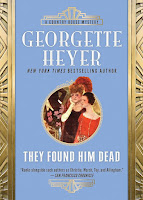
They found him dead (by Georgette Heyer)

They found him dead by Georgette Heyer
(Amazon UK link)
I’ve decided to finish re-reading Georgette Heyer’s crime fiction novels in chronological order. I picked up ‘The Found him Dead’ a couple of days ago, and found it quite compulsive. I last read it in 2011 and had entirely forgotten the story. Heyer’s characterisation is always excellent, with just a hint of caricature to make people all the more memorable. These books were written as contemporary novels in the 1930s, somewhat in the style of Agatha Christie’s ‘cosy crime’ fiction. 

The book opens with a dinner party to celebrate Silas Kane’s 60th birthday party. Sixty is not old, or even elderly, but he has apparently had some problems with his heart. His mother Emily is 80, and she’s quite frail although very strong-willed and mentally acute. Silas has a nephew, Clement, whom he doesn’t much like; Clement is married to the over-dramatic self-centred Rosemary.  

Silas also has a great-nephew, Jim, whom he likes very much, and Jim has a half-brother, fourteen-year-old Timothy. Invited to the party are Silas’s business partner Joe Mansell, as well as Joe’s wife, and their daughter Betty with her husband. And the whole is observed, initially, by Emily’s companion Patricia Allison.  From Patricia’s inclusion in the dinner party it’s clear that she’s a close family friend rather than a servant.

I found the number of people a bit overwhelming at first and had to backtrack over the first chapter to write down their names, and who was related to whom. But it’s a testament to Heyer’s writing that by the end of the book I could recall (and distinguish) them all. Right at the start, there are clearly undercurrents and tensions, but nobody expects that, the following morning, someone will be found dead. 

Everything points to an accident, until, just a few days later, someone else is killed: this time it’s obvious what happened, as there’s a loud noise, and then the character is found slumped over, with a bullet hole in his head. The local police are stumped, after interviewing everybody concerned - including a few extra characters who are in or around the house at the time - so Scotland Yard is called in. 

Inspector Hannasyde and Sergeant Hemingway are an excellent pair of sleuths, introduced first in ‘Death in the Stocks’, which I re-read in July 2022, and then used again in ‘Behold, Here’s Poison’, which I re-read in October 2022. Hannasyde is highly intelligent and resourceful, with a sense of humour. Hemingway is more gregarious. He’s meticulous in his research, but doesn’t always reach conclusions as rapidly as his boss. 

Just to make things even more stressful, a third character is apparently at risk… more than one person warns him that he’s likely to be the next victim, and a couple of ‘accidents’ look as though they were attempts to take him out too. I had guessed, about a third of the way through the book, who was the most likely perpetrator of the second death; I’m not sure if it’s ever established whether or not the same person was responsible for the first. 

The first time I read Heyer’s crime novels, I very much liked the way her characters are so three-dimensional and believable, even with those with some exaggerated traits. However I felt that her novels weren’t as cleverly plotted as those in similar vein by Agatha Christie, who always keeps me guessing right to the end. But re-reading this book, it occurred to me that perhaps it’s deliberate that the reader is pretty sure ‘who did it’ early in the book. Heyer was brilliant at writing in an ironic style, revealing so much by conversations and events that take her characters’ minds in different directions. 

I knew, of course, that it would all be sorted out in the end, but I still found the last few chapters quite stressful. I was certain I knew the perpetrator by that stage - it became increasingly obvious as events unfolded, but the people concerned were entirely unaware. Most of them, anyway. There are one or two extra cast members who arrive a bit later in the book, whom I appreciated very much. 

Alongside the tension there’s some low-key humour, much of it involving the teenage Timothy who loves gangster movies, and is thrilled to be in a house where so much criminal activity is happening. There’s even a low-key romance. The whole makes for a very enjoyable read.  Definitely recommended if you like this style of book. 


Review copyright 2024 Sue's Book Reviews

7 Jan 2024

The Foundling (by Georgette Heyer)

The Foundling
(Amazon UK link)
I re-read my collection of Georgette Heyer novels regularly, and usually find that even if I recall the overall storyline, there’s a lot which I have forgotten. That’s certainly true of ‘The Foundling’ which I last read in 2018. I remembered that a young, beautiful and not very bright young woman was rescued by an altruistic nobleman, but I had somehow muddled the plot, in my mind, with ‘Charity Girl’. 

There are undoubtedly similarities between the two rescues, and the characters of the heroes, as well as the quiet women they end up falling in love with. The most marked similarity is perhaps that the novel is written from the perspective of the hero rather than the heroine. But I had entirely forgotten the early part of this novel. 

Gilly, the Duke of Sale, was orphaned at a young age and has been brought up by his Uncle. A lot of care and affection has been lavished on him, as he was quite a sickly child. But now he’s in his early twenties and feeling rather hemmed in not just by his family but by his valet, his groom, and other devoted servants. They’re all old family retainers who have been with him since his childhood and he’s far too kind to ask them to stop anticipating his every move. 

Gilly’s uncle tells him that he should really make a formal proposal to his good friend Harriet, something which was planned for them both by their respective fathers. Gilly is quite shocked to learn that this is expected, but can’t think of anyone else he would like to marry. So, obedient as ever to his family’s demands, he rides over to make her an offer…

There are two cousins: the older, affectionate and loyal Gideon, and the younger, rather wild Matthew. Matthew, we learn, has got himself into a difficult situation involving breach of promise to a beautiful young woman called Belinda. So Gilly determines to go to his rescue, posing as an ordinary person without a retinue of servants, and without recourse to his title. 

It’s basically a coming of age story; Gilly comes up against all kinds of obstacles and falls into different adventures. Along the way he takes a 15-year-old runaway boy under his wing, and the beautiful (but brainless) Belinda also foists herself on him, enlivening the conversation with requests for a purple gown.

Some of the adventures are quite hair-raising but Gilly rises to the occasion, discovering abilities and strengths which he didn’t know he possessed. He also realises that life is nowhere near so easy, or so pleasant, without his valet and some of the other staff around him. 

There’s much more to the story: subplots I had no recollection of at all, humorous asides when I laughed aloud, and some very poignant scenes that almost brought a tear to my eye. I thoroughly enjoyed re-reading this book and am already looking forward to reading it again in another five or six years. 

Review copyright 2024 Sue's Book Reviews

12 Nov 2023

Black Sheep (by Georgette Heyer)

Black Sheep by Georgette Heyer
(Amazon UK link)
I re-read my collection of historical novels by Georgette Heyer regularly; they’re my comfort reading, but I try to limit them to one a month. I last read ‘Black Sheep’ in 2019 but - as ever - had forgotten most of the details of the story, even though I recalled, vaguely, the main outline of the plot. 

Abby is the main character in this. She’s twenty-eight, and a strong-minded, practical young woman with a good sense of humour. She sometimes rails against the rules imposed on society in the Regency era, but has no wish to bring shame or disgrace on her family. She lives with her much older sister Selina, and their orphaned niece Fanny, who is sixteen. 

Abby has been away, visiting other relatives at the start of this book and returns to her home in Bath to discover that Fanny has fallen in love. Selina rather likes Stacy, the young man who has captured Fanny’s heart, although she agrees that Fanny is rather young to think of marriage; she hasn’t yet had her debutante season in London, and had been looking forward to it. 

However Abby is suspicious of Stacy, partly fuelled by rumours having reached her old-fashioned and prudish brother. And it turns out that Stacy, while outwardly charming, is quite manipulative: Fanny is an heiress, and Stacy is seriously in debt. 

Then Stacy’s uncle, Miles, appears in Bath after a lengthy exile in India. He’s escorted home a young man, the brother of Fanny’s best friend. And while Miles never used to appeal to me much, I did like him when I read the book this time. He is confident without being arrogant, and clicks immediately with Abby due to a shared sense of the ridiculous. He also tends to scoff at convention, but is different in that he cares nothing for family ties.

It’s well-written, as I expect with Georgette Heyer, and is quite educational in the sense of explaining some of the cultures and customs of the era. Miles has rather a sordid past, although he insists he is now reformed. And while he has some things in common with his nephew (whom he had not seen for more than twenty years), he doesn’t have his worst faults and rather despises him.

The solution to Fanny’s infatuation (and the risk of her doing something she would regret) is partly solved by an attack of influenza. But Miles takes a part in a way that’s a bit high-handed, but also amusing. 

It’s a fast-paced and enjoyable novel, one whose ending I hadn’t entirely recalled although as each scene started I did remember the outcome. I still don’t really like what happens at the end - last time I read this, I was very unimpressed - but Abby goes along with it, and I’m not sure any other solution would have worked.

Not my favourite of Heyer’s novels, but still a good read. As with most of this author's books, it's available for the Kindle, sometimes quite inexpensively.  These books are usually in print in paperback too, and widely available in second-hand and charity shops. 

Review copyright 2023 Sue's Book Reviews

7 Oct 2023

The Unknown Ajax (by Georgette Heyer)

The Unknown Ajax by Georgette Heyer
(Amazon UK link)
I do like re-reading Georgette Heyer’s light historical romance novels regularly. It’s only five years since I last read ‘The Unknown Ajax’, but even when I recall the basic outline of a story, there are always plenty of scenes or conversations which I had entirely forgotten. There are others which I enjoy all the more for remembering them as they approach.

Hugo is the hero of this book, but we don’t meet him immediately. Instead we meet his estranged family: his grandfather, a couple of his aunts, and several of his cousins. His grandfather, the Earl, has been in a worse mood than usual. Nobody imagines that he’s grieving the loss of his oldest living son Granville and Granville’s son Oliver, as he never much liked them. It’s assumed that his next oldest son, Matthew, is now his heir.

So it’s a shock to everyone - particularly Matthew and his sons Vincent and Claude - when the Earl announces that his heir is arriving soon. He is the son of his late son Hugh and a weaver’s daughter - cast out of the family due to this ‘low’ connection. The Earl knew of Hugo’s existence but hadn’t told anyone else. Now the family lawyer has located him… 

The laws of inheritance were fairly complex in Regency times, and when land or property was ‘entailed’ the owners could do nothing to change it. The Earl is sure Hugo will be an illiterate yokel but hopes to make something of him before he comes into his inheritance. The family name - Darracott - is very important to him, as it is to most of his descendants. There’s perhaps more in this book about ‘classism’ than in some of Heyer’s others, much of it in a mildly humorous vein. 

Whenever I read this book I have a few moments when I confuse the storyline with ‘The Quiet Gentleman’; but I did quickly remember that although Hugo’s cousins don’t much like him, they’re not bad people and don’t plan to murder him. Vincent does say he wouldn’t pull him away from the edge of a cliff, but then Hugo, who is always placid and good-natured, points out that if he attempted this feat, Vincent would fall too. 

Anthea is the heroine, daughter of one of the Earl’s late sons, and sister to Richmond who is his grandfather’s favourite. I liked Anthea; she’s kind and caring, and mostly diplomatic, but she’s also quite spirited and takes exception to her grandfather’s telling her that she should marry Hugo. However the two become friends in the skilled way that Heyer had of showing, by conversation and action, how close two compatible people can come even when they start out with antipathy. It’s clear that they’re falling in love long before Anthea has any inkling of it, but this romance is one of the most low-key in any of Heyer’s books of this genre.

The family live near the Sussex/Kent border, and smuggling of spirits was rife in the area. Hugo is rather shocked at the family apparently turning a blind eye to ‘run’ cargo, and I found it amusing that his family consider his attitude ‘shabby-genteel’. Not that any of them actually approve of smuggling, but the taxes are so high and people need to earn a living, and get their brandy without bankrupting themselves…

It’s an exciting story, mainly character-based but with a good deal of plot, too. I did remember the outcome, and very much looked forward to the final, show-down scene which is brilliantly done. The morality is a bit shocking by today’s standards, and Hugo himself feels some remorse; but the result is positive for all concerned (well, other than the lieutenant involved). 

‘The Unknown Ajax’ is not one of my absolute favourites of Heyer’s novels. Smuggling and the upper-class acceptance of it in the era is rather an anathema to me, and the quotations from what was apparently a well-known work, relating to the ‘Ajax’, went mostly over my head.  But there are some amusing comments and a few wonderfully ironic scenes, and I’m already looking forward to reading it yet again in another few years.

Review copyright 2023 Sue's Book Reviews

20 Aug 2023

Cotillion (by Georgette Heyer)

Cotillion by Georgette Heyer
(Amazon UK link)
Georgette Heyer’s historical ‘regency romance’ novels have been my favourite comfort reading for several decades. I try to limit myself to about ten each year, re-reading them regularly. I like most of them very much, but one that stands out as a top favourite every time I read it is ‘Cotillion’. The last time I read it was in 2018, and although I recalled the basic plot well, I had forgotten a lot of the detail and some of the characters.

The book opens at a chilly, rather depressing mansion where Great Uncle Matthew is convinced he’s on his last legs. He is planning to make his will, as he has quite a lot of money. He never goes anywhere and won’t spend more than the bare minimum on household supplies or food. 

He has an adopted daughter, Kitty, whom he’s fond of - or, at least, feels somewhat responsible for.  And he has six great-nephews of marriageable age, although one of them (George) is already married. But Uncle Matthew has decided that Kitty must marry one of the others: the rector Hugh, the Corinthian Jack, the dandy Freddie, the military man Claude, or the Earl Foster (known as Dolph). 

The five unmarried great-nephews have been summoned, but only two turn up: Dolph and Hugh, with George (who is Hugh’s brother) as well. It’s all very awkward, but both Dolph and Hugh make awkward proposals to Kitty, which she refuses. Their characters are wonderfully drawn in just the first chapter: Dolph, with a kind heart but low IQ, is under his mother’s thumb. George is a bit of a snob and also very materialistic. And Hugh is upright and quite kind, but doesn’t realise how very condescending he can be…

Unsurprisingly Kitty decides to run away and bumps into Freddy who has arrived late and has no idea what Uncle Matthew proposes. So Kitty concocts a plan to enable her to spend some time in London, naively unaware of the difficulties she might encounter, or what problems her proposed deception might lead to…

Freddy is one of my absolute favourites of Georgette Heyer’s male leads. He’s not particularly bright - or so his family tells him - but he has impeccable taste, and plenty of common sense. He’s extremely prosaic - there are some very amusing scenes when Kitty’s former governess tries to quote poetry to him, or when Kitty drags him around some of the historic sights of London. And he also takes his responsibilities seriously. Kitty brings out the best in him and he starts surprising his relatives with his forward-thinking and problem-solving. 

There are parts of the book that are a bit sordid, but all too realistic for the era; we meet some characters in this who are not part of the upper classes, but they’re treated sympathetically, even if some of them are obviously vulgar. Kitty is naive at first, and her kindness and friendliness means she gets involved with some rather dodgy folk - yet even they are shown to have good qualities. 

I don’t know quite why I like this story so much, but although I’ve read it at least half a dozen times, maybe more, I enjoy it every time. I chuckled aloud at some of Freddy’s comments, and found it almost impossible to put down once I’d read a couple of chapters. Then, after a typical Heyer gathering of several diverse people as problems are solved, the final scene - as ever - moved me almost to tears.  

Definitely recommended.  

Review copyright 2023 Sue's Book Reviews

19 Jul 2023

Regency Buck (by Georgette Heyer)

Regency Buck by Georgette Heyer
(Amazon UK link)
I re-read most of my Georgette Heyer novels regularly, sometimes changing my preferences as I discover new ways of looking at a novel I hadn’t been too keen on - or, occasionally, being less than impressed by one which I used to count as a favourite. I hadn’t read ‘Regency Buck’ since 2018 and noted that I had given it three (or possibly three-and-a-half) stars rather than the usual four to five in my personal rating. But I couldn’t remember what it was about, so approached it with an open mind.

Judith Taverner is the heroine of this novel, which starts towards the end of 1811. She’s tall, attractive, intelligent, and wealthy. She is also feisty with a strong will and little concern for what anyone might think. She and her brother Perry are travelling to London when we first meet them, wanting to meet their new guardian, Lord Worth. He was a friend - or, at least, a good acquaintance - of their somewhat irascible father. They have never met him, but he has full charge of their inheritance until they come of age. 

Once I’d started I did recall the broad outline. It would be a spoiler to say much more about the story; suffice it to say that Lord Worth is not what they were expecting - and he clashes almost immediately with Judith.  Her brother Perry is quieter and generally more amiable, although he’s looking forward to doing all the things young men of his age do in this era, such as gambling extensively and watching fights, both from boxers and (worse) cockfights. 

Apparently this was the first of Georgette Hyer’s ‘Regency’ novels set in the period when there was a Prince Regent in the UK rather than a reigning monarch. This is perhaps why there’s so much historical detail about the royal family, and events around the era; there’s also a great deal of description of the rather garish palace at Brighton which, later in the book, Judith and Perry visit.  

As with most of the Heyer novels, once I’d started it was quite hard to put down, and I found myself reading a chapter or two at every odd moment. It’s quite an exciting book with a cleverly-written plot. Instead of being primarily a romance story, there’s also a crime/mystery/thriller thread that runs through. And it’s so well done that, even though I remembered the outcome I found myself wondering if I’d remembered wrongly: it’s not until near the end that all is revealed and we discover who the villain of the story really is. 

And yet, it’s still not one of my favourites. I found the historical detail a bit tedious and skimmed several passages of description. There’s also a driving race, in the latter half of the book, which is described in detail; perhaps it would be of interest to people who know the places concerned, but although I’m sure it was authentic (Heyer was excellent at historical detail) it didn’t much add to the story. Worst of all were the detailed descriptions of fights, including one early in the book that might have put me off entirely if it were a different author. 

I also found the ‘hero’ rather overbearing and arrogant; Heyer has a few of this kind of hero, but I didn’t find him at all appealing, so the romantic part, while inevitable, didn’t move me at all. 

However the characterisation is very good, with some amusing scenes - Heyer was a master in showing rather than telling, and I very much appreciate her use of language. I also liked the fact that Beau Brummel (a real person) appears as a character in the book, rather than being referred to in passing. No doubt i’ll read this again in another five or six years, but I wouldn’t recommend this as an introduction to Heyer, unless you appreciate a lot of historical detail and description. 

Review copyright 2023 Sue's Book Reviews

23 May 2023

False Colours (by Georgette Heyer)

False Colours by Georgette Heyer
(Amazon UK link)
I do like re-reading my Georgette Heyer books. Her light regency romance novels are cleverly plotted with excellent characterisation; just the thing for a rainy weekend, or a holiday. Or, as in my case, for re-reading every so often to remind myself of the stories. I last read ‘False Colours’ in 2016, and it’s a book I’ve read many times over the past fifty years or so, so there were no surprises for me. I recalled the basic plot and some of the people. But I still thoroughly enjoyed re-visiting them.

Kit Fancot is the hero of this book, although he spends most of it pretending to be his twin brother Evelyn. Kit has been abroad in the army, working as a diplomat.. The details of engagements and diplomacy at the start of the 19th century aren’t of much interest to me but it’s easy enough to skim lightly over those passages. There aren’t many, and they didn’t detract at all from my enjoyment of the book.

Evelyn, we quickly learn, has proposed a marriage of convenience to their neighbour - and his mother’s goddaughter - Cressy. She hasn’t entirely decided whether to go ahead with it, but her father has recently remarried and she doesn’t get along with his new wife, so she’s very tempted. And a dinner has been arranged for Evelyn to meet her relatives; in particular her outspoken grandmother who is a strong force in the family.

Evelyn had to travel to Brighton a week earlier and should have returned several days before Kit turns up, out of the blue. So their mother proposes he take his brother’s place. Kit, who’s a person of integrity, is very reluctant to do so until he realises how embarrassed Cressy would be if nobody turned up when all her relatives were gathered…

Naturally, this starts events in a train that can’t be stopped and Kit finds himself impersonating his brother for much longer than he had planned to. And the story follows all kinds of twists and turns, some of which I had forgotten until the page when they happened.  There’s humour in some of the conversations, as well as caricatures of some of the people Kit has to deal with.

I particularly liked the somewhat hapless Sir Bonamy Ripple, who is described as so large that he took up an entire sofa when sitting down. Yet he’s very intelligent, good at complex card games, and fantastically wealthy. He has adored Kit’s mother since she was a debutante, and never married. He lives a life of hedonism and yet he’s extremely generous.

Once I’d started reading ‘False Colours’ I could hardly put it down. It’s comfort reading at its best, moving in one or two places, amusing in others, and overall an excellent story. I’d have liked it to go on longer; the ending is quite sudden, and we never really learn what Evelyn is going to do - but he hasn’t actually been a major player in the book, despite almost everyone thinking that Kit is him.

Definitely recommended if you like this kind of historical fiction set amongst the aristocracy, with a light romantic thread.

Review copyright 2023 Sue's Book Reviews

22 Mar 2023

The Corinthian (by Georgette Heyer)

The Corinthian by Georgette Heyer
(Amazon UK link)
I love re-reading Georgette Heyer’s novels. Even though I’ve read them - the historical romance ones, anyway - at least four or five times each, I’ve always forgotten most of the details by the time I re-read six or seven years later. That was the case with ‘The Cornithian’, which I’ve just finished reading for what is, I think, the sixth time. The last time I read it was in July 2016.


I was a bit surprised, at first, how little I recalled in the first few chapters. We meet Sir Richard Wyndham, his sister Louisa and her husband and mother. Sir Richard is a Corinthian - fastidious in dress, an excellent horseman, and quite athletic. He’s also rather bored, as his life is mostly quite predictable. His family want him to get married to produce an heir, and he sees the justice of their comments. 


So he decides he had better marry a young woman he knows, who (his family tell him) considers that they are almost betrothed. He doesn’t dislike her, but finds her rather cold and distant. And when they meet, she says theirs will be a marriage of convenience, made primarily because he is very wealthy, and her family are deeply in debt.


Rather depressed, Sir Richard goes to his club, gambles and drinks, and then starts to walk home in the early hours of the morning. And something startling happens, jolting him out of his inward thinking, and nudging him into an adventure of the kind he never dreamed of. He becomes physically uncomfortable, talks to people of the kind he had never before communicated with, and learns to laugh… 


As I read, I did have odd moments where I recalled a scene, or knew what was coming. But they were surprisingly rare. I enjoyed the story thoroughly - much of it is unlikely, but Heyer’s characters are so good and her situations so believable that I had no problem suspending reality and going along with the story. It’s a good contrast between a young man who has always observed all the conventions and a young woman who cares nothing for convention or tradition, and does exactly what she thinks best… until events overtake her and she believes she’s unworthy of someone else’s devotion.


There’s an unpleasant scene which isn’t described in too much detail, thankfully. There’s a nice mixture of the upper and middle classes with the working (and, in some cases, thieving) classes. Heyer’s research is impeccable as always, and even her minor characters shine, albeit in a somewhat caricatured way. There’s gentle humour - not laugh-aloud humour, but enough to make me smile, or appreciate the turn of phrase, and there’s a good story with a lot of different subplots.


First published in 1940, this novel has been in print almost continually for over eighty years. Definitely recommended, if you like this genre of historical romance.


Review copyright 2023 Sue's Book Reviews

3 Feb 2023

The Quiet Gentleman (by Georgette Heyer)

The Quiet Gentleman by Georgette Heyer
(Amazon UK link)
After re-reading some of Georgette Heyer’s 20th century crime fiction novels last year, I decided to return to my more normal Heyer diet, that of her historical romances, for which she is better known. I decided to start with ‘The Quiet Gentleman’ since I hadn’t read it since 2015, even though I recalled that it wasn’t one of my favourites.

I had entirely forgotten the characters when I started this. Gervase, the new Earl, is the hero, the ‘quiet gentleman’ of the title. His father died a year before the book begins, when Gervase was a soldier, involved in wars abroad. He’s now returning to take his place at Stanyon, one of the estates left to him. It’s occupied by his stepmother (though Heyer insists on calling her his ‘mother-in-law’), his younger half-brother Martin, their cousin Theo who manages the estates, and a chaplain who is a very minor character.

The Dowager is an opinionated woman who can't be more than about fifty, if that, but behaves as if she’s much older. She regularly changes her mind about people and events, likes to give monologues about family connections, and rarely agrees to anything unless she’s had an idea herself. She thinks that Gervase, who is so quiet and apparently amenable, will follow whatever she wants. He turns out to have not just a mind of his own but a strong will too, and is used to being in command. Much of the humour in the book is found in the Dowager’s lengthy and sometimes ridiculous speeches.

Staying with the Dowager is Drusilla Morville, who is described as a short, slightly plump and ordinary looking young woman who is full of common sense. She’s always willing to help, and is very likeable, and she grew on me as her personality and feelings develop through the novel. I had not recalled her at all, which I suppose ties in with her seeing herself as a forgettable nonentity. There’s a beautiful neighbour, too, called Marianne whom all the young men seem to be a little in love with. Marianne is quite naive, but full of integrity, and also surprisingly likeable.

Martin is a hot-tempered young man who resents Gervase, as he had been brought up as if he were going to inherit everything. He was his father’s favourite, and has been quite spoiled by his mother, so he tends to lose his temper and become irrational. Theo works hard and seems to be committed to helping Gervase’s interests, particularly when one or two accidents start occurring, and it doesn’t seem as if they’re all unintentional…

When I was just a chapter or two into the book, I confused it with ‘The Unknown Ajax’, which features another ex-army man with a resentful family, but which has smugglers and a dramatic denouement which is very cleverly done. I quickly realised my error and by the time I was half-way through had remembered the outcome, although not much of the detail. I’d quite forgotten who the book’s heroine was - and it’s not something that’s really mentioned until towards the end.

The story is quite exciting, whether or not one knows the outcome and who the ‘villain’ turns out to be. I liked several of the characters, and although it’s still not one of my favourites, I did enjoy re-reading ‘The Quiet Gentleman’. The writing is good, with an nice pace and meticulous attention to historical accuracy, as I’ve come to expect with Georgette Heyer. I liked the ending scene too; it’s not as abrupt as in some of the author’s books.

Not necessarily recommended as an introduction to Heyer’s work, as it's a tad heavy and over-detailed in place. But well worth reading if you’re a fan of her writing.

Review copyright 2023 Sue's Book Reviews