Showing posts with label Lone Pine. Show all posts

8 Feb 2023

Home to Witchend (by Malcolm Saville)

Home to Witchend
(Amazon UK link)
I have very much enjoyed revisiting Malcolm Saville’s ‘Lone Pine’ series for teenagers over the past two-and-a-half years. I’ve read one book every month or so, interspersed with other books, rather than all twenty consecutively. I have just finished the 20th and last in the series, ‘Home to Witchend’, which I last read at the end of 2010, just over twelve years ago. 

My edition of this book is an Armada one, but as far as I understand it, it was published like this - on the front it claims to be an Armada Original - so my book isn’t abridged, unlike the other Armada editions I had read in the past. For that reason, I didn’t make any attempt to get hold of a more recent ‘Girls Gone by’ publication of ‘Home to Witchend’. I may do so at some point if it is printed again, as I gather it comes with a short story as well as interesting information about the author and the series. 


I knew this book was a way of ending the series with a reunion of the entire Lone Pine crew, along with their parents and close friends. I knew that two of the three older Lone Pine couples were going to make interesting announcements. But I had entirely forgotten the details of the story. I hadn’t even remembered that the evil Miss Ballinger returns along with her supposed niece, and the man who first appeared in ‘The Gay Dolphin Adventure’...


Action switches between the Lone Pine activity and that of the baddies. I’m always more interested in the relationships and interactions between the Lone Piners, particularly David Morton and Peter (Petronella) Sterling, who know they’re going to spend their lives together. They haven’t seen each other much, recently, as Peter works in a stables in Shropshire while David has been working and studying in London. Peter starts to wonder if David has found more glamorous girls in the city, and is feeling quite insecure as the book opens. She also begins to wonder what her father really thinks of David. 


Tom and Jenny are mentioned several times but don’t have huge parts in this story; Jon and Penny don’t even appear until later in the book. But there’s plenty about David’s twin brother and sister, Richard and Mary, who are almost twelve but don’t seem to have matured much since their days of being nine in ‘Mystery at Witchend’. 


David is 18 in this book, Peter about to have her 18th birthday, and I was a bit surprised to learn that Jenny, who used to be younger than Peter, is now six months older. But ages are flexible in these books which span several decades - the author deliberately kept his main characters the same ages in the first few books and then allowed them to grow up just a little, although the culture and environment around them moved forwards with the author. 


There’s quite an exciting plot involving some forged bank notes - that’s the part I had totally forgotten - which David and the twins stumble upon. David really wants to concentrate on his girlfriend, but Richard is keen to be a journalist and wants to report his findings to his friend James, a journalist with a big newspaper. And, as happens in all these books, adventures just happen around them. 


I thought this book was a good blend of relational interactions and excitement, with some tension as people get caught up in danger, although we know they’re going to be rescued eventually. And while the ending is perhaps a tad over-organised, it works well to tie up the entire series, leaving open a future with the younger Lone Piners and some new recruits while the older ones pair off, remaining true to each other but no longer interested in tracking strangers or watching birds.


Malcolm Saville had quite a gift of description - without it becoming dull - and characterisation, and as with his other books, the writing in ‘Home to Witchend’ is just the right pace for my tastes. It’s not a book to read as a standalone; although each adventure is complete in itself, this one brings together so many characters from other books that it would be very confusing to a new reader.  However, to anyone (teenager or adult) who has loved other books in the series, this is highly recommended. 


Review copyright 2023 Sue's Book Reviews

24 Dec 2022

Where's my Girl? (by Malcolm Saville)

Where's my Girl? by Malcolm Saville
(Amazon UK link)
I’m so glad I decided to re-read the ‘Lone Pine’ series by Malcolm Saville. I started with ‘Mystery at Witchend in August 2020, and - interspersed with many other books - I’ve gradually read them, some in the full ‘Girls Gone By’ editions for the first time.  I’m almost at the end now; I’ve just finished reading the 19th in the series, ‘Where’s My Girl?’. I have a hardback edition, which I apparently bought when I was seventeen, the book was only published a few years earlier so I have a full edition of the original text.

However although I’ve re-read the books several times, I’d entirely forgotten the plot of this one. I last read it twelve years ago, and apparently it didn’t make much impression. I did vaguely recall the early chapters, where 18-year-old Tom has a nasty accident and temporarily loses his memory, but I had no idea what the story was going to be about.

In a somewhat convoluted opening, we learn that Jon and Penny, who are in France with her parents, have invited the other Lone Piners to stay in a guesthouse which Penny’s parents have bought. It’s being managed by a Colonel and his wife, and they want to see how it goes with a group of young guests. It’s supposedly for horse-riding enthusiasts, so they want Peter (Petronella) to take a look at the three horses they have already, and maybe look at advising them on getting some more.

The Colonel and his wife seem pleased to see them, and friendly. The Colonel, it turns out, is an accomplished craftsman who makes carvings of horses, and has quite a trade in selling them as a sideline. They have three members of staff, a Cypriot family - father, mother and teenage daughter - who don’t seem particularly friendly. And there are a lot of comings and goings at the Colonel’s workshop which seem a bit odd to the Lone Piners, but they try not to be suspicious…

The guesthouse is in Devon, and is a place they had previously visited so they’re interested to see the renovations, and familiar with the area nearby, so they go out in pairs to explore, wondering why the Colonel’s wife is so keen to know where they’re going all the time. Their previous acquaintance Dan Start, a journalist, pops up and tries to flirt with Peter, but she really has no eyes for anyone except David.

The book feels more up-to-date than some of the earlier books; unsurprising as it’s set in the 1970s rather than the 1940s, although the older Lone Piners are only a couple of years older, and the twins Mary and Dickie just one year older than they were in the first book. They’ve matured somewhat, and the real risks of danger are not minimised when some very unpleasant activity is uncovered.

It’s a good story, one I liked reading; I wonder if I’ll remember the plot better when I re-read it in another decade or so. Recommended to younger teenagers who want a good adventure story - no need to have read any earlier ones, although I feel it adds to the books to do so - or to nostalgic adults like myself who remember the books fondly from our teenage years. Unfortunately it's very expensive and hard to find - but libraries might have a copy.

Review copyright 2022 Sue's Book Reviews

15 Oct 2022

Strangers at Witchend (by Malcolm Saville)

Strangers at Witchend by Malcolm Saville
(Amazon UK link)
I am so pleased I decided to re-read the ‘Lone Pine’ series by Malcolm Saville over the past couple of years. They were some of my favourite books as a teenager, and I’m delighted to have managed to acquire some ‘Girls Gone By’ editions that have the full text, replacing my abridged Armada editions, many of which were falling to pieces due to having been read so many times.

‘Strangers at Witchend is 18th in the series, and it turns out that the Armada edition of this was not abridged, but the GGBP version is more sturdy, and, like others from this publisher, has interesting introductory material in addition to the story. I last read this in 2010, and since it’s not one I read as a young teenager, or quite as often as the earlier books, I had almost entirely forgotten the plot.

In this novel, several of the Lone Pine club gather at the Witchend home in Shropshire, which Mr Sterling is caretaking. Jon and Penny (who live in Rye) do not come into this, but all the others do, to a greater or lesser extent. David and Peter (Petronella) are an established ‘item’ now, but other than the odd arm around shoulders or going off by themselves, there’s no extra development of their romance.

For Tom and Jenny there’s even less development; Tom is mostly working on his uncle’s farm, and Jenny in her father’s shop some miles away. This story is much more about the twins, Dickie and Mary, and their friend Harriet who is about a year older.

Hoping for a reasonably peaceful holiday, the club members are surprised to find rather a lot of strangers in the area. Some ask about renting or buying properties, then someone breaks into the pantry and steals food. There are also mysterious goings-on at apparently abandoned or neglected cottages. James Wilson, the journalist, is hot on the trail of a story for his newspaper.

There’s more backstory than we’ve seen before for Peter’s father Mr Sterling, and some expansion in business for Harriet’s grandfather Mr Sparrow, who appears to be about the same age as Mr Sterling despite Peter being only about six or seven years older than Harriet. And there’s a new character, a boy just a little younger than Harriet, called Kevin. In this unfortunate child, whose father is a criminal and whose mother neglects him, we get a glimpse into a rather different world from that of the mostly quite privileged Lone Piners.

The storyline is a bit complicated and I’m not sure I managed to keep track of everything, though it didn’t much matter; but it does suggest that, while all the books stand alone in a sense, it would be best to have read at least some of the earlier books before this. I did, after all, feel that I knew the seven Lone Piners involved, James the journalist, the two elderly adults, and also Peter’s cousins who are briefly involved, later in the book. If they had all been new to me, as well as the many strangers, I would have felt completely lost.

I thought it a good story, well written, and while I’d like to have seen more of the older Lone Pine members, it was good to have a book mainly involving the younger ones who are still passionate about the club and its aims. The twins are more mature than they were in earlier books, even if chronologically they have only aged a year at most.

There are some surprisingly poignant scenes towards the end of the book, and one or two places that brought tears to my eyes. I’m glad I’ve re-read it, and would recommend it to anyone - teens or adults - who has read and liked others in the series. Unfortunately the GGBP books are never long in print, and it can be hard to find second-hand editions. But if you come across an Armada paperback that is still in reasonable condition, it should contain the full story.

Review copyright 2022 Sue's Book Reviews

13 Jul 2022

Rye Royal (by Malcolm Saville)

Rye Royal by Malcolm Saville
(Amazon UK link)
I’m so glad I decided to re-read Malcolm Saville’s ‘Lone Pine’ series. I discovered it first in my teens, acquired most of the books in Amazon paperback form, and re-read them avidly at least once a decade. In the past few years I replaced many of my falling-apart paperbacks with new ‘Girls Gone By’ editions that have the added advantage of using the original full text. I had not realised, until fairly recently, that most of the Armada versions were abridged.

That’s not the case, however, with ‘Rye Royal’, seventeenth in the series. It was not abridged so my GGBP edition has the same text as my elderly Armada. It was a tad disappointing to discover this, as I’ve loved discovering the extra characterisation and conversations that were removed from the earlier Armada books. However, it’s nearly twelve years since I last read this book, so I had managed to forget quite a lot of what happened.

The book is set in Rye, and the Lone Piners involved are Jon and Penny (who live there, though both are now at college during term time), David Morton and his twin siblings Richard and Mary, and Peter (Petronella) Sterling who has not previously visited Rye. Peter is very much a country girl and even the busy-ness of small-town Rye is rather overwhelming to her. But she knows she’s going to spend her life with David… and in this book she starts to come to terms with what that might mean.

The most interesting new character, however, is the elderly Mrs Flowerdew who lives next door to Jon’s mother’s hotel. Most of the story takes place after she has been widowed. Her whole life has been spent looking after her husband. He was an academic historian with a huge library, who barely seemed to acknowledge her existence. She’s seen as somewhat eccentric by her neighbours, but in part this is because her husband was rather anti-social and expected her to be at his beck and call.

Mrs Flowerdew is persuaded to take in some overflow guests from the hotel over Christmas, in particular most of the Lone Piners who are gathering there. While they’re there she discovers something significant, and much of the plot revolves around it.

Naturally there are some bad guys too, and an unpleasant abduction, and there’s also an intriguing character called Roy Royal who runs an antiquarian bookshop in Rye, with a teenage coffee cellar in the basement. Penny likes him, and Jon respects his knowledge… but we discover fairly early on that he has a somewhat dodgy past, and is thus vulnerable to blackmail.

I remembered liking this book very much, and was not disappointed on re-reading it. It was written nearly sixty years ago, so inevitably the technology is dated - Jon has to run to a call-box rather than pulling out a mobile phone when he needs to call the police, and there are no computers or GPS devices. But it doesn’t matter; the people feel real and believable, and the story is exciting without being too tense. And, as ever in Saville’s books, there’s a lot of family interaction and conversations. The twins are growing up a little, more sensitive and mature than they used to be, and the older Lone Piners are now well-established in couples.

The writing is good, written for teenagers of the era. although these books are now mostly read by middle-aged and older folk like me, who recall them fondly from our own teenage years. They mostly feature happy family life with solid marriages, unlike much of today’s literature.

But there’s more than a hint of a stressful life in Mrs Flowerdew’s situation. I found a couple of scenes quite moving, despite having read  the book many times in the past. I hope a new generation of teens will read the books; the values may seem old-fashioned, but the series presents several good cameos of social history. This one also has some intriguing descriptions of customs and traditions associated with the town of Rye.

Definitely recommended to fans of the series - or possibly even as a starting point for teenagers looking for a good adventure story with a bit of low-key romance. Unfortunately the GGBP books go out of print regularly. They can sometimes be found second-hand, but usually at huge prices. Since the Armada version is not abridged, that is also worth looking for. 

Review copyright 2022 Sue's Book Reviews

30 May 2022

Man with Three Fingers (by Malcolm Saville)

Man with Three Fingers by Malcolm Saville
(Amazon UK link)
It’s been a nostalgic and enjoyable experience re-reading my collection of ‘Lone Pine’ books by Malcolm Saville, a series which I first read as a teenager. I’m particularly liking this read-through, partly because I’m taking it slowly - no more than one a month - rather than immersing myself in the books one after another as I used to. But another benefit is that I have managed to replace my Armada paperbacks, which were falling to pieces, with ‘Girls Gone By’ editions.

I had not realised until a few years ago that the Armada versions of these books were quite significantly abridged; I certainly appreciated being able to buy them inexpensively in my teens, and the stories as such were unchanged. But I’m loving the added richness of characterisation and scene-setting that is apparent in these books, which use the original text. They have interesting introductions too, albeit with spoilers for the stories, and information about the publishing history, the author, and the background.

I’ve just finished ‘Man with Three Fingers’, sixteenth in the series, and one which I recalled thinking was highly romantic when I was about fifteen. The older Lone Piners have grown up after some years of remaining the same age, and they have also moved in time to the 1960s, which is when this book was first introduced. So there are quite a few references to pop music, for instance, and the towns are busier with more traffic than in the earlier books, set in the 1940s.

David and Peter (Petronella) are an established couple by now, but this isn’t their story; it’s mainly about Jenny, the hot-tempered redhead daughter of a postmaster, and Tom, the nephew of a farmer who sometimes feels a bit too old for Lone Pine camps and adventures. In this story, Tom has been feeling frustrated with farming and has befriended a young man called Ned who is a lorry driver. Ned isn’t a bad person; he’s a couple of years older than Tom and is a good driver, but he’s quite easily led, and likes to show off a bit. He invites Tom to share a journey with him, something he’s not supposed to do, and that’s when this adventure begins…

It’s quite an exciting story, full of dangers which I’m sure I didn’t understand when I was a teenager, but realise now could have been extremely unpleasant. Naturally everything gets resolved satisfactorily (other than for those committing crimes) at the end, but in this book the adventure is almost secondary to Tom’s gradual awareness of Jenny’s devotion, and her willingness to go to any lengths to be with him. Her depth of feeling is poignant, but she looks young for her age and sometimes struggles to be heard by those in authority.

There’s another subplot too, one which sits alongside the dangerous adventure and the low-key romantic threads: that of a young widow who is hoping for treasure. She’s almost brushed aside more than once, as the Lone Piners have other things to think about; the inevitable discovery makes a nice conclusion, but it doesn’t entirely feel as if it belongs to the rest of the story. Not that it mattered at the time, but after finishing I did briefly wonder why this treasure-hunt was included.

I last read ‘Man with Three Fingers’ in 2010, but remembered many of the important parts of the story; it didn’t matter at all that I recalled the outcome and many of the details. Some significant issues arise, including the importance of truth and loyalty. I loved the extra conversations and narrative which made it feel like a much better-rounded story than I had remembered.

All the Lone Pine books stand alone, but it’s so much better (in my view) to have read the earlier books in the series, to see the character development and the natural way that the older Lone Piners started to pair off in romantic relationships.

Definitely recommended if you like a lightweight teenage adventure story, but the old-fashioned atmosphere of the 1960s means it will probably mostly be read by people like me who recall it fondly from our teenage years. I hope a new generation of teens will discover and relish these books, but suspect there are not so many young folk that will appreciate them.

Unfortunately the GGBP editions of these books go quickly out of print, and are hard to find; I was delighted to discover the ones I bought on a Facebook sales group. The Armada edition can sometimes be found in charity shops, and despite the abridged text, it's still a good story.

Review copyright 2022 Sue's Book Reviews

25 Apr 2022

Treasure at Amorys (by Malcolm Saville)

Treasure at Amorys by Malcolm Saville
(Amazon UK link)
I am so pleased that I decided to re-read my ‘Lone Pine’ books by Malcolm Saville, after managing to acquire ‘Girls Gone By’ editions to replace the ones I only had in Armada. My Armada paperbacks, bought inexpensively in my teens, were starting to fall apart. I’m still grateful that I had the opportunity to buy them in the 1970s, but in recent years realised that they were quite significantly abridged. So my GGBP editions, in addition to being in great condition (some pristine) and having interesting introductions, are the full original text. The storylines aren’t changed, but there’s so much more character development and description.

I had not read ‘Treasure in Amorys’ for at least twenty-five years; I’m not sure why, as I did re-read some of the series in 2010. It was never one of my favourites, partly because it doesn’t include Peter (Petronella) who’s probably my favourite character. In the previous book, ‘Not Scarlet but Gold’, which I re-read a couple of months ago, David and Peter finally declare their love for each other, so as a teenager I found it a bit frustrating that while David writes letters to her, and his twin siblings Mary and Dickie tease him a little, she doesn’t come into this book at all.

Another reason I wasn’t so keen on this book is that I did recall something about a pagan temple, and an unpleasant image of a sacrifice. I couldn’t remember anything much about it, and in fact the scene involved is a dream, fairly early in the book, but not the main focus of the story. So I read it as if it were a new book, and liked it very much this time around - albeit still a bit puzzled as to why Peter wasn’t included.

Jon and Penny are the main focus of this book, along with David and the twins. Penny, at 16, has just left school. Jon, a geeky type who is preparing for university (in an age when it wasn’t an option for most) has just started to realise how much Penny means to him - and how much he’s going to miss her when she travels abroad to stay with her parents for awhile, possibly some years. They were expecting to spend their summer in Rye with their friends, but Jon’s mother suggests staying in a different location, and they decide to do so.

Naturally there’s a tense and quite exciting adventure. The Lone Piners agree to stay in the house known as Amorys with the elderly, recently widowed and very likeable Major Bolshaw. There’s some interest locally in Roman coins and other artefacts which have recently been discovered, and it’s clear that some unpleasant people are keen to find something, most of which they probably won’t declare to the government. They turn quite nasty when they are told they can’t stay at Amorys, and try to frighten the Major and the Lone Piners away.

There’s a huge (and unlikely) coincidence in that two of the criminals involved have come up against the Lone Pine club in two or three earlier adventures; but one has to accept this kind of thing sometimes, and to be fair the criminals themselves can’t quite believe that, yet again, they’re likely to be foiled by some teenagers. Naturally everything turns out all right in the end, as this is a book for younger teenagers; but there are some quite unpleasant moments as the adventure progresses.

‘Treasure at Amorys’, 15th in the Lone Pine series, was first published in 1964, so the blossoming romance between Penny and Jon is naturally very low-key. At the request of readers Saville had set the story in the early 1960s, while keeping his characters much the same ages as they were in the earlier adventures set some decades before.

I still wouldn’t rate it as my favourite of the series, but I liked reading it very much. I will certainly re-read it again when, in perhaps eight or nine years’ time, I embark once again on a Lone Pine read-through (over a couple of years).

Recommended to anyone over the age of about ten who likes good adventure stories. It's best to have read at least some of the earlier books, in my opinion, but not necessary; each Lone Pine story stands alone. Unfortunately the GGBP editions are limited and go out of print fairly quickly, but they can often be found used, or advertised on relevant Facebook groups.

Review copyright 2022 Sue's Book Reviews

19 Feb 2022

Not Scarlet but Gold (by Malcolm Saville)

Not Scarlet but Gold by Malcolm Saville
(Amazon UK link)
In re-reading the ‘Lone Pine’ series by Malcolm Saville, I was looking forward to reaching the last seven, which I had very much liked - and re-read regularly - in my teenage years. The reason for this is that the older six Lone Piners, who have remained the same age over several decades of adventures, are now growing a little older, more mature, and more aware of their romantic feelings. ‘Not Scarlet but Gold’ is fourteenth in the series and I last read it in 2010.

In my previous read-throughs I had mostly Armada editions of the series, and had not realised until fairly recently that they are mostly abridged. My copies were somewhat falling apart and I was able to acquire many of them - including this one - in the Girls Gone By editions which have the full, original text. They also have interesting introductions, background information and details of publication - but I was most excited to be re-reading the story.

As with almost any book I have re-read regularly, I recalled some of the basic storyline, but had forgotten most of the detail. I knew it was set in the Stiperstones, with the Lone Piners staying at HQ2, formerly known as Seven White Gates, now just Seven Gates, owned by Peter’s cousin Charles and his delightful wife Trudie. 

I also remembered, vaguely, someone searching for treasure. I’d quite forgotten that this young man, who calls himself John, is supposedly the son of a long-gone German spy who had been dropped in the Shropshire hills during the war.

I had remembered, too, that Peter is a bit upset at the start of the book, and that by the end she and David have declared their love for each other (in a very low-key way, of course; this is teenage fiction from the early 1960s). But, again, I did not remember the details. And it’s a good story; reading in the full edition I appreciated the adventure part of the plot more. More than once I’d thought that some of the books seemed a bit abrupt, and that may be due to the abridging. The story itself hadn’t changed, but a lot of the descriptions and some of the conversations were cut, so there was less character development, less banter, and less background to the walks, explorations and discoveries.

The story is essentially about the Lone Piners discovering that there is some hidden treasure, and deciding they will try to find it. It’s a bit of a daunting task, as it is for John, who has come from Germany to try to discover it, but he manages to find a clue - and the Lone Piners discover the same clue, although it’s a sudden inspiration from one of them that leads to its eventual discovery.

But the finding of the treasure is almost an anti-climax; there’s a very tense situation when David and Peter get trapped in a cave with John during some heavy thunderstorms, and it’s uncertain whether they will get out. John, who has been manipulative and quite cruel, has a bit of an epiphany, which might be unrealistic but it’s encouraging too. His partner in crime, a most unpleasant person called Jem, remains a vindictive bully.

Reading as an adult I’m slightly surprised at the amount of violence that’s either shown or hinted at; Jem’s mother is a very unfortunate person, terrified of her only son, and some of the threats made are quite nasty. The rescue from the cave is also written in such a way that the reader - like the twins - is uncertain what the outcome is going to be. The twins, still mischievous and childish in many ways, have to make their minds up that tragedy may have struck.

It’s a good story, and I’m very pleased to have read the full edition now, which contains some conversations and description that I’m certain I’ve never read before. But it’s also quite dark - there’s a lot of anger; not just from - or directed at - the ‘bad’ guys; Charles, at Seven Gates, becomes very angry with the Lone Piners more than once. Harriet Sparrow, finally made an official member of the club, feels that it’s really not much fun at all, and I can see why.

The final chapter is much as I recalled it, and I can see why as a teenager it all felt so romantic. I suspect that most of today’s teens would find it rather trite. But there are plenty of adults, like me, who read this book in their own teenage years and still enjoy reading and discussing the series.

Recommended if you’re a fan of the Lone Pine books, or possibly for teens of about fifteen or older who like a good, old-fashioned adventure with low-key romance and equally low-key Christian overtones. The GGBP edition is well worth having if you're able to find it at reasonable price, but it's not always in print. If you can't find it, an Armada paperback version still tells the story well.

Review copyright 2022 Sue's Book Reviews

13 Jan 2022

Sea Witch comes home (by Malcolm Saville)

Sea Witch comes home by Malcolm Saville
(Amazon UK link)
I have been a fan of Malcolm Saville’s ‘Lone Pine’ series since my early teenage years, when I came across some of his books on my grandmother’s shelves. In the 1970s Armada books published abridged versions of this series at affordable prices for teens, and I acquired them all - or almost all of them. I re-read the series regularly, and inevitably liked some of the books better than the others.

‘Sea Witch Comes Home’, 13th in the series, was possibly my least favourite. The reason is that it doesn’t include many of the Lone Piners - just David Morton and his twin siblings Dickie and Mary. And Mackie the dog, of course. It’s not in a familiar setting, either, and the family they go to stay with - Paul and Rose - are rather quarrelsome; they want help as their father has gone missing, but they don’t want to reveal too many details - and can’t agree about what information to share anyway.

The last few times I re-read the series (which happens about once every decade now) I didn’t re-read this book. I missed out a few others, too, in my last read-through, around 2009-2010. But since then I have managed to acquire full editions of all the series, many of them in Girls Gone By form with interesting introductions and details about publication history. I’m very much appreciating reading the full text of some of the series which I only ever read in abridged form, but still wasn’t particularly looking forward to ‘Sea Witch’.

To my surprise, I thought it an extremely good read. It’s not a typical Lone Pine book; there’s not much discussion of the club, and most of the teens are not involved anyway. It’s more of a thriller-adventure story that just happens to involve the Morton family. It mostly revolves around the Channing family: Paul and Rose as mentioned above, and their father. Because Saville writes from multiple viewpoints, switching them with different chapters, we know what Mr Channing is doing, even though his children don’t.

And it’s quite an exciting plot involving cleverly stolen paintings by an artist whose work was not particularly admired during his lifetime. I assume John Jackson is a figment of Malcolm Saville’s imagination but the locations where most of the action happens are real, set on the East Coast of England. It’s even set in historical context, in 1953, when a natural disaster happened, described in much detail in the last chapters of the book.

The abridged versions of Saville’s stories still cover the plots, and some of the conversation, but anything considered extraneous was cut to fit the Armada format. And so this book, I imagine, was quite bleak: and yet, reading it now, the places and conversations between the characters are what brings it alive. I checked the hand-drawn maps at the start of the book rather more than I usually do; of course some of the buildings and the cast of people are fictional, but the author evidently knew the area and places everything and everyone in believable situations.

If you love the Lone Pine club and prefer to read books that explore their growing friendships and which are primarily from their viewpoints, then this one really doesn’t fit the pattern. Perhaps I wouldn’t even have liked this full edition much as a teen, when I was keen to read more about the low-key romances that start to blossom in later books in the series. I was also less interested in the behaviour and point of view of adults forty-plus years ago.

But reading it now, almost as if it were a standalone novel, I thought it excellent. I had totally forgotten the story - it must be thirty years or more since I read it - and at times I could hardly put it down. It could make a good introduction to the series for anyone - adult or older teenager - wanting a realistic, fast-paced adventure story with some tension; just don’t expect it to be a significant part of the Lone Pine series.

Unfortunately Girls Gone By Publication books go quickly out of print, and second-hand editions tend to be highly priced. But there are marketplaces and social media groups where they are sometimes found less expensively; it's well worth looking out for a GGBP edition if you want to read this book. 

Review copyright 2022 Sue's Book Reviews

6 Nov 2021

Mystery mine (by Malcolm Saville)

Mystery mine by Malcolm Saville
(Amazon UK link)
As a teenager I wondered if I would still want to read Malcolm Saville’s ‘Lone Pine’ series in my twenties or thirties. In my forties I wondered if I would still want to read them in my fifties. Now I’m in my sixties, I’m just over half-way through yet another re-read, this time with most of the books in the full ‘Girls Gone By’ editions, rather than the abridged Armada editions from my teens. I no longer read them all over the course of a few weeks, but spread out, at a rate of about one a month, with other books in between.

I’ve just finished the twelfth Lone Pine book, ‘Mystery Mine’. This is the one book which I never managed to acquire in Armada - I’m not sure why. But since each book stands alone, it was never a problem; I would simply re-read the series without this one. And since my favourites were the first seven and the last seven, in my last reread (when I missed out the middle six) I didn’t even notice that I didn’t have this book.

All of which is a lengthy way of saying that I came to this as if I had never read it before. It’s possible that I read a hardback edition when staying with my grandmother as a child, but if so, I had no recollection at all of the storyline. I wasn’t even sure whether one character was a goody or a baddy until towards the end of the story.

Most of the story takes place in Yorkshire, where Harriet Sparrow’s grandfather has just bought an antique shop, exchanging it with a fellow dealer who wants his one in London. Mr Sparrow is close to retirement age, and has had enough of being in the middle of a city. He invites the Lone Piners to stay on his property - he had a caravan, and plenty of space for camping, and so after some discussion (and a bit of disagreement) David, his twin siblings Dickie and Mary, Peter, Jon and Penny all converge and find themselves in the middle of an adventure.

Mr Sparrow has been approached with an offer of buying his new acquisition at a higher cost than he paid for it, but he has no wish to sell. The offer then becomes rather more pushy, and he starts to feel resistant. Some of the Lone Piners spot a trespasser climbing down an old mine shaft on the property - and others come across a man whom they’re sure they recognise from somewhere, although his appearance is a bit different…

It’s an exciting book, and alongside the story there are some excellent interactions between the Lone Piners. Penny loses her temper more than once, but also displays immense courage and loyalty. Jon finally realises that Penny isn’t just an irritating cousin whom he’s fond of, but means rather more to him, although it’s not stated openly. The twins are on good form, but Mary’s special friendship with Peter is emphasised again, and she’s separated from Dickie in the climax to the book.

It’s the characterisation that makes these books so very enjoyable and re-readable; I feel as if I know them, which is why I used to feel such a sense of loss when I finished re-reading the entire series one after another. Reading in the GGBP editions makes them all the more believable as there are many more conversations and character-based interludes that don’t add much to the plot, so were removed when the books were abridged. Not that I’m aware of the abridgements in this book of course, as it all felt new to me. And what a treat it was, reading as if for the first time.

Of course I knew it would end well, as these books always do, although I had no idea the climax would be quite so tense. I’m pleased finally to read the short section where Harriet is officially accepted as a new member of the club, even though she hasn’t yet been to Shropshire to sign herself.

Definitely recommended, but best read as part of the series. Unfortunately the GGBP edition is currently not in print, and not easily available, but is sometimes available for sale on one of the Facebook book groups. 

Review copyright 2021 Sue's Book Reviews

13 Sept 2021

The Secret of the Gorge (by Malcolm Saville)

The Secret of the Gorge by Malcolm Saville
(Amazon UK link)
I’m enjoying my slow re-read of Malcolm Saville’s ‘Lone Pine’ series of adventure stories intended for teenagers. I first came across these books in my early teens, when I discovered a few hardbacks on my grandmother’s shelves. Within the next few years, they were available in Armada paperback, inexpensively, and I gradually acquired the whole series.  But I was never all that keen on the middle books. So in my last read through, over ten years ago, I missed out several of them including ‘The Secret of the Gorge’, which is the eleventh book in the series.

In the last few years, however, I have been able to buy unabridged ‘Girls Gone By’ editions of these books. Some of my Armadas are falling to pieces, and I realised that they were abridged, some of them quite significantly. So I’ve just read this book for the first time in its full version. Since I hadn’t read it at all, even in the abridged version since 1995 or thereabouts, I had entirely forgotten the story, and all the additional characters.

It’s quite an exciting book, although it took me a few chapters to get into it. We meet the villains first: a former butler, who (as we quickly discover) was involved in a theft many years earlier, from a manor which is now about to be demolished. He is recognised by the owner of an inn where he wants to stay, and has to explain what he hopes to do - which is to attempt to discover where the lost diamonds were hidden.

The Lone Piners get involved because Jenny’s father takes her to an auction where he buys a sofa from the manor, and is approached by two men who make him a very high offer for it - but he refuses to accept. Later Jenny discovers part of a letter which has a clue…

Meanwhile, Nicholas Whiteflower, aged 12, is fed up and miserable. His mother died fairly recently and he’s living with his aunt not far from the Post Office where Jenny lives. They’re struggling to survive, and although he’s fond of his aunt he misses his mother, and is very lonely. This makes him rather obnoxious at first, but he makes friends with the Lone Piners, and realises that if they can find the diamonds, then his worries are over.

Of course it’s a preposterous idea, with only the vaguest of clues . It’s also one that’s full of all kinds of danger, since the crooks are after the same thing and are ruthless people who think nothing of getting into fights, locking people in empty buildings, kicking dogs… or worse. But the Lone Piners don’t know, at first, just how dangerous their mission is going to be, nor how difficult. So they set out, with Nicholas, to camp near the manor, and embark on their search.

What’s unusual is that - other than Jenny, and of course Nicholas - nobody is really all that keen on this adventure. They all realise that their chances of discovering the diamonds are minimal, and they don’t like the way that different people keep warning them off. They are told that they can’t go near the manor, as it’s trespassing, as is camping nearby. And the river - with the gorge of the title - is dangerous too. Floods can overtake them suddenly, and the weather isn’t exactly conducive to camping.

There are injuries, fights, dangers in the currents of the river, flooding… and also a lot of courage, integrity and kindness. The full editions of these books have not just description that’s missing from the abridged paperbacks, but interactions between the Lone Piners. There’s more than one hint of the romance to come with David and Peter, but I don’t recall any of that in the Armada book (though I may be wrong). The twins don’t have a huge part to play in this book, and Tom is a bit shadowy, but I liked Nicholas, and Jenny is full of her usual enthusiasm. But David and Peter, who suffer most of the injuries between them, are shown as mature and wise, and willing to risk their lives for what they believe to be right.

Naturally, since this is a children’s book, everything works out well in the end and the villains are booted out, but I thought the way it happens was well done even if it relied on a slightly unlikely coincidence.

So all in all, I enjoyed this book more than I expected to, and would recommend it. As with all the Lone Pine series, it stands alone, but is all the richer in characterisation for being read after the earlier books in the series.

Unfortunately the 'Girls Gone By' editions of these books never stay in print for very long, and are limited in number so second-hand versions can be very pricey. It's worth either waiting for re-prints (which can be years away), or checking for special offers through sites such as the Facebook marketplace, or Abebooks.

Review copyright 2021 Sue's Book Reviews

23 Jul 2021

Lone Pine London (by Malcolm Saville)

Lone Pine London by Malcolm Saville
(Amazon UK link)
I’m thoroughly enjoying re-reading Malcolm Saville’s ‘Lone Pine’ series now that I have them all in either hardback, or the more recently published ‘Girls Gone By’ edition. While I’m very thankful that Armada published these books inexpensively in the 1970s and 1980s, enabling me to read them regularly, I had no idea until fairly recently that some of them were quite significantly abridged.

I’m also a tad surprised to realise that it’s probably twenty-five years since I last read ‘Lone Pine London’, the tenth book in the series. I read the series in order about once per decade after I had moved beyond the teenage years, but apparently when I re-read them in around 2010, I missed out several of the books in the middle of the series. So I had totally forgotten the story when I picked it up to read a couple of days ago.

This book, as the title suggests, is set in London rather than the Shropshire hills or the Sussex coast. It involves the Morton family, who have just moved to a new area in London, and also Jon and Penny Warrender who are staying with them. This is the Christmas holidays, and it’s London of the 1950s, complete with ‘pea-souper’ fogs that can descend without warning.

The first chapter feels a little bleak: Jon, challenged by David, has gone to watch a football match. It’s not really his preferred way to spend an afternoon, but even he gets drawn into the atmosphere. Then he tries to find his way home, only to keep spotting a greasy-looking man with a foul-smelling cigar. And the man seems to recognise Jon, but doesn’t want to speak to him.

Coincidence, of course. The ‘Lone Piners’ fall into most of their adventures because they just happen to be in the same neighbourhood as some criminals, and meet people who turn out to be connected in some way with whatever is the latest excitement or mystery. But it really doesn’t matter; once swallowing the initial encounter, and Jon ‘just happening’ to ask for help in an antique shop with a friendly owner and Harriet, his twelve-year-old granddaughter, it’s an exciting and well-written book.

The characterisation is always an important part of these books, although some of the interactions were cut out in the Armada versions. Perhaps they don’t all add to the story as such, but they give a much more rounded understanding of all the relationships between the Lone Piners and the adults who relate to them. 

Harriet reminded me a little of a younger version of Jenny (in Shropshire, who does not appear in this adventure) but it didn’t much matter. Her grandfather is a delightful creation, and they add an extra dimension to the story in having local knowledge - and, of course, being inadvertently involved in the crime that’s come to the fore.

James Wilson, the journalist who was introduced in ‘The Elusive Grasshopper’ reappears again, after another slightly contrived coincidental meeting. James is now engaged to a young woman called Judith, who is another excellent addition to the cast. She feels entirely believable as she gets to know the Lone Piners, and particularly relates well to Penny. There’s also a glamorous American film star who gets involved, and is thrilled to do so.

The twins don’t get quite such a big role as they do in earlier books - if anything they come across as a bit annoying and whiny, which they’re not. But if I hadn’t already felt as if I knew them from the rest of the series, I might have felt about them as Jon sometimes does, that they’re courageous and bright, but intensely irritating. However the twins - who are ten - become friendly with Harriet and her grandfather, and are keen, after the adventure ends, to enrol Harriet in the club.

It’s a fast-paced and well-written story, with just the right amount of atmosphere and description to make it feel real, without becoming dull. While I knew everything would be all right in the end, I found some of the later chapters quite tense, and could also relate to the worries (and anger) of some of the adults who had no idea where their families had got to, and what danger they might be in.

I was surprised at how much I enjoyed this book, and would recommend it to anyone - older children, teenagers or nostalgic adults - but it’s definitely best to have read at least a few of the earlier books in the series first.

Sadly 'Lone Pine London' is not currently in print, and second-hand editions from online bookshops tend to be pricey. It's worth looking on social media marketplaces or dedicated forums for books like this, as I did, if you want to find a full hardback or GGBP edition.

Review copyright 2021 Sue's Book Reviews

10 Jun 2021

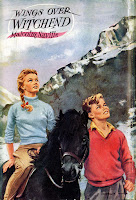
Wings over Witchend (by Malcolm Saville)

Wings over Witchend by Malcolm Saville
(Amazon UK link)
Amongst other authors and some new books I’m re-reading Malcolm Saville’s ‘Lone Pine’ series of twenty books. I loved this series as a teenager, and bought most of them in Armada paperback form, not realising at the time that they were abridged. Not that it would have made much difference, as hardback originals were very difficult to come by. I’ve re-read the series around every ten years through my adult life, although last time I seem to have missed some of them out, including ‘Wings over Witchend’.

In the meantime I’ve managed to acquire full ‘Girls Gone By’ editions of the books I had in paperback, and am very much enjoying reading the full versions, possibly for the first time. ‘Wings over Witchend’, ninth in the series, is a popular book: in a recent informal online poll on Facebook, it ranked as favourite for a significant number of people. So I was quite looking forward to reading it, particularly as I had entirely forgotten the plot.

It’s a winter story, set in the Shropshire setting around the Long Mynd, but with a snow covering and even some blizzards. The ten-year-old twins Dickie and Mary have had whooping cough, and are supposed to be getting fresh air and rest in the countryside. They are able to meet up with Peter (Petronella), their close friend who lives not far from Witchend, their Shropshire home, and right from the time they alight from the train, strange things start to happen…

There’s a rather strange lorry driver who gives them a ride, and is asking questions about a somewhat run-down inn not far away. When they arrive at Witchend, they can’t find Agnes, their housekeeper… and when they discover her, at last, she’s with an injured stranger. Snow means that Peter is unable to get home, and when her father is invited to stay with his brother over Christmas, she accepts an invitation to stay at Witchend with her friends.

Much of the story involves a forest of growing conifers, some of which are sold as Christmas trees. They’re the target for some thieves, and inevitably the children get drawn in. There’s quite a cast of characters in this story, including rather more adults than are usually involved in the Lone Pine series. The twins’ older brother David, who is Peter’s special friend, arrives with his parents, and they have more of a role than I had expected: but perhaps those parts were cut out from the abridged versions, as they don’t add too much to the story.

It’s a well-written adventure, nicely paced and with plenty of interaction between the characters, something that is generally lacking in the Armada paperbacks. There are some light-hearted sections as the twins play their role in introducing themselves to others, there’s some tension with David and Peter’s friend Tom who can be quite abrupt with the twins, as he has a hard time understanding them. And there’s a very poignant section towards the end involving the twins’ scottie dog Macbeth.

All in all, I thought this an excellent story, one that would probably appeal to children or younger teens who like adventures, and of course great comfort reading for adults like me who recall this series fondly from our younger days.

‘Wings over Witchend’ stands alone, and there are always introductions to the books that explain who the Lone Pine club are, for anyone who has not read the earlier books in the series. But since they’re an ongoing series (even if the chronology is a bit strange, and the main characters don’t get much older as the years go by) I feel it’s best to have read at least some of the earlier books first, particularly ‘Mystery at Witchend’, first in the series, and its immediate sequel ‘Seven White Gates’.

Unfortunately the 'Girls Gone By' edition of 'Wings over Witchend' is quite pricey at present, as it's not currently in print. But it can sometimes be found used or less expensively via online forums or groups. The Armada abridged version is sometimes found in charity shops, and is still worth having if you can't find a full edition.

Review copyright 2021 Sue's Book Reviews

1 May 2021

Saucers over the moor (by Malcolm Saville)

Saucers over the moor by Malcolm Saville
(Amazon UK link)
I am thoroughly enjoying re-reading the ‘Lone Pine’ series by Malcolm Saville, all the more because I now have the full (unabridged) editions of the books. I’ve just finished ‘Saucers over the moor’, which is the eighth in the series. I last read it in 2009 in the abridged Armada version, and had entirely forgotten the storyline. It’s not one I had as a teenager, so I haven’t read it as many times as I have some of the others.

This story opens in Rye, when the teenage cousins Penny and Jon arrive home from school for the holidays. Penny has lived with Jon and his mother for three years while her parents have been working abroad, but they’re expected home at last. She’s excited to be seeing them, but also slightly nervous. They have written letters to each other, of course, but in a pre-computer era, letters were slow, and there were no video chats; even phone calls were few and far between.

Penny’s parents have decided to rent a large house in Dorset for a few weeks, and suggest that Penny invite the friends whom they have heard about in their letters. So a few phone calls are made, and before long six of the Lone Pine club are together again. David and his best friend Peter (who is a girl, really Petronella), and David’s twin siblings Dickie and Mary are happily reunited with Jon and Penny. A slightly odd man called Donaldson is there to welcome them, and is taken on as a cook and cleaner.

Meanwhile a young man, just slightly older than Jon and David, is hoping for a ‘story’ to write for the newspaper where he works. Dan lives not far from the house which Penny’s parents have rented, and meets Peter when she’s on her way there, in slightly unfortunate circumstances. He’s seen what seems to be a UFO in the sky - and strangely enough, so have Jon and Penny, before leaving Rye. Jon is very excited about the science behind flying saucers, and Dan thinks it would make a superb story. However Penny is cynical and Peter very unhappy about the topic.

Unsurprisingly there’s quite a dramatic adventure that unfolds, with this unusual storyline on a topic which the author was clearly interested in, though it feels more surreal than some of the other adventures. There are some amusing incidents involving the twins and their clever patter; there are also some quite dangerous scenes where the characters were quite fortunate to emerge unscathed.

It’s a good story, which I feel is much better in the full version (I have a Girls Gone By edition now). The abridged ones tended to cut out conversation and character development, and those are the parts of the books I enjoy the most. I like the way that each of the Lone Piners becomes more distinct as the series progresses. Jon’s scientific bent comes to the fore in this one, and we see Penny alternately irritated with him and thrilled to be noticed by him. Peter’s warmth and strength of character come out too, and David’s natural leadership skills are used in a low-key way.

Certainly worth reading as part of the series, and I’m already looking forward to the next one. It can be expensive new, particularly in the full versions, but can sometimes be found at better value second-hand. Recommended for teens who like adventure stories, and nostalgic folk like me who first read Malcolm Saville as a teenager.

Review copyright 2021 Sue's Book Reviews

13 Mar 2021

The Neglected Mountain (by Malcolm Saville)

The Neglected Mountain by Malcolm Saville
(Amazon UK link)
I first came across the ‘Lone Pine’ series by Malcolm Saville when I found the earliest books on my grandmother’s shelves as a child. I managed to collect a few, and then as a teenager gradually acquired the re-published Armada paperback versions, not realising they were abridged. ‘The Neglected Mountain’ was one I particularly liked; I last read it in 2009. I was pleased to have reached it again in my current re-read of the series, now that I have a full ‘Girls Gone By’ edition.

The story involves the six Shropshire members of the Lone Pine club. David Morton is now sixteen, as is Peter (Petronella) Sterling, and in this book they start to be aware of each other in a new way. They’ve been close friends for a long time (even though the author deliberately doesn’t age them as fast as chronology would dictate) but suddenly David realises how very attractive Peter is - and she’s aware that she would do anything for him. Nothing is said, but the seeds are set, towards the end of the book, for the future.

But I’m jumping a long way ahead. The story starts at the end of another adventure, when Peter goes home to her father, prior to returning to school. She is shocked to find a stranger in her home; he seems to be very confused and has no idea where he is, or even - at first - who he is. Her father turns up with another stranger, and they learn that the two were involved in a crash landing, though neither was seriously injured. Peter finds this very disturbing, and writes to David about it, but he doesn’t reply, and she goes back to school assuming that’s the last of it.

The main part of the book then begins when Peter, David, David’s twin siblings Richard and Mary, and their friends Tom and Jenny meet to discuss what they’re going to do. They decide that they’d like to visit a local fair a few days later, and also see Trudie, a young woman who has just become engaged to Peter’s cousin Charles. Since they like a challenge, they decide to go in three different groups, by three different routes. And to make it more interesting, they ask David’s father to organise routes for them.

Mr Morton takes this quite seriously, and arranges instructions and meals for each pair, who leave at different times, with a kind of race, although only Dickie and Mary really care about winning. On their journeys, they have different encounters: Tom and Jenny come across a friend’s dog who is unhappy, apparently blind. Dickie and Mary meet an old friend who’s a detective, and are shocked when a passer-by in a car asks to buy their beloved dog Macbeth. Worse, Mackie seems to want to go with the stranger.

David and Peter have the longest journey, and towards the end of it they find a crying boy who has lost his dog. He is convinced the dog has been kidnapped, and they promise to help…

Naturally, all their experiences turn out to be linked.  There are two ‘baddies’, although one of them is a geeky kind of scientist rather than a seriously bad guy. And there are a lot more adventures to be had, near a mountain where they previously discovered a cave, and also in a town. Unlike some of the previous stories there’s no serious danger involved, other than a nasty fall in the cave, but it’s still a well-written and exciting book.

Unlike some of the earlier books, I didn’t find whole sections of the story that were new, or considerably expanded in the full edition. ‘The Neglected Mountain’ was abridged well, missing out some of the more thoughtful passages, and some of the dialogue that didn’t much add to the story (although it certainly contributes to the character development), but keeping the plot and all the important conversations including the ones between Peter and David, towards the end of the book which indicate the possibility of romance in the future. As I recalled, there are some very moving scenes.

The Armada editions of these books are quick reads, less than 200 pages. In the full edition there are nearly 280 pages of text and I liked the fact that it felt complete, rather than wishing it were longer. There’s an interesting introduction, as there is with most of these GGBP editions, with notes about the locations used as well as the publishing history.

Although all these books stand alone, it’s best to read them in order; I’d recommend reading at least ‘Seven White Gates’, before this one, and ideally also ‘The Secret of Grey Walls’. They tend to be pricey on Amazon, but can sometimes be found at better prices on social media marketplaces, or other second-hand bookshops (on or offline).

I’m already looking forward to the next in the series, which I expect to read in about a month’s time.

Review copyright 2021 Sue's Book Reviews

29 Jan 2021

The Elusive Grasshopper (by Malcolm Saville)

The Elusive Grasshopper by Malcolm Saville
(Amazon UK link)
In slowly re-reading Malcolm Saville’s ‘Lone Pine’ series, I reached the sixth, ‘The Elusive Grasshopper’, which I had not read since 2009. It follows on directly from ‘Lone Pine Five’, which I read towards the end of last year. Not that it’s necessary to have read that one first; but there are a few links that make more sense if they’re read in order.

This book opens, unusually, in Paris. Jon and Penny Warrender have been in France for a couple of weeks to improve their language. It’s worked for Jon, we learn, but Penny has become more stubbornly English. Jon is very much an academic, whereas Penny is not - she’s intuitive and caring, and full of courage, but not someone for whom academic learning comes easily.

The cousins have been staying with a French family who have a daughter, around Jon’s age, called Arlette. She is to travel back to England with them, to stay at Jon’s mother’s inn, the ‘Dolphin’, in the East Sussex town of Rye. Jon and Penny were introduced to the series in the third book, ‘The Gay Dolphin Adventure’. While it’s not necessary to have read that first, I feel it’s much more enjoyable to have done so.

Jon suddenly spots someone who is an old enemy - from the third book - and it turns out that he is travelling back to London with them, on the same train and ferry. They lose sight of him as they return to Rye, but, unsurprisingly, he’s involved in a new and exciting adventure in which they find themselves.

David Morton and the twins are invited to stay, along with Mackie the dog. They are quickly on the trail of a trio of former adversaries, as well as an innocuous-looking man who claims to be a bird-watcher, usually cycling around the countryside on a bike. Jon is suspicious, and while there are perhaps a tad too many coincidences for realism - not to mention rather a number of rescues from dangerous situations - it’s a good story.

I’d only read this book previously in the Armada edition; I’d thought it pleasant enough, but nothing special. I’m sure all the storyline was there in the abridged version, but as with others that I’ve checked, a lot of conversation and description was cut out. The Armada books are quick reads, telling the story in an almost abrupt way. The full edition - I have a Girls Gone By version - has so much more depth.

Malcolm Saville had quite a gift of characterisation, and in this book it comes out in several different ways. Jon, who has been seen as more of a quiet thinker than a leader, assumes control of the situation several times. Penny shows her impetuous, easily offended side, particularly in conversation with James Wilson, a journalist who they meet, and who isn’t entirely sure how to deal with them at first.  And the ten-year-old twins, Dickie and Mary, clearly show their differences as well as their similarities.

I liked this story very much; I’d forgotten most of it, and thought it well-written, albeit in a 1950s style. Definitely recommended to teenagers who like relatively innocent adventure stories, and of course nostalgic adults like myself who first read these books in their teens.>

'The Elusive Grasshopper' isn't an easy book to find; but sometimes it's available second-hand. Unfortunately, other than the original hardback and the recent 'Girls Gone By' edition, most versions are abridged quite significantly.

Review copyright 2021 Sue's Book Reviews

19 Dec 2020

Lone Pine Five (by Malcolm Saville)

Lone Pine Five by Malcolm Saville
(Amazon UK link)
In my re-reading of Malcolm Saville’s ‘Lone Pine’ series for teenagers, I reached the fifth in the series, ‘Lone Pine Five’. The title simply means that it’s the fifth Lone Pine book - perhaps it was originally a working title, and nobody could think of anything better. It used to confuse me, because there are six Lone Piners in the book (or seven if Macbeth the Scottie dog is included).

When I last read this book, almost twelve years ago, I had an abridged (and possibly updated) Armada paperback edition. Since then I have managed to acquire the full ‘Girls Gone By’ reprint of the original, at a charity shop in the UK. As with others which I’ve read, for the first time, in full, I found it a great deal more interesting this time.

This story mainly involves Jenny Harman, the impetuous redhead who lives at a Post Office in a village called Barton Beach. She’s close friends with Tom Ingles, who works on a farm with his uncle not far away. They can’t often see each other, but Tom sends a letter saying that he’s going to market with his uncle, and wonders if Jenny might be able to cycle over to see him. Jenny is thrilled by this.

In the course of the afternoon they visit an auction sale, and Jenny is very taken with a small spoon in a collection of random items. It’s rather dirty but Tom agrees to bid for it, and gets the spoon for a small amount. Then it’s spotted by the elderly Mr Wilkins, who is rather nervous, clearly worried about something. But he examines it closely and says that it might be valuable…

This is the start of an adventure for Tom and Jenny, along with their friends David Morton, Peter (Petronella) Sterling, and David’s twin brother and sister Richard and Mary. They all decide to camp nearby, and help Mr Wilkins with his exploration of the area, but they’re rather deterred by some terrible rain, making it impossible to put up tents. So they spend a night at the home of Peter’s cousin Charles and his father and stepmother, who were all introduced in the second book in the series, ‘Seven White Gates’.

There’s an interlude in a cave, which feels a bit familiar - at least two of the other books in the series have a similar incident - but then many of the Lone Pine series are set in the Shropshire hills, where there are many caves. And even in this full edition, it’s not as stressful to read about than some of the other cave accidents.

In fact, there’s not actually very much story as such. There are some ‘bad’ guys, but they’re more caricatured (almost comic at times) than evil. Mr Wilkins’ nephew is pompous and demanding, his wife rather snooty, and their son Percy puffed up and arrogant. We’re never in any doubt that Mr Wilkins is a ‘good’ guy, and the ending of the story happens rather quickly, after Jenny has an unexpected dream. It’s another device which Malcolm Saville uses elsewhere, and reading from my perspective as an adult, it feels almost like cheating. I never minded - or noticed! - as a teenager, or even when I previously re-read these books, however, and he does it well.

The charm in these books is the characterisation, and I like the way that Jenny and Tom are at the forefront of this novel. Much of the character-building is lost in the abridged versions, and when I read this previously it felt all too short. In the GGBP version, it felt like an enjoyable light adventure story, one that stands alone although I feel that this series works best if read in the order in which it was written.

Recommended to older children, younger teens, and most of all to adults like me who loved these books as a child. Unfortunately the full editions tend to go out of print quickly and can be pricey, but they're occasionally found in charity shops - worth looking out. And even the abridged version is better than nothing.

Review copyright 2020 Sue's Book Reviews

26 Aug 2020

Seven White Gates (by Malcolm Saville)

Seven White Gates by Malcolm Saville
(Amazon UK link)
It’s a long time since my last read-through of Malcolm Saville’s ‘Lone Pine’ series. In the past few years I have managed to acquire either hardback or ‘Girls Gone By’ full editions to replace the many Armada abridged versions which I had bought in my teens. I’m still thankful that Armada made these books available inexpensively, enabling people like me to collect them. But I had not realised, until recently, just how much had been cut out.

I read ‘Mystery at Witchend’ in the full edition about six weeks month ago, and have just finished reading the second in the series, ‘Seven White Gates’. Last time I read it, it didn’t do much for me. It’s an important book in the series, in that it introduces Jenny Harman, HQ2 and also the Romany family Reuben, Miranda and Fenella. But in the Armada edition, it moves a bit too rapidly, and much of the character-building conversation is left out.

This time, I enjoyed the book, in hardback, very much indeed. The story itself hasn’t changed, of course. The abridgements were very well done from that point of view. Peter (Petronella) Sterling receives a letter at the end of term at her boarding school, telling her that she can’t go home to Hatchholt at the start of the holidays; instead she must go to stay with her (unknown) Uncle and Aunt, at a farm called Seven White Gates.

Peter has quite a journey, mostly by bike, and shows great courage when she stops a runaway horse. She makes new friends who appear in later books, and she also discovers that there’s a mystery surrounding her Uncle Micah. She learns that he is grieving and lonely, but is still puzzled by his night-time wanderings or the way he speaks like an Old Testament prophet.

His wife Carol, however, is delightful. It seems strange that she fell in love with Micah despite his oddities, but she’s a caring, kind person who Peter likes immediately. And she’s very accommodating when Peter asks if she can invite her friends the Morton family to stay for a few days. And maybe their other friend Tom…

There’s a fair amount of description of the countryside, greatly helped by a drawn map at the start of the book, which I found myself referring to regularly. I don’t find it easy to envisage scenery, but Malcolm Saville draws some excellent word pictures of the Stiperstones, a real area in Shropshire where this story is set. He creates a tense atmosphere too, in places. Peter learns about local superstitions, and while she is cynical, she feels some of the tension too when she’s near the top of the hills.

Dickie and Mary Morton, the nine-year-old twins, have an important role in this book, and I loved the way that (at least in this full version) we begin to see their differences as well as their similarities. Mary is intuitive and sensitive, Dickie braver and more confident. Their loyalty to each other and to their friends is strong, and they have an almost uncanny connection, usually knowing what the other is thinking. But Mary’s characteristics come to the fore in this, in several ways, and I found myself liking her very much.

The book was intended for younger teenagers, and I loved the series myself when I was about thirteen or fourteen. It’s probably too tame for today’s teenagers, even though David is sixteen, and Peter nearly sixteen, but would make an excellent read for a child of about nine or older who likes well-written adventure stories. It’s set in the war years, but although inevitably there’s little technology, and some of the conversation seems dated, the people are realistic and three-dimensional, and it’s a good story.

All in all I liked it very much, and would recommend it highly, either as a read-aloud to children of perhaps eight and older, or to confident readers of around that age.; But it would also make a good read for teenagers who like this kind of story, and of course for adults like myself who remember the series nostalgically from their childhood. Best read after ‘Mystery at Witchend’, but it stands alone as a story, so it’s not essential to read them in order.

Unfortunately the 'Girls Gone By' edition is out of print, and the hardbacks are not easy to find. But even an abridged Armada edition is worth having to give the story, even if it's not as enjoyable as the full version.

Review copyright 2020 Sue's Book Reviews

15 Jul 2020

Mystery at Witchend (by Malcolm Saville)

Mystery at Witchend by Malcolm Saville
(Amazon UK link)
I have been reading Malcolm Saville’s ‘Lone Pine’ series for around fifty years, re-reading them all, even as an adult, every ten years or so. Some of my Armada paperbacks were starting to fall to pieces, and I had the opportunity of buying some of the Girls Gone By Publisher full reprints second-hand, inexpensively.

I’ve started on my latest re-read of the series, and have just finished the GGBP edition of “Mystery at Witchend’. I have been astounded at how much more content there is than in the abridged Armada version, which I last read in 2008.

The book, set in the 1940s in Shropshire, first introduces David Morton and his younger twin siblings. David is around fourteen, and the twins, Dicke and Mary, are nine. Their father is away in the war, and they have come with their mother to a house called Witchend for their summer holidays. They don’t really expect much to happen, but are looking forward to exploring the area and meeting some of the locals.

Tom Ingles is about David’s age, and works at a farm with his aunt and uncle not far away from Witchend. He doesn’t much like the countryside; he’s lived in London all his life, and isn’t too keen on the idea of being a farmer. But he learns fast and works hard, and is pleased when he discovers someone of his own age nearby.

Then there’s Peter - Petronella, to give her full name - who lives with her widowed father in a place called Hatchholt. He is the keeper of a reservoir, and quite a pernickety man, who seems rather elderly to be the father of a teenager. He adores his daughter and is kind and hospitable, so long as people are prepared to be clean and tidy.

The five young people start a club, the ‘Lone Pine’ club, with the aim of exploring, watching birds and tracking strangers. The last of those is because there have been a surprising number of people who are new to the area. There’s the friendly John Smith, an air force officer whose parachute has become tangled, and Mr Evans, who has hurt his foot. They all seem to be connected with another house, called Appledore, which is owned by Mrs Thurston and her manservant Jacob. None of the children much like Jacob but Mrs Thurston seems to be likeable, if a tad inquisitive, although the Morton’s dog Mackie dislikes her intensely.

It’s quite an exciting adventure, and having read it so many times I mostly remembered the storyline. I also remembered the Lone Piners, who all reappear regularly in the later books in the series. But in this unabridged edition, there is a great deal more conversation, sometimes entire pages which were cut out of the Armada version. It was well abridged; nothing is lost as far as the story goes. But there’s a lot more characterisation, so we get to know the adults as well as the children, and see into Dickie and Mary’s imagination far more than in the version I had previously read.

I didn’t quite trust my memory at first. So I found my Armada edition of ‘Mystery at Witchend’ in order to compare the two. But I was right. There are so many extra asides and sections that it was, in places, almost like reading a new book. The descriptions come alive much more, and the people are so believable that I could hardly put the book down.

I’m glad Armada made the abridged books in the 1970s; they were affordable for young teenagers, as I was then, and readily available. I know there are many people other my age who recall them fondly, and still re-read them regularly. But I’m even more pleased that GGBP have reprinted them in the full editions, and am looking forward greatly to reading the rest of the series over the next year or two.

Highly recommended for older children or teenagers who like a good adventure story in a historical setting, and also for people like me who love re-reading children’s fiction. As CS Lewis once said, “No book is really worth reading at the age of ten which is not equally (and often far more) worth reading at the age of fifty.”  I just wish the new editions were more widely available; unfortunately they tend to go out of print quickly, and second-hand editions can be quite highly priced.

Review copyright 2020 Sue's Book Reviews