31 Mar 2022

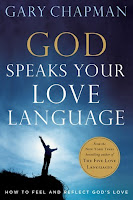
God Speaks your Love Language (by Gary Chapman)

God speaks your love language by Gary Chapman
(Amazon UK link)
Years ago when I learned about Gary Chapman’s theory of ‘love languages’, I thought the concept was excellent in helping couples (and families, to some extent) learn to express love in ways that don’t necessarily come naturally to them. 

Someone whose love language is Words of Affirmation may express love verbally, but if their loved one only really ‘speaks Acts of Service they may feel that the words are meaningless. And vice versa, of course. Learning to use one’s non-preferred love languages can enrich any relationship, particularly if one is aware of the one that is most used by their partner or relative.

I was intrigued when I came across the book ‘God Speaks your Love Language’, which I read towards the end of 2009. At the time I was pretty sure I knew my two preferred love languages, and when I read the book it seemed to fit. But I know how easy it is to make theories and articles ‘fit’ - and recently I’ve been wondering whether I was right, or indeed whether one’s preferred love language might change over the years.

So I decided to re-read the book with an open mind - and with my own rather vague theory that we don’t necessarily use the same love language with everybody. Someone who is a ‘good hugger’, for instance, may appear to be speaking the ‘Physical Touch language - but if it’s offered to everyone, is it really an expression of love, or more an expression of culture, upbringing and personal preference? I wondered if we have ‘like languages’ and also began to wonder if the way we speak to (and hear from) God might be different from the love language we speak to our partners and relatives.

The book is well laid out, starting with a general overview of the love language theory - and it’s not necessary to know one’s own, or to know much about the theory. Then the author takes one love language at a time and devotes a whole chapter to each one, explaining how God uses different ways of communicating, and how different people express their love for God. 

Some are obvious: words of songs or liturgy or spoken prayers fit with words of affirmation, physical sensations and movement fit with physical touch, serving in various roles fit with acts of service, a focus more on personal devotions and ‘quiet times’ fits with quality time, and of course the giving of money, practical gifts and time fit with the love language of gifts.

To some extent, they all resonated with me. I believe they are all important as different ways to relate to God, and to others within the Body of Christ. And yet, at the same time, I didn’t feel that any of them fit me fully, or even reasonably well. It was good to be reminded of the different - and equally valid - ways of expressing love to God and those around us, and the importance of ‘listening’ to love expressed by God and by other people in ways that we might not naturally hear.

But I don’t feel any closer to knowing what my preferred love language might be. I’m pretty sure it’s not gifts or acts of service, even though I think both are important.

In the last two chapters the author writes about love in general, and preaches quite a strong sermon about God’s love and the need to accept it, and acknowledge it, and turn our lives to Jesus. So this is a book for those in - or on the fringe of - the church; since the focus is on hearing from and speaking to God in a variety of ways, it’s rather obviously not intended for atheists or agnostics.

The writing is good, peppered with plenty of interesting anecdotes as well as Scripture quotations and references to other authors. On the whole, though I'm not sure I learned anything new, I’m glad I re-read it. Recommended to anyone wondering how spirituality and love languages work together, or who would like to explore different ways of communicating with God.

Review copyright 2022 Sue's Book Reviews

26 Mar 2022

We are all completely beside ourselves (by Karen Joy Fowler)

We are all completely beside ourselves by Karen Joy Fowler
(Amazon UK link)
I didn’t remember the name Karen Joy Fowler, although I later realised that I did read one of her books (‘The Jane Austen Book Club’) over a decade ago. But when I saw ‘We are all completely beside ourselves’ at a church book sale last year, with some positive reviews and a note that it was shortlisted for the Man Booker Prize 2014, I decided to buy it.

I had no idea what the book would be about when I started to read it; the blurb on the back is a little vague, describing a girl called Rosemary whose father ran psychological experiments, and who is no longer in touch with her two siblings. Having now read the book, I can see why the blurb is so vague, because to say much more would be to give quite a spoiler.

The storyline is very cleverly written, with quite a surprise after a few chapters - one that took me several pages to understand. Rosemary narrates the story in a chatty kind of way, addressing the reader at times as she explains just why she is saying something specific. She starts in the middle, something she’s apparently been told to do, and we gradually build up her character from her actions and thoughts.

The middle of the story - which begins in Chapter One - is set initially in a university canteen. Rosemary has been at university for some time, funded by her parents, but not doing particularly well although she hopes she might eventually gain something useful out of it. She’s eating her lunch, minding her own business when she overhears a couple arguing, and then the girl starts shouting and throwing plates. Rosemary stands up, and for some reason the police - who arrive fairly promptly - assume she’s involved.

It’s a dramatic start to a novel, one that shows her as basically a likeable person, even if rather demotivated. We learn that as a child she was a great talker but that now she’s learned to keep quiet most of the time. And this first chapter introduces Harlow, the girl who has been plate throwing. Harlow recurs in Rosemary’s life, although I never found her more than two-dimensional, and couldn’t relate to her at all.

There’s a bit of a mystery surrounding the disappearance of Rosemary’s siblings Lowell and Fern. We get brief flashes of memory, followed by some commentary, dropping hints but not really explaining anything until the unexpected part of the book happens and suddenly everything feels clearer. I almost went back to the beginning to re-read at this point, but didn’t do so; the book is interesting, and well constructed, but not so riveting that I wanted to read everything again.

Due to the psychological background, there are snippets of psychological research or theories thrown into the book here and there. So Rosemary acknowledges that her memory may be faulty - that she has repressed or ignored some thoughts, and that she may have built up apparent memories on an internal screen which don't in fact relate to reality. And yet she comes across as a person of integrity, even if rather manipulative and jealous as a small child.

The story is fascinating, educational in parts, and including a few quite controversial topics. Towards the end there's a strong agenda regarding animal rights, the evils of animal testing, the abuse of farm animals, and related issues. As a not-quite-vegetarian who’s very against animal testing, I found some brief scenes disturbing, but had no disagreement with what was said. Others would feel more strongly than I did, and some with different viewpoints might feel the book is biassed towards the animal rights movement.

I doubt if I’ll read this again, but it was a very interesting book, well-written and even including some low-key humour in places. It's a book which I would definitely recommend, so long as you don’t mind a storyline that jumps around in time, and a chatty, informal kind of narration that disguises some quite significant issues.

Review copyright 2022 Sue's Book Reviews

19 Mar 2022

The Highland Twins at the Chalet School (by Elinor M Brent-Dyer)

The Highland Twins at the Chalet School by EM Brent-Dyer
(Amazon UK link)
Slowly re-reading my way through Elinor M Brent-Dyer’s lengthy Chalet School series, I was very pleased to reach ‘The Highland Twins at the Chalet School’, which was 16th in the original series. I have a hardback edition that was my mother’s when she was a child and have always loved this particular episode in the saga. I last read it in 2011, and as ever I had forgotten many of the details, even though I recalled the main outline of the story.

Flora and Fiona McDonald are the ‘Highland Twins’ of the title, eleven-year-old girls who have never previously left their small Highland island of Erisay. They lived there with their older sister Shiena, and some brothers, but this, like the two previous books in the series, is set during World War II, and their island has been requisitioned for military purposes.

The McDonald family are quite naive, with little idea of what was going on in the rest of Scotland, let alone the world. The children have been educated at home and have barely met anyone outside their clan. But they have a friend who knows folk at the Chalet School, so it’s decided that the twins will be enrolled there, while Shiena will have to join one of the women’s services. We meet them struggling with trains, not understanding about the dangers of bombing, and dressed incongruously in men’s Highland dress.

Joey Maynard, mother of toddler triplets, welcomes the twins and Shiena and looks after them for a while, until the twins meet some of their future classmates, and decide they would l like to start school. They settle in fairly well, although they come up against the unpleasantness of an older girl who has never really taken on the Chalet School ethos.

However this isn’t just a story of unusual new girls gradually becoming ‘real’ Chalet School girls, as happens in so many of the later books. The twins have a vitally important chart showing secret entrances to their island; if this fell into the wrong hands, it could be disastrous. Several chapters of the book involve attempts by others to get hold of it, despite the twins’ insistence that nobody may see it.

There’s also a very moving account involving Joey when she hears some terrible news… I had recalled that, and the outcome, and it still brought tears to my eyes. I had quite forgotten, however, that there are other significant subplots, one involving two girls who have managed to escape from Central Europe, and one involving a great friend of Joey’s, once supremely important and wealthy, now reduced to cleaning to earn her living.

There are some inconsistencies, of course; those familiar with the series call these ‘EBDisms’, where the author forgot some detail, and the editors apparently didn’t notice them. I was surprised that the triplets, nearly two in the first chapter, are nearly three a few chapters later, when only a few weeks have passed. I was also mildly amused that ten years become eleven within the course of a sentence. No doubt there are others, too - and yet it really doesn’t matter. It’s an excellent story, well-told, with three dimensional characters.

This is also interesting from the social history point of view, written as contemporary fiction in 1942 when war was raging. So gas masks and blackouts are normal, as are men being away for lengthy periods, with poor communication, and teenagers of 18 being called up rather than going to college or starting jobs. The dangers of casual talk are emphasised within the story, and those reading when it was first published would have been able to identify strongly with the situations described.

But although I’m shocked to realise this book is now eighty years old, the people feel believable, and I could identify with several of them. It’s probably best to read this after at least a few of the earlier books - in particular ‘The Chalet School in Exile’, another of my favourites - as so many people in this book appeared in earlier ones. I don’t know if today’s teenagers would enjoy this series; I discovered it as a young teenager in the 1970s, but that was still a pre-digital era, and boarding school books for girls were popular.

A slight word of warning to the sensitive: a word now considered a racial slur is used a couple of times in the context of working very hard. Back in the 1940s this phrase was used (indeed, I recall hearing it from as late as the 1970s) without intending prejudice or hate; if anything it was expressing admiration. But the phrase could be shocking to anyone unaware of its former use.

However, with those provisos, to anyone who likes this series, or this style of teenage school fiction, I would recommend this book highly. The Armada edition was abridged, although it told most of the story. It was republished in full by Girls Gone By some years ago but prices online tend to be high - it's worth asking around if you would like this book, or wait for GGB to reprint it.

Review copyright 2022 Sue's Book Reviews

17 Mar 2022

Love Beyond Reason (by John Ortberg)

Love beyond reason by John Ortberg
(Amazon UK link)
I both liked and appreciated John Ortberg’s books the first time I read them, so I’m now re-reading them, and finding new encouragement and inspiration. I first read ‘Love beyond reason’ in 2008 and again in 2013, so it felt like time for a re-read. Not that I find anything new, exactly, in books like this - but a lot of reminders that are often surprisingly relevant.

This book essentially explains what it means to be loved by God. Not in a general way, but specific. Ortberg uses the word ‘ragged’ several times to describe us - rough at the edges, far from perfect, yet, like a battered old rag doll we are loved, deeply, passionately, and forever.

It’s easy to know these things academically, and to take them for granted, so I find it a positive experience to read books like this that make me look at the world, other people and God with a different perspective. Possibly one that I’ve lost, or moved from, or simply forgotten. I’m reminded just what God has done for me, just how much I matter to him, and how important it is to spend time together.

There are just twelve chapters in this book, and I read one a day over the course of a couple of weeks - some of them taking more than one day. I like Ortberg’s style, with plenty of anecdotes about himself, his family and his ministry. Like the best writers, he’s quite self-deprecating at times, thought not in a negative way. I smiled at one or two of the stories, but they have a way of piercing defences and making me think.

Ortberg quotes Scripture extensively, often in his own loose paraphrase that might upset some literalists, but which I found quite helpful as he puts his own slant on what Jesus was saying, or how disciples were reacting. I know the original, of course; this is first and foremost  a book for believers, and the author writes with the assumption that readers are familiar with the Bible stories, and many of the better known quotations. Of course there are extensive references in the back, but I don’t think I referred to any of them.

There’s not much more I can say - I am very pleased I read this again, and expect to continue doing so every few years. There’s much in it that is also said in other books on the same topic, but each author puts his own voice to the concepts, and expresses them in different ways.

Definitely recommended.

Review copyright 2022 Sue's Book Reviews

14 Mar 2022

Leading men (by Christopher Castellani)

Leading men by Christopher Castellani
(Amazon UK link)
I had never heard of Christopher Castellani, and I’m pretty sure I would not have come across ‘Leading men’, left to my own devices. But it was this month’s read for our local book club, so I downloaded it for my Kindle. The reviews on Amazon were mostly very positive, so I quite looked forward to reading it - and that despite the fact the the blurb calls it ‘heart-breaking’.

It didn’t break my heart. I didn’t think it wonderful. I struggled even to finish it - I felt no eagerness to keep reading at any point. In fact I had only reached 96% on my Kindle before it was time to go to the book group. I said - and others agreed - that I found it mostly rather tedious and long-winded, with flat characters. There are also confusing time changes, as the story (I hesitate to call it a plot) moves forwards and backwards, sometimes in the course of a single section.

The book revolves around the promiscuous, selfish and indulgent lifestyles of a group of people, mostly gay men, in the 1950s. There’s a party in Portofino where two couples (all men) and a mother-daughter pair meet up and become friendly. One couple, Tennessee and Frank, take the daughter, Anja, somewhat under their wing. They separate her from her rather clingy and dislikeable mother whose name I have already forgotten.

Then there’s some action set at the end of the 20th century when Anja is a late middle-aged woman. Most of the rest of the cast have died by this stage, some of them quite young. She has been widowed and is still grieving. But we never meet her husband, who, we learn, was an academic who liked to debate with her. She has in a drawer a play which has been sent to her which she thinks is dreadful. But two young men persuade her not just to let them read it, but to allow a production of it.

That’s really all the story. I don’t think there’s anything else of significance, other than a couple of the characters dying. One is in dubious circumstances. The other is more drawn out, in a hospital bed. We see him several times over the course of the book, and right at the end, waiting for someone he loves.

The prose is long-winded, the characters two-dimensional and entirely forgettable. Their lifestyles are sordid. Thankfully the author doesn’t go into too much detail, but the implications are there. Other than Frank, who is quite tender-hearted and caring, they all seem cold, self-centered, and caricatured. Which is odd, because many of them were actually real people.

On the plus side, some of the scenery writing is quite poetic, although I didn’t linger over any of it, and sometimes skimmed, hoping I would find some more story. Then there’s one scene that all of us at the book group thought was dramatic and well-written. Unfortunately it was an extremely unpleasant and violent scene, not something I wanted to remain in my memory. Other than that - well, one of the characters in the book sums it up (when talking about someone else’s book) :

"I kept waiting to feel something," Trevor says. "For the first few pages, I almost did, but then, as it went on and on, I just wanted the guy to shut up, and die already. The whole thing was so self-indulgent."

I have already forgotten who Trevor is. The cast of this book is huge, and while one or two names were familiar to me - Tennessee Williams, for instance, and Truman Capote - I know nothing of their writing. Nor, having read the book, do I wish to.

I understand, from the notes at the end, and also from Wikipedia that the author did a lot of research into the characters of Williams and his lover for fifteen years, Frank Merlo. He also invented some characters, including Anja and her mother. Frank is really the only likeable person in the book, and even he descends into drugs, smoking and licentiousness. I couldn’t relate to anyone, and I really didn’t care what happened.

Only one person in the book group had actually finished the book, the others had given up by about half-way through. It’s rare that we all agree on what we think of a book. Usually there are a mixture of likes and dislikes. But we all thought it tedious, long-winded, and somewhat depressing.

However, while I would not personally recommend this to anyone, it's evident that many people loved this book, based on the awards and rave reviews it’s had. So don’t necessarily trust my opinion. You might enjoy it from the start. But if you begin this book, and are finding it dull after the first twenty or thirty pages, then it’s probably worth giving up at that point. It’s not a story that improves part-way through.

Review copyright 2022 Sue's Book Reviews

7 Mar 2022

Why Shoot a Butler? (by Georgette Heyer)

Why shoot a butler? by Georgette Heyer
(Amazon UK link)
Although I’ve been reading - and re-reading - Georgette Heyer’s historical romance novels for around forty-five years, off and on, I only discovered her crime/detective novels in 2003. There are twelve of them and I managed to acquire them all over some years. At the start of this year I decided to re-read them (other than one which I did not like at all). I’m reading them in publication order and have just finished ‘Why shoot a butler?’

I had quite forgotten that in addition to reading this book aloud to my sons in April 2003, I re-read it (to myself) as recently as July 2016. But I had entirely forgotten the story and the characters too. I quite like it when that happens since it feels as if I’m reading something for the first time.

Frank Amberley is the main protagonist of this story, and since it was written in the 1930s as a contemporary novel, there’s a lot of formality - so he’s known for most of the book as Mr Amberley, other than to his relatives. He is in his large and rather flashy car (for the era) on his way to stay with his aunt, uncle and cousin when he comes across a vehicle with a rather distressed young woman standing next to it. Inside is a man who has been shot. We soon learn that he is the butler of the title, an innocuous kind of man, and the police cannot work out who could possibly have any motivation for the shooting.

Mr Amberley reports the incident, but does not mention the young woman. This is partly because he does not trust the local police, and since he is convinced she didn’t do the shooting, he wants to protect her. Not that she particularly appreciates it. The young woman is called Shirley Brown, and she lives in a cottage with her brother Mark who has a tendency to get very drunk and somewhat disorderly…

The plot is quite complex, but Heyer always had a tremendous gift for characterisation, so I didn’t find it difficult remembering who was whom. Amberley’s aunt Marion is a delightfully astute woman, her daughter Felicity rather excitable, with a somewhat morbid interest in crime. Amberley himself is a barrister, but we learn that he recently helped the local police to solve another puzzle, so although they don’t all like him much, they accept his assistance in trying to track down the perpetrator.

Except that it’s not that simple. The butler is not the only victim, as the novel progresses. And there are several rather suspicious characters. When I read this before I couldn’t work out what was going on, but by the end there’s really only one likely culprit, so the eventual unmasking comes as no surprise. Perhaps I did have some subconscious memory of my last reading of the book, since events fell into place reasonably well, although there’s a lot of detail about the motivations for the various crimes - and there are many - which I don’t think I could possibly have guessed from the plot.

There are one or two places where I chuckled at the repartee between Amberley and one of his friends - Heyer was so good at that kind of thing. But it occurred to me that her excellent characterisation is possibly a disadvantage in crime fiction, since I felt as if I knew most of the cast… and it was obvious that many of them could not possibly have been involved, due to their integrity and general decency. Other crime fiction of this era has rather more two-dimensional characters, so that it’s quite feasible that an unlikely one might end up the culprit.

Still, overall I thought this an enjoyable, fast-paced book with some very tense scenes towards the end. Definitely recommended if you like light crime in this genre, but don’t expect a mystery that could be solved if only you noticed all the clues. Even when the details are spelled out towards the end, I don’t think I could possibly have worked them out myself, even in my third time of reading.

Review copyright 2022 Sue's Book Reviews

3 Mar 2022

Christmas at the Island Hotel (by Jenny Colgan)

Christmas at the Island Hotel by Jenny Colgan
(Amazon UK link)
I always seem to have mixed feelings about novels by Jenny Colgan. I’ve read several and a friend remarked that I have quite a collection, given that I’m not a huge fan of her writing. And I keep putting more of them on my wishlist. I was given ‘Christmas at the Island Hotel’ last Christmas. Although it’s not remotely seasonally appropriate, I decided to read it over the past few days.

The reason I wanted this book is that it’s part of a series about some people who live on the (fictional) island of Mure, in the Scottish Highlands. I didn’t read the first two books, and that didn’t much matter, but I quite liked ‘Endless Beach’, and ‘An Island Christmas’, which I read in August 2020. The characters were not particularly memorable, but there were some quite interesting subplots and I was intrigued to know how it would continue.

When I started ‘Christmas at the Island Hotel’, I did mostly recall, vaguely, some of the story from the previous book. It helps that there’s a MacKenzie family tree at the beginning, followed by a list of all the other characters. Mure is a small island and everyone knows everyone else. However although the MacKenzie family still feature significantly, they’re not really the main focus of the book.

Instead the story revolves around the opening of ‘The Rock’, a hotel bequeathed to Finton MacKenzie by his deceased husband. Finton is mourning and really doesn’t want to run a hotel, so his sister Flora starts to get involved. Flora is technically on maternity leave from her work running a cafe, but although she loves baby Douglas, she finds it very frustrating and somewhat tedious being at home with him. Her partner Joel, by contrast, seems absolutely besotted and takes to fatherhood easily.

But these are really side stories. The Rock has to employ some new staff, including a chef - and they get the temperamental Gaspard, a French chef who shouts, swears and smokes, but is a superb cook. One of Flora’s former staff, Isla, also goes to work there, and there’s a new kitchen boy called Konstantin, from Norway - but the reader knows (though nobody on Mure does) that he’s from a wealthy family in the nobility, banished by his father because he’s such a lazy, arrogant and rather useless playboy.

The style of writing is very informal, and once again I wished there had been a bit more editing. Some sentences are so convoluted I had to read them two or three times to make sense of them. There are some stream-of-consciousness passages, where a character's thoughts spill out, and that mostly works, but in other places I’d have preferred shorter sentences. There are a handful of literary references, too, which is fine, although I was irritated at mention of Edward (rather than Edmund) and turkish delight. An editor should have spotted that mistake.

In the first half of the book, I began wondering why I’d asked for yet another book by this author. I didn’t much like any of the characters, who all seem rather two-dimensional and caricatured (particularly Gaspard), and I found the frequent viewpoint-switching annoying - sometimes several times in just one scene. And yet… as happens with all the Jenny Colgan books I’ve read, around the half-way mark I realised I was interested in the storylines, and intrigued to know what would happen.

I don’t like the assumption that people are going to leap into bed at the first hint of attraction - it’s not something I’ve been aware of in any of my circles of friends and acquaintances, and there seems to be rather a lot of it in this book, albeit (thankfully) without any intimate details. The fact that everyone seems to do this in the book is another aspect of two-dimensionalism, and adds little to the story.

But there are some good subplots too - will Dr Saif ever find out whether his long-lost wife is still alive…? Will Flora find the right balance between motherhood and work? Will Konstantin learn to wash pots and peel potatoes…? Will the spoiled and obnoxious five-year-old Agot stop yelling, and start feeling a bit of empathy for others…? And what will happen to the new, huge and unexpected Christmas decoration?

Most of these questions are answered, and the ending is, on the whole, satisfactory. By the time I had finished, I liked it rather more than I thought I would, although I don’t think I’ll be looking for the next book in the series (unless I find it in a charity shop or church book sale…). Recommended in a low-key way as light holiday reading, particularly if you've read some of the earlier books in the series.

Review copyright 2022 Sue's Book Reviews