![]() |
| (Amazon UK link) |
14 Jun 2025
Saffy's angel (by Hilary McKay)
29 Mar 2025
Apple Bough (by Noel Streatfeild)
![]() |
| (Amazon UK link) |
16 Mar 2025
The me I want to be (by John Ortberg)
![]() |
| (Amazon UK link) |
1 Sept 2024
The life you've always wanted (by John Ortberg)
![]() |
| (Amazon UK link) |
13 Jun 2024
The Sacred Diary of Adrian Plass, Christian Speaker, aged 45 3/4 (by Adrian Plass)
![]() |
| (Amazon UK link) |
7 May 2024
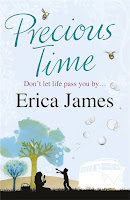
Precious Time (by Erica James)
![]() |
| (Amazon UK link) |
7 Feb 2024
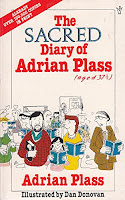
The Sacred Diary of Adrian Plass (aged 37 3/4) by Adrian Plass
![]() |
| (Amazon UK link) |
28 Dec 2023
One way to write your novel (by Dick Perry)
My other personal favourite books about writing (sadly not all in print) are:
- Writing on both sides of the brain by Henriette Anne Klauser- Bird by bird by Anne Lamott- Walking on water by Madeleine l'Engle- The five-minute writer by Margret Geraghty- Becoming a writer by Dorothea Brande- Back to creative writing school by Bridget Whelan- How to write and sell short stories by Della Galton- Writing great short stories by Margaret Lucke- Guide to fiction writing by Phyllis Whitney
20 Aug 2023
Cotillion (by Georgette Heyer)
![]() |
| (Amazon UK link) |
10 Feb 2023
The Powerful Purpose of Introverts (by Holley Gerth)
I don’t remember where I came across a recommendation for the book ‘The Powerful Purpose of Introverts’. It’s not the kind of title that would usually appeal to me, and I had not heard of the author, Holley Gerth. However, I must have seen something about it that persuaded me to put it on my wishlist. I was given it for Christmas, and started reading it a couple of weeks ago. 
(Amazon UK link)
Had I seen the subtitle when I decided I’d like this book, I might have been put off entirely. ‘Why the World needs YOU to be YOU’ is rather a scary idea. Not that I mind being me, but I’m pretty sure the world doesn’t need me at all. However, it's the only thing I didn't like The writing of the book is, in my view, excellent. I loved the style, and the information and checklists and general recommendations. The writing felt chatty, as if I were talking to a friend. I only read about ten pages per day as there was so much to think about.
The book starts with a bit of science, as the author looks at what makes people either introverted or extraverted. Some of the personality books claim that this is the least significant of the personality preferences, and I guess that’s true from the point of view of how we learn, and how we make decisions, and so on.
But if this book is to be believed, and it seems that the author has done her research well, introversion and extraversion are hard-wired into our brains. We use and react in different ways, physically, to different hormones. In lay terms (which is how I operate) it’s why extraverted people are energised by activity and parties, while introverts find them draining. That’s not to say that introverts don’t enjoy them - it’s that they need to recharge afterwards, while extraverts are charged by activity in the world.
I found this immensely reassuring, as was the reminder that everyone is unique, that we all process things a bit differently and that there are degrees of introversion and extraversion. According to one of the brief checklist tests in the book, my introversion is at about 85%.
The author goes on to mention the Myers-Briggs personality test - her preferences are apparently the same as mine, which may explain why the writing style resonates so well. She mentions other systems of categorising people too, such as the Enneagram, and points out how there are so many different ways of relating to the world and to each other.
I found the whole book fascinating - much of what is said was not new to me, but I appreciated very much the way it was said. There’s a low-key Christian theme, but it’s not at all preachy. Someone of no faith could skim or miss out the references to God, and our callings and beliefs. I knew that God loves me as an individual; I’m fortunate to have grown up knowing I was loved by many family members. But it’s still easy to think of oneself as a bit dull, or feeble, or lazy, when not involved in a lot of activities and meetings.
I was most impressed with the final chapter, where the author talks about a ‘vision statement’, acknowledging that this sounds rather formal and that not everyone wants one. But she walks through what she means, with more checklists, and I could see it - not just one but four different ways that, as an introvert, I can play my part with those around me and in the wider world.
I would recommend this book very highly to anyone who is an introvert, or who is concerned that they need a lot of time alone and wonder if it’s okay. Some extraverts might find it helpful too. In the US, where the author is based, it’s not easy to be a quiet, home-loving person as the culture there is so outgoing, bright and lively. Growing up in the UK, it wasn’t so difficult. But still, it’s not always easy to say ‘no’ to social activities, or staying up later than I want to. It's very hard saying when I've had enough (temporarily) of being with people I love very much. This book gives a kind of permission, couched in the science of why it’s important to listen to our instincts.
I ended the book feeling validated, encouraged and with a much more positive outlook than I have had for a while. It’s a book I hope to read regularly, and which I may dip into at odd moments too.
21 Sept 2022
An Ocean Apart (by Robin Pilcher)
![]() |
| (Amazon UK link) |
It’s quite a long novel, and it features a man called David who must be around forty. He is quite depressed at the start of the novel, having recently lost his wife of 18 years. He is staying with his parents - who are Scottish - and his three children are at boarding school: their choice, not his. He’s been off work since he nursed his wife through her final illness, and has been doing some gardening.
Then a crisis happens at the office and David is told he’s the only person available to visit the United States for an important meeting. His parents think it might be good for him to get away for a few days, but jet-lag and too much drinking get the better of him, and the meeting is a disaster. David falls into an even deeper depression, not helped by having caught the flu…
But he’s a strong character. I liked David very much indeed; Robin Pilcher has a gift of characterisation resembling that of his mother, and all the people in the book seem three-dimensional. David stays longer in the United States than he was planning to, and makes friends there; as an unknown person, doing some gardening as a temporary job, he feels safer than he was back in Scotland where everyone kept expressing sympathy and asking how he was doing.
As well as the story of David’s gradual healing from the worst of his depression, there’s a business thread involving some shady dealings at his father’s company. Some of this went a bit over my head, but it didn’t much matter; it runs alongside the main plot, and provides another dramatic incentive for David to finally pack up and return home.
There’s a low-key romantic thread which doesn’t get resolved until the last few pages; there are some lovely friendships made, there’s a terrific housekeeper character called Jasmine, and some very poignant scenes. The writing is excellent, the plot well-crafted (even if there’s just a tad of coincidence in the final couple of chapters - again a little reminiscent of Rosamunde Pilcher), and the people so well-drawn that I found myself wondering how they were all doing a couple of hours after I finished the book.
Very highly recommended; it’s in the genre of women’s fiction but I don’t see why men wouldn’t like it too, if they want some light character-based reading with nothing too stressful. It would make ideal holiday reading.
Review copyright 2022 Sue's Book Reviews17 Jan 2022
Winning Through (by Marcia Willett)
![]() |
| (Amazon UK link) |
‘Winning Through’ begins in 1986. As with the other books, several chapters follow the lives of the Chadwick family over a few months, and then the action leaps forward another four years. I found it a rather confusing system when I first read the books, but nowadays I appreciate it. It means there are some things we learn about in retrospect, as the characters look back on the immediate past; but it means that time passes without every detail, and people grow up a little or mature in the intervening periods.
The book begins with reflection; Fliss, who is now in her early forties, is wondering what to do about her marriage. Her husband Miles, who is rather older than she is, has been working in Hong Kong. She moved back to the family home, unwilling to leave her family behind or to send their twins to boarding school at a young age. That happened at the end of the previous book, and clearly nothing much has changed. Fliss is very fond of Miles, but he wasn’t her first love. And she still doesn’t want to move away from England.
Fliss is advised by her great uncle Theo, the last of the older generation, and quite frail now. He’s full of wisdom, much of it gleaned from reading, and from his life as a minister. He sometimes feels incompetent to advise as he never married; yet his gentle strength and insights guide all his relatives, and many others besides. It’s clear that Theo is becoming frail - he is approaching ninety at the start of the book - but nobody can bear to think of losing him.
Meanwhile Fliss’s cousin Hal - her first and best love - is struggling in his marriage to Maria. Their son Jolyon is sensitive and very afraid that they will split up. Their son Edward, who is his mother’s favourite, is nervous and seems to be pulling away from the rest of the family. Hal has promised Jolyon that he will do all he can to keep his marriage alive, and he’s not one to go back on his promises.
Fliss’s younger sister Susanna is happily married to the bohemian Gus and they have two small children, with a third due to arrive soon. And their brother Mole, who works for the navy in submarines, is still quiet, unwilling to talk about his private life, occasionally plagued with terrible nightmares. He worries continually about his family and doesn’t feel able to commit to any of the young women he becomes involved with.
It’s a character-based novel, reflective at times, as each of them confronts new challenges, learns to relate better to others, makes decisions for better or for worse. There are some significant events in the novel, including one which I recalled all too clearly, a shocking tragedy towards the end of the third book. The first time I read it, I couldn’t believe something so terrible would come in a book like this, with no warning. And yet it feels right, leading to the final chapters where there’s new hope for the future.
I had forgotten almost all the rest of the story; perhaps it’s not particularly memorable, but that doesn’t matter. The people are warm, believable and thoughtful. There’s more of a Christian emphasis in this one than the other two, with many quotations from Scripture and poetry - but as they mostly come from Theo, or when thinking about him, they don’t feel intrusive or in any way preachy.
I thoroughly enjoyed re-reading this novel. I found parts of it extremely moving, and at times could barely put it down.
Very highly recommended, if you like thoughtful women’s fiction, but it’s definitely best to have read ‘Looking Forward’ and ‘Holding On’ before.
Review copyright 2022 Sue's Book Reviews13 Nov 2021
Holding On (by Marcia Willett)
![]() |
| (Amazon UK link) |
It opens in the Summer of 1972. Fliss and Miles have been married for a couple of years, and she’s expecting her first baby. Miles, who works in the Navy, is about to be posted to Hong Kong, and while Fliss is quite excited at the idea, she’s also extremely nervous at the thought of giving birth in another country. And she knows she will miss her extended family, many of whom live at a huge rambling family mansion called ‘The Keep’.
Fliss’s grandmother, known as Freddy, is now 78. She’s still fit and active, but she’s slowing down. Fliss’s parents were killed in a coup when she was young, and Freddy brought her up, with her household help - Ellen and Fox - and a nanny, Caroline, who’s a bit younger. Fliss’s brother Mole is now a navy cadet, and her sister Susanna is soon to start at art college. But Fliss is very family-oriented, and Miles, who is rather older than she is, isn’t all that keen on the idea of becoming a father.
Fliss’s cousin Hal is married to Maria, who has always been quite possessive about him. But she’s starting to turn into a rather complaining, nagging wife who hates him being away. She’s a bit of a snob, too, and is under the impression that Hal is going to inherit The Keep one day. And she’s upset that Fliss is pregnant while she isn’t.
Then there’s Kit, Hal’s twin, who has been in a relationship with a likeable man called Jake for ten years. He’s asked her to marry him many times but she isn’t sure if she is really in love with him, and doesn’t want to be committed. She has a close friend and housemate known as Sin (Cynthia) who falls in and out of love regularly and also doesn’t necessarily want to get married.
All these people’s intertwining stories are told in the course of this book. Marcia Willett’s skill in characterisation applies to all her main characters, from small children to the elderly. And I feel almost as if I know them, so when there are poignant scenes, and inevitable losses I find my eyes filling with tears. The writing is excellent.
The action moves forward a few years after the first ten chapters or so, and we’re in 1976; Fliss and Miles returned from Hong Kong, with twins; Hal and Maria also have two sons, although she’s struggling to deal with the mess, noise and general disruption inherent in a baby and toddler. Mole qualifies and Susanna falls in love.
And then the story moves forward to 1980, and the last part is set in 1984. I recall finding these leaps a tad annoying when I first read the book, as I was caught up in the stories, and wanted to know what happened next. But Marcia Willett fills in the important gaps, with conversations and flashback daydreams, and it all works well.
I loved this book, it has everything I like in a story, including some low-key spiritual input mostly emanating from Freddy’s delightful brother-in-law Theo, who was a parson before he retired. There’s no bad language, no scenes of intimacy, no violence - just a well-told, beautifully structured family saga.
I’m already looking forward to reading the third in the series, but won’t do so immediately as I know it would be totally devastating to finish the series one after another; I love these people so much I like to spread them out a little, interspersed with other books.
Highly recommended to anyone who enjoys thoughtful women's fiction, but it's definitely best read after 'Looking Forward'.
Review copyright 2021 Sue's Book Reviews3 Aug 2021
The Chalet School in Exile (by Elinor M Brent-Dyer)
![]() |
| (Amazon UK link) |
This book was published in 1940, set (I assume) a year earlier, as the thread of World War II is looming. The Chalet School owners and Head are very worried, particularly about their German and Austrian students. Numbers are down already as parents no longer want to risk sending their daughters to what is likely to become a Nazi hotspot - and the decision is made that the school must close, possibly re-opening somewhere safer.
It’s a dramatic start to the book, and the first half is not a school story at all - no classroom anecdotes, but an astonishingly authentic contemporary account of what it would have been like for teenagers of all nationalities at the start of the war. The author does not gloss over some of the horrors and atrocities; she doesn’t give any gratuitous details, but she doesn’t ensure everyone is rescued or safe either. There are people who die in this book; there’s a violent riot, and there’s a traumatic and thrilling escape when it’s realised that some girls are in extreme danger.
‘The Chalet School in Exile’ was divided into two books when it was published in Armada; I’ve had a hardback (full) edition for a long time, and I can see that there’s a natural dividing place about half way through. The first half describes what happens as the school and various of its members attempt to leave Austria and reach safer countries. The second half is set in Guernsey with the attempt to start a new, smaller Chalet School. But apparently even with two entire paperbacks, there were significant cuts, including one entire chapter being removed. So this book is well worth acquiring in an older hardback or more recent ‘Girls Gone By’ version rather than the Armadas.
There’s a lot more in the book, of course. Joey, in her early twenties, discovers what really matters to her, and matures in unexpected ways. She gives the school some surprises, too. Several of her friends mature also, some of them through loss of loved ones, or through the enormous stress of not knowing what happened to their husbands or fathers. It’s kept from being an ultra-heavy book by the second half - another reason for having the full edition - which does have some school events, including attempts by the Middles to stir things up.
I particularly liked the way that three families from the ‘La Rochelle’ series (which I read a couple of years ago) reappear in this book, and become friendly with Joey and Madge. Their offspring are not much older than they were in the last ‘La Rochelle’ book, ‘Janie Steps In’, so it was very good to read about them too, and how some of them adjust to the Chalet School. It’s not essential to have read that book or any of the others in the series before ‘The Chalet School in Exile’, but it adds to the story to have done so. Reading earlier books in the Chalet School series helps too, as there's quite a large cast, but is perhaps less significant in this important book which stands alone in many ways.
There were several sections of this book where my eyes misted over - the writing is powerful, inspiring, and educational too - I learned more about the realities of WWII from having read this book as a teenager than I ever did from history lessons at school.
Very highly recommended indeed if you like teenage fiction and school-related stories. This is, to my mind, the very best of the ‘Chalet School’ series. The full editions tend to be pricey, but can sometimes be found at reasonable prices on social media 'marketplaces', or at second-hand shops.
Review copyright 2021 Sue's Book Reviews18 Dec 2020
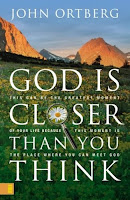
God is Closer than you Think (by John Ortberg)
![]() |
| (Amazon UK link) |
I first read ‘God is closer than you think’ in 2009, and liked it very much. But in more than a decade I had forgotten what it was about, so it was more than time for a re-read. I’ve read a chapter each day for the past ten days, and once again thought this book excellent.
The focus of the book, unsurprisingly, is on finding and communicating with God. Ortberg gives some nice analogies, one of which appears several times: that of looking for God being a bit like a ‘Where’s Wally?’ picture (or, rather, ‘Where’s Waldo?’, since it’s an American book). It’s all too easy to get distracted by everything that’s going on around us, and miss God’s presence - which is not necessarily where we expect it.
Ortberg also focuses on the need to concentrate on now - on today, which is the only time in which we live. It’s easy to get caught up in regrets or nostalgia for the past, or dreams for the future. But while memories can be positive, and planning is sometimes essential, we are actually living right now. The past can’t be changed, and we don’t know what might change in the future. That’s all the more relevant at the end of 2020, a year when almost all plans were turned upside down as the pandemic spread.
The author quotes from Brother Lawrence and others who made an effort to think about God in all they did - in everyday chores and interactions as well as while reading their Bibles or attending Church services. He gives examples and anecdotes showing that very often we need to start somewhere small: in being kind to our relatives, avoiding sarcastic comments, smiling at harassed shop workers, staying calm and patient while waiting in long queues.
There’s a helpful chapter on paths to spirituality, quoting Gary Thomas and his excellent book ‘Sacred Pathways’. I remember finding it encouraging when I first read Ortberg’s book - perhaps it was this that inspired me to find some of Gary Thomas’s writing - as I’m not the kind of person who necessarily finds singing, or church services helpful.
I like people and small groups, but am far from being an extravert. I like nature, but have no real spiritual need for it. I like reading but am not an academic. I’m certainly not an activist, and while I know that serving is a good idea, I tend not to notice opportunities to serve, and when I do, I don’t find them particularly fulfilling. But the contemplative path - one of needing a great deal of time alone, to ponder, to think and to write - describes me perfectly.
Thomas actually describes nine spiritual pathways, and goes into them in a great deal more depth than Ortberg does, but it was still a useful reminder in this book that there are many ways of finding and relating to God, and that while we probably all have elements of all of them, none is ‘better’ than any other. God made us as we are, and we need to find him in the ways he built into our personalities.
There’s much more in the book, including a chapter about how to find God when we feel low, or as if we’re just talking to a blank wall. And finally there’s a chapter pointing out that the Gospel message is not primarily about life after death (although that’s important) but about God being here with us now. As Christmas approaches and people are more aware of God coming into the world as Emmanuel (‘God with us’) it’s important to remember this.
The writing is excellent, with just the right balance between Scripture exposition and personal anecdotes, either from the author's own life and ministry, or from other friends and relatives. He quotes other writers too, as relevant, and I found it a very readable book.
All in all, I would recommend this book highly to anyone who is a Christian believer, or interested in knowing how Christian belief works, or who would simply like to feel closer to God.
Review copyright 2020 Sue's Book Reviews18 Nov 2020
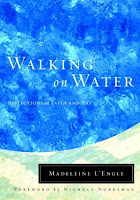
Walking on water (by Madeleine L'Engle)
![]() |
| (Amazon UK link) |
The style of the book isn’t going to appeal to everyone, but I found it warm, inviting and inspiring. The author has written lots of snippets, loosely arranged in separate chapters, on topics related to art, and writing in particular. She looks at the question of what it means to be a ‘Christian writer’ - or a ‘Christian artist’ - and rejects many possible descriptions of these phrases.
Instead, she talks about her passion for writing, about losing herself in her work. She clearly had a very deep faith, and saw God in all she did, in particular the inspiration of her writing. But she also acknowledged the need for discipline, for putting pen to paper, for finding time and space to do what one feels called to do.
There are chapters about doing one’s work - whatever it is - to the glory of God, and about the way God, as creator, inspires all his creatures to create. She talks about the importance of getting on with one’s creation, whatever it might be, whether or not it’s ever going to be polished and presented to the public. A writer has to write, an artist has to paint, a singer has to sing… and in the doing of our calling, we find the work itself can take over.
The style is unusual, in that each chapter is divided into little snippets, each of them complete in itself. Some take up less than half a page, others continue over two or three pages. They all make points, some of them expressing, in different words, what the author has already said. But it doesn’t feel repetitive, Instead, it feels almost like sitting and having a chat.
There are anecdotes from the author’s own life, giving an impression of a focussed, caring mother and grandmother, who travels the world but loves nothing more than her own home and family. There are quotations from books, some of which she cites, others of which she acknowledges that she wrote down without any reference. She picks and chooses, and in places it all feels quite random - but there’s a thread running through that made me want to keep reading, although I had to stop every few pages, to think about what was written.
The subtitle of the book is ‘personal reflections on faith and art’, and that’s exactly what this book is. It was published in 1980, but other than references to typewriters it doesn’t feel at all dated. I loved it the first time I read it, and I enjoyed it just as much this time around. I should read it far more often than once every twelve years, and am already looking forward to reading it again.
Very highly recommended if you are interested in the connection between faith and art, or a writer's personal thoughts about her life and craft.
My other personal favourite books about writing (sadly not all in print) are:
- Writing on both sides of the brain by Henriette Anne Klauser- Bird by bird by Anne Lamott- One way to write your novel by Dick Perry- Becoming a writer by Dorothea Brande- Back to creative writing school by Bridget Whelan- How to write and sell short stories by Della Galton- Writing great short stories by Margaret Lucke- Guide to fiction writing by Phyllis Whitney
Review copyright 2020 Sue's Book Reviews