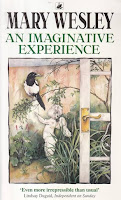
I have very mixed feelings about Mary Wesley's books. She was a very good writer, but her characters and stories tend to have an element of the bizarre in them, and rather more bad language than I am comfortable with. I have enjoyed some of her books, and been less than impressed with others. This particular one is the first novel she ever had published.
I did like the opening of 'Jumping the queue'. Matilda is a rather fussy elderly lady, who has (unusually, we are told) been cleaning her house from top to bottom for the past week. She is watched by her pet gander Gus who is quite disturbed at all the activity.
Evidently Matilda is planning something fairly drastic, since she spends inordinate amounts of energy finishing every fine detail of her cleaning, makes lists of useful numbers for some unknown person who will need them in future, and then has a phone call at cross-purposes with an old friend who calls himself Piers, but whom she calls John.
At the end of the first chapter, events take a less pleasant turn when a man arrives to take Gus away, and puts him in a sack. Not that he's going to be eaten. Gus is on his way to be a goose stud in a large shed full of lady geese. But he clearly doesn't want to be taken away, and it so upsets Matilda that I realised she wasn't simply moving house or going on an extended holiday...
I should have stopped there, really.
It's rather a bizarre book in a way. I couldn't find myself relating to Matilda in the slightest. She seems to be a mass of contradictions who doesn't trust anybody she knows well. Yet this is turned upside down a short way into the book when she agrees - for no obvious reason - to shelter a criminal from the police. Not a family member or even a friend, but someone she meets quite by chance.
So, I wondered, is the book meant to be lighthearted satire? At times it does seem that way. The situations are so unrealistic, at least in the world I inhabit, that I thought the book could not be taken seriously. Yet it was well-written, on the whole. It never gets boring, and while Matilda is quite outside my experience of humanity, the other characters who were gradually introduced do seem believable and fairly well-rounded.
But the plot isn't pleasant. There are several quite disturbing aspects of it. Not horror or suspense, and nothing particularly gory, but the kind of thing that left a rather bad taste in my mouth, and made me wonder why on earth the author hadn't written it differently. I thought the ending rather disheartening too. I wondered what the point was. I wished I hadn't bothered.
The Times, in the blurb on the back, claims that this book is 'A virtuoso performance of guileful plotting, deft characterisation and malicious wit'. No doubt they know what they're talking about. Perhaps my problem is that I don't much like warped and sick humour; however those that do might enjoy this book.
Although I have found novels by Mary Wesley rather variable, I thought that this one was a delight from start to finish.
However, 'An imaginative experience' is an unlikely story. The book opens with an almost surreal experience for Sylvester Wyke, the main protagonist of the book. He's sitting on a train minding his own business when it suddenly screeches to a halt, and a young woman jumps out. She runs across a field to a sheep which is lying on its back, and lifts the sheep back on its feet again... a bird-watcher gets involved too.
The plot which follows is almost reminiscent of a Shakespearean comedy at times - the kind where A falls in love with B who's really pining for C who turns out to be the twin brother of A, who's working as a steward for D unknown to anyone else...
During the rest of the book we follow the fortunes of Sylvester (a just-divorced writer), the girl Julia, and the bird-watcher Maurice. For good measure there's also Julia's mother, and Sylvester's bossy ex-secretary. Each has their own perspective on life and each other, and their paths cross frequently, sometimes without any of them realising it. There are coincidence galore - perhaps that's what reminded me of Shakespeare - but somehow it doesn't matter. In context it all seems to fit.
I found there to be quite a bit of humour in false assumptions that people make, and the resultant mis-communication that inevitably occurs. But it isn't a funny book as such. It's a light romance with an entirely satisfactory (if predictable) ending. Along the way there's some deep emotion as Julia's past is gradually unravelled.
I did like Sylvester! It's important to me to relate to a main character in any fictional book, and I sometimes find that hard when it's a man. But I'm an introvert; I don't like a lot of clutter around me, and I love to have the house to myself sometimes. Just like Sylvester. I could totally understand his growing frustration with his ex-secretary, who is convinced that he can't possibly manage to order his life without his ex-wife around.
Julia is much less like me as a person, but there are aspects of her life that I could relate to; for one thing she doesn't like noisy parties and loud music. Thoughts and conversations are interspersed, mostly from Sylvester's perspective. He wants to be a modern knight in shining armour, rescuing her from her past; but she, a modern and fairly self-sufficient young woman, doesn't think she wants to be rescued.
Overall I found 'An imaginative experience' to be a most enjoyable light read. The occasional bad language (Mary Wesley does seem to require at least a few obscenities in her books) doesn't detract from the story as it does - to me, anyway - with some of her others. The plot isn't meant to be entirely serious; the opening train-stopping section makes that quite clear. Yet there's enough that's deeply moving to make it well worth reading, and to linger longer in my mind than a lot of modern light fiction.
While this doesn't quite qualify as one of my absolute favourite novels, I would recommend it to anyone wanting a book for a flight or a holiday, or for a cosy afternoon with nothing too challenging.
Review copyright 2004 Sue's Book Reviews
I'm not sure why I keep picking up novels by Mary Wesley. Probably it's because the covers do look appealing, and I know she is a good writer. But I always find I have mixed feelings about her books. They tend to contain more bad language than I'm comfortable with, and have rather darkly bizarre characters at times.
'A sensible life' opens with a little girl called Flora, whose parents neglect her. She makes friends with holiday-makers, and finds herself falling in love with three different boys.
When Flora is old enough to join her parents in India, after several tedious years of boarding school, she sets out - but then changes her mind. One at a time, she meets her past acquaintances, and learns about life. Then - in rather an odd coincidence - she finds, again, the one who will bring her lasting happiness.
I thought this a pleasant novel, on the whole, with a reassuring conclusion.
I have mixed views about Mary Wesley's novels. Her writing is usually good, her plotting is clever, her characters interesting. But there seems to be rather a dark, cynical thread running through them, which I don't find appealing at all.
In addition, some of the situations in this author's books are so bizarre as to feel unrealistic, set as they are in the ordinary world. She also tends to use rather more bad language than I am comfortable with.
'Harnessing Peacocks' is about Hebe, a single mother with a twelve-year-old son. It seems that he is gradually growing apart from her, although it's hardly surprising since she sends him away to an expensive boarding school. She pays for this by being a part-time cook/housekeeper. She is also a part-time prostitute, although only with selected people.
This unlikely scenario leads to some lively clashes when men she has known happen to meet her under different circumstances. A series of coincidences leads, eventually, to a satisfactory conclusion.
On the whole, I thought this an enjoyable book, spoiled mainly by excessive use of strong swear words.
'The Camomile Lawn' is a novel by Mary Wesley, set in the first part of the 20th century.
A group of cousins have a holiday together every year, with their aunt and uncle, by some cliffs in Cornwall. The book opens on their last such holiday before the war starts. We quickly learn about their hopes and fears.
They mostly move to London, and their lives remain entangled as they discover the reality of war and adult relationships. The book is cleverly interspersed with 'flash-forwards' of various groups on their way to a funeral. We don't learn until late in the book whose funeral it is, however.
The book ends in a satisfying way with all the ends tied together.
Recommended, in a low-key way.
'Not that sort of girl' is a novel by Mary Wesley.
It mainly features a woman called Rose. We meet her when she is staying at a hotel after her husband's funeral. As she does so, she reflects on her past life.
Rose remembers the side of her life that everyone else saw. But she also thinks about her secret life and thoughts. There are some clever and effective flashbacks which alternate with the present, gradually building up a well-rounded character and an interesting story.
Rose decides what her future will hold, in what I considered a hopeful ending.
The people are believable, and the writing is good. On the whole I liked the book. But there is rather too much bad language for my tastes, so I would only recommend it with that proviso.