30 Mar 2004

Between friends (by Kathleen Rowntree)

Between friends by Kathleen Rowntree
(Amazon UK link)
"There was nothing to suggest an earth tremor occurring in Tessa Brierley's kitchen, or a maverick surge of electricity, or a tidal wave sweeping through. Sunlight continued to fasten on blue and white plates lining the dresser..."


I love this opening! Kathleen Rowntree's novel 'Between friends' starts with a major crisis, of earth-shattering importance as far as Tessa is concerned, yet life carries on around her. She continues sipping coffee with her best friend Maddy, as they have done so many times before, with no outward signs at all of the dramatic revelation that has come to Tessa, quite out of the blue.

Tessa is married to a charming philanderer called Nick, and has forgiven him many affairs in the past. The revelation - as we learn on the second page - is that Nick's latest conquest is not another student at his place of work, but Maddy herself. A chance comment of Maddy's has made it clear that she must have seen Nick at a time when Tessa was pretty certain he was with his latest girlfriend.

The rest of the book explores Tessa's reactions to this new knowledge - or suspicion; for shortly after she realises it has to be true, she begins to wonder if she's imagining things, and considers all kinds of other scenarios. Through her eyes, the book also examines the commitment of marriage, and the ties of friendship, as Tessa has to balance the two somewhat precariously, against what she thinks she knows.

'Between Friends' is in the genre best described as 'village stories'. Tessa and Maddy live in Wychwood, an old-fashioned and idyllic village complete with a Squire and his wife, and a bachelor Rector with an elderly but delightful sister. Despite being set in the 1990s there's an underlying class-consciousness and snobbery that can perhaps only be found in small English communities such as this. But rather than trying to follow the lives of all the residents, as some authors do with this genre, Kathleen Rowntree focuses primarily on Tessa and her relationships with her many friends, both in and out of the village.

I found Tessa a remarkably realistic person, perhaps because she reminded me in some ways of myself. When Maddy accidentally drops her bombshell, Tessa doesn't show any outward reaction, nor does she ask for an explanation. Instead she withdraws inwardly from the potential conflict, deciding - at least to start with - that it's better not to know for certain. Later on she weighs up the consequences of confronting either Maddy or Nick, and realises how easy it would be to lose either or both of them.

There's a fine line between hiding one's head in the sand and refusing to admit to emotional problems, and standing firm for the sake of harmony while well aware of what's going on. In my view, Tessa is on the latter side of the line: apparently weak and ignorant, but in reality stronger than anyone realises. Maddy on the surface is a far more dominant character. She organises the Women's Institute, and just about every other activity in the village. Without stating it overtly, however, the book shows how Tessa's strength of conviction comes to the fore in dealing with Maddy's surprising weakness.

Not that it's at all easy for Tessa. She's rather a bohemian, an artist who makes her living painting illustrations for children's books. She doesn't get involved in village life as much as Maddy does, and while many people like her, she doesn't have many close friends other than Maddy. Whereas she had told Maddy about all Nick's previous affairs and discussed what to do, while complaining about him in the assurance of female sympathy, she cannot tell anyone about this, nor ask for advice.

There isn't much major plot, and there's very little action that would appeal to those who prefer thrillers. Yet there are cleverly inter-woven subplots and minor characters that appeal to my emotions in differing ways, and who draw out further the different strengths and weaknesses of both Tessa and Maddy. There's a girl on the verge of nervous breakdown who is befriended and helped by Maddy; rivalries between the upper-middle classes and the working classes; an old friend of Nick and Tessa's who is dying.

I've read this book twice now: the first time about six years ago, then again last year. I was pleased to find that I had forgotten almost everything about it when I picked it up the second time, and that I enjoyed it even more than I had remembered. It was the first book I ever read by Kathleen Rowntree - I picked it up inexpensively in a second-hand bookshop - but since then I've collected nearly all her other novels. I think this one is still my favourite.

The style is light, paced just right for my tastes. with good characterisation and a sprinkling of humour alongside sufficient depth to be quite thought-provoking in places. I didn't find it un-put-downable, but that's not a bad thing when trying to read in odd moments. I read it over three days - it's only 320 pages, and I read fairly fast. I think it would be ideal for a holiday when you want something that has depth, but isn't too challenging. The ending was satisfying from my perspective, though others might disagree. It could have been trite but I didn't find it so at all.

Don't expect anything explicit in this book. Although it's about infidelity, it's all fairly low-key. Hints abound, but there are no intimate details. I prefer books that way myself.

Recommended if you like thoughtful women's fiction.

29 Mar 2004

Perfume from Provence (by Lady Fortescue)

Perfume from Provence by Lady Fortescue
(Amazon UK link)
'Perfume from Provence' is a semi-autobiographical account told in the first person by Lady Fortescue. She and her rather older husband John move to Provence in the early 1930s, to escape Britain between the wars. It covers different aspects of their new life, told with gentle humour and clever observation.

Each chapter is complete in itself, Yet each one gradually builds up the characters of the Fortescues and the people around them, making me warm to them more and more.

This book opens with a delightful chapter describing the building work which they had done on a house they bought in the days when sterling was a strong currency. The workmen are a mixture of French and Italian: hot-tempered and yet loyal, hard-working and yet taking lengthy breaks for every possible reason. 

Inevitably there are many delays, so the furniture shipped from England arrives long before the house is ready. All the workmen help in the various crises that arise, such as a large olive branch blocking the path, and a wall being knocked down by the huge delivery van. When, at last, the roof is on the house, the entire work-force has a celebration meal with wine and biscuits, music and dancing.

I very much enjoyed reading about some of the local customs. Having lived in Cyprus for the past six years, amidst another Mediterranean culture, I could appreciate some of the astute observations from a personal perspective, such as the family-oriented culture, and quickly-erupting tempers followed by shaking hands and hugs, with no grudges held.

There are some charming line drawings scattered through the book by EH Shephard (best known for his similar drawings in the 'Winnie-the-Pooh' books) which complement it perfectly. The feeling of the book is relaxed, gentle, laid-back. It's not the great struggle and activity of - say - 'Driving over Lemons'. At no point does Lady Fortescue even hint at feeling in despair, or worried that things will not work out. I can almost feel her shrugging with a smile as she writes about the way things happens slowly, according to the local traditions and culture.

Different from the norm, this is an honest and sometimes humorous account of ex-pat life in the days when it was much more difficult to move abroad than it is now. I was surprised at how much I liked reading it, since I'm not generally a fan of biographical writing.

19 Mar 2004

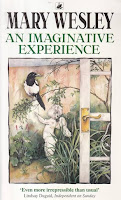
An imaginative experience (by Mary Wesley)

An imaginative experience by Mary Wesley
(Amazon UK link)
Although I have found novels by Mary Wesley rather variable, I thought that this one was a delight from start to finish.

However, 'An imaginative experience' is an unlikely story. The book opens with an almost surreal experience for Sylvester Wyke, the main protagonist of the book. He's sitting on a train minding his own business when it suddenly screeches to a halt, and a young woman jumps out. She runs across a field to a sheep which is lying on its back, and lifts the sheep back on its feet again... a bird-watcher gets involved too.

The plot which follows is almost reminiscent of a Shakespearean comedy at times - the kind where A falls in love with B who's really pining for C who turns out to be the twin brother of A, who's working as a steward for D unknown to anyone else...

During the rest of the book we follow the fortunes of Sylvester (a just-divorced writer), the girl Julia, and the bird-watcher Maurice. For good measure there's also Julia's mother, and Sylvester's bossy ex-secretary. Each has their own perspective on life and each other, and their paths cross frequently, sometimes without any of them realising it. There are coincidence galore - perhaps that's what reminded me of Shakespeare - but somehow it doesn't matter. In context it all seems to fit.

I found there to be quite a bit of humour in false assumptions that people make, and the resultant mis-communication that inevitably occurs. But it isn't a funny book as such. It's a light romance with an entirely satisfactory (if predictable) ending. Along the way there's some deep emotion as Julia's past is gradually unravelled.

I did like Sylvester! It's important to me to relate to a main character in any fictional book, and I sometimes find that hard when it's a man. But I'm an introvert; I don't like a lot of clutter around me, and I love to have the house to myself sometimes. Just like Sylvester. I could totally understand his growing frustration with his ex-secretary, who is convinced that he can't possibly manage to order his life without his ex-wife around.

Julia is much less like me as a person, but there are aspects of her life that I could relate to; for one thing she doesn't like noisy parties and loud music. Thoughts and conversations are interspersed, mostly from Sylvester's perspective. He wants to be a modern knight in shining armour, rescuing her from her past; but she, a modern and fairly self-sufficient young woman, doesn't think she wants to be rescued.

Overall I found 'An imaginative experience' to be a most enjoyable light read. The occasional bad language (Mary Wesley does seem to require at least a few obscenities in her books) doesn't detract from the story as it does - to me, anyway - with some of her others. The plot isn't meant to be entirely serious; the opening train-stopping section makes that quite clear. Yet there's enough that's deeply moving to make it well worth reading, and to linger longer in my mind than a lot of modern light fiction.

While this doesn't quite qualify as one of my absolute favourite novels, I would recommend it to anyone wanting a book for a flight or a holiday, or for a cosy afternoon with nothing too challenging.


Review copyright 2004 Sue's Book Reviews

18 Mar 2004

A Smile on the Face of God (by Adrian Plass)

A Smile on the Face of God by Adrian Plass
(Amazon UK link)
Adrian Plass is one of my top favourite Christian writers. He's best known, of course, for his 'Sacred Diary' trilogy; one of the few sets of books that makes me laugh out loud even on the second or third re-read.

But Plass doesn't just write humour. 'A Smile on the Face of God' is the warm and moving biography of Philip Ilott. Have you ever heard of Philip Ilott? I hadn't. Apparently he appeared for a while on a television programme called 'Company', but I'm not much of a TV-watcher and had never heard of that either.

Philip Ilott was born in 1936 to a rather weak father, and an obsessive-compulsive mother who didn't want him at all. His earliest memories consist of hearing terrible rows between his parents, and of trying to be good so that his mother didn't get angry with him.

When World War II started, and his father had to join the army, things got worse rather than better. He was confined to a garden shed every day after school, before his mother got home to let him into the house. She wouldn't let him in by himself in case he made it untidy. She never hugged him or gave him any form of affection, yet when his father was away she abused her her son sexually at night.

The one bright spark in Philip's week was his regular visit to his grandmother, his mother's mother, who loved her grandson and gave him the cuddles and attention that he needed. His grandmother was a devout Christian, and as a result of her influence, Philip - who had a good singing voice - managed to join the local Cathedral choir. It was the only thing he ever did which made his mother proud, yet even then she never went to hear him sing. All his life he battled with his longing to be loved by his mother.

When Philip left school he went into the army for a few years, and in that unlikely place he met a few Christians who stood out as 'different' and who invited him to Bible studies. One of them knelt to pray at his bedside every night and was bullied constantly, but never retaliated. This made such an impression on Philip that - after much soul-searching and discussion - he too decided to become a follower of Jesus. This was no crutch for the weak! Life became a great deal more difficult for him once he'd made his commitment, but it was unquestionably the turning point of his life.

The rest of the book shows Philip's gradual maturity from a confused young man to a wise and caring priest in the Anglican Church. Along the way he meets and marries a very supportive girl, and they have two children - one naturally, one adopted. But whereas stories like this are often rather triumphalistic, Philip's is a mixture of sadness and joy. Sometimes he seems to go backwards rather than forwards as he tries to follow his vocation, and continues to battle with the many problems stemming from his childhood. 

The book explores Philip's feelings and fears, particularly when he faces serious illnesses that threaten his ministry. It also looks with honesty at his stormy relationship with his adopted daughter once she becomes a teenager.

Adrian Plass - as always - writes with sensitivity and compassion, describing events without any form of preaching or judgement. It's a thought-provoking book, which could be read by Christians and non-Christians alike, although a little suspension of belief would perhaps be needed for atheists, since God is an inevitable part of the story as a significant character in Philip's life.

For myself, as a low-church Anglican, it's quite engrossing to read about Philip's return to his Anglo-Catholic roots after experimenting with evangelicalism in his twenties. For him, the rituals of high Anglicanism, and the sensory experiences - incense, images, chanting of ancient liturgy - are part of the mystery of God. 

 At the same time I think the book could equally be challenging for many in more formal traditions of worship, since Philip has an increasing experience with the charismatic movement of the church, specifically involving the ministry of divine healing.

All these things and much more are described in such a natural, low-key way that it's hard to imagine anyone being offended by them. Philip comes across as a very likeable man, whose longing for love is gradually brought to fulfilment. Along the way he finds not just healing from some of his illnesses, but healing from his past, including some painful repressed memories that come to the fore without any help from a psychiatrist.

I would recommend this book to anyone, whatever their spiritual beliefs. It's gentle and yet very moving; it shows inordinate courage and conviction from a deeply hurt man, and it's a great antidote to the many negative things written about (and by!) Christians.

(You can also read my more recent review of 'A Smile on the Face of God' written on re-reading nearly six years later)

14 Mar 2004

The joy luck club (by Amy Tan)

The joy luck club by Amy Tan
(Amazon UK link)
I had not heard of Amy Tan. I picked up 'The joy luck club' at a jumble sale when I was thinking about experimenting with reading some different fiction from my usual family sagas or romances. With the black and red cover of my edition, it looked like a light thriller.

However the book is about four Chinese mothers, born in the first decades of the 20th century, and their four daughters who were born in America shortly after World War II.

The book opens with Jing-Mei Woo - who is now in her thirties - being invited by her father to join the 'joy luck club' shortly after the death of her mother. This is a group of eight Chinese people who meet to play mah-jong, to raise money, and to gossip. Jing-Mei doesn't really want to join with these older people - her father, and three sets of honorary aunts and uncles, but does so for the sake of her mother's memory. After eating a meal, playing a game, and remembering some incidents in her past, she's given a surprise gift.

This was a promising start to the book, and I was eager to know what Jing-Mei would do after receiving this gift. However the next chapter is written from the perspective of one of the other women in the joy luck club, An-Mei Hsu, flashing back to her childhood. Again it's interesting, but I found myself feeling slightly bewildered by the contrast. Here we learn about An-Mei's unhappy past; she was abandoned by her mother, and brought up by her strict grandmother and other relatives. It's a short chapter, and recounts a painful incident.

This change of perspective continues throughout. The book has four distinct sections, each of which has four chapters. The first and last sections are devoted to the mothers, the middle two sections to the daughters. The exception is Jing-Mei who has a chapter in each section. It's not until the final chapter of the book that time moves forward again, and we learn what she does with her gift.

There isn't a great deal of plot. Instead we see, through flashbacks alternating with the present, incidents from the childhoods of each of the seven women concerned. The four mothers had very different backgrounds: one was from an extremely wealthy Chinese family, but she took her riches for granted. Another grew up rather devious and manipulative. An-Mei grew up indecisive, always wanting other people to make decisions for her. Jing-Mei's mother had to escape the invading Japanese, and lost everything as a result.

Each of the mothers ends up in America in early adulthood, so their daughters are raised as Chinese-Americans. Inevitably there are cultural clashes, and the daughters struggle to come to terms with their identities, clashing at times with what they perceive as the old-fashioned natures of their parents, and the demands of Chinese culture.

Part two of the book shows incidents from the childhood of each of the four daughters, and part three shows them as young adults, struggling with their relationships to non-Chinese Americans, making mistakes which their mothers watch with pain and inevitable misunderstandings. Ironically, despite being brought up quite differently from the way their mothers were brought up, each of the daughters shows remarkably similarities of character to her mother.

Part four returns to the three mothers for their perspectives on their adult children's lives and loves. They see themselves reflected in their daughters, and their daughters begin to understand them better. Then the final chapter is Jing-Mei's again, moving forward at last.

Every time I started a new chapter, I had to look at the contents list, to remind myself whose mother (or daughter) this character was. By the time I was half-way through, I started thinking of it as a book of short stories, and that helped. Each chapter was almost complete in itself, and could be read that way, so once I had stopped looking for connections, it made more sense. I saw the connections as I got to the end, although I still did not remember which family was which without checking.

The front cover said that the book was 'hilarious' and 'moving'. There were certainly a few places that made me smile in mild amusement. Mostly they were to do with cultural misunderstandings. But I felt the humour was bittersweet; it's all too easy to make mistakes living out of one's own culture. When the daughters were ridiculing their mother's traditions and customs, I didn't find it funny at all, but sad, from the perspectives of both.

As for 'moving': well, once I had grasped the overall concept of the book - the division and reconciliation of mothers and daughters, the gradual merging of the cultures - I suppose it could be described that way. Certain incidents within the book were somewhat emotional, although none of them moved me to tears. I think the reason for this is that it was so confusing to read, even though after finishing it I can better see the big picture.

'The joy luck club' is an international bestseller, so it would seem that I'm missing something that other people enjoy. Still, there was nothing I specially disliked about the book. I won't be returning it to the next jumble sale; I expect my younger son will read it some time since he's an avid reader of almost anything, and I might even dip into it again myself one day. If I do, though, I shall probably read it in a different order from the way it's written. I'll take one family at a time and read through all their chapters.

On the positive side, it was well-written, and I expect it gives some useful cultural background for people who have never lived outside their community. Perhaps when it was written (1989 in America) there was even more insularity in the USA than there is now, and this book could have helped bridge some gaps, helping ordinary white Americans to understand better those of Chinese and other descent. For me, growing up in multi-cultural Birmingham, and now living in Cyprus, it seemed rather ordinary.

For anyone interested in Chinese Americans, or indeed any cross-cultural issues, I'd recommend it in a low-key way. I understand a film was made of this book; perhaps it's one of the few books that would be better in movie form, since it would give a clear pictorial image of what the author - herself a Chinese American - wanted to convey.

9 Mar 2004

Monstrous Regiment (by Terry Pratchett)

Monstrous Regiment by Terry Pratchett
(Amazon UK link)
I do like Terry Pratchett's 'Discworld' series. Partly because they're so cleverly written. And partly because they don't actually fall into any traditional genre. They are fantasy - of a sort - since several non-human races co-exist happily (well, sometimes) on the Discworld, such as trolls and vampires and wizards. But they're not normal fantasy. They're humorous, satirical, thought-provoking, and full of classical allusions.

I read 'Monstrous Regiment' aloud to my teenage sons when they were 15 and 17. It's fifteenth in the Discworld series, and is the story of a teenage girl who decides to join the army. The book is about what happens as she attempts to deceive everyone by pretending to be a boy (the Discworld is very sexist still), and eventually manages to enlist.

Several adventures await, and a good many surprises. Some of her new friends turn out also to be rather different from what first appearances would suggest.

This series works wonderfully well as read-aloud books for parents who wanted to keep reading aloud to teens. The only problem is that there are no chapters in the Discworld books, so you find yourself reading until you are hoarse, and then looking for a convenient asterisk to use as a stopping point for the day.

I'm not particularly interested in books about armies, and having finished this, I would not count it as one of my favourite Discworld books. Still, there were some amusing moments here and there, and I will probably re-read it one day. Worth reading for Pratchett fans.

4 Mar 2004

Regatta (by Libby Purves)

Regatta by Libby Purves
(Amazon UK link)
'Regatta', by Libby Purves, is the story of Anansi, an eleven-year-old girl, but it's not a story for children. Anansi has come from London, where she lives with her neglectful drug-using mother and small half-sister. Her father was of African origin, but she hasn't seen anything of him since she was tiny. She has a lame foot, which she knows was caused by an angry man when she was little, and has recently been excluded from school after getting into a fight.

Social services have got involved, and Anansi is sent on a holiday to a seaside town to give her mother a break. She's sent to live with Sheila, who's caring and highly organised, and who generally takes younger children from social services as guests during the summer months.

Sheila's husband Simon is a rather dour writer, who happens to have a somewhat shocking secret. They have two teenage sons who spend their terms at boarding school, and don't much like having other children in the house. The younger son Douai, who is only a year older than Anansi, particularly resents having a girl thrust on the household, and being expected to look after her.

Anansi is very intelligent, and street-wise beyond her years. She finds it hard to comprehend the upper-middle class activities like tennis and sailing, which she's expected to take part in. She's used to verbal abuse from people she meets - both for her race and because of her limp - and is confused by people smiling at her, and being generally nice. She better understands the aggression of Sheila's sons; she rather resented her half-sister, and sees herself as a cuckoo in the nest. However after some particularly unpleasant teasing by Douai, she responds in anger by revealing something she knows - something which throws the whole community into an uproar, and causes a lot of people to take serious looks at themselves and their attitudes.

Libby Purves is an experienced sailor, and this is clear from the background to this book. All the children in the town learn to sail at a young age, and take part in regattas. Anansi is initially terrified of the river estuary where everyone sails, and her first experience - being taken out in a boat by a resentful Douai - is a disaster. But she's a tough child, and when a later opportunity arises to learn from a gentler teacher, she takes it up willingly.

As with all this author's books, there are many issues touched upon in passing, making it not just an enjoyable story, but a thought-provoking read. Questions about class divide are gently explored, including the naïveté of the upper middle classes, who make up the majority of the town where Anansi is sent. Some of them see Sheila as a bossy do-gooder, and rather despise the children she looks after, despite being friendly on the surface.

There's also the issue of bullying, both physical and emotional. But it's not shown as something clear-cut; the disadvantages of responding in anger are also demonstrated. Anansi drops her metaphorical bombshell, without realising what the consequences might be for those around her. Later on she chats to a gentle elderly man who tells her about the horrors of war, and of the damaged that can be done by real bombs.

The problem of children with neglectful parents is inevitably at the heart of this book, with social workers quite in the dark about what's best for them. Contrasting viewpoints are given: from Sheila, who simply wants to mother children and help them have fun, to a social worker who thinks it makes life more difficult when an impoverished inner-city child is shown a completely different world for a few weeks. The drug issue is barely touched upon, however; it's enough to see the damage caused to Anansi by her mother's habit, and which leads to a bigger crisis part-way through the book.

I found the character of Anansi quite delightful. She has a lot of courage, and her own set of strong principles. I found myself wondering about the unanswerable question: is personality inborn, or developed in childhood? I see in Anansi a reflection of a few people I know from all walks of life - stubborn determination which makes her fight, despite everything, to overcome all odds. She also has a deep longing for love, mostly repressed, but coming to the fore in a heroic deed which forms the climax of the book.

I found Sheila tiring but realistic. She's a little larger than life, but perhaps not atypical of a cheerful, outgoing woman who has so much love to give that she takes in other children whose parents cannot care for them properly. There's a very moving section part-way through the book where Sheila has to consider whether it would be better for her son Douai if Anansi were sent away; as a mother myself I could feel her pain at trying to meet the needs of the two hurting children.

Other main characters are sympathetically drawn, with the more minor ones being a bit caricatured - not a bad thing as it helped me to remember who was who. I did find the number of families a little confusing and sometimes forgot which children belonged to each - but this may have been deliberate. There is an overriding sense of a community, of people dropping in on each other, eating meals at different homes every night, with parents not entirely sure which children would be eating supper with them each evening. This 'large family' feeling makes Anansi's revelation all the more disastrous when it happens, potentially rocking the entire foundation of everyone's lives, not just the few who are directly involved in what she reveals. This in itself provides quite a contrast to her previous lifestyle.

I very much enjoyed reading this book, although I found it rather overwhelming in places with so many people, and the fast-paced action. While I was eager to know what was going to happen, I found I had to put it down every couple of chapters to take a break, and for my mind to catch up with what I'd been reading!

I do admit to skimming a few paragraphs of sailing technicalities here and there. I'm sure they were realistic, but I know almost nothing about sailing and was more interested in the people. However there wasn't so much that it bored me. Towards the end of the book I was almost on the edge of my seat with the excitement of a dramatic rescue involving various boats, and my lack of nautical knowledge was no handicap in understanding.

The ending of the book is moving and gives hope for the future, although perhaps it could be considered a little unrealistic. While it was encouraging, it did leave me feeling a bit as if the author had skated neatly round the difficult problem of unwanted children. Once I'd finished, I found myself feeling exhilarated, and - surprisingly - quite tired, as if I'd taken part in the rescue myself. It's a satisfying book, not over-long (it's only just over 300 pages) but with a depth of emotion, and with thought-provoking issues that often require a much longer novel for full exploration.

None of the above really does justice to the book, which is an extremely well-written novel bringing together unlikely characters in believable ways. The 'issues' are there in the background, but they don't become intrusive; I found myself thinking about them as a result of reading the book rather than being drawn into them too strongly at the time. Libby Purves' style is brisk, decisive, mildly humorous at times.

It's not my favourite of her books, but all in all, I'd recommend it to anyone wanting a light read with a little more meat than the average short novel.