![]() |
| (Amazon UK link) |
28 Nov 2025
Good Omens (by Terry Pratchett and Neil Gaiman)
10 May 2024
The Shepherd's Crown (by Terry Pratchett)
![]() |
| (Amazon UK link) |
21 Mar 2024
Raising Steam (by Terry Pratchett)
![]() |
| (Amazon UK link) |
22 Jan 2024
Snuff (by Terry Pratchett)
![]() |
| (Amazon UK link) |
9 Nov 2023
I Shall Wear Midnight (by Terry Pratchett)
![]() |
| (Amazon UK link) |
3 Oct 2023
Unseen Academicals (by Terry Pratchett)
![]() |
| (Amazon UK link) |
18 Aug 2023
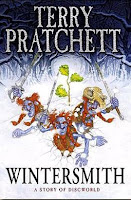
Wintersmith (by Terry Pratchett)
![]() |
| (Amazon UK link) |
25 Jun 2023
Making Money (by Terry Pratchett)
![]() |
| (Amazon UK link) |
15 May 2023
Thud (by Terry Pratchett)
![]() |
| (Amazon UK link) |
5 Mar 2023
Going Postal (by Terry Pratchett)
I was quite looking forward to reaching ‘Going Postal’ in my gradual re-read of the late Sir Terry Pratchett’s lengthy Discworld series. It’s one of the books I read aloud to my teenage sons in 2005, having bought it in hardback soon after publication, and I recalled liking it very much.
(Amazon UK link)
I had even remembered what happened in the first chapter - a very dramatic opening to the book - which results in the condemned crook Moist von Lipwig being appointed as the new Postmaster General for the Ankh Morpork post office. The post office has been entirely dormant for some years and there have been others appointed to this role, but they all suffered unpleasant accidents… some quite recently. However Moist has no option but to accept, and no chance to escape as he is determinedly followed and tracked down by a Golem known as Mr Pump.
Most of the former post office staff have long gone, but two remain. There’s the elderly Mr Grout, who believes in dosing himself with all kinds of dodgy remedies, and never washes. There’s also the younger Stanley, a gangly, nervous young man who only becomes enthusiastic when talking about his all-consuming hobby of collecting pins.
Moist has worked as a conman and swindler all his life, and was apparently very good at it, but he isn’t entirely lost to emotion, and does have a kind of standard of decency. He will engage in a fair fight, although he prefers to avoid physical pain, but he tries to avoid hurting the innocent, where possible, and is proud of the fact that he’s never killed anyone. Not directly, anyway…
It’s a good story, the first of the main Discworld books to be written in chapters; that’s something I had not remembered. And I’d forgotten most of the details of the book. Moist does not just have to restart a post office that’s stopped doing anything, he has to wade through mountains of undelivered mail, some of it going back decades, blocking up doorways and covering furniture everywhere in the huge post office.
He also finds that he’s in competition with the ‘clacks’ towers - a kind of Discworld semaphore-based phone system that uses Disc-style computers and geeky people who like numbers… but which has been taken over by a ruthless conman who’s as talented as Moist, but without his hint of humanity.
Lord Vetinari appears several times, smooth and tyrannical, yet doing what he can for the city. And there’s a wonderful section about the invention of stamps which I appreciated very much.
Still one of my favourite of the Discworld novels, probably because it’s so character-based and Moist is a wonderful, complex character who’s likeable despite his criminal tendencies. I hope it won’t be another eighteen years before I read it again.
Definitely recommended if you’re a fan of these books. If you haven’t read any Discworld books before, this could make a good starting point, as most of the characters are new to this story.
9 Jan 2023
Monstrous Regiment (by Terry Pratchett)
![]() |
| (Amazon UK link) |
It turned out to be more interesting than I had expected. Polly is the main character, and we meet her dressed as a boy so that she can join her country’s army. There are always wars, and recruiting officers tour around looking for likely lads. Polly has been working as a barmaid in her father’s inn, and has thus had the opportunity to observe a lot of men and listen to male conversation in a way that would not normally be possible for teenage girls in that era.
She is accepted, kisses the picture of ‘The Duchess’, who is a somewhat odd figure, something between a minor god and a monarch, whom nobody has seen for a long time. But The Duchess apparently tells some people what they should be doing. One of Polly’s new colleagues is a devout worshipper. They’re quite a mixed bunch - there’s a vampire (reformed); there’s a troll, and there are other different shapes and sizes of new recruits. Polly realises there may be problems when she needs to use the ‘facilities’, but she manages, although it’s not long before she starts to wonder if others of her group may also be of the female persuasion…
Polly is a quick thinker, and asks a lot of questions which makes her unpopular with one of the officers, although the other, a very large sergeant, is more benign and generally well-disposed. And they start out on their way to fight battles with no training, because the army is running out of people…
There’s quite a bit of politics in the book, Discworld style, which I skimmed. I lost track of who was attacking whom, and how the different ambushes, battles and so on worked. I was more interested in Polly’s story, her growing friendships with her new acquaintances, and the difficulties she finds in a man’s world, contrasted with her very different life prior to joining up. It’s a theme Pratchett explored in ‘Equal Rites’ in rather a different way.
Samuel Vimes of the Ankh Morpork Watch is in this book, in a fairly minor role until the end, but most of the characters are new so it’s certainly possible to read this as a stand-alone story. I prefer to read a series like this in chronological order where possible, but it’s not necessary. Still, a working knowledge of the way different races (humans, trolls, vampires, wizards etc) manage to co-exist in the Disc is a useful background. Knowing who Vimes and the other Watch members are is a nice bonus.
‘Monstrous Regiment’ is still not my favourite of the Discworld books, but I liked it better than I did nearly nineteen years ago.
Review copyright 2023 Sue's Book Reviews2 Nov 2022
A Hat Full of Sky (by Terry Pratchett)
![]() |
| (Amazon UK link) |
I re-read ‘The Wee Free Men’ back in July, and liked it very much. I last read its sequel, ‘A hat full of sky’ in 2005 and had entirely forgotten the story. Although it took me a day or two to get into it, I thought it an excellent book. As ever there are quite a few characters and more than one storyline, and it works best read as a sequel rather than a standalone.
Tiffany Aching, who is now eleven, is on her way to work for Miss Level. Her parents think she’s going to be a kitchen maid or similar, and have no idea that she’s going to learn to be a witch. Tiffany’s grandmother was - kind of - a witch but died before the first book started, and she still misses her; but she feels quite a pull to continue her work.
She’s not entirely sure that she’s cut out to be a witch, however; just riding on a broomstick makes her feel queasy. And she’s pretty sure that she’s the only one who is followed around by the Nac Mac Feegles - the six inch high ‘Wee free men’ of the first book - who have sworn to protect her. She’s also a bit disillusioned when she realises that most of her work with Miss Level is in fact cleaning, and checking animals, and helping people in the village who are sick, or elderly, or just need company.
But Tiffany is being followed by a ‘hiver’, an invisible being that preys on the vulnerable. And it seems likely that it will catch up with her at some point, and we don’t know what will happen. I hadn’t remembered at all; obviously it was all going to work out in the end, as this is a children’s book, but I had no recollection of what happened, or how the hiver was persuaded to leave Tiffany, or what happened later in the book to ensure it didn’t return.
Nor do I know whether the word is pronounced 'high-ver' (to rhyme with diver) or 'hivver' (to rhyme with shiver). It might even be 'heaver'.
I suspect that some of the book would go over the head of younger children who could, nevertheless, read it as an exciting adventure. Tiffany is an excellent heroine, who is a little naive but kind, practical and determined - and stronger than people realise. She’s also very good at making cheese.
Definitely recommended if you like Pratchett’s writing, or just want something a bit different for an older child or teenager. But do read ‘The Wee Free Men’ first, even if you haven’t read anything else set in the Discworld.
There are three more books about Tiffany Aching, but I'm going to return to the main Discworld series for a few more books before continuing with them, reading the entire series roughly in publication order.
Review copyright 2022 Sue's Book Reviews29 Aug 2022
Wings (by Terry Pratchett)
![]() |
| (Amazon UK link) |
It’s best to have read at least ‘Truckers’ before this book, but since I remembered the story, I didn’t mind just reading ‘Wings’. The background is that some outdoor ‘nomes’ (who bear no resemblance at all to the plastic creatures sold in some garden centres) were struggling to survive. They hitched a lift on the back of a truck, and found themselves at a huge department store.
There they discovered tribes of indoor nomes, who had no idea that anyone could exist outside. The store nomes had developed a kind of structure, almost a theology, revolving around the store creator, the legendary ‘Arnold Bros’. Much of this section goes over the head of a child, but I found it very amusing when I first read it.
In ‘Wings’, the nomes have heard from their black box, a kind of ancient nomic computer, that they need to travel to Florida so it can get in touch with a spaceship that’s been waiting for nomes for many centuries. Not exactly an easy undertaking for people who are just six inches high, and unknown to humanity, but with the leadership skills of Masklin and the assistance - or otherwise - of a couple of other nomes, they make it.
There’s also an entirely different storyline, in typical Pratchett style, involving some tree frogs… again, this makes slightly more sense after having read the earlier books, but I’m pretty sure when I first read ‘Wings’ I didn’t make the connection until it was explained. The trees where the frogs live are bromeliads - hence the unlikely name given to the series of books.
The writing is excellent, the story quite exciting even when we knew the outcome, and in places there’s some gentle humour, which I very much appreciated. My grandson didn’t understand all the references, but laughed out loud a few times. I’m sure as he matures, and maybe reads it for himself, he’ll appreciate it all the more.
Definitely recommended, but read ‘Truckers’ first, and ideally ‘Diggers’ too. For children of all ages….
Review copyright 2022 Sue's Book Reviews13 Aug 2022
The witch's vacuum cleaner (and other stories) (by Terry Pratchett)
![]() |
| (Amazon UK link) |
But it’s only recently that I realised that Terry Pratchett also wrote a lot of short stories for children, many of which have been collected in books. I understand that they represent some of his earliest writing and that many of them were published in magazines before he became well-known.
So when my eight-year-old grandson chose ‘The Witch’s Vacuum Cleaner (and other stories)’ from the library, I was quick to volunteer to read them aloud to him. And the first story, which involved a magician suddenly discovering that he could do magic rather than tricking his audience, was all we could have hoped for. My grandson was laughing and I was chuckling as the story progressed. The ending was perhaps a tad strange for a children’s book but it didn’t matter. We liked it very much.
However we weren’t quite so impressed by the next stories, which I read one at a time over the next few days. Several of them involve an imaginary town in the ‘Wild West’ of Wales, where sheepboys take part in rodeos, and there’s a spate of sheep rustling. While I liked some of the ironic references, some of the stories themselves lack any real plot or resolution. That doesn’t matter with just one or two, but we found they rather dragged in places.
That was true, too, of other stories: of a man who goes back in time due to a faulty television, and another who is taken up in a balloon and travels widely. The characters are likeable and some of the situations are mildly amusing. And, as with all Pratchett, they were quite satisfying to read aloud. His use of language is always excellent, and we could imagine some of the bizarre scenes quite well. But there isn’t much plot; instead they recount incidents, and then stop. Our least favourite involved an ant and a bee who decide to rebel and leave their colonies. Nice idea, but it didn’t really go anywhere.
However we did very much enjoy the final story, which involves some very small gnomes living, unseen, in a large store. In many respects this is clearly the precursor of the wonderful ‘Truckers’ trilogy. I’m glad Pratchett did start out with short stories, which are certainly different from most, and which gave him the opportunity to expand on some of his unusually creative ideas and imaginings without having to plan an entire novel.
Perhaps they shouldn’t have been collected and published; they really aren’t as good as the more polished, longer books, and I suspect he wouldn’t have wanted his early works read by the world. On the other hand, they do give a good introduction to the author for young children who aren’t yet ready for the Discworld books. And with the short story format they make good bedtime reading aloud, or could be read by children of around eight or nine and upwards who prefer reading to themselves.
Recommended in a low key way to children of about seven and up who appreciate bizarre short stories and don’t mind too much about plots - or for diehard fans of the late Sir Terry who will appreciate having more of his writing on their shelves.
Review copyright 2022 Sue's Book Reviews27 Jul 2022
The Wee Free Men (by Terry Pratchett)
![]() |
| (Amazon UK link) |
This book is set in the ‘Chalk’, an area I don’t recall from earlier books in the series. And the reason it’s intended for children rather than adults is that the heroine is nine-year-old Tiffany Aching. She is a hard-working girl who lives on a farm. She is full of integrity and also some self-righteous judgementalism. She’s very bright, and likes learning the meanings of long words. Every so often, teachers come to town and her parents encourage her to go and get a bit more education, paid for in farm produce.
Tiffany’s main expertise is in making butter and cheese, but she has also helped with lambing, and has many daily chores. One of them is watching her small brother Wentworth who must be about two-and-a-half. At the start of the book, is fixated on either sweeties or going to the toilet. Tiffany feels a sense of duty, and some loyalty, but on the whole she finds her brother annoying. So when danger threatens, she decides quite cold-bloodedly to use him as ‘bait’.
We learn early in the book that Tiffany is probably a Discworld witch. She is observant, and blessed with what the author describes as ‘first sight’, and ‘second thoughts’. The latter is the ability to observe herself thinking and analyse her thoughts. And she’s a highly analytical person. She’s not entirely sure what being a witch involves, but it appears that her late grandmother was probably the local witch when she was alive, although most of her life was taken up with delivering or rescuing lambs.
Danger threatens the Disc, and Tiffany appears to be the only person who can do anything to avert it - particularly when her small brother is stolen by a Queen of another world. Her parents are distraught, and she knows she must fetch him back. In this aim she is aided (mostly) by the ‘Wee Free Men’ - the Nac-MacFeegles, who are small ‘pictsies’ with blue skin, kilts and strong Scottish accents. They are very courageous, and love nothing better than fighting or drinking. They’re also convinced they are dead…
It’s an enjoyable story, free of some of the ‘adult’ innuendoes that tend to pop into some of the main Discworld books. There are not so many literary references, either, although there’s more than a nod to some classic children’s fantasy: Two of the Narnia books, for instance, came to mind in scenes involving snow and dreams coming true. I was also forcibly reminded of ‘Alice in Wonderland’ more than once. There are plenty of references to classic fairytales too, as the book progresses; Tiffany wonders if witches must live in gingerbread houses, or if they’re in danger of being thrown into their own ovens. She feels that they often get a bad rap in the stories.
The writing is classic Pratchett, and the storyline as complex as I have come to expect in his writing; Tiffany is never entirely certain when she’s dreaming or what the nature of reality is. And she’s a strong, likeable heroine who is quite confident, even when terrified. She’s perhaps rather mature for a nine-year-old, but that doesn’t matter; children of that age and older seem to enjoy the book, but it’s entirely appropriate to be read by adults as part of the entire series.
Recommended as an introduction to the Discworld series for anyone aged about eight or over, or as part of the series.
Review copyright 2022 Sue's Book Reviews17 Jun 2022
Night Watch (by Terry Pratchett)
![]() |
| (Amazon UK link) |
However I’m glad I decided to reread it for the sake of continuity, although it’s taken me over a week to complete. This book features Sam Vimes, both as Sir Samuel, Commander of the Watch (soon to be a father), and as the young recruit Lance Constable Sam Vimes, a couple of decades earlier.
At the start of the book there have been some nasty killings by a really unpleasant character called Carcer. Vimes is determined to catch him, and almost does so in the University library… except that it’s an area of high magic, where time and space don’t necessarily function in their normal way. And due to some complexities which only the history monks understand, both Vimes and Carcer find themselves in the past, a few days before a terrible scene of violence in the city which Vimes and some of his friends had been recalling, wearing lilac blooms in their helmets.
It’s a bit of a complex plot, one that doesn’t really follow other time-shift or time-travel books: in the Discworld understanding, there are millions of universes, where anything that might happen does happen in at least one of them. There’s no problem with Vimes meeting his younger self, although he calls himself John Keel; I didn’t quite get why he does this, but he remembers that John Keel taught him all he knew. And in this particular past, John Keel is dead, by the hand of Carcer.
So events have changed, and if young Sam is to turn into a man of integrity he needs a mentor… and the only person who can do that is the older Vimes, known as Keel.
One has to accept all kinds of unexpected, bizarre circumstances in the Discworld books, so time travel isn’t particularly difficult to take in. Sam Vimes, knowing what’s coming, and absolutely on the side of the rebels of Ankh Morpork, brings some of his natural tact and diplomacy to the fore, possibly changing what happened, but knowing that eventually he will be able to return.
I found it an engaging story. Sam Vimes, at both ages, is a likeable person; angry at times, potentially dangerous, but essentially honest, kind and fair. He does the job in front of him, finding some nostalgic pleasure in being a Sergeant again, treading the streets in boots lined only in cardboard. He meets some dubious characters, and befriends an excellent, if unconventional doctor.
There are some brief mentions of the history monks, who were introduced in the previous book ‘Thief of Time’, but it’s not necessary to have read it first. It would probably help to have read the earlier ‘Watch’ books, however:, in particular ‘Guards, Guards!’, ‘Men at Arms’, and ‘The Fifth Elephant’.
Well worth reading as part of the Discworld series, or just as part of the ‘Watch’ series.
Review copyright 2022 Sue's Book Reviews23 Apr 2022
Thief of Time (by Terry Pratchett)
![]() |
| (Amazon UK link) |
As with many of the Discworld books, there are several scenarios introduced, running roughly parallel as the story progresses, until they gradually start to converge. ‘Thief of Time’ is no exception. One section is set in a kind of monastery. Lobsang Ludd is a new recruit but he seems angry, unwilling to study, and yet remarkably intelligent. It’s felt that there’s nothing he can be taught. So he’s given as an apprentice to Lu-Tze, who works as a sweeper but is in fact a very senior monk with many talents.
The monastery features ‘history monks’, one of my favourite of Pratchett’s creations. They work to keep time running smoothly, ensuring that events happen. I’m not sure I understand the details, but they snip time from places it’s not really needed, adding it into scenarios where more time is needed. Nobody is aware that this is happening, although people do sometimes comment that time seems to have raced by, or that a moment has lasted a long time…
Meanwhile another young man, a brilliant clockmaker called Jeremy, has been approached by a slightly odd lady and asked to make a glass clock that will keep perfect time. Money is no object, and she even sends an ‘Igor’ to help him. We quickly learn that Lady LeJean is not quite who she appears; but the longer she keeps her persona, the more human she seems to become.
Then there’s Susan Sto Helit, the granddaughter of Death, who is mostly human and works very successfully as a classroom teacher of small children. She is very strict but also creative in her methods, and regularly takes her class to places they could not possibly have gone to without leaving the school. Susan doesn’t want to get dragged out of her classroom, but after reading a fairy tale about a glass clock, she realises that once again she is needed in her grandfather’s world.
Naturally there are all kinds of surprises in the book, alongside some humour and many references to the ‘real’ world, Discworld style. Pratchett pokes gentle fun at everyone - the way people cleaning the streets are often ignored, for instance; or random clichés treated as enlightened wisdom.
Although Susan has appeared in other Discworld books, and the history monks were mentioned in at least one of the others too, this book stands alone. Having said that, it’s taken for granted that the reader understands about the different guilds in Ankh-Morpork, and the way gods and monks work; there are also a couple of brief (but very important) cameo scenes involving Nanny Ogg. But it’s certainly not necessary to have read all the earlier books before this one, and for someone with a vague idea about the Discworld series, it could make a good introduction to the series.
Definitely recommended if you like the series, or even if you struggled to get into some of the earlier books and would like to try something different.
Review copyright 2022 Sue's Book Reviews15 Feb 2022
The Truth (by Terry Pratchett)
![]() |
| (Amazon UK link) |
I didn’t remember much about this book, other than that it involves a newspaper. I had quite forgotten the young and enthusiastic William de Worde, hero of this book, who is compulsively truthful. When we first meet him, he writes a monthly newsletter to a few dignitaries, letting them know what’s going on in Ankh Morpork. It’s a tedious process, writing the information longhand, then having someone from the Engravers’ Guild carefully cut out the writing - backwards - and print it on paper half a dozen or so times.
But some of the mechanically-minded dwarf population have developed a printing press, with movable type. When William discovers this, he realises that he can print dozens - maybe hundreds - of his newsletters. And as one of the dwarfs points out, if he sells lots of them inexpensively, he can earn considerably more than selling a few at high price.
And so it escalates. More copies are made, more are sold, and people become hungry for news. So William starts to produce a new ‘paper of news’ daily, employing more people, spending more money, publishing items that seem of low significance but which prompt citizen letters or even visits…
But this is Pratchett so there’s not just one main storyline. There’s also a significant one involving Lord Vetinari, the Patrician, who has been taken into custody after apparently trying to kill his secretary. William reports on what he knows, and the Watch attempt to figure out what’s going on, but they are hampered on all sides. The reader quickly learns how the apparent crime was committed, but it’s a difficult one to solve.
I’m not sure I followed all the threads fully, but the Vetinari one involves two unpleasant people who have worked all around the Disc, extorting, cheating and getting away with all kinds of nasty things - mostly employed by others who don’t want to get their hands dirty. Mr Pin is the brains of the pair, Mr Tulip the brawns, with a limited vocabulary and an urge to scrag people and destroy evidence.
Other interesting characters of significance in ‘The Truth’ involve Foul Ol’ Ron and his cronies, Gaspode the talking dog, Otto the vampire, who is an excellent iconographer, and the dodgy zombie lawyer Mr Slant. Pratchett’s writing was, in my view, at its peak with the middle Discworld novels, satirising the newspaper and printing industries, and showing - in a low-key way - the importance of all races, and the way unpleasant people are biassed. And they really are different races on the Disc, not people of the same race with different shades of skin colour.
I liked this book very much; it makes a great addition to the series, and would probably work well as an introduction to the series, too; while some characters have appeared in earlier books, most of the main ones (including William and his staff) are newly introduced in this story.
Review copyright 2022 Sue's Book Reviews