27 Feb 2023

Grace Choices (by Jeff Lucas)

Grace Choices by Jeff Lucas
(Amazon UK link)
Since it’s been awhile since I first read my collection of Jeff Lucas books, I’m slowly re-reading some of them, and liking them just as much this time around. The one I’ve been reading over the past couple of weeks is ‘Grace Choices’, a book I first read in 2017, but I hadn’t remembered anything much about it, except that it was a bit more serious than some of the other books by this author.

‘Grace Choices’ is subtitled, ‘Walking in step with the God of grace’, which is quite a claim to make. But the writing is quite pragmatic and honest about the fact that most of us get it wrong at least some of the time. There are nine chapters, after an introductory session explaining why Jeff Lucas decided to write the book. He explained that he saw a lot of people in different circumstances, and that many of them, including some devout believers, felt imprisoned in a wall without a hint of grace.


So the book takes us through different aspects of grace. There’s a good balance of Scripture, personal anecdotes and commentary. The first chapter tries to persuade us to believe the truth that God really does love - and like - each of us, that it’s not just an abstract theological idea. He acknowledges that many people have been badly damaged in their childhoods, through no fault of their own, and that it can be very difficult, sometimes, to believe that the God of the universe really does care about us. 


The book goes on to look at possibilities of changing and maturing. It emphasises more than once the need of forgiveness, not to ignore bad things, or even to stop consequences to the perpetrator; but because forgiveness opens up our hearts and minds, and stops us dwelling on hurt, or potential revenge. 


I was particularly taken with a chapter about seeing God’s grace in day-to-day events, pointing out that we can’t relive the past or see into the future. But we can appreciate what we have, and acknowledge God’s hand in a beautiful sunset, or a flower in bloom, or a hug from a loved one. We can also try to ensure that we become a means of grace to other people - showing God in us, rather than (as can be all too easy) criticising and complaining. 


It’s quite basic: there wasn’t anything new in this book, or anything I had to research further. There wasn’t anything I disagreed with, either; I appreciated the author’s anecdotes and insights, and also found some of the comments to be a useful reminder of grace all around us, and of ourselves showing grace, if possible, to those around us.  


I read about ten pages each morning, which gave me a good chunk of the book to ponder on - and hopefully to recall in the future, even after the book is back on its shelf. Jeff Lucas writes well, without being pushy or authoritarian, and all in all I thought this a good book.


Intended for believers - some familiarity with the Bible is taken for granted. The book is particularly for those who feel insignificant or who find it difficult to relax or laugh, but could be picked up by anyone who would like to know more about God’s grace in practice. 


Recommended.


Review copyright 2023 Sue's Book Reviews

25 Feb 2023

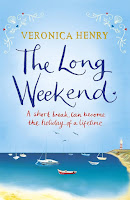
The Long Weekend (by Veronica Henry)

The Long Weekend by Veronica Henry
(Amazon UK link)
I read a few books by Veronica Henry a few years ago, and liked them very much. So I added a few more to my wishlist. One of them, which I was given for Christmas 2020, is ‘The Long Weekend’. It sat on my to-be-read shelf for over two years - I’m not entirely sure why - but I finally picked it up to read a few days ago.  


It’s a novel set over the course of a long bank holiday weekend - with a few flashbacks into the past - but it involves rather a large cast of characters. What links them is a luxury and somewhat quirky hotel in Cornwall, called ‘The TownHouse’.  It’s run by a couple called Claire and Luca; he is a superb and creative chef, she is an excellent administrator. 


They only have eight rooms, of varying sizes, but they’re almost all going to be occupied over the weekend. They also expect lunch visitors, and quite a crowd at the bar, so Luca, Claire, and their receptionist Angelica are going to be busy. 


Early in the book there’s a paragraph explaining who the visitors will be, as Claire consults her list and reminds herself; this was useful to me, since each section involves a different person or group, and it was quite hard, at first, to remember who was who. 


There’s a wealthy couple who visit regularly, and who have a proposal to make to Luca and Claire. I’ve already forgotten their names. There’s a man called Colin, coming with a ‘friend’ and her daughter, taking up two rooms. There’s a young couple, Laura and Dan, who have booked the very smallest room, one that’s only really suitable for a single person, and there are three rooms booked by six men coming on a stag weekend. They have promised not to be rowdy or to do anything embarrassing. 


Naturally, since the novel revolves around these people, there are secrets from the past, some of which unfold during the course of the story. Claire has a shock when she sees the groom from the stag night; she knew him many years earlier. Colin has managed to keep a significant part of his life a secret from his wife and family, and Laura is searching for her father, whom she has never met.


I found the stories interesting, although as the different groups of characters don’t interact with each other, the book feels more like several short stories spread out, switching from one to another to draw them out and to give a bit of tension. I thought Claire’s flashback story was probably the most interesting and developed part of the novel, but the people I liked best were Laura and Dan. 


The stories are quite engaging, and I found myself turning the pages wondering what would happen. The writing has a nice pace, and the conversations mostly feel believable. There’s nothing particularly deep, but as a light holiday read, it’s a good book, albeit fairly typical chick-lit. 


However. I didn’t find any of the characters fully three-dimensional. This may be because there are so many, and we only get their stories in short chapters spread through the book - so there’s nobody I could relate to.  I also thought there was rather too much emphasis on physical passion; two of the stories involve times of infidelity in the past, supposedly indulged in due to the heat of the moment, impossible to resist - which doesn’t feel realistic, and made me less interested in the characters concerned. 


Even less believable are two instances in the book of sudden, unplanned bedroom scenes, and one, not unplanned, but rather sordid. Thankfully there’s not too much detail in most of the encounters mentioned, and the two unplanned ones are instrumental in moving the plot along. 


They’re minor gripes, but the latter one means I wouldn’t recommend this to teenage friends, or, indeed, anyone who doesn’t like reading about this kind of thing.  


But if you’re looking for some light reading, and don’t mind the many people with different stories, and an ending that leaves some of the threads still rather open, it’s worth trying. Despite all the above comments, I did enjoy reading it, and often read fifty or more pages at a time, wanting to know what would happen in each of the different stories.


Review copyright 2023 Sue's Book Reviews

22 Feb 2023

Morgan's Passing (by Anne Tyler)

Morgan's Passing by Anne Tyler
(Amazon UK link)
I’m re-reading the novels I’ve acquired, over the years, by Anne Tyler. She’s an American novelist whose work I was first introduced to about three decades ago when we lived in the United States for a couple of years. I very much like her quirky style and her way with words, but recall almost nothing about any of the books. I last read ‘Morgan’s Passing’ in 2002, although apparently I didn’t review it afterwards. 


The novel opens with a village fair, and a puppet show. The children are getting a bit fidgety as Cinderella and the Prince are having a conversation at the ball, and even more so when the puppets disappear entirely. A young man emerges from the puppet booth, offers everyone their money back, and asks if there is a doctor in the house.


My first thought was that someone (‘Morgan’, perhaps?) had died, and that the book would then flash back to his life, or possibly move forward into the aftermath. However it turns out to be a different kind of emergency, affecting the young man’s wife. Morgan is the man who comes forward and takes charge, dealing competently with the problem and then driving the couple to the hospital.


However Morgan is not all he appears. Or, rather, he appears to be a good many different people, and everyone knows him differently. He’s eccentric in his dress - with many hats and outfits in his possession - and a neglectful tolerance of his own family. His wife Bonny looks after him well, if a little haphazardly, and they have five daughters, most of them teenagers when the story starts. 


But for some reason Morgan becomes obsessed with the young couple he has helped, and starts stalking them. It seems rather creepy in today’s society; but this book was first published in 1980, when, perhaps, such things were considered less unacceptable. It’s not that he intends any harm; far from it.  Sometimes he isn’t sure why he doesn’t go right up to them and start talking. He’s not even very good at hiding, since the couple are aware of his presence, but they feel too embarrassed to speak to him.


I wondered if they were going to continue in this way, never actually getting to know each other, but they do in fact meet at last, and become quite friendly.  Morgan’s wife Bonny likes them too, but to leave it like that would not produce a story. Instead, Morgan does something irresponsible and immoral, which made me entirely lose my mild liking for him and for the other person concerned.


I kept reading; the writing is good, the dialogue clever and light-hearted in places. There are some caricatures (such as Morgan’s mother and sister) which are rather sad, although probably intended to be amusing. Morgan himself is so weird that I never really believed in him. And the ending all seems rather depressing.


It took me over a week to finish this; the chapters are short and it’s not heavy-going, but I found that after two or three chapters my mind started wandering. I was never gripped, nor did I care much what was going to happen next.  Definitely not one of Anne Tyler's best novels. I didn’t hate it, but it’s not a book I expect to read again.


Review copyright 2023 Sue's Book Reviews

15 Feb 2023

This is how it Always is (by Laurie Frankel)

This is how it always is by Laurie Frankel
(Amazon UK link)
It’s only a little over two years since I read Laurie Frankel’s novel ‘This is how it always is’.  I thought it a wonderful book, which covered some significant contemporary issues with empathy, poignancy and some humour too. I recommended it as a good discussion starter for our local book group, and it was allocated for this month.


Since I had read the book so recently, and recalled the basic plot and characters, I wasn’t planning to read it again prior to the meeting. But on Saturday, after finishing the last book I was reading, I picked it up, to remind myself of the opening chapters. I thought I might skim the first hundred pages or so, and maybe dip into the rest.


I got so caught up in the story and enjoyed the characterisation and conversations so much that I read the entire book again. It’s not a short novel - over 400 pages - and I didn’t manage to finish it again before the meeting on Monday, but by then I had re-read three-quarters of it; I finished the rest later in the evening, and yesterday. I loved it just as much as I did the first time; possibly more, as I could remember the main storyline and was therefore less tense about what might have been coming. 


It’s a story about a delightfully bohemian, loving family in the United States. Rosie is a doctor, Penn a writer who works from home. Rosie is the main earner of the family, while Penn does most of the cooking, laundry and general housework, as well as taking children to and from school or other activities. When the book opens they have four sons: Roo, Ben, and the twins Rigel and Oriel. But it’s clear that they are about to conceive a fifth. There’s humour and drama right at the start, as Rosie tries several folk-lore or superstitious methods to conceive a girl. 


But the result is Claude. They love him, and he’s a great addition to the family. They’re all unusual children, in their way. Roo loves sport, and also plays the flute very well. Ben is a geek, highly intelligent and far ahead of everyone else in his class, academically. The twins are creative, inventive and loyal to each other. Rosie and Penn have a philosophy of saying ‘yes’ for almost anything, so long as it doesn’t hurt the child or someone else. And while there are inevitable family squabbles, there’s a lot of love, too. And a bedtime story, a fairytale created by Penn, which is ongoing and forms a kind of metaphor for the whole novel. 


However when Claude turns five, his parents realise there’s something extra about him - something different, which they deal with extremely well. Unfortunately not all their neighbours and friends are so flexible or accepting, and there are some very unpleasant scenes before they decide to pack up and move to a more liberal State, which is fine for a while…


It’s a book about parenting, about unconditional love, about the unfair differences between expectations of boys and girls, of men and women. There’s an interlude in Thailand which is revealing in more than one way, as Rosie works temporarily in a makeshift hospital without any of the equipment or drugs she would expect in an American hospital. And it helps her - and her youngest child - see their issues and the future options in a more relaxed, open way. 


The author has managed, in this remarkable book, to demonstrate a controversial issue through her characters in ways that educate, enlighten and enable empathy. No doubt there are those who would disagree, but for anyone with a reasonably open mind, or who is willing to have possible prejudices or ignorance challenged, I would recommend this book very highly.  It falls under the women’s fiction category, but could be read by anyone, older teenagers, and adults of any gender (or lack thereof). 


I’m pleased to report that the book was liked by everyone in the reading group, and it certainly provoked some interesting discussion. There are some questions intended for reading groups at the back of the book, but by the time we looked at them we realised we had already discussed almost all of the issues that were suggested.


Review copyright 2023 Sue's Book Reviews

11 Feb 2023

Other People's Secrets (by Louise Candlish)

Other People's Secrets by Louise Candlish
(Amazon UK link)
I’m glad I decided to re-read the novels I’ve acquired by Louise Candlish. Her writing is excellent, and while some of her more recent books are very tense, the older ones are a bit gentler. The plotting is still extremely well crafted, and the characters well-drawn, and once I get into any of her books they become quite difficult to put down.


I’ve just finished reading ‘Other People’s Secrets’, which I previously read nearly nine years ago. I had totally forgotten the storyline, and all the people. And it’s an interesting cast. There are two main families, and the ones I liked the most were Adam and Ginny, a young couple who - as we learn very quickly - have recently had a terrible tragedy in their lives. They have come to stay in a boathouse by a beautiful Italian lake. Adam, who is a very caring person, hopes it might begin the healing process. Ginny doesn’t really want to be healed…


In strong contrast is the wealthy Sale family. They are staying at a large, somewhat pretentious villa on the same site as the boathouse. Marty, the father, is an outgoing, friendly guy who has made his money with a huge clothing brand. Unfortunately (and, again, we learn this very early in the book) he has been persistently unfaithful to his wife Bea. She’s put up with a great deal, perhaps because there’s a lot about Marty that’s very appealing - he is generous, welcoming, and a good father. But she’s come to the end of her tether and, when this family holiday is over, she plans to divorce him. 


Marty and Bea have three adult offspring. Dom, the oldest, is irritable and grouchy throughout the book, and evidently has a secret which only his mother knows about. Second is Esther, who’s quite close to her mother but perhaps the least three-dimensional character. The youngest, just 18 and a recent school-leaver, is Pippi. Pippi is keen on fashion, she’s as outgoing as her father, and she’s also quite naive. 


Given their proximity, it’s not long before Adam and Ginny meet the Sale family, and are gradually drawn into their circle. Bea and Ginny exchange a few secrets, but there are other secrets permeating the book, including one that’s mentioned in the prologue but which isn’t revealed until close to the end of the story.


There’s another important character in the book, a young man called Zach, who is staying in the nearby town. Pippi is attracted to him, and invites him to spend time with her family. He’s quite willing to do so even though nobody knows anything about him. And he’s not a very forthcoming person…


These eight people are the cast of the story, along with some minor characters who are fairly shadowy. I think I would have liked Esther, but we don’t really get to know her. I realise I liked Bea very much the first time I read the book; this time I found her a bit too accommodating, unwilling to form her own opinions. And she does something rather shocking - though perhaps I remembered it subconsciously from my first reading of the book - that meant I found her increasingly difficult to relate to.


It was Ginny, this time, whom I found the most sympathetic character. I’m thankful I haven’t suffered what she did, but I could still feel some empathy with her, in her grief, and the way she becomes irritable, or snappish at times, and at others feels unable to move even a limb. Her husband Adam is very likeable, even if he’s a bit abrupt with Zach whom he doesn’t much like. I could sympathise with Adam, too, trying to rationalise his feelings, talking about stages of grief, dealing with Ginny’s outbursts as if they were natural steps. The problem is that he keeps telling her what he thinks is going on, which obviously does not help at all. 


It’s a cleverly written story, the secrets coming out at just the right time, keeping me turning pages long past the time I was intending to sleep, or get on with chores. I had not remembered any of the secrets that are revealed towards the end, although I had partly guessed at Zach’s (with some of the details wrong). My only gripe with the book, really, is the casual assumption that everyone - particularly teenagers and students - is regularly promiscuous as a matter of course. Perhaps it’s the case in some circles that I have never been part of, but the way everyone expected it left a bit of a sour taste. 


There’s rather too much smoking, too; something I expect in older books but it seemed unnecessary in this one. And Bea’s casual attitude to one of the secrets, and to an important issue it brought up, felt jarring. 


But other than those, which are minor details (and bugged me in part because the characters got under my skin, so I didn’t want them doing the things that felt out of character!) I thought the book was excellent.  Very highly recommended to anyone who enjoys women’s fiction with a clever, unpredictable plot and a few significant issues.


Review copyright 2023 Sue's Book Reviews

10 Feb 2023

The Powerful Purpose of Introverts (by Holley Gerth)

The Powerful Purpose of Introverts by Holley Gerth
(Amazon UK link)
I don’t remember where I came across a recommendation for the book ‘The Powerful Purpose of Introverts’. It’s not the kind of title that would usually appeal to me, and I had not heard of the author, Holley Gerth. However, I must have seen something about it that persuaded me to put it on my wishlist. I was given it for Christmas, and started reading it a couple of weeks ago. 


Had I seen the subtitle when I decided I’d like this book, I might have been put off entirely. ‘Why the World needs YOU to be YOU’ is rather a scary idea. Not that I mind being me, but I’m pretty sure the world doesn’t need me at all. However, it's the only thing I didn't like The writing of the book is, in my view, excellent. I loved the style, and the information and checklists and general recommendations. The writing felt chatty, as if I were talking to a friend. I only read about ten pages per day as there was so much to think about.


The book starts with a bit of science, as the author looks at what makes people either introverted or extraverted. Some of the personality books claim that this is the least significant of the personality preferences, and I guess that’s true from the point of view of how we learn, and how we make decisions, and so on. 


But if this book is to be believed, and it seems that the author has done her research well, introversion and extraversion are hard-wired into our brains. We use and react in different ways, physically, to different hormones. In lay terms (which is how I operate) it’s why extraverted people are energised by activity and parties, while introverts find them draining. That’s not to say that introverts don’t enjoy them - it’s that they need to recharge afterwards, while extraverts are charged by activity in the world.


I found this immensely reassuring, as was the reminder that everyone is unique, that we all process things a bit differently and that there are degrees of introversion and extraversion.  According to one of the brief checklist tests in the book, my introversion is at about 85%. 


The author goes on to mention the Myers-Briggs personality test - her preferences are apparently the same as mine, which may explain why the writing style resonates so well. She mentions other systems of categorising people too, such as the Enneagram, and points out how there are so many different ways of relating to the world and to each other.


I found the whole book fascinating - much of what is said was not new to me, but I appreciated very much the way it was said. There’s a low-key Christian theme, but it’s not at all preachy. Someone of  no faith could skim or miss out the references to God, and our callings and beliefs. I knew that God loves me as an individual; I’m fortunate to have grown up knowing I was loved by many family members. But it’s still easy to think of oneself as a bit dull, or feeble, or lazy, when not involved in a lot of activities and meetings. 


I was most impressed with the final chapter, where the author talks about a ‘vision statement’, acknowledging that this sounds rather formal and that not everyone wants one. But she walks through what she means, with more checklists, and I could see it - not just one but four different ways that, as an introvert, I can play my part with those around me and in the wider world. 


I would recommend this book very highly to anyone who is an introvert, or who is concerned that they need a lot of time alone and wonder if it’s okay. Some extraverts might find it helpful too. In the US, where the author is based, it’s not easy to be a quiet, home-loving person as the culture there is so outgoing, bright and lively. Growing up in the UK, it wasn’t so difficult. But still, it’s not always easy to say ‘no’ to social activities, or staying up later than I want to.  It's very hard saying when I've had enough (temporarily) of being with people I love very much. This book gives a kind of permission, couched in the science of why it’s important to listen to our instincts.  


I ended the book feeling validated, encouraged and with a much more positive outlook than I have had for a while. It’s a book I hope to read regularly, and which I may dip into at odd moments too.


Review copyright 2023 Sue's Book Reviews

8 Feb 2023

Home to Witchend (by Malcolm Saville)

Home to Witchend
(Amazon UK link)
I have very much enjoyed revisiting Malcolm Saville’s ‘Lone Pine’ series for teenagers over the past two-and-a-half years. I’ve read one book every month or so, interspersed with other books, rather than all twenty consecutively. I have just finished the 20th and last in the series, ‘Home to Witchend’, which I last read at the end of 2010, just over twelve years ago. 

My edition of this book is an Armada one, but as far as I understand it, it was published like this - on the front it claims to be an Armada Original - so my book isn’t abridged, unlike the other Armada editions I had read in the past. For that reason, I didn’t make any attempt to get hold of a more recent ‘Girls Gone by’ publication of ‘Home to Witchend’. I may do so at some point if it is printed again, as I gather it comes with a short story as well as interesting information about the author and the series. 


I knew this book was a way of ending the series with a reunion of the entire Lone Pine crew, along with their parents and close friends. I knew that two of the three older Lone Pine couples were going to make interesting announcements. But I had entirely forgotten the details of the story. I hadn’t even remembered that the evil Miss Ballinger returns along with her supposed niece, and the man who first appeared in ‘The Gay Dolphin Adventure’...


Action switches between the Lone Pine activity and that of the baddies. I’m always more interested in the relationships and interactions between the Lone Piners, particularly David Morton and Peter (Petronella) Sterling, who know they’re going to spend their lives together. They haven’t seen each other much, recently, as Peter works in a stables in Shropshire while David has been working and studying in London. Peter starts to wonder if David has found more glamorous girls in the city, and is feeling quite insecure as the book opens. She also begins to wonder what her father really thinks of David. 


Tom and Jenny are mentioned several times but don’t have huge parts in this story; Jon and Penny don’t even appear until later in the book. But there’s plenty about David’s twin brother and sister, Richard and Mary, who are almost twelve but don’t seem to have matured much since their days of being nine in ‘Mystery at Witchend’. 


David is 18 in this book, Peter about to have her 18th birthday, and I was a bit surprised to learn that Jenny, who used to be younger than Peter, is now six months older. But ages are flexible in these books which span several decades - the author deliberately kept his main characters the same ages in the first few books and then allowed them to grow up just a little, although the culture and environment around them moved forwards with the author. 


There’s quite an exciting plot involving some forged bank notes - that’s the part I had totally forgotten - which David and the twins stumble upon. David really wants to concentrate on his girlfriend, but Richard is keen to be a journalist and wants to report his findings to his friend James, a journalist with a big newspaper. And, as happens in all these books, adventures just happen around them. 


I thought this book was a good blend of relational interactions and excitement, with some tension as people get caught up in danger, although we know they’re going to be rescued eventually. And while the ending is perhaps a tad over-organised, it works well to tie up the entire series, leaving open a future with the younger Lone Piners and some new recruits while the older ones pair off, remaining true to each other but no longer interested in tracking strangers or watching birds.


Malcolm Saville had quite a gift of description - without it becoming dull - and characterisation, and as with his other books, the writing in ‘Home to Witchend’ is just the right pace for my tastes. It’s not a book to read as a standalone; although each adventure is complete in itself, this one brings together so many characters from other books that it would be very confusing to a new reader.  However, to anyone (teenager or adult) who has loved other books in the series, this is highly recommended. 


Review copyright 2023 Sue's Book Reviews

5 Feb 2023

The Shock of the Fall (by Nathan Filer)

The Shock of the Fall by Nathan Filer
(Amazon UK link)
I often pick up interesting-looking books at church book sales, and they then sit on my to-be-read shelf for months, sometimes years. That was the case with ‘The Shock of the Fall’, a book I bought in March 2021, and have only just read. I had never heard of Nathan Filer, and while the front cover looks intriguing, glittery and inspiring, it appealed less when I realised it wasn’t anything to do with the ‘fall’ of mankind as documented in Genesis.

However, I’m determined to read through my unread books in the next year or two and have them arranged alphabetically by author. So I finally got to it - and while the blurb on the back made it sound as if it could be quite heavy-going, it turned out to be very readable.

Matthew (Matt) is the narrator, a young man suffering from a serious psychiatric disorder. It’s made fairly clear what that is early in the book although it’s not spelled out until near the end. He’s typing up his memories, some of them at the Day Centre he goes to for his medication and for some therapeutic classes. Then he’s given a typewriter and the font changes, as he types at home.

The memories are somewhat disjointed, and interspersed with the ‘current’ time in Matt’s life, but I didn’t have much trouble working out which part of his life was being written about. It’s cleverly done, giving the impression of someone who doesn’t always remember everything, and is easily distracted.

The main theme of the book, which we learn about in the first chapter, is the death of Matt’s brother Simon. Simon was a few years older than Matt, but seemed younger because he had Down Syndrome. However he was bright and  verbal, and a good playmate to Matt even if he sometimes walked a bit strangely. Typical of people with this syndrome, Simon was very caring too. Matt misses him, and his parents are still grieving ten years later, his mother on medication for depression.

We don’t learn exactly what happened to Simon until almost the end of the book, but it’s clear that Matt was involved in some way, and feels a sense of responsibility, sometimes guilt. But he also keeps imagining he sees and hears Simon. There’s a bit of school science thrown into the mix, as Matt learns about the way atoms function, and how everyone is really part of everyone - and everything - else. Whether that’s how he perceives his late brother, or whether he’s imagining him as a child might, or whether he’s truly believing he’s there is not made clear, though he believes he has the condition for which he’s treated.

It’s a well-written story, about loss, and childhood puzzlement, and about the difficulties of being a psychiatric patient when one’s IQ and general intelligence is normal. There are bleak descriptions of the tedium of a psychiatric ward in a hospital, and of the day centre visits, which I’m sure are well researched and authentic.

I don’t think it’s a book I’ll read again, but I’m glad I read it - it’s not my usual genre, and not even one from the local reading group although it could lead to some interesting discussions. Not suitable for children or younger teens due to the subject matter and quite a bit of ‘strong’ language, but I’d recommend this, in a low-key way, to older teens or adults interested in learning a bit more about mental illness, with a bit of tension as we try to figure out what exactly might have happened to Simon - and what the significance was of the small girl mentioned in the first paragraph.

Review copyright 2023 Sue's Book Reviews

3 Feb 2023

The Quiet Gentleman (by Georgette Heyer)

The Quiet Gentleman by Georgette Heyer
(Amazon UK link)
After re-reading some of Georgette Heyer’s 20th century crime fiction novels last year, I decided to return to my more normal Heyer diet, that of her historical romances, for which she is better known. I decided to start with ‘The Quiet Gentleman’ since I hadn’t read it since 2015, even though I recalled that it wasn’t one of my favourites.

I had entirely forgotten the characters when I started this. Gervase, the new Earl, is the hero, the ‘quiet gentleman’ of the title. His father died a year before the book begins, when Gervase was a soldier, involved in wars abroad. He’s now returning to take his place at Stanyon, one of the estates left to him. It’s occupied by his stepmother (though Heyer insists on calling her his ‘mother-in-law’), his younger half-brother Martin, their cousin Theo who manages the estates, and a chaplain who is a very minor character.

The Dowager is an opinionated woman who can't be more than about fifty, if that, but behaves as if she’s much older. She regularly changes her mind about people and events, likes to give monologues about family connections, and rarely agrees to anything unless she’s had an idea herself. She thinks that Gervase, who is so quiet and apparently amenable, will follow whatever she wants. He turns out to have not just a mind of his own but a strong will too, and is used to being in command. Much of the humour in the book is found in the Dowager’s lengthy and sometimes ridiculous speeches.

Staying with the Dowager is Drusilla Morville, who is described as a short, slightly plump and ordinary looking young woman who is full of common sense. She’s always willing to help, and is very likeable, and she grew on me as her personality and feelings develop through the novel. I had not recalled her at all, which I suppose ties in with her seeing herself as a forgettable nonentity. There’s a beautiful neighbour, too, called Marianne whom all the young men seem to be a little in love with. Marianne is quite naive, but full of integrity, and also surprisingly likeable.

Martin is a hot-tempered young man who resents Gervase, as he had been brought up as if he were going to inherit everything. He was his father’s favourite, and has been quite spoiled by his mother, so he tends to lose his temper and become irrational. Theo works hard and seems to be committed to helping Gervase’s interests, particularly when one or two accidents start occurring, and it doesn’t seem as if they’re all unintentional…

When I was just a chapter or two into the book, I confused it with ‘The Unknown Ajax’, which features another ex-army man with a resentful family, but which has smugglers and a dramatic denouement which is very cleverly done. I quickly realised my error and by the time I was half-way through had remembered the outcome, although not much of the detail. I’d quite forgotten who the book’s heroine was - and it’s not something that’s really mentioned until towards the end.

The story is quite exciting, whether or not one knows the outcome and who the ‘villain’ turns out to be. I liked several of the characters, and although it’s still not one of my favourites, I did enjoy re-reading ‘The Quiet Gentleman’. The writing is good, with an nice pace and meticulous attention to historical accuracy, as I’ve come to expect with Georgette Heyer. I liked the ending scene too; it’s not as abrupt as in some of the author’s books.

Not necessarily recommended as an introduction to Heyer’s work, as it's a tad heavy and over-detailed in place. But well worth reading if you’re a fan of her writing.

Review copyright 2023 Sue's Book Reviews