I do like the late Mary Stewart’s writing. I first discovered some of her gothic style romantic thrillers when I was a teenager. I found them somewhat frightening, but also compulsive. As an adult I acquired some titles I recalled, and some which I don’t think I had previously read. One of those is ‘Nine Coaches Waiting’, which I read, probably for the first time, in 2005. So it was more than time for a re-read.
As so often happens after a gap of more than a few years, I had entirely forgotten the plot and the characters. Linda Martin is the main protagonist, and her story is told in the first person. I quite like this style, as it ensures that the character must at least survive by the end of the book. It also enables the reader to get inside the character’s head and see things from their viewpoint.
Linda is on her way to a chateau in France when we meet her. She spent some of her childhood living in France, but was then orphaned at fourteen, and lived in an orphanage in England. She was happy enough, but she’s half-French, and is looking forward to her new job as governess to nine-year-old Philippe. She only met her future employer briefly, and did not admit that she speaks French as fluently as English, as her main role is to speak only English to her charge.
This omission grows out of proportion in the first half of the story. Linda has to speak bad schoolgirl French to attempt to make herself understood to some of the household staff, and to shop owners. Her efforts provide light-hearted episodes in what is otherwise a very tense story. Mary Stewart had a tremendous gift for creating an evocative, scary atmosphere in just a few words, and by the time I was about a third of the way in, I could hardly put the book down.
Philippe is staying with his aunt (who interviewed Linda) and uncle Leon, who runs the estate despite having been badly injured and disabled in an accident. He has an electric wheelchair and the house is adapted to his needs, although he is sometimes bitter about the things he cannot do. Linda doesn’t know if he likes her or not; sometimes they are worryingly in rapport. At other times she finds him terrifying.
Then she meets Leon’s son Raoul, who manages another family estate, and is rather devastatingly attractive…
Events happen rapidly once the scene is set, and Linda becomes more and more concerned. She doesn’t know who to trust - and, reading the book, I didn’t know either. Could she trust the stolid English housekeeper Mrs Seddon, for instance? And what about the forester friend she meets, who tries to educate her about trees? Most importantly, can Raoul be trusted? And what about Philippe’s favourite Uncle, Hippolyte, who is absent for most of the book?
I had, perhaps, some vague memories towards the end of the book as I was pretty sure I knew who were the ‘bad’ guys, but I couldn’t be certain. But I had no memory of the stressful escape and hiding that forms the lengthy climax to the book, nor of the outcome, once it’s clear who was responsible for some nasty attempts on Philippe’s life, and who was trying to help him.
I very much liked the character of Philippe, and his growing friendship with Linda is one of the nicest underlying subplots of the story. I liked Mrs Seddon, too, with her fluent but atrociously accented French (I had to say ‘oh dick alone’ aloud before I realised what her favourite scent was). And while I’m not usually a fan of such tense books, this one was so well done that I expect I’ll read it again in another ten years or so.
The book was written as contemporary fiction in the late 1950s so while it seems like historical fiction from the perspective of sixty years later, it also feels very authentic. The snippets of poetry used at the start of each chapter (and from which the book title came) went somewhat over my head, but that didn't matter at all.
Definitely recommended if you like this genre of mid-20th century fiction.
Review copyright 2019 Sue's Book Reviews
In re-reading my Rosamunde Pilcher novels again over the past few years, I reached the one that is probably my least favourite: ‘The End of Summer’. It’s quite a short book - only just over 150 pages - which I last read in 2010.
Jane is the main character of this novel, and it’s told in the first person. We first meet her when she’s sitting on a beach in California, and gets chatting to a surfer. We learn from her conversation and her thoughts that she lives in a small house, essentially little more than a shack, with her father. She is not particularly well-organised, and has no real ambitions other than to keep house with him, and enjoy the sunshine.
Her father is away on business, but Jane’s dog Rusty is a faithful companion, and she doesn’t expect any visitors. So she’s rather surprised when a man arrives, who turns out to be her grandmother’s lawyer David Stewart. Jane’s grandmother lives in Scotland so she fears the worst, but is reassured. It turns out that she has written several letters to Jane’s father, urging Jane to go on a visit, and they have not received a reply.
Jane would love to visit her grandmother, who lives in a large house where she has fond memories of holidays. But she is pretty sure her father would be unable to look after himself. She knows, too, that he and her grandmother had quite a heated argument before he brought Jane to live in the United States. So she turns down the offer, but David says a flight is booked, and he’s not leaving until the following day, so if she changes her mind she can let him know.
In the morning, Jane’s father arrives home with someone else, so Jane decides that she will, after all, go with David to visit Scotland. Most of the book then takes place there, as she re-acquaints herself with old friends, and places she loves, and also her cousin Sinclair. He was her best friend when they were growing up, and she has romantic inclinations towards him….
I’ve read this book often enough that I remembered the broad outline of the plot. I recalled that Jane was going to have an unexpected visitor, and that she would fly back to Scotland. I also remembered the rather shocking climax to the book, in the penultimate chapter. But I had forgotten a lot of the detail: of Jane’s relationship with her grandmother, of the delightful people she talks to, mostly staff or other local workers. I had forgotten, too, all the things she learns about her family, in particular Sinclair’s father.
Rosamunde Pilcher’s greatest gift, in my view, was the way she created such three-dimensional characters. I could relate to Jane so strongly that I felt sorry to see the story end. There is an entirely satisfactory conclusion, albeit a tad predictable, and in the aftermath of tragedy. David Stewart is very believable, too, as is Sinclair and even Jane’s father, though we only meet him briefly.
Even my least favourite of Pilcher’s books is still a very good story, and I shall no doubt re-read this yet again in another decade or so.
Review copyright 2019 Sue's Book Reviews
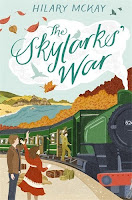
It's nearly eight years since I first read ‘Saffy’s Angel’, which was my introduction to the excellent children’s writer Hilary McKay. I started collecting others of her books, and have enjoyed them all. So when I saw that she had published a new book which had won an award and was very highly recommended, I decided to put it on my wishlist. I was given ‘The Skylarks’ War’ for my birthday a couple of months ago, and have read it over the past two days.
It’s primarily written from the viewpoint of a girl called Clarry. She was born ‘over 100 years ago’, as the start of the book tells us, and nobody was happy about her birth, other than her mother. Then her mother died. Clarry has an older brother, Peter, who was devastated and really didn’t want a new baby in the house. Their father is distant, a presence in the house but devoid of any real emotion.
Their grandmother comes to stay for a while but she has another grandchild, Rupert, to look after, at her home in Cornwall. Rupert is rather older than Peter and his parents work abroad. Rupert is very fond of his cousins and always there to greet them when they are older and go to stay for their long summer holidays.
Clarry is a likeable girl, despite the many disadvantages of her childhood. Peter soon accepts her as a willing shadow, admirer and fulfiller of most of his wishes. But always in the back of Clarry’s mind is a sense of guilt; she is convinced that it was her birth that killed their mother.
The book is written in short chapters, following Clarry as she grows up. She is bright, as is clear from the start, and eventually manages to get a place at a good girls’ school, and eventually at university. But the shadow of World War I is around her, although she’s mostly oblivious to it. Some of her immature ideas about the nature of war would be amusing if the reality were not so appalling. And when her cousin Rupert signs up and is sent abroad, he keeps his letters sanitised, talking about the countryside and the friends he makes, while playing down the horrors.
The style is very readable. It reminded me a little of Noel Streatfeild at the start, and also in the final, surprising and satisfactory but rather abrupt ending. It reminded me in places, too, of Michelle Magorian’s fiction. And there’s a style all of its own. The author had clearly done a great deal of research, and for the most part the historic parts tie in seamlessly with the fictional story. Clarry doesn’t feel entirely like a girl from the Victorian era; although she’s hemmed in by convention and adults, at times she speaks like a rather more up-to-date girl. It doesn’t matter too much; younger readers probably wouldn’t notice, and this is intended as a book for older children or younger teens.
It’s primarily a character-based book, and the main people were distinct enough to be memorable. The short chapters the excellent writing pulled me in, so that despite it being quite a long book, I finished it in just a couple of days. It’s an ambitious project, writing realistic children into situations 100 years ago, and on the whole I thought it very well done.
As a book intended for children, it’s not surprising that there’s no extreme gore or violence described, although there are some brief scenes that might upset a sensitive child. There are some shocks; two characters are casualties of war. There’s no strong language, and only the faintest hints of intimacy and love. On the whole families are contented, too, and care for each other. Peter and Clarry are emotionally neglected by their father, but much loved by their grandmother. There are neighbours who keep an eye on the children, and servants who look after them, meeting their physical needs.
And yet… for some reason, this book didn’t have the same emotional impact on me as, for instance, Noel Streatfeild's 'When the Siren Wailed', despite being rather better written. I can see that it’s a well-crafted book, and have already recommended it to friends who are interested in war-years books. I liked it very much. But somehow I didn’t fall in love with it quite as much as I expected to.
Still, definitely recommended to anyone from the age of about nine and upwards who likes character-based historical fiction.
And should anyone be interested... this is my 2000th book review on this blog, which I started in April 1999.
Review copyright 2019 Sue's Book Reviews
I collected and read all of Libby Purves’ novels over a decade ago, and have only recently started re-reading them. It’s sixteen years since I first read ‘Home Leave’, and I had entirely forgotten what it was about.
It opens with a prologue introducing Robert Grafton, at a New Year’s Eve ball in Vienna, in 1950. There he met and fell in love with the beautiful Diana. Robert was a diplomat, and she made an excellent diplomatic wife, happy to pack up and move every few years as they travelled around the world. However she didn’t find motherhood particularly rewarding. Her role in the book is as the mother of the children, but by 1996, when most of the action takes place, Diana has died.
The first chapter introduces her four very different children, and most of the story focuses on them. But the main protagonist, at least in my mind, is the oldest: Catherine, or Cat, as they call her. She’s just past forty, married to the altruistic Gervase, who is a farmer. He farms by old-fashioned methods, cruelty-free as far as possible. And he runs a scheme using ex-convicts to work in the open air and absorb some of his values. He doesn’t take on any dangerous criminals, and on the whole, it has been a success.
Cat has two teenage children from a previous marriage, and she works as a freelance writer for a large corporation. She likes to organise family gatherings, and keeps a motherly eye on her younger siblings. She’s a classic oldest child who had a temporary aberration as a young adult but has appreciated being rescued, first by her former mother-in-law Noreen, and then by the handsome Gervase. I liked Cat very much.
Toby is the second oldest; he was quite wild as a child, and is still somewhat unpredictable even in his late thirties. He’s been travelling around the world, writing shocking lyrics for songs, living a bohemian lifestyle. His brother Mark is a few years younger, and entirely different. He was a stolid child, his mother’s least favourite. He works for a large corporation, and is fairly recently married to Lindy whom he adores.
Then there’s Caroline. We get to know her early in the book when Cat finds a hotel reservation has fallen through, and she goes to spend the night at her sister’s house. Caroline was her mother’s favourite; she’s the typical ‘spoilt princess’ youngest child, perhaps a tad caricatured and not particularly likeable. But I felt sorry for her too; her husband Alan is clearly a very unpleasant (and unfaithful) person. Caroline is expecting her first baby.
There isn’t really a great deal of plot as such. The book features several family gatherings, hosted by Cat, at which we get to know her siblings and their partners, and various other relatives. We also get to know some of Gervase’s current helpers: Duanne is not particularly bright, but is very willing to work. Gary is angry, and doesn’t really care what happens to him. There’s Martin, too, a young American man taking a gap year before doing his PhD in the United States. He is very interested in Gervas’s methods, and is extremely helpful. And then there’s Winston, who doesn’t really feature much until Caroline and her baby come to stay for a while, and he proves to be an expert at child-care.
Some of the characters are caricatures - Gervase’s mother, in particular - but that’s okay. They were all easily distinguishable, and indeed memorable; I didn’t have to check any of the names despite having finished the book 24 hours before writing this. Not that I recalled any of the plot at all from my prior reading. There are some unexpected turnings in the story, and some shocks which I did not see coming. The blurb on the back mentions one particular facet of the story which proves a catalyst for the siblings to venture out of their comfort zones. This moves the story onwards, bringing some healing to Caroline, who is quite depressed after her baby’s birth, and some unexpected freedom to Cat.
Overall I found it a very enjoyable story, set as it was in several different locations, featuring different people and attitudes. There is a sense of family unity that pervade even the arguments and jealousies that arise from time to time, and a great deal of genuine niceness. I was not expecting the final surprise of the book, even though it was something I would expect to have remembered, and I absolutely loved the final paragraph.
Definitely recommended.
Review copyright 2019 Sue's Book Reviews
I have been collecting Georgette Heyer’s novels since my late teens. I love the Regency Romance books, and re-read them regularly. But I wasn’t so keen on the two more serious historical novels, ‘Beauvallet’ and ‘The Conqueror’ which I bought second-hand many years ago. They are full of battles and no doubt very well researched, but not my kind of book at all.
So I hadn’t bought Heyer’s other war-related fiction. But, in discussion on an online group dedicated to this author, several people mentioned that ‘An Infamous Army’ had more than just army-related content. Indeed, I learned that it featured some of the characters from other books: in particular Lord Worth and Judith, now married. They were the main protagonists of the novel ‘Regency Buck’, which I re-read last year. It’s not one of my favourite books but I always liked Judith Taverner, and was eager to read more about her.
‘An Infamous Army’ also claims to be a sequel to ‘Devil’s Cub’, which I also re-read last year. Again, this is not one of my top favourite Heyer novels, but I rather liked Mary Challoner. I was interested to know how she fared when marrying Lord Vidal.
So I put the book on my wish-list and was given it for my birthday a few months ago. It’s quite a long novel - over 400 pages - and it took me five days to finish. It does indeed feature Lord and Lady Worth, married for a few years, and with a small son, although he is only mentioned in passing. Lord Worth’s brother Charles is particularly significant in this book; he is a Colonel in the British army, stationed in Brussels in 1815. That city appears to be a popular place for visitors, despite Napoleon being active in much of Europe.
One of the notorious women in society is Lady Barbara Childe, a young widow who indulges in flirtations and sometimes shocking behaviour, but doesn’t seem to care. Her older brother is referred to as Lord Vidal, and is rather dull; when I discovered that his even duller wife is called Augusta, I was very confused. On learning that his parents were both dead, I felt disappointed until I learned that Lord Vidal of ‘Devil’s Cub’ and his wife are their grandparents, now known as the Duke and Duchess of Avon. They don’t in fact appear until almost the end of the book and have only a small role to play.
There’s a lot of army discussion in the book, probably extremely well researched and accurate; indeed the author evidently quotes letters and dispatches as she weaves her society story around the real history. But the descriptions of armies marching, full of names of generals and officials, left me glazed and confused, so I quickly realised I could skim those sections - sometimes entire chapters - without losing the gist of the story.
And yes, there is a typical Heyer-like plot involving Charles falling in love with someone entirely unsuitable, or so it seems. Charles is a delightful creation, with a good sense of humour and an intuitive understanding of those around him. Judith remains the confident, intelligent person she was in ‘Regency Buck’, with an excellent relationship with her husband.
Towards the end of the book, war becomes a reality, and we learn quite a bit about the battle of Waterloo. I knew, of course, that it would be a success for the Allied troops, and found the ‘Abba’ song going around my head. However, Heyer shows some of the horrors of war; there are losses and serious injuries. In contrast to the words of the song, ‘I feel like I win when I lose’, it becomes clear that many of the survivors would have said, ‘I feel like I lose when I win’, on seeing so much destruction and loss of life. The young men eager to fight on the battlefield soon discovered that the reality was a long way from their idealism. The point is made without any preaching that war is a terrible thing.
I’m glad I have finally read this book, and that I have it in my collection. I’m sure I’ll reread it in another nine or ten years, perhaps soon after rereading ‘Regency Buck’. But I would have preferred fewer war scenes, and a great deal less detail about names of people involved in the war.
Review copyright 2019 Sue's Book Reviews
Every so often I browse the special offers for Kindle books, and download a selection that are free, either long-term or temporarily, and which look interesting. Sometimes it’s years before I get around to reading them, and that’s the case with ‘A Praying Life’ by Paul Miller. He’s not an author I had heard of when I saw this book available free back in 2011, but the reviews of the book were almost unanimously positive so I downloaded it.
I started reading ‘A Praying Life’ about five weeks ago. It's subtitled ‘connecting with God in a distracting world’. I’ve read many books on prayer in the past few decades, so I wasn’t expecting anything dramatically different. But I like to have something like this to read, a few pages at a time, first thing in the morning.
I liked the style immediately. The foreword is honest and encouraging, acknowledging that prayer really isn’t easy, and that the way we talk to God sometimes bears little relation to the way we talk to family members. It’s written by someone recommending the book, and is followed by the iIntroduction, written by the author. In this, he says he never set out to write a book on prayer, but was encouraged to do so by his wife, and the friend who wrote the foreword.
Chapter One launches straight into an anecdote. The author describes an incident in the mountains when he was camping with five of his six children. One of them has a mini-crisis, and it leads on to a cynical question. Paul Miller takes a step back, and examines the way this kind of honest question pervades much of our prayer life, and indeed our general expectations of God and of life itself.
The book is divided into four or five sections, but I didn’t quite follow the divisions. Perhaps that’s because I was reading on my Kindle, where section breaks are less obvious, and one can’t page back to see where a section started, or see a heading above the page. It didn’t matter - the content flowed extremely well, gently peppered with relevant anecdotes from the author’s family life. He admits that he makes mistakes with his children, and that he forgets to pray, or doesn’t trust in God when he does.
So while the main content of the book is not anything that’s new to me, it was written with a different and very encouraging voice. Paul Miller reminds us what it means to come to God ‘like a child’. Children can be demanding and selfish, they often hassle parents, or repeat themselves. And that, we are gently reminded, is just fine. God wants our presence, not carefully formulated prayers. It’s okay to ask about things that seem petty or irrelevant to others; if they matter to us, then God cares.
I’m the kind of person who likes theory to be interspersed with examples from real people, so the style of the book, which does exactly that, was ideal for me. I didn’t agree with every word; I can’t see myself making prayer cards, as the author suggests, for instance. I got a little bogged down towards the end of the book at some of the suggestions, but that’s okay. Not everyone will agree with every word in any book. And the ideas were offered openly, giving the author’s personal experience and some examples of how these cards helped him. That doesn’t mean they are required, or even that everyone would benefit from them.
I particularly liked the idea that we’re all living in a story, whether or not our lives seem to be exciting. I liked the focus on waiting for God to act, on taking a day at a time, a step at a time, consulting God in pretty much everything we do. I don’t know that I’ll remember to follow the advice and suggestions, but I hope so.
The only parts of the book that didn’t appeal to me were some diagrams, which I struggled to understand. But I’m not a visually oriented person; charts and graphs generally leave me cold. But I’m sure they would be of interest to those who like visual aids. And they may well work better in a printed edition of this book.
Highly recommended to any believers - or fringe church members - who would like a reminder of what prayer is supposed to be, and who enjoy books with interesting and relevant anecdotes. The Kindle version I downloaded is no longer available, and the new ebook version costs almost as much as the paperback, at the time of writing. So the link above is to the paperback version of 'A Praying Life'.
Review copyright 2019 Sue's Book Reviews
I only started reading JoJo Moyes’ novels about nine years ago. I enjoyed some more than others, then in 2015 read the very powerful ‘Me Before You’, which I liked very much. I was delighted to learn that there was a sequel, and read ‘After You’ almost exactly a year ago. I was then surprised and even more pleased to discover that there was a third book about Louisa Clark, heroine of the first two books. ‘Still Me’ went on my wishlist as soon as it was out in paperback, and I was given it for my birthday in April.
I have just finished reading the book, and thought it excellent. It’s not necessary to have read the earlier books, but they certainly fill in a lot of the background. We meet Louisa at the start of chapter one as she is going through Immigration in an American airport. She’s rather tired, and a bit jet-lagged already, and finds herself talking to the official in uniform despite his lack of response. It’s a good ploy to give the bare bones of what we need to know from the previous books, and I thought it worked well.
Louisa is starting a new job, working as a personal assistant to a woman not much older than she is called Agnes. Agnes is Polish, and is the second wife of the extremely wealthy businessman Mr Gopnik. Louisa has this job due to the personal recommendation of Nathan, who was a friend of someone she used to work for, and who is Mr Gopnik’s personal trainer.
She is thrown right into a lifestyle she had barely dreamed of before. An army of ‘staff’ look after everything the Gopniks could possibly want. They own two floors of a very expensive apartment building, but barely know their neighbours. Mr Gopnik works long hours and expects his wife to be something of a ‘trophy’, appearing at charity balls and business dinners. She finds this stressful, because so many of the people she meets there were friends with his first wife.
Louisa seems to pick up what she’s supposed to do very quickly, although it’s far removed from what she is used to. Her natural style is bohemian, but suddenly she has to wear a uniform or other conventional outfits. The housekeeper doesn’t seem to like her much, and although Agnes offers a kind of friendship, their relationship is so unequal, with Louisa being a paid employee, that she feels quite lonely at times.
I vaguely recalled that Louisa started a relationship with the paramedic Sam towards the end of ‘After You’, and also got back in touch with her parents and her sister Treena. So part of the story involves her trying to maintain a long-distance relationship with someone who is very busy and doesn’t like writing letters or emails. She also tries to stay in touch with her family, so there are occasional pieces of correspondence given, when they add to the story.
I don’t think it’s as powerful a book as ‘After You’. Louisa has come to terms, mostly, with the anguish and pain she suffered at the end of ‘Me Before You’, but she’s still trying to work out who she is, what she wants out of life, and what matters to her. As such, it’s a very engaging book. I liked her very much; she has integrity and loyalty, and a deep sense of compassion. I liked some of the minor characters, too: her friend Nathan, in particular, and the doorman Ashok.
I liked Sam a lot too. Their relationship goes through rather a roller-coaster of emotions, as they manage to see each other, then some disaster happens. It’s something of a theme in the book, and would be clichéd if it weren’t a relatively minor thread, alongside Louisa’s job.
I really didn’t like either of the Gopniks, however, nor Mr Gopnik’s snooty daughter Tabitha. And I distrusted the young man Josh, whom Louisa meets at an event, from the start. He looks like someone she once loved, but it becomes apparent all too quickly that he is ultra-ambitious and too smooth, and rather a womaniser. The blurb on the back of the book implies that Josh turns Louisa's world upside-down; I didn't want that to happen, so was relieved that he turns out to be of much less importance than I feared.
My other slight problem with the books is that I didn't find the New York lifestyle and experiences entirely authentic. Perhaps they are: but there are a few places where the writing doesn’t feel quite right. Maybe I’m being picky; it doesn’t matter to the storyline that the shops show Christmas decorations before Thanksgiving (something that never happened in my experience, when we lived in the US) but it jarred just a little. The whole ultra-wealthy businessman caricature felt a bit too pat, as well. I liked Louisa’s forays into ordinary life much better, when she joins protests to save a local library, for instance, or helps a lonely old lady with her dog.
There’s a revelation from Louisa’s sister which I could see coming several chapters in advance, but I didn’t see most of the twists and turns of the story, which is quite emotive at times. I read the final 120 pages or so at one sitting as I could barely put it down. The conclusion is entirely satisfying, albeit featuring another clichéd situation - but one painted with Louisa’s typical last-minute panic and things going wrong, leaving everything quite tense up to the end.
Overall I enjoyed this book very much. Louisa herself is so likeable that I could see things through her eyes. I would recommend 'Still Me' to anyone who likes women’s fiction. Ideally it should be read after ‘Me Before You’ and ‘After You’, but it could stand alone too.
Review copyright 2019 Sue's Book Reviews
In slowly reading through Elinor M Brent-Dyer’s ‘La Rochelle’ series, I reached ‘Seven Scamps’. This is the fourth book in the series, and one I have never read before, as far as I recall. I only managed to acquire the book last year; it was out of print for a long time, and I had not even heard of it until the Girls Gone By publishers produced a new edition in 2013.
I wasn’t sure what to expect; the word ‘scamps’ sounds like young children, so I was vaguely imagining seven young children getting up to mischief. It didn’t sound all that appealing, so I was pleased to discover that the ‘scamps’ are in fact seven siblings, the Willoughby family, ranging from Maidie who is seventeen, down to Tim, who is five. They have been running rather wild in their large home, looked after by a housekeeper and various other staff while their father travels abroad on business.
We quickly learn that their mother died when Tim was only a baby, and their father couldn’t handle staying in the house after losing his wife. But their escapades have been getting worse and worse. Dina, who is about seven or eight, and the second youngest, is ‘delicate’ and has problems with her spine.
Rex, the second oldest at sixteen, also has health problems. But they all decide to spend a night sleeping in hammocks outside, without telling any of the staff - and in order to prepare for this, Marjolane (the second oldest girl) takes Tim and Dina into town, purportedly to get their hair cut, and keeps them out for much longer than is good for them.
The staff all panic, the doctor is annoyed, and the curate - whom none of them like much, and who was supposedly tutoring the boys - takes a hand too, making himself even more unpopular. Several people write to the children’s father, asking him to come home; Dina needs urgent medical treatment, and the household staff are at their wits’ end.
So their father arrives, with a surprise which nobody expected and which his older children, at least, are very annoyed about.
Then the latter part of the book takes place in Guernsey, where they go for a long holiday. Here they meet the Atherton family, introduced in the early books, who are also there for a holiday, and the former Temple sisters, Elizabeth Ozanne, Anne Chester and Janie Temple (who is still a teenager).
I did find myself forgetting some of the Athertons, but it didn’t matter too much. By that stage I felt I knew the Willoughby siblings quite well. The author succeeded in making each of the children memorable, at least during the course of the book, with distinct characters; I particularly appreciated David (third youngest) who keeps saying things that are on his mind, without realising he has spoken aloud.
The children’s actions and activities are mostly interesting to read about, with quite a modern mindset, even while clearly set in the culture and societal attitudes of the late 1920s when the book was first written. I didn’t like comments about the boys being thrashed, nor the strong sense of class consciousness which pervaded their households, but they would have been considered normal for the era.
Indeed the only thing that jarred was Tim’s very immature language - he is supposed to be five, and given the era cannot have spent hours in front of any kind of screen. But his grammar and pronunciation are like that of a much younger child - he comes across as no more than three, at least in the early part of the book.
But other than that, I thought ‘Seven Scamps’ very well written and enjoyed it very much. A great addition to the ‘La Rochelle’ series, and I liked the insights into people whom I know will eventually be connected with the much longer ‘Chalet School’ series, also by Elinor M Brent-Dyer. Next time I read it through - probably starting next year - I will appreciate the latter part of ‘The Chalet School in Exile’ rather more, after getting to know some of the people whom the Chalet School folk meet when they move to Guernsey.
Other than the rather large cast, this book stands alone and I would recommend it to anyone who likes teenage fiction of the era. The ‘Girls Gone By’ edition has the bonus of a short story at the end, featuring a meeting between Maidie Willoughby and Gerry Challoner, the main character of the first book, who has become something of a celebrity in the musical world.
The earlier books in the ‘La Rochelle’ series are:
Review copyright 2019 Sue's Book Reviews
‘Equal Rites’ is the first of Terry Pratchett’s Discworld books that I read, back in the early 1990s. My husband had started reading them, and thought I might like this one. I loved it, and was hooked… and remained so, long after he had become bored with the series.
I last read ‘Equal Rites’ in 2000, and am currently slowly re-reading through the Discworld series again, interspersed with other books. I finished ‘The Colour of Magic’ at the end of March, and ‘The Light Fantastic’ in the middle of May. So I was quite looking forward to reading ‘Equal Rites’ again. It’s the third in the series, the one that introduces the wonderful Granny Weatherwax, albeit not as developed as she becomes in later books.
But the star of this book is little Esk. She isn’t born at the opening of the book, although her mother is in labour. A very old wizard hears that Mr Smith, who was an eighth son, has seven sons already and is about to have an eighth. He doesn’t wait for the birth; he hands over his staff, and his magical powers to the new baby, who turns out to be a girl. Girls can’t be wizards. Esk’s parents, and the midwife are quite convinced of that. So they try to raise her normally, but odd things keep happening….
So Esk, aged eight, goes to Granny Weatherwax to start training in being a witch. She is a bright girl, and learns her lessons rapidly. She’s a bit frustrated that Granny’s magic mostly relates to ‘headology’ - convincing people that the witches know what they’re doing, and saying the right words - but she also learns about important herbs for various ailments, and other useful information.
But Esk’s abilities are different, and it becomes clear that she needs some training, to learn to harness her rather potent and often random bursts of power….
It’s a book about sexism, at its core. But it’s also a great satire on human life. The title is cleverly ambiguous, and there are some clever one-liners, as well as rather more innuendoes than I had remembered. It’s not as complex a story as some of Pratchett’s later Discworld books; instead of following many different threads, most of the plot concerns Esk. But that makes it a good book to start with, when introducing someone to the series.
Recommended.
Review copyright 2019 Sue's Book Reviews
I had not heard of Ruth Hogan, and am not, in general, a fan of ‘literary fiction’. I’m not entirely sure what that even means, other than books which don’t fit neatly into any other genre. But the title ‘The Keeper of Lost Things’ had popped up several times in Amazon’s recommendations and elsewhere. So when I spotted a copy inexpensively in a church book sale, it wasn’t a difficult decision to buy it.
What a delight this book turned out to be!
It’s really two stories, taking place in different time frames, although they eventually converge. The main story involves, at first, the elderly Anthony Peardew. He is a retired writer, and a collector of items which he picked up in the street, or the park, or anywhere he spotted something that could have been lost. They are mostly small items: hair bobbles, gloves, an umbrella, a button, and thousands more items. He has labelled them all meticulously, and would love to return at least some of them to their owners. But he has no idea how to go about it.
Anthony’s work is taken up by Laura, whom we first meet working as his assistant. She befriends Sunshine, a delightful girl with Down Syndrome (or, as she calls it, ‘Dancing Drome’) who lives nearby, and Freddy, who is the gardener. Gradually Laura works out a strategy for letting people know about the lost items, aided by her friends. But there’s a disturbing presence in the house… a lost soul, searching for something. It takes Sunshine’s intuition to work out what that might be.
The other storyline starts in the 1970s, when a young woman called Eunice goes to work for a publisher called Bomber. He has a relaxed, somewhat bohemian style, and a dog; he and Eunice get along very well. The connection between their story and Anthony’s is made clear fairly early in the book, but it’s not until the end that everything is neatly resolved, after two of the people concerned finally meet.
The writing is beautifully done, the main characters three-dimensional and believable. There are some caricatures too - Bomber’s dreadful sister Portia, for instance, and Laura’s unpleasant ex-husband. But I became very fond of Sunshine; her misuse of some words and lack of understanding of some cliches made me smile several times. That was not in a derogatory way at all; instead, seeing how her way of looking at life was, in many ways, healthier and far more constructive than her more complex friends.
Interspersed with the main plots there are several short stories, written in italics, which refer to some of the ‘lost things’ with explanations about why they were lost. It’s not clear until much later in the book whether these are intended to be the ‘real’ reasons the items were lost, or some of Anthony’s short stories.
There are low-key love stories in this book: one tragically cut short, one that is entirely one-sided, and one which is eventually fulfilled. There are a couple of threads about growing old, and living with dementia. There is even a ghost, or at least a searching spirit, related to one of the love stories. But underlying everything there is friendship, warmth and encouragement.
This gentle kind of novel is not everyone’s ‘lovely cup of tea’ (as Sunshine would put it) but I enjoyed it very much. When I was about two-thirds of the way through I could barely put it down - and then was sorry when it ended. Perhaps the conclusion is a tad too well-organised for reality. But then, the whole ghost story lifts it somewhat out of reality anyway, even though it’s very pragmatically done.
Highly recommended.
Review copyright 2019 Sue's Book Reviews
This year, as well as many other books, I’m gradually reading my way through JK Rowling’s ‘Harry Potter’ series of books. I’ve just finished the second one, ‘Harry Potter and the Chamber of Secrets’. It’s the fourth time I have read this book in less than twenty years, but I appreciate it every time.
The book opens, as the first one did, with Harry at home with his Dursley relatives. They are caricatures of unpleasant people: greedy, selfish, and vehemently against anything unusual or ‘abnormal’. They class Harry in this category, as he is part of the wizarding world.
But this year, Harry knows who he is. So rather than resignedly accepting his fate as an unwanted orphan, he is miserable because he has not heard from any of his friends from Hogwarts School. His horrible cousin Dudley is afraid of him and Harry has no friends other than those at school. Then a house elf arrives in Harry’s bedroom, and things get considerably worse…
There’s an exciting rescue, a dramatic and illegal car-ride, threats of expulsion if Harry and his friend Ron break any more rules, and the glorious start of term. Except that something is going on, something which Harry is more aware of than anyone else. And he has a talent which he takes for granted, but which is a shock to his friends when they learn about it, and a cause of fear to those who don’t know him so well.
The new teacher at Hogwarts is Professor Gilderoy Lockhart, a flamboyant, rather arrogant teacher who has written many books (all of which are required reading for his classes). Unfortunately, although it seems that he has rid the world of many of its worst enemies, and solved all kinds of problems, he doesn’t actually know very much about his subject. Another new character in the book is Ron’s sister Ginny. She had a very brief cameo appearance in the first book but comes into her own as a first year Hogwarts student in this one, and has an important role to play in the story.
It’s only four years since I last read ‘Harry Potter and the Chamber of Secrets’, and I thought I remembered the story fairly well. I did, of course, recall the opening to the book as well as the main conflict, the dramatic climax and the ending. But there were many details I had forgotten. Despite knowing what was coming, it made gripping reading.
As with the first book, ‘Harry Potter and the Philosopher’s Stone’, the writing is excellent, with plenty of action and realistic conversation. Her characters are believable too. Perhaps Hermione is a tad too brainy and hard-working for realism; but she makes an excellent third in the trio with Harry and Ron. But she’s not perfect. I had remembered her plan to infiltrate the Slytherin ranks during the Christmas holidays, but had entirely forgotten why Hermione herself does not, in fact, join her friends.
Knowing the overall theme of the series, with its broadly Christian good vs evil parable that culminates in the seventh book, I was able to see some of the background and clues to the eventual outcome laid down in this book. Harry learns why he is in the Gryffindor house rather than Slytherin. He learns the importance of trust and loyalty, too, and more about the power of unconditional love.
There are some scary scenes in this book, including some violence and gore. So it would not be appropriate for sensitive children, and I wouldn’t advise reading it aloud to a child younger than about eight. But for anyone over that age, including teenagers and adults, I would recommend it very highly. Best if you have already read the first in the series, but it could stand alone too.
Note: The film version of 'Harry Potter and the Chamber of Secrets' is very well done, but even if you have seen it, I would recommend reading the book as there is so much more in it to appreciate.
Review copyright 2019 Sue's Book Reviews
I had never heard of Sheila Hawkins. Apparently she died just over five years ago, but was a very popular writer in her local circle around Paphos. I doubt if I would have picked this book up, but a friend had acquired two copies and gave me one last year. My friend enjoyed it, so I finally picked it up to read a month or two back, and have just finished it.
‘The Back of Beyond’ is a honest, sometimes amusing account of the time when the author and her husband Harry moved permanently to Cyprus. They had been stationed with the army there many years earlier and fell in love with the island. According to the book, Harry took early retirement in 1984 so they could fulfil their dream. Their children were grown up, and they had few ties to the UK.
The couple had bought some land in a village a few years earlier, and planned to build a house. So they rented locally, and quickly discovered the problems inherent in a Mediterranean culture, where nothing happens quickly or on time. Thirty-five years later, that philosophy has not changed significantly!
The book is very well-written, full of observations and descriptive language of the kind which I would usually skim; but, at least in the first chapters, I read every word and appreciated the images and word pictures. The author’s husband has illustrated the book with some line drawings, which add to its appeal.
However, a lot of the focus is on local flora and fauna. I found myself having to re-read pages about local birds, and shrubs, and so on; I’m not particularly interested in natural history. And some of it is unpleasant reading - birds of prey are not kind. I didn’t enjoy the chapter about a Christmas pig being slaughtered either, although this animal undoubtedly had a good life. Nor did I like the chapter about spiders!
But I did appreciate some of the insights into local customs and communication. Sheila Hawkins was clearly a friendly, outgoing person. She was interested in her neighbours, and quickly learned at least the rudiments of Greek. She didn’t mind being corrected, or laughed at, and even then there were a surprising number of people who spoke at least reasonable English.
‘The Back of Beyond’ isn’t exactly a travel guide, although it would make interesting reading for anyone wanting to know about animals and plants in Cyprus. It isn’t exactly biographical either, although it charts the building of the house, and the couple’s gradual acceptance into what was formerly quite a closed community. But as a book to pick up at odd moments, with a light-hearted style, it made an interesting read.
Recommended to anyone wanting to know a bit more about Cyprus towards the end of the 20th century. No longer in print, but available for the Kindle.
Review copyright 2019 Sue's Book Reviews
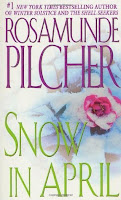
In reading my way, gradually, through the late Rosamunde Pilcher’s excellent novels, I reached ‘Snow in April’. This is a book I only discovered around the turn of the century, and have only read twice. I last read it in 2009, and my only memory of it was of someone getting snowed in at a stranger’s house in Scotland.
The opening chapter introduces Caroline, a young woman who is due to get married in a week’s time. She lives in London with her well-off and organised stepmother Diana, and Diana’s husband Shaun. Caroline likes them both very much, but has felt a bit over-protected by Diana. And, perhaps, a bit manipulated. The person she cares about most is her 11-year-old brother Jody. But he is supposed to be going to Canada with Diana and Shaun, who are moving there for a few years.
However, Jody does not want to go to Canada. Instead, he wants to find their older brother Angus. Angus has been travelling around the far East, but Jody has evidence that he is now working in Scotland. Caroline is rather persuadable - though she has a stubborn streak too - so they borrow a friend’s car and set off. Without letting anyone know in advance, without giving details of their address, and without checking with Angus whether this is okay…
It’s a long journey, and the weather gets worse and worse. The borrowed car does not have snow tyres, or even working heating, so when Caroline and Jody encounter a blizzard, the journey turns into a nightmare. Inevitably they get stuck. A light in the distance leads them to Oliver Cairney, a young man who is on his own in a large house which belonged to his brother. Oliver has just lost his brother in a horrible accident, so taking in two almost frozen young people and warming them through is quite a good distraction for him…
It’s Rosamunde Pilcher, so there are one or two coincidences in the book; it’s something I have come to expect in her novels, and I don’t have a problem with it. Oliver and his family are known to someone who is friends with Caroline’s stepmother. But although this is obvious to the reader, it isn’t to any of the characters until rather later in the book.
The writing is good, something I also expect with Pilcher’s novels. Some of the conversations are a tad stilted, even trite at times as people discuss what they are going to eat. The main characters are the upper middle classes of the era. This was first published in 1972, so even those without much money expect to have at least a cook or daily help. They all seem to drink a great deal, and smoke too. But although these things jar a little, they’re no doubt part of the author’s own culture, and appropriate for the novel.
A thread running through the book is Caroline’s lack of hunger and occasional stomach pains. Oddly enough the eventual resolution of this is something I had remembered from previous reading, as soon as it was mentioned, even though it was initially put down to pre-wedding nerves. I had remembered the romantic outcome too, though not how it happened, nor what transpired with Angus.
It’s not a long book, and I read it in a couple of hours, almost in one sitting. I became completely involved in the story line and the people. Pilcher’s greatest gift in her novels was for characterisation, and that’s what caught me up, and what makes it such a good book. Not only Caroline but even the minor characters feel realistic and three-dimensional. There are no villains in most of Pilcher’s novels; the worst we find are slightly jealous girlfriends, or somewhat materialistic businessmen, or grumpy receptionists.
Highly recommended if you enjoy character-based women’s fiction. This book is sometimes available as part of an omnibus edition with two of Rosamunde Pilcher's other shorter novels, and that may be better value than buying this on its own.
Review copyright 2019 Sue's Book Reviews
I first read some of Mary Stewart’s novels when I was a teenager. I probably borrowed them from my school library. I remember finding them quite tense, and scary in places. But I also loved the underlying romantic threads that run through most of them. ‘Thunder on the Right’ was a title I recalled - although not the story line - when I acquired a copy of the book second-hand about fifteen years ago.
I last read ‘Thunder on the Right’ in 2005, and had entirely forgotten the story. I like it when that happens as it’s like reading a book for the first time, but with the comfortable knowledge that I liked it when I read it previously. It was written in 1957 as a contemporary novel.
Jennifer is the main protagonist in this book. We meet her in a dining room in the Pyrenees, eating alone, and thinking about her cousin Gillian, whom she hopes to see soon. There are two learned ladies at the next table, discussing archaeology, and Jennifer’s thoughts are inevitably interrupted; it. It makes for a light-hearted first chapter of the book, helped by the arrival of Stephen, a young man whom Jennifer recalls with fondness. She did not expect to see him, and has no idea that he is really rather keen on her.
Jennifer is a bit concerned about her cousin, as her communications suddenly ceased three weeks earlier. And when she finally reaches the convent where Gillian was supposed to be staying, she receives some very shocking news. She meets the convent bursar, a rather hard woman whom she does not take to, and a young girl who is clearly nervous.
Most of the action takes place in or around the convent. Jennifer is very suspicious about the things she has been told, and her suspicions become more and more concerning, as she uncovers more information. Stephen insists he is not a hero; during the course of the book Jennifer has to put aside some of her romantic ideas about heroism, and tackle some extremely dangerous situations.
While most of the nuns Jennifer encounters are genuine, kind-hearted and devoted, the bursar - Dona Francisca - is an extremely unpleasant woman, more and more terrifying as the book progresses. There are various other minor characters, some nicer than others, but I thought them all well-drawn and three-dimensional.
The viewpoint stays with Jennifer’s throughout the book; it enabled me to related to her well, even though she is rather more stubborn and considerably more adventurous than I am. The writing is excellent, fast-paced and atmospheric, albeit a tad too action-filled for my tastes. There are, of course, endless lucky escapes, but that’s expected in this kind of mid-20th century light thriller.
The romantic thread is so low-key as to be almost immaterial, but contributes to the mostly satisfactory ending, where the villains have been dealt with and it looks as though life will return to normal. I liked the way that the book came full circle, with the two earnest archaeologists reappearing, immersed in their academic world of research, with no idea of everything that was going on around them.
Recommended, if you like this genre.
Review copyright 2019 Sue's Book Reviews