On the whole, I enjoy novels by the late Jane Aiken Hodge. I've collected quite a few over the years, mostly from second-hand or charity shops, since the majority are now out of print.
It's many years since I read 'Shadow of a Lady'. While I had vague recollections of the first chapter, I'd quite forgotten the rest. It's a historical novel, set in the time of the Napoleonic wars. Helen Telfair is the fictional heroine, who appears in a cameo aged eight as the book opens. However the majority of the book takes place when she is a young and independent-minded adult.
Although Helen is fictional, she is surrounded by a cast of characters from history including the flamboyant Emma Hart.
I'd recommend this book to anyone who likes their historical fiction to be primarily history. The writing is very good, as I've come to expect with Jane Aiken Hodge, but for my tastes I found the story too full of ships and battles and intrigue. In places it's rather sordid (though no doubt realistic). Indeed, the main focus of the story - Helen's marriage of convenience - relies on some extreme unpleasantness.
My tastes run towards more fiction and less history, so I found it a bit tedious in places. Still, I was interested enough to read to the end, and found the conclusion reasonably satisfying, albeit too fast and rather too tidy.
Review copyright Sue's Book Reviews, 29th July 2009
I have thoroughly enjoyed, and much appreciated every book I've read by Adrian Plass. So when I realised that he'd written a year-long series of devotional Bible readings with commentaries, helpfully subtitled, 'for ordinary followers of Jesus who sometimes find the going a bit tough', it was the work of a moment to order it.
I've been reading 'When you Walk' for about a year. It should have been exactly a year, I suppose, since there it consists of 365 daily Bible readings with commentary, but some days I didn't read any, and some days I read more than one. I was not consistent, but it seemed to balance out.
Adrian Plass covers a wide variety of topics in this book, with passages from most books of the Bible appearing. Sometimes he looks at a particular book - or part of it - and sometimes he focuses on a theme.
I gather that each of the different sections originally appeared, separately, as a shorter series of readings; each one is prefaced by some insights or family background into why it was written. The order in the book seems somewhat random, but that wasn't a problem at all.
I don't suppose I've learned anything new, from the Christian life perspective, but I've enjoyed Adrian Plass's insights, peppered with personal anecdotes and his pithy, ironic and sometimes amusing one-liners. There's also a depth of insight which I found revealing and often helpful - just seeing things in a different way can sometimes be very constructive.
Recommended to anyone who wants something of this sort. I don't know that I can remember anything specific from the book now I've finished it, but at the time I always felt it was well worth reading.
Review copyright Sue's Book Reviews, 23rd July 2009
I've been reading - and collecting - books by the late Henri Nouwen for a while, now. He was a Catholic priest who spent his later life working in a community in Canada for the mentally disabled. His writing is full of wisdom and gentleness, focusing strongly on the love of God. Nouwen suffered from depression for much of his life, and evidently found some release through his writing.
This volume, which I have just finished after reading a chapter or two per day for about a fortnight, contains two of his works: 'Life of the Beloved', and 'Our Greatest Gift'. In the first of these, Nouwen attempts to explain his amazing knowledge of being God's beloved child. He gives an introduction, describing a close friendship with a young Jewish writer, and addresses the bulk of the book to him.
There wasn't anything really new to me, but I like Nouwen's writing style, and his way of looking at aspects of belief and God's love. Writing to a young man of different faith, yet similar background (in some ways) gave an interesting slant, too.
The second book in this little volume is about caring for the dying, and also about preparing to die. I found it quite thought-provoking, if a little strange in places. The author manages to avoid being morbid, yet I couldn't quite come to terms with his suggestions that in our release from this world we effectively give the greatest gift we can to those who come after us. Nor was I entirely comfortable with his emphasis on the spirits of those we love remaining in or with us after they have passed on.
Still, I'm glad to have read it, and will no doubt continue reading more works by this fairly prolific writer.
Review copyright Sue's Book Reviews, July 2009
I'd never heard of Dorothy Koomson. However I was given this book by friends for my birthday, a few months ago. I finally picked it up to read about a fortnight ago.
I was hooked by 'Marshmallows for breakfast', pretty much from the start. The book is mainly narrated by Kendra, a young woman who recently returned from Australia to the UK, after a romantic problem. She has found a quiet studio apartment and hopes to be anonymous for a while... but finds herself rapidly embroiled in the chaotic and emotive life of her landlord and his twin six-year-olds, Jaxon and Summer.
I immediately warmed to Kendra. She has a lot of problems, which are the main focus of the book, but she's also very fond of children. Jaxon and Summer are drawn to her in the absence of their mother, and she is drawn to them. While not wanting to be involved with anyone, her heart reaches out to these rather forlorn, emotionally neglected children, whose father loves them, but doesn't know how to deal with them.
I thought the characterisation was extremely good, and I found myself particularly drawn to the twins. They're bright and loyal children who have suffered through their parents' separation - and in other ways, as becomes evident through the book - and who take this sudden and unexplained strong liking to Kendra.
There's perhaps a touch of the melodramatic in this novel. There's a prologue which slightly confused me (since I didn't know when it happened chronologically) and which gave me more clues than I wanted about the rest of the book. There are many unexplained stresses in Kendra's life, with hints given... and yet, by the time she finally writes down the history of what caused her to feel as she does, there was nothing new: the whole had been revealed already by flashbacks, asides, and intelligent guesses on the part of other characters.
There's not a whole lot of plot in the present. The novel relies on the gradual unfolding of the past, not just for Kendra but also for her landlord and his wife, and (to a lesser degree) her boss.
A surprising number of serious issues are covered - racism, workplace harrassment, the role of women, the affect of divorce on children, and several others which I won't mention, not wanting to give spoilers. They make the book thought-provoking, yet even the most unpleasant of the issues are dealt with in a sympathetic way.
If you like warm, character-driven novels with likeable people and plenty to think about afterwards, I'd recommend this highly. I shall be looking out for more by Dorothy Koomson.
Review copyright Sue's Book Reviews, 22st July 2009
Even when we lived in the UK, we were not readers of The Guardian newspaper. So when I was sent this book by 'The Bookbag' site for review, I had no idea who Lucy Mangan was, or what she wrote about. The title of the book appealed to me, as an obvious spoof on the better-known 'My family and other animals' (by Gerald Durrell), as did the idea of reading a selection of humorous columns from a British paper.
I enjoyed the introduction, by The Guardian deputy editor. He describes how he recognised Lucy Mangan's writing talent and introduced her to the world of writing regular columns.
Unfortunately, in the introduction, the best lines in the book are quoted. Out of context, they are not particularly amusing... and by the time I read them in context, later in the book, they weren't amusing either because I knew they were coming. So my first mistake was to read the intro before I read the rest of the book. It would have been better as an epilogue.
Having said that, I did feel a sense of kinship with Lucy Mangan in some of her articles. She's evidently an introvert, as I am, and also a book-lover. In a serious way. I enjoyed her writing style too - she has quite a turn of phrase, and an apt choice of words at times - and some of the columns made me smile.
On the other hand, some of them seemed extremely trite. I don't blame her: if I had to write a daily column, I'm sure I would turn out a lot of pointless drivel in addition to - possibly - some more interesting and relevant articles. Inspiration doesn't necessarily strike in the same way every day, after all. But since this book was a collection - sorted into five broad categories - it's a pity the editor didn't remove some of the more silly columns altogether.
Not a book to read through in a few sittings, but fun to dip into. I shall probably leave it in our guest flat, so that visitors who feel so inclined have something light and mildly amusing to take to the beach.
Available in Kindle form as well as paperback.
You can also read my longer review of 'My Family and Other Disasters' at the Bookbag site.
I have read and re-read Georgette Heyer's historical novels with great enjoyment over the past thirty or more years. It's only in the past few years, however, that I've discovered and started collecting her detective novels. So I was delighted to spot one that I hadn't yet read on a second-hand stall at a local church.
'Penhallow' is about a family in the middle of the 20th century, who live in an ancestral home. Adam Penhallow is a rather manipulative autocrat with a large grown-up family, and a significant number of illegitimate offspring too. Indeed, we meet one of them - Jimmy - in the opening pages of the book.
Then we gradually get to know several of the legitimate Penhallow sons, none of whom much like their father. Yet they're all, in some way, tied to him - mainly for financial reasons. Only one of them is married, although another one is rather keen to marry his stepmother's maid, much to everyone's horror. The stepmother herself, Faith, is rather a wilting kind of woman; certainly not one of Heyer's usual strong-minded heroines.
I found the early chapters a bit heavy-going, with a great deal of description and background, and not a lot of action. Heyer is, as always, a master of characterisation and I did feel, by about the middle of the book, that I was getting to know some of the people in the book. However I didn't much like any of them, which made it hard to be very interested in the story. Nor is there any single 'main' character; scenes switch from one to another without any clear viewpoint.
I knew, from the blurb on the back, who was going to be bumped off. I was slightly surprised that the murder didn't take place until over half-way through the book. Then the scene was written in a most unusual way, with the reader shown exactly what happened, with full understanding of the motives given, as we see for a while into the character's mind.
I kept thinking there would be some twist - perhaps along the lines of Agatha Christie's classic 'Orient Express' mystery, but was disappointed. Indeed, since I knew what happened - and also knew various family secrets, which had likewise been revealed, there wasn't much mystery in the book at all. The detectives appeared only near the end, and didn't have much part to play at all.
The final paragraph in the book has the police inspector remarking that it was a very unsatisfactory case... and I would entirely agree. I found the whole book rather unsatisfactory, really, and that's very unusual with a Georgette Heyer. I thought it strange, and rather unsettling.
Not really recommended - some of her others are much better. If you'd like to try just one Heyer detective novel, I'd recommend either 'A blunt instrument', or 'The unfinished clue'.
Review copyright Sue's Book Reviews, 9th July 2009
The late Phyllis Whitney was a fairly prolific American author in the 20th century, who lived to the ripe old age of 104. I haven't actually read any of her novels, nor had I heard of her; but I came across this book, about fifteen years ago, in a library sale: the book was being discontinued. As a fledgling hopeful writer, I snapped it up.
'Guide to fiction writing' was probably the first book I read about writing. I've read several other over the years, but have remembered this one positively. Having just re-read it, I'd still say it's one of the best books I've read on the topic, covering just about all aspects of writing fiction.
It particularly focuses on novels with examples and quotations from some of the author's own, when she wants to make a particular point. However, the sections of characterisation, plotting, emotion and so on are relevant to all fiction writers. Indeed, I think many non-fiction writers would probably benefit from reading this book.
Admittedly it's now rather dated. It was published in 1982, so the author was still talking about using a typewriter... something I am very thankful to have left behind many years ago, in favour of a computer. The short section at the end of the book on submitting documents for possible publication is also a little out of date in an era of email and useful websites.
But that's the only slight gripe I have with this otherwise excellent book, and I can hardly complain about a 25-year-old guide being out of date. Re-reading it in the past few weeks has enthused and encouraged me over again.
Sadly, though unsurprisingly, it's long out of print. Still highly recommended if you can get hold of a second-hand copy.
Review copyright Sue's Book Reviews, 7th July 2009
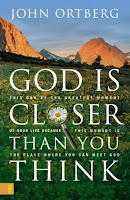
I do like John Ortberg's writing. I've now bought and read most of his books, and enjoyed them all, but I think this one, which I just finished reading, is probably my favourite so far.
'God is closer than you think' (subtitled: 'This can be the greatest moment of your life because this moment is the place where you can meet God') is a very encouraging, inspiring and also practical book for anyone wanting to know more of God's presence day by day. John Ortberg writes in his usual friendly style, which I greatly appreciate, with amusing (and sometimes self-deprecating) throwaway lines here and there. He throws in family anecdotes from time to time, too, making it all the more readable.
This book also covers a lot of very important issues in the Christian life. And it debunks certain popular viewpoints such as the idea that God is only interested in people doing 'spiritual' activities, or that he is mainly found in large gatherings, and/or 'worship' services. There's a useful chapter about seven different pathways to finding God. I found this most reassuring to one who finds church services, for the most part, rather dull. As I read through the chapter I was beginning to think that none of the pathways would apply to me. Then I got to the 'contemplative' pathway, and felt immediate resonance.
There are chapters about spotting God in the mundane, using a 'Where's Waldo?' motif that recurs through the book. There are chapters about what submission really means, at a deep level. There's also a chapter about why God sometimes seems far away. And much more. I read about a chapter each morning, and found them all extremely thought-provoking, encouraging, and sometimes challenging.
I'd recommend this 'God is Closer than you Think' highly to anyone interested in Christian spirituality, whether a new believer or a long-time (and perhaps somewhat jaded) follower of Jesus. This is a book I expect to return to repeatedly.
Note that there are also participants' guide books with the same title available; this review and the link above are for the book itself.
Review copyright Sue's Book Reviews, 6th July 2009
I'd never heard of Rachel Hore. But her novels were recommended to me on Amazon, based on books I had already read and rated. I read some of the reviews, and thought they sounded just my kind of book. So I put her novels on my wishlist, and was delighted to receive one for Christmas last year.
'The dream house' is unquestionably women's fiction, almost a saga novel. It's mainly in the present, but involves some diaries that take us into flashbacks of the early part of the 20th century.
The main character is Kate. She is finding her London job tiring, at the start of the book, and is worried that she spends too little time with her children. So when her husband Simon suggests that they should sell their house, and buy somewhere bigger in the country, she is happy to do so.
They stay at first with Simon's mother Joyce, and things seem to be going well... until Simon starts behaving strangely, and it's clear that there are problems afoot.
Meanwhile Kate has a strange dream after buying a locket in a second-hand shop. Then she meets Agnes, a delightful old lady, and begins to explore the past through her eyes. A family tree at the start of the book means that some of the unexpected revelations in the book were not in fact surprises; others, later on, were fairly predictable.
It took me a few days to get into the book, but I found the characters - particularly Kate - very believable. While I could see what was coming most of the time, I enjoyed the way it was written, and the process by which circumstances happened. By the end I found it hard to put down. There was a little too much use of coincidence for realism, but somehow it didn't matter.
Overall, I found this novel very enjoyable. I look forward to reading more by Rachel Hore. I'd highly recommend this to anyone who enjoys women's fiction that's more than a couple of hundred pages.
Review copyright Sue's Book Reviews, 5th July 2009
The author if this book is Jimmy Carter who is, of course, one of the former Presidents of the United States of America. I was vaguely aware that he had written some books in recent years, but had never read one until I was given this by a friend who had enjoyed it.
'Christmas in Plains' is a small book, which describes the former President's memories of family Christmases. These mostly took place at his parents' home in the oddly-named town (I assume it's a town) of 'Plains'.
The book covers many decades of Jimmy Carter's life, starting from his earliest memories of Christmas at home in Plains, at the farm where he grew up. Each chapter of the book moves forward through the years, including those when he was President. Then the last chapters look at some of his more recent Christmases. He mentions the 'Carter Centre' which was set up for humanitarian purposes in his retirement.
I found it interesting reading, though not compelling. I suppose what struck me most was the racism that was still rampant in the USA seventy odd years ago; the Carter family were clearly very tolerant and accepting, but even so, many of the comments show how different black and white people were considered to be.
I don't suppose I'll read it again, but it was good to have a few different insights into the Jimmy Carter's family background. He always seemed as if he would be a likeable man, and this book did nothing to disabuse me of this idea.
Recommended to anyone wanting to know a little more about this former US President.
Review copyright Sue's Book Reviews, 3rd July 2009