Showing posts with label ballet. Show all posts

16 Jan 2023

Rosa and the Special Prize (by Darcey Bussell)

Magic Ballerina: Rosa and the Special Prize
(Amazon UK link)
Last Summer, while in the UK, one of the books I started reading to my five-year-old granddaughter was ‘Rosa and the Special Prize’, by Darcey Bussell. Now retired, she was the principal dancer with the Royal Ballet for some years. The book says it’s 10th in the ‘Magic Ballerina’ series, but it didn’t seem to matter much that my granddaughter hadn’t read or heard any of the previous books in the series.

Rosa is the name of the main protagonist of this story. I assume she’s about ten or eleven, though I don't think it's stated, and she’s passionate about ballet. We meet her first in a show where she takes an important role and dances extremely well. Her teacher offers her an application form for an audition at the Royal Ballet School, and Rosa is very excited until she realises that she would have to board in London. Rosa’s mother used to be a dancer but is now in a wheelchair, and appears to be a single mother, so Rosa doesn’t want to leave her.

Then the storyline changes as Rosa’s magic ballet shoes take her to another world, where King Neptune and King Tristan, usually good friends, are not speaking to each other. Neptune thinks that Tristan has stolen his trident. Rosa meets her fairy friend Nutmeg who is able to take them underwater for a while, to search for the trident.

It’s quite an exciting story, but I only read about three chapters last summer before my granddaughter decided she would rather do something else. Perhaps the story didn’t grip her. She put a bookmark in, but I assumed that was the end of it as far as I was concerned.

However, when we visited a few days ago, after reading several other shorter books, my granddaughter (now six) produced this one again. She said she had read the next chapter herself, but wanted me to finish it. So I did… and on the whole thought it a good story. As an adult I knew it was all going to turn out all right - and that Rosa’s mother would probably persuade her to apply for the audition once she got home - but as I read, I got quite caught up in the story. I was only going to read a couple of chapters, and ended up finishing the book in one sitting. Not that it's particularly long - only about 100 pages.

The writing is good, and clearly intended to appeal to young girls with an interest in fairies and/or ballet, which covers quite a large percentage of five and six-year-olds. However it seems to have a wider appeal: my eight-year-old grandson came to listen and liked it too, though he was more interested in the search for the trident and dramatic rescue scenes than he was in the final chapter, back in the real world.

I would probably have liked this very much as a young child, though it's not the kind of book I would choose to read to myself nowadays. I would recommend it, on the whole, to read aloud to children (mainly girls) of about four or five and upwards, or as an early chapter book for children starting to become fluent in reading. Having said that, I’m not inspired to look for others in the series for my granddaughter, as I suspect the storylines would be very similar.

Review copyright 2023 Sue's Book Reviews
12 Aug 2022

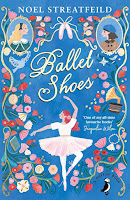
Ballet Shoes (by Noel Streatfeild)

Ballet Shoes by Noel Streatfeild
(Amazon UK link)
I have always loved Noel Streatfeild’s books and have collected most of her children’s novels over the years. Her best-known story is probably ‘Ballet Shoes’, now considered a classic, and one which I re-read regularly. I thought I might start reading it aloud to my five-year-old granddaughter but she found it a bit long-winded so, having abandoned reading aloud after a couple of chapters, I decided to read the rest of it to myself. I last read it only four-and-a-half years ago, but, as ever, had forgotten a lot of the details.

The main story, of course, is well-known. Great-Uncle Matthew, affectionately known as GUM, is a somewhat absent-minded collector of fossils. His orphaned niece Sylvia looks after him, with her former nurse known as Nana and a cook and housemaid - rather an extensive household, it seems to me from this 21st perspective, but quite a small staff for the era (1930s) in which it was written.

Gum finds three babies in rather different circumstances over about five years, and brings them to Sylvia, convinced she will be thrilled. Adoption was evidently a simpler process then than it is today, and the three girls, Pauline, Petrova and Posy, are brought up by the loving but old-fashioned Nana, and for the first ten years or so of their lives, they are comfortably off. Gum has gone on a long voyage of exploration, but put plenty of money in the bank. Sylvia is a bit dubious about when he might return so she puts some of the money aside… but eventually it runs out.

The two older girls have been going to a private school, but Sylvia can no longer afford to send them there, and decides to take in some paying guests. This works out well, and at the suggestion of one of the boarders, they are offered free places at a Stage and Dancing Academy. Pauline discovers a talent for acting, and Posy is an exceptionally good dancer, as well as a clever mimic. But Petrova wants to be some kind of engineer, and likes cars and aeroplanes much better than she likes dancing or acting.

The story is about their day-to-day lives, painting a wonderful picture of a loving - if unusual - family in the era. While the circumstances and finances mentioned are clearly well out-of-date, the personalities and conversations seem entirely relevant to today, albeit tinged with an innocence that seems to be gone from modern life. The children’s squabbles are minimal, but realistic, and Sylvia’s concerns about money all too relevant to families today.

I’d entirely forgotten some of the scenes, and many of the details, but loved re-visiting some of my favourite fictional characters, entering their world again for a few hours. I loved the book just as much as I did when I first read it over fifty years ago, and would recommend it highly to children - particularly girls - over the age of about eight or nine, and to adults who read these books in their own childhood.

Review copyright 2022 Sue's Book Reviews

3 Jun 2020

No Ballet Shoes in Syria (by Catherine Bruton)

No ballet shoes in Syria by Catherine Bruton
(Amazon UK link)
I don’t remember why I put this book on my wishlist late last year. Maybe Amazon recommended it to me, based on other books I had read or ordered, but I think it may have been a personal recommendation. I had never heard of Catherine Bruton, and I don’t often decide to read modern children’s books, although some are excellent. But ‘No Ballet Shoes for Syria’ sounded intriguing, and I was delighted to be given it for a recent birthday.

The heroine of this book is 11-year-old Aya, an asylum seeker in the UK. We meet her in a busy community centre at the start of the book, hearing ballet music from upstairs, and the faint voice of a teacher. Aya is evidently a dancer herself, although she has not been to classes for a long time now. Instead, with her mother (who is not well) and her small brother, she’s trying to understand paperwork and apply for refugee status.

Aya can’t resist going to look through the doors of the ballet class, and catches the attention of a friendly girl called Dotty. But it’s not until she finds herself dancing in frustration one day that she is invited to join the class. Clearly she has talent as well as dedication and a passion for ballet, and the main part of the story is about her gradual acceptance by others in the class, and the struggles she has to follow her her heart.

There are some happy coincidences - the head of the ballet school was herself a refugee many years earlier - and Aya has a good share of luck, although I felt she deserved every bit of it. At just eleven she looks after her brother competently, translates for her mother, answers questions, and takes on the responsibility that would normally have been her father’s…

At the end of each chapter there is an italic section, recounting Aya’s life before arriving in the UK. She lived in Aleppo in Syria, where she had friends, and went to school, and started learning ballet. War broke out when her mother was still pregnant with her brother, so the family didn’t leave as promptly as they would have liked. Her father had once worked in the UK so that’s where they were heading, but first they had to travel to Turkey, and then to Greece.

We don’t learn what happened to her father until nearly the end of the book; Aya clearly adored him, and she remembers much of what he told her, the way he treated her almost as another adult. She doesn’t understand what’s wrong with her mother, but she accepts her responsibility and is willing to give up her dreams if necessary.

It’s a well-written book with believable people, and the alternating present/past storylines work well. My only slight puzzlement is that I didn't understand the book's title; Aya did have ballet shoes in Syria, after all, and they were one of the few things she managed to bring with her when she left. But it doesn't much matter.

Aya is a likeable person who has gone through some traumatic experiences, most of which are not described in any detail. She knows that she hides some of them when she tells her new friends about her journey. So there’s nothing to traumatise a young child - and much to help them understand a little of what life as an asylum seeker might be like. She experiences prejudice (in fairly mild ways) as well as a great deal of worry and stress, but it’s expressed in the kind of language that could be understood by children of about eight or nine and upwards.

Reading as an adult, I liked the book very much. I would recommend it to anyone wanting to know more about asylum seekers from a child’s point of view; I expect thoughtful teenagers would like this too. The ballet theme, and the fact that Aya and her friends are all girls means that this will probably appeal more to girls than to boys, but it’s suitable for anyone.


Review copyright 2020 Sue's Book Reviews

24 Mar 2019

Dancing Shoes (by Noel Streatfeild)

Dancing Shoes by Noel Streatfeild
(Amazon UK link)
Ever since my teenage years, Noel Streatfeild’s novels have been an important part of my comfort reading. I suppose I was about nine when I first came across some of them on my grandparents’ bookshelves. I acquired a few in my teens, and borrowed many more from libraries. In the past twenty years or so I have been gradually collecting them, and am thoroughly enjoying re-reading them again, in between others of my favourite authors, and some new books.

‘Dancing Shoes’ was originally entitled ‘Wintle’s Wonders’. I managed to get hold of a second-hand edition about ten years ago, and when I read it then I had no memory of having read it previously. Re-reading it in the past couple of days, I recalled only the vaguest idea of the plot, but I liked it very much.

Rachel and Hilary are the main protagonists of this novel. Hilary is Rachel’s adopted sister, and they are both ten years old when the story opens. It starts with a tragedy in their lives, as happens quite often in the Streatfeild world. Rachel’s father had died some years earlier, and now her mother also dies after a nasty accident.

Rachel and Hilary are very different. Hilary is quite an extravert, a talented dancer, and somewhat allergic to hard work. Rachel is serious, loyal, and quiet, mostly keeping her feelings to herself. Rachel’s aunt Cora runs a dancing school and offers the girls a home, but they have to attend her school and be trained as dancers. Which Hilary is happy to do - she wants to be in a showy dance troupe, doing handstands and tap dancing as well as ballet. But Rachel has no talent for dancing and hates being on stage.

Rachel is also worried about Hilary getting into bad habits. She was about to audition for the Royal Ballet School when their mother died, and supposedly had a glittering future ahead as a ballet dancer. A lot of the story is about Hilary’s determination to be a ‘Wintle’s Wonder’ dancer, while Rachel tries to coerce her into taking ballet more seriously.

While there are some caricatures amongst the minor characters, I thought both Rachel and Hilary were very well created and quite three-dimensional. They are both likeable girls with very different personalities. They are in stark contrast to Aunt Cora’s daughter Dulcie, who is a couple of months older than Rachel. Dulcie is a talented dancer but is very arrogant about it, not helped by her mother’s over-praise and adulation.

Most of Noel Streatfeild’s books have talented children in them, usually dancers. So it’s unusual to find that the ‘promising’ ballet dancer, Hilary, has very little interest in taking her talent seriously. Will she be wasting her life if she abandons ballet for other kinds of dance…? The question is considered from various perspectives. I felt a bit sorry for Rachel at first, but she becomes almost compulsive in her determination to make Hilary do something she really doesn’t want to do.

In a way, it’s Rachel’s story as she is the one who gradually matures, listens to other people’s opinions, and starts her own career path in the final chapter. Although I had forgotten the story as such, it was fairly easy to see where the plot was going in the last couple of chapters. And, as with most of Streatfeild’s novels, once everything is settled, the book ends very quickly.

‘Dancing Shoes’ was written for girls of around eight to twelve, as were most of this author’s books. But I think I like them even more now than I did when I was that age, seeing the children’s development from the perspective of several decades on. They make excellent read-alouds, and while they’re inevitably dated (as is obvious from some of the comments related to money) the personalities and issues covered are always topical.

Highly recommended if you like children’s fiction of this kind, or if you know of children who like stories about dancers and stage schools.


Review by Sue F copyright 2019 Sue's Book Reviews

5 Dec 2018

Curtain Up [Theatre Shoes] (by Noel Streatfeild)

Curtain Up/Theatre Shoes by Noel Streatfeild
(Amazon UK link)
When I first discovered Noel Streatfeild’s books as a child of about seven or eight, I had no idea that she had written so many. Over the years I have acquired the majority of her books, and very much enjoy re-reading them. Most are about talented children, many taking place amongst theatre or ballet folk; this was part of Streatfeild’s own background, so her stories tend to have realistic backgrounds even if the children are sometimes exaggerated, and the adults often caricatured.

‘Curtain Up’(re-published in recent years as ‘Theatre Shoes’ or even ‘Theater Shoes’ in the United States!) was written partly in response to readers who wanted to know what happened to the Fossil sisters from the author's better-known novel ‘Ballet Shoes’. They are only minor characters in this book, and it’s not necessary to have read Ballet Shoes first, but I liked it from the perspective of learning more about the Fossil girls as young adults.

The story, however, features three very different siblings: Sorrel, Mark and Holly. Their mother died some years ago, and their father is abroad, fighting in the second world war. The children have been living with their grandfather, a somewhat reclusive vicar; they weren’t close to him, so were not broken-hearted when he died. They were looked after and generally parented by the comfortable, warm and rather strait-laced Hannah.

Shortly after they lose their grandfather, they learn that they come from a theatrical family. Their mother’s mother has been an actress, their uncle is in films, and one of their aunts is married to a Shakespearean actor. They have two cousins, too. Up to this point they knew nothing about this side of the family, partly because Hannah disapproves strongly of theatres and the stage, and they have never been to the cinema.

So they are transplanted to Grandmother’s house, and - to their horror - taken away from the boarding schools where they have been quite happy. Instead, they attend Madame Fidolia’s school of theatre and ballet, where the Fossil sisters trained. The school now teaches academic lessons as well as dance and drama.

Much of the story is about their gradual integration into the school, their fight for Mark to be moved back to his old school, as he wants to be a sailor, not an actor, and also struggling with surprising poverty, as their grandmother is very bad at money management. It’s told from the point of view of the children, and I liked it very much. Sorrel is a typical responsible oldest sibling, but she also discovers that she has some unexpected talents. Mark objects strongly to dancing and fancy costumes, and his imagination often runs riot. Holly is friendly, and amusing, and makes friends easily.

The talented ballet dancer in the book, however, is their cousin Miriam, who is Holly’s age (eight) and new to the school at the same time. Miriam is rather unlike most of the brilliant Streatfeild ballet dancers in other books; she’s observant, kind and generally friendly. However their other cousin (confusingly called Miranda - I often forgot which one was being referred to!) who is older, and very talented at drama, is also quite conceited.

I first read this book in 1985, and have re-read it a couple of times over the years; the last time I read 'Curtain Up' was in 2010. I had forgotten most of what happened, and it made a very enjoyable read over the last few days. It was quite hard to put down at times. As well as being a good story, for children or adults, this is interesting from a social history point of view - the children take for granted the coupons, and other restrictions of the war, and the air raids, and the sight of bombed-out houses.

Recommended to anyone over the age of about seven or eight who enjoys somewhat old-fashioned stories about talented children. More likely to appeal to girls than boys, but Mark is quite a strong character too. Also recommended to adults like me who enjoy these nostalgic books of the kind that were widely available in our childhood.

Review copyright 2018 Sue's Book Reviews

16 Feb 2018

Ballet Shoes (by Noel Streatfeild)

Ballet Shoes by Noel Streatfeild
(Amazon UK link)
Interspersed with new novels, and re-reading some of my favourite authors, I slip in some of my childhood comfort reading. There are some books which are just as enjoyable at fifty-something as they were when I was ten or eleven. So-called ‘crossover fiction’ did not begin with Harry Potter. Noel Streatfeild wrote character-based contemporary fiction in the early part of the 20th century, and her appeal is, as far as I’m concerned, ageless.

‘Ballet Shoes’ is Streatfeild’s best-known novel. First published in 1936, it has had some recent popularity due, in part, to the excellent adaptation by the BBC. It’s set initially in the 1920s, introducing the eccentric Great Uncle Matthew (known as GUM) whose niece Sylvia looks after his large house with its collection of fossils, collected from all over the world. When GUM manages to damage a leg, he starts travelling in ships, and instead of collecting fossils, he acquires - over a period of several years - three babies whom he brings to Sylvia to look after.

Pauline is the oldest; she’s attractive and bright, and overall a likeable child. Petrova, daughter of Russians, is the next; she’s thin and less obviously attractive, but extremely intelligent. Posy is the youngest, the daughter of a ballet dancer who cannot afford to keep her. Adoption was evidently quite straightforward in this era, or perhaps the author skated lightly over the procedures.

In any case, the story really gets going when Posy is nearly six, Petrova nearly eight, and Pauline approaching ten. They have been brought up by Nana, Sylvia’s old nurse, as respectable middle class children, with Pauline and Petrova attending a local private school. However, by this stage GUM has been gone for nearly six years, and the money he left for the children’s upkeep has just about gone.

So Sylvia decides to take in boarders. Two of them are, conveniently, retired lecturers: one specialising in literature and the other in maths. They offer to home educate the two older girls, while Sylvia teaches Posy. And another boarder, a ballet teacher, manages to get places for the three girls at a theatre/dance school nearby, in the hope that they can start earning some money when they are old enough for licenses.

Much of the novel is about the children’s varying experiences at the theatre school, where Pauline stands out as an excellent actress, and Posy as a potential ballet star. Petrova, a classic middle child, has no interest in either; she would prefer to get her hands greasy while helping to mend cars. The appeal of the story is in the relationships between the three very different children, and they way they tackle problems. Admittedly there’s some caricaturing, but there’s also a great deal of warmth and affection.

As a piece of social history, this - along with the author’s other books - is excellent. The background of London in the period between the wars is clearly shown, as is a typical impoverished household struggling to make ends meet. Nana has high standards for her charges, and expects them to be clean, polite and well-behaved, even if wearing threadbare clothes that have been mended many times, and in some cases are rather too small.

Steatfeild evidently had plenty of experience in theatre life; her scenes set on stages or auditoriums feel as natural as those in school or home. The pace of the book is excellent, covering the years until Pauline is in her mid-teens. I last read ‘Ballet Shoes’ in 2006, and while the overall story was familiar to me there were many conversations and other details which I had forgotten. All in all it made an ideal light read for a day when I wasn’t feeling well and needed something comforting and unthreatening.

Originally written for girls between the ages of about eight and fourteen, this would probably appeal to those of any age who read avidly and like this kind of gentle, but thoughtful story. It would make a great read-aloud, too, for children of any age. There are plenty of moral lessons imparted by Nana, but they’re not intrusive in my view. It’s a pleasantly nostalgic book which harks back to a simpler era - yet one where life for many was extremely difficult.

As with many of this author’s books, the ending chapter is somewhat abrupt. Several threads come together, and one problem is solved by a kind of deus ex machina appearance which isn’t entirely convincing in my view. But everything is neatly tied up, with plans for the future, and we don’t really need to know any more.

Highly recommended. Regularly in print in various editions, as well as widely available second-hand.


Review copyright 2018 Sue's Book Reviews

24 Dec 2016

Ballet Shoes for Anna (by Noel Streatfeild)

Ballet Shoes for Anna by Noel Streatfeild
(Amazon UK link)
I have loved Noel Streatfeild’s books for teenage girls since I was about nine or ten. She is best known for her classic ‘Ballet Shoes’, but also wrote quite a number of other novels which often featured talented ballet dancers. I’m re-reading my way, gradually, through my extensive Streatfeild collection and have just finished another.

‘Ballet Shoes for Anna’ is short book, rather different from others by this author, in that it starts with a devastating tragedy, set in Turkey. Three children, aged eight to ten, end up living with a rather unpleasant uncle, who believes in duty and efficiency beyond anything else. His mouse-like wife is a nice creation, if a little caricatured, but I never really believed in the awful Uncle Cecil.

Francesco, Gussie and Anna are thrown into a totally new way of life; they have travelled around in a caravan and are unused to being in a house, let alone a pristine one where noise is not tolerated. They have never been to school, but now they must. Worst of all, Anna, who is a very promising young ballet dancer, has to find a teacher. Uncle Cecil believes that dancing is sinful, so won’t help in any way, and the boys have to find a way of raising money to pay for lessons.

First published in 1972, not long after the UK adopted decimal currency, the book has several references to ‘new pence’, which is how people used to speak of currency in those days. Fifty ‘new’ pence for a lesson is seen as a vast sum; nowadays it seems like almost nothing. Still, that’s all that really dates the book, along with the lack of technology.

The children are likeable, Francesco weighed down by the responsibility of being the eldest in his family, and Gussie a classic mischief-loving middle child. Anna, at eight, seems rather young to be so dedicated to her dancing in a way that, at times, borders on selfishness, but her brothers don’t find anything strange about this. There are some other interesting characters too such as a market boy and his mother who befriend them.

It’s a good story about the difficulties of adapting to a new lifestyle; the children’s grief and culture shock is rather played down, but still leads to one or two rather moving sections that left me quite choked up. I wasn’t sure I quite believed in the atrocious grammar used by the children at first; their mother was Polish but their father was British, and they read a lot of books. But it made some good subplots, including the necessity of their unpleasant uncle to attempt to improve the children’s English.

There’s some high drama towards the end, in a scene that could, in real life, have been very nasty. But it works well in showing that some parts of UK life, even forty-plus years ago, were decidedly unpleasant and potentially dangerous. The ending itself is quite abrupt, as it somewhat typical with Noel Streatfeild’s books: the problems are solved, and the reader is left to imagine the tying-up of loose ends.

While I had remembered the basic storyline from my last re-reading of this book, in 2005, I had forgotten most of the subplots and very much enjoyed it.

Recommended for older children - boys or girls - and for those of us who remember this author's books with nostalgia from our own childhoods.

Review copyright 2016 Sue's Book Reviews

22 Dec 2014

Ballet for Laura (by Linda Blake)

Ballet for Laura by Linda Blake
(Amazon UK link)
How I wanted to read this book as a child! I owned the sequel (“Laura’s Summer Ballet”) but was convinced that there must have been a previous book. I knew nothing of the author, Linda Blake - it doesn’t appear that she wrote any other books, and there’s no biography that I can find online. Nonetheless, her second book was one of my childhood and teenage favourites.

So I was thrilled when, finally, I discovered ‘Ballet for Laura’ - in good condition - in a charity shop, in the mid-90s. I was in my thirties by then but it didn’t stop me devouring (and thoroughly enjoying) the book. It didn’t come out to Cyprus with us when we moved here ‘temporarily’, but arrived with some freight about nine years ago, when I promptly re-read it. Recently, thinking about recommending it to a friend’s daughter who enjoys ballet stories, I couldn’t resist dipping into it again…

And once more I found myself caught up in a story that’s exciting and - in places - quite moving. Laura, aged twelve, is about to follow her dreams and begin as a pupil at the Marina ballet school. She’s quite shy and very nervous, which makes it all the more surprising that she finds herself getting alone well with Scott, a senior at the school, who has a bad temper and is considered very much the black sheep.

Laura has decided talent; not the brilliance of Noel Streatfeild’s heroines of the same era (for this was written and set in the 1960s) but a determination and dedication to ballet, and a natural grace that attracts the notice of Connie, a wealthy, beautiful and gifted dancer amongst the seniors. Unfortunately Connie’s nature is spiteful and jealous, and she takes a dislike to Laura almost from the start.

It’s a school story with friendships developing, trouble brewing, and a thrilling climax when Laura is selected - almost randomly - for a tiny role onstage, and Connie does everything she can to stop her. Having not read this for nine years, I’d forgotten most of the details (while confident that the outcome would be positive) and felt some of the tension again. Connie is - I hope - caricatured, as is her eminently dislikeable cousin. But Laura and her friends and the grouchy Scott are all very well portrayed.

Intended, I assume, for the 10-14 age group originally, I think this would appeal to confident readers of about 8-11 today, particularly those who enjoy Noel Streatfeild or similar authors. It will appeal more to girls than boys, although there are boys in the school, and Scott in particular plays a significant part.

Not in print, and hard to find, although Amazon sometimes shows it at a reasonable price in the Marketplace.


Review copyright 2014 Sue's Book Reviews

7 May 2012

Drina's Dancing Year (by Jean Estoril)

Drina's Dancing Year by Jean Estoril
(Amazon UK link)
Apparently Jean Estoril was a pseudonym for the prolific writer Mabel Esther Allen. I didn't know anything about her, but know I've read at least one of her books and remembered quite liking it. I came across this one in a charity shop recently, and since I like children's books for a little light reading (or reading aloud to small friends) I picked it up.

'Drina's Dancing Year' is in fact the second in the children's series about Drina, a young orphaned ballet dancer who lives with her grandparents in London. As I read, I realised that I had at some point read the first in the series ('Ballet for Drina') although I don't remember when.

In this book, Drina gets her dream, when she is accepted into a full-time ballet school in London. There she makes some good friends and also attracts some negative attention from people who are envious of her talent. Her mother was a famous ballerina, but Drina is determined not to let anyone know because she wants to know if she can succeed on her own.

There are some fairly typical school story anecdotes, some proud achievements, and a few warnings about the dangers of a life on stage from Drina's grandparents who would really prefer her not to be a dancer. The book feels rather dated, which is not surprising as it was first published in 1958 - but that wasn't a problem. However, I don't know if today's children would find this interesting. The style and content is appropriate for girls of about 8-11; perhaps it would find favour with those who are keen on ballet.

It's not a bad book. I passed an hour or so reading it, and was interested to see how it would turn out. But it's nothing special. I imagine I could get hooked if I had several in the series - which is quite lengthy - but don't think it's as good as the ballet stories by Noel Streatfeild. It's more on a par with the later ones by Lorna Hill although the characterisation is better.

No longer in print, but fairly widely available second-hand.


Review copyright Sue's Book Reviews, 7th May 2012

18 Nov 2010

Dancing Shoes [Wintle's Wonders] (by Noel Streatfeild)

Dancing Shoes by Noel Streatfeild
(Amazon UK link)
Noel Streatfeild was one of my favourite authors when I was a child, and I like re-reading her books from time to time as an adult, when I feel like some light fiction. There are some of her books which I didn't own, so from time to time I browse the online bookshops. I was recently delighted to spot very good prices for second-hand versions of two Streatfeild books which I didn't have, from the former Play.com 'play traders'.

'Dancing Shoes' was originally known as 'Wintle's Wonders', but re-titled some years ago. I could not remember the story at all, and having now finished it, I don't recall ever having read it before.

The story is about Rachel and Hilary, who are orphaned - as so often happens in Streatfeild's books - and sent to live with their Aunt Cora and Uncle Tom. The latter is an artist, understanding and sympathetic. But Cora is a driven women who runs a successful stage school, 'Mrs Wintle's Little Wonders'. She teaches all kinds of dancing, singing and some acting, and sends troops of girls from twelve and up out to shows, holiday camps, and pantomimes. Tom and Cora have one daughter, Dulcie. She is around the same age as Rachel and Hilary, but very spoilt and conceited.

Hilary has been training at a ballet dancer, and considered very promising. However, she does not like hard work, and thinks it's far more fun to do tap dancing and acrobatics as a 'Wintle's wonder'. Rachel, who is more serious, is horrified that Hilary would consider anything other than ballet - and her attitude leads to some unfortunate misunderstandings. Rachel herself, who is not talented at dancing, has no desire at all to be a 'wonder', but must train along with the others.

Noel Streatfeild had a great gift for characterisation, and I found myself very much liking both Rachel and Hilary. Some of the less likeable characters are rather stereotyped, and naturally Dulcie is going to have her come-uppance at the end. I could see where the last chapters were leading, since the theme is similar to others by the same author, but it was very well done.

All in all, I enjoyed it. Recommended to anyone who likes this kind of light-weight children's fiction. Still in print in the UK and US, as well as being more widely available second-hand than I had expected.


Review copyright Sue's Book Reviews, 18th November 2010

4 Nov 2010

Curtain Up (by Noel Streatfeild) - also known as Theatre Shoes

Curtain Up/Theatre Shoes by Noel Streatfeild
(Amazon UK link)
Noel Streatfeild was one of my favourite authors as a child, and also during my teenage years. She wrote an early example of crossover fiction which is also interesting to adults; I read one or two of her books to my sons when they were younger, and from time to time enjoy re-reading her novels. She is probably best known for 'Ballet Shoes', but wrote quite a number of other children's novels.

It's a long time since I last read 'Curtain Up'. My version is a rather tatty hardback which I probably bought at a charity shop; since then, it was re-named 'Theater Shoes' in the USA, and also re-published as 'Theatre Shoes' in the UK. Sometimes older versions with the original title can still be found second-hand.

This book would probably be of interest to anyone who enjoyed 'Ballet Shoes', since the three Fossil sisters (Pauline, Petrova and Posy) have cameo roles as young adults, and we learn some of what they have been doing since they separated to start their different careers, and how they were affected by World War II.

For 'Curtain Up'/'Theatre Shoes' is set during the war. Sorrel, Mark and Holly have been brought up in a vicarage, with a slightly eccentric grandfather who takes little notice of them. Their mother died when they were young, and their father has recently been posted as 'missing'. Their mainstay is Hannah, a comfortably large housekeeper/nanny who loves to sing hymns.

Grandfather finishes a book he has been writing, and then passes away peacefully. So the children are taken to London, where they learn that their considerably more eccentric grandmother - whom they have never met - used to be a famous actress. They find that they have cousins and aunts and uncles too, none of whom have ever been mentioned to them before, since Hannah rather disapproves of the stage, and the family cast their mother off when she married their father.

Much to the children's dismay, they are to be moved from their current private schools to a stage training school in London, where they have to learn dancing, singing and acting as well as other lessons... and have no idea if they will cope.

It's a pleasant book with good characterisation, giving a good picture of life in a theatre school during rationing. Sorrel is a typical dependable eldest child, Mark a lively boy who would much rather play cricket than sing or dance, and Holly an imaginative little girl who likes to wear pretty clothes.

They're all likeable people, and the plot is interesting, even though I vaguely remembered most of it. I was surprised at how moving (if predictable) the ending was, too.

This book is probably best for girls between the ages of about 7 and 14, but suitable for anyone of any age wanting a light read with a little social and stage history thrown in.


Review copyright Sue's Book Reviews, 4th November 2010

29 Nov 2008

Principal Role ( by Lorna Hill)

Principal Role by Lorna Hill
(Amazon UK link)
As a young teenager, I very much enjoyed the first four books in Lorna Hill's 'Sadler's Wells' series about young ballet dancers. I think I vaguely knew there were further books in the series, but they were not in print at the time.

In recent years, they evidently came into print again. I've managed to acquire a few more of her books, in paperback, from charity shops. Unfortunately, they've all been somewhat disappointing, not (in my opinion) living up to the promise of the first four.

I picked up 'Principal Role' recently, very inexpensively, and decided to read it for some light entertainment after a somewhat heavier novel. I like children's fiction, and usually find it good for relaxing.

This is the ninth in the Sadler's Wells series, and while it wasn't a bad read, it wasn't very inspiring. The somewhat unlikely story is about Fazia, Crown Princess of a small European country, who is currently in exile.

The book opens in Switzerland, where she longs for freedom but is cooped up with her bodyguard, and - after a while - a nice young English governess called Elizabeth. Fazia is extremely good at ballet, and is destined for the Royal Ballet School in London in September. However she is not passionate about ballet at all, just seeing it as one more thing she has to learn because her brother, the King, insists.

In somewhat unlikely circumstances, after a series of mild scares, Fazia and Elizabeth bump into a young man called Timothy. He is the likeable son of a Vicar who featured in one or two of the previous books, and who is in love with another ballet dancer.

Then the action moves to London, when Fazia moves there, and also to a small mining village in the North of England, where Timothy lives. The story brings in several characters from previous books, whom I vaguely remembered. However this would probably be rather confusing (not to mention pointless) for anyone who had not read the others.

The style is fairly rushed, and the characters are pretty flat. In the earlier books, Lorna Hill wrote in the first person, so we got far more of an insight into some of the individuals. But this book is written from several third person perspectives, and it really doesn't work all that well.

It's not a bad book - if one forgets how very unlikely the basic plot is - but I'm not sure who it would appeal to. The style is that of children's books, yet the main character is 15, and the issues - such as they are - would probably not be of much interest to young children. I suppose it's really only appropriate for people like me who remember the series fondly from childhood.

No longer in print anywhere, apparently, but sometimes available second-hand.


Review copyright Sue's Book Reviews, 29th November 2008

22 Jan 2007

Swan Feather (by Lorna Hill)

Swan Feather by Lorna Hill
(Amazon UK link)
I had just finished the seventh in Lorna Hill's ballet series. I didn't much like it, but I thought would read the tenth, 'Swan Feather', which was also new to me. It was a little better, but there were still rather too many characters, some of whom would be bewildering to anyone who had not read previous books in the series.

This book is mainly about Sylvia Swan. She os a newly-introduced character, so it does stand pretty well as a complete story. There are some rather horrible incidents early in the book, which might disturb an over-sensitive young teenager. However they are soon in the past. More disturbing is the cruel and heartless Nigel who appears in previous books, and features again in this one.

The action is really much too rapid for my tastes. Do people really meet, fall in love and plan to get married in the space of about three weeks? However my main complaints are the multiple viewpoints and author comments that pepper this book. I feel that the story would would have worked much better if it had all been written from Sylvia's own perspective.

If you have read others in the series, this isn't a bad story to while away a couple of hours. But if not - or if you have no interest in ballet or teenage girls - there are far better children's books available.

This book is occasionally re-published, and fairly widely available second-hand.

20 Jan 2007

Return to the Wells (by Lorna Hill)

Return to the Wells by Lorna Hill
(Amazon UK link)
'Return to the Wells' is seventh in Lorna Hill's series for teenagers about the ballet world. As a teenager myself, I read and re-read the first four in the series and loved them, but had no idea there were more. Apparently there are twelve or thirteen altogether, all out of print. So I was delighted when I discovered this one at a charity shop.

Alas, once I started reading, my delight evaporated.

Whereas the first four books were written in the first person, albeit by different characters, this one is written in the third person. It doesn't even focus on just one or two people; the viewpoint dots around all over. It even includes some cringeworthy author asides, almost reminiscent of Victorian novels, but (in my opinion) worse.

Nor is the story very interesting. It's supposed to be complete in itself, so I assumed that it wouldn't matter that I hadn't read the fifth or sixth in the series. But I found myself bewildered by multiple characters and subplots, some of which had nothing to do with the main story.

Even the main plot was rather convoluted, involving a ballet dancer called Ella. She apparently ran away from Sadler's Wells - I didn't gather why - and is now returning. It seems that she was an adopted child, from an exaggeratedly awful 'working class' background. Perhaps that was relevant in the earlier book that introduced Ella. But I could not see the point of the story popping back to 'Me Mam' every so often, to hear the unintelligent comments of the family whom Ella seems to have cast aside in a rather snooty manner.

Then there is a foray into Switzerland when Ella recovers from an illness. It adds nothing at all to the story, and seems to be padding.

Not recommended, unless you have read the first six and want to know what happens to all the characters. I have one more in this series, but begin to think I should just have re-read the first four, which I still remember fondly.

11 Apr 2006

Ballet Shoes (by Noel Streatfeild)

Ballet Shoes by Noel Streatfeild
(Amazon UK link)
This is probably the best-known of Noel Streatfeild's books, and certainly one of my favourites. It's the story of three baby girls, adopted by the eccentric Great Uncle Matthew (GUM) and left with his niece Sylvia and her old nurse 'Nana'. They live in a vast house, and when GUM does not return from his travels after five years, money becomes very tight so they take in boarders.

The girls are educated at home, and given free places at an academy of dance and drama... and there, their talents emerge in diverse ways. There are many realistic glimpses into the world of children's theatre in the 1930s, including the need for licenses for those of 12-14 who are allowed to do professional work only if medically fit and educationally sound.

The three girls: Pauline, Petrova and Posy, are quite distinct characters, yet all believable (if a little caricatured at times) and delightful in their different ways. Family values are, as always with this author, very important, and moral lessons are demonstrated in low-key but effective ways.

It's supposedly for girls of age 8-14, though I suspect that these days it's more likely to appeal to those of about 7-11, since it's a gentle read about ordinary people with not a great deal of excitement. I've read and enjoyed it many times as an adult too.

Note: as an introduction to this book, you might also like the DVD of a TV version of 'Ballet Shoes', made in 2007.

You can also read my longer review of Ballet Shoes, written after re-reading nearly twelve years later).

8 Dec 2005

Laura's Summer Ballet (by Linda Blake)

Laura's Summer Ballet by Linda Blake
(Amazon UK link)
Why do children's books make such compulsive reading, I wonder?! After finishing 'Ballet for Laura' I thought I'd read the sequel, 'Laura's Summer Ballet', also of course by Linda Blake.

It's the story of what happens when the Marina Ballet School moves temporarily to Dorset, to get away from the heat of London and the noise of building work. Laura and her friends prepare for their end-of-year exams, including creating a short ballet as their free dancing.

There's also the mystery of Doreen, a new girl who dances well but seems not to care much about anything. She doesn't want to be friendly, and hates the thought of going to Dorset even though she comes from the country. And there's the ongoing enmity between Connie, a rich and arrogant senior, and Scott, a rather misunderstood young man who's also a senior, but is good friends with Laura and her set.

It's not really very thrilling as plots go, although there are a few exciting moments. The characterisation isn't brilliant, though it's not bad. But the book is well-written, it moves at a good pace, and for some reason it's quite a page-turner. Only 120 pages which is just as well, since at 10.30pm last night when I thought I was reading a chapter before going to bed, I found I could scarcely put it down until I'd finished.

Sadly, 'Laura's Summer Ballet' has been out of print for many years. But it can often be found second-hand.

7 Dec 2005

Ballet for Laura (by Linda Blake)

Ballet for Laura by Linda Blake
(Amazon UK link)
'Ballet for Laura' was written by Linda Blake, an author whom I can't find anywhere online to give a link. I doubt if many people will remember her, or the books she wrote. This one is a somewhat obscure book from the late 1960s, well out of print now, although it can sometimes be found second-hand.

Indeed, I wasn't even aware that this book existed for many years. I was given a copy of the sequel ('Laura's Summer Ballet') when I was twelve, and had a feeling there should have been a previous book but it wasn't until much later - perhaps ten years ago - that I spotted it in a second-hand shop.

Recently it came out here with our sea-freight. Wanting a light read last night, I picked this out. I had probably only read it once before this, so I had very little memory of the plot.

I suppose the book is rather in the Noel Streatfeild style. Laura, an orphan, is given a scholarship to a ballet school where she makes friends and also enemies. In a way it's more a school story than a character-driven book like Streatfeild's, but I still found it enjoyable. Laura is a likeable girl, totally driven by ballet but quiet and shy. She seems entirely unaware that she has the potential for great ability.

So there are fairly typical school dramas, ups and downs, and an exciting climax where a girl who dislikes Laura attempts to destroy a great opportunity for her. There are also threads about other people in the ballet school, including the rather saturnine Scott, one of the seniors. He isn't much liked by his peers and is suspected of defacing a valuable statue some months previously. He meets Laura on her first day at the school and despite her shyness, they seem to understand each other well, and she believes in him.

I thought the book very readable. Of course it's intended for girls of about 10-14, so it's not particularly deep or difficult. I suspect that these days many teens would find it beneath them, or rather stereotyped (Laura's enemy is wealthy and snooty as well as a brilliant dancer) but a confident reader of 8-11 would probably enjoy it, particularly those who like ballet. I don't see why boys shouldn't like it too, since there are boys in the story, but inevitably it will appeal more to girls.

This book only has 150 pages and I finished it in a couple of hours, then rushed to find the sequel to read straight afterwards...!

You can also read my slightly longer review of 'Ballet for Laura', written after re-reading nine years later.

12 Nov 2005

Ballet Shoes for Anna (by Noel Streatfeild)

Ballet Shoes for Anna by Noel Streatfeild
(Amazon UK link)
I like dipping into children's books from time to time, to contrast with longer or deeper adult fiction, or just for a couple of hours of light relaxation. One of my favourite children's authors is Noel Streatfeild. She is probably best known for her book 'Ballet Shoes', featuring the Fossil sisters. But she wrote a large number of other books revolving around children, many of them gifted in some way artistically.

'Ballet Shoes for Anna' is about three children called Francesco, Gussie and Anna They have lived a travelling life in Eastern countries with their artist father and Polish mother. Their grandfather is a renowned ballet master in Russia, living in Turkey at the start of the story. He is convinced that Anna (aged eight) has the talent to be a professional ballet dancer.

Disaster strikes within a couple of chapters. The three children are taken to England to live with The Uncle, who disapproves of dancing. The book revolves around their gradual adaptation to British life, to their culture clashes and new friends, and also Anna's persistence in needing to find ballet classes and a teacher who will take her seriously.

As ever with this author's work, the children are delightful - a mixture of good and bad, responsible and irresponsible - and the adults rather caricatured. But that's not a bad thing in a book intended for this age-group. The story moves along rapidly and I enjoyed it very much. I first read it in January 1988 apparently, not when I was a child, so I had forgotten most of it when I re-read it yesterday and today.

I had noted in the front of the book that it had an abrupt ending, and I found this to be true... it's really my only criticism of the book. There are some dramatic events in the last couple of chapters, then suddenly all problems are solved in a 'deus ex machina' way in about two pages. It didn't feel as if it fit with the rest of the book.

But other than that, it's excellent - and a little more thought-provoking than others by this author.

8 Oct 2000

Goodbye Gemma (by Noel Streatfeild)

Gemma in Love by Noel Streatfield
(Amazon UK link)
The 'Gemma' series of four books are some of my favourites by Noel Streatfeild. She wrote many books for children, several of which featured talented ballet dancers.

'Goodbye Gemma' is, unsurprisingly, the last in the series. Gemma, now a young teenager, is an excellent actress. She has an amazing chance to play Juliet in a University production of 'Romeo and Juliet'.

Meanwhile her shy cousin Ann, who has a fabulous voice, is 'discovered'. Ann has to make some difficult decisions about her future. And Ann's younger sister Lydia risks everything for ballet...

Family relationships are explored fully, and there's even a hint of romance. Indeed, this book was later re-published as 'Gemma in Love', perhaps trying to appeal more to the young teenage audience.

I thought this book made excellent light reading. It's best to be read after at least one of the previous books in the series, however.

Highly recommended for older children and teenagers, though it would probably appeal mostly to girls.