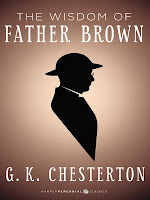
Browsing through my Kindle, wondering what to read next while on holiday with my family, I spotted GK Chesterton’s ‘The Wisdom of Father Brown’. Long out of copyright, this is one of the books I downloaded free for my Kindle from Project Gutenberg, probably some years ago.
Father Brown is a quiet, unassuming Roman Catholic priest with a tremendous gift for intuition and logical deduction. This volume, as with the others about this delightful man, is a series of short stories. So it was ideal to pick up and put down again when I had a few minutes to myself.
There are twelve chapters in this book, in which Father Brown demonstrates his ingenuity in a wide variety of cases. I read a paperback edition some years ago and had remembered the gist of first one: ‘The Mysterious Mr Glass’, although I had forgotten most of the details. But I didn’t have any memory at all of most of the others.
Rather than classic crime fiction as I understand it, these stories present Father Brown as an unlikely friend and solver of problems. There aren’t many clues, and in some cases no dramatic exposé of a criminal. Instead, Father Brown prevents tragedies, and saves innocent men from prison (or worse - this was written early in the 20th century when there was still a death penalty in the UK). He also helps to unravel unsolved mysteries from the past.
However, the various ‘cases’ tend to rely on local knowledge and insights, and the outcomes could not really be worked out by a modern reader. Occasionally I had a hunch about something which turned out to be correct, but without any certainty or detail. The ‘hunches’ may even have been due to subconscious memories, as I’m sure I’ve read this book at least once before.
Some of the stories are rather long-winded, particularly the introductions. In a couple of chapters, perhaps because I was tired, I had to read the first couple of pages three times before I could get into the story. Politics and intrigue are not my thing, and there’s a fair amount of them in more than one of the chapters. But there’s something very compelling about Father Brown, who is a delightful person, and that’s what kept me reading. The conversations, if (inevitably) old-fashioned, are believable, and the characterisation is generally good.
As a warning, chapter nine is extremely ‘politically incorrect’, with some of the worst racist words used - probably not intended to offend, but still shocking. The chapter itself is about boxing, a subject I know little about, and frankly that story made no sense to me at all. I hope that modern editions have edited or even removed this chapter.
The other eleven stories, however, are well worth reading if you like this genre of short stories.
Review copyright 2018 Sue's Book Reviews
I’ve liked GK Chesterton’s writing for many years now, ever since I first discovered his ‘Father Brown’ detective stories when I was a teenager. He wrote with an ironic humour that was unusual at the end of the 19th century and early 20th. He also had a keen eye for observation, which often makes me see things in a new philosophical light.
Since his work is now out of copyright, I’ve been able to download several volumes onto my Kindle at no cost, either from Amazon or from Project Gutenberg. I am gradually reading my way through them. I began ‘Tremendous Trifles’ about six months ago, and quickly realised that it was a work to dip into at random rather than something to read straight through.
This volume consists of a collection of some of Chesterton’s journalistic essays, which were originally published as part of an ongoing newspaper column. As such, each chapter is complete in itself. Most are somewhat thought-provoking, some are whimsical, a few are decidedly bizarre.
The titles and contents of the essays are quite a mixture, with a theme of ordinariness tying them together. Chesterton claims, in the introduction, that he is trying to encourage his readers to look at everyday objects - such as ceilings, or pens, or fences - and ponder their significance for a while rather than taking them for granted. This is what he attempts to do in the essays which result. Some of them, I assume, are true anecdotes, while others are entirely imaginative.
I didn’t know quite what to make of this, at first. If I picked it up when I was tired, or if I happened to be reading an essay that required specific knowledge of places or politicians who were unknown to me, then I read the words and took in very little of what was there. However, others of the stories appealed strongly. From time to time I came across a sentence or two that struck quite a chord; not that I can recall any of them now.
I’m glad I read this book, but I can’t see myself picking it up again; nor would I really recommend it to anyone other than fans of Chesterton’s writing who are interested in seeing something rather different from his better-known works. As social history - this is the nearest the author got to journalling, he says - they certainly have some value, and there are nicely ironic touches that I appreciated when reading. But inevitably it’s very dated, and unlikely to appeal to those of a less reflective, faster-paced generation.
Note that the given link is to a paperback edition of this book, which seems to have remained constantly in print over the decades. There are several different electronic versions too, some of them free and others not.
Review copyright 2015 Sue's Book Reviews
I've enjoyed, over the years, quite a few works by GK Chesterton. He is best known, of course for his 'Father Brown' mysteries, but was also something of a theologian in the early part of last century.
So I was pleased to find a copy of perhaps his most famous book of apologetics, 'Orthodoxy', available for Kindle. I don't remember now whether I downloaded it from Amazon or elsewhere; I started reading it several months ago, but have only really got into reading it properly in the last few weeks, and finally finished it yesterday.
This book contains a thoughtful and fascinating account of the author's move from agnosticism, in his teens, through to a profound faith in God, and subsequent adoption of the Christian faith. Chesterton describes his gradual search for meaning in life, first assuming a materialist perspective. He looks at objections to God posed by atheists, and gradually, in a consistently logical way, realises that they were all based on fallacy.
He does not describe a moment of conversion, which I can only assume was as reluctant as CS Lewis's some years later. But he describes moments of profound realisation; the 'aha' moments when circumstances and his understanding fell into place, and he could see that the truth had been in front of him all along; he simply had not recognised it.
I found this a very interesting read. Some of it was a bit long-winded, and of course it's over 100 years since it was first published, so it's not surprising that the style and some of the words seemed a bit dated. Still, there was much to ponder, which is partly why I found that a few pages at a time were sufficient. I found Chesterton's thought processes a bit convoluted in places, yet reassuring and often refreshing. Reading through his account, it became hard to imagine why anyone would not believe in the Christian God, if he or she truly considered the evidence with an open mind.
Chesterton wrote the book, apparently, to answer his critics and explain his spiritual quest. In doing so he produced an excellent apologetic for his beliefs, which is still in print as well as being available in more than one Kindle form.
Recommended to anyone who is happy with a somewhat lengthy - and, inevitably, dated - discussion of faith from a fully rational and logical standpoint.
Note: The Amazon link is to a paperback edition of this classic; Kindle editions are available, sometimes packaged with other of Chesterton's works, and generally much less expensive.
Review copyright Sue's Book Reviews, 20th November 2012
I have quite an admiration for GK Chesterton, perhaps best known for his 'Father Brown' mysteries. He also wrote some theology books, and is highly respected in the Christian writing world. I struggle a bit with some of the long-windedness of the Father Brown books, but have enjoyed the stories, so was pleased to see some of his works available, free, for the Kindle.
'The man who knew too much' is a book of short stories featuring Horne Fisher, an amateur sleuth, who, in his own words, always knows too much. He understands quite a bit about human psychology, and is also aware of a great many other details about people and events that are missed by most of those around him.
I enjoyed most of the earlier stories in the book, while finding them a bit lengthy and over-detailed in places. But there are some unusual situations, and Fisher seems to be a likeable person. I didn't find myself racing through the book, however. It took me three weeks to get through it, usually reading about half a chapter at a time.
However, towards the end, the book takes a decidedly political turn. Suddenly, rather than solving mysteries, we hear of Horne Fisher's early forays into the political world, and learn of several of his relatives, also politicians. I found it impossible to keep track of who was whom - the names were too similar, and while the plotting is clever, the characters mostly feel rather flat.
The final story is the worst of all, in my opinion. It features more political intrigue, an over-gory scene in the middle, and a highly unpleasant ending. It was quite bad enough to make me determine that I would not to read this book again, and to be glad that I had downloaded the free version although it's available in print editions too.
Probably worth reading once, although I wouldn't recommend the last two stories.
Review copyright Sue's Book Reviews, 23rd March 2011