At last I've finished 'The Fiery Cross', fifth in the Outlander series by Diana Gabaldon. The sixth and final novel in this series is due to be published towards the end of this year, and I'm looking forward to it.
A year ago I had never heard of this author, and it was a casual recommendation that made me pick up her first novel, 'Cross Stitch' from a second-hand bookstall. I've ordered all the others new as I've enjoyed them so much! They're excellent value since each one is over 1000 pages in paperback; I'm quite a fast reader but they still take me two or three weeks each.
This particular novel features Claire, Jamie, Brianna, Roger and Jemmy living in the USA in the late 18th century. It's not a straight historical novel since some of the characters are time-travellers from the 20th century, who thus know what is to come in world history terms; moreover Claire (who is a doctor) understands about germs, antiseptics and genetics. But this potentially science-fiction thread is barely relevant; it's written as if it's something quite believable, and a valid part of history.
I did find this book a little over-long in places - once or twice I skimmed forwards a few chapters, but always went back to read what I'd missed. Most of it is about day-to-day life for early colonialists, with a few military incidents and various everyday problems. Not really my kind of book at all, so I can only conclude that it's the excellent characterisations that keep me reading and wanting more.
The style is slightly odd in that over half the book is written in the 1st person (by Claire) but other sections are written in the 3rd person, mostly following Roger and Brianna. It works - indeed I can see how it's necessary in some sections - but I found it jarred once or twice before I realised whose perspective I was following.
Still, it's a minor criticism. Overall I'd highly recommend this series, even though it's more violent than I generally like.
Best read after 'Drums of Autumn', the fourth in the series.
This book is the fourth in the 'Through the Stones'/Outlander series by Diana Gabaldon which starts with 'Cross Stitch'. What an incredible series this is, with the most amazing amount of research.
The overall plot sounds like something out of science fiction: Clare Randall accidentally walks through a split stone in Scotland in the 1940s and finds herself in the midst of the Jacobite rebellion of the 1740s. For her own safety she has to marry a Scotsman called Jamie. Their marriage of convenience turns into a passionate romance in the midst of the violence and brutality of the times.
Subsequent books reveal how Clare returns to her own time, gives birth, and then - discovering that Jamie did not, after all, die at the battle of Culloden - returns to find him. Yet this brief overview barely touches at the novels, each of which is around 1000 pages long and full of subplots, with realistic portrayals of the life and times of the 18th century. There is such excellent characterisation that I found myself compelled to keep reading.
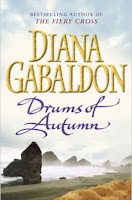
In 'Drums of Autumn' Clare and Jamie are America in the 1760s with Jamie's nephew Ian, where they begin to build themselves a home. The novel switches between their day-to-day life and that of Clare's grown-up daughter Brianna, who lives in the late 1960s. Brianna is in love with a historian called Roger who has discovered a tragic news cutting about Jamie and Clare's demise.
When Brianna discovers this, she decides to go through the stones herself and attempt to change history. Roger follows her. Much of the book is taken up with their adventures as they try - both separately and together - to find Jamie and Clare.
There are Red Indians (not a politically incorrect term in the 18th century), valuable gems, serious illnesses, and hundreds of other fine details which are so well interwoven into the book that I felt I knew more about this time in history than any other. It doesn't have the gruesomeness of one or two of the previous books, but that's a benefit in my view.
Highly recommended to anyone who has read the previous three books. But I would not recommend it as a stand-alone novel. The plot is confusing enough, and would be almost impossible to understand for someone who hadn't read the others.
As I finished a couple of days ago, I put in an order online for the next in the series, 'The Fiery Cross'.
This morning I finished 'Voyager'. This book is the third in Diana Gabaldon's series about Jamie, an 18th century Scot, and his passionate marriage to Clare, a 20th century Englishwoman. Strange idea? Yes, but this series doesn't read like fantasy at all, despite the occasional mystical reference. It's grounded in solid and brilliantly written history.
The first book, 'Cross Stitch', had me absolutely captivated as Clare first went back in time to the Jacobite Rebellion, and fell in love with Jamie. I was less impressed with 'Dragonfly in Amber' which is basically the story of how Clare came to return to her own time just before the battle of Culloden, expecting Jamie to die. It happens twenty years later and is told by Clare to her daughter Brianna.
I didn't expect to enjoy Voyager much and thought it would be the last in the series that I would read. How wrong could I get? Although it was a little slow to get going - and annoying in places as the narrative changed from 3rd person to 1st and back again - I was soon thoroughly gripped, particularly when Clare returns to find Jamie after learning that he did not, after all, die at Culloden. This manages to be less violent than the second book. Although it's full of action and not the kind of book I'd usually enjoy at all, I was captivated.
Clare meets pirates, slaves, people who have suffered terrible torture and illness, and apparently takes most of it in her stride. She's a strong and believable character whose medical training stands her in good stead despite her frequent frustrations at lack of modern resources.
Some old 'friends' from previous books make appearances. Some of them are rather surprising and, I suppose, reliant somewhat on coincidence - but that didn't worry me over-much. The last few chapters are dramatic - even more so than the rest of the book - and the ending very satisfying. It could easily have been the end of the series, but I gather there are two more books already published and a sixth which will be available later this year. Will I get the rest of them? Definitely!
My only proviso about this book is that it would be highly confusing to anyone who hasn't read the first two in the series.
I finished 'Dragonfly in Amber' by Diana Gabaldon yesterday. It's taken me over two weeks - much longer than usual, even given that it was nearly 1000 pages.
I didn't enjoy it as much as 'Cross Stitch', the first in the series. If I hadn't read that first, it would have been extremely confusing. However I wanted to know what happened to Jamie and Clare, so I persevered.
This is a bit of a strange book... mostly historical, set during the Jacobite rebellion. Yet it's far more interesting, in my opinion, than most army-type books. Diana Gabaldon really is an excellent writer. Mostly she manages to describe the conditions without being boring, and the unpleasantness and violence without getting gruesome.
Mostly... but not always. I couldn't read the description of hanging, drawing and quartering after the first paragraph. It was apparently an exercise in producing the maximum excruciating pain for the longest possible time, and only done by 'master' executioners. How can society have been so evil?
Anyway... it stops being a straight historical novel by the unlikely twist that Clare was born in the 20th century and went back 200 years in time to the midst of war-torn Scotland. At least, that's what happens in 'Cross Stitch'. In 'Dragonfly in Amber' she starts off back in the 20th century with a grown-up daughter who knows nothing of her mother's strange time-travelling past, and eventually tells her the story... which is the bulk of the novel, continuing where the previous one left off.
Confused? All I can say is: if it appeals, try 'Cross Stitch' first. That's excellent. But don't expect quite so much of this one. Still, there was enough of a draw at the end to make me put in an order for 'Voyager', the third in the series.
I picked up this book - 'Cross Stitch' by Diana Gabaldon - second-hand after reading a recommendation somewhere. When I finally started reading it, over two weeks ago now, I was almost instantly hooked. At first I tried reading just a couple of chapters each night before going to sleep, but by the end I could barely put it down. And it's a LONG book!
It isn't anything to do with embroidery, however. Perhaps the title caused some confusion, as it has now been re-published as 'Outlander'.
This novel begins just outside Inverness in 1946. Clare and Frank were married shortly before the war, then parted for the duration; Clare worked as a nurse. Now they are back together again and taking a short holiday. Frank is an intellectual type who is fascinated by Scottish history and researching his family tree. Clare (who narrates the entire book) loves him and enjoys his company but finds him amusingly tedious when he starts lecturing on his favourite subject.
It's clear from the first sentence that this book has a mystical side to it - a 'disappearance'. Indeed, the blurb on the back tells us that Clare is going to find herself in the middle of a skirmish in 1743, so the first few chapters are really setting the scene. I found myself gripped almost from the start: observing Clare in her natural surroundings, learning a little of the history of the place. I wondered what the significance was of her interest in herbalism, and whether something dramatic would happen at an ancient stone circle which she visits.
I didn't know quite what to expect with a novel that evidently combined time travel with history. I was impressed right from the beginning with the crisp writing style. Diana Gabaldon moves the plot forward at exactly the right pace to hold my interest, with minimal descriptions. I had a pretty good picture of Clare by the time she does her disappearing: she is a confident, intelligent, and also passionate young woman. These qualities become more evident as she is forced to adapt to unexpected new circumstances, entirely at the mercy of the Scottish rebels into whose hands she falls.
Underlying the whole book is a deep and thrilling romance which manages to be moving without being trite, passionate, sometimes erotic without being cringeworthy. The historical surroundings are so well researched that I found Jacobite Scotland coming alive to me in a way I could never have imagined. I have never before become engrossed in a novel where most of the characters were male, and much of the action involves fighting. But this book was gripping! For a week I managed to read just a chapter or two at bedtime... thereafter I was completely hooked and finished the remaining 500 or more pages in just three days.
I wondered at one stage why the author bothered to start Clare off in the 20th century - why not simply set the novel in 1743? But gradually I realised that it's a very clever plot device: we see Jacobite Scotland from the point of view of someone we can relate to, whose values and ideals are similar to ours, but quite different from those in the society where she finds herself. When she begins to understand why some very unpleasant things happen, it enabled me to catch a glimpse, myself, of why such different values were held 200 years previously.
There's a fair amount of violence in the novel, and this is something which would normally put me off completely. But it managed to stay just the right side of goriness, so that I was shocked but not quite sickened. There is considerable tension but no real heart-stopping suspense. Even when Clare herself is in serious danger, the fact that she relates the book reassured me that she at least would not be killed.
In addition there's a fine thread of humour that relieves the tension every so often. I was amused at scenes with small children asking innocent questions. There is also some light-hearted banter between adults who have learned to trust each other. I felt as if my mind and emotions were taken on a roller-coaster ride: at one moment horrified at the privations and violence of a society I have never known, yet a few pages later seeing the people as not so different, deep down, from those I know in the 21st century.
I would recommend this to almost everyone, whatever their tastes in literature. My only slight reservation would be that ultra-sensitive folk might find it upsetting. I don't think I would have liked it myself as a teenager. I doubt if a child would show much interest in such a lengthy novel but if they did, I wouldn't worry too much since much of the disturbing material is couched cleverly in language that implies rather than describing exactly what happens.
All in all, I thought this a superb book and I'm looking forward to getting hold of the sequel, 'Dragonfly in Amber'.