29 Oct 2023

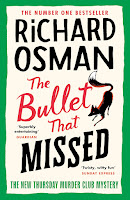
The Bullet that Missed (by Richard Osman)

The Bullet that Missed (by Richard Osman)
(Amazon UK link)
I very much liked the first book I read by Richard Osman, ‘The Thursday Murder Club’, and immediately put the second, ‘The Man that Died Twice’ on my wishlist. I wasn’t sure if I was going to want the third one, but a visitor earlier in the year had bought the book at the airport and read it while staying here, then asked if I would like it for my collection. Naturally, I accepted. 

I’ve just spent the last few days reading ‘The Bullet that Missed’. It involves the familiar quartet from the previous books (Elizabeth, Joyce, Ron and Ibrahim) and their characters feel a lot more well-developed than they were in the first book. They are all in their seventies, and live in a retirement ‘village’ and meet regularly to try to solve murders from the past. 

Elizabeth, formerly a spy, is quite hard-nosed and mostly takes the leading role. But her softer side comes out in dealings with her beloved husband Stephen, who is gradually falling further and further into dementia. There are some very poignant moments involving Stephen.  Elizabeth’s friend Joyce is fluffy and romantic on the surface, but observant and quite astute at times. Ibrahim, a former psychiatrist, is wise and intuitive. Ron is perhaps the least interesting, in my view; he’s quite tough on the surface and often takes a while to catch on. But he hates being left out of anything and when he has something to do, he does it well.  

There are other familiar characters from the earlier books,, and some who are new to this one including several TV workers, and some extra police officers. There are also some new criminals, one of whom is stalking Elizabeth and threatening her as the book opens. 

This novel features the quartet’s  investigation of the death of a former TV presenter called Bethany, whose car was driven (or, perhaps, pushed) over a cliff. Her body was never found but that’s not surprising, and the case was closed, ten years before the story starts, without any indication as to why this tragedy happened. 

There are also some very wealthy money-launderers involved in this novel, one of whom is in prison but hoping to get out soon. I found some of the technicalities of the crimes committed a bit confusing in places, but it didn’t much matter. 

The writing is terse but very well done, in my view, with occasional humorous asides.  The chapters are short, each taking different point of view; this works well and while it could have felt a bit jumpy, it somehow works. 

Until I was about half-way through the book I was finding it a bit samey, but gradually the different storylines started to come together, and some of the characters got under my skin.  By the time I was nearing the end, I could hardly put it down.

I took me until towards the end before I worked out who one of the perpetrators was most likely to be and even then I wasn’t entirely correct in my suppositions.  I’m not sure I could have worked out the complexities of what went on - for Bethany’s wasn’t the only death being investigated, by that stage. And then there were more twists, although there had been some hints and I wasn’t altogether surprised. 

All in all I thought this a good book, worth reading if you enjoyed the first two of Richard Osman’s novels. I won’t be rushing out to get the fourth, which is now available but I may well pick it up at some point. Recommended if you like light crime fiction (there’s a fair amount of tension but no real gore, and the odd humorous aside) but it would be confusing if you had not previously read the two earlier novels in the series.
Review copyright 2023 Sue's Book Reviews

26 Oct 2023

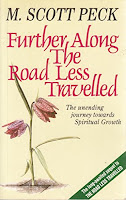
Further Along the Road Less Travelled (by Scott Peck)

Further Along the Road Less Travelled (Scott Peck)
(Amazon UK link)
Back in 2010 I read a book called ‘The Road Less Travelled’ by the psychiatrist Scott Peck. I thought it excellent, even if it left open a lot of questions. I had almost forgotten about it when I happened to see its sequel, ‘Further along the road less travelled’ at a church book sale… five years ago! I don’t know why it took me so long to pick it up to read, but I finally started it a few weeks ago and have read 10-12 pages every day. 

It’s quite an old book now, first published in 1993, fourteen years after the publication of the first book. In the intervening years, the author had decided that, after weighing up many options, he believed that the Christian faith made the most sense, and that he would follow Jesus. So this book has a far more spiritual emphasis than the earlier one, with many mentions of God. 

But it’s essentially a book bringing some of the theories of psychiatry - or, at least, Scott Peck’s understanding of it - to the general public. The writing is excellent: clear and interesting without either extreme of being over-technical or condescending.  I had forgotten most of what was explained in the first book, but it didn’t seem to matter. 

One of the chapters struck me particularly. It was about general stages of development of humanity - or, as I understand it, groups, or cultures, or ideas. They’re not new ideas; I already knew, for instance,  that to move from chaos or barbarianism into a more democratic, free lifestyle or society there generally had to be a period of strict laws, possibly martial law (as happened under Ancient Rome, for instance). But I hadn’t taken in that to move between strict laws and open democracy there needs to be a period of questioning, possibly rebellion. 

I had not, however, interpolated this into normal human development. As the author points out, a  baby’s world is chaotic and it takes a couple of years, at least, for a child to figure out all his boundaries. Young children then tend to be quite black-and-white in their thinking, observing rules and expecting others to do so. The teenage years are typically full of questions (sometimes rebellion) as a young person decides that not all rules make sense. And, all being well, by the time they’re in their twenties or so, they have started to develop some balance, thinking for themselves, accepting that some rules are important; able to query when relevant, but also able to accept authority when appropriate. 

This felt like an ‘aha!’ moment, when what I knew and observed already fell into place quite neatly. The author explains that some people are stuck in earlier stages and that it’s not possible to move from the first or second stage directly to the fourth: there always has to be progress in the order given (although the time frame and specifics will, of course, vary).  This helps to explain why someone at ‘stage four’ (which he calls the beginning of maturity) won’t be able to convince or persuade someone entrenched in ‘stage two’ thinking, of whatever type, until they start questioning for themselves. The churches, the author says, are full of people who are at ‘stage two’ - some of them fundamentalists who won’t see outside the box, but others nice, friendly people who have no need to rebel or question,and are happy to go along with what they have always been told.

Other chapters look at issues such as spirituality, at psychotherapy in general terms and at what was called the ‘New Age’ movement - and there’s a warning against reacting too strongly against anything. The author writes are very balanced chapter, with lists of  the positive and negative aspects of the New Age ideas.  I found much of the writing enlightening and helpful; the only one I thought rather weird was the final one, about sexuality and spirituality.  And the epilogue, which is the transcript of a talk, was rather heavier - or, possibly, just harder to read because it was a talk rather than written intended for a book.

But overall, I thought this an excellent book; I hope I’ll read it again before too many years have passed, and I hope that the principles and theories in it will stick with me in the meantime.

Review copyright 2023 Sue's Book Reviews

24 Oct 2023

The Wrong Chalet School (by Elinor M Brent-Dyer)

The Wrong Chalet School (Elinor M Brent-Dyer)
(Amazon UK link)
I do like re-reading my way regularly through Elinor M Brent-Dyer’s lengthy ‘Chalet School’ series. Originally written for teenagers in the middle decades of the 20th century, they have been published in more than one format. Most of the readers nowadays are adults like myself who recall them fondly from our mothers’ or grandmothers’ shelves, and I’m very pleased to have the entire series myself. 

‘The Wrong Chalet School’ is one I have only in Armada paperback form. I gather that this edition was uncut from the hardback, unlike many of the others; however my book, one I have had for a LONG time, is falling to pieces. I hope eventually to acquire a ‘Girls Gone By’ edition.

I last read this book in 2011, but I had read it before, more than once. It wasn’t difficult to remember the basic outline: Katharine Gordon arrives at the Chalet School, but she wasn’t supposed to go there. I couldn’t recall much else, and confused it somewhat in my mind with ‘Carola Storms the Chalet School’, which I re-read last month, and which has a similar theme. Both girls arrive unexpectedly; both had been living with aunts. 

The difference, however, is that Carola takes matters into her own hands, escaping her aunt, and her deception was uncovered very quickly. Carola, moreover, is a very impulsive person who rarely thinks ahead. Katharine, by contrast, is sent to boarding school with her aunt’s blessing, at the suggestion of her parents who are in China. There’s an ongoing subplot involving the safety - or otherwise - of Katharine’s parents which I found quite moving. 

In addition, while Carola is entirely unexpected, there’s a coincidence that’s rather large to swallow in Katherine’s case. Another girl with a similar name, is expected but does not turn up. At first it’s assumed that there was some administrative error (and we learn that a lot of letters from parents and guardians were destroyed by water from a leaky ceiling) but gradually it becomes apparent that Katharine should probably have gone somewhere else. However the other Chalet School in the area has no record of her.

Katharine turns out to be a likeable, friendly and sporty girl who excels in both swimming and tennis. She makes friends easily and loves being at the Chalet School. So she very much hopes that she’ll be allowed to stay, even if it wasn’t where she should have been…

There are one or two plot holes, quite apart from the incredible coincidence of another girl with similar name having been registered. The fact that Katharine’s trunk turns up (as well as another one which clearly is NOT hers) seems unlikely, as does the fact that her aunt - who is very absent-minded - manages to write to the Chalet School. And I would assume that a boarding school would need some of the annual fees in advance, but obviously they wouldn’t have been paid: no mention is made of them. And I really couldn’t believe  that Jo Maynard, who is in Canada with her family, met and got to know the missing girl and her mother… 

However, it’s a very enjoyable book. There’s a good balance of scenes between Katharine and friends and the staff, and two or three places that made me smile; I even chuckled once. Katharine is a well-rounded character whom I liked very much, and she makes some good friends. There are also a couple of poignant scenes and a satisfying ending, even if preceded by a somewhat dull description of a sea pageant. 

Definitely recommended as part of the series: or as an introduction to it, if you want to try one of the typical Chalet School books.  Unfortunately it's not currently in print and second-hand versions tend to be pricey. 

Review copyright 2023 Sue's Book Reviews

23 Oct 2023

A Slipping-Down Life (by Anne Tyler)

A Slipping Down Life by Anne Tyler
(Amazon UK link)
On the whole I’ve been enjoying re-reading my collection of novels by the American novelist Anne Tyler. She has a quirky style, with many wry observations that sometimes make me smile. Her characters tend to be larger than life, many of them caricatured, but then some of the situations are so strange that I don’t take them too seriously.

I just finished ‘A Slipping-Down Life’, which I read in 2006. I had entirely forgotten what it was about, but saw that on GoodReads and LibraryThing I had given it just three stars. I nearly bypassed it, but sometimes my opinions change, particularly after more than fifteen years. And it’s a very short book, more a novella than a novel, with just over 150 pages. So I knew it would be a quick read.

Unfortunately, it’s a  rather depressing book which I didn’t find amusing at all. Evie is the main character; she’s seventeen, very overweight, living a drab kind of life with a father who loves her, but has little in common with her. She’s not sporty, or academic, and her only friend is the even more overweight Violet. 

Evie spends a lot of time listening to the radio, and hears an interview with a guitarist known as Drum Casey. She is virtually tone deaf, and finds most rock music over-loud and incomprehensible, but for some reason the radio interviewer inspires her to find out more about him. This leads her to going with Violet to a rock show where Drum is performing. 

All of which could have been quite interesting, but Evie doesn’t enjoy the concert, and doesn’t understand Drum’s songs. But she starts to become obsessed with him, although she’s certain he’ll never notice her amongst the crowds of attractive fans.  Then something happens - something that made me feel squeamish, as if I didn’t want to continue reading the book, but I did keep going. And gradually Drum - who is very self-centred - starts to notice Evie.

And from then on things get worse… Evie is temporarily contented after agreeing to something so unlikely that I couldn’t believe she would go through with it.  But things go wrong for Drum, and while Evie tries to help, she eventually realises they have nothing in common. 

The ending is both depressing and inconclusive. I suppose it’s a testament to the pace and style of the writing that I kept going, but overall I found it a disappointing book that seemed to have little point to it: rather like Evie’s life at the start of the novel.

Not really recommended, unless you love Anne Tyler's style and don't mind a rather depressing read with dull, dislikable characters. 

Review copyright 2023 Sue's Book Reviews

21 Oct 2023

The Teashop on the Corner (by Milly Johnson)

The Teashop on the Corner by Milly Johnson
(Amazon UK link)
I don’t think I had ever read anything by Milly Johnson. But I’m always happy to try a new author, when the front cover looks appealing, the blurb on the back sounds interesting, and the price is right. However, although I bought ‘The Teashop on the Corner’ at a church book sale four years ago, I only just picked it up to read a few days ago. 

I was hoping for something light, easy to read and with some likeable characters. The book certainly met the first two of those criteria, but I found the number of characters quite confusing, with none of them being all that appealing. The first few chapters introduce new people rapidly, most of them caricatured, and it took a bit of effort to keep going.

I’m glad I did, as the various subplots start to converge, as they all visit a newly-opened teashop in a square that’s being redeveloped. I’m not sure why it’s called a teashop as most of the visitors drink coffee and eat cake, but that doesn’t much matter. Lena is the proprietor of the teashop; she’s always rather over-cheerful and welcoming, kind to everyone. The shop doesn’t just sell drinks and cakes; there are a large number of literary items for sale - bags made out of books, keyrings in the shape of famous characters, and many other items which mostly sound rather kitsch, although the customers seem to like them. 

The first person we meet in the book is Carla, mourning at her husband’s funeral which ends on a dramatic note. She has no idea what she will do in the future when she learns that most of what she thought about her life was wrong. Thankfully she has some good friends who take her under their wing.

The next person is Will, a young businessman who owned a roofing company that has gone bankrupt. His bank refuses any more credit, and he knows he’s going to lose everything. He’s married to a selfish, greedy person called Nicole who decides to return to her parents rather than live with someone she sees as a loser. I couldn’t begin to understand what Will saw in Nicole, or why he was still trying to appease her and promise her that things would get better when he knew that they would get a lot worse first. 

Then there’s Molly, in her late 60s who lives next door to her twin sister Margaret. Margaret has been happily married for forty years, but Molly has had two shorter-term and not so successful relationships. She has a son from her first marriage, who’s quite a bully, married to a dreadful woman called Sherry who would like to see Molly go into a care home. Then one of her former ex-husbands turns up, out of the blue…

Perhaps the problem is that there are too many viewpoints for any of them to feel fully rounded and three dimensional. Or perhaps it’s that the ‘nice’ characters are pleasant and endowed with all the virtues, even if some of them have secrets that don’t emerge until later in the book. Yes, Will has been a bit too much of a risk-taker but all the problems or secrets of the other main characters are due to events in their past which they couldn’t have done anything about. 

As for the ‘bad’ characters, they don’t seem to have any redeeming features at all. And there are rather a lot of them: Molly’s former husband, and her son and his wife; Carla’s deceased husband and his first wife; Will’s wife and her parents.  In addition the owner of the land where Lena has her shop comes from a very unpleasant childhood with parents who didn’t care, and foster parents who treated him badly. 

And there’s 14-year-old Ryan - who is, in my view, the most likeable character in the book. Ryan comes from a family of criminals; his mother left when he was a baby, his father has just moved out, two of his brothers are in jail, and the one remaining in the house is a violent bully. Somehow Ryan has managed to avoid being tainted by his family and has grown up loving books. I don’t know of many 14-year-old boys who could converse intelligently on a wide range of classic authors, but I found myself more in sympathy with Ryan than with any of the other characters. 

It’s essentially a character-based book, and as such I found it quite readable. Most of the chapters are short, and once I’d got into it, it was easy enough to remember who was whom. There are several different subplots, but most involve the main characters trying to find a way forward, out of their dilemmas, with a purpose for the future. Naturally they all achieve this in a somewhat predictable way, and some of them pair off romantically in a way that’s also rather predictable.  There are a couple of revelations towards the end of the book but while the characters are surprised, I could see them all coming. Perhaps I was supposed to.

It’s not the greatest of writing. The style of the book is informal, and a bit long-winded in places. Some of the conversations are little more than greetings and small talk; they don’t seem to go anywhere. And there were a lot of adverbs and lengthy sentences that could have been cut down. But apparently many readers like this style that breaks many of the guidelines for good writing, and it’s not a bad book.  There’s almost no bad language, and no bedroom scenes, although there are references (non-explicit)  to childhood abuse of different forms. 

I don’t suppose I’ll read this again, and I’m not inclined to look for anything else by this author. But I’m glad I finally got around to reading ‘The Teashop on the Corner’. And if I do happen to see another of her books on a future church booksale, I might just pick it up.  If you like lightweight women's fiction with somewhat stereotyped characters and a mostly happy ending, this could make good holiday reading. 


Review copyright 2023 Sue's Book Reviews

17 Oct 2023

Good Dog Dandy (by Malcolm Saville)

Good Dog Dandy by Malcolm Saville
About six weeks ago I re-read ‘The Secret of Galleybird Pit’, one of the lesser-known children’s books by Malcolm Saville (best known for his ‘Lone Pine’ series). So I decided to re-read the sequel, ‘Good Dog Dandy’, another book which I probably hadn’t read for close to fifty years. There’s a note in the front saying that I bought it in January 1974 so I’m sure I read it soon afterwards, and possibly a couple of years later, but as far as I know I haven’t read it since.

In any case, I had totally forgotten the plot and had no idea who the dog Dandy might be. I hadn’t been all that impressed with ‘The Secret of Galleybird Pit’, but liked the characters of Lucy (12) and Humf (9) so was looking forward to meeting them again.

This book starts as the school summer holidays begin. Lucy and Humf have been invited to go camping with some of their friends, and there’s a fair bit of discussion about that. Humf is very excited about a police demonstration he saw at his school, which included a police dog - Dandy of the title - and his ambition is to join the police force and train dogs like Dandy.

Their parents run a cafe, which is starting to get a good reputation in the village, and is just beginning to make a profit, but money is still tight. And Mervyn, the father, is not very good with money. Having a flawed adult in the family is an unusual feature of a book for children of this era, and while it’s handled well - Mervyn seems quite realistic - I’m not sure what age-group would find this book most interesting. Theoretically it’s for ages 9-12, but some of the adult interactions would be way over the head of most nine-year-olds. 

The main plot involves some crooks who have been raiding local farmhouses; they are typically left unlocked during the daytime, making it easy for unscrupulous people to pop in. This storyline runs through the book, involving a woman calling herself an artist and a young, scruffy man who isn’t following exactly what the artist tells him to do. But we don’t get to meet them directly until towards the end.  

There’s a fair bit of description of geographical locations that the author clearly knew well and loved, which brings the book alive even if it’s a tad long-winded in places.  Lucy and Humf are well-developed characters (even if Humf appears to be almost a clone of Dickie Morton in the Lone Pine books) and their parents, too: their mother works too hard, their father is very fond of them all but really quite immature and self-centred, if genial. Lucy tries to keep the peace, aware of her father’s failings and sometimes angry with him. 

It took a while for the book to get going, but once I was into the story, I thought it was well done. There’s some tension, some light moments when Humf becomes particularly enthusiastic, some poignancy, and a nice, if predictable climax when everyone comes together to celebrate Lucy and Humf’s mother’s birthday.  

Apparently there’s a third book in this series, but I don’t have it and it’s not currently in print. I didn’t like the first two sufficiently to want to look for the third one second-hand although I suppose if I ever see it in a charity shop I might pick it up, for the sake of completion.

I thought ‘Good Dog Dandy’ was more coherent and also more enjoyable than ‘The Secret of Galleybird Pit’, and worth reading by those who like Malcolm Saville’s writing. Perhaps a fluent reader of about ten or eleven might like this, particularly if they are interested in camping and police dogs, or it could make a good read-aloud. Despite being a sequel, it could easily stand alone. But I’m not surprised it’s out of print, and unlikely to be in many libraries; so only really found in children’s sections at second-hand bookshops.  

Review copyright 2023 Sue's Book Reviews

13 Oct 2023

A Sense of Belonging (by Erica James)

A Sense of Belonging by Erica James
(Amazon UK link)
I’m glad I decided to re-read my novels by Erica James, in publication order. I last read ‘A Sense of Belonging’ in 2008, fifteen years ago, and couldn’t remember anything much about it. I always like discovering a book which I know I liked, but where I’ve forgotten the characters and the story.

The book involves a new development of five houses, all of which have been bought. It’s a good device; it introduces diverse characters, all new to the neighbourhood, who are essentially thrown together and start to develop friendships.  Or otherwise…

I didn’t keep track of who lived where. It didn’t much matter. The first one we meet is Jessica, a romantic fiction writer who has been living in Corfu for some years. She’s had a good time, with a philandering boyfriend and has settled in well, but she knows it’s time to return to the UK. She has bought her house because it’s about a mile away from the cottage where she grew up, and where her mother is. And she is sure her mother is needing some help as she grows older.

Then we meet Kate and Alec. Alec is nearly fifty, recently divorced, fairly amicably, from someone he still works with. He now lives with Kate who is in her late twenties, stunningly beautiful, and not much older than Alec’s daughter Ruth. Kate has a gift for working with small children and would love some of her own, but Alec isn’t keen at all. However she’s determined that this won’t come between them.

The next couple to be introduced are Tony and Amanda. They have quite a stressful relationship; Tony is still grieving for his first wife, Eve, who died in a traffic accident, and Amanda resents his six-year-old daughter Hattie. They can’t agree on how to raise her, and Hattie doesn’t much like Amanda. 

Then there’s Josh. He’s moving into a house on his own because he wants to prove his independence despite knowing he has an incurable illness that is going to limit him seriously, sooner or later. He is a likeable person, but becomes very angry when any of his family ask after his health, although they have been very close.  

So the scene is set for what’s essentially a character-based novel that takes place over the course of a few months. Viewpoints switch regularly - not in a way that jars, but sufficiently often that I didn’t feel as if I got to know anyone very well. Jessica’s story is the one that I was most interested in; perhaps because she’s a writer, she was the easiest to write about in a realistic way. Jessica is intelligent, feisty, and loyal. She is the most three-dimensional of any of the characters in the book; we see her with her agent, with her mother, and becoming attracted to one of her neighbours… 

It’s all a bit predictable, I suppose, with a nice tidy ending that works out well for almost everyone (other than Alec’s grandson Oscar, who, I feel, deserves better).  And there’s rather too much introspection for my tastes, as characters talk to themselves, not really saying or asking anything that hasn’t already been established. But a lot of novels published in the late 1990s were rather rambly in this style, and it’s not difficult to skim some of the inward thoughts. 

On the whole, though, the pace is good, and there are plenty of interactions that kept me reading and wanting more. There's a bit of light humour here and there too; I loved Jessica's mother's determination to keep working on her house and garden, despite injuries. And some of Jessica's quirky conversations with Josh made me smile, too. 

It’s interesting to me to see how Erica James developed as a writer; her style comes through in this book, but not the depth of characterisation or emotion that she uses so effectively in some of her later books. Still, this is a pleasant story, one that would make good, undemanding holiday reading. The issue of Josh’s illness lifts it above some blander novels of the era, and while I didn’t much care about most of the characters, I was sorry to close the book and say goodbye to Jessica. 

Recommended if you like light, well-paced women’s fiction.

Review copyright 2023 Sue's Book Reviews

10 Oct 2023

Violeta (by Isabel Allende)

Violeta by Isabel Allende
(Amazon UK link)
I had never heard of Isabel Allende, and most probably would not have come across her novel Violeta, if it had not been on our local book group list. I left it a bit late to start reading, giving myself just three days before this month’s meeting, but I finished it just in time. It was a bit slow to get started, but it wasn’t a difficult read. 

‘Violeta’ is the fictional protagonist and narrator of this book, which is told in the slightly unusual form of a letter to her grandson. But it was easy to forget this; every so often she mentions his name, but it’s told as a complete book, rather than being broken down into a series of letters. I wasn’t entirely sure what the benefit of the epistolary format was since it’s basically Violeta telling her life story, but it works well.

She was born in 1920 in Chile, the first daughter in a family who were reasonably well off, and already had several sons. Her mother was weak - she felt as if she spent all her married life pregnant, as she had lost a lot of pregnancies to miscarriage. Obviously Violeta was not aware of her own birth; she recounts the circumstances as she was told them later, probably by one of her aunts who attended the birth. 

At the time of Violeta’s birth, the Spanish flu pandemic was just hitting South America, a couple of years after it was rampant in Europe. Violeta’s father is well-informed, and orders a form of lockdown: nobody other than he and his oldest son may leave or enter the house, and there’s lots of disinfecting. His methods are successful as nobody in the household succumbs. 

It’s essentially a historical novel, set firmly in events in Chile, although it ends in 2020. It refers to nearby countries about which I knew very little, so the book was quite educational for me.  I looked up several places and events to find out more; the author assumes a basic knowledge, rather than explaining in detail, so I didn’t feel as if I was being force-fed information, as can all too easily happen. It was easy enough to check on my phone when I didn’t quite understand something. 

The book is divided into sections, each covering a couple of decades. In the first section we see Violeta growing up, moving, meeting new people and learning about the world. She never goes to school but learns from many different people, eventually having a governess from Europe who lives with the family, and becomes important in all their lives. 

The second section charts her growing attractiveness to men, and her first few relationships. Given the era and her Catholic upbringing, Violeta is a remarkably independent, passionate woman who seems to care little for convention. She’s clear-thinking and intelligent but makes some serious mistakes in her love life. Thankfully there’s no gratuitous detail although there are brief descriptions and many implications. 

The writing is good, the pace excellent, the amount of detail just right for my tastes. And yet…although I was interested in the overall storyline, I never really empathised with Violeta, or any of the other characters. There’s no emotion coming through, despite mention of several traumatic and heartbreaking events in Violeta’s life. Possibly this is because it’s written as a factual account for her grandson; I doubt if it’s a failing of the translation. Whatever the reason, it means I didn’t much care about any of the disasters that happen, even though, intellectually, I knew they were terrible (both the real and fictional events).

‘Violeta’ is definitely worth reading for anyone who likes historical fiction, particularly if you’re interested in South American history. Isabel Allende grew up in Chile, so the book feels almost biographical rather than researched. Apparently the character of Violeta was loosely based on the author's own mother. 

There’s nothing really explicit, and descriptions of violence or even bad language, as far as I recall. The horrors are dealt with as sensitively as possible, and it’s a good story, with interesting side themes relating to feminism and other contemporary issues. 

Review copyright 2023 Sue's Book Reviews

7 Oct 2023

The Unknown Ajax (by Georgette Heyer)

The Unknown Ajax by Georgette Heyer
(Amazon UK link)
I do like re-reading Georgette Heyer’s light historical romance novels regularly. It’s only five years since I last read ‘The Unknown Ajax’, but even when I recall the basic outline of a story, there are always plenty of scenes or conversations which I had entirely forgotten. There are others which I enjoy all the more for remembering them as they approach.

Hugo is the hero of this book, but we don’t meet him immediately. Instead we meet his estranged family: his grandfather, a couple of his aunts, and several of his cousins. His grandfather, the Earl, has been in a worse mood than usual. Nobody imagines that he’s grieving the loss of his oldest living son Granville and Granville’s son Oliver, as he never much liked them. It’s assumed that his next oldest son, Matthew, is now his heir.

So it’s a shock to everyone - particularly Matthew and his sons Vincent and Claude - when the Earl announces that his heir is arriving soon. He is the son of his late son Hugh and a weaver’s daughter - cast out of the family due to this ‘low’ connection. The Earl knew of Hugo’s existence but hadn’t told anyone else. Now the family lawyer has located him… 

The laws of inheritance were fairly complex in Regency times, and when land or property was ‘entailed’ the owners could do nothing to change it. The Earl is sure Hugo will be an illiterate yokel but hopes to make something of him before he comes into his inheritance. The family name - Darracott - is very important to him, as it is to most of his descendants. There’s perhaps more in this book about ‘classism’ than in some of Heyer’s others, much of it in a mildly humorous vein. 

Whenever I read this book I have a few moments when I confuse the storyline with ‘The Quiet Gentleman’; but I did quickly remember that although Hugo’s cousins don’t much like him, they’re not bad people and don’t plan to murder him. Vincent does say he wouldn’t pull him away from the edge of a cliff, but then Hugo, who is always placid and good-natured, points out that if he attempted this feat, Vincent would fall too. 

Anthea is the heroine, daughter of one of the Earl’s late sons, and sister to Richmond who is his grandfather’s favourite. I liked Anthea; she’s kind and caring, and mostly diplomatic, but she’s also quite spirited and takes exception to her grandfather’s telling her that she should marry Hugo. However the two become friends in the skilled way that Heyer had of showing, by conversation and action, how close two compatible people can come even when they start out with antipathy. It’s clear that they’re falling in love long before Anthea has any inkling of it, but this romance is one of the most low-key in any of Heyer’s books of this genre.

The family live near the Sussex/Kent border, and smuggling of spirits was rife in the area. Hugo is rather shocked at the family apparently turning a blind eye to ‘run’ cargo, and I found it amusing that his family consider his attitude ‘shabby-genteel’. Not that any of them actually approve of smuggling, but the taxes are so high and people need to earn a living, and get their brandy without bankrupting themselves…

It’s an exciting story, mainly character-based but with a good deal of plot, too. I did remember the outcome, and very much looked forward to the final, show-down scene which is brilliantly done. The morality is a bit shocking by today’s standards, and Hugo himself feels some remorse; but the result is positive for all concerned (well, other than the lieutenant involved). 

‘The Unknown Ajax’ is not one of my absolute favourites of Heyer’s novels. Smuggling and the upper-class acceptance of it in the era is rather an anathema to me, and the quotations from what was apparently a well-known work, relating to the ‘Ajax’, went mostly over my head.  But there are some amusing comments and a few wonderfully ironic scenes, and I’m already looking forward to reading it yet again in another few years.

Review copyright 2023 Sue's Book Reviews

3 Oct 2023

Unseen Academicals (by Terry Pratchett)

Unseen Academicals by Terry Pratchett
(Amazon UK link)
Re-reading the late Sir Terry Pratchett’s lengthy Discworld series, there have been times when I wonder whether I should give up. It often takes me a while to get into them properly, and they’re not as enjoyable reading on my own as they were reading aloud to my teenage sons. But I’ve kept going, and, as I near the end, am glad that I did.

‘Unseen Academicals’ is 37th in the series.  I first read it in 2010, having borrowed it from one of my sons; I apparently liked it so much that we acquired our own copy, although I had not re-read it until just recently. I vaguely recalled that it was set mostly amongst the Discworld wizards and the Unseen University. I also remembered that it was about football. That’s not a subject which usually interests me in the slightest.

The book opens by introducing some of the staff who work at the Unseen University. There’s Glenda, an excellent cook and head of the ‘night kitchen’, for instance. There’s Juliet, a young, beautiful but not very bright young woman who works with Glenda. There’s Trevor, whose father died playing football, and who works with the candles. And there’s Mr Nutt.

I’d forgotten all about Mr Nutt, whose story runs through the book, giving a little mystery that isn’t solved until nearer the end. Mr Nutt has come from Uberwald and is considered to be a kind of goblin, but nobody really knows. He is a very private person, and extremely skilled at candle dribbling. He did not have a happy childhood, but he’s a polite, highly intelligent and well-read person. He sometimes gives offence accidentally - he’s like a Discworld version of a autistic person. 

Ponder Stibbons, who does most of the important jobs in the Unseen University, has discovered an old document stating that some ongoing finances will stop unless the wizards have a football team. Football has become a violent, unregulated sport in the streets. So a lot of the book involves the implementation of rules which (as far as I know) roughly resemble those of football as we understand it on Earth. 

It took me even longer than usual to get into this book despite some enjoyable asides and not-always-subtle references to literary or mythological figures, as happens so often in Pratchett’s writing. But gradually the story took hold of me; I was particularly keen to find out who exactly Mr Nutt is, and why he’s working so hard for so little pay in a job generally considered one of the lowest. 

One has to suspend reality on the Disc, of course; but there are some quite thought-provoking discussions about racism, and how different kinds of people (trolls, vampires, dwarfs, humans etc) can learn to get along with a few concessions. There’s also a foray into the fashion industry, and even a very low-key romantic thread. And there’s football, but somehow Pratchett managed to turn even that very dull subject into an enjoyable part of the plot.

Definitely recommended if you’re a fan of the series. Although it stands alone, it’s undoubtedly best to have read some of the earlier books, particularly those involving the wizards. Many names recur and it’s confusing enough for someone like me who is reasonably familiar with most of them. 

Review copyright 2023 Sue's Book Reviews