30 Apr 2023

Three go to the Chalet School (by Elinor M Brent-Dyer)

Three go to the Chalet School
(Amazon UK link)
It’s nearly twelve years since I last re-read ‘Three go to the Chalet School’, which has always been one of my favourites of Elinor M Brent-Dyer’s lengthy series. I loved it even when I only had the abridged Armada paperback; I like it even more now I have a ‘Girls Gone By’ published version with the full text of the original. 


I very much appreciate the extra, somewhat random information in these books. This one explains about the school which the author herself ran for some years, as well as giving general information about the locations of the (fictional) Chalet School, and some of the publication history. I didn’t think much of the front cover, although it’s apparently the one used in the first edition of ‘Three go to the Chalet School’.  Not only is  the colour of the uniform incorrect for the three girls pictured, but none of them look anything like the ‘three’ who are introduced in this book. 


However, that’s my only gripe. The book opens by introducing us to a ten-year-old girl who lives with her mother and grandmother. Mary-Lou has been friendly with the neighbouring children Clem (who’s a little older) and her brother Tony. Clem and Tony’s parents are artists, very bohemian and lax, and ‘Gran’ has just heard the father swearing and shouting at the local butcher, because he didn’t like their sausages.


So Gran tells Mary-Lou to be less friendly, and Mary-Lou, not unreasonably, objects. However she learns that they’re soon to be moving, and that she will go to school. 


Action moves to the village of Plas Howell, where Mary-Lou meets the Maynard triplets, Len, Con and Margot, playing in a meadow at the end of their new garden. Naturally, Mary-Lou is to be going to the Chalet School, and she quickly settles in and makes friends. 


In her form is another new girl, Verity-Ann. The other girls make much of their both having double-barrelled names, but Verity-Ann is quite different from Mary-Lou: she’s quiet, stubborn, and determined not to demean herself (as she sees it) to racing around or behaving like a ‘hoyden’ in free time. She also refuses to speak German…


Much of the action takes place in the classroom, as we see both new girls struggling to learn the ‘modern’ methods of teaching that the Chalet School practised. Neither of the girls had been to school before, but whereas Mary-Lou is determined to work hard (too hard…with consequences) Verity-Ann has a misguided loyalty to her past governess and it takes much longer for her to settle down.


There are other threads in this book, which lift it beyond some of the later, run-of-the-mill books in the series. Both new girls, in a somewhat unlikely coincidence, have fathers who have been working in the Amazon for the past six or seven years, and don’t really remember them at all. Verity-Ann has no other relatives; Mary-Lou does, at least, have her mother and grandmother. There’s concern about the expedition, since nothing has been heard for a long time, and this subplot is an important one running through the book. 


There’s also a romantic thread for one of the staff, something that was entirely missing from the abridged Armada edition, and one which I thought was sensitively done. The young man concerned isn’t even a doctor. 


While some of the Chalet School books are only slightly abridged in Armada, and the later ones not at all, it’s well worth trying to find a hardback or GirlsGoneBy edition of this one, as so much has been taken out in the Armada paperback. Still, it was better than nothing, and I’m glad I was able to buy the Armada books at a time when the hardbacks were out of print.


Recommended if you like this series, or if you’re interested in school stories in general. This book might make a good introduction to the Chalet School series; while it has a lot of characters that I know from previous books, we meet most of them through Mary-Lou’s eyes, so it could stand alone better than many. Unfortunately it's out of print again, and second-hand editions of either the hardback or GirlsGoneBy version are both rare and, in general, expensive.


Review copyright 2023 Sue's Book Reviews

27 Apr 2023

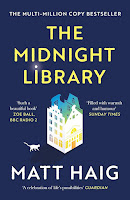
The Midnight Library (by Matt Haig)

The Midnight Library by Matt Haig
(Amazon UK link)
I had not heard of Matt Haig, and don’t know that I would ever have come across his novel ‘The Midnight Library’ if it hadn’t been next month’s reading group choice. I might perhaps have picked it up in a charity shop or church bookstall, as the cover is quite appealing and the blurb on the back intriguing, but that’s the case of many books and I’m trying not to have more than two shelves of ‘to-be-read’ books. 


However, since the book was on the list, I bought it from the Awesome Books site when I was in the UK earlier in the year, and have been reading it over the past few days. Overall, I liked it very much.


The main protagonist is a young woman called Nora. We meet her in a prologue when she’s eleven, taking refuge in her school library with a friendly, motherly librarian called Mrs Elm. At the end of the prologue there’s evidently some bad news, but we don’t learn what it was until much later in the book.


The action then switches to the day before Nora decides she wants to die… the heading of the section tells us this. And it’s rather a depressing incident, too.  It’s not surprising that Nora feels low. And the following day is worse… one thing after another goes wrong. She starts wishing her life were different, and by midnight is convinced that she’s a waste of space: that nobody will miss her if she dies, and that she can’t take any more misery. 


Action then moves to what appears to be a huge library, with Mrs Elm in charge, little changed from Nora’s memory of nearly two decades earlier. However this library, it turns out, is not a normal one: it’s a kind of interim place, where Nora can choose to relive part of her life as it would have happened if she had made a different decision at some point. There are philosophical discussions about infinite universes, in an almost Pratchett-like way; there’s also a heavy tome, the ‘book of regrets’, that lists all the things Nora wishes she had done differently.


Nora tries on a series of different lives, some of which turn out to be much worse than the one she had been living, but she has a lot of different experiences as she explores what might have happened if, for instance, she had not given up competitive swimming, or if she had followed an idle dream to study glaciers, or if she had remained in a band she and her brother were part of as teenagers.


It wasn’t hard to see where the book was going to go, and I had more-or-less worked out how it would end by about half-way through. But the writing is engaging, the situations diverse and intriguing.  One of the bylines on the front of the book says that it’s ‘filled with warmth and humour’, and while I didn’t feel that there was a lot of humour in the book, it was a warm, satisfying read.  Nora is a likeable person, who didn’t have a happy family life as a child; so it’s encouraging to see how her regrets gradually diminished as she realised that the choices she made weren’t, on the whole, so bad after all. 


It’s a book with a message (‘agenda’ is probably too strong although it’s the first word I thought of) in that it makes that point that many of the choices we now regret may in fact have led to a much better outcome than those we rejected. But it’s couched in such gentle terms, shown rather than explained, and with the delightfully surreal ‘midnight library’ as a regular stopping place, that I felt encouraged and inspired rather than being irritated by its obvious underlying message.


All in all I liked the book very much, and look forward to discussing it with others who have read it.


Review copyright 2023 Sue's Book Reviews

25 Apr 2023

Dinner at the Homesick Restaurant (by Anne Tyler)

Dinner at the Homesick Restaurant by Anne Tyler
(Amazon UK link)
Re-reading my collection of Anne Tyler novels nearly twenty years after first reading them, I’ve entirely forgotten the storylines as well as the characters. That’s good in that it means they feel almost like new books - but since I generally don’t check in advance what I thought of them previously, I might sometimes re-read a book which I didn’t much like first time round.


I last read ‘Dinner at the Homesick Restaurant’ back in 2004. So I had no recollection of it at all - and was slightly surprised at the opening paragraph, which informs us that Pearl Tull, a woman in her eighties, is dying. She’s bedridden and almost blind, but her mind is still active. Her son Ezra is with her, and she starts thinking about the past…


The book, set in small town America, takes the form of reminiscences over the decades. Each chapter is written from the point of view of one of Pearl’s three children in turn, and one or two other characters too, later in the book.  Cody, her eldest, is smooth-talking, generally popular, and rather a narcissist. He’s extremely competitive, and has always been jealous of his brother in ways that sometimes have quite unpleasant repercussions. He’s quite manipulative and not above cheating at times… and yet he’s oddly appealing as a character.


Ezra is the middle child, possibly her favourite. He’s intelligent, but slower-moving than his brother, more relaxed and accepting, and far too trusting. Ezra likes to keep his family close, to organise gatherings and meals. He is the owner of a restaurant and in the course of the book he tries to arrange several family meals at his restaurant, only to have them turn out badly for various reasons.


Jenny is the youngest. She’s highly focussed and academic right from the start, determined to be a doctor. Jenny barely remembers their father, who walked out when she was a child - and, bizarrely, Pearl kept pretending, for years, that he had just left on a long business trip. 


So the book gradually unfolds, showing us snapshots in the lives of each of these three, with different perspectives as we see events through different eyes. Pearl, it’s clear, has been extremely stressed over the years and in many ways was an unpleasant, almost abusive mother - and yet her adult children have turned out reasonably well, and stay in touch with each other, albeit loosely. 


The writing is good, as is the characterisation, but the pace is a bit slow for my tastes, and when I picked up the book some evenings I had to re-read a couple of pages to remind myself who was speaking and what was going on.  Anne Tyler has a gift for observation, and I love some of her phraseology; yet this book didn’t really grab me. It’s a circular kind of book, starting with Pearl on her deathbed, seeing her children growing up to the present date, right up to - and after - the point where she dies. 


It’s a character-based book, without a great deal of plot, and I wouldn’t particularly recommend it as an introduction to this author’s work. But it’s a pleasant enough story, and I might even read it again in another couple of decades.


Review copyright 2023 Sue's Book Reviews

15 Apr 2023

The Island (by Victoria Hislop)

The Island by Victoria Hislop
(Amazon UK link)
I had never read anything by Victoria Hislop, although two or three friends had recommended her books to me. Even when I saw a couple of the books on a church stall,  I hesitated, as they looked long and perhaps a bit heavy. But I decided to try them, although it’s taken me nearly three years to pick one of them up to read.


The one I chose was ‘The Island’, although I had no idea what it was about. Apparently it was the author's debut novel. It starts with a brief prologue set in 1953 as a young woman heads to a leper colony. An unexpected opening, and one which didn’t really make sense until much later in the book - but it certainly piqued my curiosity.


The story then moves to 2001, in the same location (Plaka - a seaside resort on the Greek island of Crete). A young woman called Alexis is on a boat, being taken to the deserted small island of Spinalonga, which was formerly a leper colony. Evidently there’s a connection with the prologue, but we don’t actually see much of Alexis, although she seems like an interesting person. 


Alexis, we quickly learn, is on a mission to discover her family roots. She was being brought up in the UK by a Greek mother and English academic father, but her mother has said very little about her past. She’s changed the subject when asked, but now Alexis is grown up her mother has accepted that her daughter wants to know - and she’s written a letter to an old friend whom she’s sure is still alive. Alexis has travelled to Crete with a boyfriend, but is on her own in her explorations, uncertain whether or not she wants to continue her relationship. 


The bulk of the story takes place in the past, beginning in 1939. It’s as if told to Alexis by her mother’s friend, and I was, at first, disappointed: I’d like to have learned more about Alexis herself. And the story from the past is, in places, quite sordid. It starts with Eleni, a teacher from Plaka, who has found some leprous patches on her body. So she has to leave her husband and teenage daughters, and go into exile, to Spinalonga. She will see her husband again from a distance, as part of his job is to take supplies, by boat, to Spinalonga. But she won’t be able to touch him, or to return - in those days, there was no cure for the disease.


I read about the reality of Spinalonga on Wikipedia and elsewhere, after I’d finished the book, and it seems that Victoria Hislop rather glossed over some of the horrors of the situation. We see Eleni move into a small, almost empty hut, but she’s a positive person: she adopts a boy who had to leave his family too, for the same reason, and she does all she can to brighten their lives. The tragedies of separations are shown, and the difficulties of adjusting; but we see very little of the starkness and filth that, apparently, was part of this colony for some years.


It’s a thought-provoking, often moving novel that helped me understand how leprosy could affect ordinary people, and how, even in the 20th century, it still carried a terrible stigma. Most of the story is about the island and its people; while Alexis gets her answers, and learns about her family, there’s a great deal of extra story which sets the scene and shows the background (albeit in a somewhat rose-coloured way) and it took me a while to work out exactly who were Alexis’s relatives. We don’t discover anything about her mother until much later in the book - and that’s quite a sordid, shocking part of the story, mostly unrelated to leprosy.


It was perhaps a mistake to start reading this book in a period when I was very busy with visiting family; the book wasn’t so gripping that I wanted to pick it up at every available moment, so I mostly only read for twenty minutes or so each evening, and my mind was so full I often had to look back a few pages to remind myself of what was happening. 


Overall, however, it’s a very readable book. I thought it extremely well written, and it painted a vivid picture of a situation and lifestyle I knew nothing about. I’m sure the overall story will stay with me for a long time - and I look forward to reading other books by this author in future.


Review copyright 2023 Sue's Book Reviews

13 Apr 2023

Seriously Funny 2 (by Adrian Plass and Jeff Lucas)

Seriously Funny 2 by Plass and Lucas
(Amazon UK link)
I have thoroughly enjoyed almost everything I have read by both Adrian Plass and Jeff Lucas, two of the best modern Christian writers, in my opinion.  So it was a no-brainer to acquire the books they wrote as a collaborative project, in particular the two entitled ‘Seriously Funny’. I re-read the first book in May last year, but hadn’t read ‘Seriously Funny 2’ since 2013. 


I’ve had a busy few weeks with visiting family, so I’ve just read a few pages of this each morning, when I could grab a few minutes to myself. It’s not a typical devotional book, but still gave me things to think about. More importantly, it gave me reassurance about life as an ordinary, everyday believer who struggles, at times, to think beyond the immediate chores and demands of those around me. 


It’s written in letter format; I wondered, when I first read this, if Jeff and Adrian wrote the letters knowing they were going to be published, and thus adjusted the way they wrote to take account of this. They come across as authentic, sometimes vulnerable; yet also with quirks that suggest they’re thinking as much about their future readers rather than each other. 


I found it a little jarring, for instance, when the letters mention the other person’s name every few paragraphs, rather than just in the simple greeting at the beginning. I don’t use people’s names when I’m talking to them, unless I need to get their attention for some reason - and I certainly don’t when I write the bulk of a letter or email to them. People can read letters at their leisure; no need to keep using their names. 


But it’s a minor gripe, and perhaps unfair to harp on about it. The bulk of the book is wonderful, discussing everything that comes to their minds. They talk about faith and Christian practice in a very relaxed, informal style. They express their frustration with jargon, and clichés, and pat answers, which are far too often given to people asking genuine questions. 


The integrity of the two comes through strongly, along with their humanity. I chuckled inwardly at the ongoing discussions of Jeff’s secret obsession with table tennis when he was a student; I smiled as they shared their ignorance (in the past) about what a concordance is. I loved the phrasing, the self-deprecating humour, and the evident camaraderie that exists between the two.


The titles of these books sum up exactly what’s inside them: amusing comments and asides which gently cushion the far more serious issues that the two authors discuss in their ongoing letters. They don’t claim to know all the answers, but they share experiences, acknowledging all the time that they could have been mistaken, and that anything positive is due to the indwelling Holy Spirit.  


Not everyone would like this style, which could be considered irreverent or even unsound by some. But if you’ve found that any of the books by either Adrian Plass or Jeff Lucas resonate with you, I would recommend this as well as the first in the series.


Review copyright 2023 Sue's Book Reviews

3 Apr 2023

The Last Thing He Told Me (by Laura Dave)

The Last Thing he Told me by Laura Dave
(Amazon UK link)
I hadn’t heard of Laura Dave. I don’t think I’d even have picked up a book with such a dark blue cover, and blurb on the back talking about a twisty-turny thriller, no matter how cleverly crafted. But ‘The last thing he told me’ was allocated for this month’s local reading group so I acquired it second-hand, and started reading it on Friday. 


It’s quite a long novel (360 pages in paperback) and at first I wondered whether I’d get to the end in time, as we have visitors staying, so I’m not reading as much as normal. I thought perhaps I’d read a hundred pages or so, and then find a summary somewhere.  In the event, it was compulsive reading - and not as heavy as I’d expected - and I finished it by the end of Sunday, after five minutes here and ten minutes there…


The story is narrated by a woman of about forty called Hannah. She’s been married for just over a year to Owen, and they live on a floating house in California. Owen has a sixteen-year-old daughter, Bailey, whom he adores - and who doesn’t much like the intrusion of a new love into his life. Hannah is doing all she can to befriend her stepdaughter, but Bailey is not responding well. 


Other than that, life is pretty much idyllic for Hannah. She works making hand-crafted rustic furniture, and Owen makes sufficient money as a software coder that they live a comfortable life.  And then, out of the blue, Owen vanishes. The company he works for is being investigated for fraud, but Hannah can’t believe he would be involved in that, or that - if he was - he wouldn’t be willing to stand trial along with his colleagues. 


He leaves her a note with just two words on it. She and Hannah have to try to make sense of what’s happened, with no information initially - and then, as they start to ask questions and investigate, the story becomes more and more confusing. It seems that what they thought they knew wasn’t even right. 


To say anything else would be a spoiler; suffice it to say I was hooked, as confused as Hannah and Bailey, perhaps; intrigued to know more. I don’t think I’d class it exactly as a thriller although there are some tense moments. But it’s certainly an exciting story, with quite a few unexpected revelations.  It reminded me a bit of some of Louise Candlish’s novels; more a psychological thriller, perhaps, than a high-action one. 


The writing is excellent, the pace exactly right, with a few flashbacks here and there to Hannah’s life with Owen before and during their marriage. I liked her very much, And I also liked the way that, although there’s a love story underlying the novel, it’s much more about Hannah and Bailey, and their growing relationship as they bond in their shared loss. Hannah is generous and wise; at times I felt she was almost too altruistic to be believable - but not quite. She has moments of being afraid, moments when she doesn’t know what to believe, and a great deal of anger.  


There’s nothing explicit in this book, no on-page violence, and minimal bad/strong language. I thought the ending was well done, but left too much open. So I’m delighted to read, at the back, that the author has started working on a sequel.


Very highly recommended. 


Review copyright 2023 Sue's Book Reviews