For some years I rather turned my nose up at the idea of reading books by Sophie Kinsella. Yes, I was snobby about so-called 'chick-lit'. Ridiculous, really, given my rather eclectic but generally non-literary tastes in fiction. The problem, I think, is that I was put off the genre by one novel I read, years ago, which was trite, and had a disappointing story-line and ending.
But at last I did start reading Sophie Kinsella's work, and was surprised at how much I enjoyed her books. I picked up 'Remember Me' in a charity shop in April, and read it yesterday...
The story is told in the present tense, which is perfect for the way the plot works. It opens with a prologue, something that can be quite annoying, but in this case is essential to the rest of the book. 25-year-old Lexi has been out for an evening with her mates, in 2004. She's not happy. She's cold, and wet; her boyfriend stood her up, and she has to be up early the following day for her father's funeral. Running for a taxi, she slips and falls...
At the start of chapter one, Lexi wakes up in hospital, in 2007. But she's convinced that it was only the previous night that she was so miserable. It turns out that she is suffering partial amnesia which means that the events of the previous three years have totally gone from her mind.
To her amazement, Lexi discovers that she's married to a rather gorgeous millionaire, and is now a director in the company she was working for in 2004. She even has a slimmer, bronzed body, perfect teeth and a manicure. She has no idea how this can have happened, but clearly it's not a dream, nor an elaborate hoax.
Physically, she recovers quickly and then returns to her home - a penthouse flat with every modern convenience and comfort, and an entire room full of designer clothes. She can't imagine how she reached this stage in life - she rather misses her jeans and flat shoes - but it appears that she has fallen on her feet.
Sadly, all is not as wonderful as it seems. Lexi's friends no longer want to know her. Her little sister has turned into a teenage trouble-maker. And Lexi herself has apparently become a strict, controlling unpopular boss. She finds herself entirely bewildered by office politics and business deals which she's supposed to be organising. She's forgotten how to drive. Her Eric husband is very picky about their fabulous home, and - frankly - rather dull. And then there's Jon, whom she finds rather disturbing...
I found this book totally un-put-down-able, and read it in one long evening. It's slightly more serious than others by Sophie Kinsella, with rather less humour; but no less enjoyable. I was intrigued to know how the author could possibly get Lexi from her casual 25-year-old self into the transformed 28-year-old who is both loved and hated, and whom she simply can't recognise as herself.
It's very cleverly done, gradually unfolding more of the past from different perspectives, building up a surprisingly believable picture, and then showing the catalyst for her change towards the end.
Slightly more swear words than I'm comfortable with, but very well written. Recommended to anyone who likes light women's fiction.
Review copyright Sue's Book Reviews, 28th August 2010
Over the years I've heard various people recommend books by the late psychotherapist Scott Peck. Indeed, this particular one has sat on my shelves for at least ten years, dipped into occasionally but never actually read. I found it at a charity shop and thought I might read it one day...
That day finally came. Over the past three weeks I've read 'The road less travelled', a chapter at a time, and found it very interesting.
The book is, basically, about spiritual growth. The author's premise is that most people are not actually interested in growing up. Some develop either a neurosis or a character disorder (he explains the difference) and may see a psychologist or psychotherapist for a while. But the majority - he claims - do not actually want to do any work to mature and grow spiritually. He suggests that most people are similar, whether or not they have a recognised problem, and that with self-help, and the listening ears of loving friends, we can all start to tread the 'road less travelled' towards spiritual maturity.
The book starts with an overview of the common problem people have with delayed gratification, and then begins to consider what we mean by love in its broadest sense. There's a summary of various psychological conditions, with several examples and anecdotes, and a look at how some people manage to overcome them, with or without the help of a therapist.
The book has some fascinating insights. I found much that was thought-provoking in the earlier chapters. However, towards the end of the book, Scott Peck looks at the subject of 'grace' from what appears to be a pseudo-Christian perspective. He gives rational and logical reasons for the existence of God. But then he suggests (in somewhat New Age style) that God is the sum total of our unconscious minds, and that our most important aim in life is not so much to become like God, but to become part of him.
This - even given possible misunderstandings or bad phraseology - seems like very dubious ground, as are one or two passing comments in the book about moral relativity, something which the author appears to espouse. I'm not one to throw the baby out entirely with the bathwater; I do think the book is worth reading despite now being nearly thirty years out of date, and despite some worrying moral issues. But take it with a large pinch of salt.
This book could make interesting discussion material for Christians or others interested in spiritual growth. Some of the ideas presented may well be useful, as could his suggestions for finding a good (rather than quack) psychotherapist if one feels the need of professional help. Still in print, but published under the 'New Age' rather than 'Christian' banner.
Review copyright Sue's Book Reviews, 27th August 2010
I first came across Madeleine L'Engle when my sons were younger, and I read them her best-known book for children, 'A Wrinkle in Time'. We collected more of her children's books, and in recent years I've started reading and enjoying some of her non-fiction.
However I had not previously read any of her novels for adults. I was pleased to find that we had 'The Small Rain', her first published novel, and have read it in the last few days.
It's about Katherine Forrester, a serious, deep-thinking child (at the beginning of the book) who is determined to be a great pianist like her mother. As the story opens, Katherine is ten years old, appearing in a play with her famous aunt, with whom she lives. She is frustrated that people never seem to tell her anything; in particular, the reason why she has not seen her mother for three years. However they are soon to be reunited.
The novel spans the next eight or nine years of Katherine's life, including bereavement, boarding school, and her first romantic affairs. Written in 1945, it was probably quite shocking in its way, since it does not try to gloss over human nature or fallibility. Katherine's parents are separated, and she begins both drinking and smoking in her early teens. She finds herself in some fairly unpleasant, seedy situations as she grows up, too.
Madeleine L'Engle states in the introduction that this novel is not autobiographical, but that some of Katherine's situations are her own; she sees her as a close sister. It was started when she was in college, and no doubt reflects realistic situations that she would have encountered. Despite having been written sixty-five years ago, the book feels quite up-to-date in its emotional impact, despite being obviously dated in some respects.
I felt that it was a bit long-winded in places, with conversation that didn't entirely flow. Some of the characters seemed a little flat, too. But overall I found it very readable, and finished it quickly. I look forward to reading the sequel, 'A Severed Wasp' at some point.
Review copyright Sue's Book Reviews, 27th August 2010
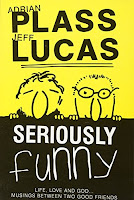
I have been reading, re-reading and thoroughly enjoying the books by Adrian Plass for many years. He's one of my favourite modern Christian authors. Probably my favourite of all from the UK. He combines humour - some of which makes me laugh out loud even on the third or fourth reading of a book - with amazingly thought-provoking insights.
However I had not heard of Jeff Lucas until recently when a friend lent me one of his books. I enjoyed it very much, and thought I might look out for more that he had written.
So I was delighted when I saw that, newly published, was a book by Adrian Plass AND Jeff Lucas. I naturally ordered it at once, and have just finished reading it.
What a gem it is, too. It consists of letters which these two writers exchanged over some months, with a brief introduction by each of them at the beginning. I'm assuming the letters - if the book really did start its existence as informal correspondence - have been heavily edited; but it hardly matters. The personalities of the two comes across with that wonderful mixture of humour and deep 'aha' moments that I've found so often with Adrian Plass's writing.
There are amusing - sometimes embarrassing - incidents recorded by them both. I love the way that these demonstrate their fallibility and humanity; they're often missing in books by 'famous' authors (Christian or otherwise). There are some clever lines scattered around here and there, easy to miss if reading too fast (although a few of the choice ones appear in the blurb on the back).
Perhaps most importantly, there are a great many thought-provoking discussions about church life, and Christian conferences, and ways that God might - or might not - speak to his people. So much that both Plass and Lucas write resonated strongly with things I've thought, or indeed heard from other people.
They don't answer any deep questions, or solve any world problems. They don't even solve any theological issues. But what they do is to take their Christian faith as an everyday part of their lives, recalling failures and disappointments rather than successes. All done with humour and the overwhelming feeling that these 'famous' Christians are just ordinary folk like the rest of us.
I read it in just a couple of days, and found it tremendously refreshing and encouraging. I would recommend it highly to any Christians who might be feeling cynical, or disillusioned, or indeed anyone just trying their best in a low-key kind of way to follow Jesus.
Review copyright Sue's Book Reviews, 26th August 2010
I'd heard of Alexander McCall Smith as a writer more than once. Various friends had recommended his detective series set in Botswana, featuring the 'number 1 lady detective' Precious Ramotswe. But the only book I've read so far in that series, 'The Kalahari typing school for men' left me underwhelmed, wondering what people could see in his writing.
But it's not fair to judge an author on just one book. So when I saw 'The Sunday philosophy club' in the local thrift store, I decided to buy it. It's the first in a separate series about another detective, and set in Scotland.
The detective in this series is the middle-aged Isabel Dalhousie. She's a review editor, and also something of a philosopher - although the 'Sunday philosophy club' of the title is only mentioned in passing throughout the novel. She's also intrigued by people, and by motivations, and likes to follow up her instincts although they prove to be somewhat unreliable at times.
The story opens as Isabel witnesses a tragedy at the end of a concert. It disturbs her, naturally, and after giving an interview to a rather insensitive journalist, it preys on her mind more and more. She determines to find out as much as she can about the circumstances, in the hope of putting her mind to rest. But the more she discovers, the more confused she becomes.
She follows up various trails, some of them leading nowhere, and has a few tense moments that make her wonder if she might be the next victim of another tragedy.
I found the book a bit long-winded in places, decidedly prone to digression. All the same, I found it surprisingly enjoyable. There are some mildly amusing moments, and also a few pages that kept me rather strongly in suspense. I quickly warmed to Isabel and also to her no-nonsense housekeeper Grace. Despite the plethora of minor characters, I didn't have too much trouble remembering who was who.
While I'm still not certain if I want to read any more about Precious Ramotswe, I'm intrigued by Isabel Dalhousie and her philosophy club. I may look for more books in this series in future.
Review copyright Sue's Book Reviews, 26th August 2010
Over the years, we've said goodbye to many friends who have departed from Cyprus for various reasons. Several of them decide to leave behind some of their books. Knowing how much I like collecting books, I'm frequently offered as many as I care to house.
It was a result of one of these events that I picked up three or four books by Jill Briscoe, a writer I had not previously come across. She's British but has lived many years in the USA where she has a fairly significant teaching ministry. Over the years, she's apparently written around 40 books.
'Queen of Hearts' sat on my shelves for many years, but - wanting something different to read - I finally picked it up about three weeks ago. The subtitle is, 'a woman in today's world'. The blurb on the back tells me that it's based on Proverbs 31, the chapter in the Bible about an ideal woman, although probably not describing a real person. Over the years I've met many people, both on and offline, who would like to live up to this lady, with varying degrees of success.
The premise of the book is that God calls us all to be 'Queen' of our husband's heart, our children's hearts, in our workplace, and to God himself. Each chapter looks at one aspect, with some anecdotes, some Scriptural pointers, and some summaries and points to ponder at the end. I thought I'd get through it quite quickly, reading a chapter or so each day. But in the event, it took me about three weeks.
There's nothing to disagree with, really. It's not that I found myself overwhelmed with new ideas, or pondering what was said. In its way, it was quite readable, and the writing was good. I suppose it might be useful to Christian women feeling discouraged or useless, but I didn't find anything in it that was inspiring or particularly thought-provoking.
'Queen of Hearts', written in the mid 1980s, has long been out of print. I'm sure Jill Briscoe has written far better books since then; I might even try to get hold of some of them, since it's not really fair to judge a writer based on a 25-year-old book written in the period when there was a lot of evangelical fluff. It's not a bad book. But it felt like what it was - a run-of-the-mill 1980s typical Christian book, supposedly encouraging to women... but in fact not saying very much.
Or perhaps I'm just a middle-aged cynic.
Review copyright Sue's Book Reviews, 24th August 2010
I was delighted to discover the books by Dick-King Smith when my sons were younger. The writing is good with a tinge of humour, the characters are real, and - since the author was a farmer before he started writing books - he knows a great deal about animals too.
'Sophie's Lucky' is the last of the six 'Sophie' books by this prolific writer. The series is about a small and determined girl who wants to be a lady farmer. She has older twin brothers who tease her, and parents who don't entirely understand her. But they encourage her in her interests, knowing that she will almost certainly realise her ambition one day.
In this story, seven-year-old Sophie and her family have the excitement of a holiday in Scotland to stay with the elderly Great-Aunt Al. Sophie and Aunt Al have been the best of friends for some time, and have rather similar personalities. Sophie totally falls in love with a pony she is lent during the holiday.
The ending of the book is both sad and encouraging, and brings a most satisfactory conclusion to this delightful series for small children.
(I wrote another review of 'Sophie's Lucky' 18 months later when reading it aloud to a small friend)
Review copyright Sue's Book Reviews, 20th August 2010
I'd never heard of Rosie Alison, despite her debut novel having been shortlisted for the Orange Fiction prize in 2010. I don't usually choose to read books about the wars years - though in fact I've read several - and would probably not have come across this book at all, if it hadn't been a surprise present from a friend.
'The very thought of you' opens in 1939. Eight-year-old Anna is about to be evacuated. Her father is overseas, fighting for England, and her mother really doesn't want to part with her daughter. But children were all supposed to be sent to the country during World War II, since London was a prime target for bombing. So Anna and her mother have a last, wonderful day together and she's then sent, with the rest of her class, on a train into the unknown.
Anna is an independent and loving child. Due in part to her own initiative, she finds herself as part of a temporary school in a large country house in Yorkshire. She misses her mother, of course, and finds it hard to fit in with the other, less thoughtful children with her. However she's dimly aware that her situation is a great deal better than that of many other children. She's well-treated, well-fed, and continues to be educated.
Anna finds herself drawn to the owners of the estate: Thomas Ashton, wheelchair-bound and a lover of poetry, and his strict, stressed wife Elizabeth. She overhears things she should not have heard, and begins to think deeply about the nature of love, and adult relationships.
The book is beautifully written, well-researched and seems realistic. Some of the characters are a bit flat, and there are some unpleasant scenes, one of which - at least - was unexpected and (in my view) rather over-brutal. However, they probably add to the realism of the novel. The last part takes place when Anna is an adult, and the ending is bittersweet, but it works.
It took me a few weeks to read this, partly because I was busy, and partly because it was thought-provoking enough that I only wanted to read a few pages at a time in the evenings. I'm pleased to have had the opportunity to read something I would not otherwise have picked up, and will look out for future books by this author.
Review copyright Sue's Book Reviews, 16th August 2010