30 Jan 2009

How to write and sell short stories (by Della Galton)

How to write and sell short stories by Della Galton
(Amazon UK link)
I'd never heard of Della Galton, but saw this book recommended very highly on at least two blogs I frequent, which are run by writers. So I bought it at the Book Depository at the end of December, and thought I might be dipping into it throughout the year. That's usually how long it takes me to read books about writing.

However, I finished 'How to write and sell short stories' this morning. I found it a very helpful - if lightweight - book, with advice on characterisation, plot, ideas for stories, and a great deal more. There are no exercises, which I think is probably a plus since I tend to get either bored or frustrated with exercises in writing books. There are, however, some good suggestions for getting started: the main advice, repeated more than once, being to set a twenty-minute timer and just write!

There are also some useful chapters at the end on finding a market, submitting, and keeping records. None of that was new to me, which is perhaps why I finished the last part of the book at one sitting. But it was a useful overview which I'm sure would be of benefit to anyone new to writing, or who has not submitted stories to magazines before.

I found Della Galton to have a breezy and friendly style which made the book very readable. I didn't have to think too hard, yet I felt uplifted and inspired with what she said. There was plenty to encourage me, including the chapter about rejections. There are tips from other writers at the end of most chapters, which reinforce or add to the main text.

My only minor complaint about this book is that the pages aren't laid out very well. There are frequent places where the heading of a new section within a chapter is at the bottom of the previous page, for instance. I found this quite disturbing at first, but I got used to it. I don't know if I had an early edition that had not been checked for layout, or whether this is a new style in non-fiction books. Still, even that didn't distract from the excellence of the writing and advice.

Very highly recommended to anyone interested in writing short stories, whether or not you have had any published.


Review copyright Sue's Book Reviews, 30th January 2009

28 Jan 2009

Lone Pine Five (by Malcolm Saville)

Lone Pine Five by Malcolm Saville
(Amazon UK link)
Malcolm Saville was one of my favourite authors when I was a teenager. Although I'm not, in general, a fan of adventure stories, his are very much character-driven and I collected and read almost the entire 'Lone Pine' series over several years. I re-read them all, in order, in the 1980s and wondered if I would ever do so again... last year I decided I would. Not all at once, as I used to, but spread out over many months, interspersed with other books.

'Lone Pine Five' is the fifth adventure in the 'Lone Pine' series for teenagers. It features David (the club captain), his girlfriend Peter (Petronella), and their friends Tom and Jenny as well as the irrepressible twins Dickie and Mary and their dog Mackie. They decide to spend some of their summer holiday camping, and aren't sure where to go when Jenny meets an elderly and rather anxious man. She discovers that he's an expert in Roman treasure, and he suspects that an old spoon she has just been given may be valuable.

So the Lone Piners decide to help. Along the way they meet a most unpleasant trio who are related to the elderly expert, and have some fairly exciting adventures which simply wouldn't happen in today's world. Fifteen-year-old girls don't go and spend an evening with an elderly man in his room, or go off in a car with him; ten-year-old twins aren't allowed to roam around and potentially get muddled up with all kinds of dubious people.

But life was simpler several decades ago. I don't suppose today's teens would be very interested in this innocent adventure story of the mid twentieth century, even in this updated 1970s Armada edition, but I still enjoyed it.

I found it rather brief, even for a light teenage novel, but perhaps that's a problem with the abridged paperback edition. Still, I was surprised by one or two unexpectedly moving moments; having not read it for over twenty years, I'd pretty much forgotten the plot.

It made good light reading for a couple of hours; I'm glad I decided to re-read the series. Previous books in the series are: Mystery at Witchend, Seven White Gates, The Gay Dolphin Adventure, and The Secret of Grey Walls. Mostly out of print in paperback, but new facsimile editions of the originals have been produced in recent years, and many of them are available in the UK.

Definitely worth re-reading!

Review copyright Sue's Book Reviews 28th January 2009

27 Jan 2009

Sweets from Morocco (by Jo Verity)

Sweets from Morocco by Jo Verity
(Amazon UK link)
I'd never heard of Jo Verity. Apparently she's a Welsh author who started writing after she retired. She won a short story award, and shortly afterwards had her first novel published.

I was sent 'Sweets from Morocco' by The Bookbag for reviewing, and have been reading it for the past few days. It's not the kind of book that makes me stay up all night, or ignore chores and other things I need to do around the house. But it was a very pleasant read for the evenings, and odd moments through the day.

It's about a sister and brother, Tessa and Lewis, who are pretty close. Early in the book a family tragedy happens, and their lives are changed forever. Tessa becomes more irresponsible during her teenage years, while Lewis behaves impeccably.

The book follows their lives over several decades, beginning in 1954 when Tessa is ten, and ending in 2005. After the first six chapters, we leap forward eight years and then see her in the throes of A-levels. This device works well throughout the book.

It's character-based, and I found both Tessa and Lewis believable. Their relatives are rather less well developed, but that didn't matter. We see them through the eyes of their offspring, after all. There are a couple of fascinating elderly characters early in the book, who give the children 'sweets from Morocco' when they visit, and also give them a glimpse into a life rather different from their own.

I found the book thought-provoking - one that will remain with me for some time, I suspect. It made me think about the effects of a family tragedy on people of different temperaments. It also reminded me how important it is to talk to children about difficult issues, rather than assume they don't understand.

Recommended.

You can also read my longer review of Sweets from Morocco on the Bookbag site.

26 Jan 2009

When the game is over, it all goes back in the box (by John Ortberg)

When the Game is Over it All Goes Back in the Box by John Ortbert
(Amazon UK link)
I like John Ortberg's books. He doesn't exactly choose snappy titles, but they're memorable nonetheless, and his writing style suits my taste. He combines anecdotes - often from his family - with encouragement about living day-to-day life as a follower of Jesus. So far, I've found his books thought-provoking and sometimes inspiring. I'm not totally gripped as I am with Philip Yancey's books, but certainly enjoy them.

I've been reading 'When the game is over, it all goes back in the box' for about a couple of weeks now. The author takes the image of a game, such as Monopoly, for the theme of the book. He recounts anecdotes with his grandmother, who taught him a great deal about sportsmanship and games in general, and he relates it to daily life - what we do, how we relate, what our aims are, and so on.

The overall theme is to make live worth living, since it will eventually come to an end, just like a board game. When it's over, there's nothing more we can do. The book is divided into sections - setup, hazards, how to play, and so on - with parts of games used as analogies for different aspects of living life.

I don't suppose there was anything in the book that I hadn't read before in other contexts, but I found an interesting and often thought-provoking read. Ortberg's style is clear and inspiring, and there are some unexpected humorous asides here and there, mostly in parenthesis, which I very much appreciated.

Recommended. Available in Kindle form (links given to Amazon UK and US). Note that there is also a participants' guide available which is not the same book.


Review copyright Sue's Book Reviews, 26th January 2009

22 Jan 2009

Sins of the Fathers (by Susan Howatch)

Sins of the Fathers by Susan Howatch
(Amazon UK link)
I so enjoy Susan Howatch's writing. she has an amazing gift of characterisation, which is cleverly used in her technique of using different voices to relate her novels.

I first read 'Sins of the Fathers' nearly nine years ago. While I found it gripping, I wasn't too impressed at the world of high finance, or the rather depressing ending. On re-reading recently, I was well aware of the setting but had entirely forgotten the plot, and indeed the climax.

It's the sequel to 'The Rich are Different', starting ten years later, in the mid part of the 20th century. The first person multiple viewpoint method of writing works extremely well to develop the various plots, and to let the reader see, gradually, how each character is motivated, and what has occurred in their past.

It mainly revolves around Cornelius van Zale, the amoral and slightly frighteningly vile head of a bank in the USA. All he really cares about is success and power in their various forms, although he is also devoted to his daughter Vicky and (in a different way) his wife Alicia. I had moments in the book when I felt a pang of sympathy for him, but these never lasted long.

The book is extremely well-written. I have little interest in high finance or the banking world, and usually get rather bored when reading novels on these topics. But somehow Susan Howatch's terse writing, combined with her incredible depth of characterisation, kept me reading almost every word.

Re-reading this book nearly nine years after I first read it, I found it gripping once again, although it took me nearly a fortnight to finish it. The end of the novel once again saddened me, but the conclusion was undoubtedly right.

Definitely best to read after 'The Rich are Different', although it could stand alone. Still in print in the UK, although not currently in the United States. Widely available second-hand.

Review copyright Sue's Book Reviews, 22nd January 2009

16 Jan 2009

Just one more day (by Susan Lewis)

Just one more day by Susan Lewis
(Amazon UK link)
I'd never heard of Susan Lewis, and probably wouldn't have chosen this book on my own. But a friend lent it to me. I picked it up about a week ago, and found it very readable.

'Just one more day' is a biographical account of the author's childhood, when her mother was battling cancer. It's cleverly told from two perspectives - eight-year-old Susan's own, and that of her mother Eddress. The background is of a struggling family in Bristol in the 1960s; the mother is strict, and ambitious for her children, the father a delightful man who reads to them, plays with them, and likes to write poetry.

I could picture the father easily. However the mother is of an era and type I have not really come across, shouting at her children when they needed encouragement, coercing them into behaviour she thought was good for them. She even denies them simple pleasures like playing outside with friends.

Yet she does this out of ignorance, not malice. She genuinely cares for both her children - for Susan and for her younger brother Gary. Yet she seems incapable of understanding her feisty and imaginative daughter.

I also found myself rather horrified at the way the parents - particularly Eddress - tell lies to their children on a regular basis. In the early chapters, Eddress has a mastectomy, but the children are told she's working away from home. They have no idea she is in hospital. So Susan imagines something worse - that her mother has another family, and may leave them permanently. She suffers at school, too, since other children know more about her parents than she does.

The images portrayed are vivid and realistic, the writing very well done. The story is told in a way that left me wanting to know a great deal more about the author's later life.

I seem to be reading more biographies and autobiographies than I used to, and mostly enjoying them. This one certainly isn't in a traditional style. The parts written as Eddress must have been at least partly fictional, even if Susan Lewis asked her father and other relatives for details of conversations. She can't possibly have known what her mother was feeling and thinking - and yet the whole is very believable.

Definitely recommended.


Review copyright Sue's Book Reviews, 16th January 2009

9 Jan 2009

Recovering the soul (by Larry Dossey)

Recovering the soul by Larry Dossey
(Amazon UK link)
I'd never heard of Larry Dossey. Perhaps not surprising, since he's a Texan doctor, although I gather he's written several books to date.

I would probably never have picked up one of his books, if it hadn't been for the recommendation of a friend, who lent me 'Recovering the soul'. I'm not a scientist, and he writes from a scientific perspective.
More significantly, his books - including this one - are categorised as 'New Age'. A label that, in the 1980s, caused evangelical Christians to throw up their hands in horror and leap back, as if they would be tainted by the sight of a book like this.

I'm beyond that stage of life now, but I still began this, a couple of weeks ago, with some reservations. However, it's quite a fascinating read. The author attempts to look beyond the early materialism of science, through quantum physics, and into unexplored realms that unite the spiritual and the scientific.

He begins with some fairly dramatic examples of experiments whose results simply cannot be explained by traditional science. Sick people who were prayed for got better much more quickly than those who were not prayed for. More bizarrely, bean seeds which were prayed for germinated more successfully than those which had no prayer offered on their behalf. There's plenty more in this vein. He gives extensive references, and although I didn't check any of them, I assume he's reporting fairly and accurately.

Dr Dossey's theory in this book is, primarily, that our minds are not the local entities we perceive them as, but 'non-local', and in a sense 'God'. The second part of the book explores (in a low-key way) some quantum physics and other scientific concepts, and the last section looks at religion as a whole, and God in particular.

It's not written at all from a Christian perspective, yet several Christian mystics and scientists from the past are quoted. The author seems to see the Christian faith as rather narrow-minded; whereas I could see much of what he discussed as fitting in quite well with my belief in God and eternity, he seemed to think that his theories were not directly compatible with any particular belief system.

He also tends to what appears like a universalism, or worse - he claims that we are all in God, and all part of the 'non-local mind' therefore we are all God. A spark of the divine, I agree. Eternal souls, yes - of course. But that does not make us God.

Overall, it was an intriguing read, if a little heavy and long-winded in places. Still, it's now twenty years out of date, and I have no idea if some of his science is now considered obsolete.

Worth reading, anyway, for an attempt at setting religion alongside scientific thinking, although strongly denominational or structured Christians (or indeed those of other faiths) might find some of it disturbing. Could give some atheists a few points for debate, however!

Still in print in both the UK and USA.


Review copyright Sue's Book Reviews, 9th January 2009

8 Jan 2009

Now and Then (by Roy Castle)

Now and Then by Roy Castle
(Amazon UK link)
I had a lot of respect for Roy Castle, who was probably best known as the presenter of the TV show 'Record Breakers' in the 1980s. He was always cheerful, and was known - in a low-key sort of way - as a Christian, and also very much a family man. When he died after a battle with cancer in 1994, his wife Fiona took on some of his charity work, and founded organisations to try and combat smoking.

So, when I saw a copy of his autobiography on a second-hand stall, I bought it immediately. I always wanted to know more about this fascinating man.

It starts well, with descriptions of Roy Castle's impoverished working-class roots, albeit in a very happy family environment. His mother encouraged him in his early appearances on stage, and his other relatives were clearly very fond of him, and proud of him when he succeeded. In a deprecating kind of way, he charts his disappointments as well as his successes.

Unfortunately, once Roy reaches the stage of being fairly well-known, the book goes downhill. It leaps about from place to place, detailing in passing a number of practical jokes, supposedly amusing conversations, and the various events he attended and people he worked with. These things are probably of interest to those who were there at the time, but left me rather bored, skimming rapidly through lists of names, and wondering what was so funny about the many incidents he cites.

Interspersed with this, I was pleased to see at least a brief mention of his courtship of and marriage to Fiona, and something about their children, although less than I would have liked. But then I'm always much more interested in people's family life than their public personas.

The last part of the book is different again. It's written in diary form, after the first diagnosis of lung cancer, with treatment that worked. He is able to work for another year, feeling mostly very well, but this is followed by a recurrence of the disease that led to his demise, shortly after the book was completed.

The Christian side of the book was low-key, without any preaching or theology (a definite plus). We read of people who prayed for Roy, and there is mention of his church family, and his baptism, and his strong faith that helped him bear whatever came his way. But I don't think there's anything in it that would offend those who are not believers.

I very much appreciated the parts of this book that described Roy's family, and found the latter section quite moving. Once or twice I even had tears in my eyes. So overall I'd say this was certainly worth reading, and very interesting in places; just a pity the middle section was not cut down significantly.

No longer in print, but may be available second-hand.


Review copyright Sue's Book Reviews, 8th January 2009

3 Jan 2009

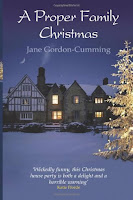
A proper family Christmas (by Jane Gordon-Cumming)

A proper family Christmas by Jane Gordon-Cumming
(Amazon UK link)
I'd never heard of Jane Gordon-Cumming. But Amazon kept recommending her book to me, and it was very highly rated with excellent reviews. Moreover, it was published by Transita, a company whose novels I have (mostly) very much enjoyed reading.

So I put 'A proper family Christmas' on my wishlist, and was delighted to receive it for Christmas. So as the New Year began, I thought I'd settle down to read it. I wasn't expecting anything heavy or difficult, and looked forward to enjoying a good light-weight story.

There are a lot of characters in this novel. So many that a family tree is provided at the front, and I found myself referring to it frequently in the early part of the book. It was useful, but I did find myself faintly irritated that the people were introduced so rapidly, and that they weren't well-rounded enough for me to tell them apart easily.

Nor was it obvious at first who were the 'main' characters. The first chapter sees Hilary, a widow, seeing her only son Daniel off for a climbing holiday. Then we switch to William, owner of a large stately home, who lives alone with his cat. William is a bit grumpy, and has evidently been annoyed by most of his relatives at some point. He really doesn't want to go and stay with his son Stephen who is married to the awful and snobby Leslie. But he is even more horrified when he learns that they, and their unattractive son Tobias, are planning to stay with him for Christmas.

Meanwhile Stephen's jolly sister Julia and her philandering husband Tony, along with their rather ghastly daughter Posy and her even more appalling Nanny also decide to stay with William. And William's sister Margery (Hilary's mother-in-law) decides that it's the ideal time to bring a friend to visit, someone who is interested in old houses and might be able to suggest ways of having it renovated.

Probably the most interesting person in the book is Frances, the new nanny to four-year-old Tobias. Hilary is the only other woman who seems both believable and likeable. The others are one-dimensional caricatures.

Having said all that, 'A proper family Christmas' is not meant to be taken seriously. The novel is something of a family farce, with misunderstandings, complications, and intense family rivalry. Each section of the family is quite certain that they are the most appropriate ones to inherit when William finally passes on. I didn't particularly like the writing style, which is rapid, switching viewpoints constantly, and interspersing thoughts and conversations with little explanation.

Still, it's not a bad book. I found I got more interested in the various relationships as it progressed. The family gathering in a mansion, and one-dimensional characters reminded me a bit of some of Agatha Christie's books - so much so that I half expected someone to be murdered. I was relieved when everything turned out much as I expected it to towards the end.

I found it pleasant enough - if a little tiring - for a very light read over the holiday season. I do slightly wonder if I was missing something (or if I should have read it when I wasn't so tired in the first place) since the Amazon reviews are so startlingly positive.

Perhaps I'll read it again in a few years, and see if I like it better.


Review copyright Sue's Book Reviews, 3rd January 2009


2 Jan 2009

The Shack (by William Paul Young)

The Shack by William Paul Young
(Amazon UK link)
The writer William Paul Young is a Canadian, whom I had never heard of. Indeed, he was pretty much unknown until he raced to success in the USA last year with his first novel.

I'm not entirely sure why 'The Shack' is SO popular. I suppose it's a good, and certainly unusual story: Mack, devastated by family tragedy, has suffered depression for four years. Then he has a note, apparently from God, inviting him to spend a weekend with him...

The majority of the book is taken up with Mack's conversations with the three Persons of God, presented in slightly unexpected human forms. Much of what is said is positive and encouraging, as he learns about the nature of unconditional love and forgiveness.

Perhaps the theology veers towards universalism, but it IS fiction, and should be taken as such. The focus is on what it means to love, and how much God loves us each as individuals. Naturally one short novel cannot possibly contain a significant amount of serious theology.

I have to admit, I nearly gave up on this book. The first few chapters are so badly written, I wanted to get out a red pen and edit them. The descriptions are ponderous, full of clichés, repetitions and unnecessary adjectives. It's very 'American' too, obviously designed for the US public. I found that a bit annoying at first, too, but eventually got used to it.

Fortunately, the book gets a lot better once the conversations with God begin, and I did find myself getting more drawn into the story. There were one or two rather emotional moments that brought a tear to my eye, and while I didn't actually read or learn anything new theologically speaking, there were some good reminders about the importance of relationship as opposed to rules in the Christian life.

The strangest thing is that Mack, who appears to know almost nothing about the nature of God, and has apparently never heard of the doctrine of Grace, is supposed to have gone to seminary (the US equivalent of Bible college). It's hard to believe that any theological college, no matter how rigid or denominational, could have left him so ignorant. It's not a significant part of the book, just puzzling why the author would have suggested - and it's more than once - that Mack did go to seminary.

This isn't a book for everyone. Anyone who does not believe in God, and doesn't want to, would probably find the book rather dull. You should also avoid it - or at least skim the first fifty or so pages - if you hate clichés and poor writing, since those early chapters really are tedious.

Still, I'd recommend it in a low-key way to anyone caught up in rule-based religion, or who wants to know more about the nature of God. It's quite thought-provoking in places; however it's important to remember that it's one man's fictional interpretation, not absolute truth.


Review copyright Sue's Book Reviews, 2nd January 2009