30 Jun 2004

The high flyer (by Susan Howatch)

The high flyer by Susan Howatch
(Amazon UK link)
'The High Flyer' is a novel by Susan Howatch, and is the second one in the 'St Benet's' series, which follows on from her Starbridge series.

This book mainly focuses on Carter Graham, a lawyer who works at a very high level in a top company in London. She's ambitious, intelligent and wealthy; she also appears to be highly organised and disciplined, and has spent the last few years following what she calls her 'life plan'. This, she thinks, will ensure that she succeeds in all possible fields - career, marriage and motherhood.

Carter is in her thirties, and recently married to Kim Betz - fitting in with her plan - who is another high flying lawyer. As the book opens, she has just discovered that her new temporary secretary is a man called Eric Tucker. Carter is annoyed at first, because she dislikes working closely with men; she worries that they might become flirtatious. However this young man behaves impeccably, so she agrees reluctantly to keep him for the two weeks while her regular secretary is away.

Unusually for Susan Howatch, this book is all written from Carter's perspective. It was clear to me from the start that while she is a supremely confident lady, there are bound to be flaws in her life-plan: life, after all, generally doesn't work out exactly as expected. And sure enough, that's what the book is about. Carter and Kim discover increasingly that they have significant differences in their expectations; worse than that, Carter starts to realise that Kim has hidden a lot of his past from her, and has even told her some lies.

There's a lot more suspense in this book than I normally like. The first time I read it, a couple of years ago, I found it almost impossible to put down. It was clear that either Kim or Carter had far more serious problems than were apparent to either of them, but for a while I wasn't sure which one was in danger. Gradually I could see the direction the book was going: one of them spends time with a rather seedy occult society, the other starts taking advice from some chance-met Christians connected with St Benet's healing centre.

Despite being part of a series, this book can be read as a stand-alone novel. As I had read the previous book 'A Question of Integrity', I knew that I could trust at least some of the St Benet's staff. I also liked seeing glimpses of people who had been major characters in that book. But still I wasn't sure what the outcome would be, and there are some shocking moments - no unnecessary gore, but events which I certainly wasn't expecting. When I read the book again recently, I did remember the main plots so there were no more shocks, but I still found it gripping.

The Christian side of the book is fairly low-key. The book talks about wholeness and integrated lifestyles rather than repentance or salvation. I found it an interesting insight into the dangers of ambition and high-flying business-people too; it was very thought-provoking towards the end.

Although I love Susan Howatch's writing, with a fast-paced style and people I can relate to strongly, I found it a bit over-suspenseful, and there was a little more bad language than I like. In discussing the book with other people, I learned that some readers object not so much to the conventional swearing, but to some unusual words coined by Carter: for instance she talks about 'nutterguff' (nonsense), or 'fluffettes' (roughly equivalent to 'dumb blondes'). I personally found this rather endearing, almost children's words used by this high flyer who was so totally in control of her work-life, but if that kind of thing annoys you, you may not want to read this.

With that one caveat, though, I would recommend this to anyone who likes suspenseful and well-written novels. There's no horror, no gore or detailed violence, but it's an exciting book with a great deal of tension. I'd also recommend it to anyone who likes books with good characters as well as plot.

25 Jun 2004

A Question of Integrity (by Susan Howatch)

A Question of Integrity by Susan Howatch
(Amazon UK link)
'A Question of Integrity' is a novel by Susan Howatch. In the United States, it is published as 'The Wonder Worker'. I've now read this book three times in five years. It's the first in a trilogy of books revolving around St Benet's Church, and the trilogy itself is a kind of sequel to six books forming the 'Starbridge' series that follows ministers in the Church of England from the early 20th century until the 1980s.

Alice, overweight, depressed, and very worried about her dying aunt, is caught in a rainstorm while out in London. Looking for shelter, she finds a church called St Benet's. To her surprise, it's not empty. Instead, some kind of service is taking place. Even more surprising, it's not a traditional church of England service but a 'healing' service, led by a tall clergyman called Nick Darrow. Alice finds him immediately attractive while feeling generally repulsed by the idea of people being emotional and asking God for healing.

On her way out - to her horror - Alice finds herself crying. The burden of caring for her aunt is too much. She is rescued by Nick, who offers to come and pray for her aunt. This starts a series of events which lead to Alice's life being increasingly bound up with the team at St Benet's. Inevitably she finds herself falling in love with Nick, but she is well aware that he has been married to a beautiful woman for twenty years and is a devout minister in the church. She is also convinced that she is so unattractive that no man would look twice at her anyway.

The first section of the book is told from Alice's perspective. Her name seems to have been deliberately chosen: there is more than one reference to Alice having fallen into 'wonderland' when she enters St Benet's and first meets Nick - who fights the temptation to be a 'wonder-worker'. The book as a whole is about Alice beginning to find peace with herself, a role in the world, and ways of expressing and finding love.

The second part of the book is told from the perspective of Lewis Hall, Nick's older colleague, who is a divorced priest with a penchant for smoking and drink. He's described as irascible, bear-like, grumpy, and yet oozing sex-appeal. The writing style changes when Lewis's section starts; it's written almost like a journal, detailing his innermost thoughts and worries, and admitting his temptations.

Lewis likes Alice very much in a fatherly sort of way, but is worried about her love for Nick. On the other hand he does not like Nick's wife Rosalind. She doesn't live at the communal Rectory in London, but in a beautiful home in Surrey where Nick commutes to at weekends. In Lewis's writing we get a hint that Nick's marriage may not be so perfect as it seems on the surface, but then again this could be Lewis's bias coming through.

The third section is told from Rosalind's perspective - again, a different style, and with new and somewhat shocking revelations as the story builds up to some dramatic events. Nick himself tells the fourth section of the book, and the final one returns to Alice's perspective after a series of climaxes and twists in the plot. One of Susan Howatch's gifts is that of telling a story from differing viewpoints, all in the first person, each one building on what went before and showing us the same events from different perspectives.

The theme of the book involves psychology, religion, failings and temptations, and also morality and integrity. Alice, who is not a Christian, has amazing integrity and serenity once she finds peace with herself. Nick, who appears on the surface to be full of integrity, has plenty of hang-ups from his youth. Amongst the lesser characters there are spiritual directors, gay activists, a hysterical woman... attempted murder, hypnosis, and a young man very confused about his sexuality.

I suppose the book would be classed as a psychological thriller. The first time I read it there were places where I felt very tense as well as places where I was shocked. But after the first few chapters it was almost impossible to put down. Reading it again recently - despite knowing what was coming - I still found it gripping. I find more in it each time I read it: the overlap between psychological, medical and spiritual language is fascinating. Wounds from the past in each character are revealing and thought-provoking, and the many subplots which weave an amazing pattern as they intertwine throughout the book.

There is of course a Christian worldview presented throughout the book, but there's nothing pushy about it. I've come across many atheists and agnostics who have enjoyed this book as much as I did - so don't be put off if the idea of a novel about a church healing centre sounds boring. The only slight disadvantage is that there's a melodramatic scene near the end of the book which seems rather unlikely. Although the first time I read it, I was so engrossed in the book that it didn't seem unbelievable at all.

All in all, highly recommended to anyone, so long as you have a day or two free to read it without interruption!

20 Jun 2004

White Boots (by Noel Streatfeild)

White Boots by Noel Streatfeild
(Amazon UK link)
I do like mid-20th century children's books. They have a lot more content to them than the majority of books written for children these days, and they're so gentle by comparison. There's no bad language, no bullying, no abuse, no marriage breakdown... just simple family scenarios and mild escapism. One of my favourite authors from this era is Noel Streatfeild.

The story in 'White Boots' (published as 'Skating Shoes' in the US) is a basic one set in post-war London. Ten-year-old Harriet Johnson has recently recovered from an unspecified lengthy illness. This has left her very thin, with her legs feeling 'cotton-woolish', as she puts it, and she has almost no energy. She's bored, but isn't allowed to return to school until she regains her strength.

Harriet's father owns a small shop, but as he relies on his erratic brother for produce to sell, the family struggle financially. This means that they cannot possibly afford to send Harriet on holiday or take her to a private gym. So she spends her days rather drearily walking along the banks of the Thames to get some fresh air and exercise. But it doesn't help: she feels no better, and the boredom becomes overwhelming.

Harriet's doctor is friendly with the manager of the local ice rink, and he has the bright idea of arranging for her to skate without charge, to try to strengthen her legs. Harriet's older brother Alec takes on a paper round which gives him enough money to hire skates daily, with a small amount over each week which he saves towards his dream - a market garden of his own where he can supply his father with good quality produce all year round.

At the ice rink on her first day, wobbly and frightened, Harriet meets a girl her age called Lalla who is being trained as a champion skater. Lalla teaches her some basic skating, and the two become friends.

That's just the first few chapters. The rest of the book is about the growing friendship. It's about Harriet starting to enjoy skating, and about Lalla discovering that she's not quite the virtuoso she thinks she is. It also covers some issues surprisingly relevant today.

Lalla's whole life is organised around this goal of being a skating champion. She has a governess who teaches her at home, and as well as extensive skating she has classes in ballet and fencing to keep her supple and strong. Money is no object in her home; yet she's lonely. When she learns that Harriet has three brothers, and that the family play games together and enjoy lively conversation over meals, Lalla longs for siblings of her own.

It doesn't sound terribly exciting, I know. I suppose that's part of the charm of this book, and others by the same author. Ordinary people are at the centre, with some nice people around them and a few caricatures (such as Lalla's Aunt) to provide a bit of drama. There's nothing to make even the most sensitive of children frightened, although there are sections which I found quite moving.

Overall it's well-written, and about the right pace for my taste. I picked it up recently for a light read before going to sleep one night, and instead of nodding off after a couple of chapters I found I was half way through the book an hour after I had hoped to be asleep. I knew what was coming; I read this first when I was nine or ten, and have read it again at least four or five times since. But still I found myself caught up in the emotions of the characters, turning pages avidly and barely noticing ends of chapters.

Noel Streatfeild's books don't seem to go out-of-date like many others written in the 1950s. There are definite hints of that era in the book, but because it's not written as a historic novel, they're things that were taken for granted at the time. Lalla doesn't just have a governess, she has a nurse who takes her everywhere, and who calls Aunt Claudia 'ma'am'. Harriet doesn't hire all-in-one ice skates as we would today, she has to hire boots and skates which came separately.

Then Alec's earnings from the paper round are two shillings per day (that's ten pence in decimal currency, although the value would be more like two pounds or more in today's money). But perhaps most telling of all, Harriet travels by herself around London on public transport, and goes out for long walks by herself along the Thames, and it never occurs to anyone that this might be dangerous.

I found the book believable, or mostly so. There's a little light humour in places, and there's a lot of warmth. Ambition and hard work are both explored in a low-key way as they apply to Lalla - and, to a lesser extent, Harriet. It's the kind of book I loved as a child. Since the story is about two ten-year-olds, I expect it's intended for girls of around that age, although fluently reading younger children wouldn't find any concepts beyond them. The reading level isn't too complicated, but equally it's not an overt easy-read.

It would make a pleasant book to read aloud, too, as there's plenty in it for adults to appreciate at a deeper level. It's not just for girls, either; I know of some boys who have read this. Since Harriet has three brothers, there's a definite male influence in the story (indeed, in a sense Alec is the star in the background, working as he does to pay for her skate hire, and then later on to help his father's shop).

The only potential problem is that it takes a while to get going, typical of books from the era in which it was written. A child reading slowly, or expecting excitement in the early chapters, might get bored before the story as such gets going. Equally a child used to exciting modern books with a lot of action might find the pace a little slow. My only slight criticism is that I didn't find the characters quite as compelling as those in some of Noel Streatfeild's other books.

But overall, I enjoyed it very much.

19 Jun 2004

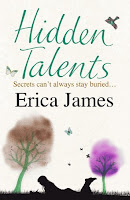
Hidden Talents (by Erica James)

Hidden Talents: Erica James
(Amazon UK link)
I do like Erica James' novels, so was delighted to be given 'Hidden Talents' for a recent birthday.  This is the ninth of her published books, and in my opinion one of her best. At nearly 500 pages it's not a particularly quick read, but that makes it all the better value.

'Hidden Talents' is primarily about Dulcie Ballantyne, who is in her early 60s. She is a published writer in a low-key sort of way. She decides to organise a small informal writing group in her home, and advertises locally.

Dulcie is also a lady with a secret. Unknown to any of her friends she's been having an affair for the past three years with a married man called Richard. As the novel opens, Dulcie is extremely worried because Richard is in hospital after a heart attack. She can't get much information from the nursing staff because she's not related to him; she obviously can't phone his family to find out what's happened either....

Meanwhile, four very different people decide to join Dulcie's writing group.

There's Beth, a widow in her 40s who's dreading her only son Nathan going away to university the following year. She joins the group to give her a new interest. She and Nathan get along well, but are rather plagued by Beth's parents-in-law who insist on being 'helpful' and inviting them to enormous meals, while driving them both wild with constant references to Nathan's father Adam. It's clear that there is something unusual about the way Adam died, but his parents won't admit to it....

Beth and Nathan are friendly with Adele Waterman, an elderly lady who lives in the flat below theirs, who is planning to move to a retirement home. We meet Jack, an estate agent, who first appears in the novel when he comes to value Adele's flat and is shown around by Beth. While Jack is successful and confident in his work, he's having a hard time in his private life. We quickly learn that his wife recently left him and moved in with his former best friend, taking their two daughters with her. Jack is angry and bitter, and when he spots the advert for the writing group, he joins thinking it might give him a new direction, and could also be cathartic in coming to terms with some of his anger....

The third member of the group is Jaz, a feisty 17-year-old who is part of a large, boisterous family. She goes to the same sixth form college as Beth's son Nathan, and has started to be friendly with him. Jaz has always been something of a loner, but longs to fit in somewhere. She has two loud older brothers, and two wild younger sisters, and suffers from being not just the middle child, but the only one who is academically inclined. She joins the group in the hope of finding some privacy and time to herself to develop her interest in writing. However she doesn't want to be teased by her family, so she pretends that she's spending Thursday evenings with her best friend Vicky....

Finally there's Victor, a rather caricatured misfit. He wears trousers that are too short for him, and is convinced that he's a brilliant writer. Right from the start he annoys the rest of the group with his pompous attitude, his dislike of playing ice-breaker games, and his general condescension. This inevitably draws the other group members together somewhat, particularly when they realise they have connections outside the group, while Victor is unknown.

The book is told, a chapter at a time, from the perspective of each of these main characters. I found this slightly jarring at first, but soon started to feel involved with each one; the technique worked well, since inevitably they all start to get to know each other and to be part of each other's lives. Their pasts unravel slowly, revealed both in their writing and in their interaction with each other, and also when we see them with their families and friends. In the process they also learn a lot about themselves.

I enjoy character-based novels in general, and felt that this was one of the best I had read for a long time. Erica James has a gift of writing from the viewpoints of a wide variety of people, and I found them all believable and likeable - even the rather sad Victor, once his situation was explored a little more deeply.

There's low-key romance, confrontation when - inevitably - Jaz's parents find out about the group, a little travel in Italy, plenty of ideas for aspiring writers in the guise of the writing group, and an intertwining of the various subplots that I felt worked extremely well. There are contemporary issues gently touched upon: betrayal, children of divorced parents, grown-up children who surprise their parents, the potential dangers of Internet acquaintances. The mixture was just right for my tastes, with the tiniest amount of suspense here and there, making me almost unable to put the book down once I was about three-quarters of the way through.

I liked, too, the birds-eye view I had of all the characters once I had got to know them. There are some surprises and one or two shocks within the book; surprises, that is, from the perspective of the people concerned. But the book was cleverly written, so that just enough hints were dropped to make me aware of what was coming up in each situation, a page or two before each one was overtly revealed. As I don't much like unexpected and dramatic plotting, I found this reassuring. It made me feel as if I were on the same wavelength as the author. However if you're the kind of person who likes to be surprised in a book, you might find it a bit frustrating.

Anyone who likes this sort of character-driven book would probably enjoy this, as would aspiring writers, and indeed those interested in how a group of dissimilar people can gel together so quickly when meeting for a common purpose. Fans of Rosamunde Pilcher, Maeve Binchy and similar authors would almost certainly like Erica James too.

I would have particularly have enjoyed this as a teenager, since one of the main characters was herself still at school. So I'd recommend it to anyone of about fourteen and older who wants a light read with a little more substance than many modern novels, as well as adults. The natural appeal of this sort of book is to women, but I should think many men could enjoy it too.

15 Jun 2004

That Hideous Strength (by CS Lewis)

That Hideous Strength by CS Lewis
(Amazon UK link)
'That Hideous Strength' is the third in CS Lewis's science fiction/fantasy trilogy. Each one stands alone, and this one is set entirely on the Earth.

Jane Studdock, a housewife in post-World War II England, is bored. She is also annoyed with her husband Mark, who spends too much of his time at his work. He is often involved in meetings that go on late, not letting her know until the last minute.

They have only been married six months, so she doesn't think he's having an affair; rather, he's wedded to his job. More worryingly, Jane has been having regular nightmares which seem far more realistic than any dreams she's had before.

One day she bumps into an old and comfortable friend, Mrs Dimble, and in conversation learns that her dreams may be more important than she realises. However she doesn't want to be psycho-analysed, nor does she want to get drawn into Mrs Dimble's overtly Christian circle. Jane and Mark are secular humanists, and proud of it. But Jane has more bad dreams, and becomes scared...

Meanwhile Mark has been accepted into the 'inner circle' of his college, and is half offered the chance of moving to a new institute which is being set up nearby. It's an experimental place which will supposedly improve society by weeding out undesirable elements, and which will have the authority to experiment on criminals and those with mental disabilities, as well as animals. A frightening thought today, this probably seemed quite believable in a post-Hitler environment.

The novel switches viewpoint between Mark and Jane as they grow further apart: Mark taken up with being important, Jane gradually learning to trust people who care for her. However this isn't a story of marriage break-down, because there are far more important issues at stake. The experimental centre is driven partly by idealistic sociologists, but partly by non-human forces of evil.

This book should probably be classified as a thriller, It has elements of science-fiction too, at least from the perspective of 1945 when it was written, but not much that would be classed as fantasy. It's a very thought-provoking book. It's chilling in places, too: to the experimental centre, other humans are disposable commodities. When the evil powers start to become stronger, violence - even murder - happens without any hesitation. There is enormous tension as Jane dreams more and more vividly of events which are soon to happen, but neither she nor we, the readers, know what their significance will be.

There's mythology involved in the book too. CS Lewis cleverly mixes ancient traditions in with modern thought, believing that there's a great deal more to the Greek and Roman myths - and more modern legends, such as the stories of King Arthur - than historians would have us believe. So a slight knowledge of the classics would be helpful for anyone reading this book, although not essential.

Inevitably with CS Lewis there's a Christian theme running underneath, but it's intelligently done with no preaching and no arrogance. There are priests (albeit lapsed ones) on the side of evil; there are good, honest atheists on the side of good. Jane finds herself amongst Christians, and Mark amongst evil-doers, but neither has any faith; both find themselves starting to wonder whether there might be more to life than what they've been taught, but there's no evangelistic conversation, no turning-point where either of them commits their life to God. Nothing, as far as I can tell, which would cause anybody of any belief system - or none - to cringe.

I first read this book when I was about fourteen, I suppose. I loved the first two books in the series ('Out of the silent Planet' and 'Perelandra') but found this one frightening and much too tense. When I re-read the others every few years I didn't always re-read this book too, as I found it so disturbing. But this time I decided to read the books as a trilogy, and although there were some tense moments in this book, and some undeniably gory sections (although they would probably seem tame to those used to reading horror stories) I remembered enough of the plot that they didn't disturb me. It was still difficult to put down, though!

As with all CS Lewis's works, this is very well-written, moving forward at a good speed, with little rambling or lengthy descriptions. There are even some moments of light humour to temper the action. My taste generally runs to character-driven novels, and while this one has a great deal of plot, I found myself relating strongly to both Mark and Jane. They are both realistic people, victims of circumstances. While it would be easy for an author to side with Jane and condemn Mark, this doesn't happen. Instead we see how easy it can be to get drawn into wrongdoing by the fear of being left out.

It's suitable for teenagers or adults, and I would recommend this to almost anybody. My husband - who mainly likes thrillers - and my teenage sons - whose tastes run mostly to fantasy or historical works - have enjoyed this as much as I did. It's not necessary to have read the first two books in the trilogy, although if you enjoy allegorical fantasy/sci-fi then they're well-worth reading too. But this one is by far the most thought-provoking and perhaps also the least dated since it deals primarily with human nature.

Mark Studdock is ambitious and somewhat amoral; he's a don at a small university, who has managed to penetrate the 'inner circle' and is then half-offered a post at a new experimental centre. His wife Jane has been having such realistic and frightening dreams that she takes professional advice.

One on each 'side' - or being pulled that way - the book is a battle of good vs evil. Christians are on the good side, but not exclusively. The evil has grown out of a twisted humanitarianism.

Often chilling, couched in wisdom, 'That Hideous Strength' makes a terrific ending to CS Lewis's sci-fi/cosmic series.

12 Jun 2004

The glorious appearing (by Tim LaHaye and Jerry Jenkins)

The glorious appearing by Tim LaHaye and Jerry Jenkins
(Amazon UK link)
'The glorious appearing' is the twelfth and last book in the 'Left Behind' series by Tim LaHaye and Jerry Jenkins.  The series has been enormously popular in the USA (and elsewhere) in the past decade. The series takes as its premise a literal interpretation of the biblical book of Revelation, and some other passages of Christian Scripture referring to the end times.

The initial idea in the first book was to get people thinking about their eternal destiny.  In a fictional setting it considered what would happen if all Christians are suddenly 'raptured' into heaven prior to seven years of tribulation on Earth, pending Jesus' second coming.

We bought the first few books (heavily discounted) some years ago and thought the first one, 'Left behind', was pretty good. It was exciting, believable, and definitely thought-provoking. Characterisation was a bit thin, and some of the conversation was stilted, but the plot carried it and made us eager to continue.

Unfortunately the books didn't improve as the series progressed. By the fourth or fifth we were all beginning to feel a bit bored. There is very little character development, and far too much action, peppered with clichés, and heavily interspersed with lengthy preaching. Moreover the series, which at first was supposed to be six or eight books, dragged on into twelve. I stopped reading at about number nine, and by then was borrowing them from friends rather than buying them anyway.

Still, I always said I would like to read the final book when it came out. It was eventually published earlier this year, and some friends bought a copy which they lent to our family a few weeks ago.

Had I missed out by not reading the last few in the series? No. That was clear immediately. The book opens with a brief 'who's who'; I recognised the names of some characters, learned that others had died, and also discovered that there were several new ones. Throughout the book I had to keep referring back to this initial section since none of the characters made any impact on me - other than the one or two whom I recognised as having been included in the entire series.

There is also a brief synopsis of the previous book, which apparently wasn't too different from whichever one I last read. The tribulation period is intended to be a time of - well, tribulation. Violence, battles, executions, betrayal... you name it. There are many possible interpretations of the book of Revelation, and the authors of this series have taken a fairly unpleasantly literal one. However as they didn't succeed in creating any characters that I cared about, even the worst of the violent descriptions rather rolled off me.

With 'The glorious appearing' being the last of the books, I knew it was going to include the final day of the tribulation when Jesus appears in the clouds to claim his people - the 'remnant' who were not Christians at the rapture, but who became believers and struggled to overcome all odds to stay alive until the last day.

The book does indeed open on the final day of the tribulation, as calculated by one or two biblical scholars amongst the remnant. Wars are still going on, and the still-living Jewish people - whether or not they have become Christians - are safely in a divinely protected camp. Various other Christians are either in safe houses or out in action; some of them are seriously wounded or even recently dead. The enemy forces, headed by the evil Nicolae Carpathia, are determined to get rid of all who do not accept Nicolae as a god.

There is potential for a very exciting story, but unfortunately it isn't reached. The authors seem determined to cram in as much preaching as possible, with lengthy explanations of biblical prophecies, and gospel messages. These are all poorly disguised by TV broadcasts or Internet sites organised by those who had become Christians during the tribulation, and who had - unbelievably - not been rounded up and executed.

I'm a Christian myself, but I found myself skimming (even skipping) these passages which said nothing new - either to me, or to anyone who had read any of the previous books. It seems to me that if somebody wasn't convinced by the dramatic events and messages of the first book, they certainly wouldn't be by the twelfth in the series.

So do I recommend it? Sadly, no. If you've read any others in the series, then you might want to get hold of this to see how it all ends - but borrow it if you can. Don't bother with it if you haven't read at least the first book as it's unlikely to make much sense. There are too many characters, far too much action, and rapid conversation which does little to advance the plot and nothing to help us understand the people.

Three out of four of us in my family read it. My husband, usually quite a slow reader, finished it in two days having also skimmed large amounts of preaching. He said it was a bit dull. My 15-year-old son (a very fast reader) read it in about two hours, and said it was far too preachy and had some strange theology in places.

I read it in about four hours, and was left unmoved. Actually that's not entirely true: I was actually rather embarrassed at the thought that anyone would read their way through some of the scenes which were clearly supposed to be highly moving, and yet - because the characters were flat - simply came across as excessive words on a page.

I do hate to be so negative about it, because I think the original idea of this series was excellent. While I don't necessarily agree with the exact interpretation of Revelation that the authors made, I can see it's one possibility. Potentially the whole series is very thought-provoking; if only it weren't so long and drawn-out, and so full of non-plot sermons. 

It does lead to some interesting discussion amongst Christians, although this particular book hasn't sparked as much conversation as the first one did. It's not the worst book I've ever read. I did get to the end, and I did realise it was a satisfactory ending to the series, albeit a bit bloodthirsty and self-righteous in places.

I don't plan on acquiring our own copy of this book, nor do I expect to read it a second time.


9 Jun 2004

Perelandra (by CS Lewis)

Perelandra by CS Lewis
(Amazon UK link)
'Perelandra' is the second book in CS Lewis's science fiction trilogy (and has been published sometimes under the rather more prosaic title of 'Voyage to Venus') but can easily be read as a standalone novel. It was written in 1943, long before space probes had determined what Venus is like. So it is important to put aside all preconceptions about life on other planets in our solar systems before picking up this book.

Dr Ransom, who was kidnapped in the first book of the trilogy, 'Out of the Silent Planet', has been a changed man since his return. He communicates with extra-terrestrial beings known as eldils, who live in space and appear as shimmers of light with high-pitched inorganic voices. These are not the angels of mythology, but are somehow more believable as divine messengers. Ransom has recently been told that he is needed to solve some problem on the planet Perelandra (the inter-planetary name for what we know as Venus) and is being sent there by the eldils.

Most of the book takes place on Perelandra, which is depicted as being filled mainly with water, on top of which float many large mat-like islands. While it's much hotter than Earth, its atmosphere keeps it significantly cooler than we would expect, given its proximity to the sun, and also contains air which Ransom has no difficulty in breathing. No explanation is made of this: it's simply something that must be accepted, along with the fact of delicious drinking water flowing in the islands, and the most wonderful fruit to eat.

Perhaps even more surprisingly, Venus in this book has a large number of animals which are very similar to those we know, and also two human beings, the Mother and Father of Perelandra. Other than being green, they're constructed in the same way as any earthly adults. But they're the first people on the planet. The Lady, who meets Ransom fairly soon after his arrival, is extremely naive. She talks about 'growing older' when she learns new things, but sometimes it seems as if she, in her innocence, is considerably wiser than the world-weary Ransom.

Given that CS Lewis was a Christian writer, it's fairly clear that this story is a parallel with that of the Garden of Eden as described in the early chapters of the Biblical book of Genesis. These first people have been given a command which seems a bit pointless, and they're seriously tempted to disobey. Ransom's mission is a great deal more serious than he realised at first, with the entire planet's future being at stake. He is not the only visitor from Earth; there are many thought-provoking discussions involving the Lady, Ransom, and a tempter.

Of course it's fiction. It's not meant to be a theological treatise, or even an explanation; it's a loose analogy which can be read as a story in its own right with little or no knowledge of the Bible. Anyone who enjoyed the Narnia books by the same author would almost certainly love this trilogy. I read it first when I was about sixteen, and totally fell in love with it. Perelandra is about as close to paradise as I could imagine, and when I didn't know the outcome of Ransom's discussions, I found it absolutely gripping.

I've read it a couple of times in the intervening years, and recently re-read the entire trilogy again. I think now my favourite is probably 'Out of the Silent Planet', but I still have a soft spot for 'Perelandra'. How wonderful it would be if Venus was this way - and how disappointing to know that it isn't! My husband read this book some years ago and was immediately captivated by the idea of making a film about it.

Our sons read this book first when they were about twelve or thirteen. It's entirely suitable for teenagers, and perhaps any good readers of nine or ten and older, although it's intended as a book for adults. There are some tense moments towards the end, with quite an exciting climax and high drama; there's even some violence which I (with my squeamishness) found most unpleasant. But I would still read it again.

The style is easy to read, fast-paced, with word pictures that bring the author's imagination to life in my mind. I'm not one for long-winded descriptions, but CS Lewis tempers his descriptions with events - the plucking of fruit, sipping water, looking over the top of waves and spying more floating lands in the distance. To my taste, he has the mixture exactly right.

It's all the more realistic, somehow, because the early part of the book (and indeed the end) is written in the first person as if CS Lewis himself is in on Ransom's secret of visiting other planet. Indeed the book opens dramatically with Lewis finding his way to Ransom's house after a mysterious note, and being the one to pack Ransom away in the box in which he is sent to Perelandra.

This book has been in print for most of the past sixty years, and is easy enough to find second-hand too. Definitely recommended.

5 Jun 2004

Out of the silent planet (by CS Lewis)

Out of the silent planet by CS Lewis
(Amazon UK link)
'Out of the Silent Planet' is a science-fiction novel from the late 1930s. It was written by CS Lewis, best known for his Narnia series for children.

I first read this book in my late teens, and have read it again three or four times over the years. It's the first of a trilogy; the others are 'Perelandra' and 'That Hideous Strength'. I'm not usually a fan of science fiction or fantasy, but I do enjoy CS Lewis's writing. When I was persuaded to try this book for the first time, I could hardly put it down. It's exciting even when re-reading it; it's quite moving in places too, and it makes me ponder each time I read it.

Dr Ransom, a philology professor from Cambridge, is the hero of this story.  He is on a solitary walking tour at the start of the book. Disappointed to find that a favourite hotel has changed hands and is no longer welcoming, he finds himself investigating a lonely house where - he's told - two academic gentlemen are working.

To his surprise, one of these men is someone he was at school with many years ago, although unfortunately Ransom did not much like him.  The other is a well-known physicist. Although they aren't exactly pleased to see Dr Ransom, they offer him a meal. He has a drink, and quickly realises it was drugged...

Next thing he knows, he's in a strange metal contraption which turns out to be a spaceship. He has been kidnapped, and is on his way with his captors to a planet called Malacandra. Worse, as he overhears, he is apparently to be given to some monsters known as 'Sorns'.

'Out of the Silent Planet, written over sixty years ago, was without the benefit of much knowledge of space beyond what astronomers could see through telescopes at the time. Inevitably there are some holes in the plot, but somehow it doesn't matter. We know now that other planets in our solar system cannot support human life, partly through extremes of temperature and partly due to lack of air. But Malacandra is more like a fantasy world than the real planet which it's supposed to be. So it wasn't difficult to accept the idea of three races who live there, whom Ransom gradually gets to know.

In a sense this is a book of wisdom and philosophy couched in a fictional setting. Ransom first becomes friendly with the 'hrossa', a race of poets and boat-lovers. Since he is a linguist, he picks up their language fairly quickly. He gradually learns, to his surprise, that these creatures, who seem at first to live in a stone-age civilisation, are peace-loving, generous, and entirely content. They are naturally monogamous, happy to accept whatever life brings and they enjoy their memories as much as the events that created the memories.

Even more surprisingly, the three races who inhabit Malacandra do so without any hint of warfare or jealousy. The 'hrossa' farm, and write poetry, and their language is the common tongue used in all business between the races. Another race has the scientists and historians; another has those who love to work with their hands and create things of beauty. Each gives freely to the others where necessary; each has their own geographical area where they are best adapted to live; each treats the other races both with respect for their gifts and also with friendly humour at their differences.

Unfortunately the two scientists who brought Ransom to Malacandra are not there to learn, nor to benefit from the wisdom of those who live there. One of them is excited by the gold that's common in the planet and wants to dig mines; the other has a hazy notion of extending humanity through space, and wants to take over Malacandra - destroying its native races for the sake of the future of mankind.

But we see everything through the eyes of Ransom, and so these notions - simple greed and twisted humanitarianism - are seen against the background of beauty and contentment. CS Lewis was a Christian as well as a gifted writer, best known for the 'Narnia' series for children, and he portrays Malacandra as a world where sin never existed. There's no Christian message given explicitly, although there are hints of a God who rules all the planets, and a God-given angelic leader of each. However there is much that's thought-provoking, as Ransom ponders many issues which he has previously taken for granted.

I'd recommend this to anyone, whether or not you usually like the fantasy/science-fiction genre. The book is fast-paced, the plot almost believable within the context of the mid 20th century, and the ending - in which it's implied that the whole is true - almost chilling. Teenagers seem to enjoy this as much as adults. I would think any fluent reader from about nine or ten upwards would like this book; alternatively it makes a good read-aloud for children of that age who still enjoy a bedtime story.

Highly recommended.

2 Jun 2004

Venetia (by Georgette Heyer)

Venetia by Georgette Heyer
(Amazon UK link)
The novel 'Venetia' is one of my favourites by Georgette Heyer.  She is definitely my most re-read historical fiction author. I have been collecting her books for nearly thirty years, and re-read them all regularly.

Venetia is one of my all-time favourite literary heroines. Twenty-five years old, in Regency England, she was brought up in Yorkshire by a reclusive father who rarely lets her out of the locality. Not that he was unkind to her. She has plenty of money which she can spend however she wishes, and the freedom to go out for walks by herself: something that most upper-class young women of the time would never have done. She runs the household too, and several of the servants are devoted to her.

When the book opens, Venetia's father has died some time previously. She is still living in - and managing - the house, although it now belongs to her brother Conway, until such time as he returns from the army. Their younger brother Aubrey is also living at home. He is a brilliant scholar who has a weak hip-joint, which meant that he was never able to go to school or to take part in the sporting activities that most young gentlemen of the time expected to enjoy.

Moreover, despite their rather narrow circle of acquaintance, Venetia has two suitors. The romantic Oswald, who cultivates a Byronic windswept appearance; he is six years younger than she is, but determined to rescue her from her dreary life. Then there's the ultra-worthy Edward, a stickler for morality, who likes to tell her in a patronising way how she ought to run her life. Venetia has never taken Oswald very seriously, but does sometimes wonder if marrying Edward - despite finding him boring - would be preferable to a spinster life forever looking after Aubrey, which seems to be her only alternative.

Out of the blue, their neighbour Lord Damerel arrives to spend a few days in his home. Damerel is called the 'wicked Baron' by local children, because his life is reputedly filled with orgies, gambling and loose women. Even more shocking for the time, when he was about twenty he ran off with a married woman. Venetia has never seen him before, but has an unexpected encounter when she is picking blackberries on his grounds. Their first meeting is not successful, but soon afterwards Aubrey has an accident while out riding, and ends up spending some time at Lord Damerel's home. Venetia and Damerel quickly realise that they have a shared sense of humour, and enjoy the same kinds of books; they quickly become good friends.

It's obvious that Venetia is falling in love with Damerel, but nothing is ever easy in Georgette Heyer's books. She must deal with the feelings of her two suitors, and the disapproval of the local respectable gentry who consider Damerel to be beyond the pale: entirely ineligible as a husband for the beautiful Venetia. Indeed, rumour has it that he doesn't intend to marry at all; the gossip is that he wants to seduce her, and keep her as his mistress. The horror of such a life for an upper-class lady can only be imagined in today's quite different moral standards.

Alongside this main story, there are plenty of subplots. Conway, absent for so long, suddenly shocks Venetia and Aubrey with a situation that provides light relief and also growing appreciation for Venetia's strong and caring character. Conway himself does not actually come into the book directly, but we get a good picture of him as a conflict-avoidant, pleasant but passive (and sometimes very stubborn) young man who likes other people to do his dirty work.

I have read 'Venetia'  at least four times and enjoy it afresh with every re-read. Venetia is such a likeable person! She's quick-witted, intelligent, kind, and has a great sense of humour. I suppose it's unlikely that somebody shut away from society would be so generous and strong, but Venetia is a reader; not as brilliant as Aubrey, but well able to counter quotations from Damerel, and highly educated, versed in all the classics from Greek tragedy to Shakespeare.

The style of writing is excellent, too. Of all Regency writers, I find Georgette Heyer by far the most plausible. Suitable language flows from the lips of her characters without seeming out of place. Her people are imaginary, but are set in realistic times, with reference made to relevant public figures at appropriate times.

In addition, Heyer's plotting works brilliantly. She has a gift of bringing several sub-plots together for an exciting climax, something which certainly happens in this book. There's light humour and some caricaturing in the minor characters - the worthy Edward really is VERY boring, for instance, so much so that his speeches are amusing rather than tedious. There are surprises throughout, yet none of them is impossible or even unbelievable given what went before.

I also like the way that Lord Damerel is portrayed. He's a typically villainous type for the time: promiscuous, wild and generally untrustworthy. Yet as he finds his way into Venetia's heart, so he finds his way into mine. He's not particularly tall or dark, and not at all handsome. Yet it's quite obvious that he's the only person who will do for her, even though their circumstances, their backgrounds and their morality are so vastly different.

I first read this book in my mid-teens, shortly after I discovered Jane Austen. In some ways the style is similar, although the writing is not quite so convoluted.  I expect anyone who enjoys classic historical romance books would enjoy this. However I appreciate it more as an adult, more aware of the conventions of Regency society contrasted with the moral freedom we have today.

The only slight disadvantage with it is that if you're unused to historical fiction, the language used might seem a bit confusing at first. I lent this book to a friend who had never before read Regency novels, and she found some of the old-fashioned slang and the somewhat formal (albeit ironic) style to be a bit off-putting. 

However she persevered, and, after a while, found that she got used to the style and very much enjoyed the story. It's not necessary to understand every word. I've picked up several terms just from the context, but it might be worth using a dictionary if you're concerned by not knowing what's meant by - for instance - a pelisse or a mail-coach.

If you already like Georgette Heyer's novels, I expect you'll love this one. If you haven't tried any of them before, but enjoy a good read, this is an excellent one to start with.