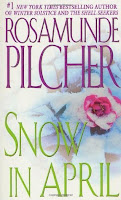
I love Rosamunde Pilcher's books. All of them. I had them all in my collection about ten years ago, and first read 'Snow in April' in 2000. Then somebody - I'm not sure who - borrowed it, and I never saw it again.
So, having re-read most of the others in recent years, I put 'Snow in April' on my wishlist, and was delighted to receive it for my recent birthday.
Caroline, who is about to get married, drives to Scotland with her younger brother Jody, to try and find their estranged older brother Angus. They are stranded in a snowstorm before they reach him, and take refuge in a large house nearby.
Meanwhile, Oliver is mourning the death of his brother Charles, and wondering what to do with his large home and farm.
Naturally these characters, introduced separately, are going to meet. Equally unsurprisingly, there's some conflict as well as some mutual attraction, with the snow making things even more complicated. It's a light novel, with a fairly predictable story-line, but in Rosamunde Pilcher's hands it becomes a delight. Perhaps not one of her very best, but still a lovely story; one that I kept picking up through the day, just so that I could read a few more pages.
Reading for the second time, I had totally forgotten the plot, other than that a girl drives to Scotland and is stranded in the snow. So I enjoyed it afresh, all over again. It's light fiction, and ends perhaps a little too abruptly - but Rosamunde Pilcher always writes moving and believable books with warm people who feel alive and real. I'm sure I'll read this again; I hope it will be long before another nine years has gone by.
Recommended to anyone who enjoys light romantic fiction with very well created characters. Not always in print, but fairly widely available second-hand. Sometimes found as part of an omnibus edition with one or two of the author's other books.
Review copyright Sue's Book Reviews, 30th April 2009
Looking at her website, Maureen Lee sounds like a lovely person. She's written a huge number of books, although until recently I had only read one of them: The Girl from Barefoot House. I found it pleasant enough but a bit flat; interesting but not gripping.
So I wasn't inspired to try any more books by this author. However, I was recently sent 'Nothing Lasts Forever', to review for The Bookbag site. The cover of the book is appealing, and I thought it started well - if a little confusingly - introducing the reader, one at a time, to four different women in brief cameos.
The main part of the book takes place in 2006 when these four women draw together to share a house. Brodie is the house owner; she has recently separated from her husband over family disagreements. Diana is the first person to join her, a well-meaning, generous young woman who feels unwanted in her family home after looking after her brothers for many years.
Then there's Vanessa, an overweight businesswoman recovering from a rejection at the altar, and there's Rachel, a teenager with a baby, whose family want the baby to be adopted.
There is so much potential with these different people as they interact, but so little of it is realised. I didn't find myself empathising with any of them. Possibly this is because the viewpoint switches rapidly so we don't really get to know any of them.
Perhaps, too, the lack of empathy is because the conversations, while realistic, don't do anything to advance the plot. Or perhaps it's because the whole feel of the novel is like that of a 1960s Liverpool saga, so the mention of mobile phones and microwaves seems strangely anachronistic.
As with the other novel I read by Maureen Lee, I didn't actively dislike this one (other than a dramatic and unpleasant climax to the book) but didn't find it gripping or moving either. It would make good holiday reading - something to pick up and set down whenever necessary - but is not the kind of book I'd want to read again.
If you're a fan of this author - and she has a huge following - you will probably disagree, and love this book.
My longer review of 'Nothing Lasts Forever' is here on the Bookbag site.
I first heard of John Wimber when we lived in the USA in the early 1990s, and attended a Vineyard congregation. Wimber was the founder of the Vineyard movement, although he was apparently well-known prior to that, as keyboard player for the band the Righteous Brothers. We did actually get to hear John Wimber speak, when we visited the Anaheim Vineyard in 1995, a couple of years before his untimely death.
As part of a Vineyard congregation, we bought the books 'Power Healing' and 'Power Evangelism', and read them with enthusiasm. Since then, they've sat on our shelves, moving country with us a couple of times; recently I thought it was about time I re-read one of them.
I have to admit to slight disappointment.
When I first read 'Power Evangelism', in the early 1990s, I found it fascinating. It's a well thought-out mixture of theology and personal testimony, describing and explaining the 'Signs and Wonders' that permeated the Vineyard movement and many other denominations in the 1980s and thereafter. When I read the book, I didn't know much about these things at all, and can remember finding it very interesting, as well as inspiring and encouraging.
I re-read it over about ten days, a chapter at a time. I was a little surprised that the theology now seems rather 'old hat'. It was interesting to read again of John Wimber's personal experience, beginning from a rather cynical conservative evangelical standpoint. But twenty-five years after the book was first published, there's not much that seems radical any more. But I suppose these theories, which were startling at the time, have now become absorbed into mainstream Christianity.
Indeed, what did surprise me - since I had entirely forgotten - was that Wimber was so positive about what he terms 'programmatic evangelism', and about congregational church life in general. The 'emerging church' movement clearly started emerging long after this.
Still, it's not a bad book. It's well laid out and clear, with plenty of sound and solid Scriptural explanations for the charismatic Gifts and 'signs and wonders'. Worth reading by anyone who is still suspicious of the Charismatic movement (as it was termed) and the use of Gifts today.
It can also be read as an interesting historical document for anyone who has been part of the Vineyard or similar groups. But don't expect anything mind-blowing or new, unless you've been raised anti-charismatic, in which case you'll need quite an open mind.
The original edition of 'Power Evangelism' can frequently be found second-hand. The image above is of the edition I read, but it links to the new edition on Amazon, which I have not read. The new version was edited and updated by Kevin Springer, with extra study-guides.
Review copyright Sue's Book Reviews, 17th April 2009
I found yet another writer I had never heard of. Kerry Reichs is - or was - in fact an American lawyer. However that's not something I would have guessed from this book which I was sent for review by The Bookbag.
Checking the pink/pastel cover, 'The good luck girl' appears to be light chick-lit. And indeed, that's how it appears in the early chapters. Maeve, the narrator, is a rather flighty young woman. She spends impulsively, way beyond her budget, and gets easily distracted.
Maeve also loses track of time, and is late for her job once too often. She looks for sympathy (and food) from her parents... by the end of the first couple of chapters, I wondered if I would warm to her at all. Her only redeeming feature seems to be her great affection for Oliver, her white cockatiel.
Maeve decides to take a trip across the United States, in the hope of reaching a long-lost friend in California and finding a glamorous job. She decides to stop off and camp at towns with unlikely names, and that's how she ends up in a place called Unknown when her elderly (and much-loved) car breaks down.
Stuck in Unknown, Maeve realises she cannot be unknown in a small town where everyone knows everyone else, and her past begins to unravel. She starts to look at the future as she matures and lets go of painful history.
I found myself liking her more and more as the book progressed. The writing is good - if light - and there is humour as well as some quite moving and thought-provoking sections.
Ideal for bedtime or holiday reading; more depth than you might expect, but don't expect anything gripping. I read it over about ten days, for just twenty minutes or so most evenings.
My longer review of The Good Luck Girl can be found on The Bookbag site.
A little over a year ago, I decided to order a couple of books on writing short stories. I read several reviews, and chose a couple that looked good. I had never heard of Ailsa Cox; it turns out that she's an academic who reads and tutors for a BA programme in creative writing. She also, as would be expected, has had several short stories published.
However, I was a bit disappointed in her book 'Writing short stories', which is billed on the back as a non-literary guide for the average short story writer. The book looks in turn at several genres of short story, with explanations of how they work.
But instead of focusing on character-building and plot development, which I had hoped for, it basically gives extensive examples of how the author herself or other authors have written in the various genres.
The examples given are - to my mind - fairly literary and mostly rather dark, even those labelled humorous. None of them were the kind of thing that appealed to me at all. None of them were the kind of thing that I would want to write, either. There were a lot of exercises at the end of each chapter, none of which were remotely appealing to me as a writer of light character-based short stories.
For someone who enjoys dark and literary short stories, this book might well be useful. But I'm afraid that I found it rather tedious. It took me over a year to wade through it as I kept losing interest; eventually I skimmed the last couple of chapters, hopeful that I might find something more interesting.
I did look at the extensive assignments given at the end of each chapter and even tried out one or two, but didn't find any inspiration. I guess they're the kind of thing that might be assigned in a university course, but I really don't want to write at that level.
Still, the book is very well-written and clear. For someone who likes darker literary short stories, and who is academically inclined, it may well be worth reading. However, if you prefer to write for light women's fiction, I would recommend either 'Writing great short stories' by Margaret Lucke or 'How to write and sell short stories' by Della Galton.
Review copyright Sue's Book Reviews, 13th April 2009
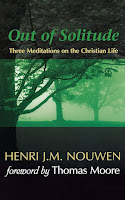
I do like Henri Nouwen's writing. He was a Catholic priest who thought deeply about his faith, and who wrote in a simple yet thought-provoking way. I borrowed one of his books nearly three years ago, and since then have slowly been collecting a few myself.
'Out of Solitude' is subtitled 'Three meditations on the Christian Life'. It's a small book, only 63 pages, divided into three sections. Each one was originally given as a sermon, and they transfer well to the printed page. I read them over three days, one meditation per day, and found myself re-reading the first two almost immediately, so as to better understand and take in all that Nouwen was saying.
The first meditation is on the theme of solitude, looking at the time when Jesus withdraw from his disciples to pray in the midst of a great deal of activity. The second is about the importance of caring in a society so keen on curing.
I had not really considered this distinction before, but Nouwen explains how caring, in the way that Jesus cared, involves reaching out to people at their own level, to suffering alongside them and empathising, rather than merely seeking to solve their problems.
The final meditation is on the topic of expectation - of looking forward to better things in life, as well as in the expectation of eternal life. I didn't find this one so helpful or thought-provoking as the first two, but it was still well worth reading.
I shall no doubt come back to this little book again in the future, and have already ordered a couple more books by Henri Nouwen. Definitely recommended to anyone seeking to follow Jesus.
Review copyright Sue's Book Reviews, 4th April 2009
I'd never heard of Jojo Moyes, although she has apparently written seven novels. I came across her when I was sent one of her novels by The Bookbag for review. The cover looked appealing, and the blurb on the back sounded like my kind of book.
'Night Music' is the story of obsessions. Matt is obsessed with the old and decrepit Spanish House. He coerces his wife Laura into pandering to the elderly Mr Pottisworth, assuming they will inherit it when he dies.
However, a distant relative turns out to be the heir. Isabel is an impractical musician, obsessed with her violin, and recently widowed. She has two delightful children: Kitty, who is fifteen and takes on far too much responsibility, and Thierry, who has withdrawn into his own world and not spoken since he lost his father in a car accident.
Most of the novel happens after Isabel and her children sell their London home and move to Spanish House. Matt takes on the renovations, clearly intending to over-charge Isabel and do work that's unnecessary, and I did find her naivety a bit frustrating at times. But she's a likeable character underneath her flakiness, and I found her children delightful.
There are caricatured minor characters, but that's not a problem. The ending of the book was over-dramatic, although perhaps I should have been able to guess what was coming, and the ending a bit on the tidy side. Nevertheless, the majority of the book was believable and enjoyable, well-written with more depth than I had expected.
All in all, I'd recommend it to anyone who enjoys women's fiction. I shall be looking out for more of Jojo Moyes' novels in future.
You can also read my longer review of 'Night Music' at The Bookbag site.
I started reading books by the American Christian writer Philip Yancey about twelve years ago, I suppose. I was introduced to one of his books by a friend, and found his style very enjoyable. He tends to write very honestly, admitting his own failings and struggles. He uses anecdotes and a chatty way of writing that I found appealing. I also found myself nodding and agreeing with just about everything he wrote.
I first read 'Disappointment with God' in 1999. I suppose it was the third or fourth book I'd read by Yancey at the time, and I found it extremely inspiring and encouraging.
Since I've now collected and read all his books, and there are no new ones at present, I've started re-reading some of them. Over the last week or two, I've read a chapter or two per day of this book. Again, I found it very readable and well-written.
It basically asks three questions: Is God hidden? Is he silent? Is he fair? Yancey talks at some length about a friend of his who wrote a book about the Biblical character Job, but then due to various circumstances, found that he had lost his faith. He was asking these questions, and concluding that God probably wasn't there at all - but if he was, he was hidden, quiet and unfair.
In the first part of this book, we look at the Old Testament period when God was by no means hidden or quiet. His people knew what he wanted, saw his signs, and sometimes heard his voice. However it didn't make them any wiser than we are today, or any more likely to love him. Nor did the majority see him as a loving father, but (in most cases) more like an autocratic boss. Yancey concludes - with some reference to CS Lewis's writing - that since God wants us to love him, and have faith, it's probably better that we don't see and hear him literally.
The questions are not really answered, but are explored thoroughly and honestly, with further anecdotes from other friends, some of whom experienced very difficult or painful circumstances, yet continued trusting God.
Yancey shows us a hint of the eternal perspective, pointing out how we are limited to a time-bound view of events, and also points out how God responded to Job - not entirely satisfactorily from some points of view, but showing him that God's view of the world is very different from anyone else's.
I have to admit, I didn't find the book as mind-blowingly inspiring as I did the first time. Perhaps this is because I could remember many of the arguments in the first part of the book; perhaps, too, I've matured a bit and no longer feel that God should be visible, audible and 'fair' in human terms.
Still, it was a good read, and I'd recommend it to anyone struggling with these questions who would like an honest approach rather than pat answers that evade the issue. 'Disappointment with God' was first published in 1988 but is still in print on both sides of the Atlantic over twenty years later, which is a testament to its popularity.
Review copyright Sue's Book Reviews, April 1st 2009