Showing posts with label crime. Show all posts

1 Dec 2025

We solve murders (by Richard Osman)

We solve murders by Richard Osman
(Amazon UK link)
On the whole, I enjoyed the first three books I read by Richard Osman, in the ‘Thursday murder club’ series. However, I didn’t plan on getting the fourth, and wasn’t even aware that he had written a book in a different series until it was chosen for the December read in our local book group.

‘We solve murders’ has a large cast of characters, and I found it quite confusing at first. The chapters are short, and at the start of the book, new people are introduced every few pages. The main character is a young woman called Amy who is the bodyguard to a well-known writer called Rosie. Rosie’s life has been threatened, so she and Amy are staying on a remote island, along with another bodyguard called Kevin.

But the prologue of the book introduces, in italics, a rather detailed way of staying anonymous and hidden online, and mentions the name of Francoise Loubet. And the first chapter is rather gruesome, telling us about Andrew Fairbanks, who was a low-key influencer who finally becomes internationally known after being murdered at sea. 

23 Sept 2024

Detection Unlimited (by Georgette Heyer)

Detection Unlimited by Georgette Heyer
(Amazon UK link)
I’m glad I decided to re-read Georgette Heyer’s crime fiction novels, as they’re a bit different from her better-known Regency romances. I’ve just finished ‘Detection Unlimited’ which is the last of the twelve crime books she wrote. I last read it in 2017 and had a vague memory of the outcome, although I had not recalled the perpetrator. These books were written as contemporary novels set in the middle of last century. This one was first published in 1953. 

This book starts with a gathering of several people at an afternoon tennis party. We meet Mr Drybeck, a solicitor, setting out to walk to the party. He meets a couple of other folk who live in the same village, and their conversation is quite revealing. We meet Mrs Midgeholme, who breeds dogs whose names all begin with U, and who treats them as if they were her children. We also meet Gavin Pleinmeller, who writes mystery stories and is quite outspoken. 

At the party there are several other residents who all know each other to some degree. I found the numbers a bit overwhelming and went back to make myself a list of people to refer to. Henry and Adelaide Haswell are the hosts of the party; they live at a large house called The Cedars. Their young adult son Charles is home, and he’s quite friendly with a young woman called Abby; she has a sense of humour and I liked her very much. Abby has an aunt, Miss Patterson, who doesn’t attend the party but plays a significant part in the novel.

And there are more. The one person who is not present is Sampson Warrenby, a ‘newcomer’ to the village whom nobody seems to like very much. He’s seen as encroaching, and is known to be very demanding, sometimes unkind to his niece Mavis. Not that anyone is particularly fond of Mavis, either, as she’s rather dull but they all feel rather sorry for her. She’s at the tennis party but is not a good player. 

Inevitably, someone is found dead as folk are going their separate ways. It seems clear that the victim has been shot by a common sort of rifle, but almost anyone who had been at the party could have done the deed. The local police are stuck so they call in Chief Inspector Hemmingway. I do like Heyer’s Scotland Yard policemen.  Hemingway is excellent at making friends with people and listening to their rambling, often discovering important information which others would miss. 

Rather than making a list of people I might have done better trying to construct a map of the village, as the geography is referred to several times. Distances and viewpoints are quite significant through the book, and I’m not good at visualising. But it was beyond me to do so, and I don’t think it mattered. Hemingway and others spend quite a bit of time checking locations, and working out who might have been able to commit the crime. 

But they don’t seem to be getting anywhere. At least ten people could possibly have been in place with a rifle at the estimated time of shooting, and most of them have some motivation. They all realise this, too; there’s some light-hearted sections of the book as several of the village residents present their own theories about who the perpetrator was, and how it happened. There’s also some low-key humour in the banter between Chief Inspector Hemmingway and his assistant, Inspector Harbottle, who has not worked with him before. 

Around three-quarters of the way through the book I vaguely remembered how the crime was committed, and was aware of little snippets of clues that I almost certainly missed the first time around. I didn’t remember who was eventually unmasked, but I did start to get an inkling, which proved to be correct.

Heyer’s crime novels don’t have the brilliant twists and turns of Agatha Christie’s, but her characters are far more three-dimensional. As much as anything this is a character-driven book rather than a mystery; while some of the people are undoubtedly caricatures, others are realistic and I felt as if I were getting to know some of them. There’s even a gentle low-key romance which unfolds. 

I always like Georgette Heyer’s writing style, and her characters’ conversation, which is often peppered with satire. She doesn’t force anything but lets the reader draw their own conclusions. It doesn’t feel particularly dated, despite the lack of technology, and overall I liked it very much. 

Recommended, if you like this kind of gentle crime fiction from seventy years ago. 

Review copyright 2024 Sue's Book Reviews

16 Aug 2024

Duplicate Death (by Georgette Heyer)

Duplicate Death by Georgette Heyer
(Amazon UK link)
I’m glad I decided to re-read Georgette Heyer’s crime fiction novels. I’ve just finished ‘Duplicate Death’, which I first read in 2008. All I could remember was that a nasty murder took place during a Bridge party. I had forgotten all the characters - and, checking back, it appears that I didn’t particularly like it last time, though I didn’t dislike it either.

This time I was prepared for a large cast of characters, and kept a note of them as they started to appear. The first chapter involves a nice family scene; Jim Kane and his wife have just received letters from their children who are away at boarding school, and Mrs Kane also receives a letter from her mother-in-law. She tells her husband that his half-brother Timothy Harte is embroiled with an adventuress, and she would really like Jim to see if he can investigate..

The names sounded vaguely familiar, but it wasn’t until rather later in the book when I realised that these three people were main characters in Heyer’s novel ‘They found him dead’, which I re-read just five months ago. Timothy was fourteen in that book, a fan of gangsters, and determined to help - or hinder - the police in an investigation. In this book, he’s ten years older, and works as a barrister. He recognises Chief Inspector Hemingway who was Sergeant Hemingway in the earlier book. 

The main action takes place in the home of Mrs Haddington, a society widow with a stunningly beautiful daughter, Cynthia. Nobody is entirely sure how she entered high society. Although this was written as a contemporary novel, first published in 1951, it’s apparent that the rules were almost as rigid as they were in the Regency era where Heyer set most of her novels. It’s suspected that her friend Lady Nest Poulton launched her, but they don’t actually seem to like each other much…

Mrs Haddington is hosting a duplicate Bridge party. She has three guests to dinner in advance, including Timothy Harte, who is in love with Mrs Haddington’s secretary Beulah. Then large numbers of visitors arrive; there are almost fifty people in the house, with eleven Bridge tables set up in two locations. I was writing down all the names as they were introduced, but it turns out that most of them are not really relevant to the story. Those that are become more memorable.

Mrs Haddington is rather cold, and not very likeable, but she’s a good hostess and while she’s quite ruthless, she adores her daughter. So much so that she’s indulged and spoiled her. Cynthia is not very bright, cares little for social rules, and wants to marry someone whom her mother doesn’t particularly like. 

Then the tragedy happens, and Chief Inspector Hemingway of Scotland Yard is called in, along with Inspector Grant. The two have quite a good rapport; Inspector Grant is Scottish and comes out with occasional words or phrases in gaelic. However some of his speech patterns are (in my opinion) more Welsh than Scottish. It’s not a huge deal; he doesn’t have much imagination but he is good at his job. 

With some of Heyer’s crime novels it’s obvious early in the book who the perpetrator is. It wasn’t obvious to me at all what had happened in this one. Despite the house being full, there are only really seven possible suspects, and the interviews and checking up are done well. Hemingway is very intuitive, and has a deceptively friendly manner that tends to put people at their ease, as he asks quite pointed questions. 

And just as he thinks he may have worked out both motivation and means for the crime, someone else is killed, using the same unpleasant technique. It throws Scotland Yard into some confusion, and further investigations take place.

I don’t think I could have worked out ‘whodunnit’ as there were some unsavoury parts of the story that didn’t get revealed until later in the book. But it was very well done, and I appreciated all the parts involving Hemingway, as well as those where Timothy takes part. The romantic thread is very low-key but runs satisfactorily alongside the main plot adding a bit of human interest.

Overall, I liked this book this time, very much, despite the gruesome subject matter - and Heyer manages to avoid writing unnecessarily gory scenes, concentrating instead on the potential suspects.

Recommended if you like this genre of mid-century crime fiction. Available in Kindle form as well as paperback, and sometimes available second-hand. 

Review copyright 2024 Sue's Book Reviews

1 Jun 2024

No Wind of Blame (by Georgette Heyer)

No Wind of Blame by Georgette Heyer
(Amazon UK link)
In my gradual re-reading of Georgette Heyer’s mid-20th century crime novels, I reached ‘No Wind of Blame’, which I first read in 2018. I had almost no memory of the book or any of the characters, other than a faint memory of how the crime was committed. 

The book is mainly set in a stately home owned by a flamboyant and very wealthy woman called Ermyntrude. She was widowed some years earlier, and then remarried the impoverished Wally Carter, who appears to have very few redeeming qualities. However he is apparently irresistible to many women, despite being a spendthrift, and regularly drunk. 

Wally has a cousin who is also his ward, Mary Cliffe. She’s one of the central characters, full of common sense and diplomacy. She's one of the few people who feels entirely real without any exaggeration or caricature. Mary is quite a contrast to Ermyntrude’s daughter Vicky, who sees life as a series of vignettes. Vicky constantly sees herself as acting a part. She regularly dresses and behaves in different parts of a play that is going on in her mind. She’s sometimes quite amusing, but Mary mostly finds her annoyingly trite and somewhat naive. 

There are others, too: the Georgian Prince who has come to stay; the local doctor; a squire and his son Hugh who is quite attracted to Mary. But she finds him rather too frivolous. There are less likeable folk as well, such as a belligerent young man who wants Wally to take responsibility for seducing his sister, or so he claims; a rather encroaching close neighbour who pops in far more frequently than Ermyntrude likes.  

So there are a lot of people in this novel, and quite a few different subplots running alongside each other, confusing the local police when a crime is committed - and it doesn’t happen until nearly half-way through the book. Nobody is all that upset about the loss of the character who is shot, but everyone tells either half-truths or downright lies in their attempts to cover up what they think they might know. 

Yet Heyer’s characterisation is such that almost all the people in the book stand out, and I didn’t find the large cast-list at all confusing. There’s low-key humour here and there, and I was pleased when Scotland Yard is called in, as Inspector Hemmingway is the person on the scene. He has appeared in several of the earlier crime fiction books, but usually as a sidekick of Superintendent Hannasyde. In this novel, Hannasyde only appears at the end of the phone; it’s Hemmingway who interviews the suspects and others in the household and neighbourhood. And I love the way his mind works. 

The viewpoint changes quite rapidly in this novel, but whereas that can make writing seem awkward, it works well in this novel. We learn just enough from each person’s point of view to know how they’re feeling, but not whether they are or are not guilty; we don’t even learn who might know of the perpetrator. 

Despite my vague memory of how the crime was committed, I had forgotten the details. It seems increasingly difficult to see just how it happened, and who might have done it, as more and more information comes to light. Even when I was fairly sure, I was puzzled by the motivation; yet that’s something that I should have been able to work out, based on a few casual remarks earlier in the novel.

I don’t like Heyer’s crime fiction as much as I like some of her historical romances, but I thought this was well-written, cleverly plotted and with memorable characters even if some of them were rather over-dramatic and caricatured. ‘No wind of blame’ was first published in 1939 but the personalities feel vibrant and modern, and I’m glad to see that these books are regularly re-published as well as being fairly widely available second-hand. 

Recommended if you like this kind of light crime fiction.  

Review copyright 2024 Sue's Book Reviews

27 Apr 2024

A Blunt Instrument (by Georgette Heyer)

A Blunt Instrument by Georgette Heyer
(Amazon UK link)
In re-reading my collection of Georgette Heyer’s crime novels, I reached ‘A Blunt Instrument’, which I first read in 2008. And although I usually forget who the perpetrator is in this kind of book, I could recall who it was in this one. I had worked it out within a few chapters the first time I read it, and thought it quite a clever story. 

I had not remembered any of the other characters when I picked this up to read yesterday. But it was very interesting knowing from the start ‘whodunit’, seeing how cleverly the author wove in many subplots and red herrings. I think this is one of her best crime novels, although I have been wondering whether she deliberately made it clear to the readers who was the guilty party, to make the investigations all the more interesting - and, at times, quite tense.

Ernest Fletcher is the victim in this story, which was first published in 1938 as a contemporary novel. He’s just been killed in the first chapter, so we never meet him. It appears, at first, that he’s universally liked: he lives with his sister, who is fond of him, and his many staff consider him a kind, generous man. We gradually learn that he had a weakness for pretty women, and had conducted several affairs over the years: mostly discreetly… 

Ernie’s nephew Neville is staying in the house, and I found him quite an amusing young man. He has little idea of economy and has travelled, incurring debts, around the world. His uncle has bailed him out many times, mostly good-naturedly. Neville is horrified at being his uncle’s heir, now owner of the stately home and his uncle’s fortune, as he insists that he prefers being penniless. 

A few minutes’ walk away live John and Helen North; they have been married for five years and seem to have become estranged. Helen has some debts which she daren’t tell her husband about, and it appears that she was visiting Ernie around the time of his murder. Helen’s sister Sally is staying; she’s a crime writer whom I also found rather likeable and amusing at times. 

Superintendent  Hannasyde of Scotland Yard is called in to the case, with his sidekick Inspector Hemmingway, and they’re assisted by the local PC Glass, who is a member of a strict religious sect and keeps quoting Scripture at anyone around him. 

All the main characters are three dimensional; Heyer was excellent at creating believable, well-rounded people, and I very much liked the interactions between them. Neville likes to invent stories that are far-fetched, which doesn’t impress the police. Hemmingway is thorough but not as astute as his boss who often has a twinkle in his eye as he listens to something outrageous.

Some of Georgette Heyer’s crime novels seem too straightforward compared to her contemporary Agatha Christie, although her characterisation is so good that it never much matters. But in this book her plotting is as masterful as her conversation and character-building, and once again I thought it a very good read.  Even knowing the perpetrator - who isn’t unmasked until near the end - I found it an enthralling read, and could barely put it down.

Definitely recommended if you like this kind of British light crime fiction set around the middle of the 20th century.

  Review copyright 2024 Sue's Book Reviews

4 Mar 2024

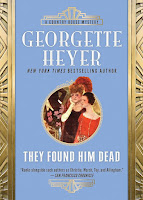
They found him dead (by Georgette Heyer)

They found him dead by Georgette Heyer
(Amazon UK link)
I’ve decided to finish re-reading Georgette Heyer’s crime fiction novels in chronological order. I picked up ‘The Found him Dead’ a couple of days ago, and found it quite compulsive. I last read it in 2011 and had entirely forgotten the story. Heyer’s characterisation is always excellent, with just a hint of caricature to make people all the more memorable. These books were written as contemporary novels in the 1930s, somewhat in the style of Agatha Christie’s ‘cosy crime’ fiction. 

The book opens with a dinner party to celebrate Silas Kane’s 60th birthday party. Sixty is not old, or even elderly, but he has apparently had some problems with his heart. His mother Emily is 80, and she’s quite frail although very strong-willed and mentally acute. Silas has a nephew, Clement, whom he doesn’t much like; Clement is married to the over-dramatic self-centred Rosemary.  

Silas also has a great-nephew, Jim, whom he likes very much, and Jim has a half-brother, fourteen-year-old Timothy. Invited to the party are Silas’s business partner Joe Mansell, as well as Joe’s wife, and their daughter Betty with her husband. And the whole is observed, initially, by Emily’s companion Patricia Allison.  From Patricia’s inclusion in the dinner party it’s clear that she’s a close family friend rather than a servant.

I found the number of people a bit overwhelming at first and had to backtrack over the first chapter to write down their names, and who was related to whom. But it’s a testament to Heyer’s writing that by the end of the book I could recall (and distinguish) them all. Right at the start, there are clearly undercurrents and tensions, but nobody expects that, the following morning, someone will be found dead. 

Everything points to an accident, until, just a few days later, someone else is killed: this time it’s obvious what happened, as there’s a loud noise, and then the character is found slumped over, with a bullet hole in his head. The local police are stumped, after interviewing everybody concerned - including a few extra characters who are in or around the house at the time - so Scotland Yard is called in. 

Inspector Hannasyde and Sergeant Hemingway are an excellent pair of sleuths, introduced first in ‘Death in the Stocks’, which I re-read in July 2022, and then used again in ‘Behold, Here’s Poison’, which I re-read in October 2022. Hannasyde is highly intelligent and resourceful, with a sense of humour. Hemingway is more gregarious. He’s meticulous in his research, but doesn’t always reach conclusions as rapidly as his boss. 

Just to make things even more stressful, a third character is apparently at risk… more than one person warns him that he’s likely to be the next victim, and a couple of ‘accidents’ look as though they were attempts to take him out too. I had guessed, about a third of the way through the book, who was the most likely perpetrator of the second death; I’m not sure if it’s ever established whether or not the same person was responsible for the first. 

The first time I read Heyer’s crime novels, I very much liked the way her characters are so three-dimensional and believable, even with those with some exaggerated traits. However I felt that her novels weren’t as cleverly plotted as those in similar vein by Agatha Christie, who always keeps me guessing right to the end. But re-reading this book, it occurred to me that perhaps it’s deliberate that the reader is pretty sure ‘who did it’ early in the book. Heyer was brilliant at writing in an ironic style, revealing so much by conversations and events that take her characters’ minds in different directions. 

I knew, of course, that it would all be sorted out in the end, but I still found the last few chapters quite stressful. I was certain I knew the perpetrator by that stage - it became increasingly obvious as events unfolded, but the people concerned were entirely unaware. Most of them, anyway. There are one or two extra cast members who arrive a bit later in the book, whom I appreciated very much. 

Alongside the tension there’s some low-key humour, much of it involving the teenage Timothy who loves gangster movies, and is thrilled to be in a house where so much criminal activity is happening. There’s even a low-key romance. The whole makes for a very enjoyable read.  Definitely recommended if you like this style of book. 


Review copyright 2024 Sue's Book Reviews

29 Oct 2023

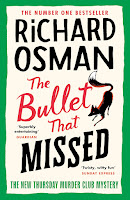
The Bullet that Missed (by Richard Osman)

The Bullet that Missed (by Richard Osman)
(Amazon UK link)
I very much liked the first book I read by Richard Osman, ‘The Thursday Murder Club’, and immediately put the second, ‘The Man that Died Twice’ on my wishlist. I wasn’t sure if I was going to want the third one, but a visitor earlier in the year had bought the book at the airport and read it while staying here, then asked if I would like it for my collection. Naturally, I accepted. 

I’ve just spent the last few days reading ‘The Bullet that Missed’. It involves the familiar quartet from the previous books (Elizabeth, Joyce, Ron and Ibrahim) and their characters feel a lot more well-developed than they were in the first book. They are all in their seventies, and live in a retirement ‘village’ and meet regularly to try to solve murders from the past. 

Elizabeth, formerly a spy, is quite hard-nosed and mostly takes the leading role. But her softer side comes out in dealings with her beloved husband Stephen, who is gradually falling further and further into dementia. There are some very poignant moments involving Stephen.  Elizabeth’s friend Joyce is fluffy and romantic on the surface, but observant and quite astute at times. Ibrahim, a former psychiatrist, is wise and intuitive. Ron is perhaps the least interesting, in my view; he’s quite tough on the surface and often takes a while to catch on. But he hates being left out of anything and when he has something to do, he does it well.  

There are other familiar characters from the earlier books,, and some who are new to this one including several TV workers, and some extra police officers. There are also some new criminals, one of whom is stalking Elizabeth and threatening her as the book opens. 

This novel features the quartet’s  investigation of the death of a former TV presenter called Bethany, whose car was driven (or, perhaps, pushed) over a cliff. Her body was never found but that’s not surprising, and the case was closed, ten years before the story starts, without any indication as to why this tragedy happened. 

There are also some very wealthy money-launderers involved in this novel, one of whom is in prison but hoping to get out soon. I found some of the technicalities of the crimes committed a bit confusing in places, but it didn’t much matter. 

The writing is terse but very well done, in my view, with occasional humorous asides.  The chapters are short, each taking different point of view; this works well and while it could have felt a bit jumpy, it somehow works. 

Until I was about half-way through the book I was finding it a bit samey, but gradually the different storylines started to come together, and some of the characters got under my skin.  By the time I was nearing the end, I could hardly put it down.

I took me until towards the end before I worked out who one of the perpetrators was most likely to be and even then I wasn’t entirely correct in my suppositions.  I’m not sure I could have worked out the complexities of what went on - for Bethany’s wasn’t the only death being investigated, by that stage. And then there were more twists, although there had been some hints and I wasn’t altogether surprised. 

All in all I thought this a good book, worth reading if you enjoyed the first two of Richard Osman’s novels. I won’t be rushing out to get the fourth, which is now available but I may well pick it up at some point. Recommended if you like light crime fiction (there’s a fair amount of tension but no real gore, and the odd humorous aside) but it would be confusing if you had not previously read the two earlier novels in the series.

Review copyright 2023 Sue's Book Reviews

11 Sept 2023

The Man who Died Twice (by Richard Osman)

The Man who Died Twice by Richard Osman
(Amazon UK link)
I very much liked Richard Osman’s debut novel ‘The Thursday Murder Club’ when I read it for our local book group just over a year ago. So I put the sequel, ‘The Man who Died Twice’ on my wishlist, and was given it for my birthday a few months ago, although it’s taken me this long to decide to read it. 

The main characters are the same as those in the first book: four people in their seventies, or roughly so, who live in a retirement village. They meet regularly to discuss unsolved crimes. Elizabeth is the driving force - she used to work for some secret organisation, and she has a clear, logical mind. Her friend Joyce is a former nurse who seems to be a bit less sharp, but often has some excellent insights due to her interest in people. 

Ron and Ibrahim are the other two: their characters are less well developed, but they have important parts to play in the book. The action starts when Elizabeth discovers that a new resident is her ex-husband, under a false name, only staying in the village temporarily. He says he has a task for her, but it’s all quite cryptic, though it involves some stolen diamonds. 

Meanwhile the police officers Chris and Donna are staking out a known drug dealer, but with little success. And then Ibrahim is beaten up by some teenage thugs…

So lots is going on, and the viewpoint changes with each chapter: I didn’t always recall whose perspective was being used, other than when it was Joyce’s turn as she writes in the first person, with many detours and apparently minor domestic details, although some of them turn out to be quite significant.

The writing, as with the first book, is racy, with wry observations and some humour, though I only recall one line that actually made me laugh aloud. Crime novels aren’t usually written with humour, and with several murdered characters it could have been gory - but the details are minimal, and only in one instance did I feel shock and regret - shared with Joyce, who becomes more and more adventurous through the novel.

There are lots of false trails which Elizabeth and others follow, and cleverly written red herrings making me uncertain who was still alive, and with no idea at all who might have committed two of the crimes. Nor did I have any idea where the diamonds might have been hidden, or how Ibrahim’s assailant was going to be brought to justice.  

There’s some gentle pathos too, particularly with Elizabeth’s husband Stephen, who stays in their flat all the time as he’s in the early stages of dementia. He forgets a lot of things, but still plays an excellent game of chess.  And there’s romance… understated, but another thread in the novel.

I’m not sure that I liked it quite as much as the first book, but it was a good read; I’m not surprised that this series has become so popular. I’d recommend it to anyone who likes ‘cosy’ crime fiction. There’s a lot of action in this although nothing too suspenseful.  I look forward to reading the third in the series in a few weeks’ time. 

Review copyright 2023 Sue's Book Reviews

4 Aug 2023

Death comes to Pemberley (by PD James)

Death comes to Pemberley (PD James)
(Amazon UK link)
For Christmas 2021, my son and daughter-in-law gave me both the DVD and the book of ‘Death Comes to Pemberley’, which they had enjoyed and thought I might like. We hadn’t heard of the title, but learned that the book was essentially Jane Austen fan fiction by the late PD James. She’s not an author I had read before; crime fiction isn’t one of my favourite genres. But I was intrigued. We decided to watch the DVD first; it was a BBC series adapted from the book, and we thought it extremely well done. 

It’s taken me this long to decide to read the book, however. That’s partly because I didn’t want the television adaptation too fresh in my mind, and partly because I wasn’t at all sure how much I would like crime fiction written in the style of Jane Austen. I very much like 'Pride and Prejudice', and felt it unlikely any author would capture the characters as originally intended. 

I thought 'Death comes to Pemberley' well-written, clearly based in the correct period and well-researched. However I didn’t feel that the language was anywhere close to authentic Austen. The people from ‘Pride and Prejudice’ are there, but they feel somewhat flat; there’s minimal characterisation, and a lot more ‘showing’ than ‘telling’. Part of Jane Austen’s brilliance lay in her conversations and monologues, revealing people’s personalities without having to say anything about them. That’s missing from this book, as is the ironic humour that pervades Austen’s work. 

However, once it had become clear that this wasn’t Austenesque writing, I was able to appreciate the story for what it is. And it’s quite a cleverly-written plot - as one would expect from a popular crime writer. Darcy and Elizabeth have been married for a decade or so when the book opens, and have two young sons although they don’t seem to spend a lot of time with them. The annual ball in honour of Darcy’s late mother is planned for a few days’ time, and the household is busy with food preparation, cleaning and organising. 

Then, on the eve of the ball, a coach races up to the front door, with a hysterical Lydia crying that her husband Wickham has been killed. She has no evidence of this, as becomes clear: they were travelling with Wickham’s friend Denny, when Denny ran into the woods and Wickham followed. Shots were heard… but nobody returned. So she told the coachman to bring her to Pemberley. 

Darcy and a couple of others set out to find out what has happened, hoping to find the two men walking towards an inn… but, as is not unexpected, given the title, a tragedy unfolds. The ball is cancelled, and the rest of the book is taken up with investigations from the police, magistrates, and eventually a judge and jury. 

Once I was into the book I found I did remember the main outline of the plot, although I’d forgotten much of the detail; or perhaps some of it was omitted in the TV adaptation. My memory of it is that it was pretty close to the novel, albeit with more scenes that are only recalled or spoken of in the book. And while I hesitate to admit it, I think the TV series was better.  It’s quite an action-packed book and I’m glad I saw the DVD first to give me a vague idea of the different locations. 

I found some of the book a bit long-winded and tedious, and with the lack of any real characterisation it was hard to sympathise with anyone. Watching the TV version, I felt a lot more empathy for several of the people, and the outcome - if a little surprising - seemed quite believable. In the novel it felt a bit contrived, not something I could possibly have guessed, and with a somewhat too neat and tidy ending. 

Worth reading, certainly, if you like both crime fiction and Jane Austen; but I wouldn’t recommend it as highly as the DVD.  


Review copyright 2023 Sue's Book Reviews

22 Dec 2022

Envious Casca (by Georgette Heyer)

Envious Casca by Georgette Heyer
(Amazon UK link)
I’ve been taking a break, this past year, from Georgette Heyer’s historical romance novels, and instead re-reading some of her mid-20th century detective fiction. I thought I might finish ten or eleven of them during the year (I had no wish to re-read ‘Penhallow’) but have only managed six, albeit interspersed with many other books.

In 2023 I’m going to go back to re-reading the Regency and other historical novels, so as it’s close to Christmas it made sense for my last chosen detective book of the year to be ‘Envious Casca’, which goes by the alternative (and far less erudite) title of ‘A Christmas Party’. Although I’ve read it twice, the last time being just six years ago, I had pretty much forgotten the story, and had no recollection of who committed the crime, or how it was done.

It’s the story of a group of ill-matched people gathering in a stately home for Christmas. Nathaniel Herriard is the owner, and he’s bad-tempered and has no wish to celebrate any festivities, nor to have his family around him. However his brother Joseph is determined to lighten the atmosphere. Joseph and his wife Maud have been living with Nathaniel for the past couple of years after retiring from the stage.

The other main characters present are Nathaniel and Joseph’s nephew and niece, Stephen and Paula, offspring of their deceased brother. Nathaniel is quite fond of them both and has been generous to them in the past, although he regularly quarrels with them. And he’s particularly annoyed this time, because Stephen has got engaged to a pretty but unintelligent young woman, and Paula has brought with her a playwright who hopes Nathaniel might help to fund his latest production. The eighth member of the party is Mathilda, a distant cousin. It’s not clear why she’s also there, but she’s a likeable, intelligent girl although considered plain.

The scene is set for a murder - and it happens, quite a long way into the book by which time it’s clear that almost anyone (except, perhaps Mathilda) could have wanted to get rid of the victim. What makes no sense is that the victim is found inside a locked room. And when the local police try to take statements, they get nowhere. Scotland Yard is called in, in the form of Inspector Hemingway (who is a regular in Heyer’s crime novels) and his colleague, Sergeant Ware. Inspector Hemingway has a sense of the ridiculous and a great deal of insight, and gets considerably more information from everyone - including the household staff - by his friendliness and sympathetic attitude.

It’s a very well-written book. Heyer’s greatest skill was always in characterisation, and this book is no exception. But she has also made a believable and clever plot, one which I hadn’t recalled the last time I read this book, in 2016, nor when I re-read it in the past few days. I had just about worked out who was the most likely perpetrator, after being suspicious of two or three other people, but had entirely forgotten how it actually happened.

There’s plenty of light-hearted dialogue that makes this a surprisingly enjoyable read, given the unpleasant subject matter. I’m not sure I could have worked out exactly what happened, although there are certainly clues.

Definitely recommended if you like this kind of 20th century ‘cosy’ crime somewhat in the Agatha Christie style.

Review copyright 2022 Sue's Book Reviews

8 Oct 2022

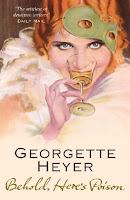
Behold, Here's Poison (by Georgette Heyer)

Behold, Here's Poison by Georgette Heyer
(Amazon UK link)
I’m surprised at how much I’m liking re-reading Georgette Heyer’s detective novels, set in the early or middle of the 20th century. I recalled that her plots were not as clever as those of Agatha Christie, but that her characters were a great deal better developed. And that’s what I’m finding once again; but being aware of that fact means that I appreciate the character quirks all the more, including some rather dry humour here and there.

I first read ‘Behold, here’s poison’ about ten years ago, and had entirely forgotten the storyline. It features a rather mis-matched family, headed by the irritable, self-centered Uncle Gregory. His household includes his twittery, economy-minded unmarried sister Harriet, his widowed sister-in-law Zoe, and Zoe’s two adult offspring, Guy and Stella. They all seem to annoy each other, and none of them much likes Uncle Gregory - but it’s still rather a shock when he’s found dead in his bed.

The doctor who lives next door - and who is engaged to Stella - has been treating Gregory for heart problems, but another aunt arrives and insists on a post mortem. Rather to everyone’s surprise (though not to the reader, given the book’s title) it turns out that Gregory has been poisoned. Inspector Hannasyde (introduced in the novel ‘Death in the Stocks’) and Sergeant Hemmingway, both of Scotland Yard, take on the investigation, but don’t seem to be getting anywhere.

The new head of the family is Stella and Guy’s cousin Randall, who is smooth-spoken, pernickety about his attire, and full of sarcasm. Nobody in the family much likes him, and they rather wish the crime could be pinned on him, but he has rather a strong alibi for the night in question.  I loved the way Randall’s character was slowly developed, with a biting tongue and an evident sense of the ridiculous despite being as self-centred as his late Uncle. At times he reminded me of Heyer’s Duke of Avon in her historical novel ‘These Old Shades’.

It looks as though nothing is going to be solved, despite several clues - and some red herrings - when someone else is found dead, also poisoned. At this point I did remember how this poisoning had happened, and why; but still couldn’t recall who committed the original crime. I suspected several of the family members and one or two others, but didn’t succeed in working it out, or even remembering it from ten years ago. I did feel a tad cheated as I’m not sure I could have worked it out; some of the characters possessed knowledge that had not been given to the reader. And yet… there are clues which should at least have pointed me in the right direction.

But although it’s a murder mystery in the Agatha Christie style, it’s really a character-based novel and I did appreciate the three-dimensional nature of most of the important people in the book, as well as the slight caricaturing of some of the others. Heyer had an eye for the exaggerated and ridiculous, and, as ever, her writing style portrays these perfectly.

Recommended if you like the ‘cosy crime’ genre; this is set in the 1930s but somehow it doesn’t feel as if it's 90 years old.

Review copyright 2022 Sue's Book Reviews

8 Jul 2022

Death in the Stocks (by Georgette Heyer)

Death in the Stocks by Georgette Heyer
(Amazon UK link)
Re-reading my Georgette Heyer crime fiction novels in the order of publication, I’ve just finished ‘Death in the Stocks’. First published in 1935, this is the first of her books to feature the wonderful Inspector Hannasyde of Scotland Yard. I first read it (aloud to my teenage sons) back in 2003, but had quite forgotten that I re-read it as recently as 2017. That might explain why I did recall some of the story, and had no trouble working out the protagonist.

But Heyer’s novels, as with her historical fiction, are primarily character-based, and that’s what I appreciate the most. The novel opens with an unpleasant scene, nicely described, as the shadows change revealing a bizarre sight: a man in the village stocks. Further investigation by a police constable reveals that the man is dead, after having been stabbed.

It doesn’t take long before we learn that the victim, Arnold Vereker, was a very wealthy but highly unpopular man who had a holiday cottage nearby. His half-sister Antonia (known as Tony) is there in the morning when the police call; she had gone to visit him and was surprised that he had not turned up. However she didn’t like him at all, and makes no attempt to hide her antagonism. She lives with her brother Kenneth, who is a rather vague but talented artist and both of them are engaged to be married - but neither of the intended spouses is particularly likeable, and - more importantly - neither is on the same wavelength as the somewhat eccentric Tony and Kenneth.

Tony calls her solicitor, who is her cousin Giles, and he’s an excellent addition to the characters. Giles has a sense of humour, but is less wacky than his cousins, and tries to mediate between them and the police, who don’t know quite what to make of them. Both Tony and Kenneth are suspects in the case: Ken stands to inherit his half-brother’s wealth, and Tony was very close to the scene of the crime. But Tony’s fiance Rudolph worked for Arnold and was being investigated for some fraud, so he’s another suspect… and there could be others.

All in all it’s quite a baffling crime at first, and everyone is beginning to think that it might never be solved… when another murder happens. At this stage I could see where the story was going; whether I worked it out from the clues (and there are some) or recalled it from my last reading, I don’t know. But while there are several suspects and things look bad for a couple of them, one person stood out to me as the most likely perpetrator - and I was correct.

With Heyer’s novels there’s usually some kind of low-key romance, and this is no exception. I could see that coming too, and it’s nicely done, but really only a sideline of the story.

All in all I liked re-reading this very much, and would recommend it to anyone who likes the ‘cosy’ style of crime fiction that was popularised by Agatha Christie in the first half of the 20th century.

Review copyright 2022 Sue's Book Reviews

4 Jul 2022

The Thursday Murder Club (by Richard Osman)

The Thursday murder club by Richard Osman
(Amazon UK link)
I didn’t recognise the name Richard Osman when our local book group agreed on his novel ‘The Thursday Murder Club’ for July’s read. When I learned that he is - or was - the co-host of the quiz show ‘Pointless’, which I’ve seen several times when visiting relatives in the UK, it gave an added interest. 

I was able to buy the book inexpensively online, and liked it very much. It made a pleasant change from the more ‘literary’ (and, in some cases, rather depressing) books we have read in recent months.

The novel is set in a retirement ‘village’ in the south of England. I assume the village is fictional along with the characters, but it seems to have been based on a real village: a community of over-60s in varying states of health, who live in this safe environment, in their own homes, but with onsite activities, a gym, a library and so on.

Four of the residents have formed an unusual club. Elizabeth, Joyce, Ibrahim and Ron are four very different people, and they get together weekly to talk about unsolved murder crimes. Joyce was formerly a nurse, and some of the book is written from her perspective in the first person; she’s the newest member, replacing Elizabeth’s friend Penny who is now on a life support machine, nearing the end of her life.

However Joyce doesn’t have much chance to explore past cases as they are thrown right into a real crime: a builder who has been working in the village is found dead, bludgeoned in his kitchen. The police get involved, and Elizabeth, who is a strong and forthright character, does some investigating on her own account. In some cases, she finds out more than the police are able to. We never find out exactly what Elizabeth’s former career was, but she has travelled all over the world and has access to a lot of secret information; when we discussed this at the reading group, we decided she was probably in the Secret Services.

The writing, we all thought, was excellent. The pace is perhaps a tiny bit slow in the middle, but there’s a lot of humour alongside the rather gory plot. Not that there’s any gratuitous violence; but the builder is not the only person to die, and some very serious issues are covered. Nevertheless, there were three or four places where I actually chuckled as I read an unexpected line.

The characterisation is good, too. We all felt that we got to know several of the main characters, and also that we were gently strung along with nicely planted misleading clues that kept us all guessing about the perpetrator(s) of the two crimes. I was quite convinced it was one person, who turned out to be dodgy in various respects but not a murderer. Then I thought it was someone else - and was wrong about that, too.

I don’t suppose I’ll read the book again, but I may well look out for the sequels. I gather that one has already been published, and a third book about the same characters is due out later this year.

Recommended if you like light crime fiction.

Review copyright 2022 Sue's Book Reviews

17 May 2022

The Unfinished Clue (by Georgette Heyer)

The Unfinished Clue by Georgette Heyer
(Amazon UK link)
I am enjoying re-reading Georgette Heyer’s light crime fiction, something I only discovered in the past twenty years or so after having loved her historical romances since I was in my teens. I first read ‘The Unfinished Clue ‘in 2008, and had entirely forgotten the plot and the characters.

Dinah Fawcett is the main character in this book; she’s a likeable, determined young woman with a sense of humour and a lot of affection for her sister Fay. Fay is rather feeble, and married to the older, overbearing Arthur. Dinah goes to spend a weekend with her brother-in-law and sister, and discovers that their mansion is rather full of guests.

Arthur is in a bad mood, and particularly annoyed that his son George has announced his engagement to a Mexican singer, whom he is proposing to bring to stay. His nephew Francis is staying too, as are a couple whom Arthur and Fay met abroad, and a man called Stephen who is in love with Fay.. Fay has invited the Vicar and his wife to dinner, and also Arthur’s old friend Mrs Twining. So when everyone has arrived, there are twelve for dinner.

It’s clear from the start (and from the blurb on the back) that Arthur is going to be bumped off, and nobody is going to be upset about it. And, indeed, the deed takes place the following morning when most of the household are around, either sitting on the terrace outside, or in and out of the house for various pursuits. In good Agatha Christie style there are plenty of false trails and red herrings, but I found them a tad too obvious: it seems that everyone in the household had a possible reason to kill Arthur, though none had a strong motivation, and most had the opportunity…

Unlike Agatha Christie’s novels, however, the characters feel believable and I could easily remember who was whom. Statements are made by the police, and then Scotland Yard is called in, in the form of Inspector Harding who interviews most of the household including some of the servants. The only real clue is a scrap of paper under Arthur’s hand, and I did actually work out what it might refer to; whether this was due to a subconscious memory of the first time I read the book, I don’t know.

I had a hunch of who might have been the culprit, and was correct. However, I wasn’t able to work out the motivation, and it felt a bit like ‘cheating’ that a lot of information was revealed in the final chapters which the reader could not possibly have known.

Still, it’s a well-written novel with a bit of ironic humour here and there, and a light romance which I could see coming fairly early on, which worked well. The characterisation is so good that it makes up for the plot being less clever than Agatha Christie’s; and while I don’t like crime fiction as much as historical romances, I’m still glad I re-read the book.

'The Unfinished Clue', like most of Heyer's novels, stands alone; I don’t think Inspector Harding comes into any of the other books. If nothing else it’s interesting from the social history point of view. Heyer’s crime novels were written as contemporary, this one nearly 90 years ago. Yet, while the situations are obviously somewhat dated, the people feel realistic and modern.

Recommended, if you like this genre of light crime fiction.

Review copyright 2022 Sue's Book Reviews

7 Mar 2022

Why Shoot a Butler? (by Georgette Heyer)

Why shoot a butler? by Georgette Heyer
(Amazon UK link)
Although I’ve been reading - and re-reading - Georgette Heyer’s historical romance novels for around forty-five years, off and on, I only discovered her crime/detective novels in 2003. There are twelve of them and I managed to acquire them all over some years. At the start of this year I decided to re-read them (other than one which I did not like at all). I’m reading them in publication order and have just finished ‘Why shoot a butler?’

I had quite forgotten that in addition to reading this book aloud to my sons in April 2003, I re-read it (to myself) as recently as July 2016. But I had entirely forgotten the story and the characters too. I quite like it when that happens since it feels as if I’m reading something for the first time.

Frank Amberley is the main protagonist of this story, and since it was written in the 1930s as a contemporary novel, there’s a lot of formality - so he’s known for most of the book as Mr Amberley, other than to his relatives. He is in his large and rather flashy car (for the era) on his way to stay with his aunt, uncle and cousin when he comes across a vehicle with a rather distressed young woman standing next to it. Inside is a man who has been shot. We soon learn that he is the butler of the title, an innocuous kind of man, and the police cannot work out who could possibly have any motivation for the shooting.

Mr Amberley reports the incident, but does not mention the young woman. This is partly because he does not trust the local police, and since he is convinced she didn’t do the shooting, he wants to protect her. Not that she particularly appreciates it. The young woman is called Shirley Brown, and she lives in a cottage with her brother Mark who has a tendency to get very drunk and somewhat disorderly…

The plot is quite complex, but Heyer always had a tremendous gift for characterisation, so I didn’t find it difficult remembering who was whom. Amberley’s aunt Marion is a delightfully astute woman, her daughter Felicity rather excitable, with a somewhat morbid interest in crime. Amberley himself is a barrister, but we learn that he recently helped the local police to solve another puzzle, so although they don’t all like him much, they accept his assistance in trying to track down the perpetrator.

Except that it’s not that simple. The butler is not the only victim, as the novel progresses. And there are several rather suspicious characters. When I read this before I couldn’t work out what was going on, but by the end there’s really only one likely culprit, so the eventual unmasking comes as no surprise. Perhaps I did have some subconscious memory of my last reading of the book, since events fell into place reasonably well, although there’s a lot of detail about the motivations for the various crimes - and there are many - which I don’t think I could possibly have guessed from the plot.

There are one or two places where I chuckled at the repartee between Amberley and one of his friends - Heyer was so good at that kind of thing. But it occurred to me that her excellent characterisation is possibly a disadvantage in crime fiction, since I felt as if I knew most of the cast… and it was obvious that many of them could not possibly have been involved, due to their integrity and general decency. Other crime fiction of this era has rather more two-dimensional characters, so that it’s quite feasible that an unlikely one might end up the culprit.

Still, overall I thought this an enjoyable, fast-paced book with some very tense scenes towards the end. Definitely recommended if you like light crime in this genre, but don’t expect a mystery that could be solved if only you noticed all the clues. Even when the details are spelled out towards the end, I don’t think I could possibly have worked them out myself, even in my third time of reading.

Review copyright 2022 Sue's Book Reviews

21 Feb 2022

Dark Chapter (by Winnie M Li)

Dark Chapter by Winnie M Li
(Amazon UK link)
I had not heard of Winnie M Li, who is a Taiwanese American writer. I very much doubt if I would have read her novel ‘Dark Chapter’, had it not been this month’s assigned read for our local book group. Even then I nearly gave up a couple of times while reading it - it’s not my kind of book at all, and in places is quite traumatic.

I read the book on my Kindle, as that was the best value when I searched two or three online bookshops - and I don’t regret that, as it’s not a book I would lend or recommend to anyone else. And yet, in places it’s quite compulsive reading. The writing is good, and the way it’s written is cleverly done. It’s also a story that clearly needed to be told.

It’s no spoiler to say that, while the book is fictional, it’s based on a serious sexual assault that the author suffered some years earlier. Writing it was probably therapeutic, and hopefully of value to others who have been through similar life-wrenching abuse.

The prologue sees the protagonist, Vivian, talking to her therapist about the dreadful incident, going over it in detail yet again. And then the action switches to the past, and at first is quite confusing since there are two voices to the book. Vivian is an intelligent woman in her late twenties; the other is Johnny, an uneducated, rough and abused Traveller boy in his mid-teens.

We learn a bit of their backgrounds, strongly contrasted. Vivian has two caring parents and a sister whom she’s quite close to. She goes to the best universities, and one of her passions is travelling: exploring the world, hiking some of the recommended trails. Johnny, by contrast, is regularly beaten - quite brutally at times - by his father, who drinks far too much. He has an older brother, Michael, who is mostly benign to him, and some younger sisters and a brother whom he finds something of a nuisance. Their father beats their mother too, and Johnny wants to be tough - he hates the crying, and wants to emulate his older brother in drinking, doing drugs, and becoming intimate with women.

The narrative seems to be designed to make the reader feel sorry for Johnny, and at first this succeeded. But he’s an extremely self-centred young man, arrogant and violent, who thinks he understands women by the time he’s fourteen. We read of his attack on a girl of just thirteen when he’s a year older, luring her into the woods with lies. The incident made me shudder with disgust, and I nearly gave up reading at that point. Johnny seems to have no conscience, no sense of right or wrong.

The narrative moves forward, peppered with far too many expletives in Johnny’s sections, but they do serve to make the different voices clear. There’s tension as we see Vivian setting out on what proves to be a disastrous hike, and Johnny feeling the need of attacking a lone woman. We see both points of view as it happens; Vivian’s increasingly frightened, Johnny’s increasingly sick. When the attack is described in graphic detail, I skimmed several pages on my Kindle; I had no wish to read exactly what happened.

However, once Vivian has reached safety and called a friend who organises police reporting, the book does become more interesting and readable. Vivian is, unsurprisingly, traumatised, not just in the days following the attack, but for a long time afterwards. She had extensive therapy, but years later is still nervous about working, embarking on a new relationship, or travelling.

There’s a court case, described in detail which is also quite tense - it’s not until a verdict is given that we know which way it’s going to go. As with the earlier part of the book, the narrative keeps switching from Vivian’s viewpoint to Johnny’s, and his fictional accounts of the scene are more evidence of his extreme self-centredeness.

It’s not an enjoyable book, nor an easy one to read, but it’s a story that was worth telling, and will hopefully raise some awareness.

Review copyright 2022 Sue's Book Reviews

20 Jan 2022

Footsteps in the Dark (by Georgette Heyer)

Footsteps in the Dark by Georgette Heyer
(Amazon UK link)
I’ve been re-reading my favourite Georgette Heyer historical romances over the past few years, as I do regularly. But this year I decided, instead, to read her crime fiction books; I will probably read one a month, interspersed with other books. When I first acquired them they were from diverse sources, mostly second-hand shops, but this time since I have them all, I thought I would read them in publication order. So I began with ‘Footsteps in the Dark’, which was first published in 1932 as a contemporary novel. I last read this novel in 2008.

Heyer, as ever, is excellent at characterisation.  Her four main protagonists are a family group: Charles, who is married to Celia, Celia’s sister Margaret, and their brother Peter. The three siblings have recently inherited an old and rambling priory which needs rather a lot of renovation. Charles is not all that keen on staying there, even for a holiday; but he has a sense of humour, and when they learn, from the village publican, that the priory is supposed to be haunted, he is determined to get to the bottom of the apparent hauntings by a hooded, cowled monk.

Gradually they get to know a few of the locals, including a rather absent-minded vicar and his somewhat talkative and annoying wife. Then there’s a retired Colonel who likes to play bridge, an entomologist who wanders around at night trying to catch moths, a doctor who likes rather too much to drink, and a somewhat secretive man who’s staying at the local inn, but won’t reveal what his work is.

It’s quite a tense story - the family hears footsteps, and what appears to be terrible groaning beneath their feet. They also discover something very unpleasant in the house, and several secret sliding doors. Gradually they get to know the other residents of the village, and it’s fairly clear that one (or more) of them is responsible for much of what is going on…it’s not until about half way through the book that a particularly nasty event occurs, and events take a more sober turn.

As I said above, Heyer’s characterisation was good. Her people seem believable in a 1930s upper-middle class kind of way, with a bit of wry humour here and there and some mildly amusing conversations, particularly involving the siblings’ aunt who is living with them. I enjoyed the interactions and the story itself.

But unlike Agatha Christie, Heyer’s crime fiction is not full of clever red herrings, nor is there a sense of ‘duh!’ when the perpetrator is finally revealed. Although I’ve read this book before, I hadn’t recalled any of the storyline, nor the outcome. I had no idea what was going on or why the ‘monk’ was in the priory so often, and I don’t think there was any indication that might have alerted me.

Apparently when I read this before I did guess who the master criminal was, but this time I didn’t; really it could have been anyone. On the other hand, I had guessed the occupation of the secretive man in the inn, but that’s partly due to my knowledge of Heyer; it’s a device she used in at least a couple of her historical novels.

There’s a very light romantic thread running through the story, one which seems, at first, to be doomed. It makes a nice side story, and a bit of conflict for the siblings separate from the mysterious goings-on in the priory. But the romance is not the focus of the novel and is very low-key.

Recommended if you like light crime fiction of this era with good characterisation and conversation.

Review copyright 2022 Sue's Book Reviews

30 Dec 2021

The Mystery of the Disappearing Cat (by Enid Blyton)

The Mystery of the Disappearing Cat by Enid Blyton
(Amazon UK link)
It’s been a busy month and I haven’t read as many books as I expected to. My ‘Goodreads’ challenge, I had decided, was a modest 100 books for 2021. I had read 98 books by Christmas Eve, so should easily have reached my target. But although I’m in the middle of four different books currently, I realised it was going to be difficult to finish any of them in two days - and I wouldn’t enjoy them if I tried to do so.

So I decided instead to re-read a couple of my children’s books. A young friend has been borrowing, repeatedly, the ‘Five Find-Outers’ series by Enid Blyton, so I decided to choose one of those. I’ve just finished ‘The Mystery of the Disappearing Cat’, second in the series, a book which I acquired in 1969 and read many times during my teens, but which I had not read for at least twenty-five years. I was expecting to find it rather trite and was pleasantly surprised that I thought it very readable.

Set in the 1940s, it was well before the days of political correctness, so one of the 12-year-old children, whose initials are FAT and who is somewhat overweight is known as ‘Fatty’, but he takes it mostly in good humour. He’s a bit boastful at times, as he knows that he’s extremely bright, but he’s also kind, and full of integrity. His dog Buster is also an important part of the group. The other 12-year-old is Pip, who’s light on his feet but rather scathing of his younger sister Bets, who is eight - but quite a clear thinker. Their friends are Larry (13) and Daisy (12)

The children evidently come from well-off middle class families; the older four are all at boarding schools, and their parents have housekeepers and cooks, though we don’t see very much of the parents. But they’re likeable children, not at all snobbish, as becomes evident in this book. They hear someone mowing the lawn in the garden next-door to Pip and Bets’ house, and meet Luke, the under-gardener, who is 15. He’s not particularly bright or formally educated, but he’s very knowledgeable and creative, and while he feels that he probably shouldn’t be friends with the children, they welcome him and do what they can to help him.

In the garden where Luke works are some valuable Siamese cats, and a few days after the story begins, one of them goes missing - the most valuable cat. The young woman who usually looks after them is away for the day, and the owner of the house is having a tea party which involves most of the staff. All evidence suggests that Luke must have stolen the cat…. But the find-outers are quite sure he is innocent, and set out to solve the mystery.

And it’s surprisingly well plotted for a children’s book. I realised that I did remember who actually committed the crime, and how it happened - there are clues scattered through the book which I’m sure I didn’t notice when I was nine, but which helped to trigger my memory. And I’d forgotten most of the details. The book is only about 100 pages long, and easy to read; yet there’s characterisation that helps distinguish all the children, as well as Luke, and the children’s friend Inspector Jenks.

There are caricatures too - the bumbling, accusatory Mr Goon the village policeman, for instance, or the trembling Miss Trimble who appears regularly but doesn’t in fact play any significant part in the story. Luke’s boss is very unpleasant to him, and we hear of his brutal stepfather. Blyton doesn’t go into gory details, but she doesn’t ignore this kind of realism either: the children are aware of bruises and beatings, and have a strong sense of what is fair.

Enid Blyton isn’t to everyone’s tastes, and naturally some of the story is old-fashioned - but even coming to it fresh over fifty years after I first read the book, I thought it a very enjoyable book. Once I’d started I could hardly put it down.

Recommended to children of about seven and upwards who like a fast-paced adventure story. All these books stand alone, so it’s not necessary to have read ‘The Mystery of the Burnt Cottage’ which is first in the series.

Review copyright 2021 Sue's Book Reviews

14 Dec 2021

Wildfire at Midnight (by Mary Stewart)

Wildfire at Midnight by Mary Stewart
(Amazon UK link)

I have enjoyed re-reading my Mary Stewart novels in recent years, and also acquiring some I had not previously read; most of her books have been re-published and are more easily available than before. I first discovered Mary Stewart’s writing in my school library as a teenager, and while some of her books were a bit too ‘thrilling’, I liked the genre of romantic suspense, and was pleased to discover several of my old favourites.

I had ‘Wildfire at Midnight’ on my wishlist for a while, and was given it for my birthday earlier this year. I’ve just finished reading it and am pretty sure it’s not one I have come across in the past, although the title feels somewhat familiar.

The protagonist of the novel is a young woman called Gianetta, a name given to her in memory of a rather shocking great-grandmother whom she never met. I’m not entirely sure what the point was of this foray into family history in the first chapter, as it’s not at all relevant to the rest of the novel. However it introduces Gianetta nicely; she works as a model, but is tired and is persuaded by her parents to take a break. We learn early in the book that she was briefly married to Nicholas, and now divorced although her mother doesn’t quite believe that they are no longer together.

So Gianetta travels to the Scottish island of Skye, hoping to get away from people, from her memories, from her work… and also from the stress of the upcoming Coronation, which sets the book firmly in historical context: the early Summer of 1953.

After arriving at the hotel which her parents recommend, Gianetta immediately recognises an actress and they become acquainted. There are other visitors too, one of whom she knows already - it seems a bit of a coincidence, but not really a problem. However I couldn’t distinguish the other visitors - married couples, two single women, and a few others. Mary Stewart’s characterisation is usually good, but I simply couldn’t keep my mind on the different guests. And it was important to do so, because this book turns out to be a murder mystery.

However it’s not in the Agatha Christie style; although the first tragedy took place off-stage, before the start of the book, it’s described rather ghoulishly. Nor is it the only one… and unsurprisingly Gianetta herself goes through some very tense moments. I had half guessed who the perpetrator was by some of the action - and when revealed, it was clear that there had been some clues, although I don’t think I would have picked them up.

I have to admit that by the time I was about three-quarters of the way through the book I was finding it so tense that I had to skip to the end to discover if my hunch was correct, and to find out what happened. I assumed that Gianetta survived, since she is the narrator of the whole book, telling the story in the past tense. But I wasn’t going to keep reading if the rest of the guests didn’t...

I found the ending quite satisfactory, if a tad surprising in one respect, and then went back to read the intervening chapters, which were less stressful when I knew the outcome. Mary Stewart was excellent at writing suspenseful prose, and as a thriller it works very well if you like this kind of tension. The romantic thread, such as it is, is quite low-key in this book.

I liked Gianetta, even if the other characters felt a bit flat, and thought it a good story. It's one which I will probably re-read in another decade or so. Not my favourite by this author, but if you like nicely tense books from the middle of the 20th century, this is a good one to try. It's now considered a modern classic, and is available in ebook form as well as paperback. Mary Stewart's novels are also often found second-hand.

Review copyright 2021 Sue's Book Reviews