30 May 2024

Stepping Up (by Sarah Turner)

Stepping Up by Sarah Turner
(Amazon UK link)
If I had seen Sarah Turner’s novel ‘Stepping Up’ in a charity shop or book sale, I might well have bought it. The cover is appealing, the blurb on the back intriguing. As it was, I bought a Kindle edition on special offer, because the book was allocated for the June meeting of our local reading group. 

When I started reading, I thought it was going to be a light-weight and somewhat fluffy novel. I was surprised, as the books chosen for the group are usually more literary, encompassing a range of different cultures and historical periods. ‘Stepping Up’ is set in the UK, in the 21st century. And the initial ramblings of the rather clueless thirty-year-old Beth didn’t lead me to suppose that it would have any depth. 

Beth, who is the first person viewpoint character of the book, is hungover, and late for work. Her car won’t start, and her parents - whom she lives with - are babysitting her three-year-old nephew. She ponders calling her best friend Jory but he will be at work. So after much mental activity, including wondering how long she will stay in her current job (for Beth has a history of leaving jobs within a few weeks), she decides to lie and say she is ill.

She relaxes, eats junk food and turns her phone off. She ignores the house phone when it rings, and browses her computer, only to find, when she eventually turns her phone on again, that there are a flurry of messages awaiting her. Most of them tell her to get in touch with her parents. She phones her father, only to learn some devastating news…

It’s the middle of March when the book opens, and the story runs over the course of the year, finishing on New Year’s Eve. During that time, Beth has to take on some unexpected responsibilities, while in shock and grieving. She learns a lot about herself in the process. So in that sense it’s a classic coming-of-age novel, even if she’s rather older than would be expected for someone so clueless. 

But it’s essentially a character-based novel, albeit one with several subplots. And the characters are very well drawn. Most of them are likeable, but with quirks that make them feel realistic. Beth is untidy, heedless and lives in the present, but she cares deeply about her family and friends. She’s also willing to acknowledge her faults and mistakes, and do what she can to fix them. 

Beth’s mother is highly organised, in stark contrast to her younger daughter, and disapproves of most of what Beth does. One aspect of the novel is their growing to appreciate each other more: Beth, in getting involved in her teenage niece’s life, realises what her mother went through fifteen years earlier. And her mother sees that while Beth’s methods might be unconventional, they can have a positive outcome.

Polly, Beth’s niece, is a three-dimensional person too, full of hopes and fears, plagued by something that worries her desperately, which she doesn’t want to talk about. There’s a lot of insight into her life, and I liked her very much. Her brother Ted is much younger - he has his fourth birthday during the book, although from his language he seems rather younger. But he’s a delightful character, full of curiosity and energy.  

Then there’s Albert, an elderly widower who lives next door to Polly and Ted, who is really very lonely. He seems grumpy but, again, he’s quite believable: he doesn’t want to acknowledge that he’s lonely so he is rather crusty when anyone offers to help. I was slightly bemused at Albert's unused mobile phone still being charged after having been dumped in a drawer for such a long time, but it wasn't a big deal. 

There’s a tragic element running through the book. There's someone lying in hospital in a coma, with little idea, at first, whether this person will ever recover. We don’t learn the answer to that, slightly to my surprise, but the final scenes are, on the whole, hopeful. And perhaps it would have been a distraction if anything definite had happened. 

But there’s also some humour; partly in misunderstandings as Albert and Beth’s parents try to get to grips with the world of mobile phones and the Internet. And partly in Ted’s mistakes, although some of them are bittersweet. I thought it a good blend; the tragedy which besets the whole family has ramifications for the rest of their lives, but there’s a sense in which they, particularly Ted, have to move through it and find new ways to live. 

And there’s a low-key romantic thread, which includes its own miscommunications and uncertainties. It’s a bit predictable, but I wasn’t sure my predictions were correct until the end when the two people concerned finally acknowledge their feelings. Happily there are no bedroom scenes to skip over - there aren’t even any passionate kisses; instead, there’s a lot of hope for a long-term and committed relationship. There are places where I smiled, places where there was almost a tear in my eye. 

The writing style had me interested even in the first chapter when it was just Beth’s internal monologue. By Chapter Two I was hooked, and could barely put the book down. The pace is excellent, the writing good, and the mixture of subplots and character development work extremely well. I liked the fact that there are no ‘bad’ guys; the main conflict of the book lies in the situation that’s described at the end of the first chapter, with further, lesser conflict in the differences of opinion between Beth and her mother, and in Polly’s secrets. 

Most people, as Beth mentions during one stressful scene, are ‘good’ - and that’s an emphasis of this thoughtful, encouraging novel. I love the way that the different marriages observed or described are happy and long-lasting, and that the ending of the book, even if somewhat open, is encouraging and uplifting. 

Definitely recommended if you like women’s fiction, and if you’re not negatively triggered by a shocking tragedy early in the book. 

Review copyright 2024 Sue's Book Reviews

28 May 2024

Circle of Friends (by Maeve Binchy)

Circle of Friends by Maeve Binchy
(Amazon UK link)
I have liked most of the books I read by Maeve Binchy, which I gradually acquired over the past twenty-five years or so. But I’ve only read most of them once or twice. So a few months ago I embarked on a gradual re-read. I’m aiming to read the novels in publication order, missing out a few of the earlier ones that I recall I didn’t particularly enjoy.  

I’ve just finished ‘Circle of Friends’, which was published in 1990. I last read it in 2008 and did not remember anything about it. This book features the residents of a small town in Ireland called Knockglen, and opens in 1949 when Benny Hogan is about to celebrate her 10th birthday. Maeve Binchy was a master of ‘showing not telling’, and in the conversation Benny has with the cook/housekeeper Patsy, we learn a great deal about her personality and circumstances. 

Benny is the only child of a quiet, devoutly Catholic couple who would have loved more children. Her father works hard at a gentleman’s outfitters, and her mother is at home full-time. Benny knows that they adore her, and she’s set her heart on a beautiful pink outfit that she has admired. However Benny is big-built, and it’s clear that she’s totally unsuited to pink velvet. It’s a deep disappointment to her when she’s presented with a nice but practical new jumper and skirt. But her mother is sure she will love it… and she hides her feelings and pretends to be happy about it.

All Benny’s local friends come to her party, and also Eve, an orphaned girl who has been brought up in the local convent. They haven’t had much to do with each other, but realise they are both lonely. After various incidents in the first chapter, they form what turns out to be a lasting friendship. 

The second chapter leaps forward eight years to 1957. Benny and Eve have just finished high school and are celebrating with coffee in the local hotel. Benny is going to university in Dublin, and Eve would love to go too, but there’s no money to send her. So she’s going to be apprenticed to a convent in Dublin. Benny is looking forward to her studies, but she won’t have much freedom as her parents expect her home every evening on the bus. 

The rest of the novel follows the first year at university for Benny and the people she gets to know.  There’s a large cast of characters, and at times I forgot who somebody was, but in most cases it didn’t much matter. The action takes place partly in Dublin, and partly in Knockglen and the novel is primarily character-based. Benny is kind, generous and a tad naive; Eve is loyal to her friends, but quite prickly and at times extremely hot-tempered. 

One of the first people Benny meets is a beautiful, poised girl called Nan. She doesn’t have a happy or secure family life, but she’s determined to rise about it. Nan has read every book she can find on etiquette, and she behaves graciously to everyone, always apparently knowing what’s the right thing to say, and when to keep quiet. It’s a testament to Maeve Binchy’s writing that I could see that Nan is a tad too good to be true, and inherently very self-centred. 

There are boys, too, of course: the handsome Jack, the jokey Aiden, the loyal Bill, and several others. Other girls in the class put out lures while Benny is sure nobody will fancy her. And if they do, they won’t have much chance to pursue a romance because she has to return to Knockglen every evening. 

Meanwhile in Knockglen, her father’s slimy assistant Sean has his eye on Benny, and two or three young relatives of other shopkeepers are determined to upgrade the shops and bring in more custom. I didn’t always follow what was going on, or recall who was related to whom. The action switches frequently from person to person, but it builds up a picture of a caring community. It also shows the tension between the older traditionalists and the younger generation who are full of creativity. 

There’s a lot that happens - the novel is over 500 pages long - and I found myself so engrossed in the different interwoven subplots that it was sometimes hard to put the book down. Benny matures a lot in the year, and learns a great deal about herself and who her real friends are.

The novel is warm, and encouraging, and ends in a positive way. It’s interesting from an Irish social history point of view - the author was, I’m sure, writing at least in part from her own experience - and the main characters are three-dimensional and believable. It’s not a quick read, but if you like character-based women’s fiction that revolves around a community of people, then I would definitely recommend this.

Review copyright 2024 Sue's Book Reviews

22 May 2024

Changes for the Chalet School (by Elinor M Brent-Dyer)

Changes for the Chalet School by Elinor M Brent-Dyer
(Amazon UK link)
In November 2019 I started re-reading the ‘Chalet School’ books by Elinor M Brent-Dyer.  I’ve read most of them at least half a dozen times over the past fifty years or so, sometimes in order, sometimes not. This time through I have managed to acquire most of them in either hardback or Girls Gone By reprints, and some of the ‘fill-ins’ too. And I’m reading them in between some new books, and some by other favourite writers.

So in all that time, I’ve only reached number 28 in the original series, ‘Changes for the Chalet School’. I last read it in 2013 and didn’t remember anything much about it. It follows directly on from ‘Bride Leads the Chalet School’, which I reread a couple of months ago, and is the last book set at the island of St Briavel’s. 

The title is a misnomer, in a way, since the ‘changes’ are forthcoming, rather than actually happening in this book. At the start of the term, there are no new girls at all. It’s the summer term, so they wouldn’t expect many, but it seems odd that there are none at all. Then Miss Annersley, the Head, announces that as of September the school will no longer be on the island. Instead, those of 12 and over are invited to be part of a new branch of the Chalet School which will be starting in Switzerland. Those who don’t go to Switzerland, for whatever reason, will join with the younger girls who are already in St Agnes House, separate from the main school. 

The plan had always been for the Sanatorium to return to the Oberland, but in 1953, when this book is set, Austria is still not considered safe; so Switzerland is the best compromise. And the finishing branch of the Chalet School is already nearby. 

With no new girls to settle in, no major problems, no illness and no actual changes, the book feels like a bit of a filler. It wouldn’t be of much interest at all to anyone who is not already familiar with the characters; but for those of us who are fans, and who have read the earlier books, it’s a good book for catching up on different members of the school. 

Jo Maynard and her family return from Canada, and the triplets are back in school. Margot hasn’t been working hard, and is threatened with being left in the UK branch of the school since she and her sisters are younger than 12. Margot also befriends Emerence Hope, the ‘difficult’ girl who was new in ‘Shocks for the Chalet School’, 25th in the original series. 

Jo brings news of several of her old friends, most of whom have married and had babies, and there’s quite a thought-provoking incident where one of the school staff tries to explain why she isn’t going to go to Switzerland. There’s a nice scene where girls are chosen to decide which books should go and which should stay… and much more. 

Towards the end of the book is a chapter about the seniors’ visit to the Cadbury factory in Bournville. I don’t think I had taken in, on previous readings of this book, what a very long journey it was - probably a couple of hundred miles, in coaches that would not have travelled very fast. A journey of over seven hours is described, without any stops at all.  The visit is then well-described, evidently based on the author’s own experience, although very different from a Cadbury World tour today. But they only stay in Bournville for a couple of hours, and then - presumably - have another seven-and-a-half hour journey back to the school.

There’s a mildly amusing incident when some of the Middles realise they haven’t done anything mischievous so far, and there’s a long section that’s rather tedious about the end-of-term regatta. It’s poignant for the girls because it’s the last one they’ll have, but doesn’t make for interesting reading. 

My previous copy of ‘Changes for the Chalet School’ was an Armada paperback which was starting to fall to pieces, so I managed to acquire a ‘Girls Gone By’ full edition since my last reread. It’s very nicely produced, with some interesting introductory material, but I didn’t notice anything extra in the text. Apparently the Armada edition had frequent minor edits; but nothing that changed the story, or missed out anything significant, as far as I can tell. 

I wouldn’t recommend this book as an introduction to the Chalet School. It's not one of my favourites. But as part of the ongoing series it’s worth reading if you're a fan, and I expect I'll re-read it again in another ten years or so.
 
Review copyright 2024 Sue's Book Reviews

17 May 2024

Eat, Drink and be Married (by Eve Makis)

Eat, Drink and be Married by Eve Makis
(Amazon UK link)
I hadn’t heard of Eve Makis, but her book ‘Eat, Drink and be Married’ looked appealing when I saw it on a church bookstall… nearly five years ago. It evidently wasn’t appealing enough for me to read it before now, but I’m working through my unread books, and finally picked it up to read a few days ago.

The story is told in the first person, from the perspective of a teenager called Anna. She’s the daughter of Greek Cypriot parents who own a fish and chip shop in the UK. Anna is quite academic and longs to go to university at some point, but her mother is very traditional. She wants Anna to find a nice Cypriot young man, get married, and have babies.

Anna has an older brother, Andy, who gets rather more freedom than she does. She refers to her parents by their first names - Tony and Tina - but is closest to her grandmother, referred to as Yiayia, the Greek word for Grandma. Her mother has two sisters who live not far away, both married, both with daughters around Anna’s age. But whereas she mostly gets along with her cousin Maria, she finds her cousin Athena very difficult. Athena’s father is British rather than Cypriot, and Anna’s mother does not approve.

It’s a book of small incidents, mostly, with some historical background. We learn how and why the family has ended up in the UK, when their hearts and souls (at least, those of the older generations) still long to be in Cyprus. Since I live in Cyprus and know some of the history, it was very interesting to read it in novel form, fleshing out a lot of details I only knew of vaguely. 

There are several references to food, unsurprisingly. Anyone familiar with Mediterranean-style hospitality will recognise that Tina’s insistence on cooking and entertaining is entirely realistic. Apparently the author of the book grew up in the UK, the daughter of Cypriot parents, so I expect that a lot of the stories and background are from her own experience. They certainly feel authentic, if a tad caricatured at times.

The story is character-based, on the whole. It shows the racism and violence that some ex-pat shop and restaurant owners experienced - and probably still do. And it also shows how easy it is for people in some cultures to ‘bend’ or ‘twist’ the truth to suit themselves… even when I entirely sympathised, I didn’t feel entirely comfortable with that, or the quick spurts of anger that come to some of the main characters, as well as the minor, racist ones. 

There’s some low-key humour, in the inevitable exaggerations and some of the interactions, and some Greek dialogue, always in Latin letters and with translations immediately below. I liked the way that Tina could be extremely rude to her customers in Greek, in a polite voice; I was also amused at some of her malapropisms. Despite having lived in the UK for so long, amongst mostly mono-lingual people, her English is stilted, with many errors that made me smile. 

There’s not a great deal of plot. Anna’s observations are wry, although at times feel rather more mature than a girl in her mid-teens. She knows she’s a bit of a misfit; she doesn’t want to go along with her family’s traditional take on a woman’s role, but she also doesn’t want to assimilate into an all-British teenager like her cousin Athena. She loves her parents - and extended family - very much, but desperately wants to follow her own dreams, and, eventually, find a young man herself rather than having him selected by her mother and aunts.

On the whole I did like the book, although I’m sure that a lot of the enjoyment was because I know people in this culture, and am aware of Cypriot and Middle Eastern tendencies. But I don’t know that I’ll read it again. 

Recommended in a low-key way if you’d like something a bit different that’s light-hearted on the whole, but with a few shocking scenes and a bittersweet ending. 
 
  Review copyright 2024 Sue's Book Reviews

13 May 2024

The Theatrical Tapes of Leonard Thynn (by Adrian Plass)

The Theatrical Tapes of Leonard Thynn by Adrian Plass
(Amazon UK link)
Having decided to re-read Adrian Plass’s fictional books, I reached ‘The Theatrical Tapes of Leonard Thynn’, third in the original ‘Sacred Diaries’ trilogy. I last read this in 2017, and recalled finding it amusing. The first time I read it, which was probably in the early 1990s shortly after it was published, I had to put the book down during one scene, as I was laughing so much.

On subsequent reads I knew what was coming, but still appreciated the book. And this time, once again, I found myself chuckling aloud several times. While I knew the main story and the brilliant ‘twist’, I had entirely forgotten the lead-up to the main event.

The story is about a ten-minute production which Adrian’s fictional church were planning to put on, for a local church competition. I’m not sure why they were only supposed to have a couple of weeks to put it together, but inevitably it starts with a lot of discussion and some misunderstandings. Several people have ideas of short plays or readings, most of which are unsuitable (albeit amusingly bad) but eventually a play, written by Adrian’s neighbour, is chosen. It’s written in verse, and tells the well-known Biblical story of Daniel in the Lions’ Den. 

It’s not a long book, less than 140 pages and only nine chapters. And the premise is that Leonard Thynn, Adrian’s somewhat strange friend, has a tape recorder and is recording all the rehearsals and the eventual play itself. It’s not clear why he does that, nor why he apparently allows Adrian to transcribe everything. But it works extremely well. 

Leonard Thynn’s mother, whose first name we never learn, is rather deaf so she makes several amusing errors; but she takes her task as wardrobe mistress seriously. Leonard himself is asked to be the prompter, and that leads to quite a poignant scene as he discovers what a prompter is… although he never entirely gets it. And then there’s a young man who wants a smoke machine, with smoke in every scene. 

Edwin, the elder of the church, exerts a calming and diplomatic influence over everyone, while Adrian’s son Gerald provides a lot of humour, as well as some unexpectedly deep comments. The most interesting subplot is perhaps the one involving the Flushpools, the henpecked Stenneth and his strict, overbearing (and often rude) wife Victoria. Assigned a part in the play that’s entirely inappropriate for her character, she slowly realises how harsh she has been, as she thinks about the role she needs to take on. 

There’s a whole lot more to this very cleverly crafted book. I would have thought it would be quite difficult to read an apparent transcript but it’s so well done that I barely thought about the potential awkwardness. As for the play itself - well, it would be a spoiler to say anything about it, other than that I love reading that section every time. I do feel a touch incredulous about the way in which several of the actors manage to re-write their lines (rhyming) in an impromptu way, but it’s a minor issue. 

There's a Christian thread running through this book, of course: this is, after all, a church production. Some excellent points are subtly made, such as the importance of this kind of group, working on a project rather than putting on happy masks on a Sunday morning. And there are some prayers, but they're honest and real. This contrasts to some extreme Christian jargon - exaggerated, I hope - which may go over the heads of people who have not been part of church circles.

It’s best to read this after ‘The Sacred Diary of Adrian Plass aged 37 ¾’, which introduces most of these characters, otherwise it would be quite confusing. The second book, ‘The Horizontal Epistles of Andromeda Veal’ isn’t so important as background, although I always like reading all three in order.  Definitely recommended. 
 
  Review copyright 2024 Sue's Book Reviews

10 May 2024

The Shepherd's Crown (by Terry Pratchett)

The Shepherd's Crown by Terry Pratchett
(Amazon UK link)
I first came across Terry Pratchett in the early 1990s, and was introduced to the Discworld series soon afterwards. I gradually acquired those that had already been published, and then as new ones were written we bought them, often in hardback. I read many of them out loud to our sons, and some to myself. But I had never sat down deliberately to read the entire series from start to finish. 

So I started a full re-read of the ‘Discworld’ series just over five years ago, not all in one chunk of time, but interspersed with other books. I finished ‘The Colour of Magic’, first in the series, at the end of March 2019. I haven’t quite managed to read one Pratchett book per month as I had hoped, which is why it’s taken me so long to read the 41 books. But at last I’ve completed them, with ‘The Shepherd's Crown’. It’s fifth in the Tiffany Aching sub-series, and the final volume of the Discworld books, published posthumously. I first read it in 2017, but hadn’t remembered anything much about it. 

Tiffany Aching is one of the most likeable Discworld characters, in my view. We first met her as a young girl in ‘The Wee Free Men’. That book was intended for younger readers: teenagers, or even older children (possibly as a read-aloud) to introduce them to the Discworld series. Unlike the main books, those featuring Tiffany have distinct chapters and a more straightforward storyline. 

In this book, Tiffany is an adult - we don’t know her exact age, but it’s made clear that she’s more than sixteen. And as such, I wouldn’t really recommend it to children, although it would be fine for teenagers. Tiffany has a young man, Preston, who is working as a junior doctor in Ankh Morpork. They correspond, and she would love to spend more time with him; but they are both passionate about their work, and know that it has to come first. Preston appeared in ‘I shall wear midnight’, and I was sorry that he doesn’t come into this story other than in Tiffany’s mind and heart.

The first few chapters of ‘The Shepherd’s Crown’ involve a dramatic and potentially very sad event which I thought was handled very well. Not wanting to give spoilers, it’s hard to say much more except that Tiffany has to take on a lot more responsibilities than she used to, and finds herself over-stretched and very tired. 

Alongside this, we learn that the elves of fairyland are planning an attack on the Discworld. These elves are not like Tolkien’s: they are selfish, manipulative and without any sense of morality or empathy. 

There are references to so many of the earlier books that it would be hard to read this as a standalone novel, even though the story itself is complete. It’s not just the Tiffany Aching ones that are relevant, either. There are references to Tiffany’s forays into elvish territory in the first book about her, but also to the experiences that the older witches had, described in ‘Lords and Ladies’. 

There are also mentions of the railway - which comes to fruition in ‘Raising Steam’ - and the emancipation and personhood of the goblins, which starts in ‘Unseen Academicals’. The Disc has come a long way since the first books, and I love the way Pratchett helped the different races live in harmony - and they really are different races, not just humans with different shades of skin colour.

The Nac Mac Feegles have a lot of action in this book, most of it either raucous or violent or both. There’s a glossary of their pseudo-Scottish vocabulary in the back of the book, but I’m familiar enough with the words, used in earlier books too, that I only referred to it once or twice. 

And then there’s a new character, a sixteen-year-old lad called Geoffrey whose father is abusive, and who has left home. He travels with his highly intelligent goat Mephistopheles, making his way to Lancre where he has an unusual request for Tiffany. Geoffrey is an interesting person, full of diplomacy and also very caring. It’s sad that we won’t learn anything else about him; but his story is encouraging and he’s a nice addition to the book. 

The writing is good, although in places I wondered if there had been some non-Pratchett additions: a few phrases and uses of punctuation didn’t ring quite true to the other books. But it doesn’t much matter. There’s plenty that’s classic Pratchett, complete with literary and other references. It’s a good story, with a positive outcome, and makes an excellent finale to the lengthy series. 

Definitely recommended if you’ve read all or most of the others in the series. 

Review copyright 2024 Sue's Book Reviews

7 May 2024

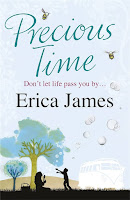
Precious Time (by Erica James)

Precious Time by Erica James
(Amazon UK link)
I have been reading and collecting novels by Erica James for twenty-four years, and have liked them all. But my absolute favourite has always been ‘Precious Time’. I first read it in 2003 and then didn’t re-read it until 2017, when I loved it just as much as I did the first time. I’m now re-reading all Erica James’ books, roughly in chronological order, and the time had come for ‘Precious Time’ once again. 

I recalled that the story was about a young mother who had decided to take her four-year-old son out of nursery school for a few months, to travel around the UK and spend time together. I remembered, too, that they befriended an elderly and cranky gentleman. But that’s all. Sometimes it’s a benefit to have a poor memory for plots, since everything felt fresh to me once again. And, for the third time, I thought this a wonderful book. 

Clara is the young mother concerned. She’s quite a high-flying business person, who has always been secretive about who her son’s father is. Ned is a bright and friendly child who has a great relationship with Clara’s parents, who look after him when he’s not at his nursery school. But he’s not happy at the school, and his grandparents have flown abroad to spend time with Clara’s brother and his family…and Clara realises that time is slipping away. She may never have the chance again, and she has plenty of savings. So she sells her car, buys a campervan, packs up her possessions, and sets out on the road with Ned. 

After a few interesting visits to different campsites, they find themselves trespassing on the grounds of a large mansion, and are confronted by the cantankerous Gabriel Liberty. We’ve already met him - the viewpoint switches from chapter to chapter - and know that he lives in some squalor despite being quite well off. He has been married twice, and widowed twice. He has three adult children but doesn’t get on with any of them, although his youngest, Jonah, buys his groceries and attempts to keep an eye on him. 

Then there’s Archie, the owner of a second-hand shop, whose life is falling apart around him. His mother had a stroke, and is living with him, and his wife has just left him. I’m not sure that Archie had a huge role in the plot of the book, but he’s a likeable person, probably in his late fifties. Archie pops into the novel from time to time alongside the main storyline.

It’s a character-based book, with quite a large cast - but Erica James had a gift of characterisation that meant all her people feel real and three dimensional. And it was very easy to recall who was whom. The plot delves a bit into the psychology of grief; the family dynamics of the Liberty family are complex, and my only surprise is that Jonah turned out as well as he did: he’s kind, forgiving and generous, totally unlike his older twin siblings. 

As I read the book, I felt almost as if I were part of the community of people that Clara discovers, and which Ned is drawn to immediately. There are many strands to the story, including an episode involving the man who is Ned’s father, though he has not known of his existence. I liked Clara’s friends - two couples, who often hang out with her, and who are Ned’s honorary aunts and uncles - and I felt very sorry for Gabriel, who is so lonely in his huge house. 

It’s the kind of book I wanted to dip into in every spare moment; yet I didn’t want it to finish. I am already looking forward to re-reading it once again in another six or seven years. There’s gentle humour, there’s positive interactions, there are moments of great poignancy, and there’s an encouraging, positive ending. A bonus is that there's no bad language, and nothing explicit. 

Definitely recommended if you like women's fiction.
 
  Review copyright 2024 Sue's Book Reviews

6 May 2024

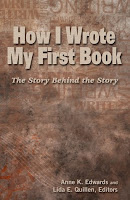
How I wrote my first book (by Lida E Quillen and Anne K Edwards)

How I wrote my first book
(Amazon UK link)
I was on a flight, and had finished a book on my Kindle. I didn’t want to start another novel, so browsed through my unread non-fiction folder. When I spotted ‘How I wrote my first book’, edited by Lida E Quillen and Anne K Edwards, I decided to try that. I had apparently downloaded it at no cost as long ago as 2011, shortly after it was published when it must have been on a special, promotional offer. I see from Amazon that it’s no longer available for the Kindle at all, so the link at the side is to the paperback edition. 

I had little idea what to expect from this book, which is subtitled, 'The story behind the story', but hoped it might give some inspiration related to writing. I had assumed it would be a longish story explaining how one person came to write a book. It turns out to contain shortish descriptions by 20 different writers about the process they went through before their first books were published. These writers are quite diverse: old and young, male and female; some who loved writing since childhood, some who had never thought of writing a novel. 

I had never heard of any of the authors included in this collection. But the stories are mostly quite interesting, albeit some more so than others. Some are full of ironical humour, others more stilted. I found a few of them rather tedious, and completely skipped one of them; but thoroughly enjoyed others. I read perhaps three of them on my flight, and since, returning, have dipped into the Kindle book, reading one or two chapters at a time. I finally finished the last one this morning.

It was fascinating reading about these different people and their approaches to writing, and as a purely biographical/anecdotal book, I would rate it reasonably well. However as a guide to writing, it was less useful. There was no consistent pattern that emerged. Indeed, the styles are as diverse as the people concerned. 

Some of the writers wrote a book in under six months, some took over twenty years. Some planned everything, some did no planning at all. Some struggled to find the time, some wrote to fill in unexpected free time. One wrote on a boat, after being persuaded to write by others. Some were close to despair, some were confident in what they had written. 

The first chapter was possibly the most useful. The author explained that there probably needs to be about a million words that are discarded by a writer before anything useful emerges. This is a bit depressing, but probably true. Later chapters were more individual; what applies to one writer may not apply at all to another. The final one had a clever analogy with crystal-growing - possibly taken to extremes but quite thought-provoking. 

However the only thing that emerged overall is something I knew already (albeit not very often putting it into practice) - to be a writer, one must write. Regularly. Not necessarily at a set time or place, not necessarily every day. But still… without putting words on a page, either handwritten or typed, a book will not get written. 

As a free Kindle book, I thought this was worth reading once. I didn’t actually learn anything new, but it was interesting reading such a variety of experiences of writing. I don’t think I’d pay the paperback price; there are so many books about writing that if I had to buy one, I’d choose one with direct instruction and exercises rather than this anecdotal one.

My personal favourite books about writing (sadly not all in print) are:
 
Writing on both sides of the brain by Henriette Anne Klauser
Bird by bird by Anne Lamott
One way to write your novel by Dick Perry
Walking on water by Madeleine l'Engle
The five-minute writer by Margret Geraghty
Becoming a writer by Dorothea Brande
Back to creative writing school by Bridget Whelan
Writing great short stories by Margaret Lucke
Guide to fiction writing by Phyllis Whitney

Review copyright 2024 Sue's Book Reviews

3 May 2024

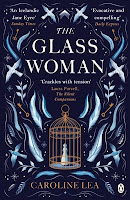
The Glass Woman (by Caroline Lea)

The Glass Woman by Caroline Lea
(Amazon UK link)
I hadn’t heard of Caroline Lea; nor would I probably have come across her novel ‘The Glass Woman’, if it hadn’t been this month’s book for our local reading group. I was able to buy it second-hand a year ago, from an online bookshop; it came in excellent condition and sat on my to-be-read shelf until a few days ago.

The prologue is rather chilling - it features a dead body coming to the surface of a sea, so cold that it’s covered in ice. It’s quickly clear that the whole story is set in Iceland, but we don’t learn the circumstances leading up to the prologue until fairly late in the book. However the scene stayed in my mind throughout. 

The main part of the story then begins in August 1686. Rósa, a young woman in her twenties, is sitting in her chilly croft with her mother. Her beloved father died before the story started, and since he’s gone they have struggled to survive. Now Rósa’s mother has a bad cough, and Rósa is worried that it’s going to get worse, possibly proving fatal. And she has to make a very difficult decision.

The narration is cleverly done, moving forwards and backwards in time as we gradually learn the circumstances of Rósa’s life. She has a childhood friend, Páll, whom she had hoped to marry, but their families don’t take this seriously. So when a wealthy stranger from another part of Iceland offers to marry her - and to provide food and fuel for her mother and their neighbours - she feels that she has no choice but to accept. And now she has to travel for several days on horseback, accompanied by her new husband’s apprentice Pétur. She has little idea what to expect, and it’s likely that she won’t see her mother (or Páll) again.

Rósa is a strong-minded person but her culture and upbringing have taught her to be submissive. She knows that, as a wife, she will have to work hard and obey whatever her husband asks her to do. And she’s willing to do that, for the sake of her mother. But some of her husband’s orders seem unreasonable: there’s a locked loft at the top of their croft, for instance, which she must never try to enter. And she’s not allowed to invite any of the people from the village into their home, nor is she to socialise with anyone.

This isn’t the kind of environment or period of history that would normally interest me, but the writing is so good that I found it quite compulsive. I set myself to reading 100 pages per day, as it’s a 400-page book and I wanted to finish it on Sunday. Instead, I read over half of the book yesterday, and finished it this morning. 

I still don’t know entirely what drew me in, as I didn’t really engage with any of the characters. Nor was the story a pleasant one: the society was quite primitive in many ways, with harsh punishments for anything hinting of witchcraft. Rósa could be beaten if she disobeys anything that her husband Jón asks. Killing of animals and birds is a natural part of society, and when Rósa attempts some empathy, it’s pushed down. 

She manages to befriend one or two of the local women but the more she does that, the more she realises they’re keeping secrets - and nobody will tell her anything about Jón’s first wife, Anna, other than that she died. Apparently this was from a sickness, but local folk are suspicious.  

The marriage is a strange one in other ways. Jón rarely approaches Rósa at night, even though she expects him to do so. He works hard, and does show occasional affection, but she’s treated more as a housekeeper than a wife. 

I found the book a little slow at first, but after the first 100 pages it was difficult to put down, so I ended up reading it any time I had a few minutes to sit down. The story is extremely well written, and my mind was full of questions - what are the noises Rósa hears at night? Or does she imagine it? Who exactly is Pétur? What happened to Anna? What secrets is Jón keeping…?  

In the latter half of the book there’s an extra element introduced, in the first person, with Jón as the narrator. This jarred a little at first, but I quickly realised that it was a clever device, to increase the suspense.  

I wouldn't say I enjoyed the book, exactly, but I’m glad I read it. I’ve learned a lot about historic Icelandic culture, and I’m sure that some of the story will stay with me for a while. I doubt if I’ll read the book again, but I would recommend it to anyone who likes mildly suspenseful stories and who is looking for something a bit different.

Review copyright 2024 Sue's Book Reviews

2 May 2024

Gemma Alone/Gemma the Star (by Noel Streatfeild)

Gemma the Star by Noel Streatfeild
(Amazon UK link)
I have loved Noel Streatfeild’s books for children since I first discovered some of them on my grandmother’s shelves when I was, I suppose, about eight or nine. I have acquired most of them over the years, and reread them sporadically. I picked up ‘Gemma’ to reread in January, and the sequel ‘Gemma and Sisters’ in mid-March

So it was time for the third in the series, originally titled ‘Gemma Alone’. I last read it in 2015 after buying a replacement to my forty-year-old paperback which had fallen to pieces, only to discover that the book is now called ‘Gemma the Star’. I didn't dislike that nearly as much as the garish orange cover to the book; but that's my only gripe. 

The book continues the story of the Robinson family, and is best read after the first two. However there are plenty of flashbacks or explanations for readers who pick this one up without having read the others. Gemma, who must be fourteen by now, is about to join the local small drama school, moving out of the huge comprehensive where she struggled to keep up academically.

Moreover, Gemma is now using her real name, no longer worried about people knowing that she’s a former child film star with no current work. She finds the school inspiring; she loves the acting and other relevant classes, and she even begins to understand some maths when she’s given some extra coaching. However she has a lot of questions to ask herself when opportunities arise for professional work. 

Gemma’s cousin Lydia is also starting at the theatre school as a ballet student. Lydia is very driven and quite self-centred, and determined to do things that her excellent teacher Miss Arrowhead won’t allow. Inevitably this gets her into trouble - although we never really learn what Miss Arrowhead thinks about her doing some tap dancing in the family shows known as ‘Gemma and Sisters’. 

Lydie’s older sister Ann is destined for music college, or so her father thinks, but Ann is an academic who wants to study. And she loathes the entrances, exits and general artificial nature of appearances, when all she wants to do is sing. But she can’t quite pluck up the courage to tell her parents she’d like to go to Oxford.

As for Robin, youngest in the family, he and his friend Nigs are entering a talent competition with Robin’s ‘swirled’ songs. Unfortunately they can’t hear each other, so the girls are drawn in to help. 

As a standalone story this wouldn’t be all that interesting, I think; nothing too dramatic happens, it’s more a book about starting to grow up, at least as far as Ann and Gemma are concerned. The Robinson parents are excellent, in my opinion: open-minded, fair, and willing to listen, even if they sometimes draw strict boundaries. Gemma’s mother, the flighty Rowena, is less so - and Gemma realises, when she meets her mother for the first time in a few years, that she’s not a typical mother. 

I liked reading this very much; the characters are all well-drawn and I feel as if I know them. While the setting is undoubtedly somewhat dated (this was first published in 1969) the people are vibrant, albeit a tad caricatured in some respects, and their interactions and emotions are still relevant today. 

Definitely recommended for fluent readers of about eight and upwards, or as a read-aloud; but probably most likely to be read by nostalgic adults who loved Noel Streatfeild’s books when they were younger.

Not currently in print, but fairly widely available second-hand. 

  Review copyright 2024 Sue's Book Reviews