It’s more than twenty years since I last read ‘The Princess of the Chalet School’, third in Elinor M Brent-Dyer’s lengthy series about a boarding school in Austria, which started in the 1920s. The last time I read the series through, I skipped this one as I was away from home when I acquired the next one in the series, and wanted to read it at once.
So although I remembered the outline - that the Princess Elisaveta, from an imaginary central European mini-state called Belsornia joins the Chalet School - I had pretty much forgotten the actual story. It’s set in the summer term, right after the fill-in ‘Deira joins the Chalet School’ which I read for the first time a couple of months ago.
The story starts with a rather unwell and miserable Elisaveta; she is over-protected by the palace staff, but feels quite lonely. She’s been ill and should be recovering; but she’s dreading going back to her rather old-fashioned governesses and solitary existence. Her doctor understands her well, and proposes that she be sent to a boarding school with good mountain air - and so she ends up, incognito at first, at the Chalet School.
I had entirely forgotten that the first part of the book is mainly concerned with a most unpleasant woman who has been employed as a new Matron to the school. Matron Webb is harsh in her methods, and does not fit in at all with the Chalet School ethos. Some of the Middles form the ‘SSM’ - the Society for the Suppression of Matron - but although some of their ideas are a little amusing, I was more interested to read, again, some of the positive principles of the school - and, I assume, the author - being explained. While they might seem obvious today, they were far ahead of their time. Children and their ideas were respected, conversation with adults was encouraged, and staff were expected to be flexible.
Once the Matron problem is solved, the focus moves back to Elisaveta. She has had no trouble being accepted by the girls in the school, and throws herself enthusiastically into everything, particularly the Girl Guides. However, she has a cousin, who is in line for the throne of Belsornia, but is not much liked by her father or the King (her grandfather). And Elisaveta is in danger if he discovers where she is…
So the latter half of the book is really quite exciting. While I knew the book wouldn’t end in disaster for the main characters, I couldn’t remember at all what happened, and found it quite difficult to put down during the most tense part of the story.
I was surprised at just how much I enjoyed this book. I think the author was at her best in the earlier stories, when the ideas were fresh and the characters realistic, with each book having a different focus. While it helps to have read the author’s first two books, ‘The School at the Chalet’ and ‘Jo of the Chalet School’, as general background, this one stands alone so well that it could make a good introduction to the series.
My edition is a hardback that used to belong to my mother; it has more recently been reproduced in paperback by 'Girls Gone By'. The Armada paperback edition which can often be found second-hand has only minor cuts and changes.
Highly recommended, if you like this era of children's/teenage school stories. Suitable for fluent readers of about eight or nine and older, but also enjoyable for adults who recall the series with nostalgia from their childhood.
Review copyright 2020 Sue's Book Reviews
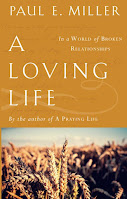
I first came across Paul E Miller’s writing when I downloaded and read his book ‘A Praying Life’ free for my Kindle nearly a year ago. I liked the style very much indeed, and afterwards put a couple of his other books on my wishlist. I was given ‘A Loving Life’ for Christmas, and have just finished reading it.
I didn’t realise - or had forgotten, anyway - that this book is basically an in-depth study of the Biblical book of Ruth. The story is well-known - the Jewish Naomi has moved to Moab, married someone there, and had two sons. But when the story opens, her husband and sons have all died.
Her daughters-in-law want to stay with her but she tries to persuade them to return to their families when she decides to return to Israel. One of them does as she asks, but Ruth, showing tremendous love and sacrifice, insists that she will stay with Naomi. When they arrive, Ruth goes to work in the fields, gleaning wheat - and in the end she marries the boss, Boaz.
I don’t think I’d thought too much before about just what an incredible, strong woman Ruth was. That comes through in this book, although the focus is on her deep, abiding love. She is willing to give up her biological family for the sake of her mother-in-law, and move to somewhere she has never been to. She will be a foreigner, possibly an outcast, and it appears when they set out that there’s little chance of her marrying again.
Each chapter of this book tells a little more of the story, with the emphasis all the time on what the author calls ‘hesed’ love, using a Hebrew word to demonstrate that this is much more than ordinary care or affection; it’s the kind of love that endures, that forgives, that is willing to keep loving even when pushed aside or rejected.
Naomi in fact gives ‘hesed’ love when she tells her daughters-in-law to go back to their families, although she becomes quite bitter for a while too. But it’s Ruth who is the heroine of this book, the ‘Christ’ figure who gives up everything she has in order to care for her mother-in-law.
The writing is good, including a few anecdotes in the author’s own life and experience, and also explaining some of the cultural and historical background to the book of Ruth. I found it very interesting, although it took me a while to get through it as I only read a chapter each day. There was much to ponder, and I hope I have a better overview of what real love is, explained in practical and specific ways.
Definitely recommended.
Review copyright 2020 Sue's Book Reviews
When I started re-reading Terry Pratchett’s Discworld books a few years ago, I didn’t get as far as ‘Moving Pictures’; so the last time I read it was back in 2004. I remembered that it was one of my favourite of the early Pratchett books, and of course I recalled that it was a kind of Discworld spoof of Hollywood. But I had entirely forgotten the actual storyline.
But this time I'm getting further into the series. I re-read 'Eric' back in February, and was quite looking forward to getting to this one, the tenth in the series.
The hero of the book is a failed wizard called Victor. Having said that, he has to work pretty hard to fail his exams every year, and he’s probably more knowledgeable than many successful wizards as a result. But the wording of a legacy means that, so long as he’s studying - and so long as he fails by only a certain margin - he can continue at the wizarding university for as long as it takes.
But, the night before another final, when the wizards have finally worked out a way that will force him to pass with 100% - or fail with zero - he sees something that makes him forget entirely about his exams. Instead, he travels to ‘Holy Wood’, to find out what’s going on.
The alchemists have discovered how to make what they call ‘moving pictures’. Cameras in the Discworld work by having a lot of imps painting pictures inside. Moving pictures have these imps painting ultra fast, coerced to do so by rather a cruel method, and then the resultant ‘click’ is projected on a screen by the light of salamanders. It’s all very clever pseudo-science, Discworld style, and I was impressed, once again, by Pratchett’s brilliance at this kind of satire.
Naturally there’s a heroine too, a girl called Ginger, who plays the starring role in all the clicks. There are some trolls who dress up as various monsters or aggressors, and there’s Victor, who seems to know how to act, and what to say, and even how to kiss Ginger… because of the magic of Holy Wood.
One significant character in this book is 'Cut-my-own-throat' (or CMOT) Dibbler, seller of sausages-in-buns and other dubious produce, he too is caught up in the magic of Holy Wood. He develops significantly in this book, becoming an almost three-dimensional entrepreneur with some visionary ideas...
There are lots of clever references to classic films, many of which I probably didn’t get; but more than once I found myself smiling, even slightly chuckling as the significance of a throwaway line became clear to me.
It’s a good story, with a dramatic conclusion. Since I wrote quite a comprehensive review of ‘Moving Pictures’ last time I read it, I’ll leave this one shorter rather than risk spoilers.
Definitely recommended to anyone who likes Pratchett’s writing, or if you’d like a light-hearted read set in the unique and intriguing Discworld. It stands alone, so there's no need to have read any of the earlier ones beforehand.
Review copyright 2020 Sue's Book Reviews
I have liked all the books I have read by Catherine Ryan Hyde, over the past decade or so. So I’m gradually acquiring more. I was a bit startled to realise, when I picked up ‘Take me with you’ to read, recently, that I was given it for my birthday nearly three years ago. I’m very glad that I have read it at last!
The book is about a teacher called August, who spends his summers travelling around the United States in a motorhome. We meet him early in June one year when his vehicle has broken down. He has managed to find a small and friendly repair shop, but he’s concerned that the cost of getting the motorhome fixed will curtail his trip somewhat. He has quite a tight budget, and there’s one place he had particularly wanted to get to….
The garage mechanic is called Wes. He’s a single father with two young sons; Seth is twelve and Henry is seven. They’re nice lads, and they are very taken with August’s dog. Seth is a serious boy, always feeling that he’s not good enough. And Henry doesn’t speak to anyone… except, sometimes, his brother.
There are some major issues in August’s past. We quickly learn that he suffered a devastating bereavement not long before the story starts. He is also recovering from another problem. The blurb on the back says what this is, but I rather wish I hadn’t read it; I’d have preferred to learn about his past as the story unfolds.
It’s hard to say more without spoilers; suffice it to say (since this is also in the blurb on the back) that Seth and Henry end up travelling with August in his motorhome. He isn’t keen on the idea, and they’re both quite stressed for a variety of reasons. The dog Woody plays a quiet but important part in the book,helping Henry in particular to feel more secure and relaxed. And there are some excellent conversations between August and Seth, as they get to know each other and help each other come to terms with some of their problems.
A book which covers three people’s travelling into a number of national parks and other campsites around the US could have been quite tedious, but Catherine Ryan Hyde makes it a thoroughly enjoyable journey. The focus is always on the people, and the things they learn. The descriptions give an overview; the places are real and can be researched online by anyone wanting to know more about them. But I didn’t skim much, if at all, as I turned the pages, more and more involved in the lives of these three different people,
The writing is excellent, as is the characterisation. I liked August so much; he’s had a difficult life in many ways, but is likeable, full of integrity, and determined to make the most of his life. Seth, too, is a responsible, honest lad. Yet both of them have their flaws. August can lose his temper; Seth is very easily offended. Henry is less three-dimensional, at least in the main part of the book, but I liked him - and believed in him - too.
There are some serious issues covered in the book, but there’s very little bad language - indeed, Seth apologies for even the mildest of bad language - as well as no violence or intimacy. This book would be appropriate for a teenager or even an older, thoughtful child, although some of the issues might be a tad disturbing or hard to understand for a younger child.
But it’s also an excellent book for adults; there is so much to think about, so much that kept the people in my mind and made it difficult to put the book down when I had to do other things. And the last chapters are extremely moving. There is some sadness at lost time - the last section of the book jumps us ahead by eight years, so the boys are grown up - and introduces other issues. It takes the story full-circle, in a way which would, again, be a spoiler to explain. And there were two incidents, in the last couple of chapters, where I had tears in my eyes, at thoughtfulness and love, in the best sense of the word.
It’s not a fast-paced book; if you prefer novels with plenty of plot, or fast action, this isn’t for you. But if you like thoughtful, character-based books which explore issues and develop friendships, this is a great read. It’s supposedly women’s fiction but it only just occurred to me that all the main characters are men.
All in all, I loved this book and would recommend it highly to anyone who likes this genre.
Review copyright 2020 Sue's Book Reviews
I reread all my Georgette Heyer historical romances regularly, and find I like them afresh each time. It had been ten years since I last read ‘Charity Girl’, so it was more than time for a reread. I knew that this was one of my favourites, but only remembered the general outline of the plot rather than any of the characters or details.
Viscount Ashley Desford is the hero of this book. He’s one of Heyer’s nicest young men, in my view. His family want him to get married, now he’s approaching thirty, but to date he hasn’t found anyone he wants to spend his life with. His mother had hoped he would marry his childhood friend Henrietta (Hetta) but they had agreed that they would not ‘suit’, and so he had never proposed.
Desford is staying with some friends and is taken to a ball hosted by some rather arrogant neighbours. He is presented to a beautiful young woman and dances with her, but she raises no emotion in his heart at all. On his way through the hall, after escaping the heat for a while, he encounters the beauty’s cousin Cherry, who is peeping through the banisters. He spends a few minutes chatting with her, despite her fear that her other cousins might overhear.
The following day, Desford spots Cherry running away from her aunt’s home. He learns that she’s been treated like a servant, and offered no affection at all. She was overheard chatting to him and has been criticised so unjustly that she’s decided to take refuge with her estranged grandfather in London. After trying to persuade her to return to her aunt's, Desford agrees to take her to London with him.
That’s just the start of an amusing and thoroughly enjoyable adventure, at least from Desford’s point of view. Naturally, the grandfather cannot be found so he decides to leave Cherry with his friend Hetta and her hypochondriac mother, while he attempts to find either the grandfather, or the teacher whose school Cherry attended until she turned eighteen, who was kind to her….
The pace is good, the action alternating between Desford, determined to solve the problem he has taken on, and Cherry, who is a likeable if rather foolish girl and has made herself invaluable to Hetta’s mother. Into the mix comes Simon, Desford’s younger brother, who is unexpectedly caught up in the plot and makes an excellent addition.
There are some inevitable caricatures amongst the minor characters: mostly quite unpleasant people, but amusing nonetheless. Cherry’s grandfather, when eventually tracked down, is in a situation which reminded me of one of Heyer’s other books, but amusingly portrayed in a way that made me feel he deserved his fate. Another of her relatives is a classic narcissist, charming - at first glance - but manipulative, with an ability to twist everything to his own purposes.
Indeed, with her unsympathetic aunt and nasty cousins, poor Cherry ‘s relatives are all highly dislikeable. The eventual resolution of her problems is perhaps a bit forced; there’s no indication that it might happen, but it solves everyone’s problems rather well, so I didn’t mind. And despite giving her name to the novel, she’s not the most important person.
The characterisation is excellent; I liked Desford so much, and could almost feel his frustration. It’s perhaps unusual for the hero of a romance book to be the main protagonist, but it works extremely well, in my view. I had, of course, remembered who Desford was going to end up marrying, but had quite forgotten how it all happened. Heyer often ends her stories rather abruptly, with a brief kiss on the final page. In ‘Charity Girl’ the final declaration scene takes almost three pages, and there’s a distinct romantic tension for a couple of pages before.
Very highly recommended to anyone who likes this kind of light regency romance. I’m already looking forward to reading it again, hopefully before another ten years have passed.
Review copyright 2020 Sue's Book Reviews
I am glad I finally decided to read - or perhaps re-read - Susan Cooper’s ‘Dark is Rising’ series. I’ve just finished ‘Greenwitch’, the third in the series. I think I probably read it when we first acquired it, twenty or so years ago, but I hadn’t remembered the story at all.
The book follows on nicely from both the earlier books in the series. The first one, ‘Over Sea, Under Stone’, introduced the Drew children: Simon, Jane and Barney. In that book they discovered an ancient cup or grail, helped and advised by their Great Uncle Merry. The second book, 'The Dark is Rising', introduces the Stanton family, and particularly Will, a boy of eleven who learns that he is an ‘Old One’, someone who fights for the Light against the powers of darkness. Great Uncle Merry appears in that book as, simply, Merriman.
In ‘Greenwitch’, the four children meet, although the Drew children have no idea, at first, that Will is connected with Merriman and that he is far more than he appears. The grail has been stolen, and they go down to Cornwall to stay with their great uncle. Will is staying in the next-door house with his aunt and uncle.
Fairly early in the story, Jane is privileged to watch the building of the ‘greenwitch’, an ancient custom which the village women do all night while their menfolk are out sailing. When they have built this large structure out of branches and leaves, they all make wishes. Jane feels that there is something powerful about the greenwitch, although most of the women just think it’s a silly tradition.
The writing is excellent, well-paced and with some dramatic descriptions. There’s a particularly unpleasant character who becomes gradually nastier as the book progresses, but unlike in the first one it was clear to me who could be trusted and who could not.
It’s not a long book, but quite exciting in places. Naturally the Light is going to defeat the dark eventually - it’s a children’s or young teenage book, after all, and there are two more in the series - but I found myself feeling tense more than once as yet more danger appears.
There’s a strong element of fantasy in this book, albeit set firmly in the real world. Will, Merriman and other people of the Light have unusual abilities, some of them quite startling. There are also several scenes where dreams and reality are interposed on each other and it’s not certain what is real and what is not. The whole idea of the greenwitch - with a personality, and role is new in this book, and the concept of ‘wild’ magic, subject neither to dark nor Light.
I enjoyed reading this book, and would recommend it to anyone over the age of about ten. Although it could stand alone, it’s definitely better, in my view, to read it in sequence after the first two in the series.
Review copyright 2020 Sue's Book Reviews
Nearly ten years ago I read the teenage novel ‘Holes’ by Louis Sachar, and liked it very much. So when I spotted ‘Small Steps’ by the same author on a church bookstall a little over a year ago, it was not a difficult decision to pay 50 cents to buy it. I didn’t pick it up to read until a few days ago, however, and have just finished it.
The main protagonist is a teenage boy whose real name is Theodore. He is determined to get rid of the nickname ‘Armpit', but that’s how the author mainly refers to him. He was one of the characters in ‘Holes’, when he was sent to a juvenile correction facility; but as it was so long ago when I read it, I didn’t recall him. It didn’t matter. There are references to his past, and the reason for him having been sent to the camp is mentioned, but ‘Small Steps’ stands alone.
Theodore is working hard. He goes to high school where he is determined to graduate (the book is American), and he also works as a kind of trainee gardener. He lives with his parents - who are very suspicious of him, and quite rude at times - and has been saving as much as he can of his earnings. I was startled when the amount in his bank account was mentioned. But he works hard, and is determined to stay out of trouble…
Unfortunately Armpit has a friend known as X-Ray who is quite manipulative. Armpit is soft-hearted and finds it hard to stand up to anyone. So when X-Ray persuades him to join him on a slightly dubious ‘business’ deal, and - more importantly - to put up most of the money, Armpit agrees, albeit reluctantly.
Alongside the story of these boys is the story about a teenage girl called Kaira who has become a pop sensation. She has a fabulous voice, but not much of a life. Her stepfather is her business manager and she doesn’t like him at all. She is protected on all sides, and not supposed to mingle even with her band.
There’s another side subplot involving a ten-year-old girl called Ginny. She lives next-door to Armpit and his parents, and despite many differences the two are very close friends. Ginny has cerebral palsy, and the author manages to explain the condition and give Ginny a very positive, likeable character. Armpit looks after her when he can, and Ginny encourages and supports him.
X-Ray’s business venture involves re-selling tickets to Kaira’s upcoming concert, which is where the two subplots come together.
The writing is good, sometimes a tad too crisp for my tastes, but likely to appeal to younger readers. I kept thinking I knew where the story was going, and was pleasantly surprised, on the whole, when something entirely different transpired. It would have been all too easy for the gullible Armpit to lose all his money, or to be thrown out of the concert when another problem transpires. But the author cleverly finds unexpected ways through or out of each scenario, and I found it quite difficult to put down.
It’s not a story for young children. There are one or two sexual references and some mild bad language; there’s also some serious violence. It’s not gory, but some of it is quite unpleasant. There are a lot of references to racial discrimination and abuse, and also some insights into the lonely life of a popular singer. There’s betrayal and double-crossing, and a great deal of lying to the police.
And yet it’s an extremely appealing book. I’d have liked a bit more closure in the ending, but perhaps the author will write another book about these characters one day.
Recommended to anyone over the age of about eleven or twelve.
Review copyright 2020 Sue's Book Reviews
I have been thoroughly enjoying re-reading Mary Sheepshanks’ novels - four of them in that name, and two in her alternative name of Mary Nickson. I’ve just finished re-reading ‘Secrets and Shadows’, written under the latter name. It’s a sequel to ‘Off Balance’ which I re-read in January, and I remember being delighted to discover this when I first read ‘Secrets and Shadows’ nearly twelve years ago.
This book takes place about six years after the end of ‘Off Balance’. Giles and Isabel have established an arts centre connected with their large home, and run regular writing retreats. As the story starts, one of this is about to begin, and the bulk of the story follows the participants as they start to explore their talents (or otherwise) and get to know each other.
One of the writing group is Marnie, a prickly young American woman who is on a quest to discover something in Scotland. We already know something about her when we meet her; the first chapters introduce her as a young child, neglected by her mother, when she meets and becomes friendly with an elderly lady called Luciana. Twenty years later we quickly learn that Luciana left her some clues to what she called a treasure hunt, and also a great deal of money.
Then there’s Louisa, a young woman of similar age, who is related to Isabel. She’s bright and very friendly, but there’s clearly something not quite right. She’s broken up with her likeable (but dull) boyfriend, but doesn’t know what she wants. It becomes increasingly clear as the novel progresses that all is not well with Louisa; and she is contrasted strongly with Marnie, although the two manage to become friendly.
Christopher is a personable young man who has a secret; again we learn fairly soon what it is, but he’s been through a very rough time, and has also recently ended a relationship. He is quite serious about writing and hopes to learn whether or not he has any talent. He doesn’t expect to find two attractive young women who both take a shine to him…
The other writing group participants are more caricatured. There’s one married couple: the husband is self-centred and arrogant; he’s had some writing published and thinks he is much more advanced than the rest of the group. His long-suffering wife is regularly put down by him, but she has done some writing too… and gradually emerges as a likeable, if rather flat character.
Then there’s a woman who’s passionate about gardening, a military man, and a woman who runs a shop. They are different enough that I could easily distinguish them, and they add some flavour and background to the group and the various subplots, but they’re not particularly significant.
Meanwhile Isabel and Giles have a visiting small boy, Rory, who is Isabel’s nephew… and they quickly realise that her sister Lorna is, once again, trying to destroy their marriage. This storyline is a good sideline to the main plot, which involves Marnie’s search and the gradual uncovering of other people’s secrets. Isabel is a very three-dimensional, believable person and I did find myself feeling a tad sorry for Lorna towards the end; she’s quite nasty, but it’s partly a result of her childhood, knowing that no matter how hard she tried, people liked her younger sister better.
I have to admit that, in places, the writing is a bit wordy. I skimmed a few of the descriptions of scenery, and skipped over a couple of authorial comments and one or two excesses of introspection. But they’re so minor that I don’t think I noticed them the first time I read the book, and they certainly didn’t detract from my enjoyment of this excellent novel.
Very highly recommended if you like women’s fiction, but It’s best if read after ‘Off Balance’. Sometimes available second-hand, or in Kindle form.
Review copyright 2020 Sue's Book Reviews
I regularly check Amazon for free or inexpensive books for my Kindle, particularly before travelling. I also receive emails with some offers. About a year ago I spotted ‘The Uninvited Companion’. I had never heard of the author, Scott E Shaum, but it sounded interesting and the reviews were positive.
I started reading it while visiting relatives a few weeks ago, and have just finished it. It’s not that the book is a long or difficult read, but I found my mind wandering if I read more than three or four pages at a time. The writing is good, but a tad repetitive in places.
The theme is that we all have to undergo suffering in various ways, and that it can be a positive thing. The author describes some of his own physical sufferings as he came to terms with some unpleasant symptoms, which took a long time to diagnose. He acknowledges that emotional or mental suffering can be just as unpleasant as physical pain.
The book is written from a Christian perspective, so there are examples from the Bible of how people - some of them great men or women of God - suffered in different ways. Jesus is the obvious example of tremendous suffering for the sake of humankind. But Paul also suffered in many ways on his journeys around the Mediterranean, with imprisonment, beatings, shipwreck and more. Paul had his famous ‘thorn in the flesh too’, some kind of chronic suffering which he had to learn to live with.
There are chapters about how we can learn and grow through suffering, and how important it is to see the primacy of God being with us, not necessarily removing the pain. He explains that it’s important to grieve, to rant and rave at God if we feel like it, to admit to our frustrations and anger.
He also points out that sometimes when we suffer something, we are much more able to help others going through the same or similar circumstances later on. Then there are suggestions of how we should best react to someone who is suffering, by being with them and offering support rather than trying to rationalise or ‘fix’ everything.
None of which was new to me, but it was good to be reminded of the importance of seeing God’s hand in all we do. And while it was a bit disconcerting, in the early chapters, to be told that I wasn’t going to ‘grow’ if I didn’t suffer, and that it’s part of God’s love to enable suffering, I could gradually see that this is the case. My sufferings are very mild compared to many; I hesitate even to use the word ‘suffering’, but there have been difficult times in my life when I did learn a great deal about relying on God and responding better to others.
However, there was one place where I didn’t agree with the book. The author says that our immediate response to almost any suffering is to minimise or get rid of it. Whereas, he says, it may be that God wants us to go through it. I do agree that we often can’t ‘fix’ other people’s problems, and it’s better to offer support and encouragement than easy or trite answers. On the other hand, if someone has a headache, I will offer them a tablet. If a new mother is struggling with a screaming baby, I will offer what advice or suggestions I can to solve the problem.
Asking God into a situation is good and right, but there are times when I think it’s also helpful to ease symptoms or temporarily remove the trigger of the suffering. I don’t think it’s going against God’s will to help someone through their suffering: if he has placed me with the person, and I have some pertinent suggestions or advice, I think it would be wrong not to offer them. Nor am I going to avoid taking medication myself, or following other recommendations to ease pain if they are possible. I don’t wish to become a martyr.
Still, on the whole it’s a useful book. If it’s a bit long-winded and repetitive in places, it has plenty to think about and some practical help with coming to terms with our suffering and other long-term or difficult problems. I would recommend it, on the whole if you can find it free or inexpensively; however it is unlikely to be of interest to anyone outside the Christian faith, and its price at the time of writing is (in my view) excessive for an ebook.
Review copyright 2020 Sue's Book Reviews