28 Feb 2013

The Commandments: For the peace of mind (by David Zephaniah)

David Zephaniah is apparently quite a prolific author and blogger, but this book was so dreadful that I am not going to put any links at all in this post.

I downloaded 'The Commandments: for the peace of mind' free for my Kindle.  I am very glad not to have paid anything for a book which is a total misnomer. Normally peaceful, my hackles started to rise until I abandoned the book entirely about a third of the way through. It's very rare for me to give up on a book; sometimes I will skim the second half, but this one was so bad I could not continue.

The author is Jewish, and claims to be a direct descendant of the Biblical prophet sharing his last name. That, apparently, gives him the authority to tell everyone else why he is right about life and God, and they are wrong. This book is an appallingly badly written rant, full of typos ('principals' for 'principles' kept appearing, for instance) and bad grammar even though he says that he lives - or lived - in the US.

I could cope with the bad style of writing, just about, if the content had been any good. However, it was not. It went from bad to worse until I could bear it no longer. It was unfortunate because I almost found myself wanting to reject every single thing he said, including his insistence that God created us (which I do believe).

Just one example of his bizarrely inaccurate understanding: the author insists that promiscuity, the high divorce rate and materialism in the US are entirely the result of immigration from poorer countries, rather than something inherent in western lifestyles. I have no clue how he could have come up with that idea. 

He also appears to believe that Israel has a perfect society - and he, of course, had a perfect childhood. He says that he does not mind what religion people follow; he doesn't even think it matters one way or another. But then he points out all the worst things he has found amongst some Christians, and writes them all off as a result.

As for his comments about women... I suspect that many people would have been in danger of throwing their Kindles out of the window when they came to this section. I quote some of what he says: "physically they are cowards... stab you in the back... jealous of other people... never happy with their looks... many families have fights because of women... "!! I am no feminist and found this almost amusing, it was so bigoted and wrong. Further on he mentions that children grow up corrupt only if their mothers are corrupted. No mention of corrupt fathers...

All in all, this was so unbelievably dreadful that I could not finish it, and would not dream of linking to it.

NOT recommended under any circumstances.

Your signature work (by Dianna Booher)

Your signature work by Dianna Booher
(Amazon UK link)
Apparently, Dianna Booher is an American expert in business practice, who has published 46 books. I had not heard of her before, and most likely would not have done so, but for one of her books appearing on my son's bookshelves. The cover looked interesting, and there was a quotation on the back relating to artists or performers and their autographs. So I thought I would try it.

Unfortunately, 'Your signature work' uses an extended metaphor of a basketball game to portray principles in the workplace. The author claims at the beginning that no knowledge of basketball is needed to understand it, but that was not true. I got quite bogged down at times with odd words and phrases such as 'scrimmage', 'behind the arc', or 'double dribbling'. 

I could undoubtedly have looked these phrases up, had I been remotely interested in basketall. Indeed, I did actually attempt to look up 'scrimmage' in both my American and my British dictionary, since the entire chapter on that topic made no sense. But neither was of any use. I didn't bother with the other mystifying terms used.

Even stranger to me was the glorification of team sports. I don't in the least mind how people choose to stay fit, and if they want to play sports - or if others want to watch them - then that's fine. But I rarely mix with people who watch sports, so the whole concept seems a little odd. I couldn't get my head around the idea that winning could be taken so seriously in what is, essentially, just a game. Nor did I like the implication that in business there must be winners and losers. Perhaps that happens, but in a book which is supposedly Christian in ethos, it seems very dubious ethically.

Putting the annoying basketball metaphors aside, I could not really relate to the business examples either. But, unfortunately, that's what the majority of the book consists of. The comment about autographs appears to be the sole reference to creative types. There's a sort of theme about one's life and work style being one's 'autograph' but that also made no sense to me. After all, a real autograph is just a stylised squiggle, not something that says anything much about a person's life or character.

By the time I was about a third of the way through, I realised that I could skip the basketball references, and skim the business sections too. I kept reading because - to be fair - the structure is clear, the writing style is pretty good, and I kept thinking that eventually something new or inspiring would come up. It's not as if I disagreed with the concluding advice of each chapter. It's just that they are all such very obvious maxims. For instance, it's mentioned that one should be honest, make peace where possible, eliminate the unnecessary and admit to faults. And so on. I would be a little worried if I had reached adulthood without knowing the importance of these things.

There are - from time to time - Bible examples and passages in the book. However, rather than looking at them in any detail, the author seems to have selected ones that fit with her themes; not every chapter has one at all. They felt almost as if they were put in just to try to make a point, in a way that will irritate Christians and non-Christians alike.

I reached the end and still could not see the point. Even if I had been a fan of organised sport and had understood basketball, I cannot see how there was anything new or inspiring in this book... unless of course it's true (as was apparently implied) that most businesspeople in the US are naturally aggressive, dishonest and slow.

It's not the worst book I've ever read, and I did finish it. But I wouldn't, personally, recommend it. 


Review copyright Sue's Book Reviews, 28th February 2013

26 Feb 2013

Prune your life to bloom (by Roselyn Brown)

I had not heard of Roselyn Brown. I can't find any record of her online, so I don't know anything about her. I only came across her book when browsing the UK Kindle store on Amazon, collecting a few that were on special offer.

'Prune your life to bloom' was available free. Always interested in this kind of self-help book, I downloaded it and forgot about it until recently when it caught my eye in the midst of my large quantity of unread Kindle books.

It's not a long book, but it's nicely laid out. It describes minimalist living, including how to determine what is clutter, both from a practical/material point of view, and also from the emotional perspective. It talks about getting rid of unessentials from our house, with a checklist of how to tell if something is clutter or not, and it also explains the importance of getting rid of emotional 'baggage' from the past.

I didn't find anything new or inspiring in this book, but that's partly because I've read so many other books and sites on the topic of clutter, and family life in general. It doesn't tell readers how to get rid of individual pieces of clutter, or even what the author considers clutter herself: instead, it recommends each person work that out for themselves.

I was impressed by the organisation and structure of this e-book, which I thought would give a useful overview for anyone to whom these are new ideas. It's a little sad that I was also the impressed by the lack of typos: rather unusual, these days, in self-published e-books.

It's not a bad book at all, although probably not something I would want to have paid for. Ideal as a quick read for for anyone wanting to understand why clutter of all kinds can be a problem, and how to get started on releasing some of it.

Unfortunately it no longer seems to be available at Amazon UK, so no links in this post.


23 Feb 2013

A Generous Orthodoxy (by Brian McLaren)

A Generous Orthodoxy by Brian McLaren
(Amazon UK link)
The writer Brian McLaren has - probably rather to his dismay - become a highly controversial figure in some Christian circles. I first heard of him mentioned some years ago, not always positively, as one of the leaders of the ‘emerging church’ in the US. From time to time since then, I have heard people say that he was off the rails, a liberal (said in disparaging tones), that he didn’t believe in the Bible, and that he supported gay marriage.

I prefer to find out what people believe by reading some of their books, before offering any kind of opinion. I was given a link to McLaren’s blog - which I enjoyed - and recently read his pseudo-fictional trilogy beginning with 'A New Kind of Christian' in which an imaginary pastor and teacher (and others) discuss life, the world and the universe. I liked many things about these books, once I became used to the style, but the author was careful to state that while the conversations and anecdotes were based on real ones, the main character was not intended to be representative of his own opinions or beliefs.

So I finally picked up ‘A Generous Orthodoxy’, a book which had been on our shelves for a while but struck me as looking decidedly over-heavy. The subtitle alone was enough to put me off: ‘Why I Am a Missional, Evangelical, Post/Protestant, Liberal/Conservative, Mystical/Poetic, Biblical, Charismatic/Contemplative, ... Emergent, Unfinished Christian’. Before reading this I decided I would read GK Chesterton’s classic ‘Orthodoxy’, which in some respects was an inspiration for McLaren’s book, and found that very thought-provoking.

I still resisted reading 'A Generous Orthodoxy' for a while, then decided to read a chapter or two every day. It took me about three weeks, and was well worth reading, in my view.

It starts with a lengthy light-hearted disclaimer, and begins properly with an overview of the author's journey in faith. He begins with the flannel-graph pictures at Sunday School, goes through typical teenage doubts, then finds the 'Jesus movement' which enables him to retain his faith. He then finds what he calls different views of Jesus reflected in different Christian traditions. 

He begins with the Conservative Evangelical one, and moves outward, to embrace more and more viewpoints, before considering the idea of a 'generous' orthodoxy, open to all, encompassing much. He is careful to be as positive as he can about each picture of Jesus he comes across, and to emphasise that each one is just a part of the whole truth which no individual or church body can ever fully grasp.

After outlining his impressions and experiences with different flavours of Christianity, McLaren then explains why he considers himself to be missional, Biblical, Contemplative, and so on, including his understanding of more controversial terms such as Calvinist, Charismatic, and even Liberal/Conservative. It all made a lot of sense, and I found myself nodding inwardly many times. It's good stuff, based on solid Biblical foundations, infused with the wisdom of tradition - he has read widely and references extensively - and a great deal of rational thinking.

Wisely, the author does not talk about his position on current 'issues' over which the church is sadly divided, but emphasises instead the message of Jesus. He particularly talks about the importance of demonstrating God's love to the world, seeing the Kingdom of Heaven as here and now, rather than simply trying to focus on eternity as so many seem to.

There's a lot of wisdom in this book, and a great deal to think about. I would definitely recommend it, particularly for those who have already written off McLaren due to his sometimes controversial actions (albeit based on love). The style is intellectual but not as heavy as I expected, and some of the church history very interesting, alongside the author's opinions and beliefs.

Available in paperback, and also in Kindle form.

Review copyright Sue's Book Reviews, 23rd February 2013

22 Feb 2013

Breathing Grace (by Harry Kraus)

Breathing grace by Harry Kraus
(Amazon UK link)
I had never heard of Harry Kraus. Probably I would not have done so, but for the fact that one of his e-books was on special offer last year - free for a few days - and showing quite high on the Kindle list of downloads for Christian books. He is apparently an American missionary surgeon - something which became apparent from the start of this book, and which really made me want to like it.

I often download a selection of free books for the Kindle to see what they are like; unquestionably some of them are junk. Usually, in those cases, the books are not available in any other format. However, 'Breathing Grace' has been available as a book for many years, and is still available in hardback.

This book is subtitled 'What you need more than your next breath', taking as its theme the idea that most Christians go through life in 'grace deficit'. This might not threaten our physical lives as much as oxygen deficit, but it certainly affects us spiritually.

Each chapter begins with the dramatic telling of a true medical incident, most of them involving the author in some way. He gives some relevant terminology, and explains what emergency doctors and paramedics do in life-threatening situations. In particular, I learned about the essential 'ABC' - Airways, Breathing, Circulation - which he then translates into metaphors for the Christian life.

It’s a clever idea. The medical anecdotes are clearly written, giving a clear picture and providing a modern parable that I found tends to stick in the memory. Unfortunately, I found the latter parts of each chapter a bit too repetitive, once the initial point had been made. Yes, there are blockages to grace. Yes, we need to focus on God. Yes, we need to turn away from known sin. And so on. Grace is a powerful concept to those who are not aware of it, and certainly not something I want to take for granted. But somehow it didn’t feel to me as if there was enough real content in the book to follow the different medical dramas.

Having said that, it's true that the message of grace needs to be taught, and probably re-taught. It’s all too easy to get caught up in worldly things, or distractions of one kind or another. Perhaps the book was written for a particular time or culture - I'm not sure. But as I read - and it took me a couple of months to get through this book - it began to feel to me as if the author was proposing an ABC of turning to God, a quick-fix in an emergency situation, rather than an ongoing indwelling of the Holy Spirit.

Clearly he was aware of this possible misinterpretation, since he warns against it in the final chapter. Yet, the nature of the medical examples given imply, somehow, that it's only in emergencies that we need to pause and remember God - and that, having done so, we should be fine thereafter.

I don't recall finding anything that I would disagree with in this book. The theology is standard, the writing clear. But somehow I didn’t find anything new (other than the medical terminology) or particularly inspirational either.

Still, I didn’t pay for it, and the Kindle edition of this book is inexpensive even when it’s not free, so I can’t really complain. For some, it may be a good way to think about the subject a little differently. For others, it may be new and refreshing. But if I want to read a book about grace, I would prefer to re-read Philip Yancey’s classic ‘What’s so Amazing about Grace’.


Review copyright Sue's Book Reviews, 22nd February 2013

19 Feb 2013

The Westing Game (by Ellen Raskin)

The Westing Game by Ellen Raskin
(Amazon UK link)
A friend lent me this book, as she and her teenagers had all enjoyed it very much. Apparently it’s a considered a classic children’s book in the US although I had not previously heard of it. The author, Ellen Raskin, was a writer and illustrator during the middle of the 20th century.

The Westing Game is not a long book; at under 200 pages I read it in just a few hours, over about three days. It has quite a large cast of characters, in particular sixteen apparently random people who are the ‘heirs’ of a most unusual will...

The book opens with these people being offered low rentals for apartments in ‘Sunset Towers’, a previously empty block. Barney Northrop, who sends out the offers is pretty sure that they will all accept, since their names are already printed on their mailboxes.

There’s the Wexler family: the father a mild podiatrist who has an office in the block, his wife an upwardly mobile snob. They have two daughters: the lovely Angela, engaged to a medical intern, and 13-year-old Turtle who is something of a brat. Any time anyone touches Turtle’s hair, even by accident, she kicks them on the shins.

The other family of four are Mr and Mrs Theodorakis (who barely feature) and their two sons, Theo and Chris. Chris has some kind of muscular disease that limits him to a wheelchair, and affects his speech quite badly, but he’s highly intelligent and particularly interested in birds. Theo is distinguished by being extremely nice.

Then we have the Hoo family: the father a restaurant owner (with his restaurant at the top of the tower); his wife a recent immigrant who speaks almost no English. Mr Hoo has a son, Doug, who is a talented runner.

There are also some single residents: Flora Baumbach, a gushing and elderly dressmaker, Judge Ford, a self-made woman with a keen mind; Sydelle Pulaski, who likes attention and pretends to have a limp.

This mixed bunch of people - other than Theo and Chris’s parents - along with Sandy McSouthers (doorman to the towers), Berthe Crow (cleaner in the block) and Otis Amber (62-year-old delivery man/postman) are called together, a few weeks after settling in, to learn that they are the heirs to the large fortune of Samuel Westing, an eccentric man who lived - at one point - in the nearby Westing Mansion. However, in order to inherit they have to follow some very strange rules, and solve some decidedly odd clues which, it's said, will tell them who took his life.

This involves the sixteen heirs being divided into eight pairs, each given four or five printed words and told to find answers. The book then follows them all over the next few days as they discuss their clues and attempt - in various ingenious ways - to determine exactly what Westing wants of them.

So the book is - sort of - a murder mystery, in a light-hearted kind of way. But this is no Agatha Christie. There are few subtle clues dropped, and no red herrings to speak of. It’s fairly obvious that none of the pairs of participants have any idea what their words mean, and that their attempts to solve the puzzle are completely off track. 

I was quite pleased that I did manage to solve one part of the mystery myself, about half-way through the book, when something about the clues fell into place in my mind. I was hoping that there would be more instances of ‘aha’ moments where I could figure out something else, but that was the only one. The rest followed fairly rapidly, and there was not much that could have been worked out by readers.

The characterisation in this book isn’t great. I was surprised to find that I did manage to keep each of the sixteen main characters fairly clearly in my mind, but that’s because the author chose distinct names, characteristics and professions quite cleverly. Sydelle usually makes some reference to her crutch, Turtle to her braid, or the latest person she has kicked. I did find that Theo and Doug, the two high school seniors (sixth-formers, in UK terms) were a bit similar, but it didn’t much matter.

As the narrative flitted rapidly from viewpoint to viewpoint, I had no difficulty remembering who was who, but did not find that I actually empathised with any of them. Perhaps the book was too short for real character development, or perhaps it wasn’t meant to be there. Agatha Christie’s books similarly tend to lack three-dimensional people, and her names and characteristics can make it hard even to remember who is who, sometimes. But Agatha Christie was a genius at plotting. I didn’t feel the same way about Ellen Ruskin.

Still, the story flows well, and there are some mildly amusing moments, particularly during the original reading of the will. It was fun to read, but is not something I'm likely to read again. This book would probably be more interesting to teens and adults in the US, as some of the references would be meaningless to anyone who had not lived there.

Available in Kindle form as well as paperback.


Review copyright Sue's Book Reviews, 19th February 2013

17 Feb 2013

The mummyfesto (by Linda Green)

The mummyfesto by Linda Green
(Amazon UK link)
I hadn't come across the author Linda Green before. Perhaps I would not have done, but when browsing the shelves at The Bookbag, I thought her latest novel, 'The mummyfesto', sounded intriguing. The Amazon synopsis said that it was about three mothers who save a school lollipop lady, then decide to stand for the next general election....

The story is indeed about three women, who meet regularly in the primary school playground. Sam has two sons: Zach, who is seven, and five-year-old Oscar. Anna has two teenagers, Will and Charlotte, and a younger daughter called Esme. Jackie just has Alice. Sadly, Oscar suffers from an incurable muscle-wasting disease, and can only move in a wheelchair. Sam and her partner Rob have to use ventilators and other machines just to keep him alive.  Jackie and Anna, too, have stressful lives in various ways.

The book begins with a typical and amusing journey to school for Sam and her sons. Then they hear that the school lollipop lady, is being made redundant. They are horrified and decide to start a petition.. which, with the help of their friends, is wildly successful. They get on the local news and start brainstorming about what they would do if they were politicians. So Sam proposes starting a new political party that puts families first.

Most of the book then follows the rapid rise of the ‘Lollipop’ party, with ideas for its 'mummyfesto' that will suit ordinary people. It's interspersed with events from family life for each of these three women.

The book starts a bit slowly, and I had a hard time distinguishing the difference voices of Anna and Jackie, although Sam stood out as different and very likeable. However, by half way through the story moves rapidly, with difficulties piling high for each family, and towards the end I had to grab a box of tissues. What happened was not unexpected, but very moving.

I do have a few small niggles with the novel. I felt as if there were rather too many important issues just touched upon, with little realistic resolution. I was a disappointed that home education was only mentioned in passing, treated as if it were a poor alternative to school rather than a positive decision.  There are a few unlikely scenes and coincidences; none a problem on its own, but by the end I felt there were rather too many.

I felt irritated, too, that there were a couple of unnecessary jibes at God, which were irrelevant to the story. I was also a bit disturbed by the amount of bad language in the book, which means it isn't really suitable for young people, despite the book being quite appropriate otherwise.

Still, these are minor complaints in comparison to the book as a whole. It was amusing in places, highly emotional in others, and written with a great pace. I enjoyed it very much, overall.

Definitely recommended, if you don’t mind the aforementioned niggles. Available in Kindle form as well as paperback.

You can also read my longer review of The Mummyfesto at the Bookbag site.

12 Feb 2013

The Tapestry of Love (by Rosy Thornton)

The Tapestry of Love by Rosy Thornton
(Amazon UK link)
It's a few years since I came across Rosy Thornton. Having enjoyed two of her books, I put a third on my wishlist and was delighted to receive it for Christmas.

The main character in 'The tapestry of love' is Catherine Parkstone, who is driving through hordes of sheep as this book opens. She’s desperate for some coffee, but decides that a bar of Dairy Milk will have to suffice. She glances at her watch before resigning herself to waiting... the picture is painted, vividly, of a typical British businesswoman entering a completely different culture.

We soon learn that Catherine has bought an old farmhouse in the Cevennes mountains in France. She has just emerged from a divorce, and her two young adult children are established at university and in a job. Her mother is in a pleasant nursing home, suffering with advanced Alzheimer’s Disease, and barely recognises her daughter.. so Catherine is, at last, following her dreams and moving into France, where she hopes to establish a business making curtains, furniture covers and tapestries for the locals.

The first part of the book takes us through the first months, where Catherine gets to know her neighbours, discovers what will and won’t grow, becomes more confident in her language skills, and gradually begins to feel as if she’s settling in. She finds herself quite attracted to the somewhat mysterious Patrick, one of the few of her neighbours with excellent English... then her sister Bryony arrives for a holiday, and embarks on what seems to be an affair with Patrick.

There’s not really a whole lot more plot to this gentle and enjoyable novel. Catherine is on a journey to establish a new life as an expat; having done that as a family ourselves, I could relate to her quite strongly in her struggles with bureaucracy, her frustrations about lack of time sense, and her gradual explorations beyond her own boundaries.

There are also questions of priorities - of how she relates to her children, her sister, her mother. As she goes through the different classical stages of culture adjustment ,and comes up against some apparent obstacles to her business, she has to ask herself whether or not it’s worthwhile, or whether she should cut her losses and return to the UK.

I don’t know why this book was so enjoyable; there’s more description than I am usually comfortable with, more people than I could easily remember, more detail about farm life than I find interesting. And yet, seeing everything through Catherine’s eyes (albeit in the third person) I could almost imagine her home and her environment ,and feel some of her confusion and pain when difficulties arose or people behaved out of character.

The writing is excellent, a cut above the majority of modern books, and somehow the pace is exactly right. It would not appeal to anyone who likes fast action - although there are one or two quite tense scenes - and there’s no fantasy, no crime; even the romance element is very low-key. Yet somehow it was a delightful book, and one that I would recommend to anyone who enjoys women’s fiction.

Available on Kindle as well as in paperback.


Review copyright Sue's Book Reviews, 12th February 2013

10 Feb 2013

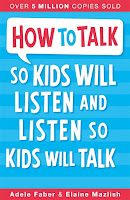
How to Talk so Kids will Listen and Listen so Kids will Talk (by Adele Faber and Elaine Mazlish)

How to talk so kids will listen and listen so kids will talk
(Amazon UK link)
It's many years, now, since I first heard of Adele Faber and Elaine Mazlish, an American writing duo who also run workshops on parenting. I expect someone recommended one of their books to me when we lived, briefly, in the US during the early 1990s when my sons were small. I know I very much enjoyed this one; the principles it put forward were some of those I believed in already, and which I had discussed with church friends at a short course we had done together. So while I liked the book, I didn't see the need to get a copy for myself...

However, when I saw 'How to talk so kids will listen and listen so kids will talk' on the Bookbag shelves, I leapt at the chance to re-read it. In doing so, I felt a touch of regret that I had not had a copy to refer to regularly when my sons were growing up.

This book aims to reverse the negative, punishment-based parenting that is so common these days. Children are seen not as problems, but as lovable small people needing a little guidance. The authors propose a new ‘language’ which begins with listening properly, helping children to deal with their feelings by encouraging them to name their fears - or anger - by observation, gentle discussion, and acceptance.

The next chapter is about encouraging co-operation. Parents are told not to demand, accuse, threaten or bribe their children, but to express a problem in neutral terms: ‘the milk is spilled; we need a cloth.’ Different techniques are advised, depending on circumstances. Far too many adults get caught up in trying to control rather than co-operate, and nagging rather than finding appropriate ways to communicate their wishes.

Further chapters include topics such as encouraging autonomy, finding alternatives to punishment, offering encouraging praise, and freeing children from roles: positive ones as well as negative name-calling.

Each chapter describes typical scenarios, then proposes alternative ways to deal with them. Towards the end of each chapter there’s a section with exercises for parents to try during the week, encouraging them to observe the ways they interact with their children. This is followed by examples from workshops which are easily recognisable, and mostly reassuring.

This 30th anniversary edition has been expanded, including a section written by the daughter of one of the authors, recounting some of the frustrations she had with her own children. The non-coercive, language of communicating came naturally to her, but it didn’t turn her children into angels, nor did it mean that she always made the right responses. Her account is amusing in places, and very encouraging.

My own experience in the past suggests that, while it’s not easy to adopt all the principles, they do work eventually. I made plenty of mistakes, but as the authors point out, there are always second chance with children.

Very highly recommended indeed.

You can also read my somewhat longer review of 'How to Talk so Kids will Listen and Listen so Kids will Talk' at The Bookbag.