I don't quite know why I like Terry Pratchett's books so much, as they're not my normal genre for reading at all. But he minimises the fantasy element (once one accepts the bizarrenness of a Disc-shaped world on the back of four elephants, and the multiple species that co-exist in something resembling harmony - sometimes -that live on it). There's some very clever satire that's surprisingly thought-provoking. And some clever one-liners too, that sometimes have me chuckling out loud.
'Wyrd aisters' is the sixth 'Discworld' novel, and in my view shows Pratchett at his best. There are cleverly intertwined plots, humorous characters, and brilliant references that take the mickey from the 'real world'.
Granny Weatherwax, Nanny Ogg and Magrat open the book, in an attempt to form a coven. Magrat is the youngest, newest witch in the neighbourhood and would love to do things traditionally. She has yet to come to terms with the rather more relaxed lifestyle of Nanny Ogg (who loves a drink and has a large number of children and grandchildren) or the practical 'headology' taught by Granny Weatherwax.
Meanwhile the King of Lancre just happens to be murdered by a Duke. The Duke is one of the next in line to the throne, and is persuaded to commit the murder by his loud and ambitious wife....
Yes, this book is an overt spoof on Shakespeare's 'MacBeth'. With a sprinkling of 'Hamlet', and a touch of 'King Lear'. Familiarity with these plays probably enhances the enjoyment of 'Wyrd Sisters', although it's not vital.
A baby, the son of the murdered King (complete with the royal crown), is rushed from the palace by a lone horseman. This brave man hands the baby to the witches before dropping dead. The three decide that they can't possibly look after a small child, so they pass him on to a band of travelling players and hide the crown amongst stage props....
The story veers well away from Shakespeare many times, although I expect the Bard would enjoy it thoroughly if he were still alive. Time passes - at times considerably more quickly than usual - and eventually the baby, now grown-up, arrives back in Lancre.
But the plot really isn't all that important. There are some lovely images, and references not just to Shakespeare but to classic fairytales: for instance, Granny and Nanny knew personally the witch responsible for the Sleeping Beauty. Apparently she lived in a gingerbread house.
Suitable for adults or teenagers; indeed there's no reason why fluently reading younger children shouldn't enjoy it too, although they would probably miss many of the references. My younger son was about nine when he first read 'Wyrd Sisters'.
All in all, I recommend it highly for an enjoyable light read. There's no need to have read any other Discworld books beforehand since this stands alone, although it works quite well to read 'Witches Abroad' soon after.
There's something very reassuring about re-reading old favourite children's books. Frances Hodgson Burnett didn't write very many, but they're all worth reading again, by adults and children. They make good books to read aloud, too.
'The Secret Garden' is probably the best-known of her works. It's mainly about the spoilt Mary Lennox, who arrives at Misselthwaite Manor after tragedy strikes her parents out in India. Mary has known no life other than that as a colonial daughter surrounded by servants, and has never had to do anything for herself.
The maid Martha is assigned to Mary, and is so friendly that Mary soon accepts her, which is just as well since almost everyone else mostly ignores her. Her guardian is the owner of the manor, but is a recluse since his young wife died.
Mary gradually explores the huge gardens, discovers some secrets, and meets the delightful free spirit Dickon who has a remarkably gift with animals. Gradually she gains health and strength of body and mind - sadly missing from her days in India - through fresh air and wholesome food. It also helps that she no longer gets her own way all the time!
I do like the way that unlovable characters are at the fore of this book, yet still make the reader care about them, and even empathise with them to some degree. There is, of course, some snobbery and class consciousness, but then it was written well over a hundred years ago.
There's a very pleasant film version of 'The Secret Garden', available on DVD. I don't always like movies made from books, but thought this one worked well, although some of the plot was changed rather more than I like.
The author Elizabeth Goudge's writing is always relaxed. It's perhaps a bit long-winded in places, but character-driven in a positive way, and sometimes, has a touch of magic. I don't expect to read her books in a hurry since there's usually a fair bit of description, which manages to add to the story rather than being boring.
'Island Magic' is a lovely book. Gentle and insightful writing takes us to the heart of a family living in the Channel Islands in the late 1880s. Rachelle, the mother, is the driving force behind the family. Her husband André struggles to keep going with a failing farm, trying hard to suppress his creative side.
They have five living children, each of whom has a distinct character so well developed that I found them quite recognisable. There's the intellectual bookworm Michelle, the caring motherly Peronelle, and the scared, anxious Jacqueline. These are the teenagers in the family who love each other dearly, and yet, at the same time, drive each other wild.
Then there's Colin, eight years old and yearning for independence. The book opens with Colin out at sea with three rather disreputable sailors. He knows that his parents would not allow him to be with them, yet he needs the escape from his mainly female household. Colin is his mother's favourite and knows how to manipulate her lovingly. He's an accomplished liar, having learned that life is most peaceful when he pretends that he has been following innocent pursuits. So he hides many of his activities from her.
The youngest in the family is Charlotte. At five years old she is perhaps the least believable of the children. She's contented and loving, even religiously pious. She is fond of everyone, even her bad-tempered and arrogant grandfather. When she isn't spending time with other children she imagines playmates of her own. As the baby she is somewhat spoiled by her sisters, yet her character seems to thrive on affection and attention. Charlotte causes no trouble to anybody.
The family is almost bankrupt and André is in despair. He thinks the only answer is to go and live with his father, but Rachelle cannot bear that idea. So they agree to six more months to see if they can survive. Rachelle is certain something will turn up - and indeed it does, in the form of a stranger rescued from a shipwreck. He comes to live in their stable to recuperate, and gradually becomes a vital part of the family.
There's obviously some secret about this man. We learn that he is no stranger to the Channel Islands, although he pretends to be. He has travelled widely and had many thrilling experiences, yet he suffers from a kind of depression. He does not want any relationship ties, yet he finds himself drawn to the whole family. He is determined to help each one in some way, seeing with an outsider's eye what the parents do not necessarily notice.
So it's a character-driven novel, descriptive, insightful and often moving. In about a year of the family's life there are inevitable problems, both major and minor, a serious illness, and changing perspectives for all.
Definitely recommended.
Sometimes I feel like delving into classic literature, and Jane Austen is one of my favourite choices. She didn't write many novels, and they don't appeal to everyone. But I like her satirical touch and clever characterisation.
The novel 'Emma' opens with Emma's Woodhouse's father complaining gently about their recent change in circumstances. Emma's best friend, who was once her governess, has recently married and moved about a mile away.
Mr Woodhouse is quite a comic character who wants everything to stay exactly the same as it always has been, but Jane Austen somehow manages to make him sympathetic and likeable. He's clearly devoted to his daughter, and frequently worries aloud about illnesses, draughts, and people being inconvenienced. As his idea of inconvenience doesn't necessarily make sense, there's some humour throughout the book whenever he appears.
The plot, such as it is, is based on Emma's continual mis-reading of other people's intentions. She befriends an orphan about her own age called Harriet. She is convinced that Harriet must have come from a gentleman's home, and tries several times to find a husband for her. Harriet's first love is a worthy farmer, but Emma does not consider him good enough for her friend.
She points her first in the direction of the local minister, and then of someone else. Harriet is rather pathetically grateful for her high-born friend's recommendations and takes on board whatever she is told. Since Emma has a good opinion of herself, she considers Harriet intelligent and sensible for following her suggestions; only gradually does she realise that her friend has few original thoughts in her mind and is too easily led.
The entire novel covers daily walks, visits and conversations between Emma and her neighbours, with a few diversions such as parties or balls. It's a pleasant enough social commentary on life in an upper-class English village two hundred years ago, written with close observation and the thread of irony that made me keep reading.
Having said that, it felt like quite a chore at times. The dated style of language didn't particularly worry me. Within a few pages I had no problem with that. But it was quite an effort reading through some of the long-winded conversations, particularly those involving some elderly ladies whose lives seem to revolve around a series of tangential thoughts.
So, all in all, I wasn't very keen on this book. According to the introductory notes, Emma was the pinnacle of Jane Austen's novels. She finally reached her ideal of a truly domestic novel revolving around a small community with no outsiders involved. I suppose she was the forerunner of the 1980s village stories and 'aga sagas', although 200 years ago anything kitchen-related was done by the servants in upper-class households rather than the main characters of books.
Emma is certainly an intriguing character as the main protagonist. At twenty-one she is in charge of her father's household, and has been pampered her entire life. Nobody ever dares to go against her, other than an old family friend, Mr Kingsley, whose younger brother is married to Emma's older sister. She is mostly good-hearted and cares deeply for those around her, but she is not intended to be a nice character. She is basically a snob, spending a great deal of time aware of 'class' and 'quality', and doing her best to match-make amongst those she considers equals.
A heroine with faults was perhaps rather a risky undertaking in Jane Austen's day, and it's a tribute to her writing skills that this book is still popular today. But despite seeing its good points, I didn't really enjoy reading it. Give it a try if you like Jane Austen, or if you're interested in social history, but be prepared to skim in places. If you're unfamiliar with this author, I'd recommend trying one of her other books first.
Oddly enough, this is one of the few books where I felt that the film version worked rather better. Possibly because there was scenery and action, and some of the introspection vanishes, while the satire remains. I particularly like the Kate Beckinsdale version of 'Emma', produced in 1996.
How I love Rosamunde Pilcher's books! Both her longer sagas and her shorter, lighter romances have the most wonderful characters who get right under my skin, almost from the first chapter.
I last read 'Under Gemini' in 1999 so it was more than time for a re-read.
Rose and Flora are twins, separated at birth when their parents divorced, and decided to take one of them each. Bizarrely, neither parent mentioned the existence of a twin to the child they raised. They look identical, but have rather different personalities. By a somewhat unlikely coincidence they meet, for the first time, in their early twenties.
The story doesn't switch between the perspectives of the twins, as I thought it might. Instead it focuses on Flora, a friendly and caring person who was brought up in Cornwall by her father. She is temporarily a little envious of her sister's evident wealth and casual confidence, but quickly realises that she is probably the happier of the two.
Because Flora is a nice person, she gets drawn into a plan to play out a masquerade: to go with Rose's ex-fiancé Antony to meet his grandmother, who is seriously ill. Her honest nature baulks at living a lie, yet her naturally generous side is moved by Antony's appeal to do a good turn. So she goes with him to Scotland - where the bulk of the story takes place - pretending to be her twin. Here she meets Antony's delightful extended family and is welcomed with open arms. But (being a stranger to dishonesty) she feels increasingly uncomfortable with the part she is having to play...
There are quite a few other main characters in this book - indeed, each of the ten chapters focuses on a different one - and many minor ones, but they are all treated respectfully. Moreover, they are all distinct enough that I never once muddled even the housekeeper or the nurse in my mind.
'Under Gemini' is set firmly in the upper-middle class world where this author seems most comfortable. It was written in 1976 but set perhaps a few years before that. Money is rarely a problem to anyone in Pilcher's earlier novels. Older people expect to have housekeepers or cleaners to do their work, children are expected to be sent to boarding school by the time they're eleven at the latest. This rather barbaric practice slightly dimmed my appreciation of her books the first time I read them; now I take it for granted as the cultural context of the books. These people belong to the kind of circle I am never likely to mix in but whom I can still appreciate as charming and lovable.
And indeed, every person in this book from 77-year-old Tuppy, Antony's grandmother, down to Jason, his seven-year-old nephew, is skilfully and sympathetically portrayed. Besides that there's an interesting plot to go along with the characters. This isn't a rambling saga-type book, nor is it full of introspection and flashback. Instead it's driven forward by the major dilemma - what on earth will Antony and Flora do? If they confess their duplicity, they will hurt the whole family. The longer they leave it, the more painful it will be. Yet if they continue with the pretence their internal values are compromised and they feel increasingly stressed and uncomfortable.
But there are no moral recriminations. This is not a Victorian novel decrying the sin of falsehood or pointing out that deceit leads to a tangled web. Nevertheless, it's quite thought-provoking. Is a white lie sometimes appropriate in order to save someone else from pain? Is it acceptable when it's apparently the last wishes of an elderly and much-loved relative?
It's not a long book, it's certainly not difficult to read and it's not particularly deep despite the interesting questions that occurred in my mind. I've read it three times now and enjoyed it afresh each time; it's the ideal kind of book for a wet weekend or a beach holiday.
Definitely recommended.
I tend to have mixed feelings about Susan Sallis' historical novels. They have interesting plots, and not too much of the horror of the past described. The people tend to be believable, too - but not, on the whole, sympathetic.
Still, having just finished reading 'A Scattering of Daisies', I decided to continue on to its sequel, second in the Rising family saga.
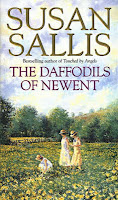
In 'The Daffodils of Newent', the Rising girls have grown up. April, the youngest, gets married in the first chapter. Her husband has a dark side, after suffering in World War I.
Nancy is already married to an actor; March, too, is married, but not very happily. Her husband is an old man; moreover there's a young and manipulative man who claims to love her.
Like the first book in the series, this is well-written, and I kept reading even though I still couldn't feel any sympathy for any of the characters. I'm not sure why this is, as they were all believable.
The ending was hopeful, I thought. But I didn't feel inspired to try any more in this series.