Every so often I re-read one of Georgette Heyer's wonderful historical novels. I enjoy them afresh every time.
Sir Waldo is 'The Nonesuch' of the title of this book, an intelligent and athletic man in his mid-thirties in Regency England. The novel opens with various of his relatives bemoaning the fact that Waldo has recently inherited Broom House in Yorkshire. Not that they particularly wanted it for themselves, since it's reputed to be in a poor state of repair, but they resent the fact that Waldo is a philanthropist, and is planning to convert the house to a school for penniless orphans.
Sir Waldo makes his way to Broom House, accompanied by his young cousin Julian, Lord Lindeth, expecting to stay a week or so to set in motion some refurbishments. The neighbourhood doesn't know quite what to expect of two wealthy and titled gentlemen appearing in their midst, but are soon pleasantly surprised to find them friendly, and happy to attend dinners and dances.
We quickly meet their richest neighbours: Mrs Underhill, her two children and her excessively beautiful niece Tiffany. Tiffany, who is only 17, is an heiress and has been considerably spoiled all her life; she thinks of little but herself, and her stunning beauty. She determines to captivate Lord Lindeth as soon as she claps eyes on him, and not surprisingly he's bowled over by her looks.
Meanwhile Sir Waldo meets Tiffany's companion, 26-year-old Ancilla Trent. Miss Trent is a delightful character: wise, witty and with a very dry sense of humour that immediately appeals to him. She comes from an upper class family who fell on hard times, but Sir Waldo knows her uncle, and they discover a great deal in common. With such interesting new friends, Waldo and Julian decide to stay longer in Yorkshire than they had originally planned.
Since the book is set two hundred years ago, life is in many ways a lot more complicated than it would be today. Miss Trent as a governess/companion only attends parties as chaperone to Tiffany, and would never expect to dance or to be given attention by a gentleman. Moreover girls in their late teens were very much protected - never allowed to see men alone, unable to go to town by themselves, and generally bound by conventions which seem by modern standards to be extreme and in some cases rather pointless. Men, on the other hand, expected to have a vast amount of liberty and were even encouraged to be promiscuous in their late teens and early twenties.
The book is lively and enjoyable, following the two households and various of their local friends as they go on outings, enjoy parties, and generally converse in the manner expected. It's obvious from fairly early in the book who is going to fall in love with whom, and in the manner of such Regency romances there are no unpleasant surprises, although Georgette Heyer is a master of unexpected situations.
The characters are mostly very well developed, none of them perfect and even the spoilt Tiffany having some redeeming features. I found myself relating quite strongly to Miss Trent. The language and conversation move the story forward at exactly the right pace for my tastes, and seem to me realistic; of course I wasn't around to hear how people spoke in Regency times, but it flows well and is consistent.
I first read this book in my teens, and found it a little slower moving than others by the same author; since then I've read most of her novels including this one every five or six years. I found I remembered the main plot of this one when I read it recently, and one or two of the minor events. But there were still parts I'd quite forgotten, and it was no less enjoyable for my knowledge of what was to come. Indeed I probably appreciated it all the more: Miss Trent's ironical sense of humour, and an amusing misunderstanding towards the end of the book had me almost laughing out loud.
The vocabulary, of course, is dated; I lent this book to a North American friend who had never read British historical novels before, and she said she found the first few chapters a bit bewildering, until she got used to the style and the slang words which pepper much of the conversation.
Oddly enough I don't remember finding any problems with these when I first read the book as a teenager: possibly this is because I had previously read and enjoyed Jane Austen's books, or perhaps it was that it's so well-written that it's quite possible to understand the meaning behind the words even without a precise knowledge of what they mean. Indeed, I rather like the sound of such insulting phrases as 'buffleheaded clunch', 'sapskull' and 'gapeseed'!
I'd recommend this book to anybody, though it probably appeals more to women than to men. It's character-driven but there's a reasonable amount of action and not too much reflection or description. It isn't my favourite of Georgette Heyer's novels, but it's still enjoyable. It's the kind of book that kindled my interest in history by introducing realistic characters in past settings - so much more interesting than the politics and scientific discoveries that seemed to be the main content of my history lessons at school!
Recommended.
'Forgotten Laughter' is a novel by Marcia Willett, an author I usually enjoy very much...
Brigid lives in the countryside and owns two small cottages that she lets out for holidays. Over the years she's become quite friendly with some of the regular visitors, one of whom is called Louise. This novel opens when Louise is on her way to stay, in a rather anxious state because she suspects that her partner is having an affair. There are clear hints that Louise's agitation goes a great deal deeper than this, that there is some tragedy in her past which she has been repressing.
Meanwhile Brigid is not entirely happy herself: her husband spends much of his time away, working for the Navy, but is considering early retirement; she's the kind of person who needs time and space to herself, and isn't sure if she will be able to cope with him being there all the time, much as she loves him. Brigid is also trying to deal with her mother, who abandoned her as a child but who is staying long-term in one of her cottages, and her half-sister Jemima who lives not far away.
Jemima also likes her own space, and although she's had a series of casual relationships she considers herself mistress material rather than wanting to settle down. But suddenly she meets someone on the rebound from another woman, and she starts to fall in love with him against her better judgement.
So there's the seeds of a pleasant 'aga-saga' type of family story, and that's what I was expecting. This is Marcia Willett's eleventh novel, and while - unlike some of the critics - I don't consider her in Roamunde Pilcher's league, she generally writes enjoyable heart-warming stories that have upbeat endings and characters I can care about.
Unfortunately I found 'Forgotten Laughter' to be over-complicated, and I felt it could have done with some extra editing. In addition to the main characters, there are a sprinkling of walk-on parts belonging to people who've appeared in previous books by the same author, and there seems to be an enormous amount of explanation about everyone's background and past. I know it's important for a writer to know everything about their characters, but it doesn't all need to be included in the book!
'Show, don't tell' is one of the golden rules for novelists, and while of course good authors break 'rules' all the time, I felt that Marcia Willett went rather overboard in telling us what people were thinking, and why, rather than demonstrating it in action.
What's more, the past history style isn't limited to the first few chapters - where it could be skimmed - but is scattered throughout the book. Two people arrange to have a meal together at the end of a chapter, for instance, then the following chapter shows one of them doing some mundane task, and thinking about the conversation, followed by a bit of author's interpolation telling us what had happened. I don't mind this occasionally - this style can be easier to follow than a direct flashback - but I thought it was overdone, and included far too much detail.
I also felt that there were some extra elements that didn't quite work. About a quarter of the way through the book Louise comes to a crisis point, but it happens so suddenly - and after an excess of explanations, with very little happening - that I didn't find myself emotionally moved at all, despite the content being something that would normally have affected me deeply. In addition I found some of the male characters to be rather faceless. We never even learn the name of the man Jemima falls in love with, and Louise's partner Martin seems to change from an untrustworthy rotter to a thoroughly decent chap, without any real reason.
There's also a background subplot involving a murderer on the loose, who has killed a few women out for walks. Suspense is built quite successfully on several occasions when one of the main characters is out walking and sees a lone figure, or drives somewhere and is followed closely by a particular car. This subplot fits neatly into the rest of the novel in various ways - ending in a manner that was probably meant to be a surprise, but which I'd guessed would happen - however, as I really dislike even mild suspense, it meant it wasn't a book I wanted to read late at night.
A plus point, from my perspective, is that there's no bad language at all in Marcia Willett's books, nor any erotic detail that would make it unsuitable for children coming across them. Sex clearly happens, but we only know about it when people emerge from the sheets and get up to make coffee. It's the kind of book I'd like to have read in my teens when I wanted to explore adult emotions without being distracted by intimate and detailed physical descriptions.
All in all, it's a nice enough book, if long-winded. It was almost 500 pages long, and I felt could easily have been edited by about a fifth to make it more flowing and readable. But I did find myself caring about the main characters, at least by the end of the book, and some of the minor ones too. The final chapters tie up various loose ends quite neatly, with one or two unexpected developments, and I didn't feel dissatisfied by it.
But I didn't feel warmed and emotional, either. Fans of Marcia Willett will probably want to read it, as I did, and perhaps add it to their collections . But I wouldn't really recommend it to somebody new to this author unless you come across it second-hand, or find it in a library.
Note: you can also read my longer, and more enthusiastic review of 'Forgotten Laughter' after re-reading five and a half years later.
'Apple Bough' is a delightful book for children by Noel Streatfeild.
The Forum family used to live in a rambling old house called Apple Bough, and the four children still remember it with nostalgia. Myra, the oldest, is twelve when this story starts: a sensible, motherly child who adores her younger siblings and worries about the future. She deeply misses her dog Wag, who had to be left in England with a friend when the family started touring the world.
The reason for the touring is that Sebastian, next in age to Myra, is a child prodigy violinist. Noel Streatfeild's books usually feature brilliantly gifted children, and 'Apple Bough' is no exception. Sebastian was discovered at the age of eight by a famous Russian conductor, and was contracted to tour initially for six months, but this gradually extended until the family seem to spend their entire lives travelling. There are 'rest periods', but they're usually in European or American cities where Sebastian can study with great teachers.
David and Polly, the parents, both love travelling. They're musicians and artists themselves, and are convinced that the children love being 'world citizens' as much as they do. However after four years of travelling, the children - including Sebastian - long to have a stable home, and to see their grandparents in England again. They find it impossible to tell their parents of their wishes, since Sebastian is earning huge amounts of money and is under contract, and Polly is convinced that the family must always stay together. But at last they do visit the UK and after chatting to her grandparents, Myra begins a low-key campaign to find them a permanent base.
I do like Noel Streatfeild's books! They're intended for children of age eight and upwards; I read and enjoyed most of them when I was around nine or ten, then I read them again in my teens, and still re-read them from time to time as an adult. 'Apple Bough', which was first published in 1962, is one of my favourites. It's a lovely book to curl up with when I need a bit of time to myself. It's not all that long, under 200 pages, so I can read it in a couple of hours without a break.
It's primarily a character-based novel, and inevitably in a short book there's some low-key caricature. While Myra and Sebastian are very well-rounded people and I can relate quite strongly to Myra, their younger siblings Wolfie and Ettie are a little larger than life. Both are strongly extraverted, and also artistically talented: Wolfie being a natural actor, and Ettie a highly promising ballet dancer.
The parents David and Polly are delightful, and clearly adore their children. But it's hard to imagine quite such a vague and dreamy couple travelling the world and keeping track of their family so successfully. They employ a governess, Miss Popple, who is rather typecast for the role: comfortable and organised, gradually taking charge not just of the children's education but of the food and housework, and general management of the family.
It's not the kind of book that would appeal to children whose main literary diet is 'Goosebumps' and the like, but for a thoughtful or creative child I would recommend it highly. I used to love reading about 'successful' children in the arts world, even though my own talents were always more home-based, like those of Myra.
Some of Noel Streatfeild's books are intended mainly for girls, but this one would appeal to either gender; one of my sons has read several of her books and very much enjoyed them. It could also work well as a read-aloud book for any age - the chapters aren't too long, and there's plenty to interest an adult as well as a child. The idea of children being unable to communicate their deepest wishes to their parents struck home with me quite forcibly as I re-read this book recently, and could lead to some interesting conversations.
Overall it's a nostalgic book, describing as it does a more relaxed way of life where strangers were generally to be trusted, and children could feel a positive pride in their abilities and their nationality without this causing any difficulties. Of course it's escapism - life wasn't so idealistic even in the 1960s - but then I like my entertainment to be positive and relaxing.
There's a little light humour now and again, and some quite moving sections too when the children are prepared to sacrifice their own desires to keep the family harmonious. The ending is deeply satisfying; not entirely unexpected, but heart-warming and encouraging.
Definitely recommended, to anyone over the age of about eight.
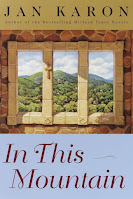
'In This Mountain' is an episode in the American town of Mitford, by Jan Karon. It is is the seventh book in the series featuring the Episcopalian priest Father Tim and his wife Cynthia.
Tim is finding his retirement rather tedious. After a lifetime of ministering to local people, with weekly sermons and pastoral visits, he feels somewhat at a loose end for much of his time. His wife is busy writing and illustrating children's books, and has been invited on a tour of the country after winning a prestigious award; Tim wants to do something meaningful and fulfilling. So after much prayer and discussion they arrange to spend a year working for a mission in Tennessee, helping disadvantaged children.
All is going well with their preparations, although the letters from the team already in Tennessee are a little worrying in an amusing way, describing as they do the appalling conditions in which Tim and Cynthia will be expected to live and work! But nobody in Mitford wants them to leave, and Tim is feeling increasingly unwell. He suffers from diabetes, and is supposed to monitor his sugar-levels carefully as well as taking regular exercise - but he hasn't been doing so, and inevitably a crisis occurs.
The rest of the book deals with Tim coming through the crisis and the resultant depression, which brings back some painful memories from his childhood. However it's not as heavy as it sounds; the book also follows the lives of various of the Mitford residents. At times it feels a little in the style of an English village novel, with a fair amount of humour.
It took a while for me to get into this book. I've read all the others in the series, but didn't re-read them prior to starting this one, so I came to it afresh. The style is typically modern American with lots of short dialogue sections, and an informal style that I found slightly jarring at first, although I got used to it after a few chapters.
I wasn't entirely sure what to expect. Previous novels in the series introduced Father Tim as a long-term bachelor, then showed him falling in love with his neighbour and getting married in his sixties. Later books watched him take his retirement after fighting the idea for many years. By the time this one starts, he and Cynthia are living in comfort in the house that used to belong to her, and are taking an active part in the daily life of Mitford. Tim is seventy, but feels considerably younger, until his diabetes gets the better of him.
Could there be anything new in this book, I wondered? At first I thought there wasn't, that it would be a simple continuation of the gentle conversations and interactions between the characters with not much more, or else that the series would take a totally new turn with the mission work in Tennessee. But once again Jan Karon has succeeded in a charming novel that drew me in gradually, and left me with plenty that was thought-provoking, with some issues I'm still pondering in odd moments.
It's a clearly Christian novel. God is very important to both Tim and Cynthia, and increasingly so to other people in the village, but it's not preachy. Nor does it have any of rigid right-wing fundamentalism that can sometimes underpin American Christian novels. Tim struggles to find God's plan for his latter years, and longs to find healing from the depression that partly stems from his childhood, growing up with an unloving father. As a Christian myself I could relate to the whole question of finding God's plan rather than merely doing what seems right and good to oneself.
It's also a very gentle love story. It's not often that such deep tenderness and delight is shown in an elderly couple, but Jan Karon manages this beautifully. Tim is about fifteen years older than Cynthia, and worried sometimes about losing her; but clearly they adore and cherish each other. There are other low-key romance elements in the book, including a subplot involving Tim's unofficially adopted son Dooley who has just completed his first year at university.
My fifteen-year-old son loves these books as much as I do, and was eager for me to finish this book so he could read it too. I doubt if much younger children would like the somewhat rambling style and lack of fast action, but anyone from about twelve or upwards who likes character-driven novels could well enjoy this series. There's some humour, some places that make me feel weepy, and a positive ending that leaves the way open for another sequel - I hope!
'In this Mountain' could probably be read as a stand-alone novel, but I'd recommend reading at least one or two of the earlier novels in the series first, particularly 'At Home at Mitford', the first in the series. There are several minor characters, and even having read all the rest of the series in previous years I couldn't remember exactly who was who. It didn't particularly matter, since the main characters are clear and well-rounded, but could potentially be confusing.
'The Heart of the Family' is the last book in the Damerosehay trilogy by Elizabeth Goudge.
Sebastian Weber, who has suffered enormously during World War II and is in very poor health, comes to stay at Damerosehay. This is a large house in Hampshire which is owned by David and Sally Eliot. Sebastian has come to work as David's secretary although he has an irrational dislike of him. On arrival, in the rain, he meets David and Sally's daughter Meg, and is totally beguiled by her. She is only four years old but has an old-world charm that makes her wiser than her years.
Shortly after Sebastian's arrival, David - who is an actor - returns after a tour of America. He is exhausted, and also rather jaded by the continual mask he has to wear to meet his audiences. He carries within him deep scars from his time as a pilot in World War II, and some fresh shame at temptations from America to which he nearly succumbed.
Sally is heavily pregnant and easily tired, and David is strongly aware of Sebastian's dislike. However his homecoming is not all painful. His daughter Meg is the light of his life, and he that finds his son Robin, now two years old, has matured considerably in his absence.
'The Heart of the Family' has, perhaps, the least plot of the three books in this series. Although it could be read as a standalone novel, it makes far more sense as the sequel to 'The Bird in the Tree' and 'The Herb of Grace'.
Nevertheless there are plenty of subplots and significant human interaction across the generations. Lucilla, beloved matriarch of the Eliot family now lives in a small cottage with her daughter Margaret. Lucilla is ninety-one, and sure that she does not have long to live. Nevertheless she usually knows what people are thinking, and still has a strong role in the organising of the family. She has a special bond with David, who was always her favourite grandson, and even more of an affinity with little Meg. Lucilla feels that those who are just beginning their life are closest to those who are nearing the end.
The book is also about Sebastian and his total acceptance into the Eliot family, filling a space which none previously knew existed. Despite his initial reluctance to be in the home of a man he hates, the peace of Damerosehay gets into his mind. He is perhaps most helped at first by the housekeeper Mrs Wilkes who ministers to him and mothers him in practical ways. Gradually more and more of his past is revealed, and the reasons for his bitterness and ill-health become clearer.
It's also about Sally coming to terms with her fears of childbirth, which she has previously been ashamed of, and it's about Lucilla's fears for every one of her descendants. It's about a young man falling in love with somebody his mother would not consider suitable, and it's about hope and integrity and faith. There's a mystical and religious underpinning of the conversations, as there is to some degree in all Elizabeth Goudge's books, with a sprinkling of poetry and classical allusions.
I have only read this book three times over several years. It never fails to move me as I empathise strongly with many of the characters. Elizabeth Goudge is brilliant at characterisation; all her people seem entirely believable, and she has a deep sensitivity which shines through all her writing. She understands both the elderly and the very young; she sympathises with the temptations that befall the middle-aged; she accepts as natural the fears that so many of us are hesitant to voice.
As with the others in the trilogy, this isn't a book to be read in a hurry, and I don't really recommend it to anyone who hasn't read at least 'The Herb of Grace' previously. It's long-winded, but not unpleasantly so; it's emotional and thought-provoking without leaving me drained. The ending is bittersweet, and provides good closure to the trilogy without leaving me longing for more. I am sad to say farewell to the characters each time I finish reading this book, and yet the ends are tied, the future is hopeful.
Recommended, preferably after reading the other two books in the series ('The Bird in the Tree' and 'The Herb of Grace').
I first came across Elizabeth Goudge's writing when I was a child, and gradually discovered more and more of her books as I grew up. I found most of them second-hand at charity shops. 'The Herb of Grace' is the second in a trilogy of books about the Eliots of Damerosehay.
When I first read it in my teens I had no idea that it was part of a series. It stands alone without any difficulty, and is not plagued with a huge amount of flashback to the first book ('The Bird in the Tree'). Later on when I discovered the series, however, it added greatly to my understanding and enjoyment to read the three together.
The book is mostly about Sally Adair, who is in her early twenties. She is conscious both of a deep contentment about her life and a sense of shame that she has been so fortunate. She keeps house for her father, a well-known artist, and her only wish is - eventually - to have a husband and children. One of the delights of her daily life is to meet the five Eliot children and their dog in the grocery shop.
Nadine Eliot, in her late thirties, is not contented. She is a beautiful woman married to George, a rather older man who adores her, but she still clings deep in her heart to another love. While she has never met Sally, hers are the five children who run errands for her daily. She does her best for them and cares about them all, but has never been truly maternal.
George's mother Lucilla Eliot, who is eighty-five, is - despite her frail appearance - the centre and the driving force of her large family. She lives at Damerosehay, a beautiful old house near the Hampshire coast, with her spinster daughter Margaret. Lucilla is sensitive and deeply emotional, but also cannot help sometimes being rather manipulative when she believes she knows what is best for her loved ones.
Much of the book is about growth and healing, about wholeness and integrity. It's also about falling in love and self-sacrifice. It is almost entirely character-driven, with such delightful and distinct people that I think of them as close friends when I read this book even though it was written in the 1940s.
'The Herb of Grace' is not for readers who like fast action and complex plotting. Nor is it a book to read in a hurry. There's a wealth of description; I'm the kind of person who usually skips descriptive paragraphs, but in Elizabeth Goudge's writing they add a three-dimensional aspect to both the story and (more importantly) the people. As I slow down to savour the language and the images, I find myself in the minds of the different characters, experiencing their hopes and fears, seeing the inn come to life as once again it hosts residents and visitors.
It's a book to read and to re-read. I suppose I've read it five or six times in all, and it never fails to move me deeply. There are moments of gentle humour, moments of increased understanding about human nature, moments when my eyes are moist with tears. I don't know any other author who has such a great empathy with so many facets of personality, and such an awareness of what makes people the way they are, through both inborn nature and childhood experiences. It's a book that helps me find perspective in the minor irritations of life, where I can identify in turn with several of the characters and understand their viewpoints as they deal with different situations.
The only disadvantage is that it's rather long-winded at times, and some of the conversations are over-philosophical, exploring deep issues at a level not common in daily chit-chat. Elizabeth Goudge always has a little mysticism running through her books too: a sense of each human life being just one thread in the tapestry of eternity. As Lucilla grows older, so she becomes more able to read her family's faces, to know what they're thinking as well as what they're saying. She's also aware of the spirits of those who have died - not as ghosts, more as imprints on the places they loved.
I'd recommend this to anyone who enjoys a thoughtful character-driven novel. There's nothing unsuitable for children in it, but the concepts are probably beyond all but the most intuitive under the age of about eleven or twelve. It's a book to savour, to curl up with on a wet afternoon, or to escape for a while from the noise and overwhelm of everyday life.
'The Herb of Grace' has been reprinted many times in the past sixty years, in both hardback and paperback.
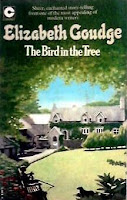
'The Bird in the Tree' is the first novel in the Damerosehay series by Elizabeth Goudge.
The book opens with Ben (aged 9) and his younger siblings Tommy and Caroline rushing out to meet their adult cousin David, who is coming to stay at the family home, Damerosehay. In a few brief word pictures the children are described: Ben - delicate and sensitive; Tommy - loud and cheerful; Caroline - dreamy and mysterious.
Lucilla, David and the children's grandmother, is focal point of the family. She brought David up after his father died from war wounds; she is now looking after her three younger grandchildren, since their parents are divorced. Their father George works in India, and their mother Nadine runs an antique shop in London. Her home (Damerosehay) is a haven of peace to the entire family, and particularly for Ben, whose health suffered from the Indian climate, and also during his parents' many fights.
David's arrival is not as relaxed as usual, and Lucilla senses it. He has a secret which he knows is going to upset the stability of the family, and which will make Lucilla distressed and angry. He worries that he may have to forfeit future visits; indeed, his grandmother might reject him entirely. He doesn't tell her his news until he has spent a night in the house, and neither of them sleep very well. When he does tell Lucilla, her reaction is worse than he expected. However she comes up with a plan - indeed, a demand - which he agrees to fulfil before making a decision about his future.
That's a summary of the early part of the book, but this isn't a plot-driven novel. It's an early version of a family saga with strong characters who interact with each other deeply. Elizabeth Goudge was a very talented author, who managed to weave something magical into her stories, drawing personalities who are clear and distinct, making each conversation entirely believable in context. She must have been a superb study of human nature.
From the opening moment when the children go to meet David, to the time when Lucilla realises that there is something badly wrong, two fairly lengthy chapters have intervened. There is no further action during these chapters: the children meet David, and come back to Damerosehay in his car. But we learn about the marshes, and where the house is set; we learn about David's father - Lucilla's favourite son - and his tragic death; we learn about how Lucilla and David discovered Damerosehay twenty years previously, and how the rest of the family rallied round to pay for it. We also read about some of the legends of the area, which might seem irrelevant padding, but which reappear later in the book with significance to the story.
'The Bird in the Tree' was first published in 1940, and is the first of three novels about the Eliots of Damerosehay. With today's fast-paced writing style, they would probably have been condensed into one book if they had been written sixty years later, and what a loss that would have been! I'm not the kind of person who usually enjoys lengthy descriptions. I'm often tempted to skip over them and get to the conversations when I'm reading a slow-moving book. But I've learned not to do this with Elizabeth Goudge. Her descriptions are masterly paintings that bring the people and places alive. She doesn't just talk about what people see, she talks about their feelings, their longings, their imagination. There's something mystical about her writing, and yet the people are so real that when I finish her novels I feel as if I'm bidding farewell to dear friends.
It's not a book to rush through, or to read when there are demands of family and home. When I was distracted once or twice while reading this, I found I would read a page or two without taking in a word. It does need concentration, and peace - perhaps because Damerosehay itself is such a haven of peace. Life moves at a gentle pace, the young moving rapidly and the old taking their time as the pattern of the years unfolds, weaving past and present together.
It's a book about integrity, and faithfulness, and being true to oneself. It asks some poignant questions about truth, and whether it's better to give in to emotion to please oneself or to deny strong feelings for the sake of the wider community. There are faint Christian undertones, and a sense that moral order is God-ordained, but only in a low-key way. The book might seem quaint, even irrelevant to modern readers, yet it makes the point that human nature doesn't change; the struggles David is experiencing were mirrored to some extent in Lucilla's own youth, fifty years previously.
I like the way that all the generations are covered, from 78-year-old Lucilla down to five-year-old Caroline, each with their own part to play. The interactions between adults and children seem healthy and positive. Inevitably there are places that seem out-of-date, such as the whole issues of servants and the general class-consciousness of the 1940s leading to formal modes of address. But given that it's based in that period, I don't find it unpleasant.
All in all, I love this book. It's not for people who like action and adventure. But if you enjoy a cosy study of human nature, and have a few hours to spare with nothing demanding your attention, I can recommend it highly.
'A Little Princess' is a children's book by Frances Hodgson Burnett, which I find more appealing as an adult than I ever did as a child. It's a charming book set in Victorian England, first published in 1905.
This book opens with seven-year-old Sara Crewe observing the cold, damp surroundings of London as her father takes her to Miss Minchin's boarding school. Sara's father works in India, and although she has lived there until recently, it wasn't considered a healthy climate for children. Most British children born in India at the start of the 20th century were sent to schools in the UK from a young age. So although it sounds almost barbaric in today's society, it was accepted as the thing to do.
Sara's mother died when she was a baby, so her father has been everything to her. Although she's been given every material thing possible, and could have become extremely spoilt, we soon discover that she's a delightful little girl who adores her father. She's been treated well, and given lots of love, as well as knowing ever since she can remember that one day she would have to leave and go to England. She had seen other children departing, and heard that they were quite happy, so she's determined to bear it and not make a fuss. She and her father are almost heartbroken at having to part when he goes back to India, but they both hide their feelings, each wanting to make the parting a little less painful for the other.
So Sara begins school. Since her father has bought her an extravagant selection of clothes and ornaments, and is very rich, Miss Minchin (a most unpleasant specimen amongst teachers) treats her as a favourite, giving her the best place at table and the head position of any processions of children when they go out. Snobbery abounds, and a lesser child might have let it go to her head. Indeed, some of the previously favoured children are very jealous. But Sara is generous, loving, and humble about her abilities. She befriends a rather overweight girl who's the dunce of the class, treats the scullery maid with kindness, looks after a spoilt four-year-old who also has no mother, and tries to be polite to everyone.
About half way through the book disaster ensues, leaving Sara penniless. The horrible Miss Minchin wants to throw her out on the streets, but is persuaded to keep her so long as she works. So Sara teaches the younger children (although she's only eleven herself by this time), works as an extra kitchen-maid, runs errands, and sleeps in the attic next to the scullery-maid who is one of her few remaining friends.
Essentially, this book is another variation on the 'Cinderella' theme. Riches to rags, and (inevitably) a happy ending. It could be trite, but somehow it isn't. Frances Hodgson Burnett is best known for 'The Secret Garden', but I prefer 'A Little Princess' myself. It claims to be a book for girls of ages eight to twelve, but I would suggest it's a book for anyone of age eight and upwards. As an adult I love to read this book just as much as I did when I was a child; perhaps more. I re-read it this weekend, wanting something I could curl up with to shut out the world for a few hours. Despite knowing what would happen, and despite it being a children's book, I found that three or four times I had tears running down my face - and I'm not an overly emotional person.
Sara is a charming and likeable child, both when she's wealthy and when she has nothing. I did find her many virtues a little overwhelming: as well as her friendliness and generosity she's immensely loyal and totally honest, she's an avid reader, she enjoys learning and does well in all her lessons, and she has a vivid imagination like that of 'Anne of Green Gables' making her a popular story-teller. However she doesn't have an ounce of pride or snobbery, although she carries herself like the princess of the title. She could be unbearable, but somehow she isn't.
The book is very well-written, and really doesn't read like something of 100 years old. Clearly the culture is Victorian, with boarding schools for four-year-olds, and scullery maids, and beggars, but while the language suits the period, I don't find it dated. A fluently reading eight-year-old (boy or girl) would have no problems with this book: one of my sons first read it at that age, and thoroughly enjoyed it. He's re-read it as a teenager, and will probably do so again. Despite its appeal to children, as an adult I didn't find it condescending or simplistic at all.
I think it would work very well as a read-aloud book too; the chapters are short and the characters lively. There's nothing unsuitable for younger children: another author might make Sara's plight morbid or traumatic, but for my tastes exactly the right amount of unpleasantness was described. She becomes cold, she is frequently hungry, and she is often uncomfortable. She gets worn out by all her errands, and is scolded constantly. So she's very unhappy at times. But we never read about her being beaten or abused in any way other than verbally. Unrealistic? Probably. But it works.
I very much enjoyed the way that the ending was written, too. There's a definite element of coincidence in the book, and if this had been introduced suddenly it would have seemed totally unbelievable, leaving a sense of disappointment. However Frances Hodgson Burnett cleverly introduces conversations between other characters which tell us - the readers - what's going to happen in the end, in a way that increases tension as we know something that the characters don't, and wonder how on earth the happy ending is going to happen!
As an adult I can see that the one significant coincidence is actually highly unlikely - but it doesn't matter. From the moment it's introduced until the end, Sara's plight runs alongside further conversations between the other people who are going to be involved in her future. So the ending isn't a surprise, but the way it happens is very satisfying.
Highly recommended to anyone - adult or child - who enjoys this kind of book.